
High-bay warehouses instead of manual labor at the Naarmann private dairy: The fight for margins – More than just a steel colossus
Xpert Pre-Release

Available in 27 languages 📢
Prefer Xpert.Digital on GoogleⓘPublished on: September 23, 2026 / Updated on: September 24, 2026 – Author: Konrad Wolfenstein
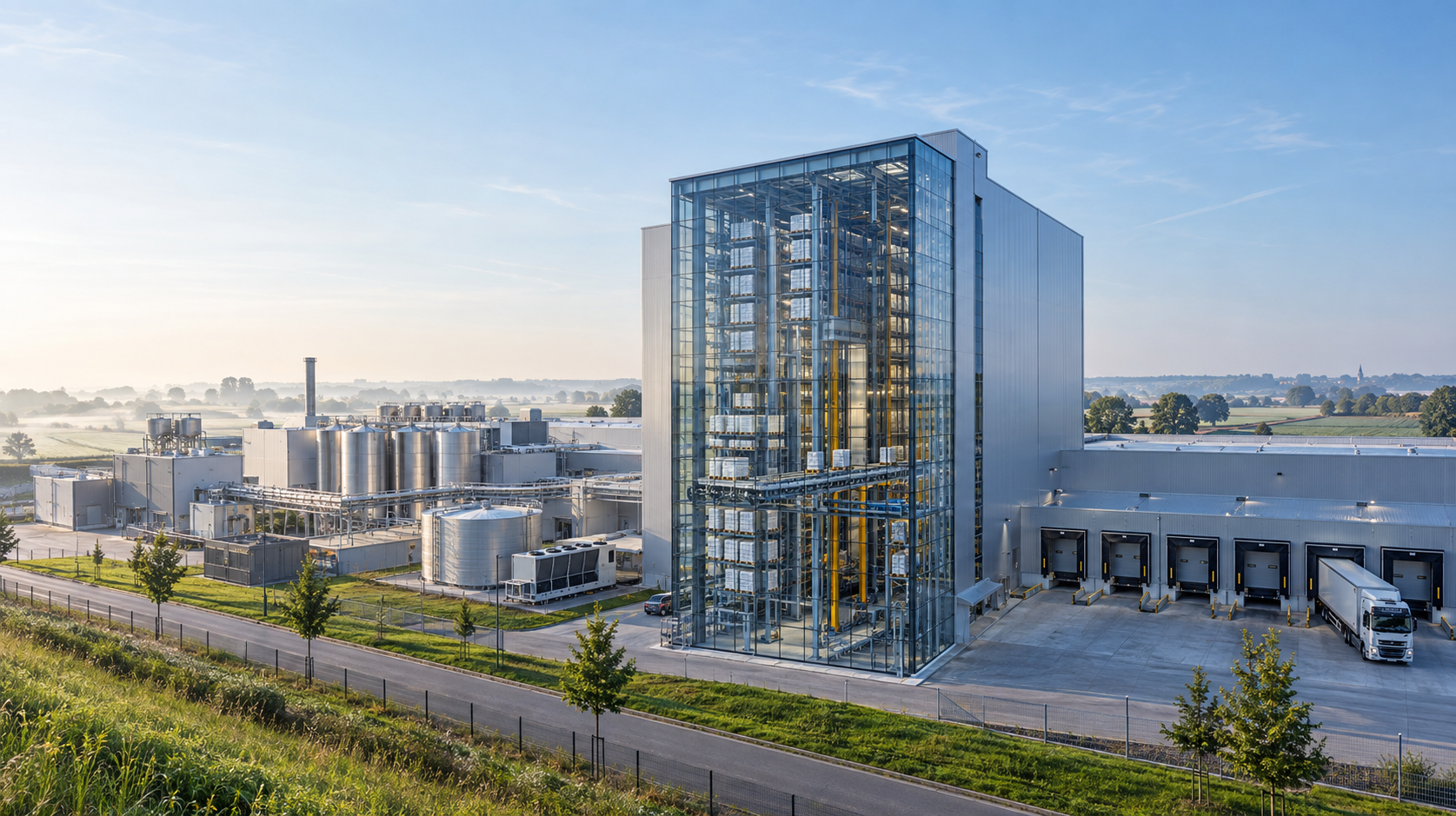
High-bay warehouses instead of manual labor at the Naarmann private dairy: The fight for margins – More than just a steel colossus – Creative image on the topic, with AI: Xpert.Digital
When the dairy grows upwards: This is what's behind Naarmann's new mega-warehouse
High-bay warehouses instead of manual labor at the Naarmann private dairy: The fight for margins – More than just a steel colossus
When the dairy grows upwards: This is what's behind Naarmann's new mega-warehouse
Vegan, catering and bulk packaging: Why the warehouse now decides the future of dairies
The new bottleneck in the food industry: Why producing milk alone is no longer enough
Production capacity and good recipes alone have long ceased to guarantee a competitive advantage. Logistics has transformed from a downstream cost factor into a crucial strategic element for margins and market share. The privately owned Naarmann dairy in Neuenkirchen, North Rhine-Westphalia, provides a striking example of this shift. By investing in a state-of-the-art, automated high-bay warehouse, this long-established, medium-sized company is responding to the growing demands of the foodservice market, persistent cost pressures, and an increasingly complex product range – from classic cream to vegan cooking cream. But the construction project is far more than just a new steel and concrete building. It represents a fundamental realignment, combining automation, energy efficiency, and digital precision to secure the future viability of the site. Read on to discover why the warehouse will determine the company's future success, the challenges involved in its implementation, and why a good night's sleep sets the pace for modern logistics.
When the dairy grows upwards: Naarmann's logistical leap in Neuenkirchen
Those who only produce milk will lose out – in the future, the warehouse will determine the profit margin
The expansion of the Naarmann private dairy in Neuenkirchen with a high-bay warehouse is far more than just an additional building for finished goods. It represents a fundamental shift in the competitive logic of the food industry. Production capacity alone is no longer sufficient for sustained success in the business with restaurants, large-scale consumers, and industrial processors. Increasingly, the decisive factor is whether a manufacturer can provide its products quickly, reliably, with precise batch delivery, energy-efficiently, and in the sequence required by the customer. The warehouse is thus transforming from a downstream cost center into a strategic component of the business model.
Especially with long-life dairy products, cream, desserts, sauces, ice cream mixes, and plant-based alternatives, added value isn't solely generated during processing. It also stems from the ability to economically manage numerous product variations, packaging sizes, and customer specifications. An automated high-bay warehouse can consolidate this complexity. It creates buffers between production and sales, reduces internal transport, and enables more precise shipping control. For Naarmann, the investment is therefore primarily a growth and productivity project.
The economic significance extends beyond the company itself. The Neuenkirchen site is located in a region with a strong food industry, high-performing agriculture, and industrial processing. Extensive modernization strengthens local value creation, technical jobs, and demand for services in construction, plant engineering, automation, energy, and building technology. At the same time, the project illustrates the pressure to adapt that medium-sized food manufacturers face. Rising wages, volatile energy prices, stringent requirements for traceability and sustainability, and an increasingly concentrated customer market necessitate a combination of specialization and efficiency.
From warehouse construction to location strategy
A high-bay warehouse is often reduced to simply the number of additional pallet spaces it provides. Economically, this view is too narrow. Its true function lies in organizing production, storage, order picking, and shipping as a cohesive system. The planned expansion in Neuenkirchen includes not only the warehouse itself, but also shipping and order picking areas, seven loading docks, an overhead monorail, a dispatch area with break rooms, energy and security infrastructure, as well as wastewater, fire protection, and noise control systems. This will create not just an isolated warehouse, but a new logistics operating unit.
This integration is crucial. If pallets have to be manually moved multiple times after production, transported to distant warehouses, or temporarily stored externally, costs arise at numerous points. Additional forklifts, drivers, storage space, and transport operations are required. At the same time, the risk of damage, incorrect entries, and delays increases. Furthermore, external storage incurs rental and transportation costs and weakens direct control over inventory, batch size, and availability. A high-bay warehouse located close to the production site can reduce these inefficiencies and transform scattered individual processes into a controllable material flow.
Vertical construction has a particular economic logic. Commercial space is scarce, and expanding an existing production site is often more sensible than building a second one. Storing goods vertically increases capacity without proportionally increasing the land area. This conserves space and shortens distances between production and shipping. For an established company, this is often the only way to create additional capacity in close proximity to the production lines.
However, increased density also increases dependence on technical availability. In a largely automated warehouse, malfunctions in storage and retrieval systems, conveyor technology, control software, or power supply can disrupt the entire flow of goods. Therefore, redundancy, spare parts inventory, preventive maintenance, and a robust emergency response system are essential for sound economic planning. High space efficiency only translates into real benefits if the system operates reliably for years.
The new bottleneck is located behind the bottling plant
Dairies are traditionally viewed from the perspective of raw materials and processing. Raw milk intake, heat treatment, blending, drying, fermentation, and bottling are considered core processes. However, with a growing product range, the bottleneck is increasingly shifting to the end of production. The more product variations, packaging sizes, brands, recipes, and customer labels a company offers, the more difficult it becomes to get finished goods to market without delay.
This challenge is particularly pronounced for a specialized supplier to the food service and food processing industries. Unlike traditional retail, their business isn't dominated by standardized small packages in high volumes. They also deal with bulk containers, customized products, contract manufacturing, and various logistics units. One-liter, five-liter, ten-liter, or large industrial containers all require different warehousing and order picking strategies. Order structures can also fluctuate significantly: some customers regularly require full pallets, others mixed shipments, or short-notice replenishments.
An automated high-bay warehouse partially decouples production speed from sales speed. The bottling line can run longer, more economical production runs, while the warehouse handles time-based and customer-specific sorting. Ideally, this reduces changeover times and cleaning effort per unit produced. Product changeovers are particularly expensive in food processing because they often involve washing, cleaning, and inspection processes. A larger finished goods buffer can therefore improve not only logistics but also production efficiency.
However, the benefits depend on disciplined inventory planning. Additional storage capacity should not be confused with the freedom to produce unlimited quantities for stock. Even durable products have expiration dates, tied-up capital, and sales risks. A poorly managed high-bay warehouse can only better conceal excess inventory. It only becomes economically viable through accurate forecasts, clear inventory targets, and consistent management based on turnover rate, remaining shelf life, and customer priority.
Buffer capacity as insurance
Reliable delivery is a key competitive factor in the food industry. Large-scale kitchens, restaurant chains, hospitals, catering companies, and industrial processors can only tolerate limited production downtime or ingredient shortages. Those who fail to deliver reliably jeopardize their customers' own service provision. This results in high economic value for reliable inventory, even if the goods in question are not immediately sold.
In this context, a larger warehouse acts like operational insurance. It can absorb fluctuations between production and demand, bridge supply bottlenecks, and cushion planned maintenance downtime. It also facilitates preparation for seasonal peaks. Ice cream base mixes, desserts, cream products, and certain beverages exhibit different demand patterns than standardized basic products. A sufficiently sized buffer allows for better synchronization of production and sales.
This insurance, however, is not free. Every additional inventory ties up working capital. Raw materials, packaging, energy, wages, and machine time are paid for before the customer accepts the goods. Storage, insurance, and financing costs are added to this. If interest rates rise or payment terms lengthen, the capital commitment becomes more expensive. Therefore, the goal is not the highest possible inventory, but rather the economically optimal range for each product group.
For Naarmann, it is likely particularly important to distinguish between standard items and customer-specific products. Standard products with a broad customer base can be stocked with relatively low risk. Special formulas, labels, or packaging, on the other hand, can be difficult to sell elsewhere if demand drops. An intelligent warehouse management system must reflect these differences and control inventory not only by quantity but also according to sales risk.
Automation to combat cost pressure
The German food industry is one of the country's largest industrial sectors, but operates with limited margins in many segments. In 2024, it generated nominal sales of approximately €232.7 billion, while real sales remained slightly down. The sector employed around 658,000 people in nearly 6,000 companies. This combination of high economic importance, weak real growth, and rising costs explains why investments are increasingly focused on productivity and process stability.
Dairies are also under pressure from fluctuating raw material prices. In 2024, German producers delivered around 31.3 million tons of milk to dairies. The average price for conventionally produced milk was just over 48 cents per kilogram, significantly higher than in many previous years. For a processor, a high raw material price does not automatically mean higher margins. The crucial factors are whether increased costs can be passed on to customers and how efficiently the raw material is transformed into higher-value products.
Automation targets precisely those costs that a company can directly influence. Storage and retrieval systems and conveyor technology can move pallets around the clock, automatically update inventory, and prioritize transport orders. This doesn't necessarily reduce the total number of employees, but it does change their roles. Physically demanding, monotonous, and error-prone tasks become less important, while technical support, maintenance, data analysis, and process control become more crucial.
The economic advantage lies not only in saved labor hours. Automation increases repeatability, reduces search times, and improves planning. A pallet whose location is clearly known by the system does not need to be searched for or manually updated. Errors regarding batch, quantity, or destination ramp occur less frequently. In an industry with strict traceability requirements, this precision is valuable because it limits complaints, recalls, and operational uncertainty.
At the same time, new fixed costs arise. Depreciation, software maintenance, service contracts, spare parts, and qualified on-call services must be financed regardless of capacity utilization. The investment therefore pays off primarily with sufficient throughput and consistent usage. The high-bay warehouse increases the site's operational leverage: With good capacity utilization, the cost per pallet decreases; with weak demand, the high fixed cost base reduces the margin.
A market between concentration and niche
The German dairy industry is becoming more concentrated. In 2024, 107 dairy companies received raw milk, three fewer than in 2021. A total of 137 dairies processed approximately 34.2 million tons of raw milk. The average processing volume per company increased, while the number of producers decreased in several product groups. This trend is particularly evident in the areas of liquid milk, cheese, butter, and dried milk products.
Concentration favors large companies because purchasing, production, sales, and brand building offer significant economies of scale. A medium-sized supplier cannot effectively win this competition by simply copying large corporations in terms of standard products and unit costs. The more convincing strategy lies in focused specialization: customer-oriented development, flexible batch sizes, special packaging, foodservice expertise, contract manufacturing, and products with higher functional benefits.
Naarmann clearly follows this logic. Their product range extends from long-life milk and cream products to desserts, sauces, yogurt, and ice cream mixes, as well as plant-based options. They also offer packaging sizes for various professional applications. This breadth is an advantage in sales but creates complexity in production and warehousing. The more successful the niche strategy becomes, the more industrialized the logistics will need to be.
High-bay warehouses are therefore not at odds with the flexibility of medium-sized businesses. In fact, they can be a prerequisite for it. Automated standard processes in the background free up resources for customer-specific services in the foreground. When storage, inventory management, and order fulfillment run reliably, the company can focus more on recipe development, customer service, and new applications. The technology standardizes the material flow without necessarily standardizing the product range.
The danger lies in excessive product variety. Not every additional item generates enough profit margin to justify procurement, planning, cleaning, quality control, warehousing, and distribution. Therefore, as capacity increases, a systematic streamlining of the product range should be implemented. Products with low sales, low margins, and high logistical complexity must be critically examined. Otherwise, the efficiency of the successful items will subsidize the inefficiency of the unprofitable ones.
Food service requires different logistics
The foodservice market differs structurally from traditional grocery retail. Restaurants, hotels, catering services, and industrial kitchens require products that are efficient to process, deliver consistent results, and are available in professional-sized containers. In addition to taste and quality, key factors include yield, stability, foaming properties, heat stability, dosability, and shelf life.
These requirements favor suppliers who combine product development and application expertise. A barista product isn't purchased solely based on its ingredient list, but rather on its performance in the machine and the cup. A cooking cream must function reliably in commercial kitchens. An ice cream base mix must deliver reproducible results and save time. The economic value thus arises from solving the customer problem, not just from the raw material itself.
Logistically, this approach leads to a higher number of professional items and packaging. Customers often order on an as-needed basis and expect short lead times. At the same time, order peaks are harder to predict because weather, events, holidays, and restaurant capacity all influence demand. An efficient warehouse improves responsiveness without requiring every fluctuation to be immediately absorbed in production.
The seven loading docks of the new shipping structure indicate a greater decoupling and parallelization of loading processes. Multiple vehicles can be processed in a timely manner, while order picking and preparation are systematically organized. This potentially reduces truck downtime. Short time windows, reliable dock occupancy, and correct loading sequences are crucial because carriers are increasingly factoring in waiting times and drivers are in short supply.
Your intralogistics experts

Consulting, planning and implementation of complete solutions for high-bay warehouses and automated storage systems - Image: Xpert.Digital
More information here:
Challenges and solutions: The role of technology in the modern dairy
Digitization is becoming mandatory
An automated warehouse is only as good as its data. Physical pallet movement and digital inventory management must be synchronized at all times. This requires close integration between production planning, warehouse management, quality management, sales, shipping, and accounting systems. Item number, batch, production time, expiration date, storage location, and release status must be uniquely linked.
Batch tracking is of particular importance to the food industry. If quality deviations occur, a manufacturer must be able to quickly identify which raw materials were used in which products and which customers the affected batches reached. A digitally integrated high-bay warehouse shortens this analysis. It can block stock, prevent removals, and specifically identify affected pallets.
The order of retrieval can also be controlled more precisely. Instead of the simple principle that the goods received first are retrieved first, the system can take remaining shelf life into account. Products with the earliest expiration date are given priority, provided customer requirements and delivery conditions allow it. This reduces write-offs and improves inventory quality.
However, digitalization increases the cyber risk. Warehouse management, conveyor technology, and control systems form a cyber-physical system. A failure of the central software can halt operations despite intact mechanical components. Therefore, separate networks, regulated access rights, secure data backups, restart plans, and regular testing are essential. The planned server area with its own cooling system is technically sound, but it is insufficient as a security concept on its own. Crucially, the organizational control of the entire system is paramount.
Energy determines the return on investment
Dairies require significant amounts of heat, cooling, and electricity. Milk is cooled, heated, homogenized, concentrated, dried, or aseptically bottled. Additional requirements include cleaning, compressed air, ventilation, pumps, and building services. A new warehouse increases electricity demand due to conveyor technology, storage and retrieval systems, IT, lighting, and, if necessary, temperature control. Therefore, the economic evaluation must consider more than just construction costs and personnel savings.
At the Neuenkirchen site, the logistics expansion is embedded in a broader energy architecture. Three combined heat and power plants with a combined thermal output of more than three megawatts, district heating networks, thermal storage systems, and a large electric heat pump with a thermal output of approximately one megawatt demonstrate that energy generation and heat recovery are increasingly being considered in an integrated manner. This makes sense for a dairy because heating and cooling demands occur simultaneously, and waste heat from processes can be utilized.
Heat pumps can raise low temperatures and feed them into production or building circuits. Their economic viability depends significantly on the relationship between electricity and fuel prices, the achievable temperatures, as well as operating time and efficiency. Heat storage increases their benefits because it decouples generation and consumption over time. This allows for smoothing peak loads and better utilization of cheaper electricity hours.
The warehouse itself also offers opportunities for efficiency improvements. Automated systems require less traffic area than manually operated warehouses. Taller buildings often have a smaller roof and building envelope relative to their storage capacity. Closed transitions between production, storage, and shipping can reduce temperature losses. Modern drive systems partially regenerate braking energy, while energy management systems limit simultaneous peak loads.
Nevertheless, the energy efficiency should not be presented as universally positive. A high-bay warehouse does not automatically save energy. Poor insulation, oversized ventilation, unnecessary lighting, or inefficient driving strategies can increase consumption. The crucial metric is energy consumption per pallet moved and stored. Only when this is considered in conjunction with capacity utilization, throughput, and avoided external trips does a reliable picture emerge.
Sustainability without sugarcoating
The environmental assessment of the investment is multifaceted. Positive aspects include the more compact use of land, potentially shorter internal transport routes, reduced external storage transport, and the possibility of energy-efficient automation. At the same time, the construction generates significant embodied emissions from steel, concrete, facades, and technical equipment. The additional electricity consumption must also be taken into account.
A credible assessment therefore requires a life-cycle approach. The construction phase, decades of operation, maintenance, modernization, and eventual dismantling must all be factored into the same calculation. A long-lasting warehouse with high utilization can spread the initial environmental impact across a large number of pallet movements. Conversely, an oversized building with consistently low utilization fares worse.
Avoiding food waste is also crucial. Precise inventory management, improved shelf-life control, and lower damage rates can prevent perfectly good products from being written off. The environmental benefit of avoiding a ton of food waste is often greater than that of a small technical energy saving, because raw material production, processing, packaging, and transport are already embedded in the product.
The site is located in a sensitive area with residential use and nature and water protection requirements. This necessitates technical measures regarding noise, lighting, drainage, and material storage. A noise barrier over 120 meters long and at least three meters high, silencers on ventilation and exhaust systems, and restricted nighttime logistics demonstrate that industrial efficiency cannot be achieved at the expense of the surrounding environment. The social sustainability of the site itself becomes a factor of production.
Nighttime rest limits the theoretical throughput
The new logistics system is not intended to be an unrestricted 24/7 shipping operation. Between 10 p.m. and 6 a.m., no truck movements or loading operations are permitted in the loading zone and order picking area. Diesel-powered refrigeration units are also prohibited from running at night in parking areas and on loading docks. These restrictions are relevant to profitability because they limit the usable shipping corridor.
This increases the importance of precise daily planning. Vehicles must be processed within shorter time windows, pallets must be provided on time, and loading docks must be used efficiently. High-bay warehouses can partially compensate for this disadvantage by pre-sequencing orders during periods of low production and preparing goods for daily shipment. Crucially, internal movements and external truck processes must be planned separately.
For sales, this means that later order acceptance times cannot be extended indefinitely. Express delivery is only economical if sufficient inventory, transport capacity, and loading dock time slots are available. Customer promises must therefore align with real logistical limitations. An automated system increases speed, but it cannot buy an extra hour outside the permitted operating window.
Freight forwarders must also be integrated into the time slot management system. Digital pre-registration, fixed slots, and transparent status information reduce congestion and waiting times. The seven loading docks only realize their full potential if access, document verification, staging, and departure are coordinated. Otherwise, the bottleneck simply shifts from the warehouse to the yard.
Employment will become more technical
Automation is often portrayed as the antithesis of traditional employment. In practice, it primarily changes the structure of work. Fewer manual pallet movements mean less physical strain and less contact between people and heavy vehicles. At the same time, the demand for mechatronics, electrical engineering, IT, maintenance, and process management is growing.
For Neuenkirchen, this investment can therefore secure skilled industrial jobs. A modern site has a better chance of maintaining production and development in the long term than a company with outdated logistics and rising unit costs. The alternative to automation is not automatically more employment. It can also mean a gradual loss of competitiveness, outsourcing, or relocation.
The personnel strategy still needs to be actively shaped. Employees require training in plant operation, troubleshooting, digital booking processes, and safety. Knowledge should not reside solely with external integrators. If every malfunction requires a technician from the supplier, high costs and lengthy downtimes result. An internal team should be able to diagnose common errors and perform defined interventions independently.
The transition from the old to the new system is particularly challenging. During commissioning, production and shipping continue, while master data must be checked, interfaces tested, and employees trained. During this phase, the effort and risk of errors initially increase. The expected savings only materialize after a stable ramp-up. A realistic investment calculation must take this period into account.
Returns are generated within the overall system
Without published investment figures, number of storage locations, and throughput data, a reliable amortization period cannot be calculated. Nevertheless, the key value drivers can be clearly identified. On the positive side are avoided external storage costs, reduced internal transport, less manual effort, faster order picking, lower error rates, reduced damage, fewer write-offs, and improved delivery reliability. In addition, there are potential production advantages through larger batch sizes and fewer changeovers.
On the cost side, there are construction and technology, financing, depreciation, maintenance, software, energy, spare parts, insurance, and additional technical training. Furthermore, compliance with noise, fire, water, and occupational safety regulations incurs significant ancillary costs. These expenditures are not unproductive ballast, but rather a prerequisite for a sustainably viable industrial site.
Return on investment depends heavily on capacity utilization. With strong growth, fixed costs are spread across more pallets and orders. Conversely, with stagnant sales, excess capacity can negatively impact the return on investment. Therefore, the warehouse should be operated modularly and ramped up gradually wherever possible. Not every aisle, conveyor, or picking zone needs to be operating at maximum capacity from day one.
Another value driver is the avoided opportunity cost burden. If existing inventory limits hinder additional orders, new products, or larger customers, expansion not only creates savings but also revenue potential. This effect is more difficult to measure but is often strategically more important. The warehouse then becomes a prerequisite for sales and product development to grow in the first place.
The biggest risks lie in the details
The first risk is incorrect sizing. A warehouse that is too small will quickly reach its limits and only partially justify the investment. A warehouse that is too large ties up capital and incurs consistently high fixed costs. Therefore, planning must be based on realistic sales scenarios, not just optimistic growth targets. Seasonal peaks, product structure, pallet heights, batch rules, and required safety stocks must be modeled separately.
The second risk is technological dependency. Proprietary control systems and specialized components can tie the operator to individual suppliers in the long term. Spare parts availability, response times, and software maintenance must therefore be considered in the contract and lifecycle analysis. A seemingly inexpensive system can become costly if key components are only available with long delivery times.
The third risk concerns data quality. Incorrect dimensions, weights, pallet contours, or batch data can disrupt automated processes more severely than manual procedures. Automation tolerates less improvisation. Master data maintenance therefore becomes a core operational task and should not be treated as a one-off IT project.
The fourth risk is concentration in a single location. While tightly integrated production and logistics are efficient, they increase the impact of local failures. Fire, power outages, IT malfunctions, or technical damage can affect a large part of the supply chain simultaneously. Fire protection, sprinkler systems, transformer stations, emergency power concepts, data backup, and alternative shipping routes must therefore be understood as a cohesive resilience architecture.
The fifth risk arises from market changes. Plant-based alternatives, shifting demand in the food service industry, customer consolidation, and new packaging requirements can all alter the product portfolio. Therefore, the warehouse should not be optimized solely for current pallet configurations. A degree of flexibility in terms of loads, heights, and throughput profiles enhances future viability.
Plant-based products change the shopping cart
The expansion coincides with a period in which dairies are broadening their business model. Many companies are no longer exclusively processing animal milk, but are also developing oat drinks, vegan cooking creams, dessert alternatives, and other plant-based products. Naarmann has capitalized on this trend for professional customers. This increases the number of potential raw materials, recipes, and customer groups.
Economically, this diversification makes sense because it reduces the company's dependence on a single product category. It enables cross-selling to existing food service and industrial customers and leverages existing expertise in formulation, preservation, aseptic filling, and bulk packaging. At the same time, the market is highly competitive, and not every plant-based product achieves sustained high growth rates.
For logistics, diversification means additional segregation and labeling requirements. Allergens, ingredients, packaging, and customer specifications must be clearly managed. A modern warehouse can support this complexity if its digital infrastructure is well-designed. However, it cannot compensate for inadequate product and process organization.
Strategically, Naarmann shouldn't treat dairy products and plant-based alternatives as opposing worlds. In the professional market, application is what counts. A customer might need classic cream for one product, vegan cooking cream for another, and a custom blend for a third. Those who can reliably supply both options increase their relevance as a system partner.
Regional impact with industrial reach
The Neuenkirchen site benefits from the combination of regional roots and supra-regional sales markets. Milk processing creates a sustained demand for agricultural raw materials, transport, packaging, technology, and services. Investments in modern facilities increase the likelihood that this added value remains within the region.
In the Steinfurt district, the production of food and animal feed already plays a significant industrial role. North Rhine-Westphalia as a whole is one of the most important regions for the German food industry. A high-performing dairy therefore integrates into a broad network encompassing agriculture, mechanical engineering, logistics, trade, and research.
However, the regional impact should not be measured solely by direct employment. Technological expansions generate orders for construction companies, electrical planners, automation specialists, maintenance firms, and testing service providers. This, in turn, creates ongoing expenses for maintenance, energy, cleaning, waste disposal, and transportation. A portion of this demand remains within the region, stabilizing the local supply chain.
At the same time, responsibility towards the surrounding area increases. Traffic, noise, land use, and lighting are directly perceived by residents. Economic success and local acceptance are therefore inextricably linked. Good communication, reliable operating procedures, and measurable environmental performance are not secondary considerations, but rather integral to securing the location's future.
The measure of success
The success of a high-bay warehouse should not be measured by its height or the number of storage locations. Operational and financial key performance indicators (KPIs) are crucial. These include costs per pallet stored and retrieved, order processing time, loading dock waiting time, on-time delivery performance, system availability, inventory accuracy, write-off rate, energy consumption per pallet, and the number of manual interventions.
Equally important is the impact on production. If larger storage buffers allow for longer production runs, changeover times, cleaning efforts, and line utilization must measurably improve. However, if the number of product variants increases significantly at the same time, this advantage can disappear. Therefore, logistics and production metrics should not be evaluated separately.
For customers, the investment should translate into higher availability, fewer shortages, and more reliable delivery windows. These improvements can strengthen customer loyalty and make price discussions more objective. A supplier who demonstrably delivers more consistently and provides more professional data will compete less solely on the lowest price.
Finally, the return on investment must be regularly reviewed. The initial plan is merely a hypothesis. Actual savings, additional revenue, maintenance costs, and energy consumption should be compared with the assumptions after the ramp-up phase. Deviations provide insights for process improvements and future investments.
More than a steel building
The planned logistics expansion in Neuenkirchen embodies a fundamental structural change in the dairy industry. Value creation no longer arises solely from processing large quantities of raw materials. It arises from the ability to precisely manage complex product ranges, customer-specific requirements, energy flows, and supply chains. The high-bay warehouse is the physical infrastructure for this capability.
For Naarmann, the project offers the opportunity to strengthen its position between large dairy corporations and small, specialized suppliers. The company can combine industrial efficiency with the customer-centric approach of a medium-sized enterprise. This is precisely the strategic logic: standardized, automated processes in the background and flexible, application-oriented solutions for customers in the foreground.
The investment is not a guaranteed success, however. Its profitability depends on capacity utilization, data quality, technical availability, energy efficiency, and product range discipline. If these factors are mastered, not only do costs decrease, but the location also gains speed, resilience, and growth potential. If they are underestimated, expensive infrastructure is created that merely manages complexity.
The provocative core message therefore remains valid: In a mature and cost-intensive market, the quality of what comes out of the bottling plant is no longer the sole deciding factor. Equally crucial is how intelligently a company manages the entire process from the line to the loading dock. Those who master this process better protect their margins, increase their delivery capacity, and create the leeway for new products and markets.
Your global marketing and business development partner
☑️ Our business language is English or German
☑️ NEW: Correspondence in your native language!

Konrad Wolfenstein
I and my team are happy to be available to you as your personal advisor.
You can contact me by filling out the contact form here [email protected]:or simply call me at +49 7348 4088 965. My email address is
I'm looking forward to our joint project.










