Google's May 2026 update is complete: Why you absolutely must wait before making SEO changes
Xpert Pre-Release

Available in 27 languages 📢
Prefer Xpert.Digital on GoogleⓘPublished on: June 3, 2026 / Updated on: June 3, 2026 – Author: Konrad Wolfenstein
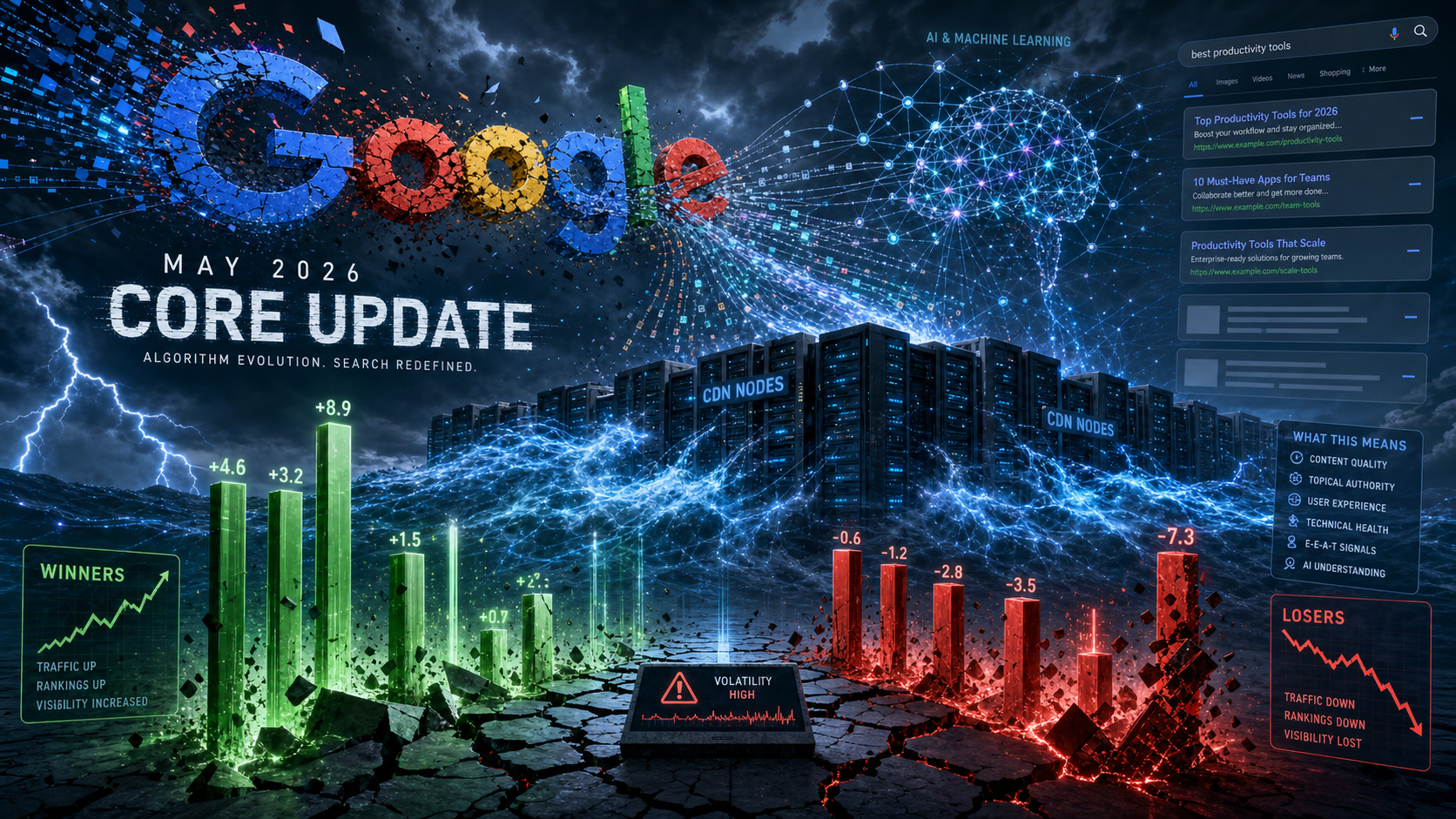
Google's May 2026 update is complete: Why you absolutely must wait before making SEO changes – Image: Xpert.Digital
“AI Slop” is being brutally punished: This is how radically Google’s new update is changing the web
Why the classic click on the number 1 ad is dying out and the traffic boom is a trap: Your own CDN dilemma with the Google Core Update
The Google Core Update from May 2026 is officially complete – leaving behind a search engine ecosystem undergoing historic upheaval. What initially appeared to be a routine algorithm calibration quickly revealed itself to be a seismic event for the SEO world. Accompanied by unprecedented waves of volatility and flanked by the massive rollout of new AI agents, this update marks a fundamental paradigm shift: The classic click on the blue link is increasingly giving way to citations in AI-generated answers. While small publishers fear for their reach and unedited mass content ("AI Slop") suffers a drastic drop in visibility, genuine human expertise (EEAT) and a robust server infrastructure are moving into focus. Those who don't understand the new rules of Google's "AI-First" strategy risk becoming completely invisible on the web of tomorrow. A detailed analysis of the winners, the losers, and the technical background.
Related to this:

Twelve days that shook up the search engine ecosystem – and why this update was different from all others
The Google Core Update from May 2026 is complete. It began on May 21, 2026, and officially ended after twelve days – on June 2, 2026. Google had initially predicted a rollout of up to fourteen days, meaning the update was completed slightly earlier than expected. The official completion can be verified via the Google Search Status Dashboard. This is the second major core update of 2026, following the March 2026 Core Update, the March 2026 Spam Update, and the February 2026 Discover Update.
What sets this update apart from its predecessors, however, is not just its scope, but the intensity of the changes, the unusual pattern of volatility waves, and the structural impact on entire industries. Those who were able to follow the developments in real time witnessed something whose clarity and dynamism are virtually unparalleled in the recent history of search engine optimization.
The second earthquake of the year – its place in the 2026 update chronology
To understand the significance of the May update, it's helpful to look back at the preceding months. The year 2026 began without a break for the SEO industry: shortly after the start of the new year, several unannounced waves of volatility were observed – on January 6th, 12th, and 15th/16th – without any official confirmation from Google. In February, the Semrush sensor registered values between eight and ten points on its scale, which usually indicates a major core update, although Google made no announcement whatsoever. March then brought the first official core update of the year, which rolled out from March 27th to April 8th and was accompanied by exceptionally high volatility: nearly 80 percent of the top three search results changed their positions, and almost one in four results in the top ten disappeared completely from the first hundred hits.
The March 2026 Core Update delivered alarming figures, according to the analysis firm SE Ranking: 79.5 percent of all URLs in the top three changed their position, compared to 66.8 percent in the December 2025 update. In the top ten segment, 90.7 percent of the results shifted. Only 20.5 percent of the top three URLs retained their exact position, compared to 33.1 percent in the previous update. For every winner, there were four losers – a balance that, according to SISTRIX data, hit the German e-commerce sector particularly hard.
The May update picked up right where this left off and intensified this dynamic even further. Tracking tools registered exceptional values during the rollout: Semrush recorded a volatility score of 78 out of 100, Sistrix 65 out of 100, and Accuranker 72 out of 100. These measurements significantly exceeded the norm and signaled one of the strongest core updates in years.
The rollout pattern: waves, data centers, and cyclical traffic spikes
One of the most striking phenomena of this update was the unusual pattern of ranking changes. Anyone monitoring traffic in real time could observe regular ups and downs at short intervals – a phenomenon that sparked intense discussions within the SEO community. These cyclical traffic fluctuations, which sometimes occurred hourly, can be explained by the technical architecture of Google core updates.
Google's Head of Communications, John Mueller, had already pointed out in the context of previous updates that core updates are not rolled out as a single, cohesive event. Instead, it's a multi-stage process in which different systems and components are gradually brought online – depending on what the respective teams have been working on. This explains why ranking fluctuations during a rollout often appear in waves: sometimes the results stabilize briefly, then the next system begins to take effect. Google explicitly emphasizes that short-term ranking fluctuations during a rollout are not indicative of a website's final state. They are a technical side effect of the sequential deployment of multiple independent ranking and quality systems.
The May update displayed this phenomenon in its most extreme form. SISTRIX documented a two-stage pattern for the US market: an initial wave began just one to two days after the official start, followed by a second significant reaction about a week later. In the UK market, the radar readings reached their peak on May 29th, before another particularly strong wave of volatility hit shortly before the official closing date on June 2nd. Observers described this as an exceptionally active update that continued to generate movement right up until the final hours before the official closing.
For website operators who have observed frequent, short spikes in traffic, this technical background offers a plausible explanation: When Google sequentially switches different data centers to the new ranking configurations, and these changes are coordinated, website operators experience periodic traffic pulses. This pattern was not as pronounced with previous updates.
A particularly striking example was provided by the real-time data from Xpert.Digital: Over several days, traffic increased in a remarkably consistent rhythm every three hours – sometimes with enormous peak values that can hardly be explained other than by Google switching its data centers to the new ranking configurations one after the other in coordinated intervals. This pattern was so pronounced in its regularity that it clearly differed from organic user fluctuations and instead pointed to a technically timed switching process on the Google infrastructure side. Thus, Xpert.Digital's observations align with what John Mueller described regarding the multi-stage, system-wide deployment of core updates.
When success becomes an infrastructure test: Our CDN dilemma
One aspect that receives little attention in global SEO discussions, but is of immediate practical relevance to website operators, concerns the infrastructure side of a sudden traffic surge. Core updates are usually viewed from the perspective of winners and losers – less often from the perspective of those who, while among the winners, are let down by their own infrastructure.
A massive, unexpected surge in traffic, such as that triggered by a core update, places extremely high demands on Content Delivery Networks (CDNs) and hosting providers. CDN services are designed to cushion traffic spikes and deliver content from geographically distributed nodes. However, if baseline traffic increases drastically within a few days and reaches irregular peak values, even professional CDN setups reach their limits – or providers simply terminate the contract without warning if the contractually agreed capacity limits are exceeded.
Switching CDNs while the system is running is no trivial matter. Every CDN environment has its own caching syntax, configuration logic, and behavior with dynamic and static content. What worked with just a few lines of configuration on the old provider needs to be rethought and tested on the new one – under the pressure of a running system that has just gained visibility thanks to a Google Core Update. Mistakes at this stage can jeopardize that gained visibility with technical issues like slow loading times, faulty delivery, or incomplete caching. It's a classic situation where success quickly becomes a burden.
This experience is not an isolated incident. With growing AI-driven search traffic and the increasing frequency of major Google updates, infrastructure resilience is becoming a strategic factor that is still under-discussed in the SEO community. Those who want to be among the winners in the next core update should not only focus on content and technical SEO, but also assess whether the underlying infrastructure can handle a sudden surge in traffic without causing damage.
Xpert.Digital experienced this scenario firsthand during the May update: Traffic surged so dramatically that their existing CDN partner terminated the agreement within 48 hours. A switch to a new CDN provider was initiated immediately – but the new environment brought with it a different caching syntax that the team had to familiarize themselves with while maintaining operations. This is a prime example of how a sudden traffic increase following a core update can be not only an opportunity but also an immediate operational burden. Publishers with partners like these, as the saying goes, really don't need enemies.
Related to this:

Affected industries: Who won, who lost and why
Google itself always describes core updates as industry-agnostic quality calibrations, and it's true that no sector is fundamentally exempt. Nevertheless, the data reveals clear patterns.
In the finance and stock market news sector, significant shifts were observed. Websites like ariva.de saw visibility gains of around 18.3 percent, while other financial portals experienced declines of between 12 and 16 percent. Job portals showed average visibility increases of 15 to 20 percent, with the winners clearly focusing more on structured, directly user-relevant content. Health websites – as with previous updates – underwent another reordering, with clinically oriented, research-based sources gaining ground over general consumer health portals.
A consistent pattern across the last three core updates is the decline of aggregators and directory sites in favor of original sources and strong brands. In the March update, independent SEO analyst Aleyda Solis precisely identified this trend based on SISTRIX data: Official and institutional sites, specialist and niche providers, and established brands gained ground, while aggregators, directories, and comparison sites lost out. Particularly striking was the decline in visibility of job aggregators like ZipRecruiter and Glassdoor, while direct employer sites and specialized platforms like USAJobs and Amazon.jobs saw significant gains. This pattern continued noticeably in the May update.
In e-commerce, the data from the March 2026 Core Update – considered the direct precursor to the May update – paints a particularly harsh picture: Among the 134 identified losers, online shops, with 39 domains, represented the largest industry group. May followed the same pattern: Brands with a consistent brand experience, authentic product descriptions, and genuine user reviews benefited, while shops with duplicate manufacturer text or generic product descriptions continued to lose ground.
Another striking phenomenon was that users who initially benefited from an update lost positions during the rollout – and vice versa. This is a direct consequence of the multi-layered system architecture: when different ranking components are activated sequentially, early signals can be corrected by later calibrations. Google therefore explicitly recommends waiting at least one week after the completion of a core update before evaluating Search Console data.
🎯🎯🎯 Data-driven B2B industry hub as a quasi-in-house solution

The quasi-in-house solution: How Xpert.Digital closes operational gaps in B2B marketing and sales – Smart Content-Driven Business - Image: Xpert.Digital
Xpert.Digital is a data-driven B2B industry hub led by Konrad Wolfenstein . The company acts as an external, quasi-in-house solution for industrial partners, closing operational gaps in marketing, content, and sales – without requiring additional resources on the client side.
More information here:
Quoted instead of ranked: How to become a source for Google's AI agents
The structural context: AI takeover, answer engine, and the end of the classic click
The May update cannot be viewed in isolation from a fundamental structural transformation of the search engine market. Immediately prior to the update—at Google I/O on May 19, 2026—Google unveiled a series of groundbreaking innovations: the integration of Gemini 3.5 Flash as the default model in AI Mode, a complete redesign of the search box, and the launch of AI agents that continuously search for relevant information in the background. Just a few days later, the core update began—a timing that is hardly coincidental.
Since its launch, AI Mode has reached one billion monthly users within a year, with search queries doubling quarter-over-quarter. This development fundamentally changes what a Google core update means. While traditional core updates shifted visibility in the classic blue link format, the May update intervenes in a search landscape where AI Overviews already appear in 58 percent of all US search queries. According to an Ahrefs analysis, the presence of an AI Overview reduces the click-through rate for the top organic result by 58 percent. Even those holding the number one spot are therefore losing the majority of their potential clicks to Google itself.
An analysis by Define Media Group of 64 websites and several billion clicks shows that organic search traffic has declined by 42 percent since the expansion of AI Overviews. This decline is not a temporary phenomenon but has proven to be structural: it began immediately after the launch of AI Overviews, accelerated after its expansion in May 2025, and by the fourth quarter of 2025, search traffic was already 42 percent below pre-crisis levels. Google Discover, on the other hand, grew by 30 percent during the same period, reaching near parity with traditional web search traffic. Breaking news traffic even increased by 103 percent.
This means that a core update in 2026 will no longer primarily be a question of which page appears in third or eighth place. It will be a question of whether one is even cited as a source in AI Overviews and AI Agents. The paradigm is shifting from ranking to being cited. Anyone who doesn't appear as a trusted, authoritative source in Google's AI ecosystem will lose out—regardless of their position in the traditional organic search results.
Related to this:

EEAT as an algorithmic currency: Why quality characteristics now count
The acronym EEAT stands for Experience, Expertise, Authoritativeness, and Trustworthiness – and it's no exaggeration to say that these four dimensions became the central algorithmic currency in the May update. Websites that demonstrate verifiable expertise, employ named authors with verifiable external visibility, and provide proprietary data have consistently performed better in the last three core updates than websites with unlabeled AI output.
The consequence for content without recognizable authorship, sources, or firsthand knowledge is brutal: it loses visibility, not because Google penalizes it, but because Google's quality rating systems increasingly classify it as less relevant than content with verifiable expertise. The Helpful Content Update, which has been developed gradually since 2022 and is now fully integrated into Core Updates, targets precisely this mechanism.
What Google addresses with the term "AI Slop"—namely, mass-produced, low-quality AI content lacking editorial value—doesn't just affect obvious content farms. It also affects reputable companies that have relied on AI-generated texts without sufficient human oversight. These texts may appear grammatically correct and thematically relevant, but they lack independent knowledge and original perspectives. AI-generated content without human supervision has lost as much as 35 to 60 percent of its visibility in past updates. The May update continues and exacerbates this trend.
Interestingly, Google explicitly states that it does not penalize AI-generated content per se, but rather evaluates its quality exclusively. The deciding factor is not the production method, but its usefulness to the searcher. A well-researched, AI-assisted, and editorially reviewed text can rank just as well as one created entirely by humans. What loses out is the mass production of content lacking substantive content.
Small publishers, large platforms: The power shift in the publisher ecosystem
One of the most controversial developments surrounding the May update is the perceived preferential treatment of large platforms and established brands over small, independent publishers. This debate is not new—it has accompanied Google updates for years—but it takes on a new dimension through the combination of algorithmic recalibration and AI overview expansion.
Observations from the SEO community show that Reddit and other user-generated content platforms have systematically gained visibility in recent updates. At the same time, small, niche publishers, despite offering high-quality content, have lost reach because they lack the brand authority and link structure of large destination websites. Furthermore, in Brazil, smaller sites that previously appeared regularly in Google Discover were removed from the platform, while high-linked sites with clickbait content were favored – a finding that raises questions about the consistency of quality ranking.
From an economic perspective, this development is significant: If aggregators and intermediaries permanently lose visibility, advertising revenue potential shifts to direct sources. For job portals, this means that employers are increasingly searched for and found directly. For financial news, it means that official sources are preferred over journalistic aggregators. This structurally changes the economics of digital publishing, not just temporarily.
The development of AI-powered reviews exacerbates this effect. According to recent data, websites heavily reliant on organic search traffic have lost between 20 and 40 percent of their traffic since the widespread expansion of AI-powered reviews. For small, independent publishers who primarily rely on display advertising for funding, such a decline is a threat to their very existence – even if their content quality meets all EEAT criteria.
The timing is no coincidence: The update is in the context of Google I/O 2026
It is particularly noteworthy that the May update was launched immediately following Google I/O 2026. At the developer conference on May 19, Google announced the most profound redesign of its search engine in a quarter of a century: an AI-powered search box, search agents that run permanently in the background, agent-based booking features, and the global rollout of Personal Intelligence in AI mode for nearly 200 countries.
In this context, the Core Update should not be understood as an isolated quality signal, but rather as algorithmic preparation for a fundamentally new search paradigm. Google is calibrating its ranking systems to what is relevant in the AI-first search ecosystem: content that is not only optimized for keywords, but can also serve as authoritative, citable sources for AI agents. Those who hold the number one position in the classic blue links, but do not appear as sources in AI Overviews, may gain visibility, but they lose clicks. The real goal, therefore, is no longer ranking, but citation.
The strategic implications are profound: SEO in 2026 is no longer solely a matter of on-page optimization and link structure. It's a matter of brand identity, thematic authority across platforms, and the ability to be identified as a primary source that Google's AI systems classify as reliable. Multi-channel presence—on LinkedIn, Reddit, in industry publications, and on one's own website—is increasingly becoming a secondary ranking factor.
What remains: Recommendations for action after the rollout is complete
Following the official end of the rollout, the analysis phase has begun. Google recommends waiting at least one week after completion before re-evaluating Search Console data. The period prior to May 21st serves as the basis for comparison. It is important to clearly distinguish between minor ranking drops, which require no action, and significant declines that necessitate in-depth content analysis.
The experience-based recommendation is: No quick fixes during or immediately after a core update. Short-term reactions to waves of volatility, which are technically caused by the phased rollout, lead to knee-jerk reactions instead of strategic thinking. The winners of these core updates are not websites that reacted quickly, but websites that have consistently invested in genuine quality: original research, verifying authorship, proprietary data, and a clearly identifiable editorial perspective.
For websites experiencing substantial drops in rankings, the following applies: identify which pages are affected, analyze which competitors have gained ground, and understand which content patterns Google currently favors. A comprehensive content audit strategy that consolidates or removes low-quality pages is not a defensive step, but can improve the performance of the strong pages on the same domain.
Infrastructure remains an underestimated factor. Those who are among the traffic winners in the next core update need not only excellent content – they also need a CDN and hosting infrastructure that can handle sudden spikes in traffic without jeopardizing operations or risking critical business relationships. The experience of being let down by one's own infrastructure in the middle of a traffic surge is an operational risk that can be largely eliminated through proactive planning and redundancy setups.
The next update is coming, and the playing field will continue to change
Google performs core updates several times a year. Given the pattern from 2026 – with updates in March and May, interrupted by spam updates and the special Discover update in February – it can be assumed that the next core update will follow in a few months. Those who use the time until then to strengthen their content and technical foundation will be better positioned than those who make short-term keyword adjustments.
The deeper message of the May update is structural: Google is transforming from a search engine to an answer engine, from a link aggregator to an AI agent that gathers, synthesizes, and directly presents information on behalf of the user. In this ecosystem, high-quality, authoritative, well-structured content is no longer optional—it is the only sustainable response to an algorithmic reality that systematically filters out mass-produced, unsubstantial content.
The Google Core Update from May 2026 doesn't mark a closed chapter, but rather another step in an ongoing fundamental restructuring of the entire search engine ecosystem. Those who understand this are not victims of the algorithm – but rather active participants in shaping their visibility within the digital economy.
Your global marketing and business development partner
☑️ Our business language is English or German
☑️ NEW: Correspondence in your native language!

Konrad Wolfenstein
I and my team are happy to be available to you as your personal advisor.
You can contact me by filling out the contact form here simply call me at +49 7348 4088 965. My email address is [email protected]:or
I'm looking forward to our joint project.
☑️ SME support in strategy, consulting, planning and implementation
☑️ Creation or realignment of the digital strategy and digitization
☑️ Expansion and optimization of international sales processes
☑️ Global & Digital B2B trading platforms
☑️ Pioneer Business Development / Marketing / PR / Trade Fairs
B2B support and SaaS for SEO and GEO (AI search) combined: The all-in-one solution for B2B companies

B2B support and SaaS for SEO and GEO (AI search) combined: The all-in-one solution for B2B companies - Image: Xpert.Digital
AI search changes everything: How this SaaS solution will revolutionize your B2B ranking forever.
The digital landscape for B2B companies is undergoing rapid change. Driven by artificial intelligence, the rules of online visibility are being rewritten. For companies, it has always been a challenge not only to be visible in the digital mass, but also to be relevant to the right decision-makers. Traditional SEO strategies and managing local presence (geo-marketing) are complex, time-consuming, and often a battle against constantly changing algorithms and intense competition.
But what if there were a solution that not only simplified this process but also made it smarter, more predictive, and far more effective? This is where the combination of specialized B2B support with a powerful SaaS (Software as a Service) platform comes into play, specifically designed for the demands of SEO and GEO in the age of AI search.
This new generation of tools no longer relies solely on manual keyword analysis and backlink strategies. Instead, it leverages artificial intelligence to more accurately understand search intent, automatically optimize local ranking factors, and conduct real-time competitive analysis. The result is a proactive, data-driven strategy that gives B2B companies a decisive advantage: they are not only found, but perceived as the leading authority in their niche and location.
Here's the symbiosis of B2B support and AI-powered SaaS technology that transforms SEO and GEO marketing, and how your company can benefit from it to grow sustainably in the digital space.
More information here: