
Germany's comeback begins with the disenchantment of the old success model: A path to economic renewal
Xpert Pre-Release

Available in 27 languages 📢
Prefer Xpert.Digital on GoogleⓘPublished on: October 4, 2026 / Updated on: October 4, 2026 – Author: Konrad Wolfenstein
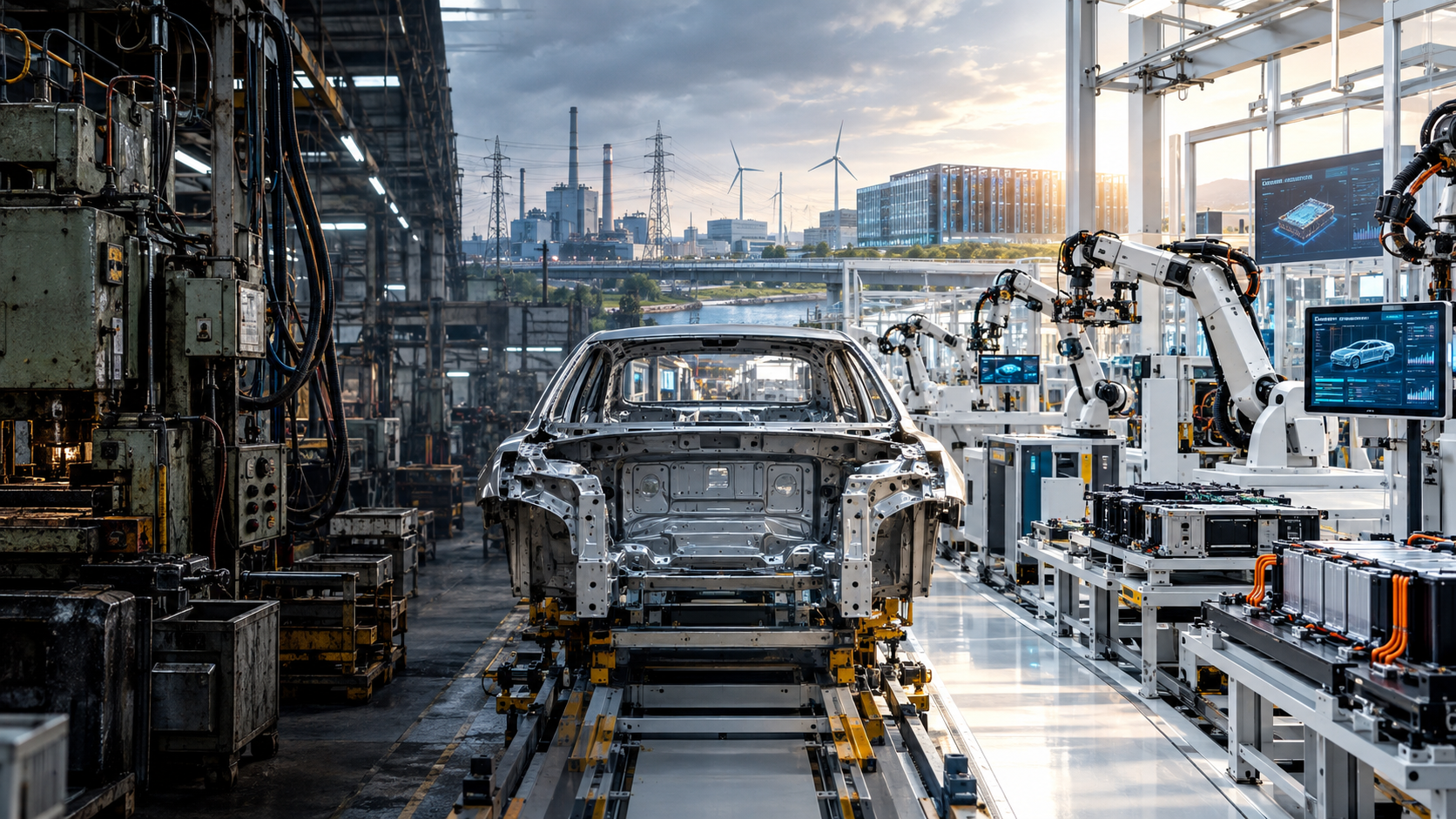
Germany's comeback begins with the disenchantment of the old success model: A path to economic renewal – creative image on the topic, with AI: Xpert.Digital
Reforms for the future: Germany's structural transformation in focus
From crisis to opportunity: Germany's industrial challenges
The path to recovery: Energy prices and bureaucracy – Germany's location factors in transition
The ongoing economic difficulties are not a temporary phenomenon, but rather an expression of a profound structural realignment of the economic model. For decades, the country benefited from a strong industrial sector, favorable energy prices, and close integration with global markets. But times have changed: High labor costs, demographic challenges, digital lags, and geopolitical tensions are taking their toll on the German economy.
While current economic data may suggest a recovery, this should not obscure the existing problems. Growth is often based on government spending rather than a sound economic foundation. Companies like Volkswagen exemplify the challenges arising from an outdated business model. Bold reforms are essential to safeguard competitiveness and initiate a comeback. Germany must not only optimize its industrial processes but also create the framework for innovation, investment, and skilled workers. Only then can the country once again become a leading location for business and industry.
It is not decline that is inevitable – but failure without a radical will to reform
Germany is not experiencing a typical economic downturn that will resolve itself with lower interest rates, increased government spending, and a bit more optimism. The country is undergoing a structural realignment of its economic model. For decades, its success was based on a high-performing industrial sector, comparatively inexpensive energy, close ties with China, open global markets, technologically leading products, and a reliable government. Several of these prerequisites now apply only to a limited extent or not at all. At the same time, new burdens have emerged: demographic pressure, high labor costs, slow permitting processes, a complex tax and transfer system, overburdened municipalities, digital lags, and increasing geopolitical fragmentation.
The situation is serious, but by no means hopeless. Germany still possesses a large industrial capital stock, highly skilled professionals, efficient research organizations, strong medium-sized companies, globally recognized brands, and a central location within the European single market. The problem, therefore, is not a lack of economic substance, but rather the declining ability to translate existing substance quickly enough into new products, scalable business models, and productive investments. This is precisely where the real danger lies: Germany is still strong enough to suppress the pressure for reform, but already too weak to afford further years of hesitation.
The upswing masks the structural erosion
At first glance, the economic data for 2026 sends a reassuring signal. After two very weak years and real growth of just 0.2 percent in 2025, economic output is expected to pick up again. In the fall of 2026, key forecasts for the year as a whole ranged between roughly 1.1 and 1.3 percent. This improvement is welcome, but should not be mistaken for a lasting turnaround. A significant portion of the growth stems from government spending, infrastructure programs, defense investments, tax incentives, and more stable domestic demand. Foreign trade, which used to be a regular pillar of German growth, is providing only weak or even negative impetus.
The crucial distinction lies between cyclical growth and potential growth. Cyclical growth indicates how strongly an economy can recover from a period of weakness in the short term. Potential growth, on the other hand, describes how quickly it can grow sustainably without creating new imbalances. This is precisely where Germany's core problem lies. Estimates for potential output growth are now only in the range of a few tenths of a percentage point. Without reforms, growth could come to a near standstill by the end of the decade. A temporary upswing would then merely be a recovery within an increasingly flattened long-term growth path.
This diagnosis explains why economic sentiment and measured economic performance can temporarily diverge. Even if order books rise, consumers spend more again, and public investment picks up, high operating costs, low productivity gains, and a shrinking labor supply persist. A stronger economy buys time, but it doesn't replace reforms. In the worst-case scenario, it even removes the political pressure to act from the debate before the underlying problems are resolved.
Volkswagen is the stress test of the industrial model
Volkswagen exemplifies the German industrial crisis because almost all of the country's conflicts are concentrated within the corporation. These include high fixed costs, complex corporate structures, political influence, demanding collective bargaining agreements, parallel technological strategies, increasing competitive pressure from China, challenging software projects, new trade barriers, and the costly transition to electromobility. The corporation is not weak because it cannot build cars. It is under pressure because the economic logic of its previous successful model no longer works reliably.
The figures illustrate the pressure. While Volkswagen achieved sales of around €321.9 billion in 2025, its operating profit fell to approximately €8.9 billion, a decline of more than half. The operating return on sales dropped from 5.9 to 2.8 percent. Special charges, US tariffs, currency effects, and the adjustment of Porsche's product strategy played a significant role in this. However, even after adjusting for these factors, profitability remained below the level required by a capital-intensive global corporation to justify substantial investments in batteries, software, electronic architectures, new platforms, and factory upgrades.
Volkswagen is therefore not proof of the inevitable decline of German industry, but rather of the dangerous delay in necessary adjustments. Too many variants, brands, platforms, and decision-making stages increase costs and slow down processes. At the same time, factories must be utilized to capacity, jobs secured, and regional interests considered. What appears from a business perspective to be a consistent simplification quickly becomes a political and social conflict. This very tension characterizes the entire industrial landscape: Germany often knows what changes are needed, but lacks a sufficiently robust framework to distribute costs, risks, and transitions swiftly.
The central lesson, therefore, is not that Germany must save Volkswagen. Rather, the country must create conditions under which even a large industrial corporation can make faster decisions, produce more cost-effectively, and profitably scale new technologies. Companies themselves remain responsible in this process. Location policy must not perpetuate inefficient structures. It must facilitate investment, enable competition, and provide social security during structural change, without dictating its outcome.
China's rise ends the comfortable division of labor
The former German-China model was simple and exceptionally profitable: German companies sold high-quality vehicles, machinery, chemical products, and equipment to a rapidly growing market. In return, China supplied inexpensive consumer goods and intermediate products. This division of labor is over. Chinese companies are no longer just cost-effective suppliers in numerous industries, but technologically powerful competitors. This is particularly evident in electric vehicles, batteries, solar technology, power electronics, digital platforms, and increasingly also in mechanical engineering.
In the Chinese automotive market, nearly 55 percent of newly sold vehicles were electric by 2025. More than 13 million electric cars were sold there within a single year. A share of around 60 percent was expected for 2026. At the same time, seven out of ten battery-electric vehicles in China were already cheaper than an average comparable combustion engine vehicle by 2025. This fundamentally changes the competitive landscape. German manufacturers are no longer just facing state-supported low-cost providers, but highly integrated corporations with large domestic markets, short development cycles, in-house battery expertise, high-performance software, and aggressive pricing strategies.
The Chinese market has thus transformed from a source of revenue into a strategic testing ground. German suppliers must develop local products there more quickly, adapt more effectively to Chinese software ecosystems, and simultaneously prevent key technological capabilities from migrating entirely out of Europe. Added to this is increasing export pressure. When the Chinese domestic market weakened in 2026, Chinese manufacturers significantly increased their vehicle exports. Electric models played a particularly important role in this. Competition is therefore intensifying not only in China, but also in Europe, South America, Southeast Asia, and the Middle East.
However, isolating Europe would be the wrong answer. Tariffs can compensate for unfair competitive conditions and create time for adjustments, but they cannot compensate for a lack of productivity. Those who compete solely on the basis of protective measures increase the cost of transformation and weaken incentives for innovation. Instead, Germany and Europe need a dual strategy: consistent trade policy resistance in cases of demonstrable distortions, and at the same time, an open, competitive single market that enables investment, scaling, and faster industrial cooperation.
The automotive industry is not only losing sales, but also profitability
The German automotive industry remains an economic powerhouse. In 2025, it generated approximately €533.7 billion in revenue and employed an average of nearly 732,000 people. At the same time, total revenue declined by 1.5 percent and employment by 5.3 percent. Job losses were particularly pronounced among suppliers and parts manufacturers. Foreign sales decreased, while investments outside Germany increased more significantly. This development demonstrates that the industry is not simply disappearing, but rather that its value creation is being redistributed geographically and technologically.
In the first half of 2026, the pressure intensified. The combined revenues of the three major German manufacturers, Volkswagen, Mercedes-Benz, and BMW, amounted to approximately €284 billion, 2.9 percent below the previous year's level. Their earnings before interest and taxes (EBIT) fell by about 19 percent to €13 billion. A particularly problematic aspect is that not only are unit sales and market share declining, but also the ability to generate sufficient profits from high revenues. Lower margins, in turn, weaken the financing of the transformation.
The industry still possesses considerable innovative strength. In 2024, German automotive companies spent around €59.4 billion worldwide on research and development, more than €31 billion of which was invested domestically. This refutes the simplistic claim that the industry has completely missed the boat on technological advancements. The real problem lies less in a lack of research than in the speed at which research is translated into competitive, affordable, and scalable products. Germany develops a great deal, but often industrializes too slowly and too expensively.
The future strength of the industry will therefore not be measured solely by the share of German brands in traditional vehicle manufacturing. Crucially, what will matter is which part of the new value chain remains in the country: battery cells and battery management, power electronics, semiconductors, vehicle software, automated driving, industrial data spaces, recycling, and digital services. A country can continue to assemble many vehicles and still lose strategic importance if the most profitable technologies, platforms, and data ecosystems are controlled elsewhere.
Energy prices are a location indicator, not a fringe issue
Germany's energy problem is often either dramatized or downplayed. Both are misleading. Not every company is energy-intensive, and large industrial customers pay different rates than medium-sized businesses. Nevertheless, German electricity costs are a significant disadvantage compared to other European countries. For medium-sized commercial consumers with an annual consumption between 500 and 2,000 megawatt-hours, the price in the second half of 2025 was €22.64 per 100 kilowatt-hours. The EU average was €18.37. This placed Germany among the most expensive locations in the European Union.
For chemicals, metals, glass, paper, building materials, and parts of the automotive supply industry, such differences directly impact investment decisions. Even more important is the expectation of future costs. Companies invest in facilities with lifetimes of ten, twenty, or more years. Unclear regulations regarding grid fees, power plant capacities, hydrogen, CO₂ pricing, and industrial relief measures therefore not only increase ongoing costs but also the perceived risk. A location can become economically unattractive before the actual energy shortage occurs because uncertainty increases the cost of capital.
A temporary industrial electricity price can stabilize energy-intensive value creation, but it must not become a permanent substitute for a functioning energy system. Crucial factors include faster grid expansion, more guaranteed capacity, market-based incentives for storage and flexible demand, realistic import options for hydrogen and its derivatives, and better European coordination. Government-imposed price components and grid costs must also be reviewed. The success of the energy transition is measured not only by the share of renewable energies, but also by whether security of supply, climate protection, and competitive overall costs are achieved simultaneously.
Bureaucracy primarily costs speed
The German debate on bureaucracy suffers from the fact that it is too often conducted solely in terms of working hours and euro amounts. The annually recorded bureaucratic costs to businesses amount to more than 60 billion euros. This sum is considerable, but it only represents a portion of the burden. The greater damage arises from delays, uncertainty, and the loss of entrepreneurial attention. When investments are approved over several years, reporting obligations have to be fulfilled multiple times, and authorities cannot exchange data, opportunity costs arise that cannot be fully captured by any standard calculation.
This hits small and medium-sized enterprises (SMEs) particularly hard. Large corporations can maintain their own departments for legal affairs, sustainability reporting, export controls, data protection, and permit management. For an SME, these same obligations tie up a significantly larger proportion of available skilled workers. Surveys show that a clear majority of companies have perceived an increase in bureaucratic burdens in recent years. Some have even had to hire additional staff, not to develop new products or acquire customers, but to process regulations.
Effective bureaucracy reduction requires more than simply eliminating individual forms. First, reporting obligations must be consolidated across departments and government levels. Second, the government should, in principle, collect data only once and then reuse it in a legally compliant manner. Third, new laws require mandatory practical testing with small and medium-sized enterprises. Fourth, permitting processes should run in parallel rather than sequentially. Fifth, deadlines, responsibilities, and digital interfaces must be clearly defined and enforceable.
Deregulation does not mean a lack of rules. Reliable environmental, labor, and consumer protection standards are a competitive advantage when implemented in a comprehensible, technology-neutral, and efficient manner. The goal, therefore, is not a weaker rule of law, but a more effective one. A rule that cannot be monitored, waits years for decisions, or requires multiple layers of documentation does not provide better protection. It merely weakens the acceptance of sensible regulation.
The state must transform itself from applicant to enabler
The digital weakness of public administration is not a matter of convenience, but a hindrance to productivity. Germany possesses leading expertise in semiconductors, industrial automation, mechanical engineering, and edge technologies. At the same time, its digital administrative performance remains below the European average. In 2025, Germany achieved 78.11 out of 100 points for digital services for citizens, while the EU average was 84.64 points. For services for businesses, the German score was 77.76 points compared to 88.59 points in the European Union.
The backlog isn't solely due to a lack of software. The federal distribution of responsibilities, inconsistent registers, differing technical standards, and complex legal frameworks prevent comprehensive digitization. Many processes are only superficially digitized: a PDF can be downloaded online, but after completion, it's manually processed internally. A productive administration, however, requires digitized workflows from application to decision, shared identities, interoperable registers, and automated plausibility checks.
For businesses, a central digital business account should consolidate all interactions with the government and social security. Master data, permits, statistical reports, tax information, and grant applications could be managed there based on the principle of single data entry. Artificial intelligence can further assist by pre-screening applications, applying legal changes, and relieving the burden on administrative staff. However, this requires clear responsibilities, secure data spaces, and standardized interfaces.
The crucial reform therefore concerns the architecture of the state. Germany needs binding common standards and central basic components, without centrally controlling every municipal application. Federalism should enable diversity, but not justify permanent technical incompatibility. Where identical administrative services are provided, identical digital building blocks should be used. The state must evolve from a producer of individual, isolated solutions to the operator of a reliable platform.
Our EU and German expertise in business development, sales and marketing

Our EU and German expertise in business development, sales and marketing - Image: Xpert.Digital
Industry focus areas: B2B, digitalization (from AI to XR), mechanical engineering, logistics, renewable energies and industry
More information here:
A thematic hub offering insights and expertise:
- Knowledge platform covering global and regional economies, innovation and industry-specific trends
- A collection of analyses, insights, and background information from our key areas of focus
- A place for expertise and information on current developments in business and technology
- A hub for companies seeking information on markets, digitalization, and industry innovations
Infrastructure investments: A key to success
High taxes exacerbate the skilled worker shortage
Germany not only has too few workers, but also underutilizes existing labor. In 2024, the tax burden on a single average earner amounted to 47.9 percent of total labor costs, the second highest among OECD countries. The OECD average was 34.9 percent. This makes employment more expensive for companies and simultaneously reduces the financial benefit of additional work for employees.
High marginal tax rates are particularly problematic. Those who increase their working hours or switch from marginal employment to regular work may simultaneously lose benefits and pay higher taxes and social security contributions. This often affects secondary earners, single parents, and low- or middle-income households. Therefore, any reform must consider the interplay between income tax, social security contributions, housing benefits, child allowances, and other benefits. Individual tax breaks are rendered ineffective if entitlements are abruptly eliminated elsewhere.
Reducing the tax burden on labor is financially feasible if the government reviews tax breaks, broadens the tax base, and prioritizes spending more consistently. Joint taxation of married couples should also be more strongly aligned with individual work incentives. This does not mean disadvantaging families. The goal must be to better align support with children and actual need, rather than favoring low labor force participation.
In addition, Germany needs more flexible working time models, better childcare, faster recognition of foreign qualifications, and skills-based immigration. More jobs are not created through moral appeals, but through better incentives and reliable infrastructure. Those who demand full-time employment must ensure that childcare, mobility, further training, and net income actually make full-time work attractive.
Demographics make reforms unavoidable
Demographic change is altering the economic landscape more profoundly than any short-term economic fluctuation. Germany's working-age population could shrink by around nine percent within a decade. In the long term, a decline of approximately 22 percent is even possible by 2060. At the same time, the ratio of older people to the working-age population is increasing significantly. This not only reduces the labor supply but also puts pressure on the financing of pensions, healthcare, and long-term care.
Without countermeasures, a self-reinforcing cycle ensues. Higher social security contributions increase labor costs, weaken employment incentives, and burden businesses. A smaller labor supply limits production and tax revenues. At the same time, age-related expenditures rise. The state then has less leeway for education, digitalization, defense, and infrastructure. If additional burdens are imposed primarily on younger employees and companies, this accelerates migration and reluctance to invest.
A viable solution consists of several components. The actual retirement age must rise, incentives for early retirement should be reduced, and voluntary continued employment should be made significantly more attractive. Women must be able to work more hours more easily through reliable childcare and fewer tax-related disincentives. Skilled immigration requires faster visas, digital processes, affordable housing, and better social integration. Automation and artificial intelligence must be strategically deployed where labor shortages limit growth.
No single measure will neutralize the demographic effect. However, together, higher labor force participation, longer working lives, migration, and productivity gains can significantly mitigate the decline. The politically inconvenient aspect is that successes will only become visible over several years. Precisely for this reason, implementation must begin immediately.
Infrastructure determines private investment
For a long time, Germany has relied on a capital stock whose quality was built up prematurely. Roads, bridges, schools, railways, power grids, and administrative buildings were modernized too slowly in many places. The investment backlog perceived by municipalities reached approximately €215.7 billion in 2024, increasing by 15.9 percent within a single year. School buildings alone accounted for €67.8 billion, while roads and transport infrastructure accounted for €53.4 billion.
This backlog has a direct impact on businesses. A dilapidated bridge lengthens delivery times, a lack of power connections prevents new facilities, slow networks hinder digital business models, and poor schools exacerbate the skilled labor shortage in the long term. Public and private investment are therefore not mutually exclusive. Modern infrastructure increases the return on private projects and mobilizes additional capital.
The government's new investment volume could mark a significant turning point. However, money alone does not guarantee effectiveness. If planning capacity is lacking, tenders are overly complex, construction costs rise, and permits take years to obtain, a larger budget will primarily lead to higher prices. What is needed are more standardized construction procedures, long-term project pipelines, pooled expertise, and better financial resources for municipalities. Funds must be allocated according to transparent priorities to where they generate the greatest overall economic benefit.
The key indicator should therefore not be how much money has been politically pledged, but rather how many functional facilities, networks, schools, and transport links are actually built. An investing state only promotes growth if it can select, approve, and implement projects. Implementation capacity thus becomes a form of economic infrastructure in itself.
Debt finances time, but not competitiveness
Easing fiscal leeway allows for higher spending on infrastructure and defense. Given the investment backlog and the geopolitical situation, this is fundamentally justifiable. However, it would be dangerous to assume that additional debt could mask structural weaknesses. Government spending can keep factories operating at full capacity and stabilize incomes. But it doesn't automatically lower energy costs, speed up permitting, or improve productivity on its own.
Debt is sustainable primarily when it increases future production potential. Investments in networks, education, research, digital administration, and defense capabilities can fulfill this condition. Consumption-based spending, permanently subsidized operating costs, and politically motivated individual aid packages often do not. Therefore, every major spending program needs a robust impact assessment and clear success criteria.
Equally important is the additionality of the funding. If new special funds merely replace existing investments from the regular budget, no additional modernization boost will occur. The core budget then gains leeway for other expenditures, while the visible investment effect remains smaller than promised. Transparent separation of funds, multi-year planning, and independent oversight are therefore essential.
Fiscal and structural policies must work together. Investments without reforms risk being bogged down by budget constraints. Reforms without investment leave businesses and citizens to cope with outdated infrastructure. Germany's comeback requires both: more productive capital and better rules for its use.
Innovation too often fails due to a lack of scalability
Germany is not a country lacking in innovation. It boasts strong universities, Fraunhofer Institutes, industrial research, patents, and highly specialized medium-sized companies. The entrepreneurial spirit is also showing positive signs. In the first half of 2026, 3,053 startups were founded, a record number. In 2025, around €7.2 billion in venture capital flowed into German startups. Sectors such as defense technology, artificial intelligence, and climate and energy technology developed particularly dynamically.
The weakness often begins after a successful founding. Growth companies require large financing rounds, international sales capacities, computing power, skilled personnel, and rapid acquisition of public reference customers. The German and European capital markets remain less deep than US markets during later growth phases. As a result, companies relocate their headquarters, sell early, or scale more slowly. The consequence is a pattern where research and early innovation take place in Germany, but the greatest value creation occurs elsewhere.
An effective strategy must mobilize more institutional capital for growth financing. Insurance companies, pension funds, and public funds can provide a larger share of long-term capital under clear risk rules. At the same time, Europe needs more attractive stock exchanges, better employee participation conditions, and a truly integrated capital market. Public funds should complement private investors, not crowd them out.
The government, too, can act as a smart early adopter. Particularly in defense, cybersecurity, public administration, energy, and healthcare, public procurement can facilitate market entry for young technology companies. The deciding factor should not be a supplier's origin alone, but rather their ability to solve a problem better, faster, and more effectively. An innovation-driven demand policy is often more effective than further piecemeal subsidies.
Productivity is the real question of prosperity
Germany's reform debate often focuses on the distribution of existing income. In an aging society with weak potential growth, this is insufficient. Without higher productivity, every distributional conflict will intensify. Wages, pensions, corporate profits, defense spending, and climate investments will then compete for barely growing economic output.
Productivity doesn't mean increasing the workload of employees or ruthlessly intensifying workflows. It describes how much value is created with a given amount of labor and capital. Modern software, automated processes, better machinery, faster administration, skilled workers, and a more efficient energy supply can all increase productivity. In Germany, there is particularly great potential in the widespread application of existing technologies.
Artificial intelligence is neither a panacea nor a threat. It can automate documentation, predictively maintain production facilities, shorten development times, and alleviate the shortage of skilled workers in administration and businesses. The greatest benefits likely arise not from a few spectacular models, but from thousands of concrete applications in small and medium-sized enterprises (SMEs). Prerequisites include secure cloud and data infrastructures, clear liability regulations, available computing power, and employees who are qualified to use the systems.
A productivity-oriented policy evaluates measures based on whether they enable learning processes, investment, and better use of scarce resources. This also requires ending unsuccessful programs. Germany needs less symbolic subsidy policies and more institutional capacity for learning.
Industrial policy needs goals, not favorite companies
The state cannot leave structural change entirely to the market because energy supply, security, infrastructure, and technological dependencies affect public interests. At the same time, the state is rarely good at predicting individual winners. A modern industrial policy should therefore set clear goals and frameworks, but maintain competition for the best solutions.
Strategic goals can include security of supply, climate-neutral production, technological sovereignty, and military capability. However, this does not mean that every existing factory or national company should be permanently protected. Subsidies should be tied to measurable investments, innovations, productivity gains, and time limits. Failure must remain a possibility; otherwise, subsidies become an insurance policy against corporate responsibility.
European scaling is particularly important. Germany alone is too small for many platform, cloud, semiconductor, and defense projects. The European single market offers sufficient demand and capital, but remains fragmented due to differing rules, approvals, and national interests. A serious European industrial policy therefore does not begin with ever more funding programs, but with common standards, open procurement markets, and an integrated capital market.
For Germany, this signifies a shift in mentality. National control is not always synonymous with economic sovereignty. A competitive European supplier can be strategically more valuable than a permanently subsidized national producer. Sovereignty arises from options for action, not from autarky.
Reforms need a clear order
The multitude of problems must not lead to a reform list without priorities. Measures that directly accelerate investment must be prioritized. These include binding deadlines for permits, parallel review processes, digital business accounts, standardized data requirements, and faster network connections. These reforms cost relatively little but can quickly mobilize private projects.
Next, labor supply and productivity must be strengthened. Lowering the marginal tax rate on additional work, improving childcare, attracting skilled immigrants, providing further training, and making employment more attractive to older people directly counteract demographic pressure. At the same time, companies should be able to more easily depreciate investments in automation, software, and artificial intelligence.
The third level concerns the major systems: pensions, healthcare, long-term care, energy, and municipal finances. Transitional periods and social compensation are necessary here, but precisely for this reason, preparations must not be postponed any longer. Those who only begin these reforms during an acute financial crisis will be forced to implement harsher and more unfair measures.
Finally, Germany needs an institutional reform of implementation. Laws should include objectives, responsibilities, deadlines, and metrics. Progress must be publicly comparable. Ministries and agencies need more expertise in digitalization, project management, and impact measurement. Political success should no longer be measured by the number of new programs, but by verifiable results.
Social balance must not prevent change
The industrial transformation will create winners and losers. Regions with a high proportion of traditional automotive supply or energy-intensive production are particularly vulnerable. Responsible policy must not abandon employees by simply pointing to abstract market forces. It should promote further education, mobility, entrepreneurship, and regional infrastructure.
Social compensation becomes counterproductive, however, if it preserves every existing structure. Short-time work, transfer companies, and regional aid can facilitate transitions. On the other hand, permanent subsidies for uncompetitive business models tie up capital and labor that are then lacking elsewhere. The task is to protect people, not to maintain every job unchanged.
Honesty is crucial here. Not every job will remain in its current form. At the same time, new jobs are emerging in energy technology, defense, software, data centers, network expansion, healthcare, and industrial services. Policymakers must accelerate this shift instead of denying it rhetorically. Good structural policy combines clear signals of adaptation with reliable support.
Companies also bear responsibility. Those who have distributed high profits for years, postponed technological decisions, or built complex structures cannot simply pass the entire cost of corrective action on to employees and the state. A credible reform system requires contributions from all stakeholders: more efficient companies, a more effective state, and reasonable adjustments for employees.
Germany's strength lies in its potential for cooperation
The German economy continues to possess exceptional capabilities. Small and medium-sized enterprises (SMEs) combine engineering expertise with global customer relationships. Large corporations have access to capital, brands, and international production networks. Research institutions lay the technological foundations. The European single market offers opportunities for scaling, and the energy transition is generating new demand for machinery, networks, storage technology, and digital systems. Increased defense spending can also strengthen industrial capacity and technological development.
These strengths, however, only unfold when they are interconnected. Research without growth capital remains in the laboratory. Capital without swift approvals migrates elsewhere. Renewable energy without grids does not reduce industrial costs. Immigration without housing and digital administration does not solve the skills shortage. Government investment without planning capacity does not create infrastructure. The quality of a location therefore depends less on a single outstanding measure than on the functionality of the overall system.
This is precisely where the opportunity lies. Many of Germany's problems are self-inflicted and therefore, in principle, solvable. The country has sufficient resources to modernize infrastructure, reduce the burden on workers, digitize public administration, and finance innovation. The problem is not a lack of money, but rather a lack of priority, speed, and consistency. Reform policies, therefore, need not dismantle the welfare state or discard industrial traditions. They must adapt the state, businesses, and social security systems to a changed reality.
The comeback begins with uncomfortable honesty
Germany is not facing a choice between decline and a return to the old normal. The old normal is not coming back. Cheap Russian energy, risk-free business with China, a steadily growing labor supply, and undisputed technological leadership were historical conditions, not lasting guarantees. A convincing comeback agenda must therefore be forward-looking.
The rationale is this: Germany can once again become a leading growth and industrial location, but not by simply reverting to the old model. What's needed is a more productive, digital, European, and adaptable economy. Volkswagen demonstrates the high costs of delayed change. At the same time, the company's industrial strength shows that renewal remains possible when complexity decreases, decisions are made more quickly, and innovation is scaled economically.
The greatest danger is not a lack of reform ideas. Energy prices, bureaucracy, taxes, demographics, infrastructure, capital markets, and digitalization have been known issues for years. The real danger lies in political complacency regarding the creeping loss of competitiveness. A country can appear prosperous for a long time while its future value creation base erodes. This is precisely why the reform phase must begin before an acute crisis eliminates all options.
A German comeback is realistic if public investment is linked to structural reforms, social transitions are organized, and measurable results are demanded. It will be neither free nor conflict-free. But the alternative would be more expensive: less industrial value creation, lower tax revenues, weaker social security, and a growing loss of political agency. Germany doesn't need to think smaller. It needs to make faster decisions, prioritize more clearly, and relearn how to translate knowledge into economic strength.
🎯🎯🎯 Data-driven B2B industry hub as a quasi-in-house solution

The quasi-in-house solution: How Xpert.Digital closes operational gaps in B2B marketing and sales – Smart Content-Driven Business - Image: Xpert.Digital
Xpert.Digital is a data-driven B2B industry hub led by Konrad Wolfenstein . The company acts as an external, quasi-in-house solution for industrial partners, closing operational gaps in marketing, content, and sales – without requiring additional resources on the client side.
More information here:
Your global marketing and business development partner
☑️ Our business language is English or German
☑️ NEW: Correspondence in your native language!

Konrad Wolfenstein
I and my team are happy to be available to you as your personal advisor.
You can contact me by filling out the contact form here [email protected]:or simply call me at +49 7348 4088 965. My email address is
I'm looking forward to our joint project.










