
Ingenious space-saving trick: How an Austrian company suddenly turns freight transport upright
Xpert Pre-Release

Available in 27 languages 📢
Prefer Xpert.Digital on GoogleⓘPublished on: June 6, 2026 / Updated on: June 6, 2026 – Author: Konrad Wolfenstein
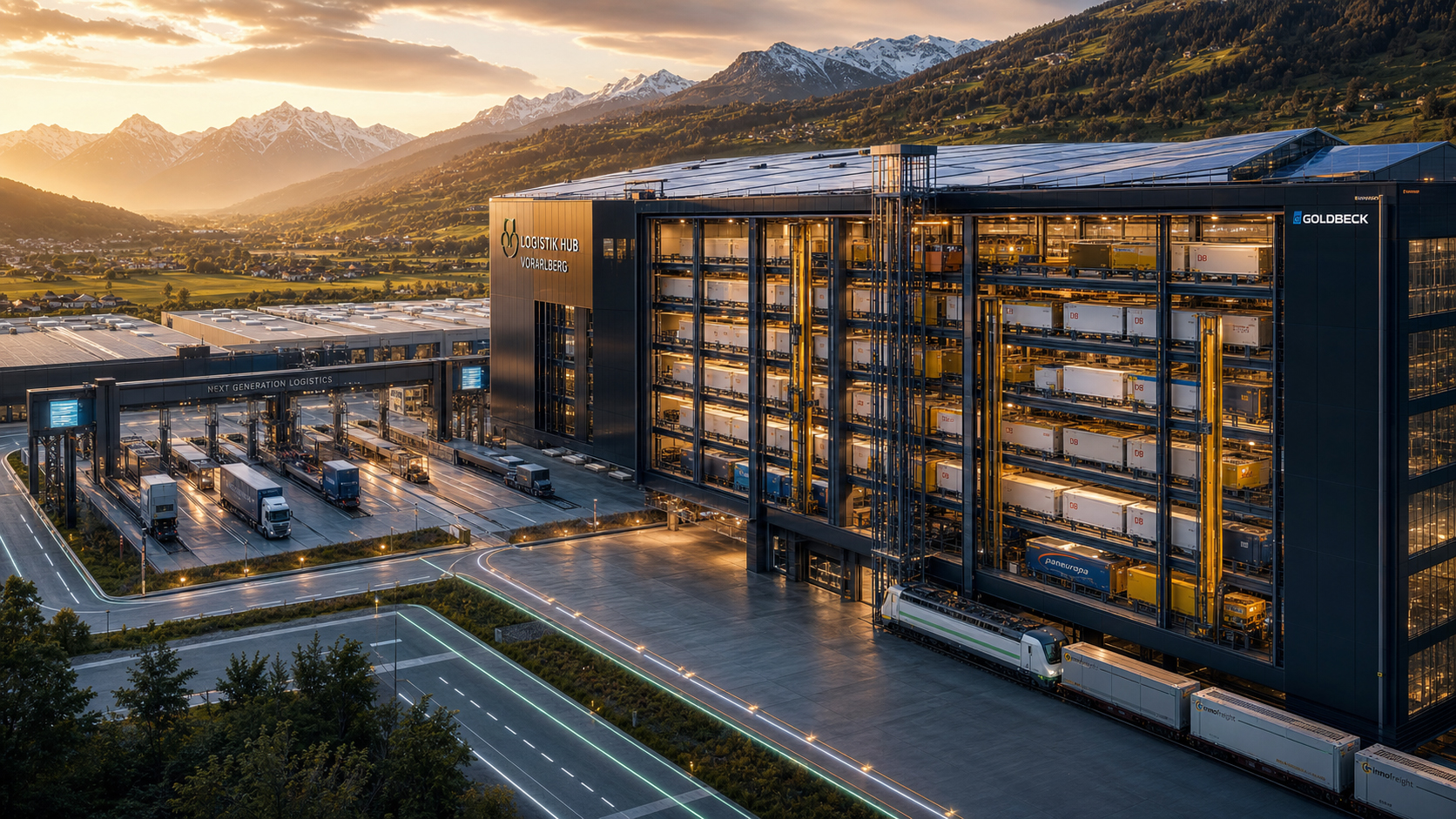
Ingenious space-saving trick: How an Austrian company suddenly turned freight transport upright – Creative image: Xpert.Digital
The end of huge freight yards? This invention is revolutionizing rail and road transport
From cable car to super terminal: Why this vertical system is shaking up the logistics industry
Space shortage solved: How a high-bay warehouse specialist is completely reinventing combined transport
Intermodal freight transport is considered the backbone of a sustainable transport revolution in Europe – yet in practice, it has suffered for decades from a massive problem of space and efficiency. Conventional terminals, where containers and semi-trailers are transferred from road to rail, devour vast plots of land, which are particularly scarce and expensive in metropolitan areas. The result: important modal shift projects fail, and traffic congestion increases. But now, a specialist in intralogistics is presenting a surprisingly logical solution to this structural dilemma. The Austrian company LTW Intralogistics, a subsidiary of the Doppelmayr Group, is building the terminal of the future not horizontally, but vertically. By merging fully automated high-bay warehouses with integrated rail tracks, this innovation leader is creating a bridge that saves significant space, reduces emissions, and drastically accelerates transshipment. How this radical change of perspective – from horizontal thinking to vertical space utilization – resolves the bottleneck of combined transport and why the system could soon become a model for all of Europe.
LTW Intralogistics: The vertical revolution in intermodal freight transport
When the high-bay specialist from Wolfurt reinvents rail and road logistics — and why that's no coincidence
The Austrian company LTW Intralogistics, based in Wolfurt, Vorarlberg, has been known for over four decades as a specialist in automated high-bay warehouses. What is less publicly discussed is that in recent years LTW has built a technological bridge between two worlds traditionally considered separate – internal intralogistics and external intermodal freight transport. This step is not a marketing-driven foray into unfamiliar territory, but rather the logical result of a core technology that is proving unexpectedly revolutionary for the bottleneck of combined transport: the high-bay warehouse as a terminal.
The structural dilemma of combined transport
To understand why LTW's solution is so special, one must first understand the problem that the entire industry has been unable to solve sustainably for decades. Combined transport—the transport of goods in standardized loading units such as containers, swap bodies, and semi-trailers, where the main leg is by rail and the pre- and post-carriage is by road—is considered the backbone of a sustainable European freight transport policy. The German government has set itself the goal of increasing the market share of rail freight from around 19 percent to 25 percent by 2030. The Federal Ministry for Digital Affairs and Transport also expects the volume of goods transported in rail-based combined transport to increase by 76 percent between 2019 and 2051.
Despite this political backing, combined transport is stagnating in many areas. In 2023, transport performance in combined rail freight in Germany fell to 52.3 billion tonne-kilometers. The 18 largest European combined transport terminal operators recorded a decline in handling volume to around 5.07 million loading units in 2025—a decrease of three percent compared to the previous year. The causes identified were economic weakness, but above all, limited infrastructure capacity and quality problems in the rail network.
The underlying problem, however, is structural in nature: Conventional intermodal terminals require enormous amounts of space. A traditional terminal, where semi-trailers, swap bodies, and containers are loaded and unloaded horizontally using gantry cranes or reach stackers, consumes several times more space per parking space than a vertically organized system. Suitable sites near cities or existing rail sidings are scarce and expensive. Furthermore, open-air terminals generate noise and light pollution, which quickly leads to planning conflicts near residential areas. The result: Many worthwhile projects for shifting freight from road to rail fail simply because a suitable terminal location cannot be found.
Furthermore, there is an operational drawback: Traditional terminals do not offer direct, immediate access to individual loading units. Anyone wanting to quickly transship a specific type of freight often has to move other units out of the way first. The inherent flexibility that trucks offer on the road is fundamentally lacking in rail terminal transport.
From warehouse specialist to system architect: LTW's core competence meets a new field of application
LTW Intralogistics was founded in 1981 as Lagertechnik Wolfurt and has since been a wholly owned subsidiary of the Doppelmayr Group, the global market and innovation leader in ropeway construction. This affiliation with the group is more than just a formal ownership structure: it means that LTW storage and retrieval systems, conveyor technology, and support structures are manufactured according to ropeway manufacturing standards—using certified materials, the tightest manufacturing tolerances, and a quality assurance system designed for systems where errors could endanger human lives. For intralogistics, this translates to exceptional robustness, extreme load-bearing capacity, and maximum operational reliability.
Over the course of four decades, LTW has implemented more than 1,000 turnkey intralogistics systems in over 35 countries, installing more than 2,400 storage and retrieval machines. The company built Europe's tallest aisle-bound storage and retrieval machines, reaching a height of 44 meters, for ZF Services in Schweinfurt, and developed systems for deep-freeze areas at -30 degrees Celsius, as well as for heavy automotive components and sensitive pharmaceuticals. It stores pallets and small parts just as reliably as boats and containers.
The first LTW stacker crane for containers was manufactured for armasuisse, the Swiss procurement agency for defense equipment. The 20-meter-high crane, with a payload of 18 tons, serves a high-bay warehouse with 206 storage locations, where containers, swap bodies, and roll-off containers are stored. A special gate system allows minor maintenance work to be carried out directly at the storage location; a dual drive system guarantees maximum availability even in the event of a malfunction. This reference project marks the technological transition from internal intralogistics to external transport logistics.
A second crucial reference is the project at the Jungfraujoch: LTW implemented the first fully automated loading and unloading station for railcars operating at an altitude of 3,454 meters. The swap body, which the Jungfrau Railway pushes ahead of it on its way from the Eiger Glacier to the Jungfraujoch, is unloaded completely automatically—with an unloading window of just three minutes, while passenger traffic continues uninterrupted. This project demonstrates that LTW not only masters racking technology but also manages the automated interface between the rail vehicle and the storage system in real time under extreme conditions.
The unique selling point: The fully automated high-bay warehouse as an intermodal terminal
The real breakthrough in LTW's intermodal positioning lies in the cooperation with the Hamburg-based consulting firm Gomultimodal and the Swiss logistics developer Beat Wegmüller of Bewe Logistik Consulting. Together they developed the rXp-InterregioCargo concept — an innovative approach to combined transport based on the Cargo S-Bahn idea and integrating the fully automated LTW high-bay warehouse as the central terminal backbone.
The core principle is as simple as it is radical: Instead of designing a combined transport terminal as a space-intensive outdoor area with gantry cranes or reach stackers, the terminal is built vertically – as a fully automated high-bay warehouse according to proven LTW standards. The loading track is integrated directly into the high-bay warehouse. Within a width of just 12 meters, up to 100 13.60-meter swap bodies can be stored per 100 meters of length. Two rows of racks with storage spaces for all common containers and swap bodies flank the track, between which fully automated storage and retrieval machines handle the transfer between the train and the racks.
The integrated horizontal and vertical handling technology enables simultaneous automated loading and unloading of trains and trucks—a feature not found at conventional terminals. Containers are transferred through transfer ports in the building wall to gantry cranes on the exterior, which then handle the loading and unloading of the trucks. Since storage and retrieval machines and gantry cranes are at least redundant, operational readiness is ensured even during maintenance work or unplanned outages.
On a footprint of approximately 9,000 square meters, a redundant high-bay warehouse, including transfer zones, can be created for up to 500 loaded semi-trailers. This corresponds to six times the storage capacity of a conventional semi-trailer parking facility or the volume of twelve 700-meter-long trucks. A conventional external terminal with the same capacity would require significantly more floor space.
The EcoSlider and decentralized development: Flexibility beyond the large terminal
In addition to the high-bay warehouse, which serves as a high-performance terminal for sites handling more than 150 daily loading units, the rXp EcoSlider handling device forms the second technological core of the system. Standard swap body vehicles are equipped with this device, which enables containers or swap bodies to be loaded directly from the truck onto the rXp RailTruck and back—at any siding or loading track with a single lane width of just four meters.
This horizontal direct transshipment, without cranes or special terminal infrastructure, potentially unlocks hundreds of existing sidings and loading tracks that are currently underutilized for freight traffic. The simple transshipment between truck and train enables various transport options: direct transfer from siding to siding, from siding to loading track with truck transport, or from loading track to loading track with truck transport both before and after. The concept also includes train services with multiple stops, similar to a suburban rail system.
The overall system thus addresses both problem levels of combined transport simultaneously: the infrastructure problem of large, space-intensive terminals through the vertical high-bay racking solution and the access problem away from the major hubs through the decentralized EcoSlider transshipment.
The economic imperative: Land as a critical resource
The full economic value of this technological combination only becomes apparent when considering land economics. Inner-city or rail-adjacent sites suitable for terminal use are among the most expensive and scarce land categories in Europe. A conventional intermodal terminal with reach stackers or gantry cranes requires a space for maneuvering areas, waiting lanes, and parking areas that is rarely available in urban environments. LTW's high-bay racking solution reverses this logic: the scarce factor of land is replaced by the available factor of height.
This directly impacts the feasibility of the project. In Bad Hersfeld—the pilot site designated for the rXp InterregioCargo concept—an area of approximately 33,000 square meters is available, on which a combined transport terminal, including a fully automated high-bay warehouse with a capacity of over 150 intermodal transport units, is to be built by 2030. For comparison: The European rail network comprises approximately 222,000 kilometers and more than 12,000 freight handling points in 30 countries—most of which are operated by small and medium-sized enterprises that could hardly mobilize the space required for conventional large terminals.
Furthermore, the enclosed design of the high-bay warehouse offers advantages that conventional open terminals cannot match: The complete enclosure of all handling operations virtually eliminates noise and light emissions. This allows operation even in close proximity to office or residential buildings—a crucial locational advantage for urban logistics hubs or depots in industrial parks bordering existing residential areas. The enclosure also significantly improves theft protection for the loading units. Photovoltaic systems can also be installed on the building's roof and walls, generating a portion of the operating electricity directly on-site.
LTW Intralogistics Solutions – Intermodal Transport

LTW Intralogistics Solutions – Intermodal Transport – Image: LTW Intralogistics GmbH
LTW offers its customers not individual components, but integrated complete solutions. Consulting, planning, mechanical and electrotechnical components, control and automation technology, as well as software and service – everything is networked and precisely coordinated.
In-house production of key components is particularly advantageous. This allows for optimal control of quality, supply chains, and interfaces.
LTW stands for reliability, transparency, and collaborative partnership. Loyalty and honesty are firmly anchored in the company's philosophy – a handshake still means something here.
Related to this:
How a high-bay warehouse is bringing the transport revolution to the rails
The energy and sustainability dimension: More than just green communication
Intermodal rail freight causes less than one-fifth of the greenhouse gas emissions of road freight. Against the backdrop of the European Green Deal, which aims for a 90 percent reduction in transport-related greenhouse gas emissions by 2050, the shift from road to rail is not a voluntary quality feature, but a regulatory necessity.
LTW is also implementing these sustainability ambitions technologically: With the CAPDRIVE storage and retrieval machine, the company demonstrates, using real-world comparative data, how energy consumption and energy costs can be significantly reduced through regenerative braking. The supercapacitor technology in the hybrid storage and retrieval machine stores braking energy and makes it fully available again, enabling energy savings of up to one-third and a reduction in connected load of up to 80 percent. In a high-performance terminal where storage and retrieval machines operate around the clock, these efficiency gains add up to considerable cost advantages.
The Cargo S-Bahn, which serves as the system's rail vehicle in the rXp InterregioCargo concept, operates electrically—both on electrified lines via the overhead line and on non-electrified track sections using battery storage. All carriage spaces of the train are equipped with 3×400 V electrical connections, enabling the electrical operation of refrigerated containers while in motion—a feature of considerable market value in temperature-controlled food and pharmaceutical transport.
The Doppelmayr DNA: Quality under extreme conditions as a differentiating feature
An often underestimated aspect of LTW's positioning is the institutional anchoring of quality by its parent company, Doppelmayr. Cable car systems operate under conditions where mechanical failure costs human lives. The resulting manufacturing philosophy—certified materials, minimal manufacturing tolerances, consistent quality assurance, and multiple redundancies—is applied to every LTW component. Storage and retrieval machines and conveyor components are manufactured in the same workshops and to the same standards as the cable cars' suspension ropes and running gear.
For an intermodal terminal operating at peak capacity 24/7, and whose operational reliability is crucial for entire train schedules and supply chains, this quality assurance is not a marketing promise but a measurable economic advantage. Terminal outages in combined transport create cascading effects: A terminal that stops not only blocks its own handling operations but also delays trains, impacting downstream terminals and supply chains across Europe. The physical redundancy provided by at least two stacker cranes and gantry cranes aligns perfectly with the safety principles of cable car construction.
The Doppelmayr Group employs more than 3,000 people worldwide and has implemented more than 15,100 cable car systems in over 95 countries. This global manufacturing and service infrastructure is available to LTW for international projects—a scaling advantage that an independent medium-sized company could hardly replicate.
The software dimension: LIOS as an invisible enabler
Fully automated high-bay warehouses—whether as classic intralogistics systems or intermodal terminals—stand or fall on the quality of their software. With LIOS (LTW Intralogistics Operating System), LTW has developed a modular software family specifically designed for the unique characteristics of LTW system components. The key feature is the bottom-up approach: the software was not conceived as an abstract warehouse management system and then adapted to hardware, but rather developed from the ground up based on a thorough understanding of LTW's own components.
The LIOS cockpit is a browser-based application that fully visualizes and controls all components of an intralogistics system. Employees can access and monitor the system from anywhere—relevant data down to the PLC (programmable logic controller) level is visible at all times, and malfunctions can be identified and located immediately. The LTW LIOS Material Flow System (MFS) manages material flow and optimizes goods flows in real time, while the Warehouse Management System (WMS) ensures complete warehouse management and inventory control.
For an intermodal terminal, this software integration means the system knows at all times which loading unit is located where, which train will arrive at the platform and when, and which truck is waiting at which transfer port. The simultaneous loading and unloading of trains and trucks, made possible by the rXp high-bay warehouse, is technically impossible to manage without precise, real-time coordination logic. LIOS provides exactly this logic—from a single source, without external software interfaces that would introduce potential sources of error and integration effort.
Market positioning and competition: Why the gap exists
The market for automated container terminals was valued at US$11.3 billion in 2025 and is projected to grow to an estimated US$22.4 billion by 2035, representing an average annual growth rate of 7.9 percent. This growth is primarily driven by three factors: increasing trade volumes, regulatory pressure to reduce CO₂ emissions, and the deployment of robotics, IoT, and AI in terminal automation.
The established competitors in this market—from Kalmar and Liebherr to Konecranes—traditionally focus on port container terminals and large-scale marshalling yards. The specific combination of vertical high-bay warehouse, integrated rail track, and automated horizontal transshipment for continental and regional combined transport is not a standard product offered by established terminal technology providers. CargoBeamer, for example, is building its first proprietary terminal in Germany in Kaldenkirchen, designed for the transport of semi-trailers by rail and with an annual transshipment capacity of up to 228,000 loading units—a horizontal solution on approximately 159,000 square meters of final development area, the diametrical opposite of the vertical LTW approach.
With its high-bay racking solution, LTW specifically targets the medium-distance corridor between traditional large terminals—that is, the regional hubs and inner-city logistics centers, where space constraints and emissions regulations preclude conventional solutions. This strategic niche is currently underserved, even though it represents precisely the segment that is crucial for the politically desired shift from road to rail for last-mile delivery.
The Bad Hersfeld pilot project: A real-world stress test of a new paradigm
According to Gerhard Oswald, Managing Director of Gomultimodal, Bad Hersfeld is the hub of German general cargo transport. Every working day, one to two trucks arrive in this district every minute – and the trend is rising. The town lies on the fully electrified TEN-T line, which allows for train lengths of 740 meters and a permitted speed of up to 160 kilometers per hour for freight trains. The 14-kilometer distance to the Bebra marshalling yard, one of the largest in Germany, offers a wide range of transport connections. Over 50 well-known industrial, commercial, and logistics companies are located within a 20-kilometer radius of the planned terminal site.
The planned terminal, featuring a fully automated high-bay warehouse with a capacity of over 150 intermodal transport units, is scheduled to go into operation by 2030. The cargo S-Bahn trains serving the terminal are slated to begin operating in 2028 on previously identified, used, and unused connecting tracks within a catchment area of approximately 150 kilometers around Bad Hersfeld. This pilot project will demonstrate whether the system lives up to its theoretical promises under real-world conditions—and, if successful, could become a model for reactivating hundreds of disused freight sidings in Central Europe.
The strategic logic: Why an intralogistics company has the better cards here
It may seem paradoxical at first glance that a specialist in intralogistics high-bay warehouses can redesign intermodal transport logistics. The explanation lies in the nature of the problem: the bottleneck in combined transport is not the railway, not the truck, and not even the freight forwarder—it is the terminal as the physical interface. And this is precisely where LTW's core competence lies: building automated, high-precision storage systems that deliver maximum throughput and availability in the smallest possible space.
Traditional terminal builders think in terms of gantry cranes and reach stackers—machines optimized for horizontal outdoor areas. LTW thinks in terms of stacker cranes and vertical space utilization—machines optimized for maximum density and automation in a limited footprint. This shift in perspective is the true unique selling point. Not a single component, but the entire system concept—the combination of high-bay racking technology built to Doppelmayr quality standards, integrated rail connection, fully automated handling, soundproof enclosure, energy recovery, and proprietary LIOS software—results in a technological unit that is not replicated in this form on the market.
Since 2014, LTW has explicitly highlighted its commitment to intermodal transport as an expression of its innovative strength. At LogiMAT 2026, the company presented its holistic approach to future-oriented material flow solutions under the motto "Flow. In every detail." and explicitly emphasized its increased focus on multimodal material flow solutions that intelligently link different transport routes and systems.
Economic assessment: Scalability meets structural demand
From an economic perspective, the LTW concept possesses several characteristics that are crucial for sustainable market penetration. First, the solution is modular and scalable: from a small, EcoSlider-supported direct transshipment facility on a single track to a fully automated high-bay terminal with 500 pallet spaces, the system forms a coherent product family that can be adapted to different levels of demand. Second, the demand is structurally driven: regulatory pressure to reduce CO₂ emissions, political targets for shifting freight to rail, and the increasing shortage of affordable logistics space in cities and suburbs are not mere cyclical fads, but rather long-term megatrends.
Thirdly, enclosure and automation significantly reduce operating costs compared to conventional terminals: Gantry crane and reach stacker terminals require high personnel costs, are weather-dependent, and struggle with rising energy costs. A fully automated high-bay warehouse can be operated 24 hours a day, seven days a week with minimal personnel; its operating costs are predictable and largely independent of weather conditions. Photovoltaics on roof and wall surfaces, as well as regenerative braking using supercapacitors, further reduce energy costs.
Fourthly, LTW, as a member of the Doppelmayr Group, enjoys a significant financial advantage: The parent company employs more than 3,000 people and processes around 30,000 tons of steel annually at its Wolfurt plants. This production capacity and the associated balance sheet strength make it possible to handle even large-scale terminal projects with complex financing structures—a tremendous advantage over purely start-up-based approaches in the field of terminal innovation.
The silent leader of a long overdue system change
The European freight transport sector is facing one of its most profound transformations. The combined transport system, long a well-intentioned but structurally limited niche product, is gaining significant momentum due to regulatory pressure, technological advancements, and the changing availability of space in European cities. The solution offered by LTW Intralogistics from Wolfurt is technologically mature—as evidenced by its references at armasuisse, on the Jungfraujoch, and in numerous high-bay warehouse projects worldwide. The concept is economically sound and politically expedient.
What remains is the scaled market proof. The Bad Hersfeld terminal will demonstrate by 2030 whether the rXp InterregioCargo system, with the LTW high-bay warehouse at its core, can truly multiply the modal shift potential of combined transport. If this proof succeeds, a company from Vorarlberg, Austria, will have achieved what decades of European transport policy have failed to do: technologically overcome the crucial bottleneck in combined freight transport—simply by thinking vertically where everyone else was thinking horizontally.
Consulting - Planning - Implementation

Konrad Wolfenstein
I would be happy to serve as your personal advisor.
You can contact me at wolfenstein∂xpert.digital or
Just call me on +49 7348 4088 965 .
Your container high-bay warehouse and container terminal experts

Container high-bay warehouses and container terminals: The logistical interplay – expert advice and solutions - Creative image: Xpert.Digital
This innovative technology promises to fundamentally change container logistics. Instead of stacking containers horizontally as before, they will be stored vertically in multi-story steel racking structures. This not only allows for a drastic increase in storage capacity within the same area, but also revolutionizes all processes at the container terminal.
More information here:










