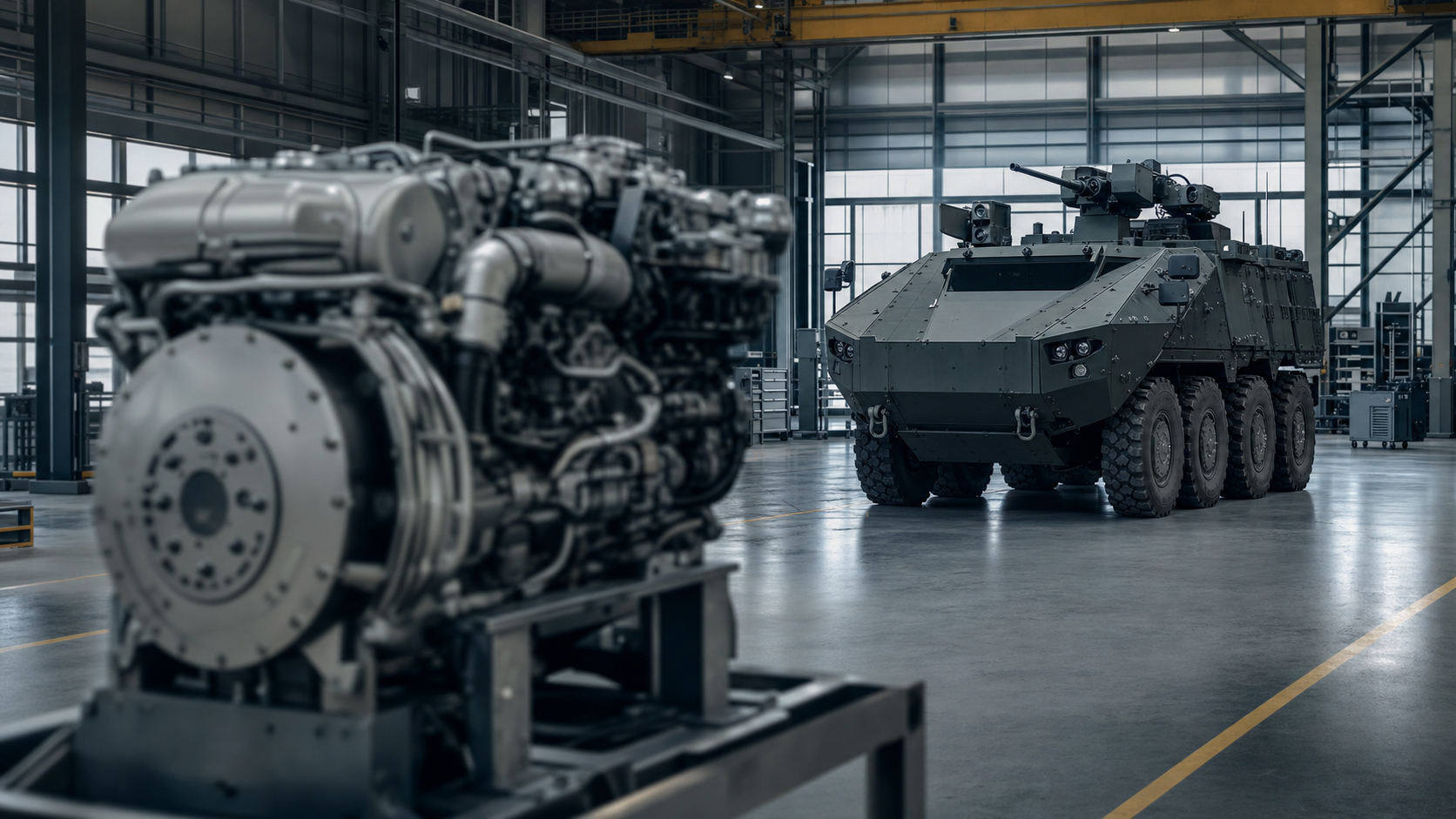
From engine manufacturer to systems integrator: How Deutz is reinventing its defense business with the FFG acquisition – Creative image: Xpert.Digital
Between billion-dollar orders and capacity bottlenecks: The risky bet of the Cologne-based Deutz Group
Expected sales explosion: How Deutz is profiting from the global arms boom through a mega-acquisition
Cologne-based engine manufacturer Deutz is facing the biggest and most far-reaching transformation in its more than 160-year history. With the planned acquisition of Flensburg-based defense specialist FFG for around €1.6 billion, the long-established company is undergoing a radical strategic shift: from a traditional supplier, Deutz is evolving into a powerful systems provider for complete military vehicle platforms. This historic step promises billions in revenue in the booming European defense sector and gives the group a new, long-term oriented shareholder structure. On the other hand, the mega-deal presents immense challenges – from looming industrial capacity bottlenecks to delicate conflicts of interest with existing major customers such as Rheinmetall and KNDS. A closer look at the strategic background, the complex financing structure, and the risky balancing act of the new corporate strategy.
Between conflict of interest and capacity bottleneck – is Deutz risking too much at once with 1.6 billion euros?
A traditional company is looking for its second mainstay
Deutz is considered the world's oldest engine manufacturer and, for much of its more than 160-year history, was inextricably linked to the classic internal combustion engine for construction and agricultural machinery, forklifts, and commercial vehicles. This very close connection to a cyclical business dependent on the construction and agricultural sectors has increasingly put the Cologne-based company under pressure in recent years, prompting the board to undertake a fundamental change in strategy. With the "Next Deutz" program, the company has divided its organization into five independent business units: Engines, Service, Energy, NewTech, and Defense. Since then, it has pursued the stated goal of doubling revenue by 2030 while simultaneously increasing profitability in all divisions. The most recent and by far the largest component of this transformation is the complete acquisition of the Flensburg-based defense supplier FFG for approximately €1.6 billion. This acquisition represents the largest in Deutz's history and definitively transforms it from a pure engine manufacturer into a systems provider for military vehicles, drive systems, and energy solutions.
The billion-dollar deal and its financing architecture
The purchase price of approximately €1.6 billion for FFG will, according to the currently known key details of the transaction, be paid in cash to a significant extent, around €1 billion, and financed through debt. The remaining amount of approximately €0.6 billion will be settled through the issuance of new Deutz shares as part of a capital increase against contribution in kind. This structure has far-reaching consequences for the shareholder structure of the Cologne-based company, as the existing owner families of FFG will thereby acquire a stake of up to 29.9 percent as new, long-term anchor shareholders in Deutz and are also seeking two seats on the supervisory board, without affecting the existing parity-based co-determination of the board. An extraordinary general meeting is scheduled for August 24, 2026, for the final implementation of the transaction. At this meeting, the existing shareholders must approve the capital increase, while approval from the relevant antitrust authorities is still pending. The board expects the transaction to be fully completed between the end of 2026 and the first quarter of 2027, meaning that the changed shareholder structure and the new group arrangements will only have a material impact after some delay.
What FFG actually brings to the portfolio
FFG Flensburger Fahrzeugbau is not your average defense supplier, but a highly specialized developer and manufacturer of complete military vehicle platforms, focusing on wheeled and tracked vehicles. Based on the Leopard 2 main battle tank chassis, the company maintains its own Wisent platform, which can be equipped as needed for mine clearance, engineering vehicles with articulated excavators and bridge-laying capabilities, or recovery vehicles with a 30-ton crane arm. This portfolio is complemented by modernizations and modifications for other support vehicles, including the Boxer infantry fighting vehicle, as well as conventional troop carriers. FFG's clientele includes the German Armed Forces (Bundeswehr) and several NATO partners such as Canada, Denmark, the Netherlands, and Ukraine, giving the Flensburg-based company a diversified and geopolitically broad order portfolio. Last year, FFG generated revenue of approximately €750 million, with its current order backlog of nearly €1.9 billion already significantly exceeding the annual revenue and thus ensuring high capacity utilization for years to come. A particularly valuable strategic component of the business model is the high-margin maintenance and repair business, because tracked vehicles of this category have a lifespan of fifty years or more and undergo repeated modernization phases over this period, in which engines and drives need to be renewed.
The new sales and earnings figures for the group
The integration of FFG fundamentally shifts the balance of power within the Deutz Group. Prior to the acquisition, the defense division, which had only been operating as an independent business unit since the beginning of the year, together with the traditional supplier business for engines and generators, achieved sales in the low to mid-double-digit millions. Meanwhile, the Group expects total sales of between €2.3 and €2.5 billion for the current fiscal year, and the energy business, launched only about three years ago, has already reached over €300 million. CEO Sebastian Schulte had spoken in the spring of a target sales figure of around €300 million for the defense division by 2030, but this target has been surpassed many times over at a stroke by the FFG acquisition. Since FFG alone already contributes €750 million in revenue and has a growing order backlog, the Executive Board considers it highly likely that the combined defense division will exceed the €1 billion annual revenue mark as early as 2027, thus becoming the largest or second-largest revenue generator of the entire group. According to the CEO, the medium-term group target of €4 billion in revenue by 2030, with an adjusted EBIT margin of ten percent, should be achieved significantly earlier than originally planned as a result of the transaction. This is also due to the fact that FFG is already profitable as an independent company, and the combination with Deutz is expected to have a noticeably positive effect on the group's EBIT margin, according to the company.
Synergy potential between engine manufacturer and vehicle manufacturer
The strategic logic behind the acquisition stems from the complementary strengths of the two companies. While Deutz has primarily been active in the defense industry as a supplier of combustion engines, generators, and, more recently, electric drive systems, FFG possesses the capability to develop, integrate, and maintain complete vehicle platforms for decades. The CEO clearly states the goal of increasingly integrating Deutz engines into FFG's vehicle platforms in the future, while simultaneously emphasizing that ultimately, the customer decides on the specific configuration, and Deutz merely has the capability to offer technically suitable drive systems for the specific requirements of these vehicles. This wording already reveals a certain diplomatic caution, as management explicitly states that FFG should not be reduced to the role of a mere sales channel for Deutz engines, but rather should develop its independent value primarily through its excellent and long-standing customer relationships with the armed forces of several NATO countries. On the other hand, Deutz contributes its decades-long proven ability to scale production to an industrial scale, as well as a global service network, to the merger. FFG expects to benefit from this in developing new markets and expanding its maintenance business. According to the board, this combination will generate significant revenue synergies, particularly in the areas of engines and service, as well as additional sales opportunities for other Deutz products such as generators or electrical solutions based on swappable batteries.
The delicate relationship with existing customers from the arms industry
It is precisely at this point, however, that the most complex challenge of the entire merger becomes apparent, because with the acquisition of an independent vehicle integrator, Deutz inevitably enters a field of tension with precisely those companies that have thus far been among the most important customers of Deutz engines and components in the defense industry. Large systems integrators such as Rheinmetall and KNDS, which dominate the market for armored vehicles in Germany and Europe, have sourced and continue to source drive technology to varying degrees from suppliers like Deutz, without, until now, possessing their own engine production facilities of comparable breadth and depth. As soon as Deutz, through FFG, becomes a supplier of complete, ready-to-use vehicle platforms, the former supplier will enter into direct competition with precisely those systems integrators to whom it intends to continue selling engines. This dual role as both a supplier and a competitor in the systems business is by no means new in the defense sector, as other large supplier groups operate in similar configurations. However, it demands a high degree of trust-building communication from Deutz with existing customers to prevent them from getting the impression that sensitive information about tenders or technical requirements could leak to competitors in the automotive sector via the new FFG subsidiary. The management's publicly communicated approach of explicitly not positioning FFG as an extended sales arm for Deutz engines, but rather emphasizing the operational and commercial independence of the Flensburg-based unit, can also be interpreted as an attempt to preemptively dispel precisely these concerns of potential competitors and customers. Whether these assurances will suffice to ensure that Deutz is perceived as a truly neutral supplier in sensitive procurement processes, such as those within the framework of defense programs for the German Armed Forces or other NATO countries, will only become clear in the practical collaboration of the coming years, as contracting authorities and competing systems integrators are likely to be closely monitoring the new corporate structure.
Capacity issues with a rapidly growing order backlog
Besides the question of potential conflicts of interest, such an accelerated growth rate immediately raises the question of industrial capacity. FFG is already investing in a third tank production line at its Flensburg site to even be able to process the existing order backlog of nearly €1.9 billion, as well as the large pipeline of further, yet-to-be-commissioned projects hinted at by the board. This investment in additional production capacity is a clear indication that existing plant capacities are already reaching their limits before the combined group has even reached its targeted revenue of €1 billion in the defense business alone. Furthermore, the European defense sector as a whole is suffering from a massive excess of demand, triggered by ongoing geopolitical tensions and the rearmament programs of several NATO states, which has led to a shortage of specialized personnel, suppliers of armor steel and propulsion components, and production capacity across the entire industry. While Deutz itself likes to point to its decades-long proven ability to flexibly adapt its production to fluctuating demand, this experience stems primarily from the cyclical, but fundamentally civilian, engine business for construction and agricultural machinery and cannot be readily transferred to the complex, safety-relevant certification and quality requirements of armored vehicle manufacturing. If the already apparent capacity bottleneck at FFG cannot be resolved in the coming years through the rapid expansion of new production lines, additional skilled personnel, and stable supply chains, the ambitious growth forecast of one billion euros in revenue by 2027 risks failing due to real-world economic constraints, regardless of the actual size of the theoretical order backlog on paper.
Hub for Security and Defense - Advice and Information

Hub for Security and Defense - Image: Xpert.Digital
The Security and Defence Hub offers expert advice and up-to-date information to effectively support companies and organizations in strengthening their role in European security and defence policy. Working closely with the SME Connect Defence Working Group, it particularly promotes small and medium-sized enterprises (SMEs) that wish to further develop their innovative capacity and competitiveness in the defence sector. As a central point of contact, the Hub thus creates a crucial bridge between SMEs and European defence strategy.
Related to this:
Strategic realignment at Deutz: What the FFG takeover means for the defense industry
The dual role as supplier and system provider in the market context
The European arms market for armored vehicles has historically been dominated by a few established systems integrators, which are generally closely intertwined with their respective national defense ministries and have long-standing, often politically sensitive, supply relationships. In the past, the German Federal Cartel Office has explicitly emphasized, in the context of mergers in this sector, such as the establishment of a joint venture between Rheinmetall, KNDS, and Thales in the armored vehicle sector, that market participants in this segment continue to compete with each other despite occasional cooperation, particularly because national tendering procedures regularly pit the respective national suppliers against one another. For Deutz, this market structure means that the company will have to operate simultaneously as a supplier of drive technology to systems integrators like Rheinmetall or KNDS and, through FFG, as an independent provider of complete vehicle platforms, compete with these companies for the same tenders. In a market where procurement processes are traditionally long-established and heavily reliant on existing relationships of trust, such a dual role can be interpreted both as a competitive advantage, because one has access to more information about the entire value creation process, and as a risk, because established system houses could diversify their own supply strategy in order not to be dependent on a competitor.
Financial viability and the role of new anchor shareholders
The financing structure of the deal also raises fundamental questions about Deutz's financial health after the merger. The raising of approximately one billion euros in debt will initially increase the group's debt significantly, a fact the board downplays by pointing out that FFG's high profitability will help to quickly reduce this debt. Indeed, the fact that FFG generates substantial revenue from its high-margin maintenance and repair business, in addition to its traditional vehicle manufacturing, suggests a solid cash flow base that can contribute to debt reduction, provided the projected surge in demand in the European defense industry does not abruptly subside. At the same time, the acquisition of a stake of up to 29.9 percent by the existing FFG owner families fundamentally alters Deutz's shareholder structure, as these families will become the largest single shareholders of the MDAX-listed company and gain additional strategic influence through two planned seats on the supervisory board. For existing minority shareholders, this means a noticeable dilution of their relative stake, while at the same time a new, entrepreneurial anchor shareholder is created whose deep industry knowledge in the defense sector could potentially have a stabilizing effect on the group's long-term strategic direction. The announcement of the takeover was initially received positively on the capital market; the share price rose significantly on the day of the announcement, although the price had already been under speculative pressure in the preceding weeks and has remained volatile overall since then.
Analyst opinions and valuation on the capital market
Several research firms, in their initial assessments, praised the transaction as a strategically sound move completed at an attractive price, confirming or even raising their buy recommendations for Deutz shares. Their price targets are predominantly significantly above the current share price, indicating a noticeable discrepancy between the analysts' fundamental assessment and the investor reaction so far. This discrepancy can be partly explained by the fact that the market initially values the integration risks of such a large and complex acquisition, the operational management of the aforementioned capacity constraints, and the pending approval from the shareholders' meeting and antitrust authorities with a certain cautionary discount before a sustainably higher valuation can establish itself. At the same time, the reduction in short positions among institutional investors shows that at least some professional market participants have now revised their skeptical stance towards the stock.
Geopolitical tailwinds as a key value driver
The timing of the acquisition is no coincidence, but rather reflects the massive shift in European defense policy over the past few years. The ongoing tensions with Russia, the war in Ukraine, and the defense spending increases decided upon by numerous NATO states have triggered a structural surge in demand for armored vehicles, ammunition, and military logistics, from which specialized suppliers like Deutz and FFG are particularly benefiting. This broader political climate provides the defense sector with a level of visibility and planning security that is virtually unattainable in the cyclical core business of construction and agricultural machinery. At the same time, this very high dependence on political decisions and defense budgets makes Deutz's new core business vulnerable to shifts in the geopolitical landscape, such as a surprise diplomatic breakthrough or a change in security policy priorities by individual governments, even if such a scenario is considered rather unlikely in the medium term.
Strategic realignment beyond the defense sector
However, it would be an oversimplification to reduce the "Next Deutz" strategy solely to the defense business, as the company is simultaneously pursuing an equally ambitious expansion of its energy business. This expansion began with the acquisition of the US supplier Blue Star Power Systems in 2024 and has since been consistently broadened through the purchase of Frerk Aggregatebau and the planned acquisition of Maxi Trust Power in Brazil. The growing demand for decentralized emergency power supplies, particularly for data centers, is considered a structurally growing market, which Deutz views as a further area of synergy with military drive technology, as both application areas require robust drives capable of operating under extreme conditions. The portfolio is complemented by the NewTech business unit, in which Deutz consolidates alternative drive solutions such as battery storage systems and electric drives. Through the acquisitions of UMS and Sobek, Deutz has gained additional expertise in battery-electric off-highway drives and highly integrated electrical systems for unmanned platforms. The start of series production of the Gereon unmanned ground system in summer 2026 together with the Munich-based defense tech company ARX Robotics at the Ulm site underlines that Deutz is increasingly transferring its drive expertise into completely new, software-driven product categories and thus going far beyond classic engine manufacturing.
Operational recovery as the foundation of transformation
That Deutz can afford this costly transformation is also due to the solid operational performance of the current fiscal year. In the most recent quarter, group sales rose by 8.4 percent to €530 million, while adjusted EBIT increased by 45.7 percent to €37.3 million, and the adjusted EBIT margin improved from 5.2 to 7.0 percent. Order intake also developed significantly positively, rising by 41.2 percent to €771 million. In addition to the Service and Energy divisions, the traditional engine business in the construction and agricultural machinery sectors also showed initial signs of recovery. This operational strength in the core business provides the financial basis to manage the additional debt from the FFG acquisition without jeopardizing investment capacity in the other growth areas. It also confirms that the "Next Deutz" strategy is not solely based on speculative future expectations, but also on a solid operational foundation.
Open questions and risks on the path to implementation
Despite the overall positive reception of the deal, several key uncertainties remain that will determine the transaction's actual success. Given FFG's market significance in Europe, approval from antitrust authorities is not a mere formality, even though similar mergers have ultimately been approved in the past. Integrating 1,100 additional FFG employees into the existing group structure of approximately 6,000 employees requires substantial management capital and carries the typical risk of cultural friction, as is regularly observed in acquisitions of this magnitude. Added to this is the previously described capacity issue, which cannot be resolved solely through capital commitments, but only through the actual, time-consuming expansion of production lines, qualification processes, and supply chains. Finally, it remains to be seen how the new dual role as a supplier and systems provider will affect relationships with existing customers among the major defense contractors, because trust in such a security-sensitive market cannot be built solely through press releases, but must be proven over years of concrete collaboration. Overall, the FFG deal exemplifies how a long-established industrial group attempts to profit from the historic turning point in European security policy without losing operational control over a rapidly growing and increasingly complex business model – a balancing act whose outcome will only be fully assessable in the coming years.
Consulting - Planning - Implementation

Markus Becker
I would be happy to serve as your personal advisor.
Head of Business Development
Chairman SME Connect Defense Working Group
Consulting - Planning - Implementation
Konrad Wolfenstein
I would be happy to serve as your personal advisor.
You can contact me at wolfenstein∂xpert.digital or
Just call me on +49 7348 4088 965 .