
From tool to autopilot: Which ten industries are being reinvented by the AI revolution?

Available in 27 languages 📢
Prefer Xpert.Digital on GoogleⓘPublished on: April 13, 2026 / Updated on: April 13, 2026 – Author: Konrad Wolfenstein
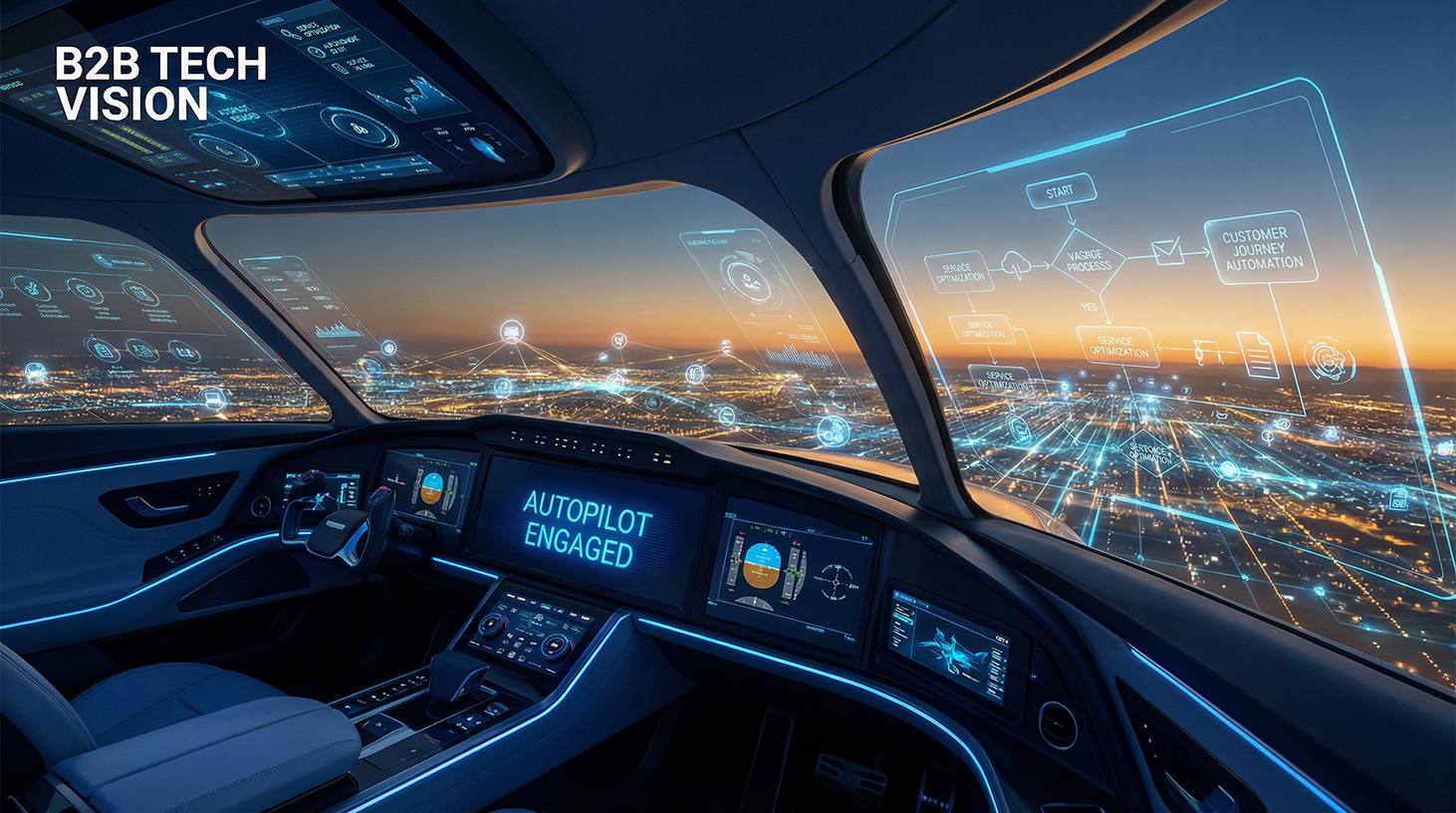
From tool to autopilot: Which ten industries are being reinvented by the AI revolution – Image: Xpert.Digital
When the cockpit is empty – and the plane still flies
The “GenAI Divide”: Why 95% of AI projects fail – and who really benefits
Artificial intelligence was long considered a useful assistant – a digital co-pilot that supports humans, sorts data, or accelerates routines. But this cautious paradigm is currently undergoing a radical shift. AI is leaving the mere toolbox and becoming an autopilot: it independently manages entire value chains, makes decisions in real time, and executes them without human intervention. While the market for this so-called hyperautomation is exploding worldwide, a stark divide is emerging in business practice, dubbed the "GenAI Divide." On one side are pioneers who are achieving massive productivity gains through autonomous AI agents and securing an insurmountable market advantage. On the other side, the vast majority are stuck in endless pilot projects that deliver no measurable added value. Those who miss the leap to the autonomous phase risk falling behind exponentially. The following analysis ruthlessly reveals the ten industries in which AI autopilot is already operational – and where the windows for first-mover advantages are gradually closing.
Related to this:

The multi-billion dollar hyperautomation market: These 10 industries are now letting AI take the wheel
The metaphor of the autopilot isn't new, but it captures the essence of an economic paradigm shift that is currently unfolding in real time. For decades, artificial intelligence was considered an assistance tool—a helpful co-pilot that provides humans with recommendations, processes data, or accelerates routines. This co-pilot approach was rational, cautious, and ultimately limited, as it left control with humans and kept AI in the toolbox. What has been happening since 2025 represents a categorical break with this logic: AI is moving from the toolbox into the value chain itself—it is becoming an autopilot that independently controls, decides, and executes entire process chains without waiting for human approval.
The market for AI-powered automation is growing so rapidly that even optimistic forecasts can barely keep pace: from just under $10 billion in 2025 to a projected $19.6 billion by 2026 – a doubling within just a few quarters. Enterprise adoption has also skyrocketed: from 22 percent of all companies in 2023 to 75 percent in 2024. The global AI market has now reached a value of $391 billion, with annual growth exceeding 31 percent – and is projected to increase ninefold by 2033. Hyperautomation, the complete automation of complex business processes by interconnected AI agents, is accelerating at an annual growth rate of 19.8 percent and is expected to reach a market of almost $32 billion by 2029.
Paradoxically, these impressive growth figures contrast sharply with a sobering operational reality: An MIT study entitled "State of AI in Business 2025" arrives at the sobering conclusion that 95 percent of all generative AI pilot projects in companies fail to achieve a measurable return on investment – despite global investments of 30 to 40 billion dollars. The report describes a "GenAI Divide": On the one hand, a small elite of companies that have deeply integrated AI into their value creation processes and are recording significant productivity gains. On the other hand, a large majority that is stuck in the stage of endless pilot projects. According to current data from Insight Enterprises, seven out of ten companies in the EMEA region are still in the pilot or experimental phase, and in Germany, only one in 14 companies has fully integrated AI into its operations.
This discrepancy is no coincidence. It perfectly illustrates the core tenet of the autopilot paradigm: AI as a tool will always be limited. Only AI within the value chain can unleash its full transformative potential. The following analysis reveals the ten industries most affected by this paradigm shift and its most far-reaching consequences.
Financial services and banking: The autonomous financial analyst
No industry has internalized the logic of autopilot earlier and more consistently than the financial sector. Banks and insurance companies face a dual pressure: rising customer expectations on the one hand, and increasing regulatory complexity on the other. Autonomous AI agents are evolving from rule-based process machines into true "virtual financial analysts": they interpret data, detect anomalies in real time, suggest courses of action, and—with increasing autonomy—execute the corresponding measures themselves.
Specifically, this means that credit checks no longer require several days of processing time by human employees, but are carried out by AI agents in seconds, with a significantly lower error rate. Fraud detection, which previously relied on rigid rule sets, learns dynamically from current transaction data. According to recent industry reports, over 91 percent of security managers in financial institutions plan to implement AI-driven security workflows by the end of 2025. The concept of autopilot is no longer a visionary future topic in the financial sector – it is an operational reality.
Insurance: Claims settlement without human intervention
The insurance industry is following closely behind the financial industry. AI agents are taking over claims processing from the initial report to payment – reviewing, prioritizing, and deciding. What used to take weeks, as claims adjusters had to review documents, ask questions, and make decisions, is now largely automated: AI scans claims reports, compares them with policy data, assesses risk factors, and approves settlement in straightforward cases – entirely without human intervention.
In underwriting and risk assessment, AI systems analyze customer data, policy histories, and external information sources to make sound and transparent risk decisions. Sales teams benefit from 24/7 AI assistants that answer standard inquiries, provide context-based information, and actively support advisors in their work. In its 2025 study on AI adoption in the financial sector, PwC identifies general process automation, AI-supported customer support, and application and contract processing as the three leading application areas in the insurance segment.
Logistics and Supply Chain: When the supply chain thinks for itself
The logistics industry is experiencing its autopilot moment in full public view and in real time. Since the beginning of 2026, active "AI agents" have increasingly replaced passive assistance systems: They independently detect delivery delays, check alternative routes, and proactively inform customers – often even before the truck gets stuck in traffic. According to expert estimates, the operational return on investment for Agentic AI is the highest across all industries in the supply chain sector.
Specific autopilot applications include fully automated inventory management across multiple warehouse locations, dynamic route optimization taking into account weather, traffic congestion, and demand fluctuations, and real-time supplier coordination. The chemical company Dow provides an impressive example: Previously, over 100,000 freight invoices per year were manually reviewed. An autonomous AI agent in Microsoft Copilot Studio now scans these documents for billing errors and automatically submits any discrepancies for review – human intervention is reduced to final approval.
Healthcare: Clinical-grade AI relieves the burden on hospitals
The healthcare system is facing a systemic bottleneck: a shortage of skilled workers is colliding with increasing demand for care, and new working time regulations are exacerbating the situation. AI agents are not being discussed here as a convenient solution, but as a structural necessity. Since the beginning of 2026, hospitals have been deeply integrating so-called "clinical-grade AI" into their processes: software systems listen in during ward rounds and automatically generate discharge summaries, reducing the administrative burden per patient by up to 40 percent.
In hospital logistics – one of the most complex cross-functional areas of hospital operations – the Fraunhofer Institute for Material Flow and Logistics has identified significant untapped potential: In a medium-sized hospital, up to 15,000 items must be coordinated and up to 1,000 internal transports managed daily. Learning AI systems that dynamically adapt to changing conditions are now capable of automating transport planning, material requests for modular cabinets, and nursing documentation. The German Federal Ministry of Health is explicitly funding the use of AI in transfusion medicine for automated, guideline-compliant blood product allocation through the "AutoPiLoT" research project.
🤖🚀 Managed AI Platform: Faster, safer & smarter to AI solutions with UNFRAME.AI

Managed AI Platform - Image: Xpert.Digital
Here you will learn how your company can implement customized AI solutions quickly, securely and without high entry barriers.
A managed AI platform is your all-inclusive, worry-free solution for artificial intelligence. Instead of dealing with complex technology, expensive infrastructure, and lengthy development processes, you receive a ready-made solution tailored to your needs from a specialized partner – often within just a few days.
The key advantages at a glance:
⚡ Rapid implementation: From idea to ready-to-use application in days, not months. We deliver practical solutions that create immediate added value.
🔒 Maximum data security: Your sensitive data stays with you. We guarantee secure and compliant processing without sharing data with third parties.
💸 No financial risk: You only pay for results. High upfront investments in hardware, software, or personnel are completely eliminated.
🎯 Focus on your core business: Concentrate on what you do best. We take care of the entire technical implementation, operation, and maintenance of your AI solution.
📈 Future-proof & scalable: Your AI grows with you. We ensure continuous optimization and scalability, and flexibly adapt the models to new requirements.
More information here:
From co-pilot to autopilot: Why first movers should decide now
Legal and tax advice: Legal Tech enters the autonomous phase
Few sectors have experienced such a steep rise in AI adoption over the past two years as legal departments and tax consultancies. According to FTI Consulting's General Counsel Report 2025, 44 percent of the surveyed general counsel at global corporations are now actively using generative AI – compared to 28 percent the previous year and just 20 percent in 2023. FTI Consulting expects that by the end of 2026, virtually all legal departments of relevant corporations worldwide will be using AI applications in their daily operations.
In tax consulting, AI has reached the status of an indispensable tool after a year of experimentation. Research is automatically pre-structured, drafts are generated by AI, and consultants gain time for strategically essential tasks. In 2025, the German Association of Tax Advisors (DStV) published its own white paper on autonomous AI agents in law firms, clearly distinguishing between assistants and true agents and outlining implementation strategies with a roadmap. The downside: Liability issues are gaining considerable importance. A case before the Cologne District Court in 2025, in which a lawyer submitted an AI-generated pleading containing fabricated judgments and non-existent sources, illustrates the risks of uncontrolled AI delegation.
Related to this:

E-commerce and retail: The algorithm buys for the customer
In retail and e-commerce, perhaps the most far-reaching shift in the autopilot paradigm is taking place: not only is the supply side becoming automated, but also the demand side. In so-called "agentic commerce," it is no longer the individual who buys directly, but their AI agent – based on predefined preferences, budget, and intentions. McKinsey & Company forecasts a global transaction volume of three to five trillion dollars by 2030, processed via AI agents.
For retailers, this means a strategic realignment: it's no longer enough to convince human consumers – it's about winning over the consumer's algorithm. Agent-to-agent commerce, where the customer's AI purchasing agent communicates directly with the retailer's AI service agent, reduces transactions that used to take minutes to fractions of a second. New platforms like Genstore are already building fully AI-powered online shops that operate autonomously, from product listing and marketing campaigns to customer service.
Marketing and communication: From campaign to autonomous machine
Marketing has long been a prime example of creative human effort. This remains true – but the operational execution is shifting radically towards AI autopilots. Autonomous AI agents not only generate content, they execute complete marketing workflows: from automated lead generation and dynamic campaign management to personalized customer communication in real time.
According to industry analyses, by 2026 a significant portion of all customer interactions will already be agent-to-agent – customers' AI assistants will communicate directly with companies' AI marketing agents. The consequences for brands are drastic: visibility in the age of agentic commerce is no longer solely aimed at human readers, but at machine decision-making systems. Hyper-personalization, real-time segmentation, and fully automated content production are part of the new standard that platform providers like Salesforce, Adobe, and Braze are defining as the market standard for 2026.
Human Resources: Autonomous Personnel Management
Human resources and recruiting are among the areas with the highest proportion of repetitive, rule-based tasks – and therefore among the most obvious candidates for an autopilot approach. Autonomous AI agents analyze applications, automatically match job requirements and applicant profiles, answer applicant questions via chatbot, and guide the entire hiring process without manual intervention. This significantly shortens hiring processes and enables a more consistent, objective (less biased) basis for decision-making.
In employee lifecycle management, AI autopilot ranges from onboarding automation and continuous skills development to the early detection of turnover risks. People analytics systems process performance data, identify patterns, and derive automated recommendations for promotions, salary adjustments, and development measures. EY's 2024 European AI Barometer shows that 65 percent of employees expect AI to take over parts of their work—a signal that has a particularly strong impact on self-organization in HR.
Construction and real estate: Planning on autopilot
The construction industry has traditionally been considered resistant to digitalization, but AI transformation is taking hold here too – albeit with a delay. Initial studies show that companies that strategically use AI can reduce planning times by up to 20 percent. AI-supported generative design systems develop numerous design variants in a very short time, automatically taking into account key parameters such as construction costs, structural design, and CO₂ footprint.
In building operations, AI solutions are already taking over facility management for predictive maintenance: Sensor networks deliver real-time data, AI systems analyze deviations and initiate automated maintenance measures before damage even occurs. AI connects planning, execution, and operation into a fully digital, data-driven cycle – from the initial architectural design to the end of a building's life cycle. According to the 2024 OECD report, Germany is still at the beginning of this transformation, while international markets are already using advanced autonomous construction processes.
IT, Enterprise Software and ERP: The self-managing company
IT infrastructure, enterprise applications, and ERP systems form the backbone of any digital autopilot strategy. At the same time, they themselves are a key application area: Autonomous AI agents monitor infrastructure in IT operating environments, detect anomalies, and independently initiate countermeasures – a fundamental shift from reactive to proactive IT operations. Gartner predicts that by the end of 2026, 40 percent of all enterprise applications will have integrated task-specific AI agents – a dramatic leap from less than 5 percent in 2025.
ERP systems are becoming intelligent data hubs: The integration of AI into cloud ERP solutions enables the automated adaptation of business processes to new situations in real time. A large company provides an impressive practical example: it has built 7,000 Power Apps, 18,000 automated processes, and 650 autonomous agents using Microsoft Power Platform and Copilot Studio – resulting in annual savings in the tens of millions. Ninety percent of large companies worldwide have now declared hyperautomation a strategic priority.
The GenAI Divide: Why timing is crucial
A strategic look at all ten industries reveals a common pattern: the autopilot effect is not evenly distributed. It is concentrated in companies that have made the crucial step from the experimentation phase to operational integration. McKinsey's analysis shows that AI-driven companies trade on the stock market at valuation multiples 15 to 35 percent higher than traditional competitors. Productivity gains of 25 to 45 percent in automated processes and direct cost reductions of 20 to 60 percent with suitable processes are not theoretical potentials, but documented results from real-world implementation.
The downside of this transformation lies in what the MIT study describes as the "GenAI Divide": Companies that continue to treat AI merely as a tool and remain stuck in pilot projects will fall structurally behind those that have deeply integrated AI into their value creation – not gradually, but exponentially. European companies face particular pressure to act: IDC predicts that European companies' investments in AI technologies will exceed $250 billion by 2029, an increase of more than 36 percent compared to today. The crucial question is therefore no longer whether the shift from co-pilot to autopilot will occur, but how quickly – and in which sectors the windows for first-mover advantages are still open.
Top Ten Overview: Industries
| # | Industry | Core Autopilot Application |
|---|---|---|
| 1 | Financial Services & Banking | Autonomous credit decision-making, risk management |
| 2 | Insurance | Claims settlement, underwriting |
| 3 | Logistics & Supply Chain | Real-time route optimization, inventory management |
| 4 | healthcare | Clinical documentation, hospital logistics |
| 5 | Legal & Tax Advice | Contract analysis, autonomous law firm processes |
| 6 | E-commerce & Retail | Agentic Commerce, autonomous online shop |
| 7 | Marketing & Communication | Autonomous campaign management, lead generation |
| 8 | Human Resources | Autonomous recruiting, employee lifecycle |
| 9 | Construction & Real Estate | Generative design, predictive maintenance |
| 10 | IT, Enterprise Software & ERP | Self-healing IT infrastructure, agent-driven ERP |
The top ten industries and their key autopilot applications include: Financial Services & Banking, where autonomous credit decisions and risk management are paramount; Insurance, with automated claims settlement and assisted underwriting; Logistics & Supply Chain, which benefits from real-time route optimization and optimized inventory management; Healthcare, which primarily uses autopilots for clinical documentation and hospital logistics; Legal & Tax, where contract analysis and autonomous law firm processes are relevant; E-commerce & Retail, with agentic commerce and autonomous online shops; Marketing & Communications, which utilizes autonomous campaign management and lead generation; Human Resources, which relies on autonomous recruiting and employee lifecycle management; Construction & Real Estate, where generative design and predictive maintenance are key applications; and IT, Enterprise Software & ERP, where self-healing IT infrastructures and agent-driven ERP systems play central roles.
Consulting - Planning - Implementation

Konrad Wolfenstein
I would be happy to serve as your personal advisor.
contact me at wolfenstein ∂ xpert.digital
Just call me on +49 7348 4088 965 .





