
Fire protection and sprinkler systems in logistics centers with high-bay warehouses: What a 10,000-square-meter warehouse really costs
Xpert Pre-Release

Language selection 📢
Published on: March 13, 2026 / Updated on: March 13, 2026 – Author: Konrad Wolfenstein
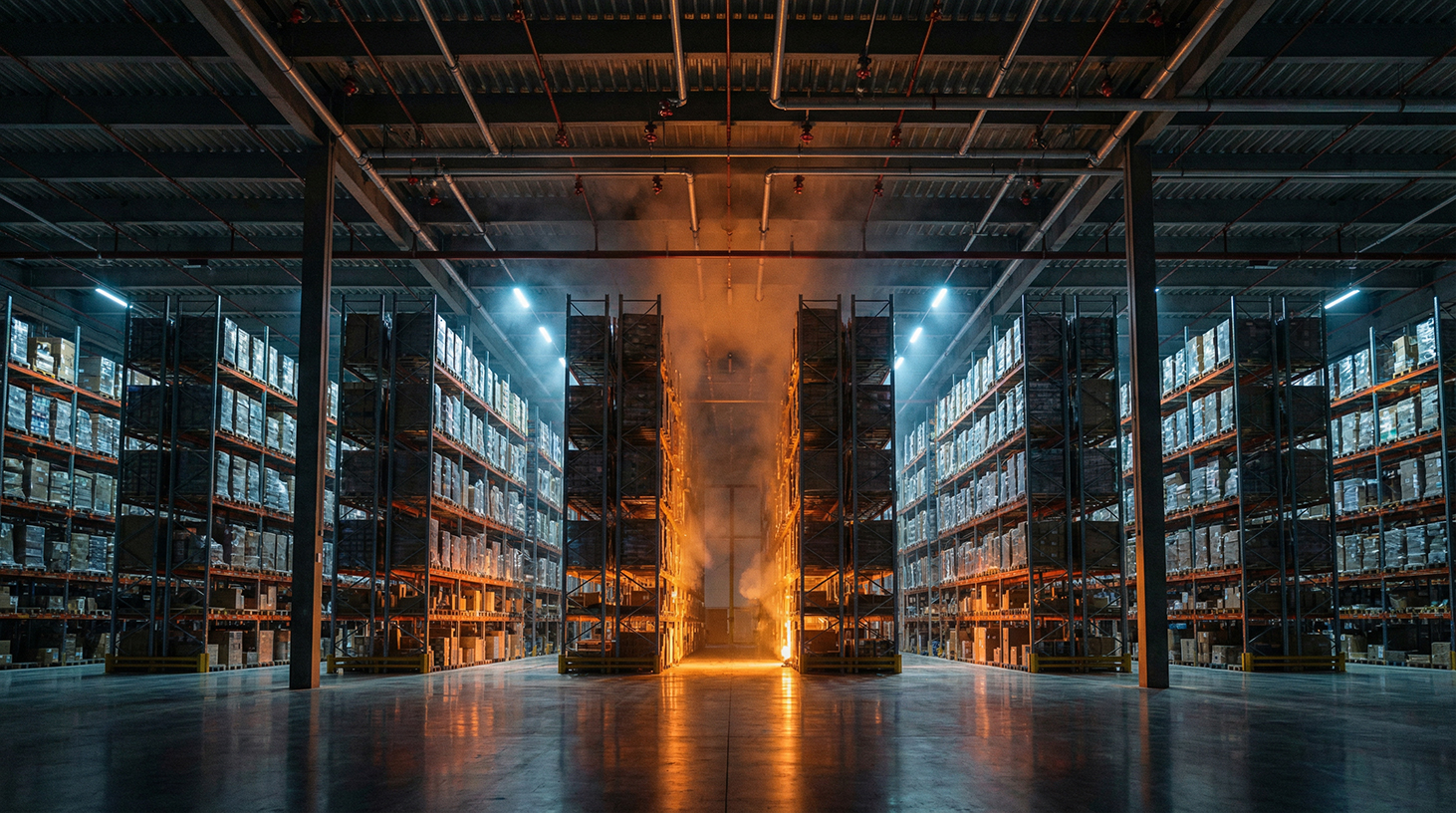
Fire protection and sprinkler systems in logistics centers with high-bay warehouses: What a 10,000-square-meter warehouse really costs – Image: Xpert.Digital
Logistics center cost trap: Why fire protection often blows the entire budget
When extinguishing water becomes a risk: Why classic sprinklers are often the wrong choice
Lithium batteries & automation: These fire protection alternatives replace the sprinkler
Up to 60% insurance discount: This is how the most expensive trade in logistics construction pays for itself
Anyone investing in a modern logistics center usually plans meticulously: land, building envelope, smart racking technology, and state-of-the-art automation are top priorities. However, one crucial cost factor is often completely underestimated until the first inspection by the insurance company's fire safety expert – the sprinkler system. What many building owners initially dismiss as a minor incidental expense quickly reveals itself after groundbreaking as the most expensive single component of the entire building's technical equipment. For a standard 10,000-square-meter warehouse alone, the cost of compliant fire protection systems can easily exceed one million euros.
Our in-depth analysis reveals why fire protection costs in logistics construction are skyrocketing and what hidden operating costs lurk like an iceberg beneath the surface of the investment. We shed light on the paradox of why, in the age of sensitive automation technology and mass lithium-ion batteries, the very water that should be a lifesaver for firefighting often becomes the biggest operational risk itself. Furthermore, we demonstrate the innovative alternatives the market offers today beyond the 170-year-old sprinkler technology and how the right fire protection strategy – strategically coupled with substantial insurance discounts – not only protects your construction budget but also safeguards the survival of your company in a critical situation.
Why the most expensive budget item is the one most investors only discover after the groundbreaking ceremony
Anyone investing in a new logistics center typically focuses first on the land, building envelope, racking systems, and automation. Fire protection, and in particular the sprinkler system, often only enters the budget planning of many end customers when the insurer's fire safety expert first reviews the plans and defines the actual requirements. This often leads to a rude awakening, as the cost of a standards-compliant sprinkler system in a modern logistics center is not a minor expense, but rather regularly represents the largest single item within the entire building's technical equipment. This analysis provides an initial overview of investment and operating costs, examines alternative fire protection concepts, and assesses the risks that sprinkler systems themselves can pose.
How a logistics hall costs today and where fire protection plays a role
The pure construction costs for a logistics hall with a floor area of 10,000 square meters in Germany currently range from approximately €600 to €900 net per square meter, assuming a conventional warehouse without automation. At this size, the client already benefits from economies of scale, so the total construction costs are estimated at between €6 and €9 million. However, as soon as such a warehouse is equipped with modern intralogistics, shuttle systems, or high-bay racking technology, the total investment costs increase considerably. Construction costs including automation can then easily reach €900 to €1,300 per square meter or more, resulting in total project costs of €9 to €13 million.
In this context, the sprinkler system appears as a seemingly insignificant, yet financially significant, item. The construction price index in Germany has risen by approximately 30 percent since 2021, which has also driven up the costs of fire protection systems. For a mid-range logistics property, Catella Research estimated the price per square meter at €1,220 as early as 2021, with premium locations commanding considerably higher prices. These figures illustrate that the total investment in a logistics center today quickly reaches the tens of millions of euros, and fire protection, as a system-critical component, accounts for a proportionally increasing share of this total.
Where every euro goes: The cost structure of a logistics center in detail
The typical cost breakdown for a logistics project clearly illustrates why fire protection is often underestimated. The building envelope, consisting of the supporting structure, foundation slab, roof, and facade, consumes between 35 and 45 percent of the total budget. Intralogistics and automation, including racking systems, conveyor technology, shuttle systems, and control technology, account for another 30 to 40 percent. Technical building equipment, which includes the sprinkler system, electrical installations, heating, ventilation, and air conditioning, makes up 15 to 25 percent of the costs. Planning and ancillary costs add another 8 to 12 percent.
Within building services engineering, the sprinkler system is regularly the dominant single item. The cost of a sprinkler system in a 10,000-square-meter logistics center ranges from €80 to €120 per square meter, resulting in total costs of €800,000 to €1.2 million. Relative to the pure construction costs of a non-automated warehouse, this corresponds to a share of approximately 9 to 13 percent; relative to the total project costs including automation, it still represents 6 to 9 percent. In England, an expenditure of up to 15 percent of the total construction costs for fire detection and suppression measures was considered quite justifiable and appropriate.
| Cost block | share of total costs | Amount for 10,000 m² (example) |
|---|---|---|
| Building envelope (structure, floor, roof, facade) | 35 to 45 percent | 3.5 to 5.0 million euros |
| Intralogistics and automation | 30 to 40 percent | 3.0 to 4.5 million euros |
| Technical building equipment (including sprinklers) | 15 to 25 percent | 1.5 to 2.5 million euros |
| Planning and additional costs | 8 to 12 percent | 0.8 to 1.2 million euros |
The total cost of a logistics hall is divided into several main areas. The largest share is comprised of the building envelope, which includes the supporting structure, floor, roof, and facade. This item accounts for 35 to 45 percent of the total costs, which, for a typical facility of 10,000 m², corresponds to between 3.5 and 5.0 million euros. Another significant factor is intralogistics and automation, which accounts for 30 to 40 percent of the total cost, or approximately 3.0 to 4.5 million euros for a facility of this size.
Building services engineering (BSE) represents the third largest cost category, accounting for 15 to 25 percent of the budget (1.5 to 2.5 million euros). A dominant single item within BSE is the sprinkler system. The cost for this alone can range from 800,000 to 1.2 million euros in a 10,000 m² logistics center (80 to 120 euros/m²). These high costs result from technical requirements such as high water density, a water demand exceeding 10,000 liters per minute, and the need for redundant pumping stations and large firewater storage tanks.
Finally, planning and incidental costs should be estimated at a share of 8 to 12 percent, which in this example corresponds to an amount of 0.8 to 1.2 million euros.
Why sprinkler systems in logistics centers cost as much as entire building technology elsewhere
The question of why a sprinkler system in a logistics center is significantly more expensive than in a conventional commercial building can be traced back to several technical requirements. Modern logistics warehouses require high extinguishing densities because the fire load is considerable due to packaging materials, plastic containers, and high storage densities. For storage heights exceeding 7.5 meters, industrial building regulations mandate automatic extinguishing systems. In high-bay warehouses with heights over 12 meters, simple ceiling sprinklers are often insufficient; additional in-rack sprinklers must be installed at various levels within the rack structures.
In addition, there is the enormous demand for firefighting water. Modern sprinkler systems for logistics areas can have a water requirement of more than 10,000 liters per minute. This amount of water must be supplied via redundant pumping stations, and the firefighting water storage requires underground or aboveground tanks with capacities typically ranging from 500 to 2,000 cubic meters. The cost of such a firefighting water tank alone, including excavation work, special foundations, and connections, can reach six-figure sums. ESFR sprinklers, which can be used in buildings up to 13.5 meters high and offer the advantage of eliminating the need for additional rack sprinklers, deliver approximately 900 liters per minute per sprinkler. With a system designed for twelve sprinklers activating simultaneously, this results in an instantaneous demand of almost 11,000 liters per minute.
Another cost driver is the design of the system by specialized planners who must develop an individual solution for each project. The storage classification, the proportion of plastics in the stored goods, the building geometry, and the flexibility required for storing different product groups must all be coordinated. This complexity makes providing general cost estimates difficult and explains why even experienced intralogistics professionals often underestimate the actual fire protection costs.
Operating costs: The iceberg beneath the investment peak
The initial investment in a sprinkler system is by no means the end of the financial burden. Ongoing operating costs for maintenance, inspection, and repairs add up to considerable sums over the system's lifespan. According to VdS guidelines, which are the standard for most sprinkler systems in Germany, the operator must appoint a trained sprinkler technician to perform daily or weekly visual inspections. Maintenance by a VdS-certified specialist company is required every six months for dry sprinkler systems and annually for wet sprinkler systems. Every three years, an independent expert is required to verify the system's effectiveness, provided the system is mandated by building regulations.
Basic maintenance starts at around €480 per year, but these base costs are just the tip of the iceberg. Additional costs include flat-rate inspections, emergency service surcharges, the replacement of wear-prone components such as drain valves every three years or safety valves every five years, as well as the complex tank inspections every five years and internal tank cleaning every fifteen years. The particularly expensive inspections of older systems after 12.5 years for dry systems and after 25 years for wet systems require the use of endoscopes for internal pipe inspection, laboratory testing of individual sprinkler heads, and, if necessary, extensive refurbishment measures.
| Maintenance point | VdS interval | Estimated cost range |
|---|---|---|
| Basic maintenance of wet systems | Yearly | From €480/year |
| Maintenance of drying system | Semi-annually | Higher than wet system |
| Expert review | Every 3 years | 2,000 to 5,000 euros |
| Container inspection | Every 5 years | 3,000 to 8,000 euros |
| Container cleaning | Every 15 years | 5,000 to 15,000 euros |
| Existing system inspection (laboratory test) | 12.5 or 25 years | 10,000 to 30,000 euros |
Basic maintenance for a wet system must be carried out annually and costs from €480. In contrast, a dry system is serviced every six months, which incurs higher costs. An expert inspection is required every three years, costing between €2,000 and €5,000. A tank inspection takes place every five years and costs between €3,000 and €8,000. After 15 years, tank cleaning is necessary, costing between €5,000 and €15,000. Finally, after 12.5 or 25 years, a comprehensive system assessment is required, consisting of a laboratory test, which costs between €10,000 and €30,000.
For internationally insured logistics properties that must also meet the FM Global standard, maintenance costs can be even higher, as FM Global requires an internal pipe network inspection after five years, while VdS only mandates this as part of the existing system inspection. In such cases, operators effectively have to comply with the stricter standard, which drives up ongoing costs.
LTW Intralogistics Solutions

LTW Intralogistics – Engineers of Flow - Image: LTW Intralogistics GmbH
LTW offers its customers not individual components, but integrated complete solutions. Consulting, planning, mechanical and electrotechnical components, control and automation technology, as well as software and service – everything is networked and precisely coordinated.
In-house production of key components is particularly advantageous. This allows for optimal control of quality, supply chains, and interfaces.
LTW stands for reliability, transparency, and collaborative partnership. Loyalty and honesty are firmly anchored in the company's philosophy – a handshake still means something here.
Related to this:
The most expensive mistake in logistics planning that almost everyone makes
The paradox of firefighting water: When rescue becomes a risk
One of the most pressing economic questions surrounding sprinkler systems concerns the so-called consequential damages resulting from their activation. While sprinkler systems undoubtedly save lives and drastically reduce property damage in the event of a fire, they simultaneously pose a significant risk of damage to stored goods and installed equipment. In an automated logistics center, the escaping extinguishing water can not only soak and render unusable the affected goods, but also damage or destroy sensitive control technology, sensors, and drive components.
Damage statistics illustrate the seriousness of the problem from a different perspective. In the event of a fire, the extent of damage in facilities with automatic fire suppression systems is four to five times less than in facilities without such protection. However, in the case of a false alarm or a fire suppression operation in an automated high-bay warehouse, restarting production may take days or weeks, depending on the extent of damage to goods and equipment. Business interruptions often result in higher costs than the damage to the building or inventory itself. A prolonged shutdown due to fire damage can incur significantly higher costs than the actual material damage, because rent, salaries, and other fixed costs continue while revenue is lost.
The situation is particularly critical when it comes to storing lithium-ion batteries, the proportion of which in logistics centers is steadily increasing. Fire tests conducted by the German Insurance Association (GDV) have shown that while large quantities of water and fast-acting sprinkler systems effectively combat fire spread, they generally fail to extinguish fires at the individual battery level in large battery units. If larger quantities of batteries catch fire, the blaze spreads very rapidly, and explosions are then a real possibility. For storage areas containing lithium-ion batteries, risk prevention experts therefore recommend a comprehensive fire protection concept that goes far beyond a simple sprinkler system.
Beyond the sprinkler: What alternatives the market offers today
In view of the risks and costs of conventional sprinkler systems described above, several alternative and complementary fire protection technologies have become established in recent years and are gaining increasing importance in the logistics industry.
The OxyReduct oxygen reduction system from manufacturer Wagner represents a fundamentally different approach. Instead of extinguishing a fire that has already broken out, the system prevents fires from starting by introducing controlled amounts of nitrogen into the protected area, lowering the oxygen concentration to below the ignition threshold of the materials present. The protected area remains accessible for occasional, non-continuous activities. This system is already in use in spaces ranging from two to 200,000 cubic meters and offers the advantage of preventing fire development, contamination, and damage caused by extinguishing agents. The latest variant, OxyReduct F-Line, utilizes hydrogen-based fuel cell technology and operates with zero CO₂ emissions. In terms of operating costs, energy consumption can be reduced by up to 80 percent compared to conventional personal protective equipment (PPE) technology. This system is particularly attractive for deep-freeze and high-bay warehouses, as well as areas containing high-value or water-sensitive goods.
Water mist fire suppression systems represent a second significant alternative. These systems use high-pressure technology to generate an extremely fine water mist with droplets in the micrometer range, consuming up to 95 percent less water than conventional sprinkler systems. While a classic sprinkler distributes approximately 5 millimeters of water per square meter per minute, a water mist system requires only 0.6 millimeters. This results in significantly less consequential damage after activation. Compared to classic sprinkler systems, up to 85 percent less extinguishing water is used, and the water storage tank and equipment in the sprinkler control center can be more compact, saving on construction costs. The low-pressure technology, operating at 10 to 16 bar, offers excellent value for money and, due to the small pipe diameters, is particularly suitable for retrofitting.
A third, particularly innovative concept, patented by two experienced engineers, differs fundamentally from all previous systems. In the event of a false alarm, the system is triggered, but causes no damage to goods or equipment. Operations can resume within one to two hours. This innovation can be implemented modularly or used for selective protection, for example, of storage areas containing batteries, where sprinkler systems would only exacerbate the damage in the event of a fire. Hot foam extinguishing systems have also become established as an alternative, addressing the limitations of the over 170-year-old sprinkler system, especially given the increasing fire load from lithium-ion batteries. Furthermore, fire extinguishing systems using the extinguishing agent F-500 EA exist, which requires only 20 percent of the water of conventional systems and is particularly environmentally friendly.
| technology | Water consumption | Consequential damage upon triggering | Investment costs | Special feature |
|---|---|---|---|---|
| Conventional sprinkler system | 100 percent (reference) | High (saturation) | Medium to high | Proven, 98 percent reliability |
| ESFR sprinklers | High, but only ceiling height | High | High | No shelf sprinklers needed up to 13.5 m |
| Pre-controlled system (VTAV) | 100 percent upon triggering | Reduced false alarms | Higher than wet system | No water in case of a pure false alarm |
| Water mist fire suppression system | 5 to 15 percent | Small amount | Medium to high | Up to 95 percent less water |
| OxyReduct (Oxygen Reduction) | No water | None | High (investment), low (operation) | Fire prevention instead of fire fighting |
| Hot foam fire extinguishing system | Very low | Small amount | Medium | Suitable for Li-ion areas |
There are various fire fighting technologies that differ in terms of water consumption, consequential damage, investment costs and special features.
The conventional sprinkler system, with a water consumption of 100 percent, serves as the reference. It has a proven reliability of 98 percent, but causes significant consequential damage due to waterlogging, while requiring medium to high investment costs. ESFR sprinklers also have high water consumption and cause significant consequential damage, but are characterized by high investment costs and eliminate the need for rack sprinklers up to a height of 13.5 meters.
Pre-controlled fire suppression systems (VTAV) are more expensive than wet-type systems and also consume 100 percent of the water when triggered. However, they reduce consequential damage because no water is released in the case of a false alarm. Water mist fire suppression systems are significantly more water-efficient, requiring only 5 to 15 percent of the water volume and thus minimizing consequential damage. Their investment costs range from medium to high.
The OxyReduct system operates entirely without water, preventing fires by reducing oxygen levels rather than fighting them. It causes no consequential damage and, after a high initial investment, has low operating costs. Hot foam extinguishing systems are particularly suitable for areas with lithium-ion batteries, offering very low water consumption, minimal consequential damage, and moderate investment costs.
Insurance as gatekeeper: Why the property insurer has the final say
One aspect that many investors underestimate during the planning phase is the crucial role of property insurance. Insurers often make the insurability of larger properties dependent on the presence or design of a sprinkler system and offer premium discounts for such systems. These discounts can amount to up to 60 percent for fire insurance premiums, and in some cases even up to 65 percent. The investment in a sprinkler system can pay for itself through the saved insurance premiums within just a few years.
Each facility and each stored product is individually assessed by the insurance company's fire safety officer. The assessment considers the existence and condition of fire protection systems, the type of goods stored, the storage height, the degree of automation, and the structural fire protection measures. Missing or outdated systems significantly increase the risk profile and thus the insurance costs. For facilities with automatic extinguishing systems, the risk of total loss in the event of a fire is up to 50 percent lower. This statistic explains why insurers place such high value on the correct sizing and regular maintenance of sprinkler systems.
Coordination with the potential insurer should therefore take place not after the construction planning phase, but already during the concept phase. If this step is omitted, costly redesigns may occur during construction, or in the worst case, an insurance gap that jeopardizes the entire business. Experience shows that companies that do not implement adequate fire protection measures are considered higher risk and therefore face significantly higher insurance costs.
Real-world risk scenario: What happens if there's a real fire?
The economic consequences of a major fire in a logistics center are devastating and extend far beyond the immediate material damage. In February 2026, a major fire at the automotive supplier Burgmaier in Allmendingen caused more than €200 million in damage, completely destroying the production hall and the company headquarters. The company's approximately 750 employees faced an existential threat. In October 2025, a warehouse in the Limburg-Weilburg district burned to the ground, causing millions of euros in damage. In August 2025, a major fire in Niedernhausen destroyed an entire industrial complex, with over 250 firefighters battling the flames for hours in intense heat.
These incidents illustrate that investing in adequate fire protection is not an optional luxury, but a vital measure for survival. The German Insurance Association (GDV) emphasizes that business interruptions often incur higher costs than the damage to the building or its contents. In a logistics center, which serves as a central hub for internal and external market supply, an outage lasting several days or weeks can disrupt supply chains, lead to customer losses, and, in the worst-case scenario, threaten the company's existence. Furthermore, business interruption insurance, designed to mitigate these risks, is contingent on the quality of fire protection measures and only pays out in the event of damage if the agreed-upon fire protection standards have been met.
Sources of error: What goes wrong in practice
The causes of inadequate fire protection in logistics centers are manifold. An analysis by the reinsurer General Re identifies several typical sources of error: the selection of a fire suppression system unsuitable for the warehouse design, incorrect sizing and arrangement of the pipe network, the incorrect selection of sprinkler heads without considering the ceiling height, insufficient consideration of the existing fire load, and inadequate acceptance testing and verification of effectiveness during commissioning. Particularly problematic is the failure to subsequently adapt the installed sprinkler system to changes in the warehouse design, especially when storing products classified as fire hazards, such as lithium-ion batteries in areas originally designed for other product groups.
For investors and end customers planning a new warehouse, this leads to clear recommendations. Fire protection must be an integral part of the planning phase and not added later. Involving the insurer in the concept phase avoids surprises later on and can even reduce construction costs by allowing the elimination of other fire protection measures, such as expensive firewalls. If a sprinkler system is already in place, less expensive building materials can be used, room sizes don't have to be limited to 1,600 square meters, and the choice of building materials becomes more flexible. These compensatory effects are often overlooked and can significantly reduce the net cost of fire protection.
Strategic recommendations for decision-makers
Investing in fire protection for a logistics center is not a question of whether, but how. For end customers investing in a new warehouse for the first time and who haven't yet considered sprinkler systems, the key findings of this analysis can be summarized into five strategic areas of action.
First, the fire protection concept should be developed in parallel with the logistics planning from the earliest planning phase, ideally with the involvement of the future insurer and a specialized fire protection planner. Second, realistic budget planning is essential, allocating between €800,000 and €1.2 million for the sprinkler system alone in a 10,000-square-meter logistics center, plus annual operating costs in the five-figure range. Third, alternative fire protection technologies such as oxygen reduction systems or water mist extinguishing systems should be evaluated objectively, especially if water-sensitive goods or lithium-ion batteries are stored. Fourth, the sprinkler system must be understood as a dynamic system that requires adjustments when the storage concept or the stored product groups change. Fifth, insurance premium discounts of up to 60 percent should be included in the cost-benefit analysis, as they significantly reduce the net cost of fire protection.
The topic is complex and not always trivial, even for experienced intralogistics professionals. However, addressing fire protection early and systematically not only protects human lives and property, but also ensures business continuity and thus the company's economic viability.
Consulting - Planning - Implementation

Konrad Wolfenstein
I would be happy to serve as your personal advisor.
contact me at wolfenstein ∂ xpert.digital
Just call me on +49 7348 4088 965 (Munich) .
Your intralogistics experts

Consulting, planning and implementation of complete solutions for high-bay warehouses and automated storage systems - Image: Xpert.Digital
More information here:










