
When experts hire external consultants despite having 25,000 employees: Why the pension insurance system is squandering millions
Xpert Pre-Release

Available in 27 languages 📢
Prefer Xpert.Digital on GoogleⓘPublished on: June 4, 2026 / Updated on: June 4, 2026 – Author: Konrad Wolfenstein
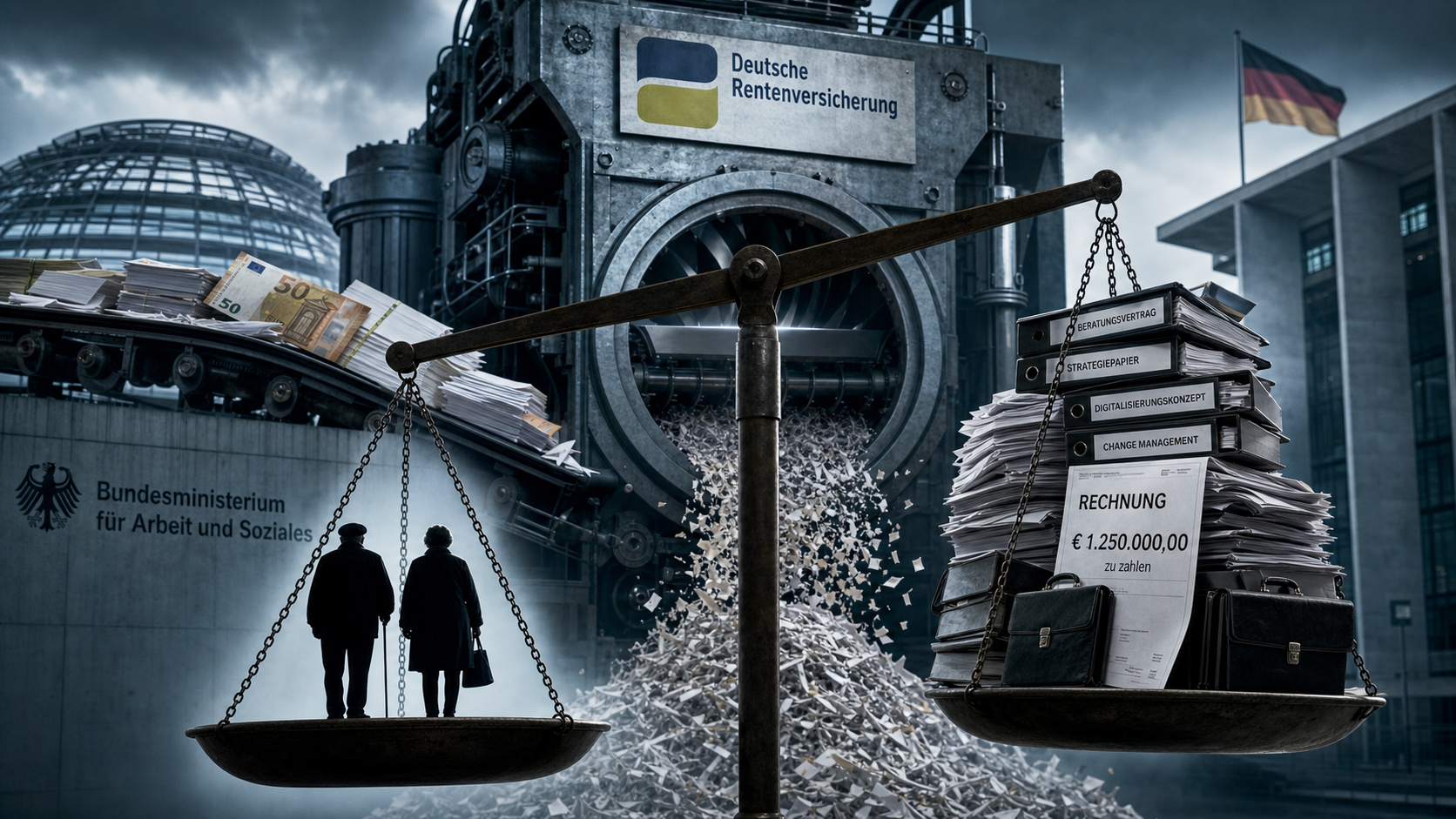
When experts hire external consultants despite having 25,000 employees: Why the pension insurance system is squandering millions – Image: Xpert.Digital
Bureaucratic madness at the German Federal Pension Insurance (DRV Bund): 20 million euros for external consultants without demonstrable benefit
Court of Auditors sounds the alarm: The 20 million euro scandal of the German Pension Insurance
Pension paradox worth billions: Staff unit grows by 1,800% – and consulting costs explode with it
With around 25,000 employees and an annual budget in the hundreds of billions, the German Federal Pension Insurance Fund (DRV Bund) should, in theory, possess more than enough in-house expertise. However, the reality is drastically different: year after year, tens of millions of euros flow into the pockets of external management consultants. A recent and explosive audit report by the Federal Court of Auditors from May 2026 now ruthlessly exposes how this mega-agency has become entangled in a web of questionable procurement practices, opaque accounting tricks, and exploding consulting costs.
Particularly striking: An internally established digital task force grew by an absurd 1,800 percent in size – yet instead of saving on external expenditures, consulting costs continued to skyrocket. While consulting firms often determine their own needs, the measurable benefit for taxpayers and pensioners is completely ignored. This is a systematic failure of the control architecture and a costly, multi-billion-euro paradox within public administration. Why does a government agency repeatedly buy into its own incompetence without ever truly addressing it? A deep dive into the latest auditors' report.
Why an agency with 25,000 specialists still cannot manage without external consultants – and who really benefits from this
The German Federal Pension Insurance Fund (DRV Bund) is not a small agency that needs to seek external help due to a lack of resources. With around 25,000 employees, a total annual budget of several hundred billion euros, and decades of institutional expertise in pension systems, social law, and administrative digitalization, it is one of the largest and most financially powerful social security institutions worldwide. Nevertheless, in recent years it has spent almost 20 million euros on external strategic consultants – for projects whose objectives, according to the Federal Court of Auditors, were often unclear, whose benefits were not demonstrable, and whose awarding of contracts was legally questionable. The Federal Court of Auditors published its latest audit report in May 2026 and soberly concludes: Expenditure on external consulting has not decreased following the criticisms from 2024 – it has continued to rise.
This finding is not merely disconcerting from an accounting perspective. It raises fundamental questions about the institutional logic of public administration, about incentive structures, control failures, and the strange phenomenon that an authority must repeatedly pay dearly to rectify its own incompetence – without ever truly succeeding.
An institution caught between self-governance and state mandate
To understand the structural problem, one must consider the legal and organizational nature of the German Federal Pension Insurance Fund. It is not a federal agency in the strict sense, but rather a self-governing public corporation. This means that it is subject to its own assembly of representatives, it manages contribution funds that are compulsorily paid to it by insured persons and employers, and it simultaneously operates under the legal supervision of the Federal Ministry of Labour and Social Affairs (BMAS) and the Federal Office for Social Security. This structure creates a characteristic gray area between public control and institutional autonomy.
In practice, this leads to a governance dilemma: On the one hand, the German Federal Pension Insurance Fund (DRV Bund) is bound by statutory duties and – as the Federal Court of Auditors explicitly emphasizes – may only perform those activities assigned to it by law. On the other hand, it has considerable leeway in organizing its internal processes, its IT infrastructure, and its strategic direction. It is precisely within this leeway that the most costly problems arise. For when a public corporation begins to see itself as a company with top management, a corporate culture, and its own transformation strategy, then the use of management consultants almost inevitably follows – with all the rituals and terminology that the consulting industry has cultivated for decades.
The Federal Court of Auditors pointedly commented on this in its report: The German Federal Pension Insurance Fund (DRV Bund) partly sees itself as a company with its own corporate strategy. However, this is not a statutory duty of a social insurance institution. In other words, the transformation from an administrative authority to a digitally savvy service provider is not only problematic from a budgetary perspective – it is fundamentally an overstepping of its institutional mandate.
The principal-agent dilemma in its purest bureaucratic form
Economists have known this fundamental problem for decades under the term "principal-agent problem": When a client (principal) entrusts a contractor (agent) with a task, conflicts of interest and information asymmetries arise. The agent knows more about their own work than the principal. They can exploit this information gap to pursue their own interests, which do not necessarily align with those of the client.
In the case of the German Federal Pension Insurance Fund (DRV Bund), several principal-agent relationships overlap in a disastrous way. The insured, as the true owners of the system, can hardly directly control the work of the agency. While legislators and supervisory authorities have formal oversight rights, they are dependent on the information provided by the DRV itself. Finally, external consultants have a genuine economic interest in generating, perpetuating, and expanding the need for consulting services. The Federal Court of Auditors has explicitly identified a particularly explosive aspect of this problem: in several cases, external consultants themselves determined the need for consulting services for which they were subsequently commissioned. Whoever diagnoses the hunger also brings the restaurant along.
This situation is not unique to the pension insurance system. For years, the Federal Court of Auditors has observed a similar pattern across the entire federal administration. From 2020 to 2023, the federal government's spending on external consulting increased by 39 percent to almost €240 million annually. In total, the federal government has spent more than €1.6 billion on external consulting services over the past ten years. The Budget Committee had already called for a substantial reduction in the use of consultants in 2020 – without any significant success. Experts estimate that the government spends a total of around €3 billion annually on management consultants, with the total volume roughly doubling within approximately eight years.
Why 25,000 experts still need external consultants
The obvious counter-question is: If the pension insurance system is one of the largest social security organizations in the world, why doesn't it have the internal knowledge it needs?
The German Federal Pension Insurance Fund's (DRV Bund) response is initially quite plausible: Digital transformation, demographic change, and numerous pension reforms have triggered profound changes requiring additional expertise. The 25,000 employees do not possess the necessary specialized knowledge in all areas. This is not an unreasonable objection. No company or public authority can maintain all conceivable skills within its own workforce.
The real problem, however, lies deeper. It's not about whether external consulting is ever justified – of course it can be. It's about whether the pension insurance system is even capable of assessing when and for what purpose external consulting is truly necessary. The Federal Court of Auditors doubts precisely this: it criticizes not only the level of expenditure, but also the complete absence of a systematic process for assessing needs. In almost all the cases examined, no specific objectives were defined. Concrete success criteria, measurable results, and evidence of the actual use of the consulting services were lacking.
The Court of Auditors already documented a particularly egregious example in its 2024 report: A consulting firm received €765,000 for producing a ten-page document consisting primarily of empty bullet points. When asked, the pension insurance provider was unable to explain why these rules of procedure were even necessary. In response to the Court of Auditors' question, the only explanation given was that it was a "process undergoing change." This is the kind of justification that would lead to immediate consequences in the private sector. Apparently, in a self-governing public corporation with guaranteed contribution-based funding, it suffices.
The paradox of the growing staff unit: More personnel, more advice
Perhaps the most absurd episode of the entire process concerns the development of the internal staff unit for digital strategy and digital transformation. When this unit was founded, it had three employees. One of its goals was to reduce dependence on external consultants in the medium term by building up in-house expertise. A sensible idea – in theory.
In practice, the number of employees in this staff unit rose to 57 – an increase of exactly 1,800 percent. One might expect that 57 specialists in digital strategy and transformation would significantly reduce the need for external consulting. Instead, spending on external consulting continued to rise in parallel. Every new internal project apparently generated new external consulting contracts, which in turn led to new internal projects – a self-reinforcing cycle of institutional spending expansion.
This phenomenon is known in public administration as "Parkinson's Law": work expands to fill the time available for its completion – and bureaucratic apparatuses tend to reproduce and grow themselves, regardless of their actual workload. In the specific case of the German Federal Pension Insurance Fund (DRV Bund), this mechanism led to a situation where a staff unit intended to reduce consulting costs effectively co-financed these costs while simultaneously massively expanding its own personnel budget.
Almost 20 million euros: The anatomy of the consulting budget
Looking at the specific figures documented by the Federal Court of Auditors for the audited period reveals a more nuanced picture of the allocation of funds.
Since 2019, the German Federal Pension Insurance Fund (DRV Bund) has paid a total of €8.6 million to three consulting firms for its digital strategy. A further €2.9 million was invested in establishing an internal office, and an additional €210,000 was spent on academic support. According to the report, €4.4 million was allocated to digital transformation and €3.2 million to project management. The DRV Bund states that the total value of strategic consulting contracts during the audited period amounts to almost €20 million – a sum that includes services for strategy development, transformation, and consulting for the board of directors and management.
The Court of Auditors is particularly critical of the allocation of funds to the Corporate Development unit. The pension insurance institution plans to spend an additional €4.7 million on external consulting services for the years 2025 to 2029. According to the Court of Auditors, the planning documents frequently use general terms such as "transformation," "further development," or the development of key performance indicators and dashboards as justification – formulations so unspecific that they could, in effect, justify any consulting contract. Concrete objectives and measurable results, on the other hand, are often not documented.
Another finding, whose significance is often underestimated, concerns the procurement practices themselves. The Court of Auditors already noted in its 2024 observations that multi-million-euro contracts were regularly awarded to the same consulting firms – sometimes even to consultants personally known to the clients. This is not only a budgetary issue, but also a substantive one: if the same firms are consistently commissioned, precisely that external, unbiased "outside perspective" is lost, which is supposed to constitute the real value of external consulting.
Accounting tricks: When consulting costs become IT expenses
Among the most explosive aspects of the Court of Auditors' report is a seemingly technical accounting trick that, at first glance, appears to be a technical procedure, but in its consequences raises significant transparency problems.
The Federal Court of Auditors has found that the German Federal Pension Insurance Fund (DRV Bund) is increasingly recording IT-related consulting costs as IT expenditures, rather than as consulting costs. This reclassification has a practical effect: it obscures whether consulting costs are actually decreasing or whether they are simply being reallocated to other budget lines. This makes it more difficult for external auditors and parliament to assess the actual extent of consulting engagement. The Court of Auditors is therefore demanding full transparency in all consulting contracts and regular random audits.
This practice is not an isolated case. At the federal level, the Court of Auditors has also criticized the outdated content, format, and procedures of consulting reports, stating that the data quality is inadequate. Effective parliamentary oversight, however, requires that parliament receives reliable and complete information about the use of external consultants. Where accounting creativity obscures the true costs, this fundamental requirement is not met.
Our EU and German expertise in business development, sales and marketing

Our EU and German expertise in business development, sales and marketing - Image: Xpert.Digital
Industry focus areas: B2B, digitalization (from AI to XR), mechanical engineering, logistics, renewable energies and industry
More information here:
A thematic hub offering insights and expertise:
- Knowledge platform covering global and regional economies, innovation and industry-specific trends
- A collection of analyses, insights, and background information from our key areas of focus
- A place for expertise and information on current developments in business and technology
- A hub for companies seeking information on markets, digitalization, and industry innovations
Cultural change just a show? How the pension insurance system continues to pay millions to consultants
The cultural change that isn't one: Institutional inertia
When the Federal Court of Auditors confronted the German Pension Insurance Association (DRV Bund) with blatant deficiencies in its 2024 report, the agency responded by announcing a cultural shift. New processes, training courses, and organizational reforms were intended to ensure a responsible approach to external consultants in the future. The Federal Ministry of Labor and Social Affairs and the Federal Office for Social Security supported this self-portrayal. Together, they saw the announced measures as the seeds of a fundamental change.
The Court of Auditors sees things differently. In its current audit, it notes that the announced measures have hardly been implemented so far and their effects are not yet apparent. The auditors even explicitly describe the introduced checklist for reviewing new consulting contracts as a potential token measure that lacks enforcement power without genuine controls. In its report, the Court of Auditors formulates a principle that it finds lacking in the pension insurance system and whose disregard it considers a systemic failure: avoid unnecessary expenditures instead of justifying them.
Why isn't the promised cultural shift taking effect? The answer lies in the structure of the incentive systems operating within the agency. Public administrators in Germany aren't paid to minimize consulting expenditures. There's no performance-based compensation tied to cost savings. There are no institutional career incentives that reward prudent budgeting. What does exist are incentives to avoid risk: If a project fails and the manager has previously brought in a consultant, the responsibility is distributed to the consultant. If they haven't brought in a consultant and the project still fails, they alone face the criticism. In this context, external consulting also functions as a hedging strategy for the individual manager—a finding that the Federal Court of Auditors doesn't explicitly state, but which aptly explains the observed patterns of behavior.
What the pension insurance could have done for that money
To grasp the scale of the wasted funds, it's worth looking at alternative uses. In 2024, the German Federal Pension Insurance Fund (DRV Bund) managed administrative and procedural costs amounting to approximately 1.3 percent of its total expenditures. In 2024, it even underspent its allocated budget of €2.4 billion by around €110 million – a fact the agency itself touts as evidence of sound financial management.
This self-portrayal stands in stark contrast to the consulting expenditures. Twenty million euros for external strategy consultants without any proven benefit – that's not a negligible item that disappears into a billion-euro budget. For comparison: The Federal Court of Auditors estimates the annual loss due to unregistered self-employed individuals subject to mandatory insurance at around 5,000 euros per unregistered person. Had the German Federal Pension Insurance Fund (DRV Bund) instead consistently fulfilled its actual duty – the complete registration of individuals subject to mandatory insurance – the lost revenue would have more than compensated for the consulting budget. But that's another aspect of the same institutional failure: The DRV has known for over 20 years that thousands of self-employed individuals are not paying pension contributions and has failed to rectify this situation.
The silence of the regulators: Who is actually controlling whom?
A key aspect that receives too little attention in the public debate concerns the role of the supervisory authorities. The German Federal Pension Insurance Fund (DRV Bund) is subject to the legal supervision of the Federal Ministry of Labor and Social Affairs (BMAS). The Federal Office for Social Security exercises technical supervision. Both authorities were involved in the proceedings – and supported the DRV Bund's self-portrayal by deeming the alleged cultural shift credible.
This raises an uncomfortable question: Did the supervisory authority fulfill its own duty of oversight? The Court of Auditors' answer is implicit, but unequivocal: Had the supervisory body acted consistently, a situation would not have arisen in which, four years after the initial complaints, no reliable results are available. The interplay between the self-governing body, the ministerial supervisor, and parliamentary oversight by the Bundestag's Audit Committee failed in this case. Each body passed the buck to the others.
The situation is further complicated by information asymmetry: The German Federal Pension Insurance Fund (DRV Bund) is the only institution with detailed knowledge of its own processes, contracts, and project results. The Federal Court of Auditors can review, determine, and criticize – but it cannot take direct action. The Bundestag's Audit Committee can issue recommendations – but it has no power to impose sanctions beyond political pressure. The Federal Ministry of Labor and Social Affairs (BMAS) can exercise legal oversight – but only as long as the DRV Bund does not exceed its legal framework. And, as we have seen, this framework is broad enough to allow considerable leeway for institutionally questionable behavior.
The global context: Public administration and the consulting business
The case of the German Pension Insurance is embedded in a global trend that requires systematic analysis. Worldwide, the market for consulting services in the public sector has grown to approximately US$73 billion and is projected to exceed US$110 billion by 2035 – with an average annual growth rate of nearly 4 percent. This trend reflects a structural shift: Public administrations are increasingly delegating strategic thinking, reform planning, and even core administrative management tasks to private consulting firms.
This phenomenon is particularly pronounced in Germany. As early as the 1990s and 2000s, experts diagnosed rapid growth in the consulting market for public sector clients, significantly outpacing the general market. At its peak, 40 to 50 of the approximately 1,000 McKinsey consultants in Germany were permanently employed in the public sector. The major global consulting firms – McKinsey, Roland Berger, Boston Consulting Group, PricewaterhouseCoopers, and Deloitte – systematically developed government clients as a growth market. And in Germany, there is hardly any structured counterweight: The attempt to create a state-owned alternative with "PD – Berater der öffentlichen Hand" (PD – Consultants to the Public Sector) achieved a turnover of up to €100 million, but barely scratched the surface of the overall market volume.
The authority's response pattern: a statement without substance
The German Federal Pension Insurance Fund's reaction to the audit results deserves separate consideration because it reveals a characteristic bureaucratic pattern. In its 32-page statement, the agency emphasizes that it uses contribution and tax revenue exclusively for statutory tasks. It points to profound challenges posed by digitalization, demographic change, and pension reforms. It lists successes: digital services, process improvements, shorter processing times for disability pensions, and national and international awards for digitalization projects.
The Federal Court of Auditors remains unconvinced – and specifies precisely why. The statement fails to provide concrete answers to many specific questions. It does not document the results achieved through the individual consulting engagements. It provides no verifiable evidence that the millions spent made a difference – better, cheaper, or faster – compared to what would have been worse, more expensive, or slower without external consultants. Four years after the initial complaints, the authority still cannot answer this fundamental question.
This is the real scandal: not the expenditures themselves, but the inability or unwillingness to demonstrate that these expenditures have generated any measurable benefit for insured persons and pensioners. If an institution with a legal monopoly, guaranteed contribution-based financing, and a budget in the billions can evade verifiable performance measurement for four years, then that is no accident – it is the result of a control structure that is simply not adequately designed for such cases.
What would need to change: A systemic diagnosis
A serious answer to this problem cannot simply be to hire fewer consultants. The causes lie deeper, and the solutions must address the underlying structural issues.
First and foremost, a fundamental change in procurement practices is required: Consulting contracts should only be awarded when there is a concrete, documented need, defined objectives, and measurable success criteria. This sounds obvious, but it is clearly not the case in current practice. The Federal Court of Auditors has already formulated "Key Points for the Economical Use of External Consultants" that describe precisely these requirements – and it has found that the German Federal Pension Insurance Fund (DRV Bund) is not complying with them in almost all of the cases it examined.
Secondly, a redesign of incentive structures would help. Administrative managers should receive rewards for successfully reducing external consulting expenditures – not only when projects fail and compensation claims loom. Performance reviews that explicitly reward prudent budgeting would be a first step.
Thirdly, more robust parliamentary oversight is needed. The current practice, in which the Federal Court of Auditors identifies deficiencies, issues recommendations, and then four years later finds that the same deficiencies persist without any effective consequences, reveals a fundamental weakness in oversight. A more binding sanctions framework is required here – for example, in the form of automatic budget freezes in cases of repeated procurement violations.
Ultimately, the German Federal Pension Insurance Fund (DRV Bund) should be required to provide an honest answer to the question of which competencies it intends to develop internally on a long-term basis and which it can permanently forgo. The paradoxical parallel development of massive internal staff expansion and simultaneously increasing consulting expenditures demonstrates that there is currently no clear strategy – or that the existing strategy is ineffective. An honest competency atlas that identifies gaps and outlines a realistic development path would be more valuable than any further external consulting services.
Related to this:

Why the answer to the title question is not a simple one
The initial question – why an institution that should be the experts itself still spends millions on external consultants – can now be answered more precisely.
The pension insurance system has experts. It has 25,000 of them. But that's not the problem. The problem is threefold: First, there's a lack of institutional incentives to actually utilize and further develop the existing expertise, instead of resorting to external consultants. Second, there's a lack of reliable control mechanisms to detect and prevent this avoidance in a timely manner. And third, the external consulting industry itself becomes a structural part of the problem because it actively contributes to creating a need for consulting services – through cultivating relationships, defining terms and reform agendas, and by conducting needs assessments for its own benefit.
The Federal Court of Auditors condensed this finding into a single sentence that serves as a programmatic diagnosis: Avoid unnecessary expenditures instead of justifying unnecessary expenditures. It is a sentence that sounds so banal that one would hardly consider it necessary – and that is precisely why it says so much about the state of the institution to which it had to be written.
Whether the promised cultural shift will ever materialize will only become clear in the coming years, according to the Court of Auditors. The experience of the last four years offers little cause for optimism. As long as the fundamental incentive and control structures remain unchanged, new consultants will arrive, new projects will emerge, new millions will flow – and the Court of Auditors will continue to sound the alarm, without anyone being obligated to listen seriously.
Related to this:





