

Eurosatory 2026: Europe's new reality is revealed at the world's largest arms fair
Xpert Pre-Release

Available in 27 languages 📢
Prefer Xpert.Digital on GoogleⓘPublished on: March 25, 2026 / Updated on: March 25, 2026 – Author: Konrad Wolfenstein
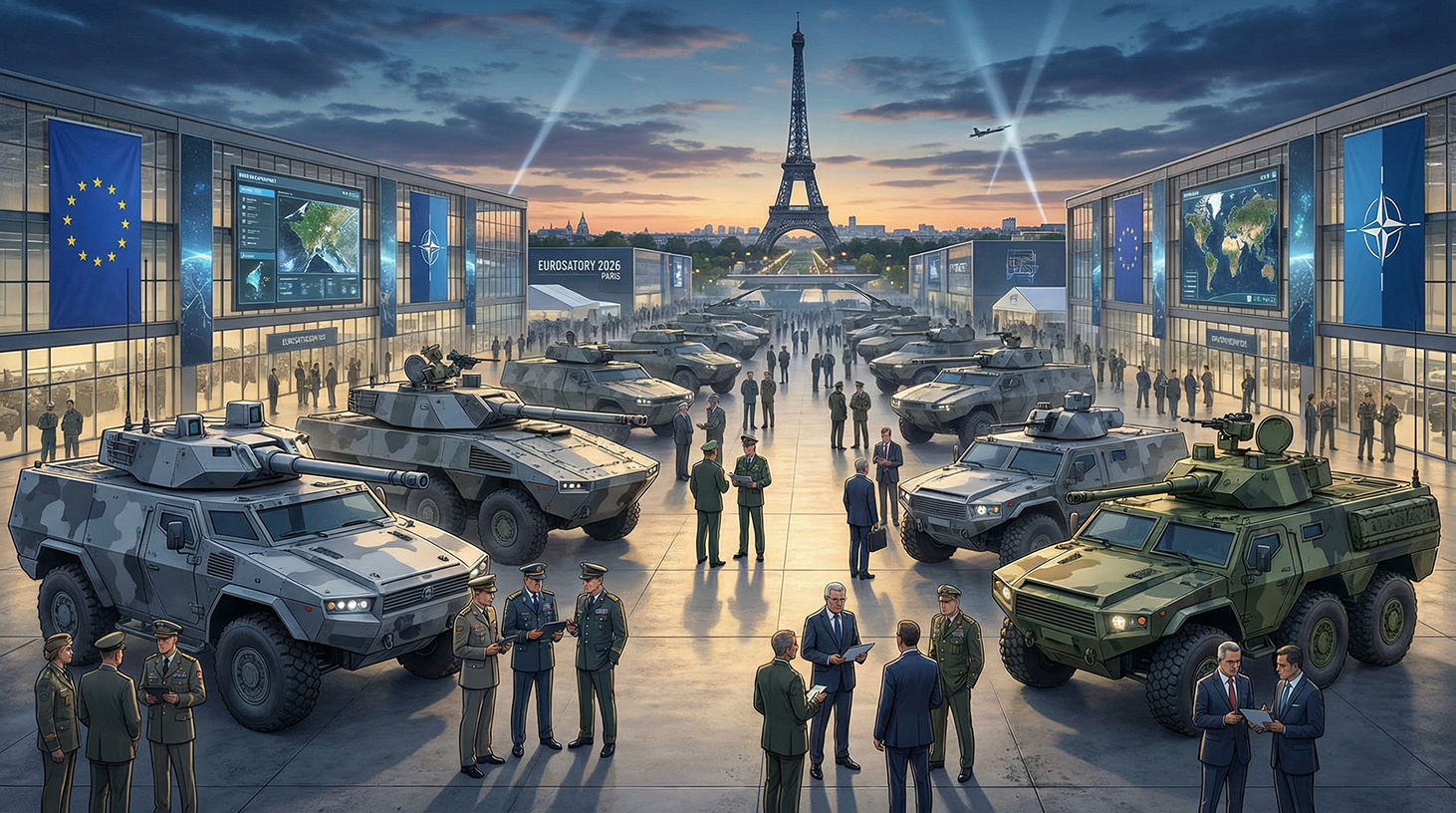
Eurosatory 2026: Europe's new reality is on display at the world's largest arms fair – Image: Xpert.Digital
The end of the illusion of peace: Europe's desperate and expensive path to becoming a new superpower
A turning point with a price tag: Why Europe is now pumping 800 billion euros into armaments
Five percent for the military: How the new world order is radically transforming Europe's economy
Europe's security policy naiveté is a thing of the past – and the awakening from decades of peace illusion comes at a historic price. When Eurosatory, the world's most important forum for land and air defense, opens its doors in Paris in June 2026, it will no longer be just about arms displays. It will be about the very survival of the European security architecture. Faced with global crises, enormous pressure from Washington, and an unprecedented need for investment amounting to hundreds of billions of euros, the continent is on the cusp of a massive paradigm shift. While the arms industry is booming and corporations like Rheinmetall are posting record profits, new technologies such as artificial intelligence and state-of-the-art drone systems are revolutionizing warfare. This profound transformation challenges not only politics but the entire economy: Europe must learn that peace and strategic autonomy are no longer a given, but require a gigantic financial and industrial effort.
Related to this:

When peace is no longer a given – and Europe finally understands what that costs
From exhibition to strategy: What Eurosatory really means
From June 15 to 19, 2026, the world's most important forum for land and air defense will open its doors in Paris. Eurosatory, held every two years at the Parc des Expositions de Paris Nord Villepinte, is more than just a trade fair. It is a seismograph, a strategic hub, and a mirror reflecting an era in which Europe is paying a high price for its security policy naiveté. More than 2,000 exhibitors from over 60 countries and more than 62,000 trade visitors from 150 nations—these figures describe not just an exhibition, but a global balance of power undergoing a historic shift.
The event, themed "Protect your future" in 2026, precisely reflects the zeitgeist of a world where concepts like deterrence, strategic autonomy, and military strength have suddenly returned to the forefront of political and economic debates. What was once considered a niche foreign policy issue has become a core question of European statehood: How does a continent defend its security, its values, and its economic stability in a geopolitically unstable world? Eurosatory 2026 offers more than just answers in the form of weapons systems and technology demonstrations—it is the place where these answers take on their industrial and strategic form.
Since its founding in 1967 on the Satory military grounds near Versailles, the trade fair has developed into the world's leading exhibition for defense technology. What once began with 30 exhibitors is now a 125,000-square-meter exhibition forum where government representatives, armed forces, corporations, and startups jointly discuss the future of security. This institutional continuity gives Eurosatory a significance that transcends individual exhibitions: it is the institutional memory and, at the same time, the driving force behind the development of an industry whose relevance, after decades of decline, has once again become undeniable.
The end of illusions: Three decades of misguided security policy investments
To understand what is being negotiated at Eurosatory 2026, one must reread Europe's recent history – through an economic lens that doesn't shy away from uncomfortable truths. After the end of the Cold War, Europe experienced what economists called the peace dividend: the dissolution of the East-West confrontation created fiscal leeway that was redirected into social spending, infrastructure, and the welfare state. Between 1987 and 1994, global military spending fell by more than 30 percent, and European states were particularly active in this process.
In Germany, defense spending as a share of gross domestic product fell from three to five percent during the Cold War decades to below 1.5 percent after the turn of the millennium. The Bundeswehr shrank from almost 500,000 personnel to well under 200,000. Barracks were closed, ammunition depots emptied, and arms production facilities shut down. Similar processes took place in France, Italy, Spain, and almost all other Western European countries. The logic behind it seemed compelling: Germany was "surrounded only by friends," as then-Foreign Minister Klaus Kinkel put it.
This era did not end with a single event, but with a growing realization. Russia's annexation of Crimea in 2014 was an initial warning shot, heard but largely ignored. The complete invasion of Ukraine in February 2022 was then the final proof that the peace dividend was based on a mistake. Europe had spent three decades dismantling its defense capabilities and now faced the consequences: empty arsenals, underfunded armed forces, fragmented industrial capacity, and a frightening dependence on the United States. More than 60 percent of European states' weapons systems came from non-EU countries, with the US alone supplying over 64 percent. This dependence was not an economic inconvenience, but a strategic vulnerability of systemic importance.
A turning point with a price tag: The cost of waking up
The term "turning point," coined by Chancellor Olaf Scholz in February 2022, sounds politically and morally significant. But above all, it carries a price tag. And this price tag is exceptionally high. The so-called Draghi Report, commissioned by the European Commission in 2024, estimated the European investment needs in the defense sector at around 500 billion euros – for improved air defense, precision-guided weapons, ammunition depots, and cyber defense. Other analyses arrive at even higher figures.
The reactions of the European institutions followed swiftly, though not always coherently. In March 2025, European Commission President Ursula von der Leyen presented the so-called "ReArm Europe" plan, which aims to mobilize around €800 billion within four years for the development and modernization of European defense. The core of this plan consists of a fiscal readjustment: By activating the escape clause in the Stability and Growth Pact, EU member states can take on substantial debt without triggering an excessive deficit procedure. In the long term, at least 1.5 percent of GDP is to be allocated to the defense sector, which would mean up to €650 billion in additional funding over four years.
This fiscal framework is complemented by two specific instruments: the European Defence Industry Programme (EDIP) with an initial budget of €1.5 billion, and the SAFE (Security Action for Europe) instrument, which provides loans of up to €150 billion for joint defense procurement. EDIP aims to structurally strengthen the European defense industry, stabilize supply chains, and increase the share of European components in defence systems to at least 65 percent. SAFE, in turn, creates incentives for coordinated procurement projects involving at least two EU Member States and covers areas that will be a focus at Eurosatory 2026: munitions, drones, drone defense, cybersecurity, AI-powered weapons systems, and space capabilities.
The European Parliament adopted EDIP in March 2026 with 457 votes – a clear signal that the democratically legitimized European institution also recognizes the necessity of this structural transformation. Nevertheless, the gap between ambition and reality remains considerable: the EDIP budget of €1.5 billion is widely considered by experts to be completely inadequate. The disparity between the security policy objectives for 2030 and the allocated funds is a persistent challenge that will be openly debated at Eurosatory.
The new NATO paradigm: Five percent as a political challenge
At the NATO summit in The Hague in June 2025, the 32 member states adopted a resolution whose implications can hardly be overstated: By 2035, all member states are to spend five percent of their gross domestic product on defense – 3.5 percent for direct defense expenditures and 1.5 percent for defense-related infrastructure, industry, and resilience. As recently as the end of 2024, hardly any of the major European countries had consistently met the two percent target. Now, a goal is on the table that amounts to an economic revolution for most EU states.
In 2025, for the first time, all NATO members – with the exception of Iceland, which has a Vatican-like structure and no armed forces of its own – met the two percent target for defense spending. Germany spent approximately €91 billion on defense in 2025, ranking fourth worldwide behind the USA (€781 billion), China (€450.6 billion), and Russia (€444 billion). Defense spending in Germany is projected at €108.2 billion for 2026, financed through the regular defense budget and the special Bundeswehr fund. Spending is expected to increase to around €152 billion by 2029 – a tripling compared to 2023 and a paradigm shift that was institutionally secured through an amendment to the Basic Law (Germany's constitution), exempting defense spending above one percent of GDP from the restrictions of the debt brake.
At the European level, the outlook is even more spectacular. A McKinsey study from 2025 concluded that European NATO states could increase their total defense spending by €300 billion to more than €800 billion per year by 2030. By 2028, Europe could be investing more in military armaments than the US currently spends. This development not only alters the balance of security policy but also fundamentally changes the structure of the global defense industry. The International Institute for Strategic Studies (IISS) found that by 2025 alone, Europe's share of global defense spending had risen from 17 to 21 percent – a shift that transforms the continent from a recipient of defense aid to a potential defense anchor.
The industrial reality: Who profits, who invests, who expands
Abstract figures take on a human face at Eurosatory. Here, companies that are profiting from the European arms race exhibit – and their figures are impressive. Rheinmetall, the Düsseldorf-based defense company long considered a classic automotive supplier, has become a symbol of European defense reindustrialization. In fiscal year 2025, group sales rose by 29 percent to €9.935 billion, while operating profit climbed to a record €1.841 billion with an operating margin of 18.5 percent. The order backlog reached a historic high of €63.8 billion at the end of 2025 – more than six times annual sales – securing Rheinmetall a production perspective well beyond 2030.
For 2026, the company is planning for sales of up to €14 billion. Rheinmetall CEO Armin Papperger summed up the situation succinctly: an era of rearmament in Europe has begun. The company is massively expanding its workforce – from 32,000 to a target of 40,000 employees – and is even considering producing tanks in a former Volkswagen plant. In the munitions division alone, a chronically underfunded area of European defense, the order backlog amounts to €21.6 billion.
The British company BAE Systems generated approximately €16.76 billion in revenue in the first half of 2025 – an increase of 11 percent compared to the same period of the previous year – and boasts an order backlog of £75.4 billion. The Swedish company Saab secured significant contracts, including GlobalEye early warning aircraft for France and A26 submarines for Poland, and projected revenue growth of up to 24 percent for 2025. That the European defense industry is being discovered not only by government contracts but also by venture capital is demonstrated by another indicator: in 2024, over US$1 billion flowed into European defense tech startups – more than five times the amount invested four years earlier.
At Eurosatory, Rheinmetall is presenting, among other things, the digital platform "Battlesuite," which aims to improve military combat operations through networked system integration and better coordination of forces. The company is also planning to build a munitions factory in Ukraine – a symbol of the European defense industry's expansion far beyond actual manufacturing and its redesign of supply chains.
Hub for Security and Defense - Advice and Information

Hub for Security and Defense - Image: Xpert.Digital
The Security and Defence Hub offers expert advice and up-to-date information to effectively support companies and organizations in strengthening their role in European security and defence policy. Working closely with the SME Connect Defence Working Group, it particularly promotes small and medium-sized enterprises (SMEs) that wish to further develop their innovative capacity and competitiveness in the defence sector. As a central point of contact, the Hub thus creates a crucial bridge between SMEs and European defence strategy.
Related to this:
Multi-Domain Superiority: The technologies shaping tomorrow's warfare
Technological priorities: What really matters at Eurosatory 2026
Eurosatory 2026 sets thematic priorities that precisely reflect the technological fault lines of modern warfare. The motto "Multi-Domain Superiority" summarizes what it's all about: no longer just ground superiority, but simultaneous control of land combat, airspace, cyberspace, outer space, and the electromagnetic spectrum.
Artificial intelligence is at the forefront of this development. At Eurosatory, AI systems will be presented that improve real-time reconnaissance, accelerate decision-making processes, and increase the precision of strikes against strategic targets. AI enables not only better accuracy but also a new form of situational awareness: By fusing data from satellites, ground sensors, drones, and human reconnaissance, a shared, near real-time updated situational picture is created for all participants in an operation. The integration of AI into command-and-control systems thus fundamentally changes the structure of military decision-making.
Drones and counter-drone systems have received an enormous boost in development as a result of the war in Ukraine and dominate the technological agenda of Eurosatory 2026. The war in Ukraine has demonstrated that cost-effective, mass-produced unmanned systems have fundamentally changed ground warfare tactics. The trade fair will showcase both offensive drone systems and defensive solutions – a balance that reflects the military reality of the 21st century. Hybrid threats, drone attacks, and cyber operations have become daily risks that demand new system architectures.
Space as an operational domain is gaining wider attention for the first time at Eurosatory 2026. Satellite communication, geolocation, GPS synchronization, and the monitoring of sensitive areas are integral components of modern armed forces organization. For Eurosatory, this represents a conceptual expansion: the traditional land and air trade fair is increasingly opening itself up to issues of defense infrastructure that extend beyond the physical battlefield. The next generation of armored vehicles—faster, more resilient, hybrid-powered, and equipped with active protection systems—forms the core of the exhibition, while peripheral technologies are increasingly defining the character of the overall event.
Related to this:
The dual nature of economics: risk and opportunity simultaneously
The question of whether massive defense spending is good or bad for the economy has no simple answer. Economic literature and current studies present a nuanced picture. In 2025, the Kiel Institute for the World Economy (IfW) concluded that higher defense spending could increase GDP by 0.9 to 1.5 percent annually, provided EU member states raised their military expenditures from two to 3.5 percent of GDP and primarily switched to domestically produced high-tech weapons. This study thus refutes the widespread assumption that more armaments automatically mean less prosperity – the classic "guns vs. butter" dilemma is more complex in modern economies than previously thought.
The financing structure is crucial: If defense spending is financed from the outset through tax increases, growth may be lower or even negative. If, on the other hand, it is financed through debt – which corresponds to the current European approach – significant short-term demand impulses will be generated in industry. The McKinsey study from 2025 indicates that the additional European defense spending of €165 billion annually alone could create up to 1.2 million new jobs in Europe. A recent study by EY and DekaBank puts the annual European spending requirement to achieve NATO targets by 2035 at around €770 billion.
The flip side of this calculation lies in the opportunity costs and the challenges of implementation. Europe is losing one million workers annually due to demographic change, and defense companies are competing with civilian industries for limited skilled labor. Rheinmetall itself points to this bottleneck: To grow from 32,000 to 40,000 employees, the company needs a pool of qualified engineers, mechatronics technicians, and IT specialists, which faces intense competition in Germany. Furthermore, rising yields on European government bonds indicate that capital markets are already pricing in growing national debt – a warning signal for finance ministers who simultaneously need to free up budgetary space for defense, infrastructure, and social services.
Another area of economic risk lies in the question of industrial capacity. After decades of downsizing, the European arms industry was unable to immediately meet the sudden surge in demand. Munitions production, in particular, revealed glaring bottlenecks: long delivery times, scarce raw materials, and a lack of production lines have highlighted the gap between political promises and actual delivery capabilities. Ramping up production capacity takes time and capital – Rheinmetall experienced this firsthand: in the first half of 2025, despite record sales, the company reported a negative cash flow because short-term investments in capacity expansion and inventories exceeded cash inflows.
The transatlantic question: dependence, decoupling and realignment
No issue dominates the strategic agenda of Eurosatory 2026 more than the question of the future of the transatlantic security architecture. Under the second Trump administration, the US has pursued a foreign policy that poses questions to Europe that were thought to have been answered since the end of World War II. The US National Security Strategy of 2025 has addressed its former European allies in a manner that can be understood less as a partnership and more as a form of pressure. Trump is demanding defense spending of five percent of GDP—a target that even the US cannot meet—while simultaneously sending signals that are shaking Europe's confidence in Washington's reliable support.
The suspension of US military aid to Ukraine was a turning point that significantly accelerated the urgency of the "ReArm Europe" plan. The message was unequivocal: Europe cannot permanently rely on American security guarantees without building its own capabilities. This has consequences for the structure of European arms procurement, which became particularly evident at Eurosatory. Since 2025, European institutions have been systematically trying to reduce the procurement of arms from American suppliers and to favor European producers. Resistance from Washington is considerable: The US Deputy Secretary of State publicly criticized Brussels' "Buy European" policy.
The SAFE regulation reflects this conflict: The original plan was to effectively exclude US defense companies from participation, which led to tensions with Washington. The agreement now stipulates that up to 35 percent of the value of procured defense equipment can come from manufacturers outside the EU and Ukraine – a compromise that illustrates the political sensitivity of this issue. Furthermore, the fact that Germany was the only major economy not to initially issue a declaration of intent to participate in SAFE demonstrates that, despite all the progress, European unity on defense issues continues to follow an institutional logic that strongly prioritizes national self-interest.
EDIP, SAFE, ReArm: Three instruments, one goal – and its pitfalls
The architecture of the European defense strategy is complex and multifaceted. EDIP, SAFE, and ReArm Europe are not alternative approaches, but rather complementary instruments within an overarching plan summarized under the term "Readiness 2030." This term embodies the ambition to bring Europe to a state of defense readiness by 2030 that meets the quantitative and qualitative requirements of a changing security landscape.
EDIP focuses on the supply and industry side: It creates incentives for joint defense projects where at least 65 percent of the components originate in Europe, promotes supply chain transformation through the FAST instrument with at least €150 million, and supports Ukraine with €300 million to modernize its own defense industry. SAFE, on the other hand, operates on the demand side: It provides low-interest loans with maturities of up to 45 years to support member states in the joint procurement of priority goods – munitions, drones, air defense, cyber defense, and AI systems. By the deadline at the end of November 2025, 19 member states had already submitted national investment plans.
The critical economic question remains that of the overall volume. Europe's defense industry needs planning certainty and economies of scale to become competitive. Short-term and undersized programs like the €1.5 billion EDIP send signals, but they don't provide a structural foundation. The 2030 targets—at least 50 percent European procurement, and even 60 percent by 2035—require investments in the hundreds of billions, which cannot be achieved solely through EDIP and SAFE. This is the real challenge of European defense financing: not setting targets, but consistently providing the resources to make those targets a reality.
The question of joint European procurement also reveals structural problems that extend far beyond financing. National industrial policies, differing procurement standards, technical incompatibilities, and politically motivated preferences for national champions have hampered European defense integration for decades. The fact that the SAFE instrument requires joint projects involving at least two member states is an institutional step in the right direction – but it does not resolve the deeper obstacles to cooperation that are repeatedly addressed in conferences and background discussions at Eurosatory.
Armaments, resilience, and the strategic thinking of the future
Eurosatory 2026 is taking place at a time when the strategic depth of the European defense debate is greater than it has been in decades. The trade fair is no longer just a showcase for weapons and vehicles, but an intellectual forum for the question of what security architecture Europe needs in the third decade of the 21st century. This is about more than military hardware – it's about resilience in the broadest sense: the resilience of critical infrastructure against cyberattacks, independence from unstable supply chains, and the ability to mobilize quickly in a crisis.
The concept of "Defence Readiness" therefore includes areas that were long considered non-military: energy supply, digital infrastructure, transport networks, and industrial capacities. The SAFE Regulation explicitly names the protection of critical infrastructure, cybersecurity, military mobility, and space capabilities as eligible investment areas – an expression of the expanded concept of security, which considers the entire economic substance of a state as relevant to security.
In this context, Eurosatory 2026 offers a unique platform. Over 100 conferences, more than 300 speakers, and numerous bilateral discussions between governments, armed forces, and industry make the trade fair a place where political signals are translated into industrial decisions and vice versa. New procurement programs are initiated, technological collaborations are launched, and partnerships are forged that will shape the security landscape of Europe in the coming years. Eurosatory is therefore not a reflection of a finished strategy, but rather the site of its ongoing development.
What Eurosatory 2026 reveals about Europe's path
Eurosatory 2026 is a barometer for a continent in transition. Europe is undergoing a fundamental shift in its understanding of security policy, its industrial capacities, and its fiscal priorities. Three decades of demilitarization cannot be reversed in three years – that would be a dangerous illusion. But the direction is clear, and the instruments are in place.
What will be crucial after 2026 is the consistency of political decision-making. The Hague decisions, the ReArm Europe initiative, the SAFE and EDIP programs – all these are important first steps. But between political decision and industrial reality lies a long and arduous road, requiring capacity building, skilled workers training, supply chains securing, and persistent allocation of funding. European defense companies are ready, as the figures from Rheinmetall, BAE Systems, and Saab demonstrate. The political structures are emerging. And Eurosatory 2026 is where this transition will take its most visible form.
The overarching question is not purely military. It is economic, political, and social: Is Europe prepared to permanently invest more in its own security – not just in budgetary resources, but also in industrial priorities, in a willingness to engage in technological cooperation across national borders, and in the understanding that security is not a given, but a societal investment? The answer will not be found solely at Eurosatory. But it will be revealed there in all its industrial, technological, and strategic complexity – and that is what makes this trade fair one of the most significant economic and political events of 2026.
Consulting - Planning - Implementation

Markus Becker
I would be happy to serve as your personal advisor.
Head of Business Development
Chairman SME Connect Defense Working Group
Consulting - Planning - Implementation
Konrad Wolfenstein
I would be happy to serve as your personal advisor.
contact me at wolfenstein ∂ xpert.digital
Just call me on +49 7348 4088 965 (Munich) .





