
China's Silk Road vs. Europe's Global Gateway: The hidden battle for our supply chains – Image: Xpert.Digital
Europe's forgotten land bridge: What the Balkans have to do with the new Silk Road
Booming thanks to Russia sanctions: Why everyone is now betting on the "Middle Corridor"
Global supply chains are being reorganized at breathtaking speed. Triggered by Russia's war of aggression against Ukraine, geopolitical tensions, and the pursuit of strategic independence, the world's economic powers are searching for new ways to connect Asia and Europe. In this global game of chess for the logistics of the future, two infrastructure projects are coming into focus that could hardly be more different: On the one hand, the Trans-Caspian International Transport Route (TITR) – also known as the Central Corridor – which is currently experiencing unprecedented growth and attracting billions in investment. On the other hand, the Pan-European Corridor VIII, a Balkan project conceived 30 years ago, remains an unfinished piece of the puzzle of European integration.
At first glance, the booming Silk Road and the faltering European infrastructure in the Western Balkans seem to have nothing to do with each other. But appearances are deceiving. Both routes are inextricably linked geographically, economically, and politically. They are the crucial axes of a new Eurasian architecture that will determine how independent Europe can truly be in the future. This comprehensive analysis shows why the fate of the European corridor cannot be understood without considering the Asian boom, who really benefits in this multi-billion-dollar race, and why the Black Sea is becoming the most important hub of the 21st century.
Related to this:


Europe's forgotten land bridge and the new Silk Road of the 21st century
Europe is building corridors – but who actually reaches their destination?
Thirty years after its conceptual birth at the Second Pan-European Transport Conference in Crete, Greece, Pan-European Corridor VIII remains unfinished. At the same time, freight volume on the Trans-Caspian International Transport Route (TITR), better known as the Central Corridor, is exploding: within seven years, transport volume on this route has increased fivefold, from 0.8 million tons to 4.5 million tons annually. Two infrastructure projects that at first glance appear unrelated are in fact closely linked – geographically, strategically, and economically. This analysis sheds light on why the fate of one corridor cannot be explained without understanding the other, what geopolitical forces are at play, and what is at stake.
The foundation: Historical context of both routes
Corridor VIII – a Balkan dream from 1994
At the 1994 Crete Conference, European transport ministers defined ten pan-European transport corridors intended to transform the continent into a coherent network. Corridor VIII was conceived as the only multimodal east-west axis between the Black Sea and the Adriatic: from the Bulgarian Black Sea ports of Varna and Burgas, via Sofia and Skopje, to Tirana and the Albanian Adriatic port of Durrës, with ferry connections to Bari and Brindisi in southern Italy. The total route is approximately 1,500 kilometers long and spans three national territories as well as one of the most economically underdeveloped regions in Europe.
The idea was brilliantly simple: Albania, North Macedonia, and Bulgaria should be integrated through a continuous rail and road connection, diversifying access to the Black Sea for Western Europe and reducing dependence on the Bosporus strait route controlled by Turkey. What sounded simple would prove to be a Sisyphean task over three decades.
The Silk Road is returning – as a logistics corridor
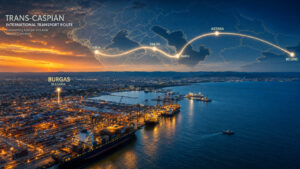
The Trans-Caspian International Transport Route didn't have a single origin. It gradually emerged from an agreement between the national railway companies of Kazakhstan, Azerbaijan, and Georgia in 2013, was institutionalized in 2017 with the founding of the international association of the same name, and experienced dramatic acceleration after the Russian attack on Ukraine in February 2022. The route runs from Central China and Southeast Asia through Kazakhstan, crosses the Caspian Sea by ferry to Azerbaijan, continues through Georgia to the Turkish border, and from there either directly into the EU via Turkey or via Georgia's Black Sea ports of Poti and Batumi to Romania and Bulgaria. With approximately 4,250 kilometers of rail and 500 kilometers of sea route, it is geographically the shortest land connection between Western China and Europe.
The structural problem: Why Corridor VIII got stuck
Lack of tracks, lack of resources, lack of will
The most critical bottleneck in the entire corridor lies at the border between Bulgaria and North Macedonia. To this day, a continuous rail connection is lacking on both sides. Although the 31-kilometer Kumanovo–Beljakovce section in North Macedonia was officially opened in January 2025, this is only the first phase of a multi-phase development. The next phase is intended to connect Beljakovce with Kriva Palanka, and only after that will the cross-border connection to Bulgaria follow – including the technically challenging Deve Bair Tunnel, whose construction is scheduled to begin no earlier than 2026 and be completed by 2030.
On the Albanian side, the port of Durrës represents another critical point. It is currently not connected to the rail network, which fundamentally contradicts modern port logistics. While the European Investment Bank has provided a financing package of €90.5 million for the modernization of the Durrës–Rrogozhina section, this 34-kilometer stretch is only a small piece of a vast, still incomplete infrastructure puzzle.
The railway network in the Western Balkans has seen little development since the Balkan wars of the 1990s. Less than half of the lines are electrified, and average travel speeds are far below European standards. The structural investment backlog spans decades, and the underfunded state budgets of the neighboring countries are incapable of resolving it on their own.
The political dimensions of the infrastructure crisis
Anyone who believes that Corridor VIII is a purely technical or financial problem underestimates its political dimension. The corridor crosses historically conflict-ridden territories, touches upon sensitive sovereignty issues, and is an arena for external influence. Observers like the Bulgarian filmmaker Boris Despodov described early on how the corridor has become a pawn in the power struggle between major powers. The statement by an anonymous analyst that Russia has no interest in its completion because a fully operational Corridor VIII would reduce Western Europe's dependence on the Bosporus and Dardanelles—which Turkey controls—is difficult to substantiate, but strategically plausible.
Added to this are the protracted integration processes of the neighboring countries with the EU. North Macedonia was blocked for years by a Bulgarian veto, which used historical minority issues as leverage. Albania began accession negotiations in 2022 and aims for a conclusion by 2027, but as recently as 2025 the European Parliament called for improvements in the rule of law and the fight against corruption. As long as the political integration of the neighboring states remains stalled, the institutional framework necessary for smooth transnational infrastructure development is also lacking.
Related to this:


The Trans-Caspian Route: Ascent from the Shadow of the North
How Russia's war revolutionized a trade route
The disruption was brutal and abrupt. With Russia's invasion of Ukraine in February 2022, the transit route through Russia and Belarus, known as the Northern Corridor, became virtually impassable for Western logistics companies. EU sanctions, bans on Russian carriers operating within the EU, skyrocketing insurance costs, and the constant threat of reputational damage led to a 40 percent decline in China-EU shipments via the Northern Corridor. Companies like Maersk, CMA CGM, and DHL began evaluating alternatives—and discovered the Central Corridor.
The growth of the TITR since 2022 is remarkable: in 2024, transport volume increased by 62 percent to 4.5 million tons, with container traffic exploding by 170 percent to 56,500 TEU. Growth was particularly significant in transport to China and Europe: 35,600 TEU were moved, 27 times more than the previous year. Compared to seven years ago, this represents a fivefold increase in total volume. The Iran-Iraq War, which destabilized the Strait of Hormuz from the beginning of 2026, gave the Middle Corridor an additional boost and even put pressure on the alternative sea route via the Suez Canal.
The Baku-Tbilisi-Kars railway as key infrastructure
The centerpiece of the TITR in its western section is the Baku-Tbilisi-Kars Railway (BTK), which connects Azerbaijan with Georgia and Turkey. It was commissioned in 2017 and, following extensive modernization work between May 2023 and May 2024, officially entered full operation in June 2026. The increase in capacity is dramatic: from an initial 1 million tons of freight capacity per year to 5 million tons. The 826-kilometer line is a critical link connecting Central Asian rail networks with Turkish and European rail infrastructure.
On the Kazakh side, the World Bank approved an $846 million IBRD guarantee in February 2026 to mobilize $1.41 billion in private long-term financing for a rail infrastructure project along the Kazakh section of the TITR. The project involves constructing a new 322.3-kilometer (200-mile) rail line between Mointy and Kyzylzhar, eliminating a significant detour in the network, reducing the route length by 149 kilometers (80 miles), alleviating congestion, and enabling the operation of double-stack container trains for the first time. By 2030, this is expected to triple freight volume and halve end-to-end transit time.
Related to this:
Bottlenecks and structural weaknesses of both routes
The Caspian Sea as a logistical bottleneck
Despite impressive growth figures, the Trans-Caspian Route has an Achilles' heel: the ferry crossing of the Caspian Sea. There are no fixed schedules between the Kazakh ports of Aktau and Quryq and the Azerbaijani port of Baku – the ferries depart when they are full. The Caspian fleet consists mainly of Soviet-built vessels from the 1980s, although Azerbaijan has put new RoPax ferries into service in recent years. As recently as 2022, the maximum weekly capacity of the Caspian ferry fleet was limited to around 3,000 TEU, which is far from sufficient to replicate the volumes of the Trans-Siberian Northern Route network.
The EBRD and the EU are therefore investing heavily in port expansion. A financing package of up to €45 million for the expansion of the port of Aktau is intended to double its container handling capacity. By the end of 2026, Aktau is slated to become the largest container terminal in the Caspian region, capable of handling up to 240,000 TEU annually. Kazakhstan also plans a massive expansion of its ports and has announced an order for six new ferries this year. The TITR currently has a total capacity of 6 million tons, which is to be increased to 10 million tons by 2027.
Heterogeneous standards and bureaucratic obstacles
Both corridors suffer from a fundamental structural problem: they cross numerous national borders with differing legal systems, track gauges, customs formalities, and fee structures. The Central Corridor touches the legal systems of China, Kazakhstan, Azerbaijan, Georgia, Turkey, and at least one EU member state – each of these crossings introduces friction. A uniform transport cost tariff for the entire TITR route has yet to be implemented. High port and rail charges, as well as complex border clearances, are considered significant competitive disadvantages compared to the sea route and the historic Northern Corridor.
The same applies, albeit on a smaller scale, to Corridor VIII. Between Bulgaria and North Macedonia alone, not only are physical tracks lacking, but also interoperable systems for cross-border train protection and track access charges. The differing electrification standards and signaling systems frequently necessitate locomotive changes at borders, increasing both time and costs. In April 2026, the German Eastern Business Association explicitly emphasized that the lack of connections in the hinterland of the ports and bureaucratic border crossing procedures undermine the competitiveness of the entire Black Sea region as a transit corridor.
The geopolitical dimension: Who benefits, who loses?
Europe and the diversification strategy
From a European perspective, both corridors serve the same overarching logic: the diversification of trade and transport routes away from geopolitically exposed routes. Dependence on the Bosporus and Dardanelles – straits that the Montreux Treaty grants Turkey as instruments of power – represents a latent risk for European strategists. Corridor VIII would offer a direct alternative by connecting the Black Sea access points of Varna and Burgas with the Adriatic Sea without touching Turkish territory. However, this advantage will only be fully realized once the railway line is fully operational – which is not currently the case.
The TITR, in turn, plays a key role in the EU's Global Gateway Initiative, the European counterpart to China's Belt and Road Initiative. In 2024, the EU and its partners pledged around €10 billion for sustainable transport infrastructure in Central Asia, an amount that was reaffirmed and expanded at the first EU-Central Asia Summit in Samarkand in April 2025. The World Bank estimates the total investment requirement for the Central Corridor at around US$28 billion over the next 15 years, of which US$25 billion is for rail infrastructure alone.
China's double game between the corridors
China is a complementary actor whose interests complicate the entire analysis. Beijing has traditionally favored and heavily subsidized the northern Trans-Siberian Corridor. The highly subsidized China Railway Express trains on the Northern Corridor still transported 1.46 million TEU per week in 2021 – a volume that the Central Corridor cannot even come close to reaching in the short term, even in its most optimistic projections. Nevertheless, China is diversifying its route strategy: the TITR is an integral part of the Belt and Road Initiative, and Beijing is investing both in the Anaklia port on the Black Sea in Georgia (a Chinese consortium was awarded the contract) and in the China-Kyrgyzstan-Uzbekistan Railway, which will create a new feeder route to the Central Corridor.
This presents Europe with a dilemma: On the one hand, a diversified trade route is a strategic advantage. On the other hand, a stronger Chinese presence along the TITR infrastructure potentially allows Beijing greater influence over European supply chains. The analytical service chinaobservers.eu identified this tension as a strategic challenge for Europe as early as the end of 2025.
Kazakhstan, Azerbaijan and Georgia as new middlemen
The biggest economic winners of the TITR boom are the transit states at the heart of the corridor. Kazakhstan is positioning itself as a central logistics hub for Eurasia. KTZ, the Kazakh state railway operator, plans to invest $10 billion in infrastructure by 2030. This year alone, Kazakhstan is extending 900 kilometers of new railway lines and ordering six new Caspian Sea cargo ships. Azerbaijan has significantly strengthened its transit role through the BTK corridor, and Georgia—a transit country between the Caspian and Black Seas—recorded a 72 percent increase in Uzbek freight volume at the Georgian port of Poti alone in July 2023 compared to 2021. Doshken Satpaev of the Kazakh Risk Assessment Group aptly summarized the sentiment: While Russia and the Middle East suffered from instability, the Central Corridor had demonstrated its stability—and that was its real competitive advantage.
Russia's strategic defeat
For Russia, both corridors represent a strategic threat. The TITR boom directly means that transit volumes and fees that previously flowed through Russian territory are being permanently diverted to alternative routes. Estimates suggest that the Northern Corridor's volume has fallen to less than 50 percent of its pre-war level since 2022. Russia has responded by attempting to expand the North-South Transport Corridor (INSTC) through Iran to India—a parallel corridor seen by experts as Moscow's geopolitical answer to its increasing isolation in Eurasian transit. However, the Iran-Iraq War and the control of the Strait of Hormuz by rival powers have also severely impacted this alternative recently.
Our EU and German expertise in business development, sales and marketing


Our EU and German expertise in business development, sales and marketing - Image: Xpert.Digital
Industry focus areas: B2B, digitalization (from AI to XR), mechanical engineering, logistics, renewable energies and industry
More information here:
A thematic hub offering insights and expertise:
- Knowledge platform covering global and regional economies, innovation and industry-specific trends
- A collection of analyses, insights, and background information from our key areas of focus
- A place for expertise and information on current developments in business and technology
- A hub for companies seeking information on markets, digitalization, and industry innovations
Corridor VIII vs. Central Corridor: Who will win the race for speed and influence?
The economic arithmetic: What both corridors can really achieve
Transit and time comparison of routes
The competitiveness of a transport route is measured by three key parameters: transport time, cost, and reliability. A direct comparison of the three relevant routes clearly illustrates their relative strengths and weaknesses. The Northern Corridor via the Trans-Siberian Railway takes 12 to 16 days for a distance of 10,000 to 10,300 kilometers, the Central Corridor 18 to 23 days for 9,400 to 11,000 kilometers, and the sea route via the Suez Canal 35 to 45 days for 16,400 kilometers. A similar picture emerges regarding costs: A FEU container costs between US$2,500 and US$3,250 on the Central Corridor, approximately US$2,599 to US$3,121 on the Northern Corridor, and US$1,500 to US$2,000 on the sea route, albeit with twice the transit time.
TITR has already significantly improved its transit time. What previously took 38 to 53 days has been reduced to 18 to 23 days, with a target of 14 to 18 days. By comparison, the China Railway Express on the direct China-Europe route takes 13 to 17 days. The remaining time gap is primarily due to unavoidable intermodal transfers – transshipment from rail to ferry and back to rail – as well as inefficient customs procedures.
Related to this:

Which goods are moving along which routes?
The composition of the cargo is crucial for route selection. Time-critical, high-value goods such as electronics, vehicle parts, and pharmaceuticals prefer fast land routes; bulk goods, raw materials, and mass-produced commodities dominate the slow but inexpensive sea route. Currently, the Trans-Inland Waterway (TITR) is dominated by oil products, chemicals, metals, and fast-moving consumer goods from China, as well as food, industrial equipment, and vehicles in the opposite direction. Future potential lies in expanding container traffic for manufactured industrial goods—precisely the category for which fast and reliable routes are particularly valuable.
The relevant freight potential for Corridor VIII is structured differently. It is conceived less as a China-Europe transit corridor and more as a regional development axis: goods from the Black Sea region and Bulgaria's hinterland are to reach the Adriatic and thus the western Mediterranean more quickly, while Albanian and North Macedonian exporters will gain direct access to EU markets. Once fully completed, the eastern section will be able to transport approximately 500,000 tons of goods and half a million passengers annually – modest figures by transoceanic standards, but transformative for the economies concerned.
Development economic impacts
The economic development dimension of Corridor VIII is at least as important for the neighboring regions as its transit function. North Macedonia's Deputy Prime Minister Mexhiti described the economic, tourism, and geopolitical significance of the new Kicevo-Ohrid motorway link as "multidimensional": shorter travel times, improved freight transport, integration into regional cooperation networks, and liberation of the western part of the country from infrastructural isolation. The Team Europe rail financing package – the EU, EIB, and EBRD jointly – of over €560 million for the eastern section of Corridor VIII in North Macedonia illustrates that the EU uses the link between infrastructure investment and the EU integration process as a strategic instrument.
For Albania, with a GDP per capita significantly below the EU average, a fully functional Corridor VIII would upgrade the port of Durrës from a local Mediterranean port to a strategic hub in a continental freight axis – with corresponding boosts for the port economy, industrial development and employment in the surrounding area.
The convergence of both systems: An underestimated synergy
The Black Sea as a strategic connection zone
The crucial, often overlooked analytical step lies in understanding both corridors not as separate systems, but as potentially complementary axes of an integrated Eurasian network. Corridor VIII ends in the east at the Black Sea ports of Varna and Burgas in Bulgaria. The Central Corridor leads in the west to Georgian Black Sea ports such as Poti and Batumi, and – in the long term – to the deep-water port of Anaklia. The Black Sea thus functions as a natural connection zone: cargo from Central Asia and China could reach the Georgian Black Sea ports via the TITR and from there be transported by ship to Varna or Burgas, before continuing its journey along Corridor VIII towards the Adriatic Sea – completely bypassing the Turkish Straits and Russia.
The strategic importance of this connection was explicitly discussed at the expert forum of the German Eastern Business Association in April 2026. There was agreement that the Middle Corridor is more than just a crisis alternative – it possesses independent development potential as an engine for Central Asia and the South Caucasus. In a detailed study, the OECD recommends developing the TITR not primarily as a transit corridor for external actors, but as an engine for integration in Central Asia and the South Caucasus.
Competition from Corridor X and China's Balkan strategy
It would be analytically incomplete to ignore the competitive situation. Parallel to Corridor VIII, the EU is developing the Western Balkans–Eastern Mediterranean Corridor (formerly Corridor X), which runs from Austria through Slovenia, Croatia, Serbia, and North Macedonia to Greece. The sixth EU investment package for the Western Balkans, totaling over €1.2 billion, was explicitly focused in 2024 on the Belgrade–Velika Plana high-speed rail link within this corridor. Corridor X also benefits from Chinese investments in Greek ports, particularly Piraeus—a situation that highlights the geopolitical subtext: China favors routes that bring its goods directly to Central Europe, while the EU prioritizes routes that strengthen Europe's strategic autonomy.
Corridor VIII and the Central Corridor are not in direct competition with Corridor X in this context, but rather complement it by providing an additional capacity and risk diversification axis. With the TEN-T network and the Western Balkans–Eastern Mediterranean Corridor, the EU has created an institutional framework under which both axes are intended to coexist and reinforce each other in the long term.
Investment landscape and financing architecture
Multilateral capital allocation with geopolitical considerations
The financing architecture of both corridors reflects the geopolitical priorities of their main sponsors. The EU and its financing institutions – the EIB, the EBRD, and the Western Balkans Investment Framework (WBIF) – are the dominant capital providers for Corridor VIII. Team Europe's €560 million package for the eastern rail section in North Macedonia, the €90.5 million package for Durrës–Rrogozhina in Albania, and the overall pipeline of projects with business opportunities for construction service providers, engineering firms, and machinery manufacturers demonstrate a coordinated commitment that views infrastructure as an instrument of integration.
For the Central Corridor, the World Bank has emerged as a key system architect. In addition to guaranteeing US$846 million for the Kazakh rail project, the institution estimates the total investment requirement at US$28 billion over 15 years, with US$25 billion earmarked for rail infrastructure. The EBRD also invested in the Aktau port, the EIB provided Kazakhstan with €200 million for transport and energy infrastructure, and an investor conference in Tashkent at the end of 2025 brought together European institutions, South Caucasian partners, and Central Asian governments to move projects from the planning stage to the financing phase. Private sector players such as Maersk, MSC, and DHL, after initial skepticism, are showing increasing operational presence on the route.
The investment risk profile in comparison
Both projects are highly complex in terms of political risk exposure. Corridor VIII operates in an environment of fragile statehood and incomplete democratic reforms. The investment risk for private investors is correspondingly high, which is why public guarantees and grants predominate. The Middle Corridor faces different types of risk: currency instability in Kazakhstan, Georgia's geopolitical predicament between EU aspirations and Russian pressure, and the latent threat of Armenian-Azerbaijani conflict, which could physically impact a key infrastructure route. The Carnegie Endowment for International Peace noted in April 2026 that the proposed deep-water port of Anaklia, identified by the World Bank and others as a critical bottleneck resolver, continues to raise unresolved geopolitical questions.
Scenarios up to 2030 and beyond
The optimistic scenario: Integration and synergy
In the most favorable scenario, both corridors will make substantial progress by 2030. Corridor VIII will gain the long-missing rail link between Bulgaria and North Macedonia with the Deve Bair Tunnel, Durrës will be connected to the rail network, and the port will be developed into a strategic freight hub. Albania's EU accession prospects – with the aim of completing the accession process by 2027 – create institutional incentives for further reforms and infrastructure investments. On the Central Corridor, freight volume will triple by 2030 through the implementation of ongoing investment programs, the target of 300,000 TEU container traffic by 2029 will be nearly achieved, and the BTK capacity of 5 million tons will be fully utilized.
The synergy would lie in the creation of a coherent freight transit axis from Central China to the Caspian Sea, the Black Sea, Varna, Durrës, and the Adriatic Sea, offering for the first time a complete alternative to both northern and southern routes. Transit time for container cargo along the entire route would decrease to 20 to 25 days through the digitalization of border clearance, harmonized customs procedures, and improved port logistics – competitive with the maritime Suez Canal and safer than any route through geopolitical hotspots.
The pessimistic scenario: fragmentation and missed opportunities
The pessimistic scenario stems from the empirical observation that Corridor VIII has already taken thirty years to complete. Should the Bulgarian-North Macedonian rail link fail again—whether for technical, financial, or political reasons—the corridor would remain a multimodal incomplete system: road yes, rail no. Without a rail connection, the corridor loses its multimodal character and thus its attractiveness for freight transit. Simultaneously, the Central Corridor could experience a slowdown if private investors increase risk premiums in the face of stagnant volume growth, international financial institutions redirect their funds to other priorities, and political rivalries between neighboring states complicate operational coordination.
The realistic scenario: Asymmetric development
The most likely scenario is an asymmetrical development: Thanks to massive investment flows, a clear geopolitical logic, and private-sector demand, the Central Corridor is making significantly more progress than Corridor VIII. By 2030, the TITR could reach an annual transport volume of 8 to 10 million tons – if the Aktau port, the BTK line, and the Kazakh rail network are developed as planned. Corridor VIII, on the other hand, remains a slowly maturing infrastructure project, driven primarily by institutional levers – EU accession incentives and funding commitments – without generating the dynamics of a market-driven pull factor.
What both corridors teach us about Europe
The story of Corridor VIII and the Trans-Caspian Route is essentially a story about the conditions under which infrastructure is built or fails. Where military crises and trade pressures create the necessary momentum, infrastructure develops rapidly – as demonstrated by the TITR's growth since 2022. Where infrastructure is primarily used as a political instrument of integration – as with Corridor VIII – the pace is significantly slower, but potentially more sustainable because it is deeply embedded in institutional reforms.
With both projects, Europe has placed a double bet: one on the speed of geopolitical pressure, the other on the viability of institutional integration. Only if both bets pay off will the complete picture of a Eurasian connectivity architecture emerge that truly strengthens Europe's strategic autonomy. This requires more than billions in investment capital: it requires political will in North Macedonia and Albania to transpose EU law into national law; it requires coordination between Kazakhstan, Azerbaijan, and Georgia on tariff and customs harmonization; and it requires the EU to implement its Global Gateway strategy not just as a narrative, but as an operationally funded program.
Whoever controls Eurasia's trade routes controls a significant part of the 21st century. The question is not whether these corridors will be created, but who will build them, under what conditions, and whose interests they will serve in the long term.
🎯🎯🎯 Data-driven B2B industry hub as a quasi-in-house solution


The quasi-in-house solution: How Xpert.Digital closes operational gaps in B2B marketing and sales – Smart Content-Driven Business - Image: Xpert.Digital
Xpert.Digital is a data-driven B2B industry hub led by Konrad Wolfenstein . The company acts as an external, quasi-in-house solution for industrial partners, closing operational gaps in marketing, content, and sales – without requiring additional resources on the client side.
More information here:
Your global marketing and business development partner
☑️ Our business language is English or German
☑️ NEW: Correspondence in your native language!

Konrad Wolfenstein
I and my team are happy to be available to you as your personal advisor.
You can contact me by filling out the contact form here wolfenstein@xpert.digital:or simply call me at +49 7348 4088 965. My email address is
I'm looking forward to our joint project.
☑️ SME support in strategy, consulting, planning and implementation
☑️ Creation or realignment of the digital strategy and digitization
☑️ Expansion and optimization of international sales processes
☑️ Global & Digital B2B trading platforms
☑️ Pioneer Business Development / Marketing / PR / Trade Fairs
Your container high-bay warehouse and container terminal experts

Container high-bay warehouses and container terminals: The logistical interplay – expert advice and solutions - Creative image: Xpert.Digital
This innovative technology promises to fundamentally change container logistics. Instead of stacking containers horizontally as before, they will be stored vertically in multi-story steel racking structures. This not only allows for a drastic increase in storage capacity within the same area, but also revolutionizes all processes at the container terminal.
More information here: