
German know-how, Chinese money, American AI – salvation or sell-off of European technological sovereignty?
Xpert Pre-Release

Available in 27 languages 📢
Prefer Xpert.Digital on GoogleⓘPublished on: April 7, 2026 / Updated on: April 7, 2026 – Author: Konrad Wolfenstein
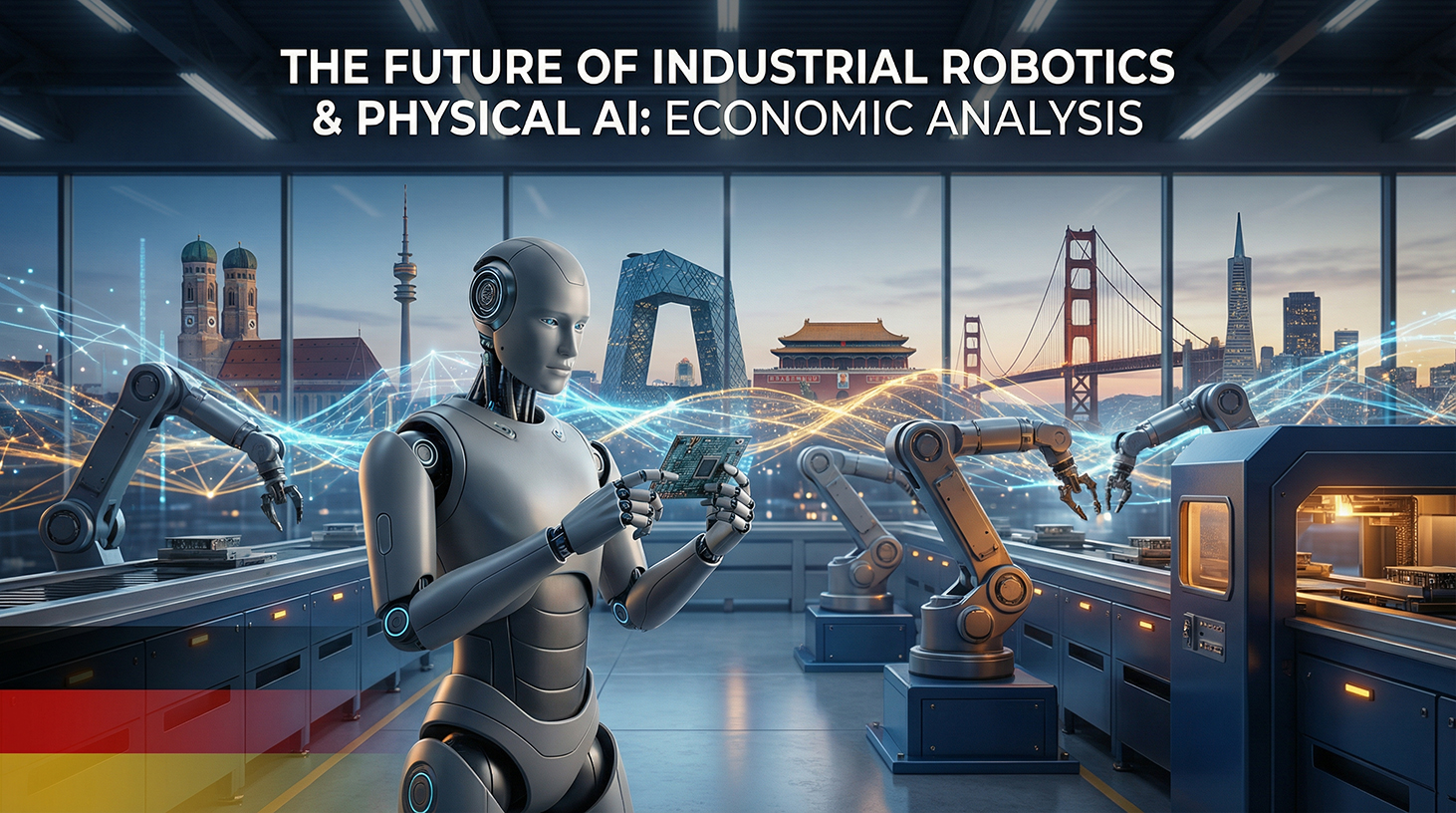
German know-how, Chinese money, American AI – salvation or sell-off of European technological sovereignty? – Image: Xpert.Digital
Agile Robots' billion-dollar plan: How a Munich start-up is secretly revolutionizing the global robotics industry
Human-Machine Revolution: Why the whole world is watching this humanoid robot from Munich
A flagship German startup, powered by American artificial intelligence and financed with Asian millions: Agile Robots' rise marks a turning point in European technological history. While the Munich-based robotics pioneer ventures into the era of humanoid robots with its new "Agile ONE" model and positions itself as a global consolidator of so-called "physical AI" in factories worldwide, a pressing geopolitical question is growing in the background. Is the company facing the same fate as the Augsburg-based robotics manufacturer KUKA? Between revolutionary engineering spirit, a chronic lack of European venture capital, and the justified fear of a technological sell-off to China, an unprecedented economic thriller is unfolding. A deep dive into the strategy of a company that is radically redefining the boundaries between national sovereignty and global reality.
Agile Robots: When German engineering thinking meets global capital
To understand why the Agile Robots case is so sensitive, one must first understand the KUKA case. In 2016, the Chinese household appliance company Midea acquired the Augsburg-based robotics pioneer KUKA for approximately €4.5 billion. The offer of €115 per share was significantly higher than the company's market capitalization at the time, the IG Metall union received job guarantees until 2023, and the company headquarters were to remain in Augsburg. In the short term, this sounds like a fair deal. In the medium term, however, history tells a different story.
Since the complete takeover – in May 2022, shareholders overwhelmingly approved a squeeze-out that made Midea the sole owner – KUKA's robotics future has increasingly shifted to China. Satellite images and insider reports show how Midea is transferring key development expertise to the Chinese city of Foshan. The Munich-based robotics pioneer, which once helped shape the global market for industrial robots, is now under Chinese control – and the real impetus for innovation no longer comes from Bavaria. Midea's humanoid robot Miro U, which cooks and chops vegetables simultaneously in videos, is being developed in China, not in Augsburg. The pattern is clear: over time, know-how migrates along with the capital.
From the DLR research lab to the world's elite: The development of Agile Robots
Against this backdrop, the story of Agile Robots is particularly noteworthy. Dr. Zhaopeng Chen, former group leader at the German Aerospace Center (DLR) in Oberpfaffenhofen, founded the company in 2018 together with other experts from the research institution. The DLR is considered one of the most technically renowned research institutions in Europe, especially in the field of force-controlled robotics and human-machine interaction. Agile Robots has built on this foundation of scientific rigor from the very beginning.
The company is headquartered in Munich but also maintains a second headquarters in Beijing. This dual identity is not accidental, but rather a strategic move. Chen deliberately cultivated a multinational character: engineering expertise from the German university and research environment, combined with access to the Chinese manufacturing ecosystem and venture capital markets. By 2024, the company generated approximately €200 million in revenue and employed more than 2,500 highly qualified staff in Germany, China, and India.
The Capital Triangle: Who is financing Munich's ambitions?
Agile Robots' investor structure reflects the geopolitically charged technology landscape of our time. In its Series C funding round completed in 2021, the company raised a total of $220 million. The round was led by SoftBank Vision Fund 2 – the fund of Japanese technology investor Masayoshi Son, who has been betting on global technology dominance for years. Other participants included Sequoia Capital China, Hillhouse Ventures, the Abu Dhabi Royal Group, and strategic investors such as Xiaomi, Foxconn Industrial Internet, and Midas.
Even back then, Agile Robots claimed to be the world's only unicorn – a company with a valuation of over one billion US dollars – in the intelligent robotics industry. The composition of its investors reveals the geopolitical complexity: SoftBank represents Japanese global capital, Sequoia China and Xiaomi Chinese backing, and the Abu Dhabi Royal Group Arab state assets. What sounds on paper like diversified financing is, in reality, a bet on technologies where national interests and economic ambitions are inextricably intertwined.
Strategic Acquisitions: How Agile Robots is Building an Ecosystem
What sets Agile Robots apart from other robotics startups is a consistent acquisition strategy that is transforming a technology company into a fully integrated platform provider. The most significant step was the acquisition in November 2023 of Franka Emika – a Munich-based robotics pioneer that had previously filed for insolvency. Franka Emika was known for its Panda robotic arm, one of the world's first truly collaborative industrial robots, which had found widespread application in research and development. The insolvency was reportedly due to irreconcilable shareholder disputes.
Agile Robots acquired the company, with its approximately 100 employees, for a reported purchase price exceeding €30 million. For CEO Zhaopeng Chen, this was not merely an acquisition of assets, but a signal of industrial policy: the takeover sends a clear message for Germany as a location for robotics and AI. Critics, however – including the business newspaper Die Welt – noted that the issue of know-how loss to China also arises here, and parallels to the KUKA acquisition are being discussed.
Agile Robots took its second decisive strategic step with its investment in idealworks. Founded in 2020 as a BMW Group subsidiary, the company specializing in autonomous logistics and mobile robots opened its doors to Agile Robots as a majority shareholder in 2023. By September 2025, Agile Robots had acquired the remaining shares and now owns 100 percent of idealworks. More than 850 of the iw.hub autonomous mobile robots developed by idealworks are currently in operation at BMW Group production sites worldwide. The BMW Group remains on board as a long-term partner – a clear indication that the automotive industry considers Agile Robots' model to be reliable.
The portfolio is complemented by the acquisition of BÄR Automation and the partnership with audEERING, a company specializing in AI speech analysis. The result is a comprehensive automation ecosystem: from robotic arms and collaborative cobots to humanoid robots, autonomous transport vehicles, and AI-supported human-machine communication.
The Google DeepMind partnership: Where computing power meets precision
On March 24, 2026, Agile Robots and Google DeepMind announced a strategic research partnership that propels the company into a new dimension. At its core, the partnership focuses on integrating Google DeepMind's Gemini Robotics foundation models into Agile Robots' hardware platform. Google DeepMind, the world's leading AI research lab, brings its foundation models to the real world, while Agile Robots provides the physical infrastructure and industrial deployment experience.
Carolina Parada, Senior Director and Head of Robotics at Google DeepMind, described the partnership as an important step toward translating the impact of AI into the real world and developing more advanced models for the next generation of robots. The underlying technical logic is compelling: Gemini Robotics models are trained using real-time data from industrial operations—every interaction of an Agile Robots system in a real factory feeds training data back into the AI loop, the models improve, and improved models, in turn, expand the robots' capabilities. This cyclical model is not a vision of the future, but rather the explicit strategic core of the collaboration.
In addition, Agile Robots is an anchor customer of Europe's first industrial AI cloud, built in cooperation with Deutsche Telekom and NVIDIA – 10,000 GPUs in German data centers, GDPR-compliant. This architecture is no accidental detail. It signals that Agile Robots takes data sovereignty seriously and positions European compliance as a competitive advantage – especially compared to Chinese competitors.
The Agile ONE: When the humanoid enters the factory
In November 2025, Agile Robots unveiled the Agile ONE humanoid robot, with series production scheduled to begin in early 2026 at a new production facility in Fürstenfeldbruck near Munich. The Agile ONE was specifically developed for industrial environments – not as a showroom demonstrator, but as a practical tool for ongoing production processes.
Technically, the Agile ONE stands out thanks to force sensors in each joint and fingertip sensors, enabling precise manipulation for both delicate and force-intensive tasks. The underlying AI model was trained on one of Europe's largest industrial datasets, supplemented by simulated and manually collected data. Industry experts estimate the sales price at €50,000 to €150,000 – significantly more expensive than Chinese competitors, but with a clear focus on precision (5-millimeter manufacturing tolerances), data security, and integration into existing production systems.
Agile Robots' approach is consistently geared towards industrial environments. Factories offer reliable conditions: clearly defined processes, manageable risks, and immediately identifiable deviations. In this environment, a humanoid robot can gain experience and gradually adapt before being deployed in more complex and less structured settings. Industry thus serves as a testing ground for physical AI, a controlled framework in which reliability is developed.
🎯🎯🎯 Data-driven B2B industry hub as a quasi-in-house solution

The quasi-in-house solution: How Xpert.Digital closes operational gaps in B2B marketing and sales – Smart Content-Driven Business - Image: Xpert.Digital
Xpert.Digital is a data-driven B2B industry hub led by Konrad Wolfenstein . The company acts as an external, quasi-in-house solution for industrial partners, closing operational gaps in marketing, content, and sales – without requiring additional resources on the client side.
More information here:
Physical AI and the race for global robotics dominance
The global robotics market: Why the course is being set now
All these developments are taking place in a market environment of historic dynamism. The global robotics market, estimated by GlobalData to reach approximately US$90 billion in 2024, is projected to grow to US$205.5 billion by 2030 – an average annual growth rate of 15 percent. The sub-market of humanoid robots, even smaller, is growing even faster: from around US$3.14 billion in 2025 to a projected US$81.55 billion in 2035, corresponding to an annual growth rate of approximately 38.5 percent.
The AI-driven industrial robot market, in particular, was estimated at US$16.8 billion for 2025 and is projected to grow to US$33.3 billion by 2035. These figures illustrate a structural shift: automation is no longer merely a cost-saving measure, but a tool for securing capacity. In the G7 countries, there were more than two million unfilled factory jobs in 2024 – and demographic pressures are set to intensify.
China understands this dynamic and is acting accordingly. In 2023, China absorbed around 50 percent of all newly installed industrial robots worldwide. The Chinese government is pumping over US$10 billion annually into robotics research, granting tax breaks of up to 50 percent, and driving complete vertical integration of the value chain through its "Made in China 2025" strategy – from chip manufacturing and module design to software and algorithms. According to Chinese figures, 86 percent of the approximately 250 individual goals of this strategy have already been achieved.
Physical AI as a new paradigm: What the technology is changing
The term "Physical AI," which Agile Robots CEO Zhaopeng Chen places at the center of his communication, is not a marketing slogan, but describes a genuine paradigm. Physical AI refers to artificial intelligence that directly links perception, movement, and decision-making – a system that not only calculates, but also acts, learns, and adapts in the physical world.
This differs fundamentally from classic industrial automation: Traditional robots execute fixed, programmed sequences; they are precise but rigid. A robot equipped with Physical AI, such as the Agile ONE, measures pressure and resistance when grasping a tool, adjusts its speed and movement when a person approaches, and learns from every interaction. This makes it not only safer when working alongside humans but also more flexible for changing production requirements – a crucial advantage over classic industrial robots, whose reprogramming is expensive and time-consuming.
NVIDIA, as a global platform provider, recognized this trend early on. At the GTC conference, NVIDIA announced collaborations with a broad robotics ecosystem, including ABB Robotics, FANUC, KUKA, Figure, and Agility Robotics. Idealworks, the Agile Robots subsidiary, has been collaborating with NVIDIA for years in the areas of simulation and autonomous mobility. The infrastructure on which Agile Robots runs the AI training for the Agile ONE is also based on NVIDIA technology.
The German-Chinese hybrid model: Between pragmatism and risk
The crucial question raised by Agile Robots is not a technical one, but a strategic-economic one: Is the business model of a German-Chinese hybrid company a pragmatic means of preserving the European technology base – or does it prepare the way for the next KUKA moment in the long term?
The arguments in favor of this model are compelling. Without Chinese and international capital, Agile Robots would never have been able to scale at the speed the market demands. European venture capital is structurally underdeveloped – the VDMA (German Engineering Federation) explicitly warns in its "Robotics Action Plan for Europe" that Europe urgently needs more venture capital and that institutional investors must be mobilized through regulatory reforms. A comparison with the French Tibi initiative, which successfully harnessed capital for innovation, shows that solutions exist – but these are currently the exception, not the rule.
The risks are equally clear. Agile Robots' investor structure – Sequoia China, Xiaomi, Foxconn, Hillhouse – includes players that are subject to state influence in their home markets or even operate directly alongside the state. Should China employ geopolitical pressure, these investors could become leverage. Recent developments at KUKA demonstrate how slowly but surely power dynamics can shift, even when all guarantees were initially given. A VDI News article, which addresses the uncertainty surrounding a potential outflow of know-how to China in connection with the Franka acquisition, precisely summarizes this ambivalence.
European industrial policy at a crossroads: Who sets the agenda?
The Agile Robots case is a microcosm of the strategic challenge facing Europe as a whole. Technological sovereignty – a term prominently used by both the German Federal Government and EU Commission President Ursula von der Leyen in recent years – cannot be achieved through defensive isolation. It must be created through proactive investments in domestic capabilities.
The VDMA action plan states this clearly: Europe is facing a loss of global competitiveness and must respond with a targeted robotics offensive. China's five-year robotics plan and the US's America First agenda are creating an environment in which Europe will structurally fall behind without active industrial policy countermeasures. China's robot density doubled within four years to 470 robots per 10,000 workers – a pace that Europe currently cannot even come close to matching.
The question raised by Agile Robots is therefore also one for legislators and investors: If European companies cannot find sufficient European funding sources, they will inevitably have to resort to Asian or American capital. The result will not be an immediate "fire sale," but rather a structural dependency that builds up through many small decisions and funding rounds.
The consolidator as a future model: What Agile Robots is really aiming for
Agile Robots is increasingly positioning itself as a global consolidator for physical AI – a company that not only sells robots but is building a complete ecosystem of hardware, software, AI platform, autonomous logistics, and service infrastructure. With over 20,000 robotics solutions installed worldwide, more than 2,300 employees in Germany, China, and India, and revenues exceeding €200 million in 2024, the company has reached a scale that makes it a serious global player.
The product portfolio is consistently integrated: The seven-axis Diana 7 robot arm for precision applications in the automotive and electronics industries, the AI-powered Yu 5 Industrial logistics robot for sorting and packaging, the Agile Hand with five movable fingers and 360-degree joint speed for aerospace applications – all these systems are networked via the central Agilecore software platform, which analyzes data in real time and continuously optimizes processes. This platform-based approach is the real differentiator compared to traditional robotics companies.
Three perspectives on an ambivalent reality
Anyone who views Agile Robots through only one lens fails to do justice to the complexity of the issue. At least three simultaneously valid perspectives deserve consideration.
First, the industrial policy perspective: What Agile Robots is building is one of the few European companies that can compete in the global arena of the physical AI era. Without this type of company, Europe would end up as a mere consumer of American and Chinese robotics platforms. The fact that global capital is needed for this is not a weakness, but a structural problem of the European financing ecosystem.
Secondly, the geopolitical perspective: Intertwining with Chinese investors represents a strategic vulnerability. Technology transfer, data access, and dependencies are real risks that cannot be eliminated by well-intentioned declarations of intent. The KUKA experience demonstrates how quickly contractually agreed-upon guarantees can become less valid when economic power shifts.
Thirdly, the entrepreneurial perspective: Dr. Zhaopeng Chen and his team have built a company within just a few years that combines German aerospace research, Bavarian automotive supplier expertise, Asian capital, and cutting-edge American AI research. This is not naive eclecticism, but a highly complex strategic orchestration of global resources. In a world where no single nation possesses all the relevant competencies, this ability to integrate is a core competency in its own right.
Between claims to sovereignty and global reality: A sober assessment
The transformation of the global automation and robotics industry is happening at a speed that regularly outpaces national industrial strategies. What is happening in Munich today is the emergence of a type of company that transcends the boundaries of traditional national industries: neither purely German, nor purely Chinese, nor purely American, but a hybrid that benefits from the strengths of all three poles.
The question of whether this should be the future of European industrial policy is wrongly framed. A more accurate question would be: What framework conditions must Europe create so that such companies are not dependent on foreign capital – or, if they are, so that structural safeguards are in place? The answer lies in a better venture capital ecosystem, clear rules for foreign direct investment (FDI) screening, and a European industrial AI infrastructure that guarantees data sovereignty.
Agile Robots proves that building globally competitive technology companies in Europe is possible. At the same time, it is a symptom of the fact that Europe has not yet sufficiently developed the necessary capital structures. The humanoid robot working alongside a BMW engineer in a Bavarian factory, controlled by an American AI model trained in a German GDPR-compliant data center – this robot embodies the complexity of our time. Whether it becomes a success story of European technology policy or another case study of missed opportunities depends less on Agile Robots itself than on the political and economic decisions made now.
Your global marketing and business development partner
☑️ Our business language is English or German
☑️ NEW: Correspondence in your native language!

Konrad Wolfenstein
I and my team are happy to be available to you as your personal advisor.
You can contact me by filling out the contact form here or simply call me at +49 7348 4088 965. My email address is : [email protected]
I'm looking forward to our joint project.









