
Energy from North Africa: First gas, then green hydrogen – This is what's behind the new Berlin-Algiers axis
Xpert Pre-Release

Available in 27 languages 📢
Prefer Xpert.Digital on GoogleⓘPublished on: July 20, 2026 / Updated on: July 20, 2026 – Author: Konrad Wolfenstein
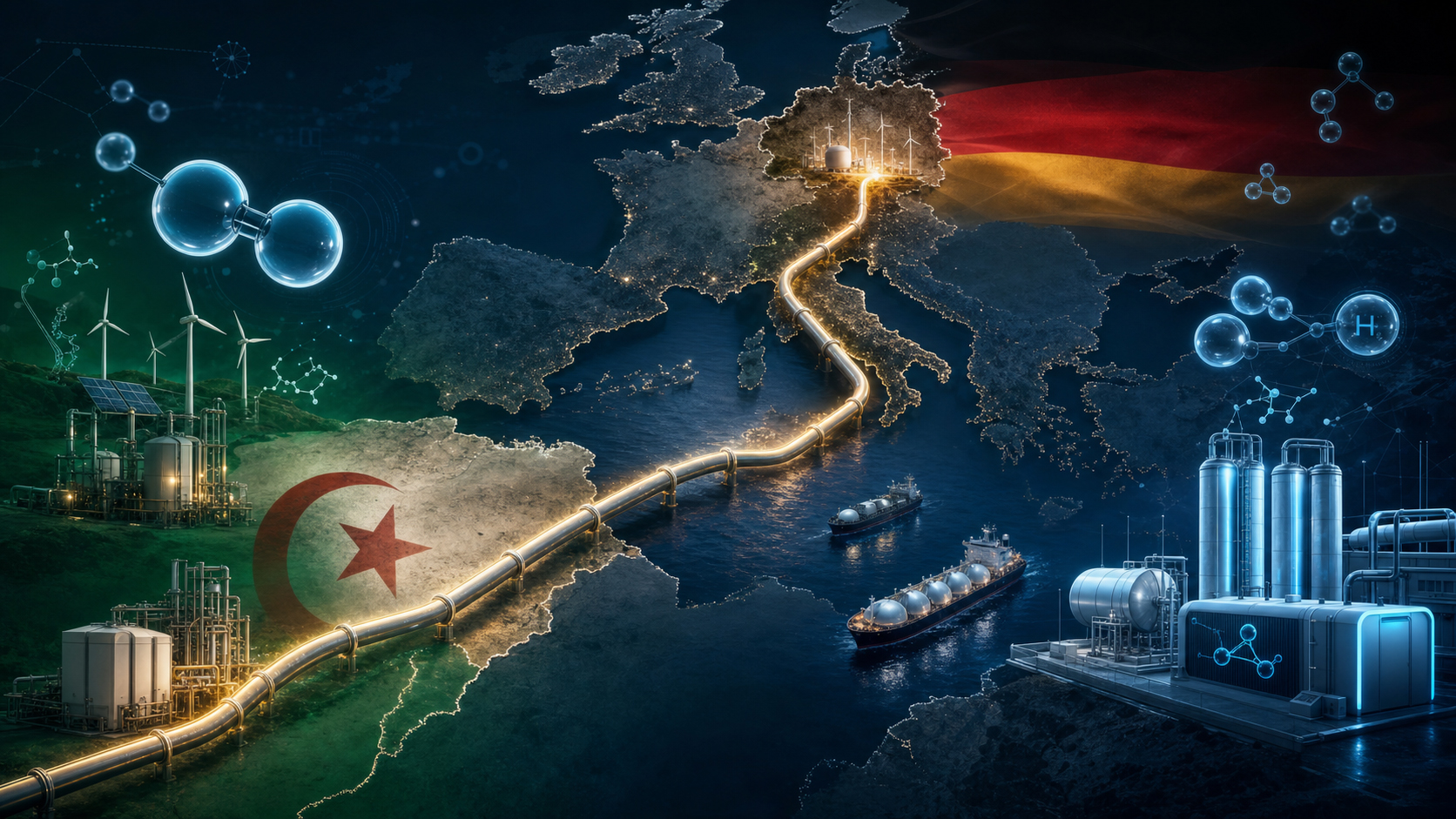
Energy from North Africa: First gas, then green hydrogen – This is what's behind the new Berlin-Algiers axis – Image: Xpert.Digital
Why our most important project now depends heavily on Italy
Chancellor Merz is betting on Algeria: This is Germany's new secret energy plan
When Chancellor Friedrich Merz received Algerian President Abdelmadjid Tebboune in Berlin, the stakes were far higher than mere diplomatic pleasantries – they concerned the backbone of Germany's energy supply. Following the definitive end of Russian gas deliveries, North Africa moved to the center of geopolitical strategy. The plan was as gigantic as it was ambitious: In the short term, massive deliveries of pipeline gas were intended to secure Germany's reserves. In the long term, a 3,300-kilometer-long hydrogen pipeline across the Mediterranean was meant to fuel Germany's green transition. But the pact with the authoritarian state presented not only enormous logistical and financial hurdles, but also a moral dilemma. Was Germany simply exchanging one critical dependency for another? A profound analysis of the new strategic axis between Berlin and Algiers.
A state visit with strategic calculations
The state visit took place in Berlin on July 16, 2026, at the invitation of Federal President Frank-Walter Steinmeier. Tebboune was first received with military honors by Steinmeier at the Villa Borsig, before meeting with Federal Chancellor Merz in the Federal Chancellery in the afternoon, after which the two appeared together before the press.
The timing was anything but accidental. The visit coincided with a period of acute geopolitical uncertainty, as oil prices were rising again due to US attacks on Iran and Iranian retaliatory strikes in the Gulf, thus bringing the vulnerability of European energy supplies via the Strait of Hormuz back into sharp focus. The trip gained additional significance from the first direct delivery of liquefied natural gas (LNG) to Germany by the state-owned company Sonatrach, which arrived at the Wilhelmshaven import terminal on July 2nd. According to the German government, the official purpose of the visit was to strengthen bilateral relations and address energy and economic policy issues. It was accompanied by a business delegation of 100 to 150 Algerian company representatives and a parallel economic forum in Berlin. This clearly clarifies the context of the visit: it represented the political culmination of Berlin's increasingly urgent search for stable energy partners since the end of Russian pipeline gas deliveries, a search further intensified by the current Middle East crisis.
The talks between Merz and Tebboune revolved around two parallel timelines. In the short term, the focus is on additional liquefied natural gas (LNG) deliveries to close Germany's current supply gaps. In the long term, the goal is to build a completely new energy infrastructure to transport green hydrogen from the Algerian Sahara across the Mediterranean to southern Germany. These two projects are closely intertwined, because the green future solution is unlikely to materialize without the fossil fuel-based interim solution. This is the real crux of this state visit, a point often overlooked in the public discourse.
Algeria's rise to become Europe's second most important gas supplier
Few countries have benefited as much from the paradigm shift in European energy policy as Algeria. Within just a few years, the North African nation rose to become the second-largest supplier of pipeline gas to the European Union, as Merz explicitly emphasized at the meeting. This development was by no means a given. Algeria already exports around 39 to 40 billion cubic meters of gas annually to the European Union, which corresponds to approximately 13 to 14 percent of European gas imports. The decisive advantage over liquefied natural gas (LNG) deliveries from Qatar or the USA lies in the pipeline infrastructure, which has been in place for decades and operates much more cost-effectively and reliably than maritime transport by tanker.
Algeria's geographical proximity to Europe is a structural advantage unmatched by any other major gas-producing country in the world. Since 1983, Algerian gas has flowed via the Transmed pipeline to Sicily and from there to Italy and Central Europe, while the Medgaz pipeline provides a direct link to Spain. With proven natural gas reserves estimated at 2.3 to 2.5 trillion cubic meters, Algeria has sufficient resources to fulfill this role for decades to come. Current annual production is around 100 to 105 billion cubic meters, the vast majority of which is exported to the Mediterranean region via existing pipeline systems.
The urgency of this partnership is heightened by geopolitical risks elsewhere in the world. Tensions surrounding the Strait of Hormuz have repeatedly raised the question of just how vulnerable Europe's energy supply actually is. Analysts have already warned that European gas prices could rise to over €100 per megawatt-hour if this strategic waterway remains blocked for an extended period. In this scenario, Algeria is explicitly positioning itself as a reliable backup supplier and has signaled its willingness to reroute deliveries in a crisis to alleviate European shortages. This rhetoric of reliability is also a skillful diplomatic tool with which Algiers is systematically increasing its value to Europe.
The hydrogen project as a geopolitical prestige project
Alongside the current reliance on fossil fuels, the hydrogen future is increasingly taking center stage in bilateral relations. The so-called South H2 Corridor is the most ambitious infrastructure project currently being discussed between North Africa and Central Europe. The plan envisions a pipeline approximately 3,300 kilometers long, intended to transport green hydrogen from Algeria and Tunisia, via Italy and Austria, to southern Germany. A significant portion of this route can utilize existing gas pipelines, which will require technical upgrades and modernization, considerably reducing costs compared to constructing a completely new pipeline.
During his visit to Berlin, President Tebboune described the project as a flagship initiative of central importance for the expansion of renewable energies. Merz spoke of a highly interesting project for both sides and announced that he would vigorously advance the project together with Italy in the coming months. This choice of words is noteworthy, as it signals a sense of urgency that was lacking in previous declarations of intent between the two countries. A bilateral hydrogen task force between Germany and Algeria has existed since 2024, but for a long time, the political will for concrete implementation seemed to be expressed more in announcements than in actual construction progress.
Algeria itself has set ambitious export targets. By 2040, the country aims to cover ten percent of the European Union's total hydrogen demand. A capacity of up to four million tons of hydrogen annually is targeted for the South H2 corridor by 2030. These figures are impressive, but they are largely based on feasibility studies and political declarations of intent, not on binding investment decisions. The actual realization of a project of this magnitude requires billions in investment in electrolyzers, solar and wind power plants in the Algerian Sahara, and the conversion of existing pipeline infrastructure across four countries. Each of these components carries its own risks, from financing issues to regulatory hurdles in the transit countries of Tunisia, Italy, and Austria.
Economic interdependence beyond the pipeline
Energy policy cooperation is embedded in a much broader network of economic relations. According to 2023 figures, bilateral trade between Germany and Algeria amounted to approximately €3.6 billion. During the state visit, an economic forum was held in Berlin, where around thirty new agreements were signed between German and Algerian companies. Investment priorities range from the automotive industry and defense and equipment to critical minerals, agriculture, and the healthcare sector.
According to Algerian government officials, German investments totaling approximately US$900 million are currently awaiting approval from the central Algerian investment agency. This figure illustrates the significant bureaucratic and regulatory hurdles that, in practice, deter private investors from realizing planned projects. In this context, Merz explicitly emphasized the need for legal certainty and reliable, transparent processes – a diplomatically phrased indication that, from a German business perspective, Algeria's investment climate still has considerable room for improvement.
The joint declaration by both countries outlines a strategic agenda that extends far beyond energy issues. It identifies areas of cooperation such as the energy transition, infrastructure, the technology sector, transportation, the health and pharmaceutical industries, critical raw materials, agriculture, and industry. This is complemented by intentions to intensify cultural and scientific relations, as well as cooperation in the areas of migration, security, and defense. This thematic breadth demonstrates that Berlin no longer views Algeria merely as a supplier of raw materials, but as a potential strategic partner in a region that is gaining importance for Europe for several reasons.
The Trans-Saharan Pipeline as an additional trump card
In addition to the hydrogen corridor, Algeria is pursuing another major project that could further solidify its role as an energy hub between Africa and Europe. The planned Trans-Saharan Gas Pipeline is intended to connect Nigerian gas fields to Algerian territory over a distance of approximately 4,000 kilometers and transport additional gas to Europe from there via the existing Transmed and Medgaz infrastructure. With a targeted annual capacity of 30 billion cubic meters, this project, whose construction has been announced for this year, could significantly expand Algeria's role as a transit country for West African gas.
This pipeline, however, has been on the political agenda for decades and has been repeatedly postponed for financial and security reasons. The route runs through politically unstable regions in Niger and southern Algeria, where jihadist groups and smuggling networks are active. While the current geopolitical realignment of Europe following the end of Russian gas supplies has given the project new impetus, the structural risks remain unchanged. Gas currently accounts for about 90 percent of Algeria's export earnings, while production from mature existing gas fields is gradually declining, making the need for new production areas and transport routes vital for Algiers itself.
Our EU and German expertise in business development, sales and marketing

Our EU and German expertise in business development, sales and marketing - Image: Xpert.Digital
Industry focus areas: B2B, digitalization (from AI to XR), mechanical engineering, logistics, renewable energies and industry
More information here:
A thematic hub offering insights and expertise:
- Knowledge platform covering global and regional economies, innovation and industry-specific trends
- A collection of analyses, insights, and background information from our key areas of focus
- A place for expertise and information on current developments in business and technology
- A hub for companies seeking information on markets, digitalization, and industry innovations
German-Algerian energy relationship: Diversification or new dependency?
Economic dependence as a double-edged sword
From a German perspective, the question inevitably arises whether the intensified partnership with Algeria truly represents diversification or merely a shift in dependence from one authoritarian regime to another. Algeria has been ruled for decades by a military-dominated political elite, in which President Tebboune, despite elected institutions, is considered a comparatively weak civilian representative of a powerful military apparatus. Human rights organizations have criticized the restrictions on press and assembly freedom in the country for years. For German energy policy, which, after its experience with Russia, had actually intended to focus more on partnerships based on shared values, this creates a conflict of objectives between short-term security of supply and long-term strategic coherence.
At the same time, it is important to distinguish Algeria from Russia. The country does not pursue an imperialist foreign policy towards Europe and has no direct interest in using energy supplies as a political weapon, as Moscow has demonstrated since 2022. Algeria's economic survival itself depends significantly on stable energy exports to Europe, which creates a certain degree of interdependence and thus mutual reliability. President Tebboune explicitly emphasized this point during his visit to Berlin, describing his country as a reliable and trustworthy supplier and highlighting the strategic importance of cooperation with Germany.
Nevertheless, a fundamental risk remains. Authoritarian systems are inherently less predictable than democratic trading partners, especially when internal power struggles or succession issues gain importance. Algeria's political system has experienced several abrupt shifts in the past, such as during the so-called Hirak protest movement in 2019, which forced long-time President Abdelaziz Bouteflika to resign. An energy partnership designed to last for decades must realistically factor in such uncertainties, even if this is rarely explicitly addressed in official government statements.
Italy's role as a geographical bottleneck
An often underestimated aspect of the German-Algerian energy partnership is Italy's central role as a geographical transit point for both gas and future hydrogen. All relevant pipeline routes from Algeria to Germany inevitably pass through Italian territory, making Rome a structurally indispensable partner in this trilateral arrangement. During his meeting with Tebboune, Merz repeatedly emphasized that the South H2 corridor must be pursued jointly with Italy, implicitly revealing a certain dependence on the Italian government's willingness to cooperate.
Italy itself is pursuing ambitious plans to develop into a European energy hub for North African gas and hydrogen, which presents both opportunities for close cooperation and potential conflicts of interest with Germany. Should Rome set its own priorities regarding capacity allocation or should domestic political delays occur in approval processes, this could significantly impact the entire timeline for the hydrogen corridor. This multi-state involvement makes the project more complex than a purely bilateral German-Algerian agreement and increases the number of potential points of friction where delays could arise.
Methane reduction as a side project of climate policy
One aspect of the bilateral agreements that receives little attention in public reporting concerns the reduction of methane emissions along the Algerian oil and gas supply chain. Germany has offered to support Algeria in developing technical capacities to prevent methane leaks – a project in which both the German Environment and Economics Ministries are involved. Methane is a significantly more potent greenhouse gas than carbon dioxide, and leaking production facilities and flaring practices in the oil and gas industry are among the easiest sources of climate-damaging emissions to address worldwide.
For Germany, this cooperation serves a dual purpose. It improves the carbon footprint of imported fossil fuels, which is important domestically given its own ambitious climate targets, and it simultaneously creates additional economic links between German technology companies and the Algerian energy sector. For Algeria, the collaboration means access to Western expertise and investment capital, which can be specifically focused on modernizing its own extraction infrastructure. This seemingly technical side agreement exemplifies how closely economic and climate policy interests have become intertwined in modern energy foreign policy.
Historical context of the German-Algerian energy partnership
The current intensification of relations builds on an energy partnership between the two countries that has existed since 2015. This interministerial platform initially served primarily as a platform for energy policy dialogue and the promotion of renewable energies in Algeria, without resulting in any significant concrete projects in the first few years. It was only the Russian war of aggression against Ukraine and the subsequent abrupt decline in Russian gas deliveries that gave the partnership a new, much more urgent impetus. As early as summer 2022, in the midst of the acute European energy crisis, Algeria announced that it would increase its gas deliveries to Italy by four billion cubic meters annually, in addition to the 21 billion cubic meters already contractually agreed upon.
This gradual deepening of relations reveals a pattern typical of European energy foreign policy in recent years. Crises accelerate partnerships that have been cultivated at a low level for years, while calmer periods see little concrete progress. Tebboune's current visit to Berlin coincides with a period in which European gas supplies are once again under pressure, this time triggered by geopolitical tensions in the Middle East and the associated uncertainty surrounding the navigability of the Strait of Hormuz. It is telling that substantial progress in energy policy between Germany and Algeria has historically almost always been linked to acute external crises.
Economic prospects for Algeria itself
From an Algerian perspective, the deepened partnership with Germany offers a rare opportunity for the economic diversification of a country whose state budget is heavily dependent on hydrocarbon revenues. The Algerian economy has suffered for years from a lack of diversification, high youth unemployment, and a bloated public sector. Foreign direct investment amounting to several hundred million dollars, as announced at the Berlin Economic Forum, could help establish new industrial value chains in the country, particularly in the areas of renewable energy and hydrogen production.
The Algerian government has repeatedly announced reforms in recent years to improve the investment climate, including simplifying approval processes and reducing bureaucratic hurdles for foreign companies. However, the fact that German investments totaling approximately $900 million are still awaiting approval demonstrates that a significant gap persists between political announcements and practical implementation in Algeria. This remains a major obstacle for German companies wishing to invest in the country, one that cannot be fully resolved through diplomatic summits alone.
German-Algerian energy partnership: Pragmatism instead of climate utopia
The deepening of German-Algerian energy relations reflects a pragmatic, interest-driven foreign policy that has moved noticeably away from the values-based ambitions of earlier years. Germany needs additional gas in the short term and an alternative to Russian pipeline imports in the long term, while Algeria seeks economic modernization, investment capital, and international recognition as a reliable partner. This convergence of interests explains the speed at which both sides are currently moving forward, but should not obscure the structural risks inherent in such a partnership with an authoritarian, resource-rich state.
Despite all the political rhetoric, the South Hydrogen Corridor remains a long-term project fraught with considerable technical, financial, and political uncertainties. The Trans-Saharan Pipeline has been on the agenda for decades without ever being realized, which calls for caution when evaluating new announcements. Realistically, Algeria will primarily gain importance as a supplier of fossil gas in the coming years, while the green hydrogen future is unlikely to reach significant volumes until the end of the decade at the earliest. For Germany, this means that the energy partnership with Algeria is primarily an instrument for securing the transition phase, rather than a fully developed blueprint for a completely green energy future.
🎯🎯🎯 Data-driven B2B industry hub as a quasi-in-house solution

The quasi-in-house solution: How Xpert.Digital closes operational gaps in B2B marketing and sales – Smart Content-Driven Business - Image: Xpert.Digital
Xpert.Digital is a data-driven B2B industry hub led by Konrad Wolfenstein . The company acts as an external, quasi-in-house solution for industrial partners, closing operational gaps in marketing, content, and sales – without requiring additional resources on the client side.
More information here:
Your global marketing and business development partner
☑️ Our business language is English or German
☑️ NEW: Correspondence in your native language!

Konrad Wolfenstein
I and my team are happy to be available to you as your personal advisor.
You can contact me by filling out the contact form here [email protected]:or simply call me at +49 7348 4088 965. My email address is
I'm looking forward to our joint project.
☑️ SME support in strategy, consulting, planning and implementation
☑️ Creation or realignment of the digital strategy and digitization
☑️ Expansion and optimization of international sales processes
☑️ Global & Digital B2B trading platforms
☑️ Pioneer Business Development / Marketing / PR / Trade Fairs
📈🚀 From visibility to trust 👀🤝 Your scalable path with Xpert.Digital

From visibility to trust: Your scalable path with Xpert.Digital - Image: Xpert.Digital
In industrial B2B, sustainable business relationships rarely emerge overnight. They develop step by step – through visibility, professional relevance, recurring touchpoints, and growing trust. Xpert.Digital's 4-stage model addresses precisely this: It offers a structured path that begins with a manageable entry point and can evolve into deeper collaboration in business development if needed.
Instead of relying on loud marketing promises, this model puts the relationship at the forefront. Companies start with clearly defined, easily calculable measures and then decide, based on their own experience, how far they want to expand the collaboration. A key factor for this undisturbed trust-building process: The platform completely avoids annoying advertising ads, so the editorial focus remains solely on the companies' expertise.
More information here:










