
Energy autonomy instead of conflict: What the tanker disaster off Ibiza reveals about the true costs of our energy supply
Xpert Pre-Release

Available in 27 languages 📢
Prefer Xpert.Digital on GoogleⓘPublished on: November 26, 2026 / Updated on: November 26, 2026 – Author: Konrad Wolfenstein
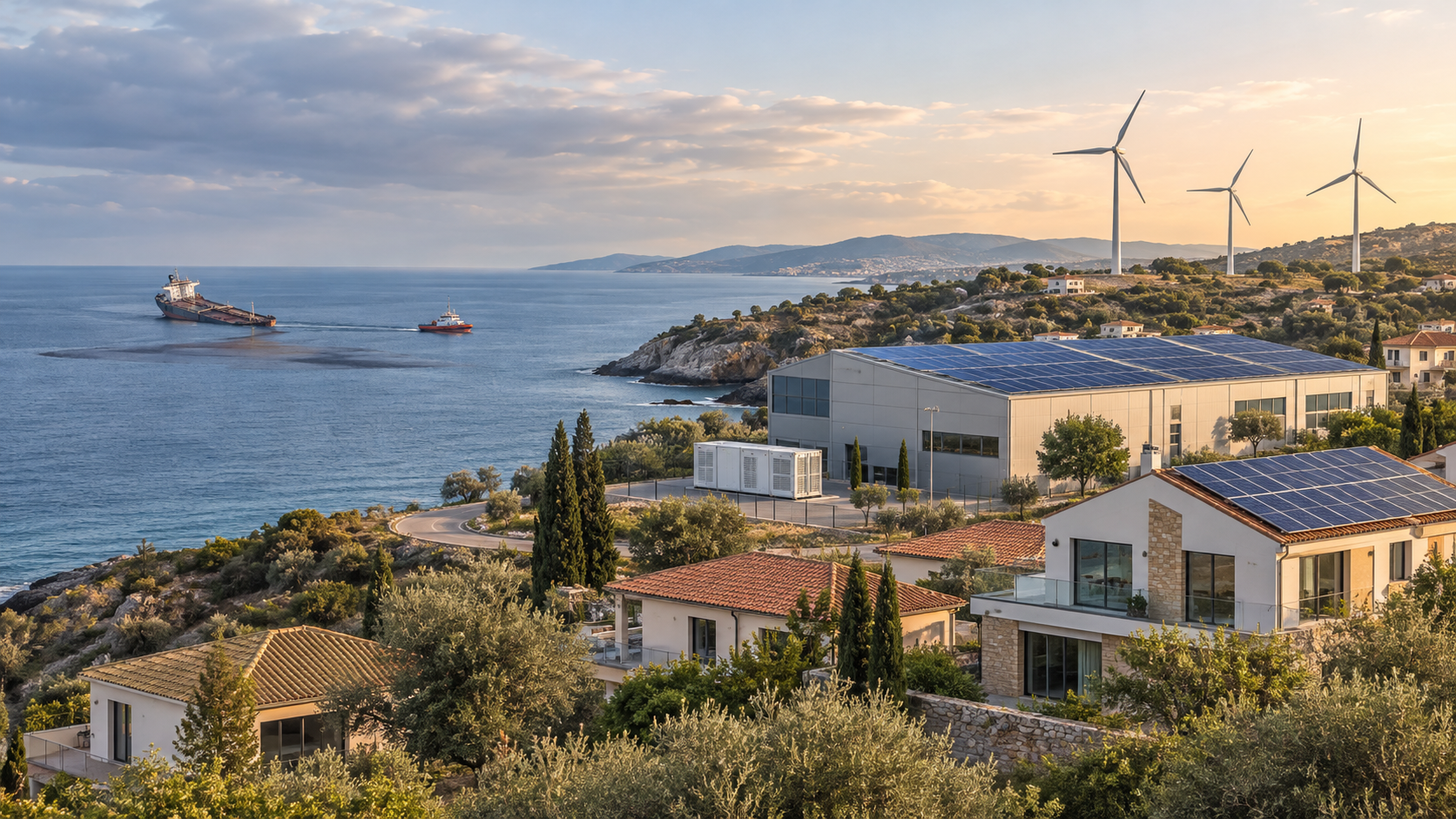
Energy autonomy instead of conflict: What the tanker disaster off Ibiza reveals about the true costs of our energy supply – Creative image on the topic, created with AI: Xpert.Digital
What the sunken tanker off Ibiza reveals about the true cost of our energy supply
Tanker accident off Ibiza: What risks does fossil fuels pose for coastlines and the economy?
Less dependent on fuel deliveries: Lessons learned from the tanker disaster off Ibiza
The sinking of the tanker "Med Emre" off Ibiza is first and foremost a human tragedy: one crew member died, others were endangered, and rescue workers had to operate under difficult conditions. At the same time, the disaster highlights an economic issue that is often neglected in the energy debate: what costs and risks arise not only during the use of energy, but also during its extraction, processing, and transport?
The tanker sank on November 26, 2026, approximately 25 nautical miles off the Mediterranean island. Spain activated its emergency plan against marine pollution and dispatched specialized vessels and a surveillance aircraft. Initial reports regarding the cargo and potential leakage were contradictory. Therefore, a clear distinction is crucial: hazardous cargo on board constitutes a serious pollution risk – but it does not necessarily prove that a large-scale oil spill has actually occurred.
The disaster, in itself, doesn't prove that every fossil fuel application can be replaced immediately. However, it serves as a reminder that fossil fuels depend on a continuously functioning supply chain: fuels must be extracted, transported, and distributed. This incurs ongoing costs and poses risks to supply, the environment, and affected regions. Renewable energies are also not without their burdens; however, their cost structure and dependencies differ. Looking at the overall picture reveals what this means for households, businesses, and forward-looking energy policy.
Those who only fight against wind turbines overlook the risks off their coast
A sinking tanker is first and foremost a human tragedy. People's lives are endangered, relatives lose a loved one, and rescue workers operate under difficult conditions. But such an accident also raises an economic question that is often neglected in the energy debate: What risks arise not only during the use of an energy source, but also during its extraction, processing, and transport?
The sinking of the "Med Emre" off Ibiza on November 26, 2026, brings this issue to the forefront once again. The ship, sailing under the Maltese flag, was en route from Algeciras to Barcelona and sank approximately 25 nautical miles (about 46 kilometers) off the Mediterranean island. Of the 17 crew members, one died after being rescued. Spain activated its national emergency plan for marine pollution at level 2. The "Clara Campoamor," a vessel specializing in oil spill response, and a surveillance aircraft were deployed. According to initial reports, the tanker may have been carrying up to 7,000 tons of diesel fuel.
The economic implications extend beyond a single accident. Fossil fuels must be continuously extracted from deposits, transported over sometimes vast distances, processed, and distributed. Every stage of this chain incurs costs and carries risks. Some appear on bills. Others only become apparent when a ship sinks, a pipeline is damaged, or a supplier country becomes a geopolitical problem.
This does not mean that renewable energies are risk-free. It does mean, however, that a fair comparison must take all relevant costs and dependencies into account. The real goal of a forward-looking energy policy should therefore be neither the defense of individual technologies nor the blanket rejection of their alternatives. It should be to enable private households, businesses, and national economies to have an affordable, reliable, and, as far as possible, self-determined energy supply.
The first economic duty is: to clearly distinguish between orders of magnitude
Especially in the event of an accident, the accuracy of the figures is crucial. The initial information released about the ship off Ibiza contains significant contradictions. Some sources equate approximately 7,000 tons of cargo with roughly 1.2 million liters. These figures are inconsistent for crude oil or diesel. Furthermore, the information differs as to whether crude oil or diesel fuel was being transported. The classification as a chemical tanker loaded with diesel initially appears more reliable; however, the exact cargo volume and any potential leakage must be considered separately.
Tons describe mass, liters describe volume. Their conversion depends on the density of the respective substance. Several thousand tons of a liquid petroleum product do not simply correspond to slightly more than one million liters. Such a discrepancy is not a minor linguistic issue, but significantly alters the assessment of potential damage.
Equally important is the distinction between the amount transported and the amount actually released. A sunken ship carrying hazardous cargo poses a serious pollution risk. However, it does not yet prove that a large-scale oil spill has already occurred. Initial reports left open the question of whether and to what extent fuel had entered the sea. Therefore, the activation of emergency measures was initially a reaction to a significant potential hazard, not proof of already fully known environmental damage.
This distinction strengthens the argument for a less risky energy supply. Those who criticize fossil fuel risks need not exaggerate them. A sound, objective analysis separates confirmed facts, preliminary data, and potential consequences. Only then can one assess the actual costs incurred and determine what precautionary measures are economically sensible.
Fossil energy is not just fuel, but a permanently functioning supply chain
The price of a liter of diesel or a kilowatt-hour of natural gas can easily give the impression that energy is primarily a tradable commodity. In reality, it is the result of a complex system of extraction facilities, refineries, ports, tankers, pipelines, storage facilities, and distribution networks.
This infrastructure doesn't require a one-time setup and then produce without further material replenishment. It remains dependent on a continuous fuel supply. A power plant can be technically sound and still face economic pressure if its fuel becomes expensive. A heating system can function perfectly and yet burden a household with unpredictable costs.
The unique aspect lies in the recurring resource consumption. Each additional operating period requires further extraction and transport. This also means that the associated price, environmental, and supply risks are repeated. A secure delivery last year does not guarantee a secure delivery next year.
The focus is different for wind and solar energy. These installations also require raw materials, industrial manufacturing, transportation, maintenance, and later dismantling or recycling. However, once built, they do not need ongoing deliveries of coal, oil, or natural gas to utilize their respective natural energy sources. The economic burden thus shifts more heavily to the initial investment and its financing. This very difference is crucial for hedging against fuel price shocks.
The choice between energy systems is therefore also a decision between different cost structures. A system more dependent on fuels carries ongoing procurement risks. A system more reliant on renewable energy generation places higher demands on capital provision, grid integration, flexibility, and time balancing.
Why the market price does not fully reflect the social cost
An energy source may appear inexpensive to its immediate buyer while simultaneously causing significant costs for others. In economics, such burdens not fully reflected in the price are called external costs.
These include, for example, health damage caused by air pollution, climate-related consequences, impairment of ecosystems, and economic losses due to environmental accidents. The German Federal Environment Agency ranks the environmental costs of electricity generation from lignite particularly high, followed by oil and hard coal. Natural gas ranks lower, and renewable energies significantly lower again. These calculations primarily consider air pollutants and greenhouse gases; certain other damages are not fully included due to a lack of data.
The mechanism can be clearly explained in the case of a tanker accident. Transport generates revenue for the companies involved and supplies customers with fuel. However, if pollution occurs, fishing businesses, hotels, restaurants, municipalities, and other coastal users can also be affected. These stakeholders are not necessarily involved in the transport business.
Even if insurance and liability regulations apply, not all damage is automatically fully compensated. A cleaned beach can be used again, while lost revenue, a damaged local image, or environmental impacts can have a longer-lasting effect. Furthermore, some consequences are difficult to quantify in monetary terms.
Conversely, it would be wrong to look for external costs solely in fossil fuels. Raw material extraction for batteries, land use, encroachment on habitats, and industrial manufacturing processes must also be considered. The crucial question is not whether a technology causes any burdens at all. The crucial question is how high these burdens are over the entire life cycle and for each energy service actually provided.
For coastal regions, an environmental accident can lead to a cross-sectoral economic shock
On a holiday island, clean seawater affects far more than just nature conservation. It is a fundamental part of the economic landscape. Tourism, leisure, gastronomy, accommodation, shipping, and to some extent, the real estate market all depend on a coastline being perceived as attractive and safe.
Severe pollution could therefore trigger several chains of effects. First, there are immediate costs for deployment and cleanup. Subsequently, beaches could be temporarily closed, boating restricted, or fishing areas avoided. Furthermore, even the public perception of a threatened holiday region can influence demand.
These effects do not necessarily occur simultaneously and cannot be assumed to have occurred in Ibiza at present. Rather, they describe the potential economic damage caused by coastal pollution. The extent of this damage depends, among other things, on the actual quantity released, the properties of the substances, the weather, currents, the season, and the affected coastal sections.
The potential for unequal distribution is economically noteworthy. The benefits of fuel transport are spread along a supra-regional supply chain. Conversely, a significant portion of the damage can be geographically concentrated in a specific coastal region.
This makes energy supply a matter of location. A region may need energy and simultaneously be vulnerable to its transport. The more of the demand can be met through local or regional production, the sooner certain transport dependencies can be reduced. This doesn't replace careful shipping policy, but in the long run it changes the amount of fuel that needs to be moved in the first place.
Fukushima and Ibiza are not identical risks, but they share the same call for a full assessment
A reactor accident and the sinking of a tanker are fundamentally different. The technical causes, potential damage progression, spatial effects, and timescales are not the same. Equating these two types of events directly leads to a loss of analytical precision.
The common economic question lies elsewhere: How are rare, potentially serious events incorporated into investment decisions, insurance, and public provision?
A purely average approach can be insufficient. A system may function reliably for many years and yet contain risks that, in the event of damage, could trigger exceptionally high costs. At the same time, it would be unwise to consider only the worst-case scenario and ignore all other probabilities.
A reliable assessment must therefore combine several dimensions: the probability of an event, its potential extent of damage, the manageability of its consequences, and the question of who will bear the financial responsibility. The temporal dimension must also be considered. Some consequences can be remedied in the short term, while others can consume resources over long periods.
This establishes a uniform standard for the energy debate. Safety requirements must not depend on whether someone politically favors a particular technology. Fossil, nuclear, and renewable energy systems should be assessed with regard to their respective risks. The conclusion need not be identical for every application, but it should be based on comparable criteria.
Energy autonomy means flexibility and not necessarily grid separation
The term energy autonomy is often confused with complete self-sufficiency. This leads to exaggerated expectations and sometimes to uneconomical investments.
For a household, autonomy can mean covering a significant portion of its own electricity needs, becoming less dependent on heating oil, and partially charging its vehicle with self-generated electricity. For a company, it can mean being able to calculate its energy costs more accurately over the long term and to continue operating critical processes temporarily during a disruption.
Complete self-sufficiency is a significantly stricter requirement. It would demand that all energy needs be met independently, even during extended periods of low solar and wind power or when technical components fail. This could require substantial additional investment.
It is therefore more economically sensible to view autonomy as a graduated degree of flexibility. A business does not need to generate every kilowatt-hour itself to improve its negotiating position and risk-bearing capacity. A household does not need to be disconnected from the electricity grid to be significantly less sensitive to certain price increases.
The key question, therefore, is not: How can all dependencies disappear? It is: Which dependencies can be reduced, diversified, or secured with reasonable effort? This perspective combines technical feasibility with economic sense.
What production costs actually reveal about renewable energies
The economic attractiveness of renewable energies cannot be justified solely on environmental grounds. Their production costs are also crucial.
For new installations in Germany, a cost analysis for 2024 determined levelized costs of electricity (LCOE) for ground-mounted photovoltaic (PV) systems and onshore wind energy to be within a range of 4.1 to 9.2 cents per kilowatt-hour. Small rooftop PV systems ranged from 6.3 to 14.4 cents. For PV battery storage systems, the range examined, depending on system type and configuration, extended from 6.0 to 22.5 cents per kilowatt-hour. These values should be considered within the context of the time period and methodology used and do not represent binding quotes for every project in 2026.
Levelized cost of electricity (LCOE) distributes investment, operating, and other considered costs over the expected electricity generation during the system's lifespan. It helps to compare technologies. However, it is neither equivalent to the household electricity price nor to the total cost of a reliable energy system.
A kilowatt-hour generated at midday and a reliably available kilowatt-hour on a windless winter evening fulfill different requirements. Therefore, for a proper comparison, grids, storage, flexible demand, and guaranteed capacity must also be considered.
However, this does not mean that low generation costs are irrelevant. They create the economic leeway to finance additional system services. The mistake is not in expanding cheap wind and solar energy. It lies in planning its generation without considering the temporal and spatial requirements.
Private benefit arises from appropriate design, not from having as much technology as possible
For private households, the combination of photovoltaics, efficient electricity use, and possibly a storage system is an obvious path to greater energy independence. However, the crucial factor is how this aligns with actual consumption.
A household that uses little electricity during the day has a different profile than a household with regular occupancy, a heat pump, and an electric car. Roof orientation, shading, usable area, future consumption trends, and financing also influence cost-effectiveness.
Two key figures must be distinguished here. The self-consumption rate describes what proportion of the generated solar power is used in the household. The degree of self-sufficiency describes what proportion of total electricity consumption is covered by the household's own system. A high self-consumption rate therefore does not automatically mean a high degree of self-sufficiency.
A small system can supply almost all of the electricity needed for self-consumption, yet still only cover a limited portion of the annual demand. A larger system can feed more electricity into the grid and simultaneously make a greater absolute contribution to self-sufficiency.
The fact that self-consumption has gained economic importance is demonstrated by developments in Germany. For 2024, self-consumption of photovoltaic electricity was recorded at 12.28 terawatt-hours. Its share of net electricity generation from photovoltaics was thus around 17 percent, compared to 13 percent in the previous year. However, these nationwide figures should not be confused with the degree of self-sufficiency of individual households.
New: Patent from the USA – install solar parks up to 30% cheaper and 40% faster and easier – with explanatory videos!

New: Patent from the USA – Install solar parks up to 30% cheaper and 40% faster and easier – with explanatory videos! - Image: Xpert.Digital
The core of this technological advancement is the deliberate departure from conventional clamp mounting, which has been the standard for decades. The new, more time- and cost-effective mounting system addresses this with a fundamentally different, more intelligent concept. Instead of clamping the modules at specific points, they are inserted into a continuous, specially shaped support rail and held securely in place. This design ensures that all forces – whether static loads from snow or dynamic loads from wind – are distributed evenly across the entire length of the module frame.
More information here:
The importance of energy autonomy for our future
A simple model calculation shows the value of self-consumed electricity
The economic benefits can be illustrated using a simplified example. Let's assume a plant generates 10,000 kilowatt-hours annually. Of this, 3,000 kilowatt-hours are consumed directly on-site. The avoided grid consumption is valued at 30 cents per kilowatt-hour, while the feed-in is compensated at 8 cents.
Under these assumptions, the value of the avoided electricity purchase is €900. The remaining 7,000 kilowatt-hours generate €560 in feed-in revenue. This results in a total annual gross benefit of €1,460 before taking into account investment, financing, maintenance, potential repairs, and other relevant costs.
If self-consumption increases by 1,000 kilowatt hours, the benefit in this model does not increase by the full 300 euros. This is because 80 euros in feed-in tariff revenue are simultaneously lost. The additional economic advantage is therefore 220 euros.
This difference is important for storage decisions. A battery must recoup its investment and operating costs from the added benefit, not from the total value of the stored electricity. Furthermore, storage losses and aging occur.
The prices mentioned are not a statement about a specific tariff or a generally applicable rate. They serve solely to illustrate the calculation logic. For a realistic decision, specific offers, contract terms, and consumption data must be considered.
Storage provides flexibility, but does not solve every supply problem
Battery storage systems can shift solar power from midday to the evening, thus improving the timing between generation and consumption. This increase in self-consumption is one of the key applications of home storage systems.
However, this does not mean that a typical home storage system could economically store summer surpluses until winter. Daily balancing and seasonal supply are different tasks. Equating the two overestimates the performance of a single device.
Sizing the storage system also requires careful consideration. A larger storage unit can hold more energy, but it won't automatically be used frequently enough to justify its additional costs. If the system produces little surplus energy in winter and the storage unit is regularly filled early in summer, the additional capacity may remain underutilized for much of the year.
Furthermore, a distinction must be made between self-consumption and backup power. Having a battery in the house does not automatically mean that all electrical circuits will continue to be supplied during a power outage. The entire system must be planned and technically implemented accordingly.
Therefore, a separate assessment is economically sensible: What benefits arise from increased self-consumption? What benefits arise from cheaper electricity procurement at certain times? What benefits arise from security of supply? Only then can it be judged which storage capacity and which additional functions are worth their price.
Heat and mobility determine actual independence
A household can be largely self-sufficient in its electricity supply and still consume large amounts of fossil fuels. This is the case, for example, if heating continues to be done with oil and the majority of driving is done with a combustion engine.
A serious strategy for energy independence must therefore consider electricity, heat, and mobility together. Electrification expands the potential uses of self-generated electricity. However, it also increases electricity demand and can create new peak loads.
With a heat pump, the entire heating system is crucial: the building's heating demand, the required flow temperatures, the heat distribution, and proper system design. Simply combining it with a photovoltaic system does not guarantee optimal efficiency. The time difference between high solar production in summer and high heating demand in winter must be taken into account.
The charging time plays a crucial role for electric cars. A vehicle that is regularly parked at the building during the day can utilize solar power under different conditions than a vehicle that only returns late in the evening.
Economic progress therefore lies less in simply acquiring more devices than in their coordinated use. Intelligent control can adapt flexible consumption to available energy. At the same time, comfort should not be unnecessarily restricted. A good energy system operates largely unnoticed in everyday use and not only under idealized test conditions.
For companies, energy autonomy is becoming a question of competitiveness
Businesses value energy differently than private households. Besides the price per unit, factors such as peak loads, security of supply, production planning, financing, and whether energy costs can be reliably factored into bid prices are all important considerations.
Businesses with high daily electricity consumption can generally be well-suited for photovoltaic systems. These can include, for example, logistics centers, cold storage facilities, workshops, retail businesses, or certain production sites. However, the decisive factor is not the industry classification, but rather the actual temporal alignment of electricity demand and generation.
A large number of roofs alone does not guarantee an economically optimal project. The roof's condition, structural integrity, grid connection, ownership, and planned usage period of the site must all be compatible. For leased buildings, the investment horizon and lease term must also be aligned.
A project can be attractive to a business even if it doesn't achieve the maximum possible self-sufficiency rate. Even partial hedging against electricity price fluctuations can stabilize the business plan. Conversely, a high self-sufficiency rate is not an end in itself if it ties up a disproportionate amount of capital.
The central business question is therefore: How does the project change the company's overall energy-related costs and risks over its lifetime? Simply looking at the annual electricity bill is insufficient to answer this.
Security of supply must be assessed according to the value of the processes involved
Not every kilowatt-hour has the same economic value for a company. The short-term failure of a non-critical lighting system is to be assessed differently than the interruption of a cold chain, a sensitive production process, or a central IT application.
This leads to an important consequence: backup power should not be planned for the entire site if only certain consumers actually require special protection.
A differentiated planning approach separates critical and deferrable loads. It determines what power is needed immediately, what bridging time is required, and how an orderly restart can be achieved. Only then can the appropriate combination of battery, uninterruptible power supply, additional backup equipment, and organizational precautions be determined.
A simplified thought experiment illustrates the logic. If a brief power outage could cause significant production losses, technical safeguards can be economically justified even for rare events. Crucially, however, reliable assumptions regarding the probability of occurrence and the extent of the damage are essential.
Energy autonomy is therefore not just a matter of self-generation. It also includes the ability to prioritize scarce energy effectively in the event of a disruption. A well-prepared company can be more resilient with limited reserves than a technically superior operation without a clear operational strategy.
Capital is the bottleneck that decides the fate of many good projects
Renewable energy self-sufficiency partially replaces ongoing expenses with upfront investments. This can be economically attractive over the system's lifespan, but it places demands on financing.
For a household, it is relevant whether the investment is financed from equity or through a loan. For a company, the additional factor is that the same capital could also be used for machinery, personnel, digitalization, or market development.
Therefore, a simple amortization period alone is not sufficient as a basis for decision-making. Other factors to consider include the useful life, financing costs, repair risks, residual values, and the timing of cash flows. The possibility of future upgrades can also be an economic factor.
A sensitivity analysis is particularly important. How does the result change with lower electricity prices? What happens with lower generation or higher consumption? What is the impact of a necessary component replacement? Will the project remain viable even under less favorable conditions?
An investment that only appears profitable under persistently high energy prices should be evaluated differently than one that offers advantages across several realistic scenarios. The economic strength of renewable self-sufficiency lies not in a guaranteed spectacular return, but often in a more robust and predictable cost structure.
New technology does not eliminate dependencies, but changes them
A nuanced analysis must also identify the weaknesses of renewable energy systems. Solar panels, batteries, inverters, and other components are produced in international supply chains. Raw material extraction and industrial manufacturing can be geographically concentrated. The supply of critical minerals is therefore a separate issue within energy security.
Furthermore, there are digital dependencies. If control, maintenance, or central functions are tied to individual providers, technical and economic switching costs can arise. A low purchase price can lose its appeal in the long run if spare parts, interfaces, or services are lacking.
The difference to fossil fuel supply chains remains significant. Once installed, a solar module does not require a continuous supply of its primary energy source. In contrast, the procurement of fuels is repeated throughout their entire operation.
A forward-looking strategy should therefore not distinguish between complete independence and complete dependence. It should examine which dependencies are time-critical, permanent, replaceable, or diversifiable.
This results in practical requirements: repairable technology, verifiable warranties, interoperable systems, robust service contracts, recycling, and multiple procurement options. Energy autonomy begins with generation but doesn't end at the inverter.
The electricity grid is not a counter-model to autonomy, but an economic ally
The desire for self-determination can lead to viewing the public network as fundamentally problematic. From an economic perspective, this would be a misunderstanding.
A grid enables the exchange of energy between different locations, consumption profiles, and generation conditions. It can utilize local surpluses and compensate for local shortages. If every household and every business were to maintain all its own reserves, additional facilities would have to be built in many places, which would rarely be used.
Individual self-sufficiency and shared infrastructure therefore fulfill different functions. A rooftop system can reduce grid consumption. A high-performance grid can simultaneously reduce storage requirements and increase the economic value of surplus generation.
However, the network also incurs costs that must be financed. If more participants cover part of their own needs, the necessity of a readily available infrastructure does not automatically disappear. This raises questions regarding the distribution of network charges and connection requirements.
A viable system must therefore combine two goals: enabling sensible self-sufficiency and reliably financing the infrastructure needed for everyone. Neither a blanket disadvantage for self-suppliers nor the complete shifting of fixed costs to other network users would be convincing.
The economically sensible perspective is therefore: as much decentralized capacity for action as possible within a resilient overall system.
A just energy transition must not end at one's own roof
Opportunities for self-sufficiency are unequally distributed. Those who own a suitable home and have capital can invest more easily than renters or households with limited financial reserves.
Businesses also start under different conditions. A company with its own warehouse and predictable daily consumption has different prerequisites than a small service provider in rented premises. A purely individualized autonomy strategy could exacerbate these differences.
Therefore, collaborative and accessible models should be included in the overall economic analysis. These could include equity investments, suitable tenant electricity concepts, shared building energy supply, or long-term renewable energy supply contracts. Their specific attractiveness depends on the legal structure, administrative costs, and contract terms.
Energy efficiency is also particularly important for low-income households. A measure that permanently reduces consumption can provide more reliable relief than a complex technical system whose financing is already strained.
Justice does not mean subsidizing every technology equally. It means broadening access to economically viable savings and a secure energy supply. The energy transition loses public support when its benefits primarily accrue to wealthy owners, while its infrastructure costs remain a difficult-to-understand burden for others.
Energy efficiency remains the most inconspicuous form of independence
In public debate, power plants, wind turbines, solar panels, and large-scale storage facilities attract a great deal of attention. Less visible are measures that reduce energy demand. Yet these are precisely the measures that can limit the necessary scope of new infrastructure.
For companies, this starts with accurately recording consumption. Without knowledge of load profiles, idle times, and losses, there is a risk of oversizing new generation capacity for an unnecessarily high demand.
Depending on the operation, optimized compressed air systems, more efficient drives, heat recovery, improved control, or modified operating procedures may be relevant. For buildings, options include aligning the heating system, reducing heat losses, and demand-based control. Which measure is economically viable must be assessed on a case-by-case basis.
The logic is simple: A consistently lower demand not only reduces ongoing energy costs. It can also enable smaller generation plants, lower storage requirements, and lower connection capacities.
Efficiency and renewable energies are therefore not competing strategies. They reinforce each other. Those who first reduce unnecessary consumption can then manage the remaining supply more effectively and often more economically.
A sensible energy policy evaluates results, not declarations
Politically charged terminology often obscures the true criteria by which an energy system should be measured. What matters is not just installed capacity, but also security of supply, total costs, environmental impact, and resilience to disruptions.
A high share of renewable energy generation is an important step forward, but it does not yet constitute a complete system description. Likewise, existing conventional power plant capacity does not automatically guarantee independence if fuels have to be imported or if plants cannot be operated economically under certain market conditions.
Sound policy should therefore plan generation, grids, storage, flexible demand, and necessary reserves together. It should reliably organize permits and connections, make investment conditions transparent, and limit perverse incentives.
This also includes allocating costs transparently. Environmental impacts should not remain invisible. At the same time, the integration costs of renewable energies must not be ignored. Only a complete accounting allows for a reliable comparison.
Technological neutrality is useful when it is applied without prejudice. It becomes problematic when it serves to postpone every decision indefinitely. Conversely, a preference for renewable energies must not lead to ignoring practical bottlenecks in grid connections, financing, or guaranteed capacity.
The crucial lesson lies not in the misfortune alone, but in the structure behind it
The sinking of a tanker off Ibiza does not, in itself, prove that every fossil fuel application could be immediately replaced. Nor does it allow for any reliable assessment of existing environmental damage as long as the extent and consequences of a potential leak remain unclear.
He points out, however, that the supposedly normal operation of fossil fuel energy relies on an extensive, constantly strained infrastructure. Its costs include not only extraction and transport, but also safety precautions, accident risks, and potential burdens on uninvolved third parties.
This presents a clear economic perspective for private households and businesses: less unnecessary consumption, more usable self-generation, suitable storage solutions, efficient electrification, and reliable integration into shared grids. Not every building requires the same solution. Not every additional kilowatt-hour of self-sufficiency justifies every price.
Renewable energies are particularly well-suited to this strategy because they can determine a larger portion of the costs in advance and reduce the need for ongoing fuel deliveries. Their limitations lie primarily in terms of availability, integration, and financing. These limitations argue for careful system planning, not a perpetual battle for dominance.
The most compelling form of energy autonomy is therefore neither the romantic notion of complete isolation nor the promise of a risk-free technology. It is the ability to meet one's own energy needs with fewer avoidable dependencies, more predictable costs, and greater resilience. This is precisely what investments and energy policy should be measured against.
Your partner for business development in the fields of photovoltaics and construction
From industrial rooftop PV to solar parks and larger solar parking lots
☑️ Our business language is English or German
☑️ NEW: Correspondence in your native language!

Konrad Wolfenstein
I and my team are happy to be available to you as your personal advisor.
You can contact me by filling out the contact form here [email protected]:or simply call me at +49 7348 4088 965. My email address is
I'm looking forward to our joint project.