
Driverless truck: Lidl and Einride test autonomous delivery logistics – What the four-month test should show
Xpert Pre-Release

Available in 27 languages 📢
Prefer Xpert.Digital on GoogleⓘPublished on: November 10, 2026 / Updated on: November 10, 2026 – Author: Konrad Wolfenstein
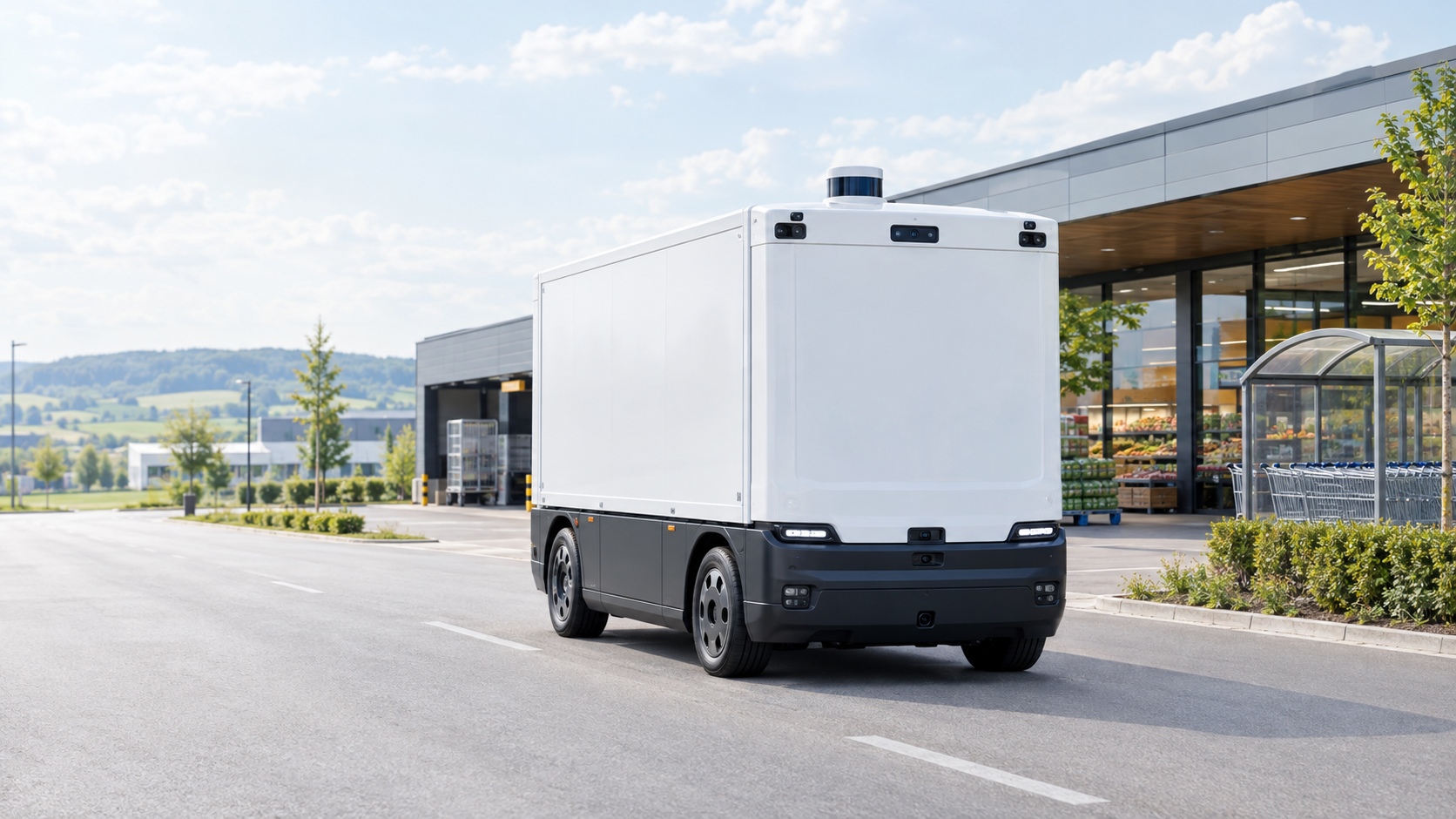
Driverless truck: Lidl and Einride are testing autonomous delivery logistics – What the four-month test aims to show – Creative image on the topic, with AI: Xpert.Digital
Driverless delivery traffic: Can Lidl's autonomous truck reduce costs?
Lidl is betting on autonomous electric trucks: This is how the test becomes a stress test for economic viability
A truck without a driver's cab is a striking symbol of the transformation of logistics. Whether this translates into a viable business model, however, depends not on the unusual vehicle design, but on a concrete question: Can the autonomous electric truck transport goods reliably, safely, and at competitive costs? This is precisely what Lidl and the Swedish technology company Einride intend to test in Edermünde, near Kassel, in the German state of Hesse. For four months, the vehicle will transport goods between an administrative and distribution center and a nearby branch – on public roads and as part of regular operations.
The trial is deliberately designed to be manageable: A clearly defined route, a fixed product range, and recurring trips are intended to demonstrate how well autonomous technology integrates into the processes of the grocery retail sector. The projected transport volumes are initially project goals, not proven results. Furthermore, official approval alone does not prove that the autonomous vehicle operates more cost-effectively than conventional transport.
For the economic assessment, more than just the journey itself is important. The vehicle, energy, charging infrastructure, software, technical monitoring, and the effort involved at loading and unloading points must all be considered together. Equally crucial is how frequently the vehicle is actually used and how reliably it handles malfunctions or changing conditions. The four-month test is therefore intended not only to evaluate the technology but also to demonstrate which parts of the supply chain are changing – and whether this results in a tangible benefit for everyday use.
The driver disappears – but the costs are far from being covered
A truck without a driver's cab is a striking symbol of technological change. However, the economically crucial factor is not what this vehicle lacks, but whether it can reliably, safely, and competitively perform a full transport function. This is precisely the question addressed by the collaboration between Lidl and the Swedish technology company Einride. In Edermünde, near Kassel in Hesse, a cabless, battery-electric truck will transport goods between an administrative and distribution center and a nearby branch. The four-month trial combines autonomous driving on public roads with a concrete task in the day-to-day operations of the grocery retail sector.
The economic significance lies less in the individual route than in the potential transformation of an established production process. Currently, transport performance arises primarily from the interplay of vehicle, driver, energy, infrastructure, and dispatching. Autonomous systems shift this relationship: software, technical monitoring, data processing, and a precisely defined operational organization gain in importance. Human labor does not disappear entirely, but rather shifts and changes its nature.
This does not mean the immediate replacement of conventional delivery fleets. Rather, it initiates an examination of the conditions under which a new transport approach can improve existing structures. The most convincing perspective, therefore, lies neither in technological euphoria nor in fundamental skepticism. Autonomous delivery logistics must be judged on whether it achieves a tangible economic advantage while maintaining comparable safety and service quality.
A manageable deployment with strategic reach
The project, presented in September at IAA TRANSPORTATION 2026 in Hanover, has clearly defined parameters. The solo vehicle used has 15 Euro pallet spaces, is intended to run up to three times a day, and will handle all dry goods deliveries along the selected route. A transport volume of more than 3,000 pallets is anticipated for the four-month project period. Operation will be carried out at SAE Level 4 in designated areas, subject to approval by the German Federal Motor Transport Authority (KBA). The project was jointly initiated by Schwarz Corporate Solutions and Schwarz Digits.
These key data describe a real-world operational use case, but not yet a proven economic breakthrough. In particular, the announced pallet volumes cannot be equated with results already achieved. Likewise, an operating permit does not automatically prove that the solution is cheaper than conventional transport.
What is remarkable, however, is the deliberate limitation. A known connection between two operational locations reduces the number of variables. Route, transfer points, type of goods, and frequency of repetition can be examined with relative precision. This makes it easier to distinguish between technical malfunctions and organizational problems.
The proximity to the actual flow of goods also prevents the evaluation from being based solely on a demonstration run. When transport is part of branch supply, technical performance promises meet concrete requirements regarding product availability, personnel planning, and time windows.
Why the grocery retail sector is becoming a test case
Food retail and transport logistics are closely intertwined. Retail spaces only generate revenue if in-demand goods are available on time. At the same time, every additional inventory ties up capital and occupies scarce storage space. This creates a conflict of objectives between high delivery readiness and maintaining the leanest possible inventory levels.
An autonomous truck must therefore prove itself not only in road traffic. It must fit into a system whose individual processes are coordinated in terms of timing. Order picking, preparation, loading, transport, goods receipt, and storage form an integrated service chain. An advantage in one segment can be completely negated by disadvantages in another.
Limiting the scope to dry goods sensibly narrows the experiment. However, it does not represent the entire spectrum of retail logistics. A successful transport of dry goods does not automatically imply that the same solution is economically viable for temperature-controlled, time-critical, or differently handled goods.
It is precisely this differentiation that makes the approach interesting. It does not attempt to automate all transport tasks simultaneously. Instead, a clearly defined subtask is selected, the requirements of which can be systematically examined.
What the announced transport volumes actually mean
The capacity figures allow for an initial assessment of the operational scope. With 15 pallet spaces and up to three daily trips, the calculated maximum one-way capacity is 45 pallets per day, provided all trips are fully utilized and actually transport goods to the branch.
A volume of 3,000 pallets corresponds to 200 loaded trips at full capacity. With three such trips per day, this would require almost 67 operating days. This calculation merely describes a theoretical ratio. It says nothing about which days the trips are made, how many pallet spaces are actually used, or how the return trips are organized.
The phrase "up to three times a day" refers to an upper limit, not a reliable average. Similarly, the figure of more than 3,000 pallets is initially a project size and not a published performance record.
Crucial information is missing for an economic evaluation: route length, travel time, actual load, energy consumption, loading times, and required support effort. Without this data, neither a reliable price per kilometer nor a realistic cost rate per pallet can be determined.
The available data is therefore sufficiently informative to understand the use case. However, it is not sufficient on its own to make an investment decision.
The crucial comparison is not diesel versus the future
A dispassionate analysis must distinguish between two changes: electric propulsion and autonomous driving. Both can be combined, but they solve different economic problems.
Electric propulsion primarily changes energy supply, charging requirements, maintenance structure, and local emissions. Autonomous driving, on the other hand, changes the organization of the driving task, technical monitoring, and the need for personnel directly in the vehicle.
Comparing an autonomous electric truck solely to a diesel-powered, human-driven vehicle conflates these effects. A fair comparison therefore requires multiple reference points: current transport methods, a conventionally driven electric truck, and finally the autonomous electric solution.
Only then can it be determined what proportion of a potential advantage stems from the drive system and what proportion from automation. It also becomes clear whether additional software and support costs negate some of the personnel savings.
This distinction is also important for strategic decision-making. A company might find that electrifying a route is already worthwhile, but automating it is not. Conversely, a particularly suitable route might offer significant benefits from automation, even though other parts of the fleet will continue to operate conventionally for the time being.
Transportation costs must be calculated across the entire supply chain
The key business metric is not the price of the vehicle, but the cost of reliably providing transport services. To determine this, all relevant costs must be aggregated over a suitable observation period.
This includes vehicle financing, depreciation, energy, charging infrastructure, maintenance, tires, insurance, software, data connections, technical support, and breakdown cover. Additional costs include integration into existing IT and operational processes.
Furthermore, autonomous systems incur costs that might not appear as separate items in a traditional vehicle invoice. These include, for example, the operation of a control center, the handling of exceptional cases, and the maintenance of route-specific operational information. Which of these services are required in the specific project and how they are billed is not publicly available.
Therefore, a functional analysis is crucial: What resources are needed to ensure that a pallet arrives safely within the promised timeframe?
A low price per kilometer can be misleading if the vehicle transports little cargo or requires additional staff hours at the loading dock. Conversely, a more expensive vehicle can be economically advantageous if it achieves high utilization and reliably alleviates costly bottlenecks.
The driver shortage changes the bill, but does not replace it
The shortage of qualified drivers is one of the challenges explicitly addressed by the project. Economically, such a bottleneck has several impacts. It can make it more difficult to fill shifts, increase the cost of short-notice replacement transport, and impair the predictability of the entire flow of goods.
Autonomous systems could provide relief here by taking over recurring, standardized journeys. The benefit would then not be solely about saving a certain number of working hours. It would also allow existing drivers to be deployed more effectively where human flexibility is particularly valuable.
However, the need for personnel doesn't simply disappear. Technical monitoring, maintenance, scheduling, and fault management also require qualified employees. The more demanding the service and the smaller the number of vehicles being serviced simultaneously, the smaller the calculated advantage may be.
A sound economic analysis should therefore not assume a blanket, complete replacement of a driver's position. It must identify which human tasks are actually eliminated, which remain, and which are new.
This may alleviate the bottleneck, but at the same time partially shift it to other qualification areas.
Level 4 means independence within clear boundaries
The stated level of autonomy is crucial for understanding the business model. Operation at SAE Level 4 refers to a defined operating environment and specified operating conditions. This does not imply a universal ability to autonomously navigate any road under all conceivable circumstances.
Economically, this limitation is by no means automatically a disadvantage. A transport service provider does not have to solve every conceivable traffic scenario to generate profit on a suitable route. The decisive factor is whether the technically manageable operating environment aligns with a sufficiently valuable and frequently recurring transport demand.
The boundary becomes relevant where actual conditions change. Construction sites, blocked access roads, unusual traffic situations, or altered operational procedures may necessitate adjustments.
Therefore, performance should not be measured solely by successful standard journeys. Equally important is how the overall system handles deviations. What situations lead to an interruption? How long does it take to resume operation? Who organizes the replacement service?
An autonomous vehicle is only as economically efficient as the process that manages its limitations.
It is not the journey, but the handover that determines the process
A cab-less vehicle initially automates the driving task. This does not mean, however, that loading, unloading, load securing, and goods receipt also occur autonomously.
This distinction is particularly important in branch operations. The vehicle must arrive at a suitable point, be clearly assigned, and fit into the goods receiving process. Employees need to know when it will be ready, how access works, and how to handle any deviations.
If drivers have previously performed certain support tasks, these tasks must be redistributed. This may result in additional working minutes at the distribution center or branch. This time must be included in the overall calculation, even if it is not booked to the transport cost center.
Ergonomic and organizational factors also play a role. An economically advantageous solution should not derive its benefits from simply shifting the effort to another area.
The real innovation, therefore, does not simply lie in a vehicle without a driver's cab. It lies in a newly coordinated collaboration between transport technology, warehouse organization, and branch operations.
Planned repetition can be more valuable than maximum reach
Long ranges and particularly high speeds are often in the public interest. For regularly repeated transport between two locations, other characteristics may be more important.
A short, reliable connection can be organized with clear departure times, defined loading windows, and recurring handover processes. This facilitates the coordination between goods delivery and vehicle availability.
The economic advantage arises from repetition. A one-time investment in setting up the operation can be spread over many similar trips. The more stable the route and the more frequently it is used, the more readily these upfront investments can be justified.
However, the importance of repetition should not be confused with automatically high utilization. A vehicle that is only used productively for a few hours a day can incur high costs per transport unit, despite technically successful journeys.
Therefore, the evaluation considers not only kilometers driven, but also productive operating hours, transported volumes, and the utilization of invested capital. Technical availability and economic capacity utilization are related, but not identical.
Your intralogistics experts

Consulting, planning and implementation of complete solutions for high-bay warehouses and automated storage systems - Image: Xpert.Digital
More information here:
The transformation of logistics: Autonomous vehicles put to the test
Loading becomes part of production planning
Electrification makes energy supply a directly relevant planning component of operations. A vehicle can only be used reliably if its state of charge, route planning, and charging infrastructure are compatible.
For a manageable route, it is generally possible to coordinate energy consumption and charging times relatively precisely. However, whether this succeeds in a specific case depends on factors that have not yet been published, such as the route profile, consumption, and available charging capacity.
The electricity price alone is not sufficient for cost calculation. Investments in charging points, any necessary site adjustments, and the timing of power consumption are also relevant. It must also be considered whether charging can take place during existing downtime or displaces productive operating time.
As the fleet grows, a single charging decision becomes a coordination task. Several vehicles may require energy simultaneously, even if their departure times are close together.
Good load planning is therefore not a secondary, auxiliary issue. It influences how many vehicles are needed and how reliably the entire transport service can be provided.
Zero emissions require a precise economic and ecological classification
A battery-electric truck produces no exhaust emissions from a combustion engine while driving. However, this local characteristic is not equivalent to completely emission-free transport performance over the entire life cycle.
A comprehensive climate assessment would require considering factors such as vehicle and battery manufacturing, electricity generation, use, and recycling. Without corresponding project data, it is impossible to quantify any reliable, concrete CO₂ savings.
Capacity utilization also influences the environmental impact. If the same goods are transported with additional, lightly loaded journeys, the environmental balance per pallet changes. Conversely, well-planned routes and high utilization can improve environmental performance.
Therefore, from both an economic and ecological perspective, there is a shared interest in efficient overall utilization. However, this does not mean that both goals are identical in every situation. For example, reserve capacity can ensure supply even though it reduces average utilization.
A credible assessment should disclose such conflicting objectives, instead of treating drive technology alone as sufficient proof of sustainability.
The size of the Lidl network is an option, not a sales guarantee
With 39 administrative and distribution centers and more than 3,250 stores, Lidl has a large potential application area in Germany. Purely mathematically, this equates to an average of more than 83 stores per distribution center in the network. However, this average does not describe specific responsibilities, distances, or delivery routes.
The strategic strength lies rather in being able to select, from many possible connections, those that are particularly well suited to the technical requirements. Not every branch needs to be suitable for a relevant economic benefit to be generated.
A selective expansion can even be more sensible than attempting comprehensive standardization. Short, frequently used routes that are easy to manage organizationally could be evaluated differently than long or highly variable routes.
Network size thus creates options and facilitates the reuse of successful standards. However, it does not prove that the first project can be transferred to all locations.
The economically relevant question is therefore not how many branches theoretically exist. The crucial question is how many suitable connections remain after a complete cost and risk analysis.
The move to a milkrun changes the rules of the game
Following successful validation, the second phase involves expanding the model into a milkrun service with multiple stops at another location. This would transform a direct connection into a more complex route structure.
Such an approach could improve vehicle utilization because multiple delivery needs could be combined into a single trip. However, the potential benefit depends on whether additional stops, waiting times, and distances negate the improved capacity utilization.
With each stop, the demands on sequence, time windows, and information exchange increase. A delay at the first location can affect subsequent deliveries. Loading must also be coordinated with the unloading sequence.
The milkrun is therefore not just a larger version of the same task. It tests a new level of organizational capability.
For scaling purposes, it would be particularly revealing whether the system can handle different branch situations without generating disproportionately high setup and maintenance costs for each location. This is precisely where it will be decided whether a local success becomes a transferable operating model.
The learning curve must grow faster than the adaptation effort
Economies of scale do not automatically arise from purchasing more vehicles. They require that experience, software, operating rules, and infrastructure can be reused multiple times.
If every new route requires extensive individual adjustments, costs will increase significantly with expansion. An economically attractive model, on the other hand, would have to ensure that new connections can be integrated with decreasing additional effort.
Several levels must be distinguished here. Technical findings can be transferred, although local access routes still need to be individually checked. A standardized goods receiving area can connect many branches, even if their spatial conditions remain different.
The relevant learning curve therefore concerns the entire system. How quickly can another location be prepared? How much personnel will be required? Which components can be adopted unchanged?
A pilot generates economic value when it answers these questions. It loses its significance when exceptionally high support requirements are ignored as a permanent norm.
For Einride, the transition from project to repeatable offering is crucial
From Einride's perspective, the collaboration is more than just a vehicle test. It offers the opportunity to test the technology within an existing retail network with actual delivery requirements.
The crucial entrepreneurial step is to develop a consistently deliverable offering from a technically feasible service. Customers need transparent pricing, clearly defined responsibilities, and reliable service quality.
For this to work, hardware, software, and operation must be economically compatible. A high-performance autonomous driving system alone is not enough if maintenance, support, or route setup remain too expensive.
Equally important is the contractual allocation of risks. Who bears the costs in the event of an interruption? What services are considered guaranteed? How are software changes and technical enhancements billed?
No details are available regarding the specific terms of the contract. This information gap limits the assessment of the business model. Successful implementation can strengthen the market position, but it is not yet proof of sustained profitable scaling.
For the Schwarz Group, the acquisition of knowledge is an asset in itself
The involvement of Schwarz Corporate Solutions and Schwarz Digits demonstrates that the topic extends beyond operational transport handling. Autonomous logistics encompasses data processing, IT integration, process design, and the long-term management of supply chains.
Early implementation can create valuable internal capabilities. The company learns what data is required, which interfaces work, and what organizational changes are actually necessary.
This knowledge gained has strategic value, even if a single pilot project does not yet yield a cost advantage. It can improve later procurement decisions and make unrealistic performance promises easier to identify.
However, this does not automatically guarantee technological independence. Those who use key functions of a specialized partner remain dependent on its performance and further development.
Sovereignty should therefore be understood primarily as the ability to act: to define one's own requirements, control data, verify system performance, and evaluate alternatives. An autonomous vehicle does not acquire these capabilities on its own. They must be developed through architectural decisions and internal expertise.
Data becomes a production factor and a source of dependency
For autonomous operation, information about vehicle status, transport order, and operational procedures must be combined. The value of this data lies in the fact that decisions can be better prepared and deviations detected more quickly.
At the same time, the importance of interfaces is growing. A delayed order, an incorrect status, or unclear responsibility can impair physical transport performance.
The support provided by the Mobility Data Space highlights the importance of a suitable data environment. However, the specific data flows and services used in the project are not detailed.
Therefore, fundamental questions are economically crucial: Who has access to the operational data? In what form can it be analyzed? Can the insights gained be reused when switching providers?
If data can only be used within a closed system, switching costs can arise. A short-term efficiency gain would then have to be weighed against a potentially stronger long-term commitment.
Security is a necessary condition, not an ordinary cost item
Approval by the Federal Motor Transport Authority is an essential component of the intended operation. However, it should not be confused with a universal approval for any routes or conditions.
From a business perspective, security initially means a clear limit: A cost advantage is not acceptable if it is based on an inadequately controlled risk.
At the same time, the safety concept and operational organization influence economic efficiency. A system that frequently enters a safe shutdown may react cautiously from a technical standpoint but still be operationally problematic. Therefore, safety performance and availability must be recorded separately and assessed together.
It's not just extraordinary incidents that are important. Even recurring minor interruptions can cause significant follow-up costs.
A reliable evaluation would therefore need to document how often deviations occur, what their causes are, and how quickly normal operation is restored. Only in this way can a distinction be made between a fundamentally functioning system and a transport service that is robust in everyday use.
A four-month study answers important questions, but not all of them
A deployment lasting several months is more informative than a single demonstration. Repeated runs make it possible to examine the stability of the operation, typical malfunctions, and the actual personnel requirements.
However, a four-month period has its limitations. It does not represent the complete long-term aging of the vehicle and battery. Nor does it readily allow for conclusions about all seasonal conditions or rare events.
Economic indicators can also be distorted in the start-up phase. High setup costs initially increase expenses, while intensive project support may provide greater operational security than would later be anticipated.
Therefore, two calculations should be separated: the actual project costs incurred and a reasoned model calculation for a stabilized continuous operation.
The second calculation must not merely contain optimistic assumptions. It must explain which costs are expected to decrease in the future, why this is plausible, and what conditions must be met.
Which key performance indicators determine success or failure?
A reliable evaluation requires a coherent system of key performance indicators. The number of pallets transported is important, but it only describes part of the overall performance.
The data to be recorded includes actual journeys made, average load, punctuality, productive operating time, and unplanned downtime. Energy consumption per transport unit and total human labor expenditure should also be recorded.
The effort required for exceptional cases is particularly relevant. A low average need for support can be misleading if individual disruptions trigger many working hours and alternative transport arrangements.
On the cost side, the effort required per successfully delivered pallet should be considered. Additionally, an evaluation of each completed delivery route on time and in full is advisable.
All key performance indicators require a suitable basis for comparison. Only a comparison with a human-driven alternative on the same or a comparable route shows whether the technology offers additional benefits.
Success, therefore, would not simply be the highest possible number of autonomously driven kilometers. Success would be a demonstrably better or more strategically valuable transport service.
The alternative to autonomous vehicles also needs to evolve
Investment decisions are often calculated against an unchanged status quo. This can overestimate the benefits of a new technology.
Conventional transport can also be improved: through adjusted routes, different time windows, better vehicle utilization, or electrification without autonomous driving. Such alternatives may require less initial investment.
The relevant comparison, therefore, is not whether an autonomous vehicle is better than a poorly organized existing process. It must prove itself against a realistically optimized alternative.
Opportunity costs must also be taken into account. Capital and management capacity invested in an autonomous project are not simultaneously available for other improvements.
Nevertheless, a pilot project that is initially more expensive can be worthwhile if it provides crucial knowledge for future decisions. However, this learning value should be explicitly stated, rather than being presented retrospectively as already achieved operational profitability.
A clear separation between research benefits, strategic preparation, and ongoing economic efficiency improves the quality of the decision.
The value of reliability can be higher than the pure savings
Focusing solely on direct costs is insufficient in the retail sector. Transportation also serves the purpose of ensuring the branch's sales potential.
When a technology improves planning, it can generate additional benefits: less short-term reorganization, better coordinated goods receipt, and less dependence on individual personnel shortages.
However, this benefit is not automatic. It must be examined based on actual changes. An autonomous solution that frequently requires replacement in case of malfunctions could also complicate the planning process.
Therefore, the entire distribution of possible outcomes is economically relevant, not just an average value. Two systems may have similar average costs but differ significantly in the frequency and severity of failures.
A company can reasonably opt for the slightly more expensive solution if it is significantly more reliable. Conversely, a nominally inexpensive technology may remain unattractive if its risks are difficult to predict.
Germany's competitive advantage lies in its industrial connectivity
The project also has a location-policy dimension. Germany is not just a place where new vehicle technology is being showcased. It is an environment where this technology must be integrated with existing business processes, approval requirements, and real-world road traffic.
Christian Hirte, as Parliamentary State Secretary at the Federal Ministry of Transport, provides political support for the initiative. However, its economic success depends not on political attention, but on whether reliably usable solutions emerge from approved individual applications.
A demanding market access approach can strengthen trust if it is linked to transparent requirements. At the same time, it is important for companies that further expansion remains predictable.
The location's opportunity therefore lies in the combination of security, technical expertise, and practical implementation. A country doesn't win simply by showcasing numerous pilot projects. What matters is whether these projects result in productive applications, skilled jobs, and competitive performance.
Realistic change begins with suitable sections
The most viable development is probably not an abrupt switch to fully autonomous delivery networks. A gradual expansion of existing fleets seems more plausible.
Autonomous vehicles would initially be deployed where recurring processes, suitable routes, and sufficient transport volumes converge. Other tasks would remain human-driven because they require greater flexibility or are not yet technically or economically viable.
Such a mixed system is not a sign of failure. It can be an efficient form of division of labor.
For Lidl and Einride, the key test lies in precisely identifying suitable use cases and demonstrating their advantages. The cabin-free design makes the transformation visible. However, its economic viability only emerges through reliable processes, manageable operating costs, and sufficient utilization.
The rationale is therefore this: Autonomous branch delivery has serious potential, especially on standardized and frequently repeated routes. Whether this becomes a widely applicable business model depends not on the technological novelty, but on the ability to permanently improve the organization of a complete transport service.
Your global marketing and business development partner
☑️ Our business language is English or German
☑️ NEW: Correspondence in your native language!

Konrad Wolfenstein
I and my team are happy to be available to you as your personal advisor.
You can contact me by filling out the contact form here [email protected]:or simply call me at +49 7348 4088 965. My email address is
I'm looking forward to our joint project.