

The price of double standards: How German foreign policy squandered the world's support
Xpert Pre-Release

Language selection 📢
Published on: June 5, 2026 / Updated on: June 5, 2026 – Author: Konrad Wolfenstein
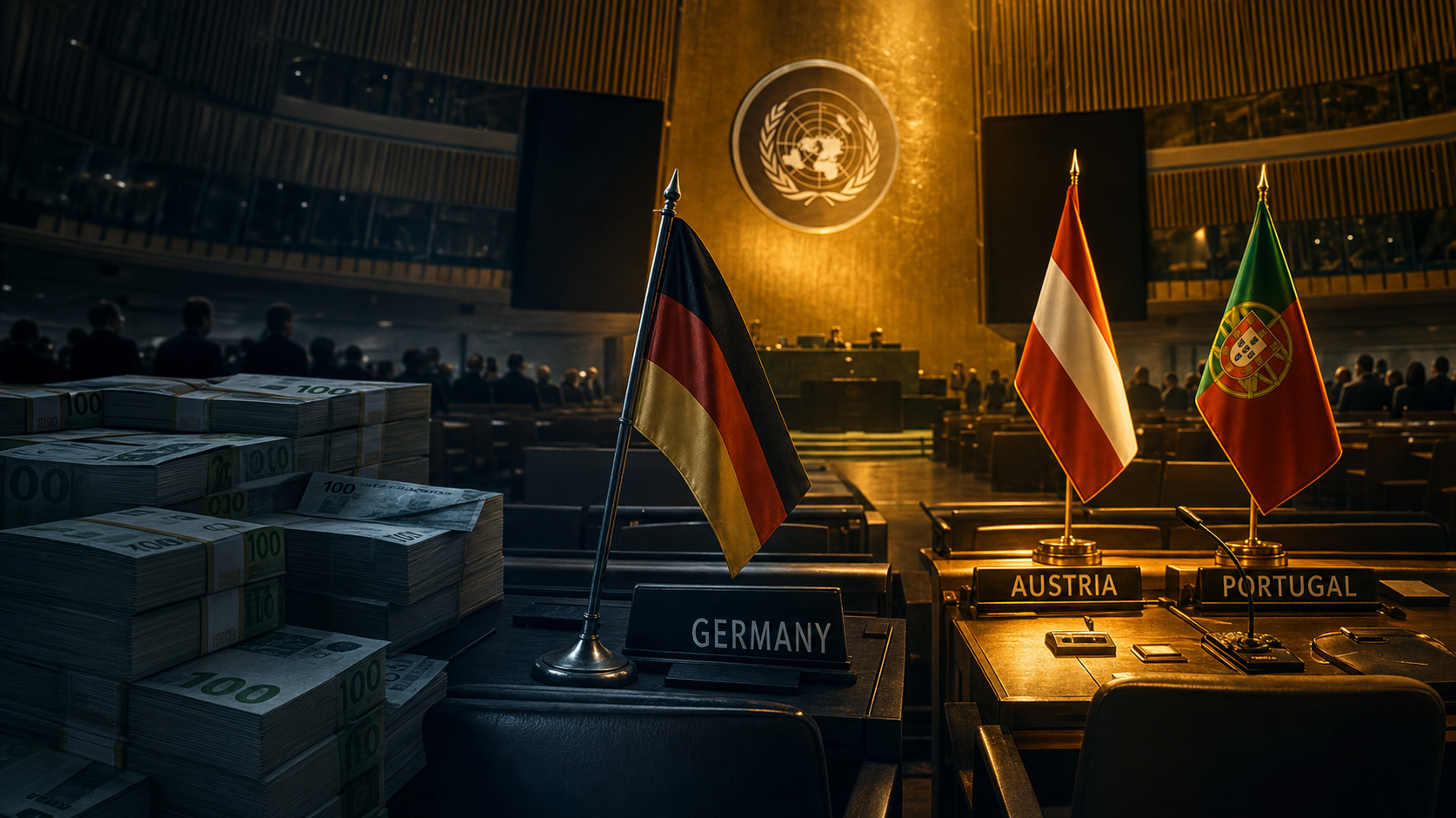
The price of double standards: How German foreign policy squandered global support – Image: Xpert.Digital
Paymaster without a voice: What the expulsion from the UN stage reveals about the state of Germany
Loss of power of the "foreign chancellors": Why the Global South has turned away from Germany
Baerbock's legacy and Merz's mistakes: The real reasons for Germany's embarrassment in the Security Council
On June 4, 2026, German foreign policy suffered a historic setback: For the first time, the Federal Republic failed to secure a non-permanent seat on the UN Security Council. Despite billions in contributions, the United Nations refused to back Germany, favoring Portugal and Austria. But the New York debacle didn't come out of nowhere. It is the harsh reckoning for years of foreign policy inconsistencies, a perceived hypocrisy in the Global South, and diplomatic blunders ranging from Annalena Baerbock to Chancellor Friedrich Merz. This is an in-depth analysis of why Germany has been reduced from a pioneer of the rules-based world order to an isolated paymaster – and why the ironclad rule of international diplomacy is: Billions in aid don't buy political power.
Germany's UN disaster: Payers without a voice
When bank transfers don't buy votes – and why that shouldn't surprise anyone
On June 4, 2026, the Federal Republic of Germany suffered a diplomatic defeat unprecedented in its history as a UN member. In the UN General Assembly vote in New York, Germany failed for the first time ever to secure a non-permanent seat on the Security Council. Portugal received 134 votes, Austria 131 – and Germany a mere 104 out of 190 votes cast. 127 votes, or a two-thirds majority, were required. The result is not merely a political signal, but a reflection of a deeper crisis in German foreign policy – one that has been building for years under several governments and has far more causes than the failure of a single individual or party.
The shock in New York: What exactly happened
Germany's candidacy for a non-permanent seat on the UN Security Council for 2027 and 2028 was long considered a sure thing. Within the Western European and Other Countries Group (WEOG), three countries were vying for two seats – a situation that made a contested vote inevitable. In the weeks leading up to the vote, German Foreign Minister Johann Wadephul campaigned intensively for German support, even undertaking an extensive diplomatic tour. His campaign slogan was: "Respect – Justice – Peace." It was all to no avail.
The voting result was devastating, not only because of the sheer number of votes, but because of the margin of defeat. Germany fell 23 votes short of the necessary threshold and lost to both of its rivals simultaneously. Immediately after the vote, Wadephul spoke of a "bitter defeat" and even admitted to having briefly considered resigning. The fact that he remained in office after a brief hesitation does not alter the fact that the Federal Republic suffered a humiliation of international significance that day.
For Chancellor Friedrich Merz, who since taking office has liked to portray himself as a "foreign chancellor" and dreamed of discussing matters on equal footing with the heads of government of the world powers in the Security Council, this is a setback of considerable symbolic weight. All the more ironic: Merz himself stayed away from the UN General Assembly in September 2025 because the budget week in the Bundestag seemed more important to him. This was certainly noted in diplomatic circles – and interpreted as an indication of how serious Germany actually is about its UN commitment.
Numbers and reality: What Germany delivers – and doesn't receive
To understand the New York disaster, one must first grasp the financial dimension. Germany is one of the largest supporters of the entire UN system. German contributions in 2023 amounted to nearly €5.1 billion, following approximately €6.8 billion in 2022. This makes Germany the second-largest contributor to the UN, right after the USA. Germany contributes 5.69 percent to the regular UN budget – equivalent to around US$195 million for the 2025 fiscal year. In addition, Germany financed Bundeswehr deployments within the framework of UN peacekeeping missions in 2022 and 2023 with a total of approximately €874.5 million.
These figures are impressive. But they also explain the real problem: In Germany – and in parts of the political establishment – a fundamental misunderstanding has taken root. There's a belief that financial contributions automatically generate political influence. This is a miscalculation that is punished particularly harshly within the United Nations system. The UN General Assembly operates on the principle of "one state, one vote" – regardless of whether the country in question contributes billions or hardly anything. The island nation of Tuvalu, with its approximately 11,000 inhabitants, has the same voting rights as the Federal Republic of Germany, with its 84 million inhabitants and the largest economy in Europe.
Power in international politics arises from the alignment of interests, strategic alliances, economic and military strength, and consistent, credible positions – not from mere payments. This is the ironclad logic of the international system, which Germany, under several governments, has apparently not sufficiently internalized. The fact that Manfred Pentz, the Hessian Minister of State for International Affairs, is now the first state representative to publicly question UN payments demonstrates how the reaction in Germany is based on this misunderstanding: those who pay and yet receive no influence feel cheated – and threaten to stop payments. This is understandable from a domestic political perspective, but strategically counterproductive.
The structural crisis: Contradictory signals over the years
The defeat in New York is not the result of a single mistake, but rather the sum of several missteps that have accumulated over years. The crucial finding is that Germany has acquired a reputation in the international community as an inconsistent, contradictory actor – a country that sometimes presents itself as the supreme defender of international law and at other times looks the other way for tactical reasons.
The pattern is well documented. During Russia's war of aggression against Ukraine, Germany took a swift and clear stance – even at considerable economic cost by ending its dependence on Russia for energy. This sent a consistent signal of a values-based foreign policy. In contrast, Germany acted hesitantly during the Gaza war. Based on its historical responsibility towards Israel as a matter of national interest, the Federal Republic found it difficult to clearly acknowledge the humanitarian catastrophe in the Gaza Strip and to describe Israeli warfare for what international legal experts and UN bodies recognized: a violation of international humanitarian law. The obvious dissonance between Germany's commitment to a values-based foreign policy and its support for Israel despite serious war crimes has severely damaged Germany's reputation in the Global South.
In Arab countries, Germany's reputation has plummeted to its lowest level in decades – only nine percent of the population there now holds a positive view of the Federal Republic. Trade unions are suspending cooperation with German foundations, human rights organizations are severing long-standing relationships, and female academics are facing rejection. Images of German weapons being used in Gaza and of the violent dispersal of pro-Palestinian demonstrations are circulating around the world. This dynamic is hitting Germany in an area where it considered itself particularly strong: as a moral authority and a reliable partner of the Global South.
Baerbock's legacy: Preliminary concerns
A key factor in Germany's defeat at the UN was already established beforehand, and its name is Annalena Baerbock. The former German Foreign Minister caused considerable irritation within the UN system through her actions in her own affairs. Since 2015, the WEOG group had decided that Germany should assume the presidency of the UN General Assembly for the 2025/26 session. The experienced top diplomat Helga Schmid – a highly respected international figure – had been designated as the candidate since September 2024.
Just a few weeks after the end of the traffic light coalition, the picture changed abruptly. Baerbock, who had just lost her post as foreign minister and had initially declared her intention to pause after "years at high speed," suddenly discovered her interest in the top New York post. Contrary to all existing agreements, the outgoing federal government pushed through Baerbock as its candidate – Helga Schmid reportedly only learned of it at the last minute. The cabinet approved Baerbock's nomination via a written procedure.
In diplomatic circles at the United Nations, this reshuffle was noted with great interest. The questions that arose were uncomfortable: Do the Germans see the UN as a stage for national power games and patronage positions? Can agreements with Berlin be reliably honored? CDU Member of Parliament Tijen Ataoğlu summed it up perfectly when she explained that many countries no longer perceive Germany as a leading, shaping nation, but rather as an uncertain and often contradictory actor. This perception has been cemented, not refuted, by Baerbock's appointment.
It's not that Baerbock's qualifications were fundamentally undisputed. She possesses international negotiating experience, and the German government defended her nomination. But ultimately, it wasn't about qualifications. It was about the signal the move sent: A country that breaks internal agreements, shifts previously agreed-upon positions for party-political or career interests, and in doing so offends a high-ranking diplomat, doesn't appear reliable in the international community. And reliability is the be-all and end-all of multilateral diplomacy.
The Gaza Syndrome: When national interest becomes a foreign policy liability
No other issue has damaged Germany's international reputation in recent years as severely as its stance in the Gaza war. German raison d'état—the commitment to Israel's security as part of German identity after the Holocaust—is a moral pillar of the German state. However, in practice, since October 7, 2023, this has become a foreign policy liability.
While Germany clearly sided with international law in Russia's attack on Ukraine, the German government avoided taking a clear position on the Gaza conflict. Foreign Minister Wadephul had pointed out on Deutschlandfunk radio before the UN vote that there were "other considerations – our alliances, our economic interests, our security policy interests" that had to be taken into account. This is diplomatically honest, but it reveals a double standard: For Germany, the principle of international law apparently does not apply absolutely, but rather contextually. It applies when it suits them and is sidelined when it becomes inconvenient.
This selective application of international law has generated deep mistrust in the Global South – where most of the votes in the UN General Assembly are held. A representative survey conducted in Germany itself in August 2025 showed that 65 percent of respondents believed the Israeli army was committing war crimes and crimes against humanity in Gaza; 59 percent considered its actions genocide against the Palestinian population. Only ten percent fully supported the statement that Israel's security should be a German national interest. German foreign policy under the previous coalition government – and to a significant extent also under the previous one – has thus distanced itself not only from the majority opinion worldwide, but also from the majority opinion at home.
This has real diplomatic consequences. Russia – which is actively working against German influence at the United Nations – was able to mobilize a large number of smaller countries that have the same voting rights as France or the USA. Countries of the Global South, which did not feel represented by the German position, abstained or voted against Germany. The SPD foreign policy expert Adis Ahmetovic put it bluntly: Anyone who claims to be the guardian of the rules-based international order must not apply double standards to international law.
Our EU and German expertise in business development, sales and marketing

Our EU and German expertise in business development, sales and marketing - Image: Xpert.Digital
Industry focus areas: B2B, digitalization (from AI to XR), mechanical engineering, logistics, renewable energies and industry
More information here:
A thematic hub offering insights and expertise:
- Knowledge platform covering global and regional economies, innovation and industry-specific trends
- A collection of analyses, insights, and background information from our key areas of focus
- A place for expertise and information on current developments in business and technology
- A hub for companies seeking information on markets, digitalization, and industry innovations
Why Germany failed in the UN ranking — and what that means for Europe
The “sick man of Europe” and his radiance
There is another, structural dimension to the defeat that should not be overlooked: Germany's relative economic and political strength has shrunk considerably in recent years. Germany's share of global GDP fell from 4.2 percent to 3.27 percent between 2004 and 2022; its population share dropped from 1.34 percent to 1.08 percent. The economic weakness of the "traffic light" coalition years, the energy price crisis, the industrial recession, and the growing paralysis in Berlin have damaged Germany's image abroad—not only in the Global South, but also in Europe.
At the same time, competition for international recognition has intensified. Brazil, India, Indonesia, Saudi Arabia, and many other emerging economies are claiming greater weight in international bodies—and have strong demographic and economic arguments to support their claim. India can point to a share of 7.2 percent of global economic output and 18.3 percent of the world's population; Brazil to 2.35 percent of economic output and 2.8 percent of the world's population. Against this backdrop, Germany's continued claim to a permanent seat on the UN Security Council appears not only poorly justified but downright anachronistic.
At the same time, Europe already has two permanent members on the Security Council: France and the United Kingdom. Adding a third European country—especially one with diminishing global influence—to this group is hardly justifiable from the perspective of the UN majority. Germany should actually be advocating for a fundamental reform of the Security Council that takes into account the changed geopolitical realities—and foregoing its own seat in favor of a potential joint European seat. That would be politically courageous, strategically consistent, and would establish Germany as a shaping force. Instead, the Federal Republic has been following the same mantra for decades: paying tens of billions of euros and hoping for its own seat.
Reactions: Between thoughts of resignation and refusal to pay
The domestic political reactions to the New York debacle are indicative of the state of German foreign policy. Wadephul admitted he had considered personal consequences – and stayed on. Merz assured everyone that the German government's responsibilities at the UN would not change as a result of the election. This statement carries little weight, since Germany was not a non-permanent member anyway.
Calls for a stronger stance on international law came from within the ranks of the SPD. SPD parliamentary group vice-chair Siemtje Möller emphasized that Germany's commitment as a reliable partner for the rules-based international order needed to be even clearer and more consistent. While this is correct in principle, it comes at a time when the damage has already been done. AfD leader Weidel saw it as another embarrassment for the Chancellor, which benefits her politically but contributes nothing strategically to a solution. Green Party leader Brantner described the result as the consequence of a foreign policy that has lost credibility and trust internationally.
The most interesting reaction came from Hesse: State Minister Manfred Pentz was the first representative of a German state to publicly question Germany's UN payments. His argument—why one of the world's largest economies should continue investing so much money in the UN if it doesn't have the influence it deserves—resonates with the intuitive sense of justice felt by many citizens. However, from a strategic perspective, it is short-sighted. A halt to payments would further marginalize Germany's importance within the UN system, allow other countries like China to fill the resulting vacuum, and definitively ruin Germany's reputation as a reliable multilateral partner.
In New York, this debate is being followed very closely. The counter-question being asked there is: Do Germans see their membership fees as a purchase of influence? If so, they will be disappointed – because influence at the United Nations is not achieved through payments, but through political persuasion, reliable alliance-building, and consistent action.
The structural contradiction: defenders of norms without norm consistency
The core problem of German foreign policy can be summed up in one formula: Germany wants to be the guardian of the rules-based international order, but only applies the rules where they are convenient. This contradiction cannot be attributed solely to one party or government. It runs through the foreign policy of the traffic light coalition under Baerbock as well as through the current black-red coalition under Merz.
The Gaza stance is merely the most prominent example of this. Chancellor Merz also initially hesitated to comment on the US attacks on Venezuela and Iran – clearly within the context of a strategy to appease the Trump administration. However, anyone who claims to uphold international law while remaining silent on the actions of allied powers risks losing credibility in the eyes of the international community. This is especially true for those countries that are heavily reliant on international law because they lack the necessary military or economic resources.
This structural double standard is the real disaster behind the disaster. It's not about 23 missing votes in New York. It's about a fundamental question of identity for German foreign policy: Does Germany want to be a state of principles that consistently upholds its values, even if it comes at a high price? Or is it a state driven by interests that adjusts its stance depending on the tactical situation? Both positions are legitimate – but one cannot simultaneously want to be known for both. A clear position can convince other states. Ambiguity cannot.
What needs to be done now: Between credibility and realpolitik
The defeat in New York also presents an opportunity, if Germany interprets it correctly. The next chance to win a non-permanent seat is normally eight years away. The time until then could be used wisely – provided the political class is prepared to face the unpleasant consequences.
First, Germany needs to streamline its foreign policy. This doesn't mean abandoning all its own interests – no country does that. It does mean, however, that deviations from the principles of international law are not shrouded in silence, but rather explained transparently. Countries that are not well-disposed towards Germany would then at least be able to understand its position – a prerequisite for any diplomatic persuasion.
Secondly, Germany should actively and seriously push forward with the reform of the UN Security Council, without primarily seeking its own seat. A European joint seat, negotiated with the other EU partners, would be more credible and geopolitically relevant than a national one. Germany could position itself as an honest broker and driving force for reform – that would be a genuine contribution to a multilateral system that urgently needs renewal.
Thirdly, the domestic debate on UN contributions should be depoliticized. The demand for contribution cuts is populist, but strategically dangerous. Germany pays not only for influence, but also for an international framework from which an export-oriented economic power like the Federal Republic benefits massively. Reducing these contributions would generate short-term support, but in the long run would cause serious damage – in a world where multilateralism is already under considerable pressure.
The pattern behind the defeat
The vote of June 4, 2026, is more than a diplomatic setback. It is the visible result of a long development in which Germany has paid more money into the international system than strategic capital. In recent years, the Federal Republic has not distinguished itself as a shaping power, but merely as a payer – willing to settle bills, but not always willing to pay the political price that real influence requires.
Annalena Baerbock has contributed to this development, but she is neither solely responsible nor the main cause. The structural reasons – the selective application of international law, the erosion of Germany's reputation in the Global South, the tactical maneuvers in dealing with the Trump administration, the diplomatic irritations caused by the Schmid affair, the Chancellor's lack of presence on the UN stage – are the result of collective foreign policy missteps across several governments.
The uncomfortable question Germany now has to answer is not: Why didn't anyone vote for us? It is: What do we actually want to be in the world? As long as this question isn't answered honestly, billions more will flow to New York – and Germany will continue to watch world politics from the sidelines.
🎯🎯🎯 Data-driven B2B industry hub as a quasi-in-house solution

The quasi-in-house solution: How Xpert.Digital closes operational gaps in B2B marketing and sales – Smart Content-Driven Business - Image: Xpert.Digital
Xpert.Digital is a data-driven B2B industry hub led by Konrad Wolfenstein . The company acts as an external, quasi-in-house solution for industrial partners, closing operational gaps in marketing, content, and sales – without requiring additional resources on the client side.
More information here:
Your global marketing and business development partner
☑️ Our business language is English or German
☑️ NEW: Correspondence in your native language!

Konrad Wolfenstein
I and my team are happy to be available to you as your personal advisor.
You can contact me by filling out the contact form here [email protected]:or simply call me at +49 7348 4088 965. My email address is
I'm looking forward to our joint project.










