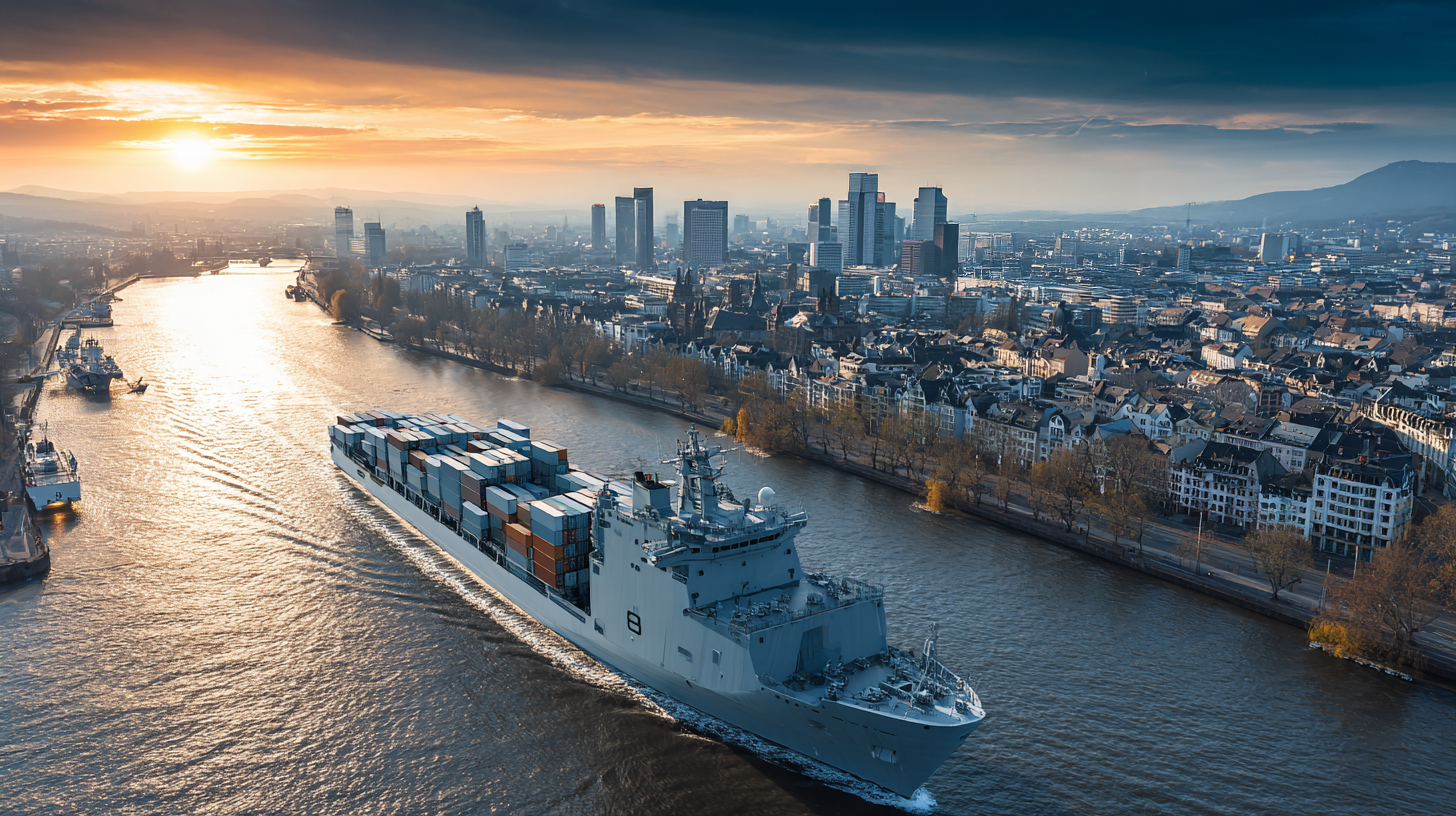
Defense instead of the economy? A strategic error? Defense logistics as a new financing channel – Creative image: Xpert.Digital
Port dispute escalates: The explosive plan behind the windfall for Bremerhaven – €1.35 billion for the NATO hub – €0 for Hamburg
Strategic error? Hamburg's CDU is up in arms against the federal decision
It is a decision of historic significance that is currently causing a political earthquake in the north of the republic: The federal government is investing the record sum of 1.35 billion euros in the port of Bremerhaven – financed from the defense budget.
While the port city is to be developed into NATO's central logistics hub on its eastern flank, Hamburg, Germany's largest universal port, misses out in this round of allocations. But what at first glance appears to be a regional distribution conflict between two Hanseatic cities reveals, upon closer inspection, the full drama of German infrastructure policy.
The following article analyzes the background of this unprecedented event. It examines how the new geopolitical security situation is revolutionizing port financing, why German ports are structurally disadvantaged in competition with Rotterdam and Antwerp, and why experts are warning of a fatal strategic blindness. Between military necessity, federal jurisdictional disputes, and the struggle for economic survival: Read why the future of German seaports is now being renegotiated.
Billions for Bremerhaven, nothing for Hamburg: When strategic blindness becomes more expensive than investment
The debate surrounding the financing of German seaports reveals a structural dilemma in federal infrastructure policy. While the federal government is providing €1.35 billion from the defense budget for Bremerhaven, Germany's largest seaport in Hamburg will initially receive nothing. This decision by the Bundestag's Budget Committee triggered a political clash between the CDU and SPD in January 2026, exemplifying the challenges posed by the interplay between national security policy, regional economic development, and the federal distribution of powers.
Defense logistics as a new financing channel
The allocation of €1.35 billion to Bremerhaven marks a paradigm shift in port financing. For the first time since the founding of the Federal Republic of Germany, such a massive sum is being specifically invested in the military infrastructure of a German seaport. The funds come from the defense budget and are to be invested between 2027 and 2031 in the renovation, modernization, and further development of the port infrastructure. This represents the largest single investment in Bremerhaven's history.
The strategic background to this decision lies in the changed security situation following the Russian attack on Ukraine and the resulting turning point. Bremerhaven is to be developed into a maritime logistics hub for NATO. Even now, rolling military supplies from the US Army are regularly handled at the overseas port on the ABC peninsula. The investments are intended to significantly expand capacity and, in a crisis, make the port the central hub for troop deployments and material transport to NATO's eastern flank.
The planned measures include reinforcing, deepening, and technically upgrading the power quay, renovating container quays, constructing heavy-load-bearing surfaces and quay walls, renewing the railway swing bridge in the Kaiserhafen harbor, and expanding the road and rail infrastructure. Furthermore, significant funds will be invested in protective measures, including visual barriers, fences, drone defense, digital surveillance, and cybersecurity. The goal is to be able to move the maximum amount of material in the shortest possible time.
Political ping-pong between the federal and state governments
The decision in favor of Bremerhaven and against Hamburg sparked a domestic political conflict that exposed the fundamental problems of German port financing. In mid-January 2026, the CDU parliamentary group in the Hamburg Parliament called on the red-green Senate to lobby the federal government for corresponding funds. Port policy spokesperson Antonia Goldner argued that Hamburg, given its geostrategic role as a key resource in times of tension or defense, needed to be strengthened. She pointed out that Hamburg, with Germany's largest seaport, was all the more entitled to such federal funding if Bremerhaven was already receiving €1.35 billion.
The SPD countered with an accusation against the federal government's maritime coordinator, Christoph Ploß, a CDU member of parliament from Hamburg. SPD parliamentary group leader Dirk Kienscherf accused Ploß of not adequately representing Hamburg's interests at the federal level. Although Ploß was aware of the insufficient federal support for German seaports, he had allowed Bremerhaven to receive the billions of euros exclusively, while all other seaports were left empty-handed.
This mutual blame game is nothing new. Back in November 2025, when the Budget Committee's decision was announced, the SPD and CDU accused each other of negligence. The structural problem runs deeper than partisan infighting would suggest. It touches on fundamental questions of the federal distribution of powers, the national security architecture, and the setting of economic policy priorities.
Structural financing deficit of German seaports
The current debate is symptomatic of decades of failure in port financing. Currently, all German seaports combined receive only €38 million annually from the federal government as basic funding. This sum has remained constant for 14 years and is completely disproportionate to actual needs. The Central Association of German Seaport Operators estimates the necessary annual investment at around €500 million. The German Trade Union Confederation arrives at similar figures. The discrepancy between available and required funds is thus a factor of 13.
Furthermore, the ZDS (Central Association of German Building Societies) has estimated the total backlog of necessary renovations at €15 billion. This figure is based on a survey of member companies and encompasses both priority and medium-term investment needs. ZDS President Angela Titzrath emphasized in November 2024 that this sum is necessary to fully and sustainably complete all urgently required modernizations within twelve years. To put this in perspective: €15 billion represents only three percent of the €500 billion special infrastructure fund planned by the German Federal Government.
The coastal states of Bremen, Hamburg, Lower Saxony, Schleswig-Holstein, and Mecklenburg-Western Pomerania have been calling for a fundamental reform of seaport financing for years. In July 2025, the CDU parliamentary group leaders of these states sent a joint letter to Chancellor Friedrich Merz and Vice-Chancellor Lars Klingbeil. They demanded a fair distribution of the burden between the federal and state governments, the inclusion of ports in the planned special fund for infrastructure and climate neutrality, and reliable basic funding of at least €500 million annually.
The CDU politicians from northern Germany argued that around 60 percent of German foreign trade is conducted via sea routes, 75 percent of European trade, and around 90 percent of global trade. Other transport routes, such as rail, road, and waterways, are naturally financed with federal funds. However, the federal government's support for ports, at 38 million euros per year, is no more than a symbolic contribution, barely enough to build a school building these days.
Economic importance and strategic vulnerability
The Port of Hamburg is far more than just a regional infrastructure facility. It generates a gross value added of more than eight billion euros annually, which corresponds to approximately eight percent of Hamburg's gross domestic product. Nationwide, the gross value added generated by the Port of Hamburg amounts to around 50 billion euros. In the Hamburg metropolitan region, approximately 124,000 jobs have a direct or indirect connection to the port. Across Germany in 2019, around 606,700 people were employed in jobs related to the Port of Hamburg, for example, through the export of goods. Around 114,400 of these jobs were directly or indirectly dependent on the port.
These figures illustrate the economic dimension of port infrastructure. The Port of Hamburg is a central hub in the global trade network, not only for the Hanseatic city but for all of Germany. Two-thirds of German foreign trade is handled via seaports. The ports ensure the supply of essential goods, raw materials, industrial components, energy sources, and consumer goods. A disruption or significant reduction in performance would have cascading effects on the entire economy.
At the same time, German seaports are facing intense competition from their European rivals, particularly Rotterdam and Antwerp. While Hamburg handled approximately 7.8 million standard containers in 2024, representing a mere 0.9 percent increase compared to the previous year, Rotterdam and Antwerp achieved significantly stronger growth. Total cargo throughput in Hamburg declined by two percent to 111.8 million tons in 2024. This development is the result of years of underinvestment in port infrastructure, restrictive regulatory frameworks, and structural competitive disadvantages compared to the Benelux ports.
Distortions of competition in the European context
The structural disadvantages faced by German seaports compared to Rotterdam and Antwerp are manifold. A key difference lies in the financing of the quays. In Hamburg, terminal operators must lease the quays from the Hamburg Port Authority and pay full costs over a depreciation and financing period of 55 years. In Bremerhaven, financing is provided at 20 percent over a longer period. In Rotterdam, however, the quays are not leased to the terminals at all, but are considered state-owned flood protection structures, wholly owned by the Dutch state.
Considering that one meter of quay wall for a large ship costs between €100,000 and €120,000, and that approximately 400 meters are required for a berth, we are talking about millions of euros in annual rental costs. This different system, which is compliant with EU regulations because flood protection does not constitute state aid, gives other ports a significant cost advantage over German seaports.
Further differences exist in labor costs. Antwerp has a state-run labor pool, a state-owned employment agency that lends employees to terminal operators as needed. This means terminal operators don't have their own staff and benefit from a significantly more flexible and cost-effective personnel structure. In German ports, terminal operators are required to maintain their own staff, which leads to higher fixed costs.
There are also disadvantages regarding value-added tax (VAT) on imports. While import VAT is due immediately in Germany, importers in the Netherlands and Belgium can defer payment. This leads to German importers increasingly choosing Rotterdam or Antwerp as their port of entry, even if the goods are destined for Germany, and then transporting the goods domestically by rail or truck.
National port strategy without financial substance
In March 2024, the German Federal Government adopted the National Port Strategy for seaports and inland ports. This document outlines strategic goals and measures to strengthen German ports. It emphasizes the role of ports in competitiveness, growth, climate protection, security of supply, and defense. The strategy explicitly recognizes the importance of ports for crisis management and the defense of Germany and its partners and allies.
However, all 139 measures are contingent on the availability of budgetary funds. Concrete funding commitments are lacking. Instead, a concept for financing port infrastructure to fulfill national responsibilities by the federal government, the states, and the port industry is yet to be developed. This has drawn massive criticism from industry associations, coastal states, and the opposition. The CDU in Hamburg described the port strategy as a document without substance that plays into the hands of European competitors.
Federal Transport Minister Volker Wissing defended himself by referring to the federal distribution of powers. Ports fall under the original jurisdiction of the states, while the federal government, according to the Basic Law, is responsible for the construction and maintenance of the connecting federal transport routes. The federal government has invested an average of around 500 million euros per year over the past ten years in the maintenance and expansion of the seaward approaches to German ports. The important principle, he said, is: plan first, then money.
A turning point in security policy and dual-use infrastructure
The security policy paradigm shift following the Russian invasion of Ukraine has fundamentally altered the role of seaports. They are no longer merely economic infrastructure, but increasingly security-relevant hubs. As the economic center of Europe and a country with significant security responsibilities, Germany is particularly vulnerable to hybrid threats. In a crisis, seaports, as hubs for defense and supply, represent the first line of attack.
The Central Association of German Seaport Operators is therefore calling for three billion euros for the repair and expansion of military port infrastructure. This sum is in addition to the 15 billion euros allocated for civilian infrastructure. The rationale lies in the dual-use nature of the port infrastructure. Investments in robust quay walls, heavy-duty loading areas, high-performance cranes, and efficient rail and road connections simultaneously serve civilian container handling, the transshipment of components for offshore wind farms, and the transport of heavy military equipment.
In September 2025, the German Armed Forces conducted the Red Storm Bravo exercise in the Port of Hamburg. The exercise simulated a scenario in which NATO troops arrived in the port with their equipment and weapons systems and were then transported eastward by road and rail. The three-day exercise involved 500 soldiers as well as Hamburg authorities, including the police, fire department, Federal Agency for Technical Relief (THW), the Federal Employment Agency, and companies such as Airbus, Blohm+Voss, and the Hamburg port logistics company HHLA.
The exercise made it clear that Hamburg would play a central role as a NATO hub in the event of war. At the same time, it revealed the vulnerability of the port infrastructure. Seaports are potential targets for drone attacks, sabotage, cyberattacks, and espionage. Protecting this critical infrastructure requires significant investments in physical security measures, drone defense, digital surveillance, and cybersecurity.
Hub for Security and Defense - Advice and Information


Hub for Security and Defense - Image: Xpert.Digital
The Security and Defence Hub offers expert advice and up-to-date information to effectively support companies and organizations in strengthening their role in European security and defence policy. Working closely with the SME Connect Defence Working Group, it particularly promotes small and medium-sized enterprises (SMEs) that wish to further develop their innovative capacity and competitiveness in the defence sector. As a central point of contact, the Hub thus creates a crucial bridge between SMEs and European defence strategy.
Related to this:
The dual-use lever: How military investments simultaneously finance infrastructure
Defense budget as a financing instrument
Financing military port infrastructure from the defense budget is a new approach, but one that is not without its reservations. The defense budget for 2025 amounts to approximately €62.43 billion in budget line 14, supplemented by around €24 billion from the Bundeswehr's special fund. In the coming years, this budget line is slated to increase significantly: to €82.69 billion in 2026, €93.35 billion in 2027, €136.48 billion in 2028, and €152.83 billion in 2029.
The €1.35 billion earmarked for Bremerhaven comes from this defense budget and is to be disbursed between 2027 and 2031. €150 million has already been allocated for 2026 alone. Financing through the defense budget has the advantage of circumventing the issue of federal jurisdiction. Defense policy is a federal responsibility, and the upgrading of ports for military purposes falls under this jurisdiction.
However, this approach raises new questions. Why does Bremerhaven receive these funds while Hamburg does not? The answer lies in Bremerhaven's specific military suitability. The port is located outside of locks, has heavy-load-bearing areas, employs skilled personnel with military expertise, and offers repair facilities. Furthermore, US Army military equipment is already regularly handled on the ABC Peninsula. Bremerhaven thus better meets the requirements of a maritime logistics hub than Hamburg.
Nevertheless, focusing on a single port is questionable from a military-strategic perspective. Florian Keisinger, CEO of the ZDS (Central Association of German Ports), emphasized that the goal should be a decentralized, resilient port cluster, not just a single hub. Concentrating on Bremerhaven creates strategic vulnerability. In the event of a targeted attack or sabotage, the entire military logistics chain would be disrupted.
Dual-use as a strategic lever: Synergies instead of silo thinking
The implementation of a consistent dual-use strategy – that is, the targeted alignment of infrastructure with both civilian and military uses – could prove to be the decisive game-changer in resolving the decades-long investment backlog in German seaports. Instead of viewing military requirements and economic interests as competing budget items, the dual-use approach offers the opportunity to combine economic necessities and security policy imperatives in a win-win situation.
First, the technical requirements are often identical. A quay wall capable of supporting heavy military equipment such as Leopard 2 tanks or self-propelled howitzers is also ideally suited for handling massive components for offshore wind farms or turbines for the energy transition. Reinforcing seabeds, deepening shipping channels, and expanding hinterland rail connections benefit the logistics industry in its daily competition, as well as NATO in a crisis. Investments in heavy-lift capabilities would therefore not only increase defense readiness but also strengthen the position of German ports in the lucrative project cargo market, where they are currently losing market share to the better-equipped western ports.
Secondly, dual-use logistics offers an elegant way out of the federal funding trap. While the federal and state governments have been passing the buck for years regarding responsibility for civilian port investments, the federal government's responsibility for defense infrastructure is undisputed. If investments in Hamburg or Bremerhaven are made under the guise of national security and collective defense, the far more lucrative defense budget can be accessed without having to initiate lengthy constitutional amendments. This would inject fresh capital into the system that could never be mobilized through the regular transportation budget.
Thirdly, such a strategy would increase national resilience through redundancy. A one-sided focus on Bremerhaven as the sole "NATO hub" creates a classic "single point of failure." A technical failure, a cyberattack, or sabotage in Bremerhaven would cripple the entire military logistics chain. A dual-use strategy that strengthens Hamburg, Wilhelmshaven, and Rostock equally distributes the risk and creates a robust network. This would not only make military deterrence more credible but also guarantee civilian supply security in a crisis – an aspect that is becoming a crucial factor for Germany's economic competitiveness in a volatile global economy.
Economic rationality versus federal fragmentation
The debate surrounding port financing reveals the limitations of the federal structure when it comes to strategic infrastructure issues. The responsibility of the individual states for port infrastructure leads to a fragmentation that is neither economically nor politically sound. Seaports are not regional facilities, but rather national hubs in the global trade and logistics network. Their efficiency determines the competitiveness of the entire German economy.
Economic rationale clearly favors increased federal funding. The national economic benefits of the ports far outweigh their regional impact. The Port of Hamburg alone generates €50 billion in gross value added nationwide. Tax revenues from port-related employment amount to approximately €2.57 billion annually. These revenues flow not only to Hamburg but into the entire federal budget.
At the same time, the German states cannot shoulder the necessary investments alone. Hamburg is investing half a billion euros in the port in its current two-year budget. This is a considerable effort, made possible only because the SPD-led Senate restructured port financing after 2011. The previous Senate, under CDU leadership, had reduced municipal funding to zero under the motto "the port finances the port." While the resumption of funding was a political achievement, it is far from sufficient to resolve the investment backlog and keep pace with European competitors.
As a small federal state, Bremen is even less able to shoulder the financing alone. The €1.35 billion from the federal government represents the largest public investment in Bremerhaven's history. Mayor Andreas Bovenschulte described it as the highest level of federal funding ever provided for a project in the state of Bremen. Without this federal funding, the necessary modernization of the port would not be financially feasible.
Climate policy dimension of port modernization
Besides defense logistics, there is a second strategic reason for massive investments in port infrastructure: the energy transition. German seaports are developing into central energy hubs for the import of green energy carriers. For the foreseeable future, Germany will be heavily dependent on energy imports, especially green hydrogen and synthetic fuels. These energy carriers will be unloaded via the seaports and distributed inland.
The necessary infrastructure still needs to be built. This includes special terminals, storage tanks, pipelines for onward transport, and transshipment facilities for liquefied natural gas. The ZDS (Central Association of German Ports) is calling for a separate financing plan for upgrading the port infrastructure to support the energy transition. These investments are necessary in addition to the €15 billion for basic renovation and the €3 billion for military infrastructure.
The climate policy imperative reinforces the urgency of port modernization. Without efficient ports, the energy transition cannot succeed. The German government has acknowledged this in its National Port Strategy and launched a federal program for climate-friendly shipping and ports with a budget of €400 million until 2029. This program is an important step, but it is far from sufficient to resolve the significant investment backlog.
Political economy of underinvestment
Decades of underinvestment in port infrastructure is the result of political market failure. The federal distribution of powers creates perverse incentives. The federal states bear the costs of port infrastructure, while the revenues accrue nationwide. This asymmetrical distribution of benefits and costs inevitably leads to underinvestment. The states only invest up to the point where the regional benefit justifies the costs. The overall economic benefit remains unconsidered.
At the same time, the political logic of federalism prevents centralized planning and financing. The federal government can invoke the Basic Law and point to the states' jurisdiction. The states can point to insufficient federal funding and relinquish responsibility. The result is an institutional stalemate in which all parties have arguments, but no one acts.
European competitors are ruthlessly exploiting this structural weakness. Rotterdam and Antwerp receive massive support from their national governments. The Netherlands and Belgium have recognized that seaports are strategic infrastructures whose performance determines the international competitiveness of their entire economies. They are investing accordingly and creating framework conditions that systematically strengthen the competitiveness of their ports.
Germany, however, remains mired in institutional debates about responsibilities, while the competitiveness of its ports continues to erode. Cargo throughput stagnates or declines, market share is lost, and investments are neglected. The political class discusses responsibilities while economic reality relentlessly marches on.
Strategic realignment as an imperative
The decision to allocate €1.35 billion from the defense budget to Bremerhaven could be a turning point. It demonstrates the federal government's willingness to invest significant funds in port infrastructure when the strategic benefits are clearly defined. Linking this to defense logistics creates the political narrative necessary to break the federal deadlock.
However, it would be a mistake to limit this logic to Bremerhaven alone. As Germany's largest seaport, Hamburg has equally great strategic importance. The NATO exercises Red Storm Alpha and Red Storm Bravo have demonstrated that Hamburg would play a central role in the event of war. Due to its location, port capacity, and transport connections, the city is an indispensable hub for troop movements to the east.
Furthermore, Hamburg is of greater importance for civilian supply security than Bremerhaven. Container throughput in Hamburg is almost twice that of Bremerhaven. The port railway in Hamburg is the largest in Europe and transports goods throughout the hinterland, reaching as far as the Czech Republic, Poland, and Scandinavia. A failure of the Port of Hamburg would have more dramatic consequences for the German economy than a failure of Bremerhaven.
The CDU in Hamburg is right to demand that Hamburg, too, must benefit from federal funds for defense-related infrastructure. The argument that only Bremerhaven meets the technical requirements is too simplistic. With appropriate investments, Hamburg could also meet these requirements. The question is not whether Hamburg is suitable, but whether the political will exists to make the necessary investments.
Governance reform as a prerequisite
Solving the financing problem requires a fundamental reform of governance structures. The distribution of federal powers must be readjusted. Seaports should be defined as national infrastructure for which the federal government bears a co-financing responsibility. This does not necessarily mean a centralization of responsibilities. Operational responsibility can remain with the states and port operators. Crucially, the federal government's financial participation must be commensurate with the overall economic benefit of the ports.
One possible model would be the establishment of a national port fund, into which the federal and state governments would contribute according to their cost-benefit ratio. This fund could ensure basic financing and launch additional investment programs for strategic projects. The funds could be distributed based on objective criteria such as cargo volume, strategic importance, the condition of the infrastructure, and contribution to the energy transition.
In parallel, the National Port Strategy should be backed up with concrete funding commitments. The current strategy is a paper tiger without any substantial impact. Strategic goals without financial resources remain mere declarations of intent. If the German government truly views ports as strategic infrastructure for the economy, security of supply, and defense, it must invest accordingly.
The ZDS's demand for three percent of the special infrastructure fund for seaports is realistic and appropriate. Fifteen billion euros would be sufficient to resolve the entire backlog of necessary repairs within twelve years. In addition, annual basic funding of 500 million euros is needed to ensure ongoing maintenance and enable new investments.
The current debate surrounding Hamburg and Bremerhaven is more than a regional conflict over resource allocation. It reveals the strategic shortsightedness of a policy that has underestimated the importance of maritime infrastructure for decades. In an increasingly unstable geopolitical landscape, where security of supply, defense capabilities, and economic resilience are becoming central political objectives, neither Germany nor Europe can afford to continue cutting back on critical infrastructure. The billions allocated to Bremerhaven are a start, but only if they mark the beginning of a comprehensive restructuring of port financing. Otherwise, it will remain a symbolic gesture, while the structural problems remain unresolved and the competitiveness of German ports continues to erode.
Consulting - Planning - Implementation

Markus Becker
I would be happy to serve as your personal advisor.
Head of Business Development
Chairman SME Connect Defense Working Group
Consulting - Planning - Implementation
Konrad Wolfenstein
I would be happy to serve as your personal advisor.
You can contact me at wolfenstein∂xpert.digital or
Just call me on +49 7348 4088 965 .
Your dual-use logistics experts

Dual-use logistics experts - Image: Xpert.Digital
The global economy is currently undergoing a fundamental transformation, a watershed moment that is shaking the foundations of global logistics. The era of hyper-globalization, characterized by the relentless pursuit of maximum efficiency and the "just-in-time" principle, is giving way to a new reality. This new reality is marked by profound structural breaks, geopolitical power shifts, and increasing fragmentation of economic policy. The once taken-for-granted predictability of international markets and supply chains is dissolving and being replaced by a period of growing uncertainty.
Related to this:
Our EU and German expertise in business development, sales and marketing

Our EU and German expertise in business development, sales and marketing - Image: Xpert.Digital
Industry focus areas: B2B, digitalization (from AI to XR), mechanical engineering, logistics, renewable energies and industry
More information here:
A thematic hub offering insights and expertise:
- Knowledge platform covering global and regional economies, innovation and industry-specific trends
- A collection of analyses, insights, and background information from our key areas of focus
- A place for expertise and information on current developments in business and technology
- A hub for companies seeking information on markets, digitalization, and industry innovations