
Threat to supply chains: Iran closes the Strait of Hormuz – 170 container ships are stuck in the Persian Gulf
Xpert Pre-Release

Language selection 📢
Published on: March 3, 2026 / Updated on: March 3, 2026 – Author: Konrad Wolfenstein
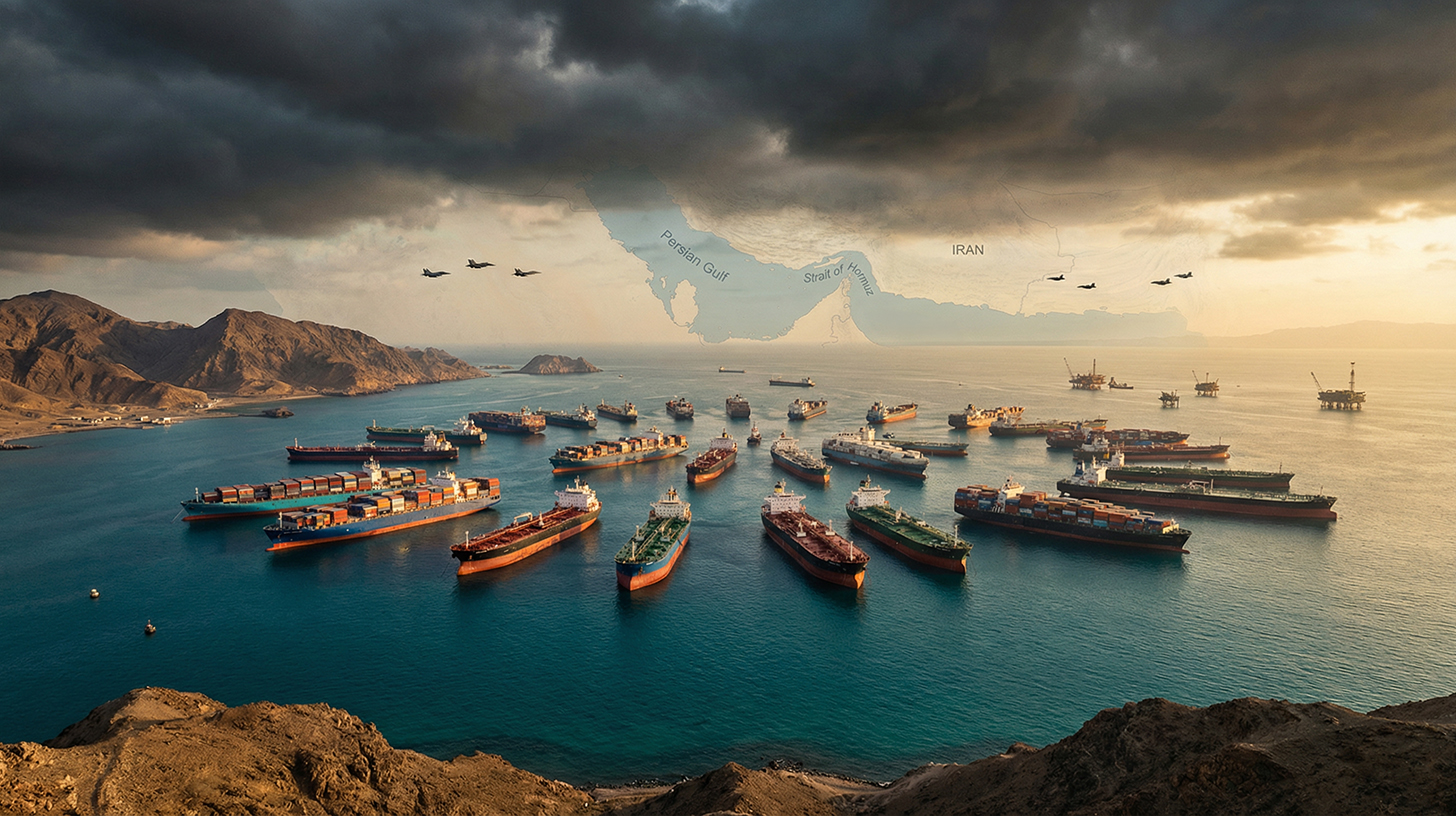
Supply chain disruption: Iran closes the Strait of Hormuz – 170 container ships are stuck in the Persian Gulf – Image: Xpert.Digital
Escalation in the Middle East: Gasoline and everyday products face massive price increases
Global economy in crisis: The Strait of Hormuz is burning – these are the consequences
An unprecedented military escalation in the Middle East has led to precisely the scenario that economists and security experts have been warning about for decades: The Iranian Revolutionary Guard has completely blocked the Strait of Hormuz, the most crucial chokepoint for global trade. More than 200 ships, including 170 fully laden container ships and gigantic oil and gas tankers, are currently stranded in the Persian Gulf. While major shipping companies are already withdrawing traffic from the region, the price of oil is skyrocketing, evoking memories of historical price shocks. For the global economy—and especially for export nations like Germany—in addition to exploding energy and fuel prices, serious supply bottlenecks are now looming. The already fragile architecture of global trade is facing a critical test with as yet unforeseeable consequences for consumers and industry.
Related to this:

World trade bottleneck under attack: The closure of the Strait of Hormuz reveals how fragile global supply chains really are
The military escalation in the Middle East in early March 2026 created a situation that economists and security experts had been warning about for decades. Following massive airstrikes by the US and Israel against Iran and the killing of Supreme Leader Ayatollah Ali Khamenei, the Iranian Revolutionary Guard Corps declared the Strait of Hormuz closed. The Iranian state news agency Tasnim reported that with the cessation of shipping and tanker traffic, the strait was effectively closed. A general in the Iranian Revolutionary Guard Corps threatened via Telegram that any ship attempting to cross the Strait of Hormuz would be burned. According to shipping data, more than 200 vessels, including oil and gas tankers, were anchored off the strait.
The scale of this crisis surpasses anything the global merchant shipping industry has experienced in recent decades. Around 170 container ships are stranded in the Persian Gulf, carrying an estimated 450,000 containers of cargo. Jeremy Nixon, CEO of the shipping company Ocean Network Express, reported at an industry conference in Long Beach that around 100 container ships are blocked, representing about ten percent of the global container fleet. Insurance companies have now suspended coverage for voyages through the strait, meaning transport companies face massive risk premiums or outright denial of coverage.
The strategic importance of the strait
The Strait of Hormuz is a narrow waterway, only about 55 kilometers wide, connecting the Persian Gulf with the Gulf of Oman and thus the Arabian Sea. The shipping lanes are each just under two miles wide and separated by a buffer zone. Around 3,000 ships pass through this route every month. The economic importance of this waterway can hardly be overstated: Approximately 20 million barrels of oil are transported daily on about 30 to 40 large tankers, representing about one-fifth of global demand. Furthermore, the strait plays a crucial role in the liquefied natural gas (LNG) trade, as roughly a quarter of global LNG traffic passes through the Strait of Hormuz, including exports from Qatar that contribute to Europe's energy security.
Eighty percent of the oil and gas transported through the Strait of Hormuz is destined for Asian markets. China, accounting for more than 90 percent, is by far the most important buyer of Iranian oil. A prolonged closure of the Strait of Hormuz would therefore not only affect the West, but also severely damage the Iranian economy itself and strain Tehran's relations with its most important trading partners.
Reactions from shipping companies
The major container shipping companies reacted immediately to the escalation. Hapag-Lloyd, the world's fifth-largest container shipping company, has halted all voyages through the Strait of Hormuz and is diverting traffic around the Cape of Good Hope. CEO Rolf Habben Jansen warned in an interview of higher fuel prices, risk premiums, and potential supply chain disruptions. He stated that networks outside the region are currently stable, but that prolonged escalation could lead to delays and rising consumer prices.
The Danish shipping company Maersk, the world's largest container shipping group, is suspending all traffic through the Bab el-Mandeb Strait and the Suez Canal until further notice, and is also halting transits through the Strait of Hormuz. Ships on routes between the Middle East, India, the Mediterranean, and the US East Coast are instead being rerouted around the Cape of Good Hope. CMA CGM, the world's third-largest shipping company, stated that 14 ships in the Persian Gulf and another seven en route there have been ordered to provide protection.
The diversion around the Cape of Good Hope means a detour of several thousand kilometers for container shipping between Europe and Asia. Depending on the route, the additional travel time ranges from seven to fourteen days. This not only significantly increases fuel consumption but also ties up ship capacity that is then lacking elsewhere. This effect was already observed during the Houthi attacks in the Red Sea in 2024 and 2025, when the diversion of numerous ships led to a noticeable increase in freight rates.
Our global industry and economic expertise in business development, sales and marketing

Our global industry and economic expertise in business development, sales and marketing - Image: Xpert.Digital
Industry focus areas: B2B, digitalization (from AI to XR), mechanical engineering, logistics, renewable energies and industry
More information here:
A thematic hub offering insights and expertise:
- Knowledge platform covering global and regional economies, innovation and industry-specific trends
- A collection of analyses, insights, and background information from our key areas of focus
- A place for expertise and information on current developments in business and technology
- A hub for companies seeking information on markets, digitalization, and industry innovations
More than just expensive gasoline: How a blockade is tearing our supply chains apart
Oil price in shock
Energy markets reacted immediately and sharply to the lockdown. The price of Brent crude rose by 14 percent in the first minutes of trading on Monday, reaching $82.37 per barrel, its highest level since January 2025. On Saturday, after the attacks began, trading platforms had already estimated the price at around $80, after Brent had closed at $72.48 on Friday.
Analysts at major investment banks paint an even bleaker picture. Oil markets could be facing their worst fears, according to a report. Brent crude could reach $100 as the market grapples with the threat of a potential supply disruption. Commodity experts warn that a prolonged shutdown could push prices well above $150 per barrel, fueling inflation as all products requiring oil become more expensive.
While alternative pipelines exist, such as those to Yanbu on the Red Sea or to the Gulf of Oman, according to the International Energy Agency, these could only replace about a quarter of the usual transport volume. Therefore, a prolonged disruption threatens a real supply problem, not just a speculative price shock.
Related to this:

Impacts on Germany and Europe
The consequences for the German economy are multifaceted. Germany obtains its natural gas primarily via pipelines from Norway and Belgium, as well as in the form of liquefied natural gas (LNG) from the USA and Canada. The most significant oil suppliers are Kazakhstan, Norway, and the USA. Therefore, the immediate supply of oil and gas is not currently at risk. Nevertheless, global market prices determine the price at the pump and on heating bills.
Fuel prices in Germany are set to rise. Experience shows that rising crude oil prices translate into higher prices at the pumps within a few days. Rising diesel prices also increase the cost of logistics, agriculture, and air travel, thus impacting many everyday goods. The German chemical industry is particularly vulnerable, as important raw materials are transported across the Strait of Hormuz.
Besides rising energy prices, the economy is particularly concerned about potential disruptions to supply chains. Significant trade flows, both by sea and air, pass through the Gulf States. If this logistics hub partially collapses, delays or even the complete absence of goods on routes between Europe and Asia could occur. Many supply chains are being disrupted, and Bavarian businesses are hoping that the effect will be short-lived.
Historical context and scenarios
History shows that geopolitical oil price shocks are often short-lived. The duration of the blockade is crucial for the economic consequences. In a short-term escalation, prices rise sharply but fall back quickly. A disruption lasting several weeks would make supply shortages a reality, and triple-digit oil prices would be possible. An escalation of the conflict threatens massive repercussions for global energy and transportation markets.
Iran has repeatedly threatened to blockade the Strait of Hormuz in the past, including by using sea mines. In 2024, the Revolutionary Guard seized the Portuguese-flagged container ship MSC Aries for alleged links to Israel. However, a complete closure of the strait is historically unprecedented. While the so-called Tanker War, in which both sides attacked merchant ships, occurred during the Iran-Iraq War in the 1980s, a complete blockade never took place.
The current situation is qualitatively different. The killing of the Supreme Leader has created a completely new dynamic. Iran is under enormous pressure to demonstrate strength, while at the same time its own economy is suffering under the blockade. Iran itself exports significant quantities of oil through the strait and receives crucial imports via it. A prolonged closure would therefore be a double-edged sword for Tehran as well.
The fragile architecture of world trade
The crisis in the Strait of Hormuz once again reveals the structural vulnerability of the globalized economy. World trade hinges on a few geographical bottlenecks: the Strait of Hormuz, the Suez Canal, the Panama Canal, and the Strait of Malacca. If even one of these chokepoints fails, the disruptions propagate in waves throughout the entire global supply chain.
The experiences of recent years have repeatedly demonstrated this vulnerability: the blockade of the Suez Canal by the Ever Given in 2021, the Houthi attacks in the Red Sea since the end of 2023, and the low water crisis in the Panama Canal in 2023 and 2024. Each time, freight rates reacted with sharp increases, which were reflected in higher consumer prices with a delay.
For Germany, as an export-oriented economy dependent on free global trade, these vulnerabilities are particularly threatening. German industry has optimized its supply chains globally over the past decades, often prioritizing efficiency over resilience. Just-in-time production only works as long as supply chains function smoothly. Any disruption triggers chain reactions that can propagate through the economy for weeks and months.
The current crisis is likely to further accelerate the ongoing trend toward regionalization and diversification of supply chains. Nearshoring, friendshoring, and the building of strategic inventories are gaining in importance. However, these adjustments take time and cost money. In the short term, the global economy remains exposed to geopolitical risks in key trade regions. The Strait of Hormuz is the most vulnerable bottleneck of all, as nowhere else do so much oil, gas, and container traffic converge in such a confined space.
Consulting - Planning - Implementation

Konrad Wolfenstein
I would be happy to serve as your personal advisor.
contact me at wolfenstein ∂ xpert.digital
Just call me on +49 7348 4088 965 (Munich) .










