
Cold Chain Food: Security of supply, growth, automation patterns – When refrigeration fails, civilization fails
Xpert Pre-Release

Available in 27 languages 📢
Prefer Xpert.Digital on GoogleⓘPublished on: August 16, 2026 / Updated on: August 16, 2026 – Author: Konrad Wolfenstein
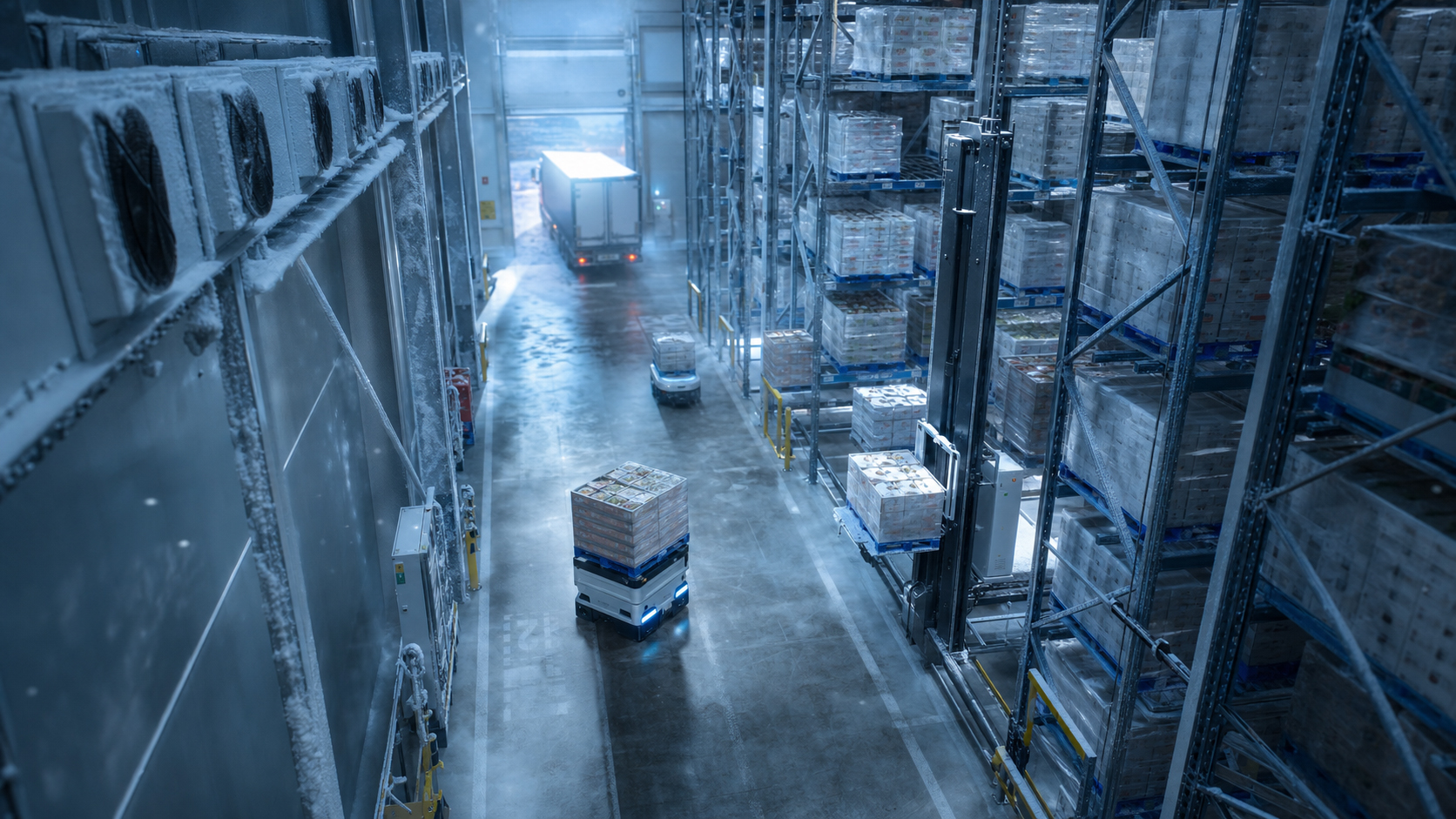
Cold Chain Food: Security of supply, growth, automation patterns – When refrigeration fails, civilization fails – Creative image on the topic, with AI: Xpert.Digital
One third spoils immediately: The invisible trillion-dollar lever against the global hunger crisis
When the "world's refrigerator" breaks down: The biggest weakness in the supermarket
Every day, an invisible, global network decides whether our supermarket shelves remain stocked or whether millions of tons of food simply spoil. The global cold chain – the so-called food cold chain – has long since become far more than just a logistical footnote. It is the "world's refrigerator," a rapidly growing multi-billion-dollar market and a key lever in the fight against global resource waste and climate change. But the industry is facing an unprecedented transformation: stricter EU climate regulations are forcing operators to make massive investments, an acute shortage of personnel is turning cryogenic warehouses into the domain of highly advanced, autonomous robots, and the growing convenience trend is driving the demand for refrigeration capacity to unprecedented heights. Anyone who understands how this icy ecosystem functions is looking at one of the most exciting, but also most demanding, growth markets of the coming decade – and at an infrastructure on which ultimately nothing less than our civilization depends.
Without them, everything collapses: The gigantic secret of our food
The global cold chain for food is one of the quietest yet most consequential infrastructures of our time. Every day, it determines whether millions of tons of meat, fish, dairy products, fruits, and vegetables actually reach consumers or spoil en route. Anyone who underestimates the economic dimension of this sector overlooks one of the most important growth markets of the coming decade, one that simultaneously plays a decisive role in food security, climate policy, and geopolitical trading capacity.
It is estimated that well over a third of all perishable food produced worldwide spoils each year before it even reaches consumers due to a lack of or interruption in continuous refrigeration. Even a delay in refrigeration of just a few hours after harvesting, for example with strawberries, can mean a loss of ten percent of the marketable produce. These figures clearly demonstrate that cold chain food is not a niche topic within the logistics industry, but rather a crucial lever in the fight against global food insecurity and resource waste.
A market that has multiplied in just a few years
Market research across various providers paints a remarkably consistent picture of a sector experiencing double-digit growth rates. The global cold chain logistics market as a whole, including pharmaceuticals and chemicals, is estimated to reach between approximately US$380 billion and US$520 billion by 2026, depending on the source, with annual growth rates ranging from six to over twenty percent, depending on the definition and methodology of the respective studies.
The specific sub-market of the food cold chain, meaning the temperature-controlled supply chain exclusively for food, is estimated to reach a volume of between approximately US$78 billion and US$237 billion by 2026. This range depends significantly on the level of value creation considered – whether only storage and transport are included, or also packaging, monitoring technology, and services. However, a common trend emerges across all studies: annual growth rates range from just under ten to around nineteen percent, allowing the sector to grow considerably faster than global food production as a whole.
| Market segment | Market volume 2026 | CAGR forecast |
|---|---|---|
| Cold Chain Logistics (total) | approximately 383 to 517 billion USD | 6 to 22 percent |
| Food Cold Chain (food only) | approximately 78 to 237 billion USD | 9.6 to 19.2 percent |
| Cold Chain Market (Grand View) | approximately USD 437 billion | 20.5 percent by 2033 |
This divergence in absolute figures is typical for young, rapidly growing infrastructure segments where market definitions are not yet standardized. More economically relevant than the exact figure in billions is the consistent trend: demand for cold chain capacity is lower than the capacity for expansion, which structurally favors rising prices for cold storage space and transport capacity.
Why the world's refrigerator is growing
Several mutually reinforcing drivers underlie this growth. The expansion of online grocery shopping necessitates smaller, but more frequent, refrigerated deliveries to the last mile, while traditional supermarket deliveries are trending downwards. At the same time, consumer behavior is shifting towards convenience-oriented products such as ready meals, which, according to market data, are among the fastest-growing application segments with annual growth of around sixteen percent.
Regulatory requirements for traceability, such as the American FSMA-204 regulation, are also driving investments in digital temperature monitoring and IoT sensors, which, according to market analyses, are growing at over fourteen percent annually, even faster than physical cold storage capacity itself. Added to this is the need for geographical expansion: While North America currently still holds the largest market share, the Asia-Pacific region is experiencing the most dynamic growth, with rates sometimes exceeding sixteen percent, driven by the expansion of organized retail structures in countries like India and China.
Two speeds of global demand
The regional distribution of growth highlights an economic divide in global markets. In the established industrialized countries of North America and Europe, the focus is primarily on modernization, automation, and regulatory adaptation of existing facilities, while in Asia, particularly in India and China, basic infrastructure often needs to be built from scratch. Several analysts identify India as the fastest-growing single country, with growth rates of up to 28 percent by 2036, followed by China with nearly 26 percent.
This dichotomy has tangible consequences for investors and companies in the B2B sector. Those operating in mature markets like Germany or the US compete for market share in a lower-margin but more stable environment, while investments in emerging markets offer higher growth opportunities but also greater infrastructural and regulatory uncertainties. Europe itself, with a market volume of around ninety billion US dollars in 2025 and a growth rate of just under thirteen percent annually, will experience solid but significantly slower growth than the global average.

Expert partner in warehouse planning and construction
The future of the cold chain: Why autonomous logistics and sustainability are crucial
Robots take command in sub-zero temperatures
The automation of the cold chain is no longer a future scenario, but rather common practice in modern distribution centers. Autonomous mobile robots, or AMRs for short, now transport payloads of between 300 and 1500 kilograms at temperatures as low as minus 25 degrees Celsius, increasingly replacing human workers in environments that are extremely physically and health-wise demanding for people.
The reason for this surge in automation lies not only in efficiency gains but also in a structural labor shortage. Working in cold storage facilities is considered one of the least attractive jobs in the logistics industry, characterized by high employee turnover and absenteeism. Automated systems can operate autonomously for twelve to eighteen hours after a charging time of approximately two hours, significantly extending the operating hours of cold storage facilities and reducing dependence on hard-to-find personnel. Additionally, such systems enable higher storage density because they can navigate more closely and precisely than forklift drivers, thus making more efficient use of valuable, energy-intensive refrigerated space.
In addition to mobile robots, modern cold storage facilities increasingly rely on automated storage and retrieval systems and software-based warehouse management systems that enable real-time tracking and precise inventory control across multiple temperature zones simultaneously. These systems are crucial for efficiently managing different product categories, such as frozen goods at minus eighteen degrees Celsius and fresh goods at two to eight degrees Celsius, within a single facility, without product mix-ups or temperature violations.
The invisible climate policy in every cold storage facility
An often overlooked but economically highly relevant factor is the regulation of refrigerants by the European F-Gas Regulation. The amended Regulation EU 2024/573, which entered into force in March 2024, significantly tightens the so-called phase-down of hydrofluorocarbons, with the aim of a complete phase-out by 2050. From 2025 onwards, refrigerants with a global warming potential (GWP) of 2500 or higher may no longer be used for the maintenance of refrigeration systems; from 2026, this also applies to air conditioning systems and heat pumps.
For operators of cold storage facilities, this means significant investment decisions. New facilities are increasingly being equipped with natural refrigerants such as carbon dioxide, ammonia, or propane, which have virtually no global warming potential but are sometimes flammable or toxic and therefore require special safety precautions. Furthermore, a levy of three euros per ton of CO2 equivalent for fluorinated refrigerants placed on the market will come into effect on January 1, 2026, further increasing the operating costs of existing facilities using conventional refrigerants. The German Federal Environment Agency estimates that a rapid switch to natural refrigerants could save more than one hundred million tons of CO2 equivalents across the EU by 2030, highlighting the climate policy implications of this seemingly purely technical regulation.
This regulation effectively acts as an innovation driver, increasingly putting established market players with older HFC systems under pressure to modernize, while new buildings and greenfield investments can rely on future-proof, natural refrigerants from the outset. For companies investing in expanding cooling infrastructure, the choice of refrigerant thus becomes a strategic decision with direct implications for compliance costs and long-term competitiveness.
Whoever controls the cold chain controls the supply
Competition in the global cold chain market is concentrated among a relatively small group of specialized large-scale providers, including Lineage, Americold Logistics, Nichirei, and diversified logistics groups such as DSV. This concentration is economically significant, as it provides the largest operators with considerable economies of scale and bargaining power vis-à-vis food manufacturers and retailers. At the same time, the technological complexity of automation and refrigerant conversion creates high barriers to entry for new, smaller competitors, which is likely to further solidify the market power of the established players in the medium term.
For small and medium-sized enterprises in the food industry, this means a growing dependence on a few specialized logistics partners whose pricing power is likely to increase in a structurally underserved market. This development should be given greater consideration in the strategic planning of producers and retailers who rely on temperature-controlled supply chains, for example through long-term capacity contracts or their own investments in smaller, specialized refrigeration infrastructure.
Between opportunity and structural vulnerability
The overall economic assessment of the cold chain food industry is mixed, but highly positive overall. On the positive side, the sector boasts robust, structurally driven growth rates, fueled by several independent, mutually reinforcing trends: the expansion of online retail, urbanization in emerging markets, stricter food safety regulations, and technological advancements in robotics and sensor technology. Investments in this area benefit from above-average demand visibility compared to many other logistics segments, as the need for refrigeration of perishable foods is largely independent of economic cycles.
On the risk side, there is the significant capital intensity, long amortization periods for refrigeration infrastructure, and an increasingly complex regulatory landscape shaped by the F-Gas Regulation and similar international regulations. Furthermore, the industry remains vulnerable to external shocks such as energy price spikes, as cold storage facilities are among the most energy-intensive building types, as well as geopolitical trade disruptions, which can be particularly damaging to temperature-controlled supply chains due to their time-critical nature.
For companies and investors concerned with the future of food security, automation, and sustainable logistics, cold chain food remains one of the most structurally interesting, albeit technically demanding, growth markets of the coming decade. Those who invest early in energy-efficient, automated, and future-proof refrigeration infrastructure are positioning themselves for a market environment in which physical refrigeration capacity is becoming increasingly scarce and therefore extremely valuable.
Your intralogistics experts

Consulting, planning and implementation of complete solutions for high-bay warehouses and automated storage systems - Image: Xpert.Digital
More information here:
Your global marketing and business development partner
☑️ Our business language is English or German
☑️ NEW: Correspondence in your native language!

Konrad Wolfenstein
I and my team are happy to be available to you as your personal advisor.
You can contact me by filling out the contact form here [email protected]:or simply call me at +49 7348 4088 965. My email address is
I'm looking forward to our joint project.
☑️ SME support in strategy, consulting, planning and implementation
☑️ Creation or realignment of the digital strategy and digitization
☑️ Expansion and optimization of international sales processes
☑️ Global & Digital B2B trading platforms
☑️ Pioneer Business Development / Marketing / PR / Trade Fairs
Our global industry and economic expertise in business development, sales and marketing

Our global industry and economic expertise in business development, sales and marketing - Image: Xpert.Digital
Industry focus areas: B2B, digitalization (from AI to XR), mechanical engineering, logistics, renewable energies and industry
More information here:
A thematic hub offering insights and expertise:
- Knowledge platform covering global and regional economies, innovation and industry-specific trends
- A collection of analyses, insights, and background information from our key areas of focus
- A place for expertise and information on current developments in business and technology
- A hub for companies seeking information on markets, digitalization, and industry innovations










