Smartly modernizing existing systems: How companies in Austria avoid capital losses – Retrofit without manufacturer ties
Xpert Pre-Release

Available in 27 languages 📢
Prefer Xpert.Digital on GoogleⓘPublished on: October 18, 2026 / Updated on: October 18, 2026 – Author: Konrad Wolfenstein
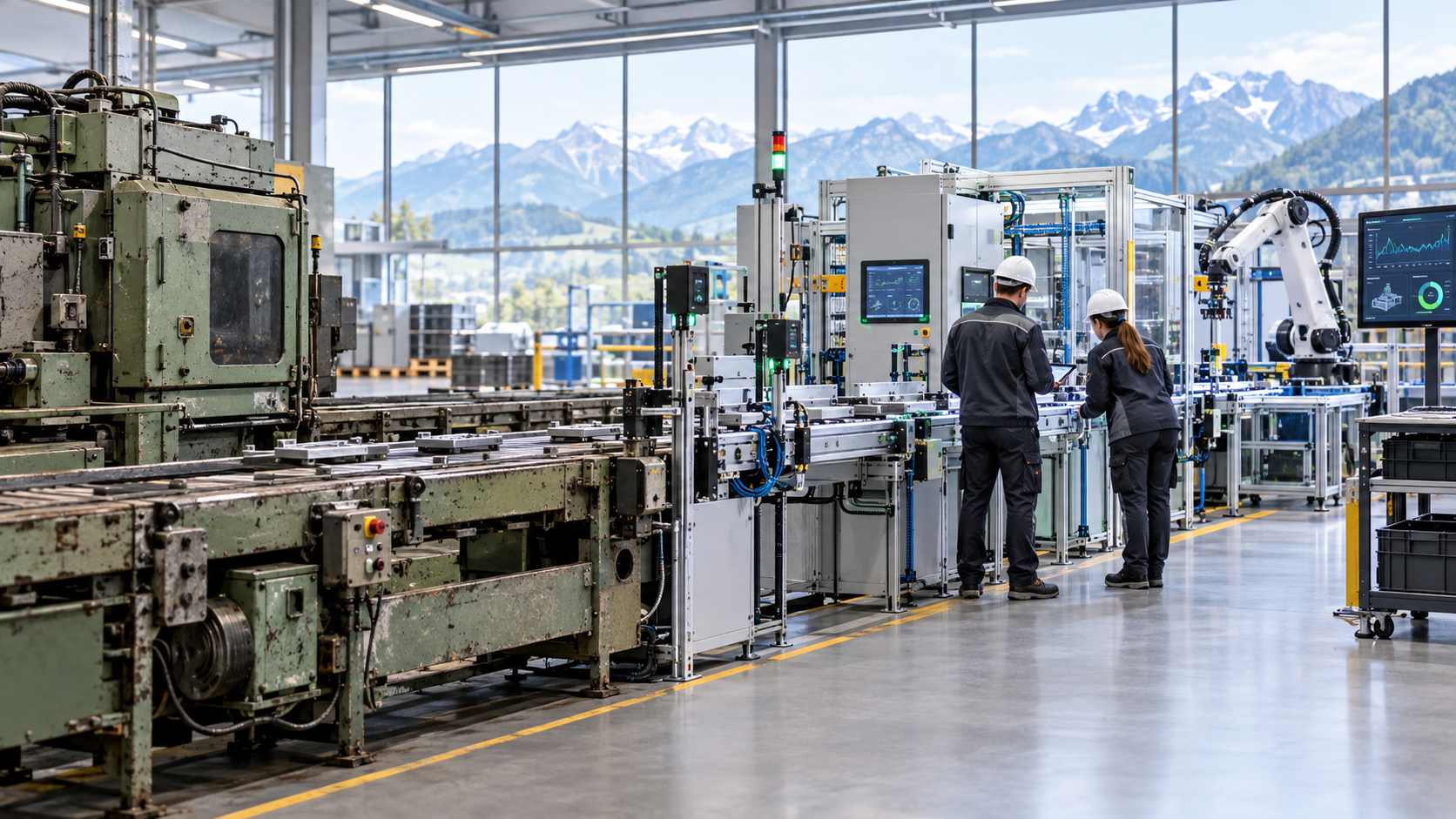
Smartly modernizing existing systems: How companies in Austria avoid capital losses – Retrofit without manufacturer lock-in – Creative image on the topic, with AI: Xpert.Digital
Retrofitting as a key to greater efficiency in Austrian industry
The Austrian retrofit market: Opportunities and challenges for suppliers
How retrofitting increases the competitiveness of companies in Austria
In Austria, many industrial companies face the challenge of efficiently modernizing their production and logistics facilities without resorting to the costly option of a completely new plant. The market for retrofitting, i.e., the targeted modernization of existing equipment, is therefore gaining increasing importance. While many systems can still be used mechanically for years, outdated controls, drives, and software urgently require replacement.
However, modernizing systems originally installed by other manufacturers or integrators is a complex undertaking. The supplier must assume responsibility for systems whose design logic and software architecture are often inadequately documented. Nevertheless, the Austrian market offers a significant opportunity for specialized retrofit providers who can gain a competitive edge through manufacturer independence and comprehensive services. In this article, we will examine in detail the current challenges and potential of the retrofit market in Austria and explain how companies can increase their efficiency and save long-term costs through smart investments in modernizing their systems.
Retrofit without manufacturer ties: The Austrian market for the modernization of third-party systems
Those who write off old plants are burning through capital – those who blindly modernize them often do so again
Austrian industry faces an investment dilemma. Many production, conveying, and intralogistics systems can still be used mechanically for years to come, while controls, drives, sensors, safety components, and software are technically obsolete or no longer reliably available. At the same time, high labor, energy, and financing costs have narrowed the scope for completely new systems. It is precisely in this gap that the retrofitting of existing projects is gaining economic importance: A specialized provider modernizes systems that were originally planned and built by another manufacturer or system integrator.
This business area is more demanding than modernizing one's own systems. The service provider assumes responsibility for systems whose design logic, software architecture, and change history are often only incompletely documented. However, the addressable market is significantly larger because the offering is not limited to the company's own installed infrastructure. Particularly in Austria, where medium-sized manufacturing companies, specialized industrial groups, and automated logistics centers frequently operate long-lasting, customized systems, manufacturer independence can become a compelling competitive advantage.
However, this model is only economically attractive if the provider sells more than just the replacement of old components. A viable retrofit combines technical inventory, risk assessment, automation, energy efficiency, cybersecurity, functional safety, data integration, and long-term service. The customer is not primarily buying new hardware, but rather extended economic lifespan, increased availability, and a reduction in difficult-to-calculate failure risks. The real value, therefore, arises from managing complexity.
Austria's industry between recovery and investment backlog
The Austrian economy will emerge from a prolonged period of weakness in 2026, but without yet entering a strong upswing. Real growth of only around 0.5 percent is expected for the year as a whole. While the industrial sector is once again providing positive impetus, the recovery remains fragile. Energy prices, international trade conflicts, geopolitical risks, weak margins, and high unit labor costs are weighing on investment activity. This reluctance is particularly pronounced in the manufacturing sector: despite improved expectations for orders and sales, only a small proportion of industrial companies plan to increase their investments.
This environment is particularly conducive to retrofit solutions. When companies don't need to fundamentally expand their capacity but require improvements in productivity, quality, and operational reliability, demand shifts from large-scale new construction projects to targeted modernizations. This is especially true for systems whose basic mechanical components are intact and whose replacement would incur high follow-up costs. The economic advantage doesn't stem solely from a lower purchase price. Retrofitting can also limit permitting, construction, training, and start-up costs, preserve existing process knowledge, and enable implementation within shorter downtime windows.
At the same time, the economic downturn should not be mistaken for an automatic surge in demand. Investment reluctance also extends to modernization. Many companies prioritize only projects whose benefits are quickly measurable or that solve an acute obsolescence, safety, or availability problem. Suppliers must therefore demonstrate the economic impact more precisely than in an environment of generous investment budgets. The key sales question is not whether a plant can be made more technically modern, but rather what costs of inaction can be avoided and when the invested capital will be recouped.
External project retrofitting as an independent business model
A third-party project is not an ordinary existing system. It is a technical system whose original manufacturer, system integrator, or software supplier is not the same as the company carrying out the modernization. The reasons for such a situation are manifold: the original supplier is no longer in business, no longer supports the product generation, has insufficient regional service capacity, demands economically unattractive terms, or cannot provide the desired cross-manufacturer integration. Sometimes, the operator has made modifications over the years, resulting in the actual system deviating significantly from the original documentation.
This changes the value chain. With in-house systems, a supplier can draw on design data, source code, parts lists, empirical data, and standardized retrofit packages. For external projects, this knowledge must first be reconstructed. Reverse engineering, on-site surveys, network analysis, control program testing, measurement of mechanical interfaces, and evaluation of safety functions become independent services. The poorer the documentation, the higher the effort and risk, but also the willingness to pay for demonstrably competent problem-solving.
A professional business model therefore separates diagnosis and implementation. The first phase generates a robust system profile, a risk matrix, and several modernization scenarios. Only on this basis are the scope of services, schedule, warranty limits, and key performance indicators agreed upon. This separation protects both parties. The operator gains transparency regarding technical dependencies, while the provider prevents unknown legacy issues from being inadvertently included in a fixed price. This is crucial from a business perspective, as undetected interface problems can wipe out the profit margin of a retrofit project within just a few days.
The real driver of demand is obsolescence
In many companies, the need for modernization doesn't begin with a strategic digitalization initiative, but rather with a discontinued frequency converter, a control module that is no longer available, or an operator panel whose replacement can only be obtained through the used equipment market. As long as the system is running, this risk seems abstract. After the first unplanned downtime, however, it becomes immediately relevant to the balance sheet. In interconnected production or logistics systems, the failure of a small electronic component can interrupt the entire material flow.
Obsolescence is therefore the strongest gateway for external project retrofitting. It combines technical urgency with clear economic damage. Programmable logic controllers (PLCs), industrial PCs, drive technology, safety controllers, fieldbus components, scanners, identification systems, and proprietary software platforms are particularly relevant. Mechanical components whose original drawings are missing or whose manufacturers no longer produce small batches also fall into this category. The supplier must not only provide replacements but also maintain or modify the functional logic of the overall system in a controlled manner.
A second driving factor is the scarcity of qualified personnel. Austrian companies reported a need for approximately 176,000 skilled workers across all sectors in 2025. The industrial sector is particularly lacking in electrical engineering, mechatronics, and information technology qualifications. Estimates suggest that there was recently a shortage of around 10,000 graduates from higher technical colleges; this gap could increase to as many as 16,000 by 2030. Automation and condition-based maintenance are therefore not only tools for rationalization but also means of stabilizing operations with limited personnel resources.
A third driver is energy efficiency. Industrial electricity prices and unit labor costs have significantly worsened Austria's cost position. Modernized motors, variable-speed drives, intelligent shutdowns, optimized compressed air, heat recovery, and data-driven load control can reduce operating costs without replacing an entire system. The economic benefits are particularly high when modernization is already necessary due to obsolescence or safety concerns, and efficiency measures are integrated as an additional value proposition.
The business case is what matters, not age
The age of a system alone is not a sufficient criterion for a retrofit. The decisive factor is the relationship between the remaining mechanical structure, technical risk, required performance, and remaining economic useful life. A twenty-year-old conveyor system can be an attractive candidate for modernization if the steel structure, supporting framework, and essential mechanical components are in good condition. Conversely, a significantly newer system may be economically unsuitable if it is fundamentally undersized, has serious design flaws, or cannot be adapted to future processes.
The investment calculation should include at least five factors: avoided downtime costs, savings in operating and energy costs, reduced maintenance costs, additional performance or capacity, and the residual value of the reused assets. Indirect effects such as reduced training requirements, shorter ramp-up phases, less intervention in buildings and infrastructure, and the avoidance of a lengthy production relocation should also be considered. These factors are often underestimated in traditional procurement comparisons, which only compare the price of retrofit equipment with the price of new equipment.
On the cost side, all project-specific risks must be identified. This includes inventory, design, software migration, new switchgear, modifications, testing, production downtime, safety assessment, documentation, spare parts packages, and start-up support. A risk buffer for unknown system conditions is also economically justifiable. A seemingly inexpensive offer without sufficient diagnostics often leads to change orders, schedule delays, or technical compromises. A higher, but reliable, price can represent greater value for the operator.
A scenario-based analysis is suitable for making this decision. The baseline scenario depicts continued operation without major modernization, including an increasing probability of malfunctions. The retrofit scenario considers investment, planned downtime, and expected improvements. The replacement scenario encompasses not only the new system but also dismantling, structural modifications, data migration, training, and start-up. Additionally, a failure scenario should illustrate the financial consequences of a critical defect with long spare parts or delivery times. Only this comprehensive view reveals the economic difference.
A market that is larger than new construction alone
The potential market cannot be meaningfully quantified as a single volume because retrofit expenditures are typically distributed across mechanical engineering, electrical engineering, software, maintenance, construction services, and energy technology in statistics. Therefore, a reliable market analysis should be based on the installed plant inventory and specific modernization projects. Relevant areas include automated warehouses, conveyor systems, production lines, packaging and palletizing technology, process plants, machine linkages, crane systems, sorting systems, and energy and utility supply.
Austria offers a broad industrial base for this. Key sectors with high sales and export volumes include metal technology, mechanical engineering, the automotive and supplier industries, chemicals, the electrical and electronics industry, food production, woodworking, plastics technology, and energy supply. The metal technology industry alone generated a production value of approximately €45 billion in 2024 and directly employed around 135,000 people. The automotive industry achieves a very high export rate and is closely linked to German and European value chains. In these sectors, plant availability, quality, and traceability are business-critical.
The market opportunity arises primarily at the interfaces between different trades. Pure component suppliers often only cover their own product area. Traditional maintenance providers are skilled in repairs, but not necessarily in software migration, functional safety, or comprehensive material flow optimization. Large general contractors, on the other hand, often prefer extensive new projects and standardized platforms. A retrofit specialist can position themselves in between: large enough to assume system responsibility, but flexible enough to manage heterogeneous inventories and limited conversion windows.
Market potential is therefore less a question of the theoretical number of older systems than of marketability. The crucial factor is how many operators are reached by a specific event: product discontinuation, recurring malfunctions, capacity bottlenecks, safety deficiencies, energy projects, software changes, or changes of ownership. Those who systematically identify these triggers tap into a predictable market. Those who only advertise modernization in general terms, on the other hand, are competing for non-committal attention.
Regional focus areas and attractive industries
Upper Austria and Styria are the most important industrial centers for complex retrofit services. They are home to a concentration of metal technology, mechanical engineering, automotive, plastics, mechatronics, materials science, environmental technology, and industrial automation. Lower Austria combines manufacturing companies with food processing, plastics, energy, and logistics hubs. Vorarlberg and Tyrol have a high density of specialized industrial companies, while the regional shortage of skilled workers exacerbates the need for automation and reliable service. Vienna is less characterized by land-intensive production but is relevant as a location for logistics, food processing, life sciences, infrastructure, engineering, and corporate headquarters.
Industries differ significantly in their retrofit logic. In the food and beverage industry, hygiene, cleanability, product changeovers, traceability, and minimal downtime are paramount. In automotive and metalworking, cycle time, quality assurance, robotics, safety, and integration with existing production control systems are key. In the chemical and process industries, explosion protection, continuous availability, and complex permitting requirements are additional considerations. In warehouses and distribution centers, throughput, inventory accuracy, availability, and the seamless integration of mechanics, controls, and warehouse management software are crucial.
Systems with a long mechanical lifespan and rapidly aging electronics are particularly attractive. These include high-bay warehouses, stacker cranes, pallet and container conveyor systems, sorters, packaging lines, lifting equipment, cranes, and certain machine tools or special-purpose machines. A large portion of the existing investment can be reused here while the control systems, drives, sensors, and software are modernized. Systems with serious structural problems, fundamental undersizing, or severely worn mechanics are less attractive. In such cases, a partial modernization can only postpone the underlying problem.
A broad, industry-neutral strategy is not recommended for market entry. Credibility is built through references in a few clearly defined application classes. For example, a supplier could start with conveyor technology and automated warehouses, later adding related areas such as palletizing, robotics, and material flow software. Regional focus on industrial corridors reduces travel and service costs, facilitates partnerships, and increases the likelihood of repeat projects.
Digitization turns repair into a data project
A modern retrofit doesn't just replace components; it transforms the information architecture of a system. Older systems often operate with isolated controllers, proprietary fieldbuses, and limited diagnostics. A contemporary modernization creates standardized interfaces, structures operational data, and makes system states visible via user interfaces, control rooms, or higher-level systems. This lays the foundation for condition-based maintenance, energy monitoring, performance analysis, and faster troubleshooting.
The economic benefits of digital functions, however, depend on their operational implementation. Sensors alone do not generate productivity. Data must be accurately captured, clearly presented, and translated into concrete maintenance or production processes. Therefore, a retrofit should only capture key performance indicators (KPIs) for which there are defined responsibilities, thresholds, and responses. Relevant parameters can include motor currents, vibrations, temperatures, operating times, jamming events, fault patterns, energy consumption, throughput, and technical availability.
In Austria, around three-quarters of companies have at least a basic level of digitalization. However, significant differences exist between large and small businesses. Large companies have achieved a basic level of digital intensity almost across the board, while smaller companies lag considerably behind. Digitalization also remains heterogeneous in the manufacturing sector. For retrofit providers, this means that solutions must be scalable. A large corporation often expects integration with manufacturing execution, maintenance, and data platforms. A medium-sized operator, on the other hand, may first require robust local diagnostics, traceable alarms, and secure remote access.
Artificial intelligence should be viewed objectively. Machine learning is already used in quality assurance, production planning, and maintenance, but its benefits depend on sufficient data quality and recurring patterns. For rare malfunctions and significantly altered system conditions, traditional limit values, physical models, and experienced technicians remain indispensable. A reputable provider, therefore, does not sell artificial intelligence as an end in itself, but rather selects the most cost-effective diagnostic method in each case.
LTW Intralogistics Solutions

LTW Intralogistics – Engineers of Flow - Image: LTW Intralogistics GmbH
LTW offers its customers not individual components, but integrated complete solutions. Consulting, planning, mechanical and electrotechnical components, control and automation technology, as well as software and service – everything is networked and precisely coordinated.
In-house production of key components is particularly advantageous. This allows for optimal control of quality, supply chains, and interfaces.
LTW stands for reliability, transparency, and collaborative partnership. Loyalty and honesty are firmly anchored in the company's philosophy – a handshake still means something here.
Related to this:
The challenge of modernizing third-party systems
The most difficult interface is the unknown legacy
Third-party systems carry a technical history within them. Previous modifications may not have been fully documented, circuit diagrams may not correspond to the actual setup, software versions are inconsistent, and spare parts may originate from multiple generations. In addition, there are makeshift solutions that have functioned for years in daily use but become a risk during a fundamental modernization. Therefore, the project does not begin with construction, but with establishing a truth about the existing system.
A comprehensive inventory encompasses mechanics, electrical systems, control systems, communication, safety, software, IT infrastructure, and operational processes. Dependencies on upstream and downstream systems must also be identified. For example, in a conveyor system, a new control system might function flawlessly from a technical standpoint but still destabilize the overall process if telegrams, buffer strategies, or release logic are not precisely aligned with the control system. Similar risks exist with recipes, batch data, quality controls, and traceability.
Access to the source code is a critical factor. If it is missing or incomplete, it must be assessed whether migration, reconstruction, or complete reprogramming is advisable. This involves not only technical feasibility but also usage rights, warranties, and future maintainability. A new solution should grant the operator greater control than the old one. This includes secure backups, up-to-date documentation, defined access rights, traceable version history, and clear rules for software modifications.
The greatest operational risk lies in the switchover point. Production and logistics often offer only short downtime windows. Therefore, software, control cabinets, and assemblies must be prefabricated and tested as much as possible. Simulations, virtual commissioning, and tests with realistic signal patterns can reveal errors before the system shuts down. However, a fallback plan remains crucial. If the new solution is not running stably in time, it must be clarified beforehand whether and how the previous state can be restored.
Safety and compliance are part of the value creation process
Retrofit projects fall legally into a category that lies between maintenance, modification, and the creation of a virtually new machine. Not every modernization triggers a complete new conformity assessment. Repairs and maintenance that do not alter the existing level of safety are treated differently than interventions that create new hazards or significantly increase existing risks. From January 2027, the new European Machinery Regulation will be fully applicable and will clarify how to handle substantial modifications, including digital changes.
For operators and providers, early legal and safety classification is therefore essential. If significant new protective measures become necessary, the party making the changes may assume the role of the manufacturer. This entails obligations for risk assessment, technical documentation, conformity assessment, and declaration of compliance with applicable requirements. This responsibility should not be discussed only at the end of the project, when the design and software are already finalized.
Functional safety must be closely linked to real-world usage. New operating modes, higher speeds, altered access points, or additional manual interventions can shift the risk profile. A retrofit that simply replaces old safety components with new ones without reviewing operational processes falls short. Emergency stop concepts, safety doors, safe speeds, restart behavior, and interfaces with adjacent machines must also be considered as a complete system.
Cybersecurity is becoming a second area of compliance and liability. Remote maintenance, networked sensors, and standardized protocols improve service but also expand the attack surface. Network segmentation, encrypted connections, role-based access control, logging, backup strategies, and a regulated approach to security updates should therefore be part of the technical concept. Undocumented remote access or permanently open manufacturer connections are particularly problematic. A manufacturer-independent retrofit should eliminate such legacy issues and clearly establish control with the operator.
Competition between original equipment manufacturer and system integrator
The original manufacturer initially enjoys a head start in terms of trust and information. They are familiar with the system, have access to original documentation, and often offer standardized modernization packages. This reduces the perceived risk for operators. At the same time, it can create a strong dependency on proprietary components, software, and service contracts. If the manufacturer is slow, expensive, or no longer strategically interested in older product generations, the market opens up to independent specialists.
Large automation and intralogistics providers possess broad portfolios, engineering capacity, and international service organizations. Austria, at the same time, has a number of high-performing medium-sized plant engineering and integration companies. Competition is therefore technically demanding and cannot be won by simply offering the lowest hourly rate. A new provider needs a clearly identifiable specialization, solid references, and the ability to coordinate responsibility across multiple trades.
The strongest positioning is not manufacturer-free at any cost, but rather manufacturer-independent with clear standards. Customers want freedom of choice, but don't want an arbitrary collection of different components. A convincing concept defines preferred control, drive, safety, and network platforms, while remaining capable of integrating heterogeneous systems. This creates standardization within an open system.
Another competitive advantage lies in the lifecycle business. Offering spare parts, condition monitoring, standby services, software maintenance, and regular system assessments after modernization stabilizes revenue and customer loyalty. Operators gain a single, responsible point of contact. For the supplier, sales costs for future expansions decrease because system knowledge and trust are already established. Retrofitting thus becomes the start of a multi-year business relationship, rather than a one-off upgrade.
Prices must reflect uncertainty
Flat-rate pricing is risky in retrofitting projects for external clients as long as the condition of the equipment is not sufficiently known. A professional pricing model begins with a paid analysis phase. The result of this is not a non-binding sales pitch, but a usable technical basis for decision-making. Depending on the complexity, a fixed price for clearly defined work packages, a target price with a jointly agreed risk corridor, or billing based on actual costs for services that cannot be fully specified can then be chosen.
The cost calculation must differentiate between known and unknown risks. Known services such as control cabinet construction, standardized components, or defined software modules are easy to price. Uncertainties regarding cable routing, mechanical wear, undocumented functions, or third-party software, on the other hand, require assumptions and delimitations. Transparency here is not a sign of incompetence, but rather of professional risk management. Crucially, the customer must understand which factors can affect the price and how these decisions are made.
Value-based pricing is possible when the economic impact is measurably quantifiable. For a plant with high downtime costs, a shorter downtime can be significantly more valuable than the energy saved. Conversely, for energy-intensive processes, reduced consumption can make the greatest contribution. In labor-intensive sectors, automation, ergonomics, and avoiding unfilled positions are paramount. Therefore, the price should not be based solely on engineering hours and material markups, but should reflect the benefits created, without making unrealistic promises of success.
Service contracts generate predictable revenue but must be modular. Not every operator needs constant on-call availability. Sensible tiers range from annual condition checks and software maintenance to guaranteed response times, comprehensive remote monitoring, and spare parts inventory. A clear distinction between maintenance, troubleshooting, improvements, and changes to the scope of services is crucial. Unclear flat rates often lead to conflicts and economically unsound commitments.
Financing and funding as accelerators
Austria supports investments in the energy efficiency of existing commercial and industrial plants. Eligible projects include improvements to industrial processes, heat recovery, the utilization of unused heat flows, efficient drives, and modern control technology. For larger transformation projects, programs for the decarbonization of industrial processes, electrification, and the use of renewable energy sources are also available. This allows a technically necessary retrofit to be expanded to include economically attractive energy and climate measures.
Funding should not replace a sound business case. A project should be technically viable and feasible with acceptable risk even without a grant. While subsidies improve returns and liquidity, they can also trigger requirements regarding documentation, scheduling, and the definition of eligible costs. Suppliers gain value when they can reliably measure savings, document initial conditions, and provide structured technical data for financing purposes.
In addition to traditional investment loans, leasing, rental, and usage-based models are conceivable, particularly when the effects are clearly measurable. For energy savings, a portion of the compensation can be linked to actual results achieved. Greater caution is advised with availability-based models because the overall performance of a third-party system depends on numerous factors that the retrofit provider cannot fully control. Without clear boundaries of responsibility, an attractive service model can become an incalculable liability risk.
For medium-sized businesses, dividing the modernization into manageable phases is often more effective than a comprehensive, one-off project. First, critical obsolescence and security risks are addressed, followed by improvements to data access and diagnostics, and then energy optimization and performance enhancement. This requires a target architecture that already considers these later steps. Otherwise, a series of expensive interim solutions will result.
Sales begins with the risk of inaction
Retrofitting is rarely successfully sold through general image-based messaging. The most effective sales approaches address specific operational risks: a lack of spare parts, recurring malfunctions, inadequate diagnostics, rising energy costs, safety deficiencies, media breaks, or a shortage of skilled personnel. A plant or obsolescence check offers a low-threshold entry point, provided it delivers clear technical benefits and is not perceived as a disguised sales pitch.
The target audience isn't just technical managers and maintenance supervisors. Production, logistics, occupational safety, IT, purchasing, finance, and management also influence the decision. Each function assesses the benefits differently. Maintenance wants spare parts and service availability, production wants stable performance, IT wants secure interfaces, purchasing wants cost transparency, and management wants a reliable return on investment. A good offering integrates these perspectives into a shared decision-making framework.
References are particularly important in external project management because the customer grants an external provider deep access to a business-critical system. Meaningful results include not only technical images but also measurable before-and-after outcomes: reduced downtime, increased availability, lower energy consumption, shorter restart times, or the elimination of obsolescence. Equally important is a description of the process during the upgrade. Customers want to know how production risks were managed.
Partnerships can accelerate market access. Suitable partners include regional electrical engineering and mechanical engineering companies, safety specialists, software providers, energy consultants, and maintenance service providers. However, the retrofit specialist should clearly define system responsibility and the customer interface. A loose network without clear leadership increases coordination costs and weakens trust.
The organization needs more than just good technicians
Successful retrofits of external projects require interdisciplinary teams. Automation engineers, electrical planners, mechanical engineers, software developers, safety experts, and commissioning engineers must develop a shared understanding of the system. Project management, procurement, documentation, and commercial risk management are also essential. The technical expertise of individual employees is insufficient if insights are not systematically documented and reused.
Knowledge management is therefore a key scaling factor. Recurring migration patterns, tested software components, checklists, test cases, interface libraries, and documented error patterns reduce the effort and risk of future projects. At the same time, standardization must not lead to schematic solutions. Every third-party system has unique characteristics that require individual evaluation. Business scalability is not achieved through identical technology, but through a repeatable analysis and decision-making process.
The spare parts strategy is also part of the business model. After a retrofit, it should be defined which components the operator stocks themselves, which are available at short notice, and which are covered by framework agreements. Criticism, delivery time, and probability of failure are more important than the pure cost of the parts. A cost-effective sensor can cause more damage if it is unavailable than an expensive but readily replaceable standard device.
The shortage of skilled workers affects both providers and customers. Therefore, remote support, standardized diagnostics, thorough documentation, and modular software are not just product features, but prerequisites for profitable growth. A business model that relies solely on the original programmer to resolve every issue is unscalable. True quality is demonstrated by the ability of other qualified personnel to confidently understand and maintain the system.
Risks that invisibly eat away at profits
The greatest commercial risk is incomplete information. Missing documentation, unknown modifications, or inaccessible source code lead to additional work that is not covered by a fixed price agreed upon too early. The second risk is the dependence on deadlines. If the customer postpones the downtime window, reserved employees and subcontractors cannot be deployed elsewhere without incurring costs. Conversely, delayed components or unforeseen technical problems can have significant consequences for the contract.
The third risk lies in the diffusion of responsibility. With a modernized, third-party system, malfunctions can arise from old mechanics, new controls, adjacent systems, or operator errors. Without clearly defined system boundaries, the retrofit provider quickly becomes the point of contact for every problem. Acceptance conditions must therefore be measurable and realistic. Availability, throughput, and quality may only be guaranteed if operating conditions, material properties, and obligations of cooperation are clearly defined.
Another risk is technological dependence on key personnel or individual suppliers. Vendor independence loses its value if the new solution is only understood by a small, specialized team. Open documentation, widely used platforms, secure source code, and operator training mitigate this problem. At the same time, the provider's intellectual property must be protected. A clear separation between customized plant software, reusable standard modules, and licensed components is advisable.
Ultimately, a retrofit can be strategically flawed even if it is technically feasible. If a plant is modernized whose product, location, or process will be obsolete within a few years, the invested capital may be lost. Therefore, the company's future must be considered before the project begins: expected product volumes, product variants, location strategy, regulatory requirements, and potential process changes. Technical feasibility is only one of several investment criteria.
A realistic way into the Austrian market
A convincing market entry begins with a narrowly defined value proposition. Instead of addressing all types of industrial plants, the supplier should choose two or three key application areas in which they demonstrably understand mechanics, automation, and process impact. For Austria, for example, automated storage and conveying technology, production line integration, or packaging and palletizing lines are suitable areas. These sectors have a large installed base, high availability requirements, and often a clear separation between durable mechanical components and rapidly aging control technology.
The first phase focuses on establishing a reference track record. Smaller, clearly defined projects such as control system migrations, security updates, or obsolescence packages can build trust. This can then be used to develop more comprehensive modernizations and service relationships. In parallel, a standardized audit product should be developed that assesses plant condition, risks, modernization path, and cost-effectiveness. This product must be valuable in its own right and benefit the customer even if implementation is carried out later or by multiple partners.
In the second phase, regional presence is strengthened. Technical sales partners, service centers, and collaborations in Upper Austria, Styria, and Lower Austria shorten response times and facilitate access to industrial networks. A purely centralized model can work for predictable projects, but loses its appeal in critical situations. Austrian industrial customers often value personal accessibility, reliability, and local references more highly than an abstract international size.
In the third phase, project-based business is supplemented with recurring revenue. Condition assessments, software maintenance, spare parts management, remote support, and training ensure continuity. Expansion into other industries or neighboring countries should only occur once processes, documentation, and personnel structure are robust. Excessively rapid growth, particularly in external project business, increases the risk of taking on unknown risks and multiplying quality problems across multiple projects.
The economic outlook until 2030
By 2030, the Austrian retrofit market is expected to be driven by four structural developments. First, a large stock of automated systems is aging, while electronic product cycles are shortening. Second, high labor costs and a shortage of skilled workers are forcing productivity increases. Third, energy and climate targets are increasing the pressure to operate existing processes more efficiently and with greater electrification. Fourth, the need for secure, transparent, and integrated production data is growing.
The market will not grow uniformly, however. Large new plants will remain superior where fundamental capacity expansions, new products, or entirely different process chains are required. Retrofitting, on the other hand, is gaining ground with capital-intensive existing systems, limited space, complex structural modifications, and where short downtimes are crucial. The most attractive projects combine several factors: A control system migration, which is necessary anyway, is coupled with energy optimization, safety improvements, and data integration. This distributes the project effort across multiple benefits.
Technically, the focus will shift from individual components to modular system architectures. Control, drive, safety, data, and remote service must remain separately updatable. Digital twins and simulation will be particularly economical where complex processes can be tested before downtime. Artificial intelligence will increase in selected diagnostic and quality applications, but will not replace traditional automation.
For service providers, the greatest opportunity lies in a position between manufacturer and consultant. They must delve deeply enough into the technology to assume responsibility, while simultaneously thinking economically enough to justify investment decisions. Simply billing by the hour does not do justice to this value. Likewise, a strategic concept without the ability to implement it is insufficient. Successful companies are those that transform a heterogeneous legacy system into a documented, secure, and incrementally modernizable target architecture.
Austria does not need modernization at any cost
Retrofitting for external projects is not a niche service for outdated machinery in Austria, but a relevant instrument for industrial capital productivity. It extends the service life of valuable assets, reduces obsolescence risks, and can simultaneously improve energy efficiency, automation, and data availability. In a period of weak investment, it offers many companies a more realistic modernization path than completely replacing functioning equipment.
However, this opportunity is inextricably linked to responsibility. The more unfamiliar the system, the more crucial analysis, documentation, safety assessment, and clear contractual boundaries become. A supplier who conceals uncertainties may win the price comparison, but not the long-term market. An operator who focuses solely on the lowest investment risks technical debt and new dependencies.
The compelling perspective, therefore, is not retrofitting instead of installing new systems, but rather determining the economically appropriate level of modernization. Some systems deserve a second technical lifespan, while others must be replaced. The professional value lies in objectively defining this boundary and then consistently implementing it. For Austrian industrial companies, precisely this capability can become a competitive advantage: less capital tied up, higher availability, better energy performance, and greater control over their own technical infrastructure.
This opens up an attractive, but not easy, market for specialized providers. Growth doesn't come from aggressive expansion, but from proven expertise, regional proximity, solid references, and a repeatable approach. Those who truly understand third-party systems don't sell spare parts; they sell the ability to transform existing industrial infrastructure into a productive future.
Consulting - Planning - Implementation

Konrad Wolfenstein
I would be happy to serve as your personal advisor.
You can contact me at wolfenstein∂xpert.digital or
Just call me on +49 7348 4088 965 .
Your intralogistics experts

Consulting, planning and implementation of complete solutions for high-bay warehouses and automated storage systems - Image: Xpert.Digital
More information here: