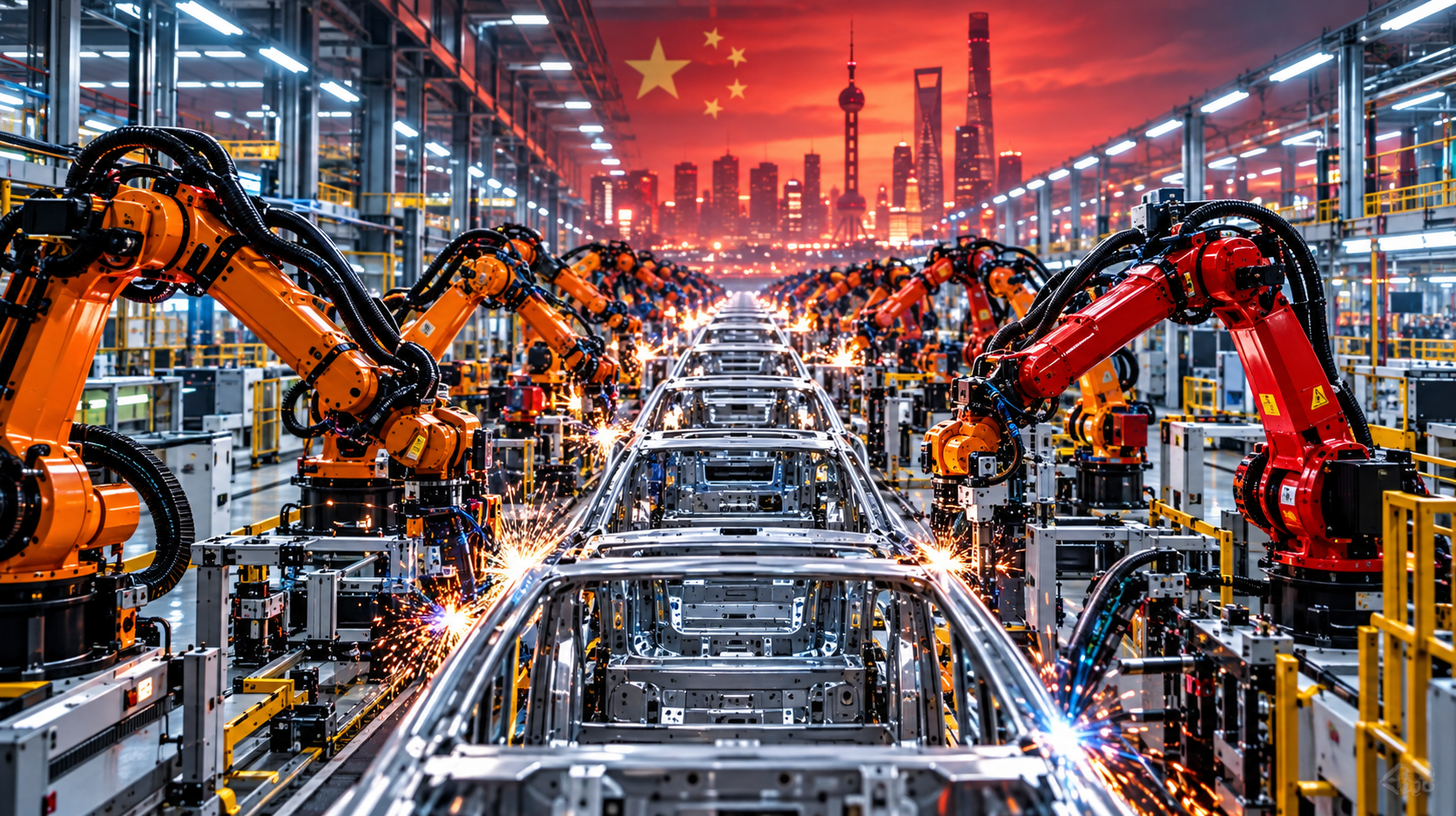
354,000 new machines: How China's robot boom is outperforming the German economy – Creative image on the topic, with AI: Xpert.Digital
From assembly line to AI machine: China's master plan for the factory of the future
Tesla has no chance? Why China has long dominated the market for humanoid robots
The 2 Million Robot Miracle: The Open Secret Behind China's New World Record
While the West debates skills shortages, high labor costs, and the threat of deindustrialization, China has long since established irreversible facts. With an unprecedented automation boom, the People's Republic definitively rewritten the global technological order in 2025. An impressive 354,000 new industrial robots were put into operation there within twelve months – almost nine times as many as in the USA and many times the nearly 25,000 units in Germany, once a pioneer in robotics. But the sheer number of machines is only half the story. Behind these record figures lies an industrial strategy meticulously planned over decades, transforming China's role from that of a mere "extended workbench" to the absolute pacesetter of global automation. Chinese manufacturers now produce the majority of robots themselves, and the country has already firmly established a leading position in the next major technological revolution – humanoid AI robots. The following analysis shows how China achieved the automation miracle, which warning signs the German economy must now take seriously, and why the battle for the factory of the future is only now entering its decisive phase.
The Robot Republic: How China is Rewriting the World Order of Automation
While the West complains about a shortage of skilled workers, Beijing is building the factory of the future – and delivering it along with the factory
There are figures that encapsulate an entire era in a single number. For the year 2025, that figure is 354,000. That's how many new industrial robots were put into operation in a single country, and that country is China. This means that almost three out of every five industrial robots installed worldwide were in the People's Republic – a 59 percent share of a global market that surpassed the threshold of 600,000 newly installed units. By comparison, the second-placed United States had 38,400 units, Japan 36,200, South Korea 30,200, and Germany, Europe's industrial powerhouse, just 24,800. China thus installed almost nine times as many robots as the USA and more than the rest of the world combined.
This analysis puts into perspective what lies behind these figures: an industrial strategy planned over decades, a shifting balance of power in the global economy, and a second technological wave in the form of humanoid robots, in which China has also already taken the lead.
An advantage that is not a snapshot in time
China's lead is not an anomaly from a single good year, but the result of a long, continuous acceleration. As early as 2024, China had already captured 54 percent of global demand with 295,000 newly installed industrial robots, setting a record. The jump to 354,000 units in 2025 represents a 20 percent increase compared to the previous year and surpassed the previous annual record by almost 60,000 units. During the same period, the global operational stock of industrial robots rose by nine percent to a record high of around five million units.
To grasp the scale, it's worth looking at the sheer number of robots: By the end of 2024, Chinese factories already housed over two million operational industrial robots – representing 43 percent of the global total and by far the largest robot fleet of any single country. This number had doubled in just three years: surpassing one million in 2021 and two million in 2024. For context, the United States had a total of around 394,000 units during the same period – meaning China has roughly five times as many operational factory robots.
The following overview shows the ranking of newly installed industrial robots in 2025 and illustrates the extent of the gap.
| country | New installations 2025 | Share / Context |
|---|---|---|
| China | 354.200 | 59% of world installations |
| USA | 38.400 | America's largest market |
| Japan | 36.200 | Second largest single market |
| South Korea | 30.200 | Highest robot density worldwide |
| Germany | 24.800 | 41% of all EU installations, -8% |
| India | 10.500 | Emerging growth market |
| Italy | 7.800 | Second largest EU market |
| Taiwan | 5.700 | electronically driven |
From extended workbench to pace-setter
The truly remarkable shift lies not only in the sales figures, but in who manufactures these robots. For decades, the Chinese robotics market was the domain of foreign suppliers – primarily the Japanese corporations Fanuc and Yaskawa, the Swiss-Swedish ABB Group, and the German manufacturer Kuka, which itself was acquired by a Chinese company in 2016. Those days are over. By 2025, 195,000 of the robots installed in China were from domestic manufacturers, an increase of 15 percent, representing a domestic market share of 55 percent. Since 2024, for the first time, more than half of all robots installed in China have come from Chinese brands.
This shift is historically unprecedented. Between 2014 and 2024, the number of robots installed by Chinese manufacturers rose from 65,000 to 310,000 units, a cumulative increase of 377 percent with an average annual growth rate of around 17 percent. The market share of domestic suppliers, which remained at only about 28 percent for much of the past decade, climbed to 47 percent in 2023 and 57 percent in 2024. China is thus not only the largest consumer of factory robots, but also now the country with the highest production output of industrial robots worldwide.
The three engines of demand
China's appetite for robots is not evenly distributed, but rather concentrated in three industrial heavyweights. Leading the way is the electrical and electronics industry, which installed around 96,400 robots in 2025, an increase of 16 percent and a 27 percent share of total national installations. This sector is the backbone of China's export economy, from smartphones and semiconductor assembly to consumer electronics, and it is driving automation with particular force.
The automotive industry follows in second place with a new record of 78,900 installed units, a growth of 38 percent. This leap is closely linked to China's rise to become the world's leading nation in electric vehicles: The massive expansion of manufacturing capacities at companies like BYD and numerous other brands requires highly automated production lines. The metal and machinery industry ranks third with 78,700 units, a remarkable increase of 44 percent. This broad demand across several key industries fundamentally distinguishes the Chinese market from those countries where automation is driven almost exclusively by the automotive sector.
The open secret of state control
To understand China's success in robotics, one must look back to 2015. That year, the Chinese government announced an industrial modernization strategy called "Made in China 2025," identifying ten strategic sectors in which China aimed to achieve global leadership. Robotics was among these priority sectors from the outset, as it was considered a touchstone of industrial maturity and a representative of the broader ambition of technological independence. The program was inspired by none other than the German "Industry 4.0" initiative – a detail that sheds particular light on the subsequent shift in the balance of power.
The core of the strategy was substitution: China aimed to gradually replace imported technology with domestically produced technology. For industrial robots, the accompanying technology roadmap set a concrete and, at the time, considered ambitious target: that by 2025, around 70 percent of domestically sold industrial robots should be manufactured by Chinese companies. While China has not fully achieved this target in terms of total installations, with a domestic share of 55 to 57 percent, it has come remarkably close – and in certain segments, such as metal processing, Chinese suppliers have already achieved market shares of around 90 percent.
The instruments of this policy were diverse and extensive. At the national and local levels, the government relied on subsidies, tax incentives, the promotion of mergers and acquisitions and joint ventures, and the establishment of specialized robotics centers and industrial parks. Reports indicate that the Chinese government allocated over US$20 billion in subsidies to the robotics industry in late 2024 and early 2025, in the form of grants, loans, tax credits, and government-backed venture capital. Furthermore, in March 2025, the National Development and Reform Commission announced a state steering fund intended to channel US$137 billion into AI and robotics startups over two decades.
Supply-side support was complemented by demand-side measures. The "Robot+" action plan, announced in 2023, mandated the introduction of domestically produced robotics in ten key sectors, including agriculture, logistics, and healthcare, thereby creating targeted demand for domestic manufacturers. This combination of supply and demand management explains why China's rise was so rapid and comprehensive. Total spending on industrial policy reached an enormous volume, estimated at approximately 1.7 percent of China's economic output.
Robot density: The more honest measure
Absolute installation figures only tell half the story, because China is a populous country with a gigantic manufacturing base. Robot density, i.e., the number of industrial robots per 10,000 manufacturing employees, is more meaningful. And here, too, China has undergone a remarkable catch-up process: The density rose from 246 robots per 10,000 employees in 2020 to 567 in 2024, an increase of 130 percent. This puts China ahead of Germany and in third place worldwide, behind South Korea and Singapore.
This metric both puts the picture into perspective and intensifies it. It puts it into perspective because South Korea, with a robot density estimated at over 1,000 units per 10,000 employees, remains unchallenged at the top and is unlikely to be overtaken in the foreseeable future. However, it also intensifies the picture because no other major economy can boast such rapid growth in density. Within five years, China more than doubled its robot density – the fastest increase among all major economies. South Korea's lead, therefore, is one of sheer numbers, not of rapid growth. And rapid growth determines the future.
🎯🎯🎯 Data-driven B2B industry hub as a quasi-in-house solution


The quasi-in-house solution: How Xpert.Digital closes operational gaps in B2B marketing and sales – Smart Content-Driven Business - Image: Xpert.Digital
Xpert.Digital is a data-driven B2B industry hub led by Konrad Wolfenstein . The company acts as an external, quasi-in-house solution for industrial partners, closing operational gaps in marketing, content, and sales – without requiring additional resources on the client side.
More information here:
Automation in the 21st century: Lessons from China
Germany: The creeping loss of connection
For the German economy, long a flagship of industrial automation and home to the robotics manufacturer Kuka, the results for 2025 are sobering. With 24,800 newly installed industrial robots, Germany remained by far the largest robotics market in Europe, accounting for 41 percent of all installations in the European Union. However, the number of new installations fell by eight percent compared to the previous year, and in the global ranking, Germany slipped to fifth place behind South Korea, Japan, the USA, and China.
The main reason lies in the weakness of the automotive industry, traditionally the largest consumer of robots in Germany. While the sector remained the leader in 2025 with 5,800 newly installed robots, representing a 23 percent share, this figure was significantly lower than in 2020, when the automotive industry accounted for 40 percent of installations. Industry statistics cite weak sales figures for electric vehicles and political and economic uncertainties, which are delaying investment decisions, as contributing factors. The metalworking, chemical, and plastics industries also recorded declining installations.
The figures on the supply side are particularly alarming. Production of industrial robots in Germany fell by 24 percent in 2025 to 23,700 units, and exports of German industrial robots even plummeted by 37 percent to 15,100 units. A country that once exported robots worldwide is thus simultaneously losing market share domestically and competitiveness in exports. Industry forecasts predict a further decline in demand for 2026, before installation figures are expected to rise again from 2027 onward. The following comparison illustrates the structural difference between the Chinese and German markets.
| dimension | China 2025 | Germany 2025 |
|---|---|---|
| New installations | 354.200 (+20%) | 24.800 (−8%) |
| World share | 59% | approximately 4% |
| Leading customer industry | Electronics (96,400) | Automobile (5,800) |
| Domestic robot production | World leader | 23.700 (−24%) |
| Automotive industry trend | +38%, record | The share decreases (40% → 23%) |
Why this shift is more than just statistics
The significance of China's lead only becomes clear when placed in the broader context of industrial value creation. Robots are not ordinary capital goods, but rather productivity multipliers. A country that automates its manufacturing on a large scale reduces its unit costs, increases its quality and repeatability, and simultaneously becomes less dependent on wage increases and demographic constraints. China is using automation to counter the dual pressure of rising wages and an aging workforce – a connection that Chinese industrial policymakers themselves openly acknowledge.
Furthermore, there is a self-reinforcing effect. Whoever installs the most robots gathers the most practical experience with their integration, maintenance, and further development. Whoever also manufactures the most robots can directly translate this experience into better products. China is thus on its way to closing the feedback loop that has so far made Japan, Germany, and Switzerland technology leaders. Industry analysis assumes that the Chinese market will continue to grow by an average of five to ten percent annually until 2029 – growth that has rarely been interrupted, even under adverse conditions.
This creates a twofold dilemma for the United States and Europe. On the one hand, their manufacturing base risks falling further behind in cost competition if automation progresses more slowly there. On the other hand, they are becoming strategically dependent because more and more of the world's automation technology originates from China – a pattern already familiar from the solar panel, battery, and electric vehicle sectors.
The second wave: Humanoid robots
While the world is still debating China's dominance in traditional industrial robots, a second, potentially far more disruptive front has already opened: humanoid robots. These are human-like machines that walk on two legs, grasp objects with arms and hands, and can be flexibly deployed in environments designed for humans. The market is still tiny – estimates for the number of units sold worldwide in 2025 range from 7,000 (International Federation of Robotics), around 13,000 (Omdia), to as many as 18,000 (IDC). But growth expectations are enormous.
It is striking that China already clearly dominates this emerging field. According to estimates for 2025, the two Chinese manufacturers Agibot and Unitree alone accounted for around 71 percent of global sales. In contrast, US providers played virtually no role: Tesla's much-discussed Optimus robot, like Figure AI and Agility Robotics, was projected to account for just one percent of global sales. The following table shows the estimated distribution of humanoid robot sales in 2025.
| Manufacturer | Origin | Estimated market share 2025 |
|---|---|---|
| Agibot | China | 39% |
| Unitree | China | 32% |
| UBTech | China | 7% |
| Leju Robotics | China | 4% |
| AI Engine | China | 3% |
| Fourier | China | 2% |
| Figure AI | USA | 1% |
| Agility Robotics | USA | 1% |
| Tesla | USA | 1% |
| Other | – | 10% |
A race that is already fiercely contested
The market for humanoid robots may be small, but competition at the top is already fierce. Agibot, a Shanghai-based company, claimed global leadership for 2025 with over 5,100 units shipped and a 39 percent market share. Unitree immediately disputed this claim, stating that it had shipped over 5,500 humanoid robots and produced more than 6,500 in the same year. The battle for market leadership reveals just how immature and yet dynamic this segment is—and how seriously the players take the symbolic title of market leader.
Also noteworthy is the revenue growth. Unitree achieved sales of approximately 1.7 billion yuan in 2025, a 335 percent increase year-on-year, while Agibot saw twenty-fold growth, reaching 1.05 billion yuan. At Unitree, revenue from humanoid robots surpassed that from the older quadrupedal robots for the first time in 2025, accounting for over 51 percent of total revenue – a signal that the industry is definitively shifting its focus to humanoid machines. The race continued in the first half of 2026: According to market data, Agibot shipped around 8,400 units and achieved a global market share of 44 percent, overtaking Unitree, which fell to second place with approximately 5,900 units and a 31 percent share.
However, one important limitation must not be overlooked: the vast majority of humanoid robots sold to date are not used in industrial production, but rather in research and education. At Unitree, in the first nine months of 2025, approximately 73.6 percent of humanoid robot sales came from research and teaching, while only about nine percent were attributable to industrial applications. The mass market for working humanoids in factories and warehouses has therefore yet to emerge.
What the major forecasts suggest
Investment banks have recognized the significance of this shift and recently revised their forecasts dramatically upwards. In its report on "physical AI," Goldman Sachs increased its sales estimate for humanoid robots in 2035 from approximately 1.4 million units to around 6.5 million – nearly five times the previous estimate. For 2030, the bank raised its forecast from 256,000 to 890,000 units, and for 2026 from 51,000 to 75,000. Goldman Sachs now estimates the market volume in 2035 at around US$138 billion, compared to a previous estimate of US$38 billion.
Crucial to this reassessment is the expected cost curve. Goldman Sachs anticipates that the average selling price of a humanoid robot will fall from around $41,800 in 2025 to approximately $21,300 in 2035, while material costs will drop from around $27,700 to $13,500. These declining costs are making the machines an increasingly economical alternative to human labor, with logistics centers and automotive manufacturing considered the earliest adopters.
Morgan Stanley's scenarios go even further, estimating the total market for humanoid robots, including downstream services, at over five trillion US dollars by 2050 and assuming potentially more than one billion humanoids in use by that time. According to this analysis, around 90 percent of these are expected to be used in industrial and commercial applications, and China is explicitly named as the leading nation in development. For the Chinese market alone, Morgan Stanley anticipates a volume of 1.5 million units by 2030 and 7.4 million by 2035. Such forecasts are subject to considerable uncertainty and should not be mistaken for certainties, but they do indicate the direction in which capital market expectations are moving.
The remaining technical hurdles
Despite all the enthusiasm, the technical limitations of humanoid robots remain considerable. Key bottlenecks include the need for skillful robotic hands, the reliability of the overall systems in continuous operation, and the lack of real-world training data for the underlying artificial intelligence. A robot that impresses in the lab must function reliably for years in the harsh environment of a factory or warehouse – and this robustness has yet to be achieved. Therefore, widespread market penetration is generally not expected until the mid-2030s, when AI, energy density, and cost curves have matured.
This is precisely where China's strategic advantage lies. A country that already operates the world's largest base of industrial robots and possesses a deep, integrated supply chain for motors, sensors, batteries, and control electronics can mass-produce humanoid robots faster and more cheaply than competitors who first have to build this base. The lead in traditional industrial robots thus becomes a springboard for leadership in humanoids – the two developments reinforce each other.
A reasoned perspective in conclusion
A sober analysis of the data leads to a clear, albeit uncomfortable, conclusion: China has not only won the race for industrial automation, but is currently transforming this lead into a leadership position in the next generation of technology. This is no accident, nor is it merely a result of low wages, but rather the fruit of an industrial strategy pursued consistently for over a decade, combining supply-side and demand-side policies, massive subsidies, and the systematic development of a domestic supplier base.
At the same time, this picture requires some nuance. China's dominance in humanoid robots has so far been based primarily on sales in research and education, not on productive industrial use. South Korea remains far ahead in robot density. And the quality and reliability of top-of-the-line Chinese robotics in the most demanding applications is still surpassed by Western and Japanese suppliers in certain areas. The Chinese lead is therefore real, but neither complete nor insurmountable.
For Germany and Europe, the real message lies less in the impressive Chinese figures than in their own decline. A decrease in robot deployment, shrinking domestic robot production, and plummeting exports are not merely a cyclical dip, but warning signs of structural weakness. Automation is not a luxury, but a prerequisite for remaining competitive in the face of high wages, aging workforces, and intense international competition. Those who slow down automation will not only fall behind in robot production, but ultimately in the entire value chain built upon them. The robotic state in the East has demonstrated how industrial policy works in the 21st century. The crucial question now is whether the West is prepared to learn the right lessons from it.
📈🚀 From visibility to trust 👀🤝 Your scalable path with Xpert.Digital


From visibility to trust: Your scalable path with Xpert.Digital - Image: Xpert.Digital
In industrial B2B, sustainable business relationships rarely emerge overnight. They develop step by step – through visibility, professional relevance, recurring touchpoints, and growing trust. Xpert.Digital's 4-stage model addresses precisely this: It offers a structured path that begins with a manageable entry point and can evolve into deeper collaboration in business development if needed.
Instead of relying on loud marketing promises, this model puts the relationship at the forefront. Companies start with clearly defined, easily calculable measures and then decide, based on their own experience, how far they want to expand the collaboration. A key factor for this undisturbed trust-building process: The platform completely avoids annoying advertising ads, so the editorial focus remains solely on the companies' expertise.
More information here:
Your global marketing and business development partner
☑️ Our business language is English or German
☑️ NEW: Correspondence in your native language!

Konrad Wolfenstein
I and my team are happy to be available to you as your personal advisor.
You can contact me by filling out the contact form here wolfenstein@xpert.digital:or simply call me at +49 7348 4088 965. My email address is
I'm looking forward to our joint project.