
China's response to 100% US tariffs: The trade conflict between the US and China reaches a new, explosive level

Available in 27 languages 📢
Prefer Xpert.Digital on GoogleⓘPublished on: October 12, 2025 / Updated on: October 12, 2025 – Author: Konrad Wolfenstein
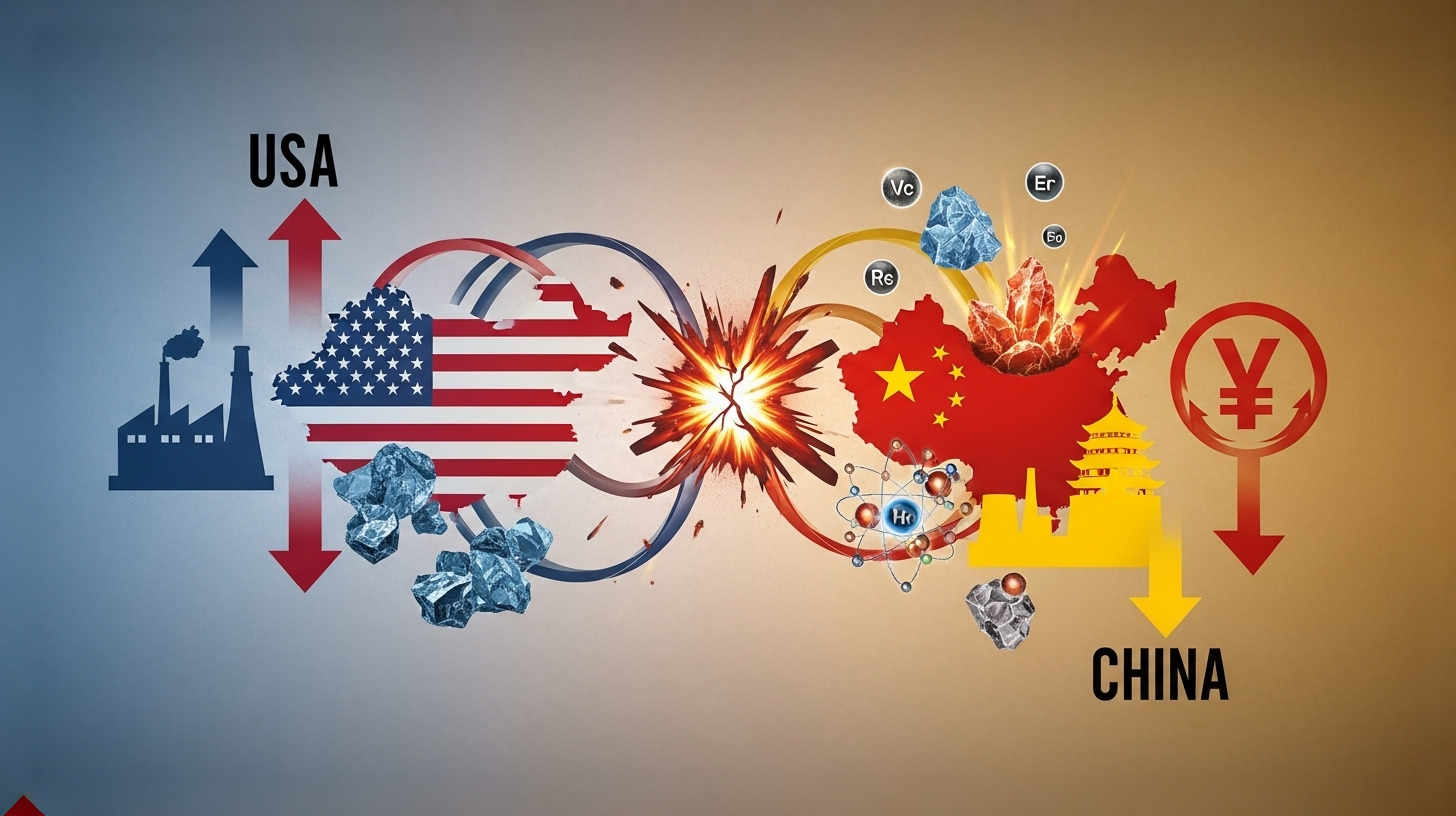
China's response to 100% US tariffs: The trade conflict between the US and China reaches a new, explosive level – Image: Xpert.Digital
Nothing works without them: How China controls the global economy with rare earth elements
Is the collapse of global supply chains imminent? 100% tariffs on Chinese goods in the US
With the threat of drastic 100 percent tariffs on Chinese imports, the US is escalating its rhetoric, but Beijing is not intimidated. China's response is as strategic as it is effective: targeted control over the export of rare earth elements. These unassuming raw materials are the hidden heart of our modern world – indispensable for smartphones, electric cars, wind turbines, and sophisticated weapons systems.
But the dispute is far more than a mere economic war. It is a bitter struggle for technological supremacy, national security, and control over the global supply chains of the future. While the US seeks to protect its semiconductor industry with tariffs and export bans, China is leveraging its near-monopoly on rare earth elements as a powerful asset. This article examines the background of the escalation, explains why rare earth elements are China's most powerful trump card, and analyzes the far-reaching consequences for the global economy, industry, and ultimately, consumers in Europe.
Related to this:

The trade dispute between China and the USA: Questions and answers from a neutral person
The ongoing trade conflict between China and the United States has escalated once again. The US is threatening new, comprehensive tariffs on Chinese goods, while Beijing is responding with countermeasures and export restrictions on rare earth elements. This Q&A text features a neutral party asking key questions to illuminate the background, measures, economic and political implications, and technical details of the dispute, providing a comprehensive overview for the reader.
What is the current reason for the new escalation in the trade dispute between China and the USA?
The immediate cause is a new tariff threat from the US government. President Donald Trump announced that, starting November 1st, he would impose additional tariffs of 100 percent on imports from China. This affects a wide range of Chinese goods and is part of a longer series of trade measures that have been in place between the two countries for several years. The Chinese government responded promptly with an official statement accusing the US of hypocrisy and nationalist economic protectionism.
What is China's justification for its criticism of the US measures?
China accuses the US of generalizing the principle of national security and using it as a pretext to tighten export controls. The Chinese Ministry of Commerce criticizes the United States for applying discriminatory measures against Chinese companies and products. According to Beijing, Washington is unilaterally expanding its right to control international trade, particularly in the semiconductor and computer chip sectors. This, they argue, is disrupting global supply chains and undermining the results of previous trade negotiations.
What are China's main accusations against the US in the current trade conflict?
China feels disadvantaged by US measures and is calling on the US government to abandon its "false approach." The accusation of double standards refers in particular to the fact that the US, on the one hand, promotes free trade, while on the other hand, in the name of national security, it shields large sectors of the economy through tariffs and export controls. Beijing urges the US to respect the results of past trade negotiations and to resolve bilateral issues through dialogue. Otherwise, the Chinese Ministry of Commerce threatened decisive countermeasures to protect its own legitimate rights and interests.
What specific countermeasures is Beijing planning in response to the US tariffs?
In direct response to the new US tariffs, the Chinese government plans to expand its export controls on rare earth elements, which are considered strategic raw materials for industry and especially the military. This will affect not only the extraction but also the processing and export of these minerals. Beijing emphasizes that this is not a general export ban; applications for civilian purposes will continue to be approved. The measure is primarily intended to further develop the domestic export control system and secure international competitive advantages.
What are rare earth elements – and why do they play such a central role in the conflict?
Rare earth elements are a group of 17 chemical elements essential for the production of a wide variety of modern technological products. The best-known representatives are neodymium, praseodymium, dysprosium, yttrium, and others. Their unique magnetic, electronic, and optical properties make them key components in the manufacture of electric motors, turbines, semiconductors, and various high-tech and military-grade products.
Although the term "rare" is misleading, these elements are not necessarily rare, but often occur only in low concentrations in the Earth's crust. Their extraction is technically demanding, as they are often bound in complex mineral mixtures. Separating the elements and subsequently processing them is environmentally and technologically intensive. Over the past few decades, China has built a specialized industry that is a world leader in extraction and processing.
Related to this:

What is the economic and geopolitical significance of rare earth elements?
Economically, rare earth elements are a crucial factor for many industrial and future technologies. Their uses range from mobile phones and wind turbines to OLED displays, electric vehicles, and precision weapons. Due to their key role, control over their extraction and processing is considered a strategic resource.
Geopolitically, China's dominant market position gives it significant leverage to exert pressure on other countries—especially the US and the EU—in trade negotiations. More than 60 percent of global production and well over 80 percent of processing takes place in China. Other countries that mine rare earths often send them to China for processing, as the country possesses unique expertise and numerous patents that make it considerably more difficult for competitors to establish their own industries.
How does China's dominant position in rare earth elements affect the global supply chain?
China's central role in extraction and processing means that a significant portion of the world's permissible raw materials and intermediate products find their way to China. A global network has been established in which Chinese companies and government agencies effectively hold a monopoly on the most important processing and final manufacturing stages. Because China holds many technical patents related to extraction and processing, other nations are often forced to ship their raw materials to China for final processing. This gives Beijing extraordinary leverage over the supply of strategic raw materials in trade conflicts, such as the current tariff dispute with the US.
Why are US measures against Chinese technology products particularly sensitive for Beijing?
China views US export controls and tariffs on semiconductors, computer chips, and other high-tech components not only as serving economic interests but also as security policy objectives. The US often justifies its measures with the need to protect national security, for example, by controlling technologies that could be used for military purposes. For China, this interference in advanced industrial sectors and the restriction of Chinese companies represents an interference in its economic development and global competition.
Beijing emphasizes that such measures disrupt global supply chains and negatively impact international trade. At the same time, China aims to secure its own technological development by expanding its innovation capacity and increasing patenting. The US, in turn, fears that its dependence on Chinese rare earths and technological components could jeopardize its own security and competitiveness.
What role do patents play in the processing of rare earth elements?
Over the past decades, China has successfully filed numerous patents related to the technological advancement and efficient processing of rare earth elements. This intellectual property presents a significant obstacle for other countries, as they are denied access to certain processes and technologies or can only gain access by paying high licensing fees.
These patents protect Chinese innovations and give the domestic industry a significant advantage. Countries like the USA or members of the European Union, which are striving to build their own processing capacities, encounter not only technical difficulties but also legal restrictions. The consequence: raw materials are exported to China, processed there, and then sold as finished products on the global market.
Are there international efforts to reduce dependence on China for rare earth elements?
Several countries have begun to strategically prepare for the possibility of trade escalation. The US, Japan, and the EU, in particular, are investing in developing their own extraction and processing capacities, opening up new deposits, and promoting recycling methods. They are also working on international cooperation to reduce technological dependence.
So far, successes have been limited, as China holds a technological and economic lead in many areas of processing. Developing alternative processes and exploring new deposits requires substantial investment and a years-long development phase. Therefore, the market structure will remain Chinese-dominated in the medium term, which continues to give China a privileged position in trade disputes.
Our global industry and economic expertise in business development, sales and marketing

Our global industry and economic expertise in business development, sales and marketing - Image: Xpert.Digital
Industry focus areas: B2B, digitalization (from AI to XR), mechanical engineering, logistics, renewable energies and industry
More information here:
A thematic hub offering insights and expertise:
- Knowledge platform covering global and regional economies, innovation and industry-specific trends
- A collection of analyses, insights, and background information from our key areas of focus
- A place for expertise and information on current developments in business and technology
- A hub for companies seeking information on markets, digitalization, and industry innovations
Rare earths as a geopolitical weapon: China's leverage in high-tech markets
How have trade talks between China and the USA developed in the past?
Trade negotiations between the two countries have been marked by fluctuating success since the start of the current trade conflict in 2018. Periods of détente, such as after the so-called "Phase 1 Deal," alternated with new sanctions and tariff packages. The negotiating partners repeatedly managed to achieve some progress, for example, by resolving issues related to agriculture or market opening. Nevertheless, key points of contention, such as access to high-tech markets or the control of key technologies, remained unresolved.
The latest round of tariffs and the renewed expansion of export controls demonstrate that neither side is currently willing to compromise or interested in a swift resolution. The tone has become harsher; both China and the US emphasize in their official communications that they do not desire a trade war – but are not afraid of one either.
Related to this:

What impact would additional tariffs of 100 percent on imports from China have on the USA?
The introduction of additional tariffs would drastically increase the price of Chinese goods in the US. This would affect consumer goods, electronics, machinery, and numerous intermediate products that are further processed in US industries. For end consumers, this could mean an immediate price increase for everyday products, from smartphones to household appliances.
US industry faces a decline in competitiveness because intermediate products are often indispensable and cannot be sourced from other suppliers in the short term. Companies would have to bear higher costs or resort to relocating production abroad. Jobs could also be affected if companies close parts of their manufacturing operations or move them overseas.
What economic and political motives lie behind the US policy?
The US is pursuing several goals with these tariff measures. On the one hand, it aims to protect its own industry from unfair, subsidized competition; on the other hand, it seeks to prevent US technology companies from becoming dependent on Chinese suppliers and service providers. At the same time, the measures are often justified on the grounds of national security, particularly in the area of military-relevant technologies.
Politically, populist motives play a role. Trade conflicts can be used in domestic political discourse to strengthen one's own position and as leverage in international competition. Especially in the run-up to elections, protective measures against China are often cited as proof of decisive action.
How does China justify its countermeasures and controls?
China justifies the expansion of export controls with the aim of improving its own export control system and developing it in compliance with the law. The government points to the importance of rare earth elements for military goods and recurring conflicts worldwide. Applications for peaceful, civilian use will continue to be approved; a general export ban is not planned. Beijing opposes a trade war but emphasizes that it is not afraid of escalation and will resolutely defend its own interests.
The accusation of double standards against the USA plays a central role in the argument. They see themselves as victims of unilateral, discriminatory protective measures and call for adherence to free trade and the resolution of disputes through dialogue.
What role does national security play in the trade conflict?
National security interests have become the dominant argument in transatlantic and transpacific trade in recent years. The US justifies many measures as protection against technological misuse by foreign powers. China, on the other hand, sees the expansion of export controls as a measure of self-protection, particularly in light of military developments and geopolitical uncertainties.
Both states use the argument of national security to defend their protective measures against foreign criticism and to declare them legally legitimate. This leads to a further widening of the political and economic divide and makes it more difficult to resolve the trade conflict based on a purely economic model.
What role does US jurisdiction play in international technology products?
The US is increasingly applying the principle of extraterritorial jurisdiction, particularly to products containing sensitive technologies or components. This means that not only products manufactured in the US, but also international goods containing US technology may be subject to US export control laws.
This often affects semiconductors and computer chips; companies in Europe, Asia, and elsewhere may have to comply with American regulations and obtain approvals from US authorities. This creates additional uncertainty and difficulties in global trade, as companies must adapt to different legal systems and conduct complex compliance checks.
How are globally operating companies reacting to increasing uncertainty?
Many internationally operating companies have begun to rethink and diversify their supply chains and production processes. The "China Plus One" strategy, for example, involves establishing production sites outside of China to be able to react flexibly to trade conflicts. Others are investing in the development of their own technologies and patents to avoid legal risks.
At the same time, interest is growing in new recycling methods and the development of alternative materials, particularly for rare earths and high-tech components. Companies are establishing compliance departments, training staff on international export regulations, and seeking legal advice to prepare for various scenarios.
Are there historical parallels to current export controls and customs measures?
Past trade conflicts, for example between Japan and the USA in the 1980s, show similar patterns: tariffs, export restrictions, legal disputes, and the debate about national security. Back then, too, technology was a central point of contention.
The unique aspect of the current dispute lies in the global interconnectedness and strategic importance of rare earth elements. While previous trade conflicts were often limited to individual sectors, the current dispute affects broad areas of industry and technology. The global dependence on China is unprecedented and gives Beijing an additional instrument of power politics.
How might trade relations develop in the medium term?
Forecasting the situation is difficult. In the short term, further escalation is likely, as both sides are acting resolutely and showing no willingness to compromise. In the medium term, alternative supply chains and new technological solutions could become established to reduce dependencies.
In the long term, a return to multilaterally coordinated international trade is possible if both states recognize that protectionist measures ultimately jeopardize global prosperity and innovation. This would require intensive negotiations, mutual concessions, and a return to constructive dialogue.
What impact will the conflict have on German and European industry?
German and European industry also faces major challenges. Many high-tech products and industrial goods require rare earth elements and other raw materials, which predominantly originate in China. Uncertainty surrounding tariffs and export controls complicates planning and increases costs. Companies are developing contingency plans, seeking alternative sources, and investing in research and development.
At the same time, opportunities for innovation and cooperation exist in the areas of raw material extraction and recycling. The EU is working on funding programs to expand technological sovereignty and reduce the gap in patents and processing technologies.
Related to this:

What are the global effects of the trade dispute on developing countries?
For many developing countries, the current situation presents both a challenge and an opportunity. Countries with their own rare earth deposits could benefit from the increased demand. However, there is a risk that they will become dependent on price fluctuations and political pressure from major economic powers.
The global interconnectedness of supply chains also means that shortages of rare earth elements could negatively impact the industrial sectors of numerous emerging economies. Many of these countries are not yet sufficiently capable of independently driving technological innovation in the raw materials sector. International development policy and technological cooperation could help reduce dependence on China and the US and open up new opportunities.
How can the current trade dispute between China and the USA be classified?
The current trade dispute between China and the US represents a complex mix of economic, political, and technological interests. At its core are key strategic resources such as rare earth elements and future-oriented industrial goods like semiconductors and computer chips.
Both sides are using the dispute to advance their own interests and secure their technology sectors. China benefits from its dominant market position in rare earths and patented processes, while the US is attempting to protect its own industry and exert geopolitical influence through tariffs and export controls.
For the global economy and international relations, the dispute represents significant uncertainty, which can lead to price fluctuations, supply bottlenecks, and innovations in response to trade-related restrictions. An end to the conflict is not currently in sight – developments in the coming months and years will show whether constructive negotiations and technological diversification can lead to a long-term easing of tensions.
Your global marketing and business development partner
☑️ Our business language is English or German
☑️ NEW: Correspondence in your native language!

Konrad Wolfenstein
I and my team are happy to be available to you as your personal advisor.
You can contact me by filling out the contact form here or simply call me at +49 7348 4088 965. My email address is: [email protected]
I'm looking forward to our joint project.
☑️ SME support in strategy, consulting, planning and implementation
☑️ Creation or realignment of the digital strategy and digitization
☑️ Expansion and optimization of international sales processes
☑️ Global & Digital B2B trading platforms
☑️ Pioneer Business Development / Marketing / PR / Trade Fairs
B2B support and SaaS for SEO and GEO (AI search) combined: The all-in-one solution for B2B companies

B2B support and SaaS for SEO and GEO (AI search) combined: The all-in-one solution for B2B companies - Image: Xpert.Digital
AI search changes everything: How this SaaS solution will revolutionize your B2B ranking forever.
The digital landscape for B2B companies is undergoing rapid change. Driven by artificial intelligence, the rules of online visibility are being rewritten. For companies, it has always been a challenge not only to be visible in the digital mass, but also to be relevant to the right decision-makers. Traditional SEO strategies and managing local presence (geo-marketing) are complex, time-consuming, and often a battle against constantly changing algorithms and intense competition.
But what if there were a solution that not only simplified this process but also made it smarter, more predictive, and far more effective? This is where the combination of specialized B2B support with a powerful SaaS (Software as a Service) platform comes into play, specifically designed for the demands of SEO and GEO in the age of AI search.
This new generation of tools no longer relies solely on manual keyword analysis and backlink strategies. Instead, it leverages artificial intelligence to more accurately understand search intent, automatically optimize local ranking factors, and conduct real-time competitive analysis. The result is a proactive, data-driven strategy that gives B2B companies a decisive advantage: they are not only found, but perceived as the leading authority in their niche and location.
Here's the symbiosis of B2B support and AI-powered SaaS technology that transforms SEO and GEO marketing, and how your company can benefit from it to grow sustainably in the digital space.
More information here:










