
Pallet storage locations and automation in high-bay warehouses: The fine line between technological revolution and operational trap
Xpert Pre-Release

Available in 27 languages 📢
Prefer Xpert.Digital on GoogleⓘPublished on: January 22, 2026 / Updated on: January 22, 2026 – Author: Konrad Wolfenstein
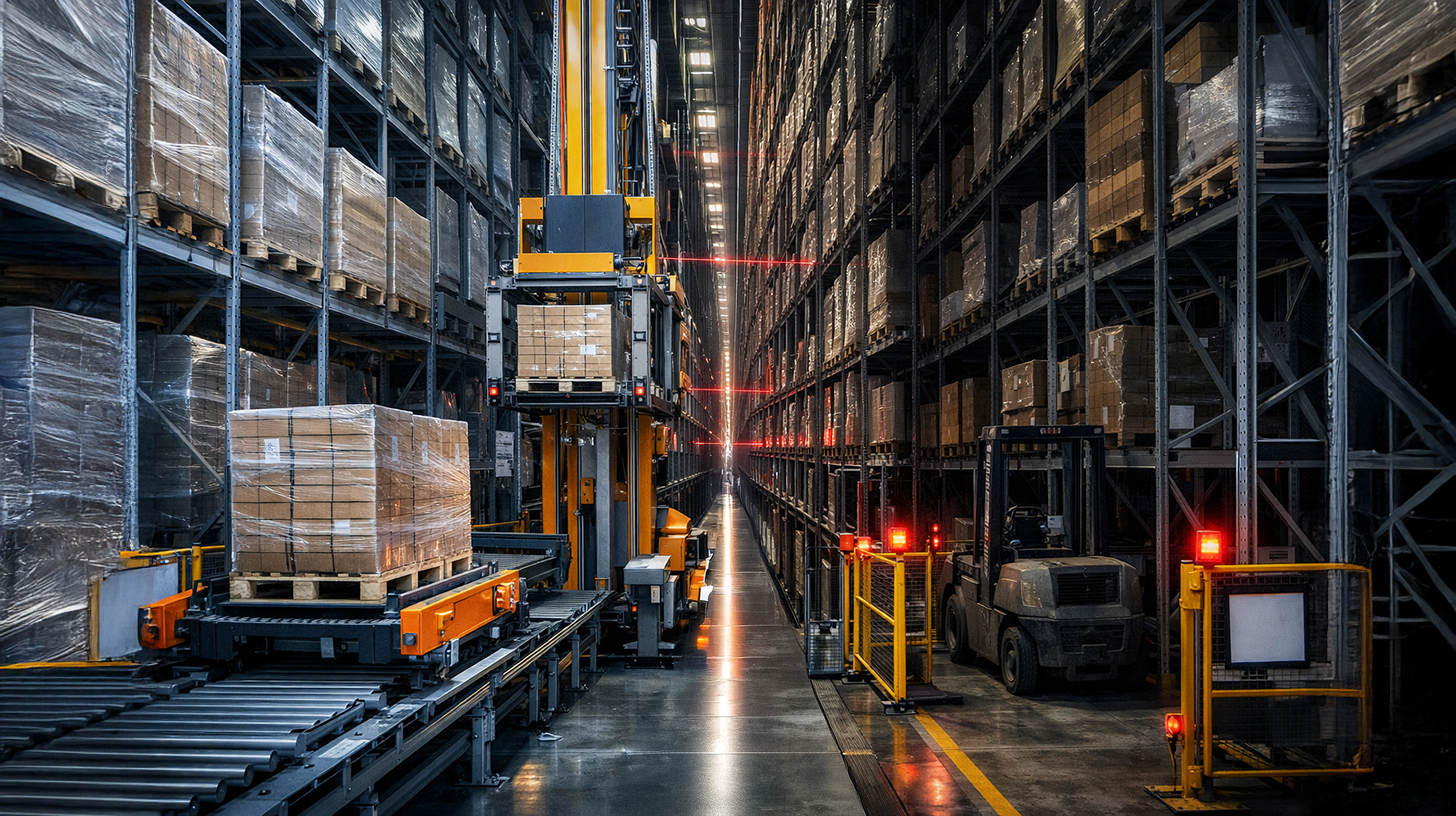
Pallet storage locations and automation in high-bay warehouses: The fine line between technological revolution and operational trap – Image: Xpert.Digital
Amazon and Walmart are leading the way: How AI and "plug-and-play" are ending the old warehouse world
Money pit or gold mine? The true cost behind automated high-bay warehouses
The year is 2026, and intralogistics is in the midst of a transformation that could hardly be more radical. What once began as the mere mechanization of warehouse processes has evolved into a technological "battle of beliefs," where the stakes are no longer just about pallet spaces, but about the very survival of companies. With a projected market volume of nearly $15 billion by 2030, the automated high-bay warehouse is transforming from a niche topic into a strategic necessity in a globally networked economy. However, the allure of efficiency promises can be deceptive: behind the impressive figures of modern Robotics-as-a-Service models and AI-driven orchestration platforms lies a complex reality fraught with underestimated risks.
While pioneers like Amazon and Walmart are setting new standards in speed and cost-efficiency through the massive deployment of autonomous mobile robots (AMRs) and artificial intelligence, much of the industry is struggling to integrate these systems. The advantages are obvious: space optimizations of up to 85 percent, drastically reduced error rates, and a return on investment often less than three years. But there's a downside. Exponentially increasing cyber threats, where ransomware can paralyze entire supply chains, and the ticking time bomb of outdated legacy systems for which spare parts are scarce, pose a serious threat to operational stability.
Added to this is the human factor, which remains ambivalent: On the one hand, automation is displacing traditional warehouse jobs, while on the other, it is creating entirely new job profiles and alleviating the chronic shortage of skilled workers that is slowing down supply chains in markets like the US and Germany.
This article takes an unflinching look behind the scenes of the polished logistics of 2026. We analyze how companies are managing the balancing act between enormous investment opportunities and existential risks, why sustainability is suddenly becoming a crucial economic factor, and why the decision for or against automation today will determine the market position of the next decade.
Strategic necessity in a growing market
The transformation of warehouses resembles a battle of beliefs between technological optimism and operational caution, where every investment decision becomes a matter of survival. The automation of high-bay warehouses is at a turning point, fundamentally redefining intralogistics. With a global market volume of US$9.86 billion in 2025, projected to grow to US$14.8 billion by 2030, this technology is evolving from a niche topic to a strategic necessity. However, examining this development reveals a complex mix of enormous opportunities and underestimated risks that extends far beyond simple cost-benefit analyses. Warehouse automation today operates within a tension between AI-powered intelligence, region-specific adoption patterns, and fundamental questions about the future of human labor in logistics.
The technological evolution of automated warehouse systems is progressing at a pace that is challenging many companies. While only 15 to 20 percent of all warehouses worldwide will use automated storage and retrieval systems in 2025, this low penetration rate simultaneously highlights the enormous growth potential of the industry. It's no longer simply about the mechanization of warehouse processes, but about highly integrated systems that combine artificial intelligence, machine learning, and real-time data analytics. The current generation of high-bay warehouses represents a fundamental shift away from rigid, monolithic infrastructures toward modular, flexibly scalable solutions that can dynamically adapt to changing business requirements.
AI revolution and autonomous orchestration
At the heart of this transformation lies the integration of self-learning algorithms that go far beyond rule-based automation. Modern warehouse management systems utilize predictive models that analyze vast amounts of data from ERP systems, IoT sensors, and warehouse management to identify patterns and generate operational recommendations in real time. Generative AI models enable conversational queries and create real-time dashboards that accelerate decision-making. These systems autonomously control entire processes and adapt to changes in supply or demand without requiring human intervention. Companies like Amazon are already using AI-powered orchestration platforms that coordinate robot movements and task distribution across entire facilities, reducing robot travel distances by approximately ten percent.
Parallel to the AI revolution, a qualitative leap is taking place in robotics. Autonomous mobile robots (AMRs) are increasingly replacing traditional driverless transport systems because they can navigate dynamically without external guidance. These AMRs utilize sensors and artificial intelligence for obstacle detection and path planning, making them more flexible and easily scalable. The latest development is mobile manipulators that can not only drive but also grasp, lift, and perform more complex physical tasks. These systems combine navigation with gripping technology and are suitable for more demanding activities such as retrieval, stocking, or handling different product groups. Locus Robotics already has over 10,000 collaborative units in operation in North America, while Amazon uses more than 1,000 AMRs each in its fulfillment centers in Shreveport and Detroit to triple throughput capacity during peak times.
The age of plug-and-play and digital twins
Technological maturity is particularly evident in the breakthrough of the plug-and-play principle, where new automation components can be integrated directly into existing systems with virtually no lengthy implementation processes. This not only reduces costs and time for commissioning but also creates an agile, future-proof automation toolkit. The proliferation of Robotics-as-a-Service (RaaS) models is transforming automation from a capital investment into an operational expense. RaaS allows companies to pay for robots on a monthly basis and scale them as needed, with maintenance, upgrades, and software perfectly coordinated. Facilities using RaaS models can deploy automation three to five times faster than with traditional approaches.
Cloud-based warehouse management systems have become the standard, enabling the integration of data from robotics, inventory management, IoT sensors, and external systems. These systems provide real-time transparency across all warehouse operations, regardless of location or device. The use of digital twins—virtual representations of real warehouse facilities—allows for simulations and predictions to identify potential bottlenecks or optimize layouts and processes before implementing actual changes. Companies report cost savings of 15 to 20 percent and throughput improvements of 25 to 30 percent, with payback periods of six to twelve months, through the use of digital twins. IoT sensors continuously deliver data on various parameters such as inventory levels, temperature, humidity, equipment status, and the location of goods, which are analyzed in real time and fed into automated control processes.
Global Markets Compared: From North America to Asia
Regional adoption patterns reveal a fragmented global landscape with widely divergent development speeds and drivers. North America dominates with a market share of 75.1 percent in 2025, driven by the e-commerce boom, acute labor shortages, and rising labor costs. Hourly wages in Los Angeles and New York warehouses exceed $20, reducing payback times for AMR deployments to under two years. Walmart has invested $200 million in autonomous forklifts, while Amazon has over one million robots in operation globally. An interesting effect of US customs policy in 2025 is the acceleration of nearshoring to Mexico, where Geekplus and DHL are rolling out a Robotics-as-a-Service program with 1,500 AMRs in five Mexican border warehouses to streamline cross-border e-commerce fulfillment processes.
Europe is experiencing more moderate growth, with a market volume of $2.42 billion in 2025, projected to reach $3.46 billion by 2030. Germany leads the market with $1.5 billion in 2024, driven by Industry 4.0 initiatives, stringent occupational safety standards, and the German government's sustainability goals. The Climate Action Program 2030 and the Sustainable Industry Framework are compelling companies to adopt greener technologies and improve safety standards in logistics operations. Central and Eastern Europe, particularly Poland and the Czech Republic, are emerging as rapidly growing logistics hubs, benefiting from cross-border investors and established platforms. SSI Schäfer, Dematic, and other European system integrators are delivering tailored solutions that address the specific regulatory requirements and sustainability targets of the EU.
Latin America represents a still largely underdeveloped market, but one with significant growth potential. Brazil and Mexico serve as key markets, where e-commerce growth is driving automation. However, the region faces considerable barriers, including high capital costs for small and medium-sized enterprises (SMEs), a shortage of skilled personnel for the maintenance and operation of sophisticated systems, and a fragmented market with widely varying levels of technological maturity and infrastructure development across countries. Regulatory uncertainties and import restrictions in certain Latin American countries increase costs and delay projects. Nevertheless, its strategic geographic location as a trade hub between North and South America makes advanced storage solutions attractive for reducing labor costs and operational inefficiencies.
The Asia-Pacific region represents the most dynamic growth region, with a market volume of $14.8 billion in 2025, projected to reach $32.87 billion by 2030. The region is expected to reach $119.52 billion by 2035, with a CAGR of 18.2 percent, making it the fastest-growing region globally. China dominates, with $2.94 billion invested in warehouse robotics in 2026, driven by the Made in China 2025 initiative and massive investments in e-commerce and logistics infrastructure. Amazon plans to invest $5 billion in India, focusing on automated warehouses, while Indian e-commerce giants recognize the transformative power of automation to address transportation delays, skilled labor shortages, and other challenges.
Southeast Asia is experiencing remarkable growth from $0.91 billion in 2026 to $1.63 billion by 2031, with a CAGR of 12.32 percent. Singapore holds 21.12 percent of the ASEAN market share in 2025, driven by government robotics grants, reliable infrastructure, and PSA's $2 billion Tua's supply chain hub. Developed land in Singapore costs over $400 per square meter, with annual rent increases of 15 percent, pushing companies to deploy autonomous mobile robots that can operate vertically and in narrow aisles. Jakarta is home to over 2,000 dark stores, each requiring systems capable of fulfilling orders in under 15 minutes. Lazada, one of Southeast Asia's largest online marketplaces, announced in 2024 the deployment of Syrius robots in regional warehouses. AutoStore opened a robot factory in Thailand, halving delivery times for ASEAN shoppers.
Quantifiable efficiency gains and cost advantages
The quantifiable benefits of automated high-bay warehouses are impressive and, in many cases, justify the substantial investment. Space optimization is paramount, with floor space savings of up to 85 percent through maximum utilization of cubic volume within a building. While standard racking and forklift solutions allow storage up to 20 or 30 feet high, automated storage and retrieval systems (ASRS) can reliably support products up to 150 feet high. This maximizes cubic utilization and eliminates the need for expansion or a new facility. ASRS also enable greater storage density, with the ability to store 25 to 30 pallets deep, all managed by automated shuttles or transporters. An example from Germany demonstrates that a heavy-duty mobile racking system requires approximately 45 percent less space compared to stationary racking, while increasing storage capacity by up to 90 percent due to minimized traffic areas.
The efficiency and productivity gains are equally substantial. Warehouse automation can lead to a 25 percent increase in productivity, a 20 percent improvement in space utilization, and a 30 percent improvement in inventory efficiency. Picking throughput increases by up to 85 percent because extensive walking distances are eliminated. Workers remain within assigned work areas, and machines deliver stored goods on demand. Picking lights illuminate the item's location and the required quantity, reducing the time employees spend searching for a specific item. Picking accuracy is increased to up to 99.99 percent because pickers are instructed to pick the correct item. GXO Logistics reports that its AI-powered visual inventory counting system can automatically scan up to 10,000 pallets per hour, dramatically speeding up inventory checks compared to manual counting cycles.
Cost savings manifest primarily through reduced labor costs, as fewer personnel are needed for repetitive and time-consuming tasks. Companies report initial annual savings of 30 percent in operating costs through automation. Payback periods for well-implemented automated storage and retrieval systems (ASRS) typically range from two to five years, with high-availability environments and operations with high labor costs seeing faster amortization. A German example illustrates this impressively. A comparison between a conventional pallet racking system with forklifts and an automated high-bay warehouse with stacker cranes shows that, despite the higher initial investment for the automated solution, the difference is offset after two years and eight months by the lower annual fixed costs, particularly personnel costs. From this point onward, the savings of the automated option are sustained throughout the warehouse's lifetime.
Underestimated risks: Cybersecurity and downtime
But behind these impressive promises of efficiency lurk risks that are often downplayed in industry communications. Cybersecurity threats to automated warehouses are increasing exponentially as the integration of physical and digital systems massively expands the attack surface. MIT, in its Warehouse of the Future Initiative, identifies five main disruptions threatening highly automated warehouse operations: cyberattacks, outages, sabotage, technological failures, and accidents, along with 26 specific vulnerabilities. Attacks on industrial control systems can alter robot movement commands, halt entire production lines, or cause inventory errors, paralyzing activity for hours or days. Ransomware infections can lock operators out of critical systems until a ransom is paid.
Autonomous logistics robots, which rely on algorithms and constant communication, are particularly vulnerable. If an attacker gains access to these systems, they could modify internal routes, cause collisions or blockages, and disrupt critical material flows. Beyond the economic impact, there is a direct risk to worker safety. Smart warehouses use wired and wireless networks to coordinate devices, and a poorly secured network facilitates communication interception, lateral movement within the environment, and unauthorized access to critical systems. Many warehouses use cloud-based warehouse management systems for scalability and real-time analytics, but misconfigured cloud storage, insecure APIs, and inadequate encryption can expose critical operational data.
The downtime costs of automated systems are substantial and often underestimated. A single crane out of service for eight hours can cost between $8,000 and $50,000, emergency repair visits cost between $5,000 and $15,000, and missed deliveries or SLA penalties can cost $10,000 to $100,000 or more. Legacy systems that are 15 to 20 years old pose a particular challenge. Many ASRS crane OEMs from the 1980s, 1990s, and early 2000s are no longer in business, leaving customers without parts, support, or upgrade paths. Outdated components, obsolete controls, and limited parts availability are ticking time bombs that dramatically increase the risk of unplanned downtime.
LTW Solutions

LTW Intralogistics – Engineers of Flow - Image: LTW Intralogistics GmbH
LTW offers its customers not individual components, but integrated complete solutions. Consulting, planning, mechanical and electrotechnical components, control and automation technology, as well as software and service – everything is networked and precisely coordinated.
In-house production of key components is particularly advantageous. This allows for optimal control of quality, supply chains, and interfaces.
LTW stands for reliability, transparency, and collaborative partnership. Loyalty and honesty are firmly anchored in the company's philosophy – a handshake still means something here.
Suitable for:
The underestimated risks of warehouse automation that many overlook – But: Warehouse robots create more jobs than they destroy
Challenges of maintenance and operational data integrity
Maintenance and complexity challenges are often underestimated. Ongoing maintenance costs typically range from one to three percent of the initial investment annually, with additional costs for repairs and parts replacement as needed. ASRS systems are complex machines that require specialized maintenance and troubleshooting capabilities. Relying solely on external vendors for every issue can be costly and lead to prolonged downtime. Data accuracy is critical, as inaccurate inventory data can lead to picking errors, stockouts, and significant operational inefficiencies. Maintaining high system reliability is essential to prevent costly downtime, as a single point of failure can halt an entire operation. Scope creep, unforeseen infrastructure requirements, and integration difficulties often result in budget overruns, making detailed project planning, contingency budgeting, and rigorous project management crucial.
The labor market is changing: Between job losses and new skills
The employment effects of automation are ambivalent and require nuanced consideration. The US saw a loss of 32,000 private-sector jobs in November 2025, the largest decline since spring 2023. Small businesses lost 120,000 positions, while large companies added 90,000 jobs, revealing a stark divide in how organizations of different sizes navigate the AI transformation. Amazon's automation has reduced its need for warehouse workers by 20 to 25 percent. Workers displaced from automated roles struggle to transition to roles that require fundamentally different skills from those developed in their previous positions.
Yet the same study that predicts 85 million jobs will be displaced by 2025 also forecasts the creation of 97 million new roles during the same period. Amazon has created over 700 entirely new job categories through automation—roles focused on managing, analyzing, and optimizing systems. Modern automation doesn't replace people; it elevates their roles. In automated warehouses, roles don't disappear; they evolve. Robots take over repetitive tasks, while people move into roles that require judgment and responsibility, such as exception handling, quality control, and workflow supervision. These roles require less physical exertion but more skill. Workers gain clearer process control, make fewer mistakes, and find their work more meaningful. Companies that adopt collaborative approaches to warehouse operations by 2026 could achieve a 32 percent higher employee retention rate.
Sustainability as a strategic competitive factor
The sustainability aspects of automated high-bay warehouses are gaining increasing strategic importance. Storage and logistics contribute approximately eleven percent of global CO2 emissions, but automation offers pathways to greater efficiency, lower emissions, and a reduced carbon footprint. AI-driven logistics, energy-efficient automated storage and retrieval systems (ASRS), self-charging robotics, and intelligent sorting systems reduce energy consumption, optimize space, and minimize waste. A study shows that wooden high-bay warehouses have a better environmental impact than conventional steel structures in five out of seven impact indicators. Weleda built a high-bay warehouse in Germany using 5,800 cubic meters of domestic wood, saving 2,600 tons of CO2. The climate-neutral energy supply, provided by 48 geothermal probes and a photovoltaic system with 10,000 modules, generates 1.3 GWh of electricity annually, saving 207 tons of CO2 per year.
ASRS in cold storage environments minimizes human handling and reduces the frequency of door openings, maintaining more stable internal environments. By automating the retrieval and storage process, ASRS contributes to more consistent temperature control, allowing refrigeration systems to operate more efficiently and resulting in lower energy consumption. In the long run, these savings can have a significant positive impact on operating costs, making ASRS an environmentally friendly solution for modern cold storage facilities. Automation optimizes storage and improves workflow efficiencies, reducing the need for physical expansion of storage space and helping companies avoid the additional CO2 emissions associated with constructing larger facilities.
Competitive landscape: Established giants and new challengers
The competitive market for ASRS solutions is dominated by established players who continuously innovate to maintain their market positions. Daifuku from Japan specializes in integrated material handling systems that increase operational efficiency. Dematic focuses on intelligent warehouse automation and offers scalable systems that adapt to customer needs. SSI Schäfer from Germany offers modular systems tailored to various industries, promoting flexibility and reducing labor costs. Vanderlande Industries emphasizes high throughput and reliability in ASRS solutions, which improves distribution capabilities. Swisslog and Murata Machinery utilize robotic technologies to enhance ASRS functionalities. Honeywell Intelligrated opened a Robotics Research Lab in Pittsburgh in February 2025 and added 200 engineers to accelerate AI-driven warehouse execution software and next-generation AMR fleets in North America.
Emerging players like Locus Robotics, AutoStore, Geekplus, and HAI Robotics are focusing on disruptive business models and innovative technologies. In August 2025, AutoStore broke ground on a $120 million cube-based storage manufacturing facility in Tennessee, targeting 10-week delivery cycles for US customers and creating 300 advanced manufacturing jobs. Geekplus and DHL rolled out a Robotics-as-a-Service program across five Mexican border warehouses in November 2025, deploying 1,500 AMRs to streamline cross-border e-commerce fulfillment under the USMCA framework. Locus Robotics debuted its LX4 collaborative mobile robot in April 2025, featuring a 25 percent payload increase and fast-swap lithium iron phosphate batteries, with initial deployments secured at two Target distribution centers in Illinois.
Key factors for implementation and recruitment
The strategic considerations for companies evaluating ASRS implementations are complex and require a holistic approach. Selecting the right warehouse automation vendor is critical and should consider multiple factors. Reliability and vendor support minimize downtime and ensure the warehouse adheres to tight service-level agreements. A vendor with a proven track record of reliability and robust support can help mitigate risks associated with unexpected technology failures. Resilience and redundancy are essential, with systems needing to adapt quickly to changing operational conditions, withstand disruptions, and have backup systems in place to minimize downtime.
Performance monitoring must support data-driven monitoring of productivity, throughput, and uptime, enabling warehouse operations to be tracked and evaluated in real time. Ergonomics is often overlooked but vital, as it directly impacts workplace safety, efficiency, and job satisfaction. Integration with existing systems presents unique challenges. Many organizations need to integrate new technology with existing infrastructure, requiring a careful assessment of the current refrigeration environment to determine the optimal integration strategy. This often involves retrofitting legacy systems with modern components or designing hybrid systems that combine manual and automated operations.
The skilled labor shortage is exacerbated by the increasing complexity of technology. The lack of qualified workers has become a critical risk factor in warehouse logistics. Staff shortages lead to longer truck dwell times at loading docks, decreased productivity, and higher error rates. Temporary work and overtime may offer short-term relief, but they drive up costs and place an additional burden on permanent staff. In the long term, the growing skills gap must be closed. Solutions focus on automation, employee retention, and professional development. However, even these efforts are hampered by a growing shortage of IT specialists as technology becomes increasingly complex.
Digitalized training methods offer the potential to bridge this gap. E-learning platforms and online videos enable managers to provide staff with precise, up-to-date training that is easily accessible and referenceable. Digital training methods can be tailored to the specific needs of the warehouse and the individual employee, resulting in a more targeted and effective learning experience. Logistics companies such as Ingram Micro and Loxxess reported a 75 percent increase in efficiency after implementing digitalized training processes on their shop floor. Digital training platforms allow training materials to be fluently translated into any language, opening the door to significantly more candidates and facilitating the recruitment of warehouse workers from Poland, Ukraine, or Turkey to Germany, even if they don't speak German.
Outlook 2026+: Convergence and Inbound Automation
The future of high-bay warehouse automation is characterized by the convergence of several technological trends. The year 2026 marks the point at which warehouse automation is no longer hardware-driven, but rather converges through software, AI, and robotics. Modular and intelligent systems will definitively replace legacy infrastructure. Static racking, manual sorting, and non-integrated conveyor systems will give way to modular robotic automated storage and retrieval systems (ASRS), AI-controlled sorters, and compact, flexible storage solutions. With stronger ROI case studies and scalable financing options, 2026 marks the definitive pivot away from traditional warehouse infrastructure.
Long overshadowed by outbound fulfillment systems, inbound automation is now taking center stage. Expect significant investments in robotic depalletizing and pallet building systems, AI-powered vision inspection that identifies products and barcodes in real time, and autonomous mobile robots for case and pallet transport. Inbound is no longer the bottleneck but is becoming the next frontier for automation ROI. Robotic depalletizing and pallet building systems leverage advanced AI vision and gripping technology to handle mixed pallets, various packaging types, and irregular stacking, resulting in higher throughput, safer ergonomics, and more consistent pallet integrity, while reducing manual labor in one of the toughest jobs in the warehouse.
Strategic orchestration through Warehouse Execution Systems (WES) is evolving into a real-time orchestrator that dynamically balances workloads across human and robotic fleets to eliminate bottlenecks. This is fueled by AI forecasting that goes beyond simple inventory counts, providing predictive decision intelligence. By analyzing micro-trends and global supply signals, AI anticipates order surges, allowing the WES to pre-position high-demand SKUs near packing stations before the first order is even placed. Digital twins enable system emulation before anything is actually built, allowing for a complete understanding of key impacts and analysis of operational impacts, providing insight and confidence in every automation decision.
The convergence of automation, AI, and green logistics will redefine what it means to operate a modern warehouse in 2025 and beyond. From data-driven energy consumption to carbon-neutral shipping, the goal is clear: to build operations that serve both business growth and planetary health. Companies investing in intelligent, sustainable automation solutions today are positioning themselves not only for operational excellence but also for long-term competitiveness in an increasingly regulated and environmentally conscious business world.
Technological optimism meets operational reality
The automation of high-bay warehouses stands at a crossroads between technological optimism and operational reality. The economic benefits are substantial and well-documented, with space optimizations of up to 85 percent, productivity increases of 25 percent, and payback periods of two to five years. At the same time, the risks should not be underestimated. Cybersecurity threats, downtime costs of tens of thousands of dollars per incident, complex maintenance requirements, and the challenge of finding and retaining qualified personnel represent real barriers that demand careful planning and risk management.
Regional disparities reveal varying levels of maturity and adoption patterns, with North America and Asia-Pacific driving automation forward with aggressive investments, while Europe takes a more moderate, regulation-driven approach, and Latin America still grappling with fundamental infrastructure and financing challenges. Employment effects are mixed, with short-term displacement in certain role categories but long-term creation of higher-value jobs requiring new skills. The sustainability dimension is becoming a strategic differentiator, as regulatory requirements and customer expectations compel companies to reduce their carbon footprints and demonstrate energy-efficient operations.
For decision-makers, this means that evaluating high-bay warehouse automation requires a holistic perspective that integrates technical feasibility, financial viability, risk management, personnel development, and strategic alignment with business objectives. Selecting the right vendor, ensuring resilience and redundancy, implementing robust cybersecurity measures, and investing in workforce training are just as critical as the technology itself. The future belongs to those companies that view automation not as a replacement for human labor, but as an augmentation that frees employees from repetitive, physically demanding tasks and allows them to focus on higher-value, more meaningful activities. This balance between technological excellence and human expertise holds the key to sustainable competitiveness in 21st-century intralogistics.
Your container high-bay warehouse and container terminal experts

Container high-bay warehouses and container terminals: The logistical interplay – expert advice and solutions - Creative image: Xpert.Digital
This innovative technology promises to fundamentally change container logistics. Instead of stacking containers horizontally as before, they will be stored vertically in multi-story steel racking structures. This not only allows for a drastic increase in storage capacity within the same area, but also revolutionizes all processes at the container terminal.
More about it here:
Your global marketing and business development partner
☑️ Our business language is English or German
☑️ NEW: Correspondence in your national language!

Konrad Wolfenstein
I would be happy to serve you and my team as a personal advisor.
You can contact me by filling out the contact form or simply call me on +49 7348 4088 965 (Munich) . My email address is: wolfenstein ∂ xpert.digital
I'm looking forward to our joint project.










