

AI | Augmented Intelligence: Why machines don't replace humans, but rather empower them
Xpert Pre-Release

Available in 27 languages 📢
Prefer Xpert.Digital on GoogleⓘPublished on: June 30, 2026 / Updated on: June 30, 2026 – Author: Konrad Wolfenstein
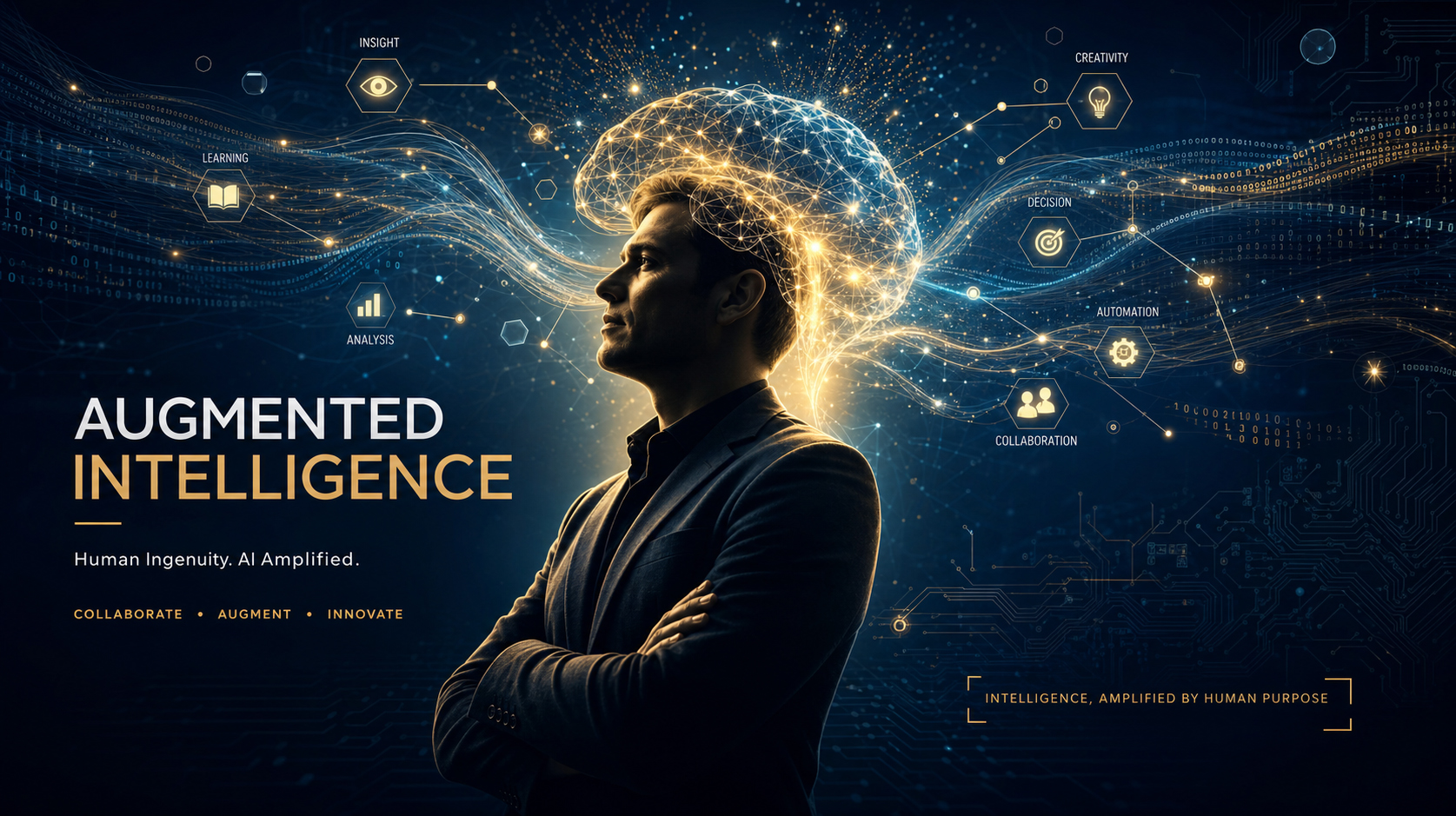
AI | Augmented Intelligence: Why machines don't replace humans, but rather empower them – Image: Xpert.Digital
The end of dangerous AI myths: Why machines make humans more powerful
Forget classic AI: Why “Augmented Intelligence” is changing the world of work and what is really happening
For years, the fear of machine replacement has dominated the discourse on artificial intelligence. When will machines take our jobs? But this narrative is too simplistic and structurally flawed. Instead of sidelining humans, a much more mature concept is increasingly coming into focus in business, science, and regulation: augmented intelligence. It doesn't aim for complete automation, but rather a symbiosis in which humans become more powerful. The machine analyzes enormous amounts of data in seconds, recognizes patterns, and delivers precise recommendations – but the crucial assessment, the ethical considerations, and the final say always remain with humans. Whether in medicine, the justice system, or industry: those who see AI merely as a means of job cuts overlook its true economic potential and risk a dangerous technological burnout among their workforce. Learn why the promised efficiency boom at the macroeconomic level is still pending, how the European AI Act legally places humans at the center, and why the future of work is not artificial, but hybrid.
When AI is not a competitor but a catalyst — the end of a dangerous narrative
What the term means — and what it deliberately does not mean
For years, the public debate on artificial intelligence has been dominated by a single question: When will machines take over human jobs? This question is not only reductive, it is fundamentally flawed. It operates on a binary logic—either human or machine—and overlooks the conceptually more mature model that science, business, and regulation are increasingly focusing on: the model of augmented intelligence.
Augmented Intelligence—often referred to as "extended intelligence" in German—describes the interplay between human and artificial intelligence, combining the strengths of both forms without one displacing the other. The crucial difference from conventional Artificial Intelligence lies neither in the technical architecture nor in the computing power, but in the concept of decision-making authority: With Augmented Intelligence, the responsibility for decisions always remains with humans. The machine analyzes, recognizes patterns, and provides recommendations—but it does not make judgments.
The US market research company Gartner has explicitly defined augmented intelligence as a combination of human and artificial intelligence that aims to enhance, rather than replace, human potential. This definition is not merely academically relevant; it reflects a strategic shift with far-reaching consequences for businesses, policymakers, and individuals alike.
Two concepts, one fundamental dividing line
To fully grasp the significance of Augmented Intelligence, it is worthwhile to take a close look at its conceptual distinction from classical Artificial Intelligence. Both concepts are based on machine learning, neural networks, and large datasets—but their objectives differ fundamentally.
Artificial intelligence in its purest form is geared towards complete automation: The machine independently takes over a defined area of responsibility without human intervention. This is sensible and efficient for repetitive, clearly defined, high-volume tasks—for example, in industrial quality control, automated data processing, or fraud detection in banking. Augmented intelligence, on the other hand, is conceptually more modest and simultaneously more demanding: It comes into play where human judgment, context sensitivity, empathy, or ethical considerations are irreplaceable.
The distinction can be summarized in a concise formula: Artificial Intelligence asks what a machine can do. Augmented Intelligence asks what a human can do better with machine support. The decision-maker doesn't change—they become more powerful. This shift in perspective has far-reaching consequences for the design, implementation, and governance of AI systems.
The historical misunderstanding — and why it persists
Apocalyptic narratives about job destruction through artificial intelligence have a long tradition. As early as the age of industrialization, the Luddite movement mobilized against mechanized looms, which they believed would render manual laborers obsolete. Indeed, every profound wave of technology has changed job profiles—but none has eliminated work entirely; instead, they have always created new fields of activity.
Current research paints a more nuanced picture than public discourse suggests. An analysis based on longitudinal employer-employee data from Scandinavia and Portugal shows that companies with greater exposure to AI do not experience a decline in overall employment, but rather a shift towards highly skilled roles. Companies are moving their workforce towards analytical and conceptual roles, while repetitive administrative tasks decrease. The much-cited widespread job losses have not yet been empirically substantiated.
The German Economic Institute (IW) reaches a similar conclusion: AI will indeed replace jobs, but will create almost the same number of new ones, so that net employment remains virtually stable—but the nature of work will change profoundly. This is the crucial point: It is not the volume of employment that is at stake, but its quality, its required skill sets, and the range of competencies that employees must possess.
How this interaction looks in practice — a sectoral perspective
Medicine: The doctor has the last word
Medicine is perhaps the most illustrative field for augmented intelligence because the consequences of incorrect decisions are most immediately apparent. AI-supported systems are already achieving remarkable results in radiology: they analyze hundreds of thousands of individual images from an MRI scan, recognize statistical patterns, and calculate probabilities for specific diseases—a task that human radiologists simply cannot accomplish with this speed and consistency. Nevertheless, the diagnosis, the therapeutic decision, and communication with the patient remain the responsibility of the physician.
In its publication on AI in healthcare, the German Medical Association (Bundesärztekammer) explicitly emphasized that AI is valuable when it supports physicians in making better decisions—not when it replaces them. In oncology, algorithms help to identify tumors with high precision using imaging techniques, enabling faster initial diagnoses that are then validated through clinical judgment and patient interviews. Early diagnosis of neurological diseases such as Alzheimer's or Parkinson's is another area of application where AI systems, based on MRI data, can detect early changes that the human eye would only perceive later—the treatment decision, however, remains the responsibility of the medical professional.
Law and compliance: Machine as initial reviewer, human as judge
In the legal field, AI systems now review tens of thousands of contract documents in minutes for legal risks, inconsistencies, and potentially disadvantageous clauses. What used to take hundreds of hours of legal counsel, the machine accomplishes in fractions of the time—but it doesn't understand what it reads in terms of context, intention, and societal value. The lawyer remains the interpreter, the negotiator, and the ethically responsible party. The AI system is its highly efficient initial reviewer.
Industry and intralogistics: Intelligent assistance for complex systems
Augmented intelligence is also gaining ground in industrial production and intralogistics. Predictive maintenance systems analyze sensor data from machines and forecast failures before they occur—but the maintenance technician decides when and how to intervene, based on operational knowledge that is not fully captured in any database. Warehouse and picking robots optimize routes and capacity utilization, but exceptional situations, customer negotiations, and strategic assortment adjustments remain in human hands.
The productivity paradox — why the promised efficiency boom has failed to materialize
Anyone following the economic debate surrounding AI inevitably encounters an uncomfortable observation: Investments in AI infrastructure and software have climbed to historic levels in recent years, yet the resulting boost in overall economic productivity is barely visible in macroeconomic data. At the end of February 2026, Goldman Sachs reached the sobering conclusion that the billions of dollars spent on AI in 2025 contributed "virtually zero" to US growth from a productivity perspective. While the spending itself acted as an economic stimulus—driven by capacity building—the promised efficiency gains across the economy remained invisible in the data.
This observation is strikingly reminiscent of the "productivity paradox" of the computer revolution, formulated by economist Robert Solow in the late 1980s: Computers are everywhere—except in productivity statistics. Back then, it took roughly two decades for the diffusion of computer technology into workflows, management practices, and organizational structures to progress far enough to become measurable in macroeconomic terms. Something similar is likely to be true for AI.
At the company level, however, a more nuanced picture emerges. An IBM study from autumn 2025, based on surveys of 3,500 executives in ten countries, revealed that two-thirds of companies in Germany are already experiencing significant productivity gains through the use of AI. Around one in five companies has already achieved its ROI targets through AI-driven initiatives. The Deloitte study "The State of GenAI in the Enterprise," published in early 2025, shows that three-quarters of the companies surveyed worldwide report that their most sophisticated GenAI solutions not only meet but exceed ROI expectations. An SAP study underscores this trend: AI could increase ROI by up to 31 percent by 2027, with 79 percent of companies expecting to achieve a positive ROI within three years.
The tension between stagnating macro-productivity and growing micro-successes can be explained by a simple but consequential fact: Companies are purchasing AI tools, but haven't yet integrated them deeply enough into their workflows, skills, and organizational structures to noticeably increase productivity per working hour. This isn't a failure of the technology—it's an implementation deficit. And it points directly to the core of the augmented intelligence concept: Without the human element to meaningfully integrate, utilize, question, and further develop the technology, AI remains an expensive tool without impact.
Human superiority — what machines structurally cannot do
The most intellectually honest discussion of augmented intelligence cannot do without a careful analysis of what structurally distinguishes human intelligence and what machine learning has not yet been able to replicate. This point is often dealt with prematurely in public discourse because reports of AI systems winning tests and outperforming human performance in certain benchmarks regularly dominate the headlines.
Empathy, as simulated by AI, is not the same as empathy as humans experience and communicate it. Studies showing that ChatGPT responds more empathetically than humans to Reddit posts about personal struggles are actually measuring the machine's ability to mimic machine-like behavior in standardized text contexts—not the depth of human connection that arises from personal history, physical presence, and shared vulnerability. The framework is flawed, not the outcome.
Creativity is another area where AI systems deliver impressive outputs—but collaborative creativity, which arises from the friction between people with different experiences, perspectives, and emotional contexts, is qualitatively different. Requiring teams to generate ideas individually in experiments reduces the influence of teamwork, which is crucial for innovation—and structurally favors the machine, which doesn't tire, doesn't feel discomfort, and doesn't take social risks.
McKinsey's December 2025 study notes that more than 70 percent of today's important human skills are used in both automatable and non-automatable tasks—their relevance remains, only their application is changing. The demand for "AI fluency"—the ability to work effectively with AI systems—has increased sevenfold in US job postings in just two years, faster than any other skill. This is not a sign of humans being replaced, but rather of the shift in the demands placed upon them.
🤖🚀 Managed AI Platform: Faster, safer & smarter to AI solutions with UNFRAME.AI

Managed AI Platform - Image: Xpert.Digital
Here you will learn how your company can implement customized AI solutions quickly, securely and without high entry barriers.
A managed AI platform is your all-inclusive, worry-free solution for artificial intelligence. Instead of dealing with complex technology, expensive infrastructure, and lengthy development processes, you receive a ready-made solution tailored to your needs from a specialized partner – often within just a few days.
The key advantages at a glance:
⚡ Rapid implementation: From idea to ready-to-use application in days, not months. We deliver practical solutions that create immediate added value.
🔒 Maximum data security: Your sensitive data stays with you. We guarantee secure and compliant processing without sharing data with third parties.
💸 No financial risk: You only pay for results. High upfront investments in hardware, software, or personnel are completely eliminated.
🎯 Focus on your core business: Concentrate on what you do best. We take care of the entire technical implementation, operation, and maintenance of your AI solution.
📈 Future-proof & scalable: Your AI grows with you. We ensure continuous optimization and scalability, and flexibly adapt the models to new requirements.
More information here:
Avoiding deskilling: What skills do people need in the AI era?
The burnout paradox — when efficiency leads to exhaustion
Augmented intelligence is not a sure thing. Research increasingly provides evidence of a key tension: what appears to be an efficiency gain at the macroeconomic level can lead to overload at the individual level. The so-called "human-in-the-loop" principle—that is, the constant human monitoring and post-processing of AI-generated content—eats up the hoped-for time savings in many companies.
A report from the Institute for Management Development (IMD) from early 2026 paints an alarming picture: While 96 percent of executives expect productivity gains from AI, the reality for employees is quite different: 77 percent report increased workloads, and 71 percent report burnout symptoms. The paradox is this: The more AI accomplishes, the more oversight work is required from humans, who cannot and should not blindly accept this performance.
The IW study from January 2025 confirms that while 45 percent of employees who have been working with AI applications for some time perceive an increase in their work performance, around 15 percent of AI users with newly introduced applications believe that their work performance has tended to decrease. The implementation time is crucial: a certain training and adaptation phase seems to be necessary before AI can be used effectively. The conclusion is obvious: augmented intelligence only increases productivity if the design of the human-machine interaction is carefully considered.
Hybrid intelligence — the organizational concept of the future
Parallel to the concept of augmented intelligence, the concept of hybrid intelligence has developed in management science, which places greater emphasis on the organizational dimension. Hybrid intelligence arises from the intertwining of human and artificial intelligence, whereby hybrid actors—that is, human-AI assemblages—fundamentally alter the logic of the division of labor, competencies, and decision-making processes.
Professor Emily Lochner and Professor Stephan Kaiser from the Bundeswehr University, writing in the Journal for Organization (2025), explored the implications of this human-machine symbiosis for organizational culture, personnel development, and leadership practice. Hybrid actors not only change what is produced, but also how decisions are made, how responsibility is assigned, and how leadership is redefined when some cognitive work is taken over by systems that neither demand a salary nor get sick, but also cannot assume moral responsibility.
This question of assigning responsibility is not a philosophical exercise, but a practical legal challenge that will occupy companies, courts, and regulators intensively in the coming years. If an AI delivers an incorrect medical diagnosis recommendation and the doctor follows it, who is liable? The augmented intelligence concept provides a clear answer: Humans decide, humans bear the responsibility.
Regulatory framework — the EU AI Act as a structuring force
With the EU AI Act, Europe has created the world's first comprehensive regulatory framework for artificial intelligence. The law entered into force on August 1, 2024, and since August 2, 2025, key obligations have been in place, including GPAI rules, governance structures, and a sanctions framework with fines of up to €35 million or seven percent of global annual revenue.
The AI Act explicitly codifies the principle of human control and oversight of AI systems in its high-risk areas—thus structurally anchoring a core concept of augmented intelligence in European law. For AI systems in sensitive areas such as medicine, finance, law enforcement, or education, this means they must guarantee mandatory risk assessment, complete documentation, and human oversight. This legal requirement reflects the conceptual heart of augmented intelligence: the machine may recommend, analyze, and optimize—but judgment and decision-making must remain with humans.
The full application of the AI Act is scheduled for August 2, 2026. This places European companies under considerable implementation pressure and, at the same time, a constructive condition: those who want to use AI in a legally compliant manner must design it according to the augmented intelligence principle. The regulatory framework and the conceptual model are therefore not opposing forces, but rather mutually reinforcing imperatives.
Skills in transition — what people need to learn for the AI era
The conceptual demand for augmented intelligence places concrete demands on the skills development of employees, as well as on education systems and companies. McKinsey's December 2025 study estimates that by 2030, AI, robotics, and automation could create around $2.9 trillion in economic value in the US—but only if companies adapt their processes accordingly and invest in the further training of their employees.
The fear of a skills gap is more real than the fear of mass unemployment. Experts estimate that around 83 million jobs will disappear worldwide by 2027, while approximately 69 million new ones will be created. The real problem lies not in the number of jobs lost, but in the discrepancy between current human skills and the requirements of new technologies. Those whose skill sets are devalued by AI often lack the skills for new roles.
The debate surrounding "deskilling"—the gradual loss of competence due to excessive reliance on AI—is particularly noteworthy in this context. If humans retain decision-making authority in the augmented intelligence model, they must also maintain the intellectual depth necessary to make those decisions. An analyst who relinquishes all data analysis to AI without understanding the methodology cannot critically evaluate the results—and thus the concept of human control loses its core. "Learning how to learn"—the ability to rapidly, individually, and continuously adapt one's skills—becomes a key competency in the AI age.
Trust as an economic resource — why transparency is more important than efficiency
A frequently underestimated aspect of augmented intelligence is its economic dimension beyond productivity metrics: building trust. In an economy where AI systems are increasingly integrated into sensitive decision-making processes—from lending to medical diagnosis—trust is not a soft category, but a hard prerequisite for acceptance, scaling, and social legitimacy.
The Deloitte report "Germany in the AI Paradox" from March 2026 shows that despite intensive use of AI, strategic added value is rarely achieved—a structural problem that is not technical, but rather organizational and cultural in nature. Companies that use AI as a black box, without explaining to employees how recommendations are generated, are investing in distrust. Augmented intelligence demands the opposite: transparency about the AI logic, explainability of recommendations, and human checkpoints in the decision-making process.
According to an SAP study, two-thirds of companies in Germany say they are still unsure whether AI is fully realizing its potential. This uncertainty is not a sign of technological failure—it is a sign of insufficient integration into human work routines and management structures. The value of augmented intelligence will only unfold when human judgment is not replaced by machine analysis, but consistently enhanced.
The economic logic of augmented humans
Long-term economic logic clearly favors the augmented intelligence model. Full automation is efficient for clearly defined, stable tasks—but the economy of the future will be dominated by complex, dynamic, and socially embedded challenges that demand human judgment, ethical sensitivity, and contextual understanding. Climate change, geopolitical instability, demographic shifts—these systemic challenges cannot be solved through automation; rather, they require decision-makers who are supported, but not replaced, by powerful machines.
McKinsey's estimate of $2.9 trillion in economic value achievable through AI and robotics by 2030 should not be interpreted as a threat, but rather as a realm of possibility—though explicitly contingent on companies investing in employee training and fostering a culture of human-machine collaboration. This is not a mere condition—it is the condition.
Augmented intelligence, for all its conceptual elegance, is not a technical product that can be bought and switched on. It is an organizational principle, a design philosophy, and a cultural imperative. It demands leaders who understand where machine analysis ends and human judgment begins. It demands employees who question AI outputs instead of blindly trusting them. And it demands regulators who create frameworks in which human decision-making authority is not an empty phrase but becomes a lived practice—anchored in processes, audits, and corporate culture.
The question is not whether machines will one day be smarter than humans in certain dimensions. The more meaningful question is: Which decisions do we, as a society, want to entrust to machines—and which do we not? Augmented Intelligence provides a clear, economically and ethically sound answer to this question: The important ones remain with humans.
Consulting - Planning - Implementation

Konrad Wolfenstein
I would be happy to serve as your personal advisor.
You can contact me at wolfenstein∂xpert.digital or
Just call me on +49 7348 4088 965 .





