
Moving away from Asian chips? Assembled in Europe: Schenker, Tuxedo & Co. – How domestic laptop manufacturers are currently shaking up the market
Xpert Pre-Release

Available in 27 languages 📢
Prefer Xpert.Digital on GoogleⓘPublished on: June 21, 2026 / Updated on: June 21, 2026 – Author: Konrad Wolfenstein
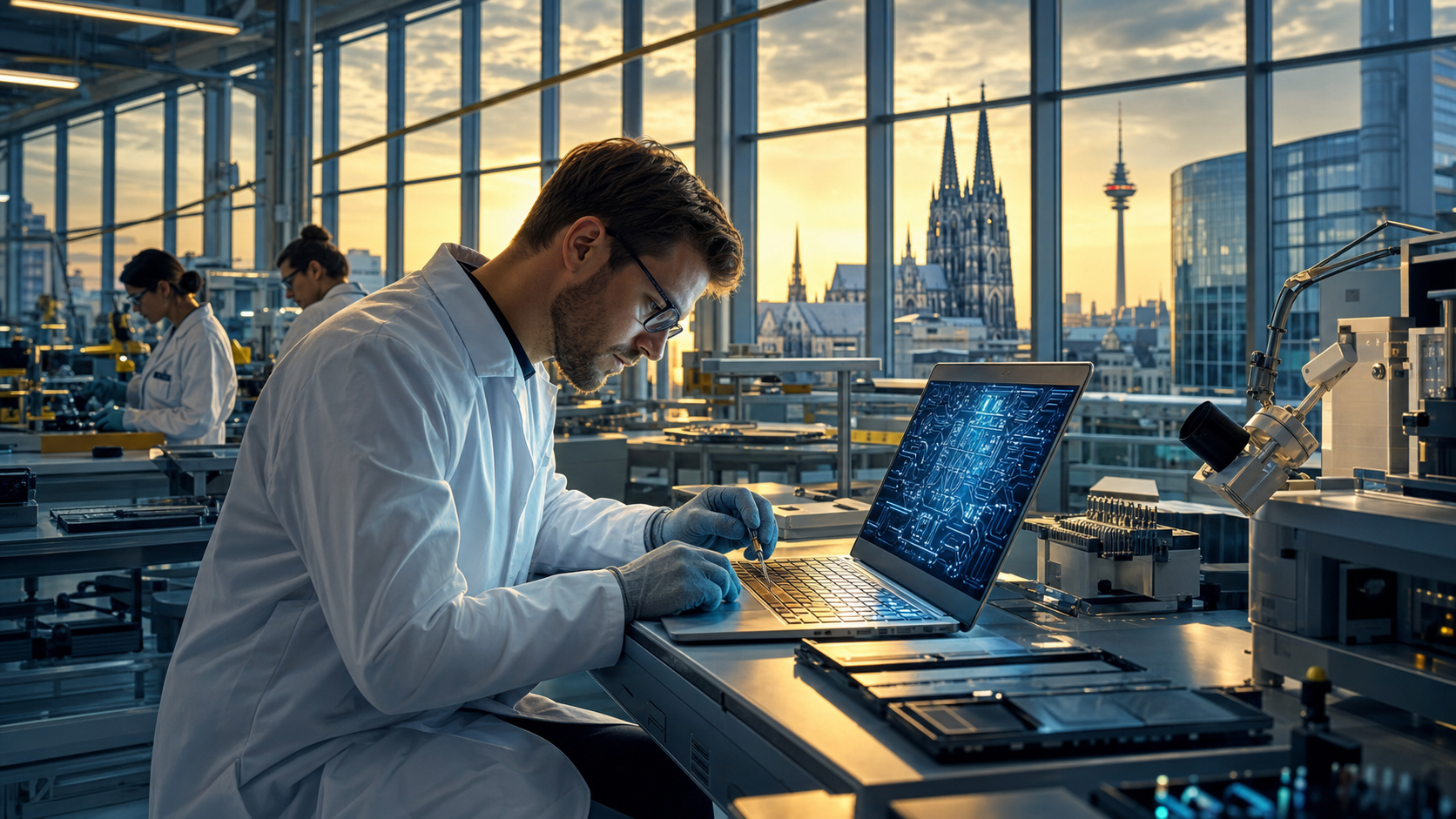
Moving away from Asian chips? Assembled in Europe: Schenker, Tuxedo & Co. – How domestic laptop manufacturers are currently shaking up the market – Image: Xpert.Digital
Insider tip “Made in Europe”: Why your next laptop shouldn't be from Lenovo or HP
Hidden backdoors in PCs? Why more and more users are opting for these European laptops
The global laptop market seems firmly in the grip of Asian and American giants. Names like Lenovo, Apple, and HP dominate the bestseller lists, while the heart of these devices—the essential microchips—is almost exclusively manufactured in TSMC's highly secure factories in Taiwan. Does this mean the dream of true technological independence and a European computer is finally over? The answer is no. Away from the mainstream, characterized by price wars and mass production, a quiet but highly innovative industry has established itself in Europe—and especially in Germany.
With customized build-to-order (BTO) systems, radical transparency through open-source firmware, and a consistent focus on data protection, repairability, and service quality, manufacturers like Schenker, Tuxedo, and NovaCustom demonstrate that digital sovereignty is much more than just a political buzzword. "Assembled in Europe" today means far more than simply assembling imported parts. It is a strategic response to geopolitical dependencies, a driver of software innovation, and a tangible quality promise for discerning users, businesses, and government agencies that want to know what's really under the hood of their devices.
Europe makes laptops. It just hardly dares to talk about it openly.
Assembled in Europe – Why the continent is capable of more than it shows
The global laptop market is a multi-billion dollar industry with clearly defined power dynamics. Worldwide, the segment was valued at approximately US$115 billion in 2025, and this figure is projected to rise to nearly US$185 billion by 2035—an annual growth rate of 4.8 percent. In Europe alone, the notebook market generated revenue of around €13.4 billion in 2025, with the trend toward more expensive devices continuing unabated: In the first weeks of the second quarter of 2026, European notebook revenues increased by 12 percent compared to the previous year, even though the number of units sold declined by 3 percent. The average selling price climbed by 11.4 percent—driven primarily by AI-enabled processor architectures and an accelerated renewal cycle in enterprise environments.
The companies claiming leadership in this market are not European names. On Amazon Germany in June 2025, Lenovo led with a 31.6 percent share of units sold, followed by Apple, HP, and Acer. European manufacturers simply do not appear on the bestseller lists of the major platforms. This is no coincidence, but rather the consequence of structural decisions made decades ago—decisions that now need to be reassessed in light of growing geopolitical tensions and the urgent call for digital sovereignty.
The foundation of the oligopoly: Why no chip works without Asia
To understand why a notebook manufactured entirely in Europe is not a realistic option in 2026, one must look at the microscopic level—at those silicon layers whose production represents the most complex and capital-intensive activity of humankind. The heart of every modern computer, the processor and the graphics chip, is designed by Intel, AMD, or Nvidia. However, these chips are manufactured almost exclusively by TSMC in Taiwan or by Samsung in South Korea.
TSMC's dominance is almost beyond words: In the second quarter of 2025, the company held a 70.2 percent market share in the global foundry business—a record high. For 5-nanometer chips, TSMC's share is over 80 percent, and for 3-nanometer chips, it's even over 90 percent. Samsung, the second-largest contract manufacturer, fell to a mere 7.2 to 7.7 percent. The Chinese company SMIC holds around 5 to 6 percent. The top 10 foundries together control 97 percent of the global market.
This is where the only European company with real weight enters the global semiconductor market: ASML from the Netherlands. The company is the world's sole manufacturer of EUV lithography machines, the exposure systems without which advanced chips under seven nanometers cannot be produced. A single one of these machines costs up to US$150 million. ASML's global market share in this key technology is estimated at 80 to 90 percent—giving the company perhaps the most impressive monopoly in the entire technology industry. Without ASML, there would be no modern processors, neither from TSMC nor from Intel.
Europe is thus in the contradictory position of having to build the only indispensable key machine for chip production, yet having to import almost all of the finished chips. This structural gap is the real core problem of Europe's technological dependence.
In addition to the processor supply chain, there's the so-called barebone industry. Nearly all notebook chassis, including their motherboards, are prefabricated by a small group of Taiwanese contract manufacturers. Clevo, founded in 1983, is considered one of the oldest and most important of these ODM (Original Design Manufacturers) and supplies its highly customizable barebone systems to numerous brands worldwide. Tongfang and Compal complete this oligopoly. Mass production takes place predominantly in China and other Southeast Asian countries, where low labor costs, government subsidies, and a highly developed supply network generate a virtually insurmountable cost advantage. Not a single consumer notebook in the world can do without Asian semiconductors, displays, or circuit boards. Anyone claiming otherwise is engaging in marketing, not industrial policy.
Between import and innovation: The model of European processors
Does this stark assessment mean that the European laptop must remain an illusion? The answer is more nuanced than the headlines suggest. Because today, the crucial added value no longer lies solely in mass production. It lies in the design, the configuration, the service, and—increasingly—in the software.
European manufacturers have established a model that can be described as build-to-order (BTO): They import raw, partially assembled barebone chassis from Asia and transform them in Europe into customized high-tech devices. This process includes individually configuring RAM and storage according to customer specifications, quality control, stress testing, operating system installation, and the configuration of proprietary or open-source firmware. The BTO model is not a European innovation—it was made the dominant strategy in the PC market by companies like Dell in the 1990s. However, European vendors have refined it and adapted it to specific market niches that international mass-market providers cannot or do not want to serve.
The economic importance of this refinement process should not be underestimated. Highly skilled jobs in assembly, quality management, customer support, and software development are created in Europe, pay European taxes, and are subject to European labor laws. Local final assembly makes the supply chain shorter, more transparent, and more resilient to global disruptions—a lesson the world painfully learned during the COVID-19 pandemic and the subsequent chip shortage.
Hüllhorst, Leipzig, Augsburg: Germany's quiet laptop industry
Germany is home to several of the most important European players in this segment, and their origin stories reflect the country's industrial strengths: medium-sized businesses, engineering culture, and the willingness to occupy narrow niches with a high degree of vertical integration.
Wortmann AG, based in Hüllhorst, Westphalia, is one of the most remarkable examples of entrepreneurial independence in the German IT sector. The family-owned company operates one of Germany's most significant IT production lines, assembling laptops, desktop PCs, servers, and other hardware components under the TERRA brand for the DACH region (Germany, Austria, and Switzerland). The group's revenue is approximately €2.1 billion, with Wortmann AG alone recently generating over €1 billion in revenue. The company primarily targets the B2B sector: schools, government agencies, medium-sized businesses, and public institutions that place high demands on reliable supply chains, certified service, and rapid response times in the event of repairs. This institutional business model protects Wortmann from the price wars in the consumer segment and enables stable margins through service contracts and long-term framework agreements. In a market dominated by global corporations, Wortmann proves that regional roots and industry-specific service quality can be viable competitive advantages — the TERRA brand may rarely be found on Amazon, but it is all the more common in German classrooms and administrative buildings.
In Leipzig, Schenker Technologies has developed a different, complementary niche since its founding in 2002 by Robert Schenker. The company, which markets high-performance laptops for gaming, content creation, and professional users under the XMG brand, exemplifies the possibilities of European build-to-order (BTO) manufacturing in the premium segment. Customers can customize their devices down to the component level using a configurator: which RAM, which SSD, which cooling system, which display variant—all of this is assembled in Saxony after the order is received and subjected to extensive stress testing. Those who already have a suitable SSD lying around can even configure an XMG model without a drive and install the existing component themselves—a service principle that simply doesn't exist among global mass-market manufacturers. Quality control takes place entirely in Leipzig, enabling short response times in the event of warranty claims and a transparent chain of responsibility.
Tuxedo Computers, based near Augsburg, represents a third approach to European laptop manufacturing: a consistent focus on Linux. The company combines current notebook hardware—including models based on Clevo barebones—with a deeply customized operating system stack. For years, Tuxedo has been developing its own Linux distribution, Tuxedo OS, based on Ubuntu with the KDE Plasma desktop, which runs seamlessly with all installed hardware—including graphics drivers, keyboard backlighting, and power management. The Tuxedo Control Center allows for fine-grained control of fan curves, power profiles, and battery charging limits directly from within the operating system. This makes the offering attractive for users who want to move away from Windows but don't want to deal with complex driver configuration. EU customers benefit from VAT-inclusive shipping and a German return address in case of warranty claims—instead of transatlantic shipping.
Amsterdam and Valencia: The radical data protection program from the niches of Europe
Outside of Germany, a remarkable European niche has emerged that interprets the concept of digital sovereignty more consistently than any other. NovaCustom operates in the Netherlands, and Slimbook in Spain—both companies target users who are not just looking for an alternative operating system, but who harbor a fundamental distrust of the entire proprietary software infrastructure of modern notebooks.
NovaCustom has focused on a unique technical feature that simply doesn't exist in the mainstream hardware industry: the complete replacement of the proprietary BIOS/UEFI with Dasharo, a custom implementation of the open-source firmware system coreboot. The conventional BIOS/UEFI of a notebook motherboard is a closed software layer that operates deep beneath the operating system, is inaccessible to the user, and could, in principle, be used as an attack surface for backdoors or state-sponsored malware. The entire debate surrounding state-mandated surveillance software, which has repeatedly occupied European security agencies in recent years, touches upon precisely this layer of the system. NovaCustom's Dasharo-coreboot makes the complete firmware source code publicly available and fully documents it. Current models in the NovaCustom laptop lines come pre-installed with Qubes OS, an operating system specializing in security through isolation. The fact that the company also relies on memory modules from GOODRAM, the Polish manufacturer Wilk Elektronik, which is the only company in Europe still producing DRAM modules, completes the picture of a consistent localization strategy. The chips themselves, however, still come from Asia—a residual dependency that NovaCustom openly acknowledges.
Slimbook, based in Valencia and operated by Grupo Odín, pursues a more open strategy: The devices ship pre-loaded with various Linux distributions, with a particularly close collaboration with the KDE project, which gave rise to the KDE Slimbook product line. Slimbook's strength lies in its excellent price-performance ratio combined with consistent Linux compatibility. Base models start at under €1,000, while top-of-the-line models with an AMD Ryzen 7 processor and 16 GB of RAM cost around €1,000, thus offering a serious alternative to premium Linux notebooks from Tuxedo or System76.
Code as a competitive advantage: Europe's software layer as a true innovation
The most profound innovation that European laptop manufacturers have produced in recent years lies not in soldering new circuit boards, but in writing code. This realization is crucial for understanding Europe's competitive positioning.
The classic BIOS/UEFI, which is installed in almost all commercially available laptops worldwide, is a proprietary system that the user can neither view nor truly control. European companies like Tuxedo Computers and NovaCustom have recognized that this is precisely where real added value can be created, something Lenovo, HP, or Acer structurally choose not to offer—because their mass-market logic is geared towards standardization and control, not transparency.
The open-source coreboot system, to which NovaCustom makes a significant contribution with its Dasharo implementation, makes a laptop's firmware layer completely transparent, auditable, and customizable. The practical advantages are substantial: Dasharo avoids persistently high CPU temperatures through optimized temperature profiles, thus extending the hardware's lifespan. Full compatibility with GNU/Linux operating systems is built into the design from the outset, not added later. Security vulnerabilities in the firmware can be identified and patched more quickly by the open-source community than in closed, proprietary systems—a principle known as Linus' Law, which states: Many eyes make light work.
Tuxedo Computers has taken a complementary approach with the Tuxedo Control Center (TCC): Instead of fully opening up the firmware, the company offers deep operating system integration, giving Linux users access to functions that would otherwise be exclusively available through manufacturer tools under Windows. Fan curves, power-saving modes, keyboard backlighting patterns, and battery charge limits are not only adjustable but also directly viewable and extendable by the open-source community.
This European software innovation has real consequences for product lifespan. A device shipped with an open firmware stack can be used beyond its hardware lifecycle because no software lock prevents the replacement of components. In a world where planned obsolescence is an increasingly regulated problem—the EU has taken an important legislative step with the right to repair—these very features become a tangible market advantage.
Our EU and German expertise in business development, sales and marketing

Our EU and German expertise in business development, sales and marketing - Image: Xpert.Digital
Industry focus areas: B2B, digitalization (from AI to XR), mechanical engineering, logistics, renewable energies and industry
More information here:
A thematic hub offering insights and expertise:
- Knowledge platform covering global and regional economies, innovation and industry-specific trends
- A collection of analyses, insights, and background information from our key areas of focus
- A place for expertise and information on current developments in business and technology
- A hub for companies seeking information on markets, digitalization, and industry innovations
Berlin's Open Hardware Revolution: How MNT Research is rethinking the laptop
Berlin as avant-garde: The open-source experiment by MNT Research
Anyone who truly wants to understand the limits of what's possible in Europe needs to visit Berlin—more precisely, the Berlin-based collective MNT Research. With its Reform series, the company has developed laptops that are unparalleled in the history of personal computing. All circuit board layouts are completely open source and freely available under the CERN OHL S 2.0 license and GNU GPLv3. The circuit boards are manufactured in Europe, while the enclosures are milled or 3D printed in Berlin.
To avoid strategic dependence on Intel and AMD, MNT Research uses ARM processors—the original MNT Reform, the NXP i.MX8M with ARM Cortex-A53 cores, and newer models, more advanced ARM implementations. The operating system is Linux. The result is not a high-performance machine for rendering 3D animations or playing current titles. It is something more valuable: the most consistent proof that the principle of a fully transparent, repairable, and local computer is technically feasible.
MNT Reform Next, the latest iteration of the product line, takes these principles to a new level: modularity, upgradeability, and repairability are embedded in the hardware from the very first design decision. All hardware documentation, firmware source code, and manufacturing records are freely accessible online—a standard that would be unthinkable in the mainstream laptop market because it would destroy the foundation of proprietary competitive advantages. With its approach, MNT Research has attracted a small but growing community of IT purists, security researchers, and open-hardware activists—proving that there is a market in Europe for radical technological self-determination.
The economic viability of the MNT model remains a question open for discussion. The company finances itself through direct sales and crowdfunding campaigns. Scaling up to mass markets is structurally impossible as long as the costs of local manufacturing and the lack of economies of scale drive final prices far above the level of competing commercial products. But that's not what MNT Research is about. It's about demonstrating a principle.
The power structure is crumbling: Europe's chip strategy between ambition and reality
Europe's political response to its structural dependence on semiconductors is the European Chips Act, which came into force in September 2023. The goal is to double the European share of global chip production from its current level of around 10 percent to 20 percent by 2030. The financial volume mobilized for this purpose is considerable: Over €80 billion in investments have already been triggered under the Chips Act. More than 85 percent of the funds for the Chips for Europe initiative have already been committed, with five pilot lines being supported with a total of €3.7 billion from European and national funds.
The most ambitious individual projects, however, demonstrate just how steep the path to self-sufficiency truly is. Intel had originally announced plans to build a state-of-the-art semiconductor factory in Magdeburg for around €30 billion—with nearly €10 billion in subsidies from the German federal government. In July 2025, Intel definitively canceled this project. The setback for Germany's ambitions as a chip-producing nation was significant. The situation in Dresden is progressing more positively: The joint venture ESMC (European Semiconductor Manufacturing Company), consisting of TSMC with a 70 percent stake and Bosch, Infineon, and NXP with 10 percent each, completed the shell construction of its first European fab at the end of 2025. Equipment installation is planned for the second half of 2026, with production starting at the end of 2027. The investment volume exceeds €10 billion, of which €5 billion is EU aid. At the highest manufacturing level, however, Dresden only produces 28/22 nanometer and 16/12 nanometer processes — while TSMC's leading plants in Taiwan are already operating at 3 nanometers and soon at 2 nanometers.
This technological gap is the most honest answer to the question of when Europe will hold a laptop whose processor was actually developed in Europe: at the earliest after 2027, and even then only in a manufacturing generation that, by the time production starts, will already be two to three generations behind its Asian competitors. While the security of supply and the resilience of European supply chains will be improved, the Dresden fab will not close the technological gap. To achieve this, Europe would need either significantly more investment—a Chips Act 2.0, which industry representatives already called for in March 2025—or a very long-term perspective.
Over 80 percent dependent: Europe's digital vulnerability in numbers
The semiconductor problem is merely the most visible tip of a structural iceberg. According to an analysis by the economic service, over 80 percent of critical digital technologies in Europe depend on non-European suppliers. A 2025 study by the European Parliament concluded that dependence on foreign communication technology, particularly from China, poses a serious threat to the EU's technological sovereignty. More than 80 percent of the digital products, services, and infrastructure that Europe needs originate from third countries.
These figures contextualize the value of European laptop manufacturers in a new way. When companies like Schenker, Tuxedo, Wortmann, or NovaCustom assemble, customize, and provide local support in Europe, they are not only contributing to the regional economy. They are forming a bulwark against complete dependence on external providers whose actions cannot be controlled by European regulators. Choosing a laptop configured by NovaCustom with Dasharo coreboot is therefore not just a technical preference—it is an economically and politically significant act.
A study by the German Federal Ministry for Economic Affairs and Energy on digital sovereignty clearly states: Significant dependencies exist in the hardware and infrastructure sector on non-European suppliers, which are considered critical. The solution cannot consist solely of multi-billion-euro government investment programs that take decades to bear fruit. It must also lie in targeted demand stimulation for European suppliers at all levels of the value chain—from public procurement and tax incentives to educational campaigns that raise awareness of the origin and value chain of digital hardware.
What “Assembled in Europe” really means: A sober assessment
The term "Assembled in Europe" should neither be romanticized nor dismissed. It describes a real, economically viable, and geopolitically significant form of value creation that differs fundamentally from a simple screw-assembly hall. European BTO manufacturers provide design services for hardware configuration, develop proprietary or open-source software stacks, operate local quality assurance services, maintain repair networks, and invest in the further training of skilled workers.
The value of this model becomes particularly clear when compared to the alternative. Anyone buying a notebook from a global mass-market retailer receives a device assembled in China or Vietnam, stored in some central warehouse in the Netherlands or the Czech Republic, and shipped via a distribution channel whose service center is often located in Eastern Europe or even outside the EU. In the event of a repair, this can lead to weeks of waiting, data loss due to the complete retention of the device, and no way to track the repair. With a German manufacturer like Schenker or Tuxedo, the processing time for repairs is significantly shorter, customer service speaks German and is available by phone, and there's a high probability that the device will actually be serviced in Germany.
Another often overlooked advantage is the absence of bloatware. Mass-market laptops typically come with a collection of pre-installed software ranging from antivirus trials and casino games to OEM driver tools, which are regularly identified as security vulnerabilities. Specialized European vendors, on the other hand, either deliver clean Windows installations or—in the case of Tuxedo, NovaCustom, and Slimbook—exclusively Linux systems optimized from the ground up for the specific hardware.
Price and positioning: For whom is the European approach worthwhile?
An honest discussion about European laptops inevitably touches on the question of price. A device from Tuxedo, Schenker, or NovaCustom is generally more expensive than a comparably equipped model from Lenovo, Acer, or ASUS in the same performance segment. The reasons for this are structural and unavoidable: higher labor costs in Germany, lower production volumes and therefore less economies of scale, as well as a more complex service and configuration model.
A current-generation Tuxedo InfinityBook Pro 14 starts at around €1,427 including VAT—a premium compared to similar competitors from the Asian mass market, but one that can be justified by measurable advantages: Linux out-of-the-box, no bloatware, German warranty processing, and open-source drivers. Schenker Technologies' XMG offering is aimed at buyers willing to pay for customized configuration and local quality control. NovaCustom charges an additional premium for its coreboot models with maximum firmware transparency, targeting an informed audience with specific security requirements.
For public institutions, government agencies, healthcare organizations, and companies with heightened data protection requirements, however, the price argument is less decisive than the risk argument. A laptop with an open firmware stack and a verifiable supply chain is not optionally more expensive for these buyers, but strategically essential. The increasing regulatory tightening through NIS-2, the Cyber Resilience Regulation, and similar EU regulations will increase the pressure on companies and government agencies not only to desire hardware transparency, but to demonstrate it.
The time horizon: What comes after the assembled model?
The medium- to long-term outlook for the European laptop market depends on three developments that are currently running in parallel.
First: the success or failure of the European semiconductor initiative. If the ESMC fab in Dresden starts operations at the end of 2027 and Europe's first domestically produced foundry site starts manufacturing chips on a significant scale, a local supply base for embedded and industrial applications will be created, at least in older process nodes. For state-of-the-art consumer processors, Europe will remain dependent on imports for the foreseeable future—a realistic target here would be the period after 2035, if at all.
Secondly, the question arises whether RISC-V, as an open processor architecture, can offer an alternative to ARM and x86. RISC-V, a completely open and license-free instruction set architecture, in principle enables the development of processors that do not require licensing fees from ARM or Intel. European research institutes and startups are working on RISC-V implementations, and the EU is funding corresponding projects as part of its chip initiative. However, it will be several more years before RISC-V can compete with ARM or x86 in terms of performance in consumer laptops.
Thirdly: market pressure due to geopolitical changes. The growing tensions between China and Taiwan, the increasing technological decoupling pressure between the Western and Chinese technology blocs, and the protectionist tendencies of the Trump administration in the US all increase the value of a stable, local supply chain. Companies that regionalize their IT procurement today are investing not only in quality, but also in resilience to geopolitical scenarios that were previously considered unlikely but are now becoming increasingly real.
Assembled in Europe: Not a compromise, but a promise of quality
The concept of "Assembled in Europe" is not a marketing label intended to mask an industrial weakness. It is an honest description of a value creation model that, under the given global conditions, makes the most of European strengths—engineering expertise, data privacy awareness, service quality, and industrial tradition. Complete manufacturing autonomy remains a future prospect, politically pursued but technologically still years away from reality.
Buying from Schenker, Tuxedo, Wortmann, or NovaCustom is a decision that goes beyond the individual device. It supports jobs in the EU that adhere to European labor and environmental standards. It provides support in the customer's language, from people who assembled the device themselves. It delivers hardware without hidden backdoors in the firmware, without bloatware, and with an open, extensible software stack. And it sends a clear market signal that European manufacturing, European software innovation, and European values in digital infrastructure are not only desired but actively sought after.
From an economic point of view, that is more than enough.
🎯🎯🎯 Data-driven B2B industry hub as a quasi-in-house solution

The quasi-in-house solution: How Xpert.Digital closes operational gaps in B2B marketing and sales – Smart Content-Driven Business - Image: Xpert.Digital
Xpert.Digital is a data-driven B2B industry hub led by Konrad Wolfenstein . The company acts as an external, quasi-in-house solution for industrial partners, closing operational gaps in marketing, content, and sales – without requiring additional resources on the client side.
More information here:
Your global marketing and business development partner
☑️ Our business language is English or German
☑️ NEW: Correspondence in your native language!

Konrad Wolfenstein
I and my team are happy to be available to you as your personal advisor.
You can contact me by filling out the contact form here [email protected]:or simply call me at +49 7348 4088 965. My email address is
I'm looking forward to our joint project.










