
Augmented Reality | AR in the trades: Increasing efficiency in industry and the trades
Xpert Pre-Release

Available in 27 languages 📢
Prefer Xpert.Digital on GoogleⓘPublished on: September 29, 2026 / Updated on: September 29, 2026 – Author: Konrad Wolfenstein
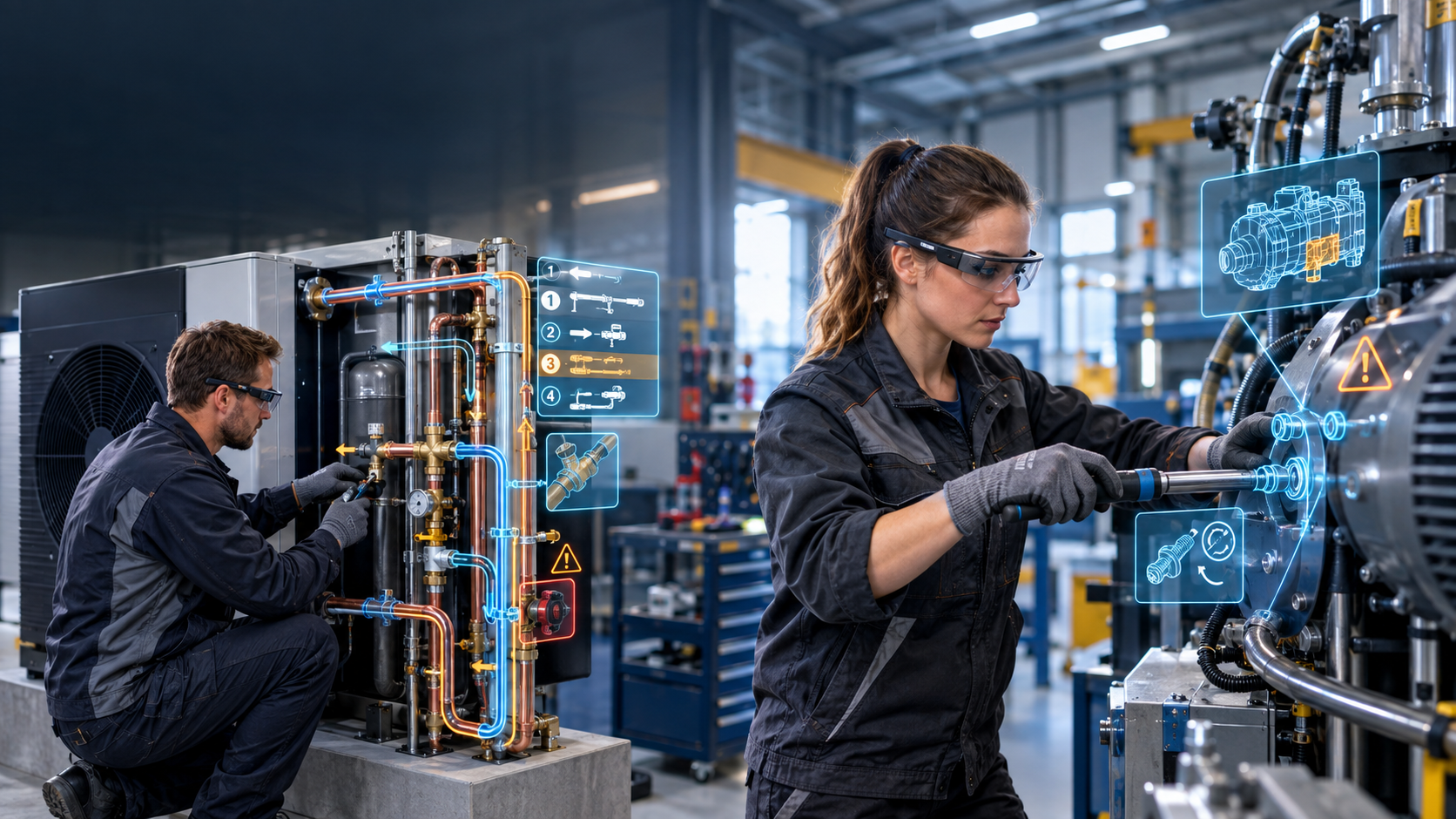
Augmented Reality | AR in the trades: Increasing efficiency in industry and crafts – Creative image on the topic, using AI: Xpert.Digital
AR technology: More than just a trend in the trades
Augmented Reality: Key to solving the skills shortage
Heat pump installation: AR as a solution for process inefficiency
Augmented Reality (AR) has established itself as a key technology in the trades and industry. Once considered a futuristic gimmick, AR is now seen as an essential tool for increasing productivity and addressing pressing challenges such as the skilled labor shortage. This profound shift is particularly evident at a time when companies face lengthy training periods, increasing product variety, and the pressure to ensure quality and safety. AR offers the opportunity to integrate digital information directly into the real-world work environment, not only increasing efficiency but also reducing error rates. Companies now face the challenge of not only understanding the technical possibilities of AR but also recognizing how to meaningfully implement this technology in their workflows to achieve maximum economic benefit. In the following sections, we will examine the various application areas of AR in the trades and industry and demonstrate how this technology helps meet the challenges of today's working world.
AR in crafts and industry: From digital showpiece to productivity tool
Those who only look for skilled workers have not yet understood the productivity issue
Augmented Reality, or AR for short, has undergone a remarkable transformation in the industrial sector. For a long time, the technology was considered a visually impressive but economically elusive enhancement to training, maintenance, and product presentations. Now, its use is increasingly focused on addressing specific operational bottlenecks: a shortage of skilled workers, lengthy training periods, more complex products, a growing variety of variants, high travel costs for specialists, and increasing demands on quality, documentation, and occupational safety. This shifts the crucial question. Companies no longer need to determine whether AR works technically, but rather in which workflows the economic benefits outweigh the costs, integration risks, and organizational side effects.
The sobering answer is: AR is neither a universal productivity machine nor a passing fad. The technology is particularly powerful where employees perform complex, infrequent, or changing tasks on physical objects and require both hands. Digital instructions can appear directly on the component, display work steps in the correct sequence, show target values, highlight deviations, or connect to a remote expert. The advantage arises not solely from the glasses or tablet, but from the combination of spatial representation, reliable process data, digitized work instructions, and seamless integration into operational systems.
Economically, AR is primarily relevant as a tool for better utilizing scarce human labor. In many cases, it doesn't replace skilled workers, but rather reduces search, learning, coordination, and diagnostic times. This is just as important for craft businesses as it is for factories, maintenance organizations, airlines, or field service technicians. Especially in Germany, where industrial value creation, an aging workforce, and shortages in technical professions converge, this function could become strategically more important than spectacular consumer applications.
The real world remains the workplace
Augmented Reality (AR) overlays the visible environment with digital information. Unlike Virtual Reality (VR), the real workplace remains visible. The system overlays, for example, arrows, text, measurements, three-dimensional models, or warnings onto machines, pipes, and components. Mixed Reality takes this concept a step further because virtual objects are spatially anchored and can react to their surroundings. In practice, however, the boundaries between these terms are fluid. The crucial factor is less the label itself and more how precise, robust, and context-aware the support is.
The hardware is also more diverse than the common term "AR glasses" suggests. Smartphones and tablets are suitable for planning, inspection, documentation, and occasional overlays. Monocular smart glasses display information in a small viewing window and are often lighter, more robust, and better suited for extended wear. Binocular headsets can display spatially anchored three-dimensional content but are heavier, more expensive, and require more ergonomic support. Projection systems deliver information directly onto a workbench or component without requiring employees to wear a device on their head. Additional certification and safety requirements apply for potentially explosive atmospheres, cleanrooms, construction sites, or aviation applications.
This differentiation is crucial from a business perspective. A company that only needs video support from a remote expert doesn't necessarily need a complex spatial headset. Conversely, a tablet isn't always sufficient if a technician needs both hands free or must see with millimeter precision which part goes where. Incorrect decisions regarding the device class increase project costs, reduce user acceptance, and lead to pilot projects that function technically but aren't used in everyday practice.
Skills shortage becomes a factor in productivity calculations
The pressure to act is not coming from the AR industry, but from the labor market. In 2025, 157 shortage occupations were identified in Germany. Construction and skilled trades, as well as jobs in plumbing, heating and air conditioning, energy technology, mechatronics, and electronics, remained particularly affected. In the skilled trades, nearly 100,000 vacancies remained unfilled; 59 out of 115 skilled trades exhibited shortages. At the same time, around 718,000 skilled trades employees were between 55 and under 65 years old and thus approaching retirement.
The average vacancy duration for reported positions in skilled trades was 242 days in 2025, compared to 167 days across all professions. At the same time, employment subject to social security contributions in the skilled trades declined between 2019 and 2025, while overall employment increased. These figures do not mean that Germany has a shortage of workers in every occupational group. Rather, they reveal a structural shortage in certain qualifications and regions. It is precisely in these areas that a technology can become economically relevant that better distributes experiential knowledge, enables less experienced employees to become competent more quickly, and relieves specialists of routine tasks.
AR, however, does not eliminate the skilled worker shortage. An on-screen assembly instruction does not replace sound judgment, safety knowledge, a feel for materials, or the ability to handle unexpected conditions. It can, however, increase the productive reach of existing skilled workers. A supervisor then doesn't have to appear on-site for every question but can support several teams remotely. New employees can learn standardized processes more quickly. Less frequently used work steps can be accessed as needed, without requiring each person to permanently memorize all the details.
The economic measure is therefore not the number of glasses distributed. What matters are additional productive hours, a shorter time to independent work, less rework, reduced downtime, and a higher first-time solution rate. Anyone who measures success solely by device usage is confusing activity with value creation.
Heat pumps particularly highlight the bottleneck
The installation of heat pumps is a prime example of the connection between climate policy, skilled labor shortages, and process inefficiencies. Studies on German construction sites show that installing a heat pump in an existing single-family home can require an average of approximately 110 working hours. Replacing a gas boiler with a heat pump took around 36 hours. Heat pump installation thus requires roughly three times as much labor. A significant portion of this time is spent on-site work, travel, coordination, dismantling existing structures, piping, electrical installation, and interfaces with other trades.
The bottleneck, therefore, lies not only in the actual assembly. It begins with the initial assessment and continues through planning, quotation, material procurement, and coordination, all the way to commissioning. Disruptions in the flow of information between handwritten notes, photos, spreadsheets, manufacturer's documentation, planning software, and inventory management systems create search time and errors. Incomplete measurements lead to queries or additional trips. Unforeseen space constraints only become apparent on the construction site. Missing components interrupt the work. Smaller companies, in particular, can hardly compensate for such inefficiencies with specialized planning departments.
This is where the manufacturer-independent application Heat Pump PlanAR comes in. A tablet captures the boiler room in three dimensions. Based on this room model, a suitable system layout can be selected. Main components can be virtually positioned, and pipework can be calculated with a focus on cost. The installer sees the planned system in the actual room via AR and can adjust positions. Subsequent changes can be made at the office workstation in a virtual view. Finally, material lists and an estimated installation time can be generated. Interfaces for measurement and operational planning are also planned for the future.
The real economic leverage lies in connecting previously separate steps. Pure visualization would be helpful, but limited. Only when a spatial scan generates a reliable quote, a bill of materials, a coordinated pipe layout, and a usable work order will transaction costs decrease along the entire process. AR then becomes the visible interface of a digital workflow, and not an isolated add-on.
Craftsmanship needs fewer media breaks
In the skilled trades, AR is often discussed as a technology for eyeglasses. However, for many businesses, the greatest initial benefit is likely to come from smartphones and tablets. These devices are readily available, familiar, and can be used during customer meetings without completely disrupting workflows. An application can map rooms, document pipe runs, take measurements, visualize different options, and immediately share information with the office, warehouse, or suppliers. The low entry point reduces investment risks and facilitates on-the-job training.
Smart glasses become useful where hands need to remain free or where information is continuously required during work. During maintenance, they can display test points, mark the correct connection, or show measured values from a system. During commissioning, they can guide the user through a defined sequence and document results. In customer service, a remote specialist can see the technician's perspective, provide guidance, and add markers to the field of vision. Especially in the case of infrequent malfunctions, this reduces the likelihood of needing a second appointment or an additional technician.
For smaller companies, cost-effectiveness remains a challenge. The purchase price of a device isn't the only deciding factor; rather, it's the total cost of ownership, including software licenses, integration, setup, training, device management, support, content maintenance, and data protection. Added to this is the effort required to translate existing knowledge into digital instructions. A company with highly standardized services and many similar projects can spread this effort across numerous orders. A company with predominantly individual, customized projects, however, needs to carefully examine which recurring process elements can actually be digitized.
Cooperative models are therefore particularly promising. Manufacturers, wholesalers, trade associations, software companies, and training centers can provide standardized content instead of requiring each business to develop everything itself. Open product data and uniform interfaces are more important than the most spectacular graphics. If device data, assembly instructions, and spare parts lists remain in proprietary silos, dependence on individual suppliers increases, and the benefit for the entire trade remains limited.
In the factory, every second counts
In industrial production, applications are more standardized and production volumes are higher. This means that even small time savings per process can have a significant economic impact. AR instructions guide employees through assembly sequences, display variants directly on the product, check work steps, and connect to tools. For example, an intelligent screwdriver can receive the required torque; the system then confirms whether the operation was performed correctly. Especially with a high degree of product variety, this reduces the need to maintain separate paper documentation for each variant or to train employees on numerous rare combinations.
Company examples demonstrate the potential, but should not be uncritically generalized. At Fujitsu, in one documented case, the assembly time for complex network systems dropped from 120 to 97 minutes. The installation of certain transceivers was reduced from 53 to 31 minutes, while training time decreased from several days to approximately one hour. Volvo reported significantly shorter update times for work documents in AR-supported quality processes and expected a 60 percent reduction in training time. In a pilot project, Sanofi reduced the training time for new operators from eight to six weeks.
These figures indicate orders of magnitude, but not universal returns. Results depend on the initial situation, task complexity, the quality of existing guidance, employee experience, and the depth of integration. Digitally overlaying a poorly structured process often results in nothing more than a digitally visible, poor process. Significant effects are particularly noticeable when previous processes involved a lot of searching, remembering, asking questions, or switching between documents. Conversely, for simple, frequently repeated tasks, an AR solution can consume more attention than it saves.
The most important industrial advantage therefore lies in managing complexity. AR reduces the information load that employees have to learn beforehand and brings variant knowledge to the point of execution. In flexible production systems, this can facilitate product switching and reduce dependence on a few people with specialized knowledge.
Learning by sight has a downside
Scientific studies confirm that AR can often reduce processing time and the number of errors compared to paper-based methods in manual assembly. An analysis of numerous studies found that projection-based, mobile, and head-mounted AR systems generally performed better in terms of task speed and accuracy than paper- or video-based training. Some experiments report significant time savings, particularly with complex tasks. However, other studies found no statistically significant differences between paper, video, and AR. The research is therefore positive, but not uniform.
One particularly revealing finding concerns the difference between short-term productivity and sustainable learning. In a field experiment, employees using AR (augmented reality) required almost 44 percent less time to learn a difficult new task; for a simple task, the advantage was just under 15 percent. However, when the complex task was later repeated without assistance, the AR group worked 23 percent slower than the control group. Furthermore, the employees using AR generated fewer of their own suggestions for process improvement.
This is economically significant. AR can efficiently guide people through a predefined process, but in doing so, it reduces the need for deeper mental engagement with the overall process. Employees may learn what to do next without fully understanding why the process was designed that way. In stable, mature, and highly standardized processes, this can be acceptable or even desirable. However, in areas that rely on continuous improvement, improvisation, and experiential knowledge, there is a risk of becoming dependent on the assistance system.
Companies should therefore distinguish between execution support and training. A good AR application doesn't constantly display every little detail. It adapts the support to experience and situation, explains connections, and gradually reduces assistance. Employees must also have the opportunity to report errors in the system and contribute their own improvements. Otherwise, digital assistance becomes digital disempowerment, saving time in the short term but costing problem-solving skills in the long run.
Maintenance becomes a distributed network of experts
Maintenance and field service are among the most economically attractive areas for AR. Machine downtime often incurs significantly higher costs than the technician's saved working time. When a problem is diagnosed more quickly, every hour of downtime avoided counts. Using smart glasses, a technician can access circuit diagrams, measurement data, test procedures, and spare parts information without interrupting their work. If local knowledge is insufficient, a remote specialist can see the same section and provide specific guidance.
This changes how expertise is organized. Instead of sending highly qualified personnel to each location, they can be centrally pooled and brought in as needed. One expert can support several plants, construction sites, or customers sequentially. Travel, waiting times, and emissions are reduced. At the same time, diagnoses and decisions become documentable. For internationally operating manufacturers, this also creates the opportunity to provide service knowledge more consistently across language and location boundaries.
The cost is particularly favorable when systems are widely distributed, downtime is expensive, and malfunctions are infrequent or complex. For frequent, standard errors, however, a good mobile knowledge base may suffice. Network availability is also crucial. A remote session is of little use if wireless connections are unstable in basements, steel buildings, or remote facilities. Therefore, critical instructions must be partially available offline, while versions and protocols are securely synchronized later.
Another lever is the connection to predictive maintenance. Sensors detect anomalies, an analysis system narrows down possible causes, and AR shows the technician the relevant inspection point. The benefit then arises from the chain of machine data, diagnostics, work instructions, spare parts information, and feedback. Without consistent system identifiers and up-to-date master data, even good visualizations remain unreliable.
🎯🏢🥽 Enterprise XR Solution Hub for B2B projects – from digital twins to customized extended reality solutions

Enterprise XR Solution Hub for B2B projects – from digital twins to customized mixed reality solutions – Image: Xpert.Digital
Xpert.Digital acts as a holistic Enterprise XR Solution Hub, seamlessly integrating high-performance Pimax hardware into industrial B2B workflows. From digital twin analysis in engineering ("top floor") to immersive training on the production floor ("shop floor"), companies receive a customized, comprehensive solution including strategic consulting and support.
More information here:
Quality assurance in industry through augmented reality
Quality is created before rework
Quality assurance is another application area with direct economic relevance. AR can spatially mark inspection points, overlay target geometries onto real components, and enforce the sequence of inspections. Deviations can be documented photographically or via video and assigned to a specific order. In combination with computer vision, the system can recognize components, check completeness, or report obvious assembly errors.
The value lies not only in a lower error rate, but also in the timing of detection. A missing part, an incorrect connection, or a skipped inspection step is usually cheaper to correct at the workstation than after final assembly, at the customer's site, or following a production outage. AR can thus shift costs: away from rework, complaints, and warranties, and toward preventive process management. Particularly in regulated industries, seamless digital documentation further enhances auditability.
However, with automatic image recognition, the system's responsibility increases. False negatives can create a false sense of security, while false positives slow down processes and undermine trust. Therefore, a visual marker should not be considered proof of the technical correctness of a work step if the sensors and testing logic do not support this conclusion. Human approvals, plausibility checks, and clearly defined escalation procedures remain essential.
From an economic perspective, companies should consider the full cost of errors. This includes scrap, rework, additional inspections, machine downtime, contractual penalties, service calls, recalls, and reputational damage. For safety-critical products, preventing even a few errors can justify significant project investment. In less critical processes, the benefits must be realized through increased production volumes or additional time savings.
Aviation makes the safety value visible
Aviation demonstrates that AR can increase not only productivity but also resilience and safety. The SAVED system integrates a display into a pilot's oxygen mask. In heavy smoke conditions in the cockpit, camera images from the front of the aircraft and key flight data can appear directly in the pilot's field of vision. This ensures orientation remains possible even when instruments or the view outside are obscured by smoke.
The technology was initially certified for cargo aircraft and introduced into flight operations. In 2026, approval was granted for installation in the Gulfstream G550; further applications for business jets are planned. Economically, this is a different case than with assembly instructions. The benefits cannot be calculated solely in terms of saved minutes. Relevant factors include the reduction of a rare but potentially catastrophic risk, technical certification, integration into existing equipment, and the availability of qualified installation and maintenance partners.
Such applications also highlight the barriers to entry in regulated markets. Hardware, display, camera, software, and installation must function reliably as a complete system. Changes can trigger new audits. Market entry is slower and more expensive than with a mobile app, but successful certification provides protection against competitors. Trust, verifiability, and serviceability become crucial assets.
This leads to a fundamental lesson for other industries. The more AR intervenes in safety-critical decisions, the less it can be treated as ordinary office software. Availability, reliability, usability under stress, and clear responsibilities then become integral to sound product design. An impressive image is not enough; what matters is reliable performance at the most critical moment.
The business case begins with the process
Investment calculations for AR should focus on the workflow, not the hardware. First, a clearly defined process must be selected: a specific assembly variant, a recurring maintenance task, onboarding on a production line, or the planning of a boiler room. Initial data must be collected for this process. This includes processing time, error rate, rework costs, number of queries, expert visits, downtime, training hours, and time until independent execution.
The annual gross benefit is derived from several components. Savings in working time are valued against the costs that can actually be avoided or used for additional productivity. This includes avoided travel, reduced waste, less rework, shorter downtimes, and potentially additional orders due to increased capacity. Caution is advised regarding time savings: ten minutes saved only represent a financial advantage if the freed-up time can be used productively or if capacity can actually be adjusted.
On the cost side, there are devices, replacement devices, software, integration, network infrastructure, device management, training, support, content creation, updates, data protection, and occupational safety. The ongoing maintenance of content is particularly often underestimated. If a product, tool, spare part, or process changes, the digital instructions must also be updated and released. Outdated AR content can be more dangerous than visibly outdated paper documents because the spatial representation suggests a high degree of accuracy.
A robust pilot project therefore requires a control group or at least a meaningful before-and-after comparison. It should include multiple employees, shifts, and real-world disruptions. A single successful demonstration under ideal conditions does not prove scalability. Only when the benefits persist after training, technical failures, and normal process variations should the company roll out the project.
Small businesses need different models
Large manufacturers can finance their own AR teams, digital twins, and central content platforms. For small and medium-sized enterprises (SMEs) and craft businesses, such an approach is rarely practical. There, the solution needs to be largely pre-configured, easy to use, and integrable with existing industry software. Economic success depends more heavily on standardized data, usage-based pricing, and external support.
For a plumbing, heating, and air conditioning (HVAC) company, even a tablet-based application can be valuable if it eliminates the need for a second on-site visit, speeds up quotes, and reduces material defects. In contrast, an expensive fleet of smart glasses might be overkill. A machine manufacturer with global service capabilities can justify a high-quality solution simply by avoiding a few expert trips and reducing downtime. Therefore, the optimal technology depends not primarily on company size, but on the value of the problem being solved.
Business models where manufacturers provide AR content as part of their product and service offerings are particularly interesting. A plant engineering company can sell digital maintenance instructions, remote support, and spare parts identification. A wholesaler can connect product data and bills of materials with ordering systems. A software provider can offer industry-specific templates and interfaces. In this way, AR transforms from an investment in equipment into an integral part of digital services.
However, this creates a new dependency for smaller users. If work instructions, customer data, and spatial scans are only available on a proprietary platform, switching providers becomes expensive. Contracts should therefore regulate data export, usage rights for self-created content, retention periods, support durations, and operation in the event of a manufacturer change or product discontinuation. Technical elegance without an exit strategy is incomplete from a business perspective.
The hardware risk is real
The history of industrial smart glasses serves as a cautionary tale. Google discontinued sales of the Glass Enterprise Edition in 2023. Microsoft ended production of the HoloLens 2; security updates are only planned until the end of 2027. This means that two prominent platforms are disappearing or entering maintenance mode, even though both enabled important industrial applications. Companies must therefore factor in that hardware cycles can be shorter than the lifespan of a machine or system.
This doesn't mean AR has failed economically. Rather, the market is shifting towards a broader ecosystem of rugged monocular devices, specialized headsets, smartphones, tablets, and spatial platforms. Providers like RealWear, Vuzix, Magic Leap, and industrial software companies are addressing diverse needs. At the same time, large technology companies are developing new spatial operating systems and lighter glasses. For users, this diversity increases the choice, but also the integration and migration risks.
A sustainable architecture should therefore decouple content from a single device as much as possible. Three-dimensional models, work instructions, media, test logic, and protocols belong in managed systems with documented interfaces. Depending on the task, the display can then be done via glasses, tablet, smartphone, or projection. Web-based standards, open data formats, and device-independent authoring tools reduce the risk of having to recreate all content when a product is discontinued.
The procurement process also includes spare parts, batteries, repairs, and hygienic reprocessing. A headset that works in a pilot's office might fail in shift work due to heat, dust, gloved operation, noise, or a lack of charging options. The most economically viable hardware is not necessarily the most technically powerful, but rather the one that reliably withstands the demands of a specific workday.
Data is more valuable than glasses
AR generates and processes sensitive information. Cameras capture production areas, customer homes, documents, colleagues, and potentially trade secrets. Microphones record conversations. Position, gaze, and movement data can allow inferences to be drawn about behavior, performance, and health. When this data is analyzed with AI, additional risks arise due to misclassifications, surveillance, and opaque decision-making.
In Europe, data protection principles such as purpose limitation, data minimization, transparency, storage limitation, and appropriate security apply. Employees must know which data is processed and for what purpose. Depending on the application, a data protection impact assessment, works council participation rights, and special protective measures may be required. Systems that evaluate employees, assign tasks algorithmically, or analyze biometric characteristics may also be subject to stricter regulations under European AI law. Emotion recognition in the workplace is generally a particularly problematic and prohibited area of application.
From a business perspective, data protection is not a subsequent legal issue, but rather an integral part of the system architecture. Video should only be transmitted or stored when necessary. Faces, screens, or private areas can be automatically masked. Access rights, encryption, logging, and deletion policies must be defined before rollout. Where possible, calculations should be performed locally on the device or in controlled corporate environments.
Acceptance also arises from a clear separation between process support and performance monitoring. Employees will hardly consider a head-mounted camera helpful if it remains unclear who sees the recordings or whether every movement is analyzed. Early involvement, transparent rules, and genuine choices in problematic situations are therefore not only socially beneficial. They also protect the investment from resistance, low usage, and future conflicts.
More information can mean less security
AR can display safety instructions, mark danger zones, and involve remote experts in inspections. It can guide employees through rare emergency procedures or warn them about an incorrect component. At the same time, it creates new hazards. A restricted field of vision, poorly placed instructions, delays, glare, or too much information can impair perception of the real environment. Heavy equipment can lead to fatigue, pressure sores, or neck strain with prolonged use.
Particularly critical are moving machines, vehicles, ladders, confined spaces, and areas with a risk of explosion. Glasses designed for an office environment are not automatically suitable for these situations. They must be compatible with helmets, safety glasses, hearing protection, and respiratory protection. Voice control must function reliably even in noisy environments without triggering false commands. In an emergency, the display must be able to be deactivated immediately. Therefore, such applications must be included in the risk assessment and tested under realistic environmental conditions.
Cognitive load also needs to be considered in a nuanced way. Well-designed prompts reduce searching and recall. Poor interfaces obscure relevant details or force users to constantly switch between their actual work and digital notifications. Therefore, the design should only display information necessary for the current step. Warnings need clear priorities, and employees must be able to pause the process or request assistance at any time.
The safety benefits are therefore not an automatic feature of AR. They arise from ergonomic design, reliable technology, appropriate personal protective equipment, training, and organizational rules. Productivity should never be achieved at the expense of people working faster but perceiving their surroundings less effectively.
Artificial intelligence makes AR context-aware
The next stage of development arises from the combination of AR and artificial intelligence. Computer vision can recognize components, tools, and system states. Speech models enable naturally formulated questions about manuals or malfunctions. Translation systems transfer instructions into multiple languages. Generative methods can create initial drafts of work instructions from videos, documentation, and expert recordings. This reduces a previously major cost factor: the manual creation and maintenance of content.
The greatest advancement would be a system that not only displays rigid steps but also recognizes the actual working state. It could determine whether the correct component has been installed, report a skipped step, or adapt the instructions to experience and the situation. In maintenance, machine data, error history, and visible symptoms could be combined. In skilled trades, room scans, product data, and planning rules could automatically generate several technically feasible variants.
However, this increased capability also increases the risk of errors. Generative AI can produce convincing-sounding but incorrect instructions. Object recognition can fail due to dirt, poor lighting, or similar factors. Therefore, safety-relevant content must not be generated without verification. Approval processes, technical limitations, traceable data sources, and human oversight remain essential. For critical tasks, the system must make uncertainty visible instead of feigning a clear recommendation.
Economically, AI shifts the focus of value creation from mere visualization to context-based decision support. The winner is not necessarily the provider with the best visual presentation, but rather the one who combines reliable operational data, expertise, models, and workflows. For industrial companies, the quality of their master data and the structure of their experiential knowledge thus become a crucial competitive factor.
Scaling requires organizational discipline
Many AR projects remain in the pilot stage because demonstration is easier than continuous operation. A small team can create impressive content for a selected process. However, during rollout, hundreds of variations, language versions, permissions, devices, updates, and process changes must be managed. Without clear accountability, a second documentation landscape develops alongside existing systems.
A successful implementation therefore begins with a process whose problem and key performance indicators (KPIs) are clearly defined. This is followed by a limited pilot project under real-world conditions. Employees, occupational safety, IT, data protection, quality assurance, and, if applicable, the works council must be involved early on. Only after robust proof of benefit has been established should the solution be extended to related processes. The portfolio grows more effectively along reusable building blocks than through numerous unconnected individual projects.
For day-to-day operations, every company needs clear content responsibility. Who updates instructions when a tool or component changes? Who verifies the technical accuracy? How is it ensured that only approved versions are displayed? How is feedback from the workshop processed? These questions are more crucial for quality and liability than the screen resolution.
Suitable key performance indicators (KPIs) include processing time, first-time resolution rate, errors and rework, downtime, training time, expert visits, usage rate, and reasons for abandonment. Additionally, ergonomics, perceived workload, comprehension, and suggestions for improvement should be recorded. An application that saves minutes but weakens knowledge, acceptance, or innovation in the long run is only superficially productive.
Europe's opportunity lies in its industrial depth
The global AR market is defined very differently in market studies. Forecasts for smart glasses, industrial AR, and the so-called industrial metaverse therefore vary considerably. Some estimates include hardware, software, and services together, while others consider only glasses or specific application areas. Double-digit growth rates are plausible, but precise market sizes should be treated with caution due to the inconsistent definitions.
For Europe, it is less crucial whether the entire market reaches a certain billion-euro threshold. Strategically more important is the position in industrial applications. Germany and its neighbors have machine manufacturers, automation specialists, measurement technology companies, trade organizations, research institutes, and specialized software providers. This proximity to real-world work processes is an advantage over purely consumer-oriented platform strategies.
In the long term, value creation lies not solely in the sale of headsets. It arises from industry models, standardized product data, verified work instructions, integrations, security concepts, and reusable digital twins. Those who understand the semantics of a system and can reliably display relevant information on the correct object have a higher barrier to entry than a provider of interchangeable visualization technology.
At the same time, there is a risk of dependency on operating systems, chips, displays, cloud platforms, and AI models. European companies should therefore focus on interoperability, data portability, and controllable operating models. A sovereign strategy does not mean manufacturing every component in-house. It means organizing critical process data and content in such a way that hardware or platform changes remain possible.
The winners are not digitizing the glasses, but the work
AR will not spread across trades and industry as a uniform revolution. The technology will gain a lasting foothold where it solves a costly and recurring problem: lengthy training, complex product variations, infrequent malfunctions, unnecessary expert travel, error-prone assembly, or time-consuming inventory management. In these cases, it can make scarce skilled workers more productive and keep knowledge available across locations and generations.
The greatest economic impact arises when AR is part of a seamless data flow. A three-dimensional scan of a boiler room must be integrated into planning, quotations, material lists, and installation. Maintenance instructions must be linked to the system status, spare parts inventory, and service reports. Quality control must not only display a notification but also provide verifiable documentation of the results. Without this integration, AR remains a digital display with limited added value.
Companies should resist the temptation to adopt high individual case values as general promises of return on investment. Time savings of 20, 40, or more percent are possible, but they only occur under specific conditions. The counter-arguments include content maintenance, equipment failures, ergonomic limitations, data protection, integration costs, and the risk of employees having a less thorough understanding of processes. A professional business case addresses both sides.
The clear perspective, therefore, is this: AR is primarily a productivity technology for human labor in an increasingly digital industry. It doesn't automate the tradesperson or technician, but rather reduces informational friction surrounding their work. This makes it economically relevant in times of skilled labor shortages. However, those who simply procure glasses will likely be disappointed. Those who standardize processes, open up data, involve employees, and consistently measure the benefits can turn augmented reality into a very real competitive advantage.
Your global marketing and business development partner
☑️ Our business language is English or German
☑️ NEW: Correspondence in your native language!

Konrad Wolfenstein
I and my team are happy to be available to you as your personal advisor.
You can contact me by filling out the contact form here [email protected]:or simply call me at +49 7348 4088 965. My email address is
I'm looking forward to our joint project.
☑️ SME support in strategy, consulting, planning and implementation
☑️ Creation or realignment of the digital strategy and digitization
☑️ Expansion and optimization of international sales processes
☑️ Global & Digital B2B trading platforms
☑️ Pioneer Business Development / Marketing / PR / Trade Fairs
🎯🎯🎯 Data-driven B2B industry hub as a quasi-in-house solution

The quasi-in-house solution: How Xpert.Digital closes operational gaps in B2B marketing and sales – Smart Content-Driven Business - Image: Xpert.Digital
Xpert.Digital is a data-driven B2B industry hub led by Konrad Wolfenstein . The company acts as an external, quasi-in-house solution for industrial partners, closing operational gaps in marketing, content, and sales – without requiring additional resources on the client side.
More information here:





