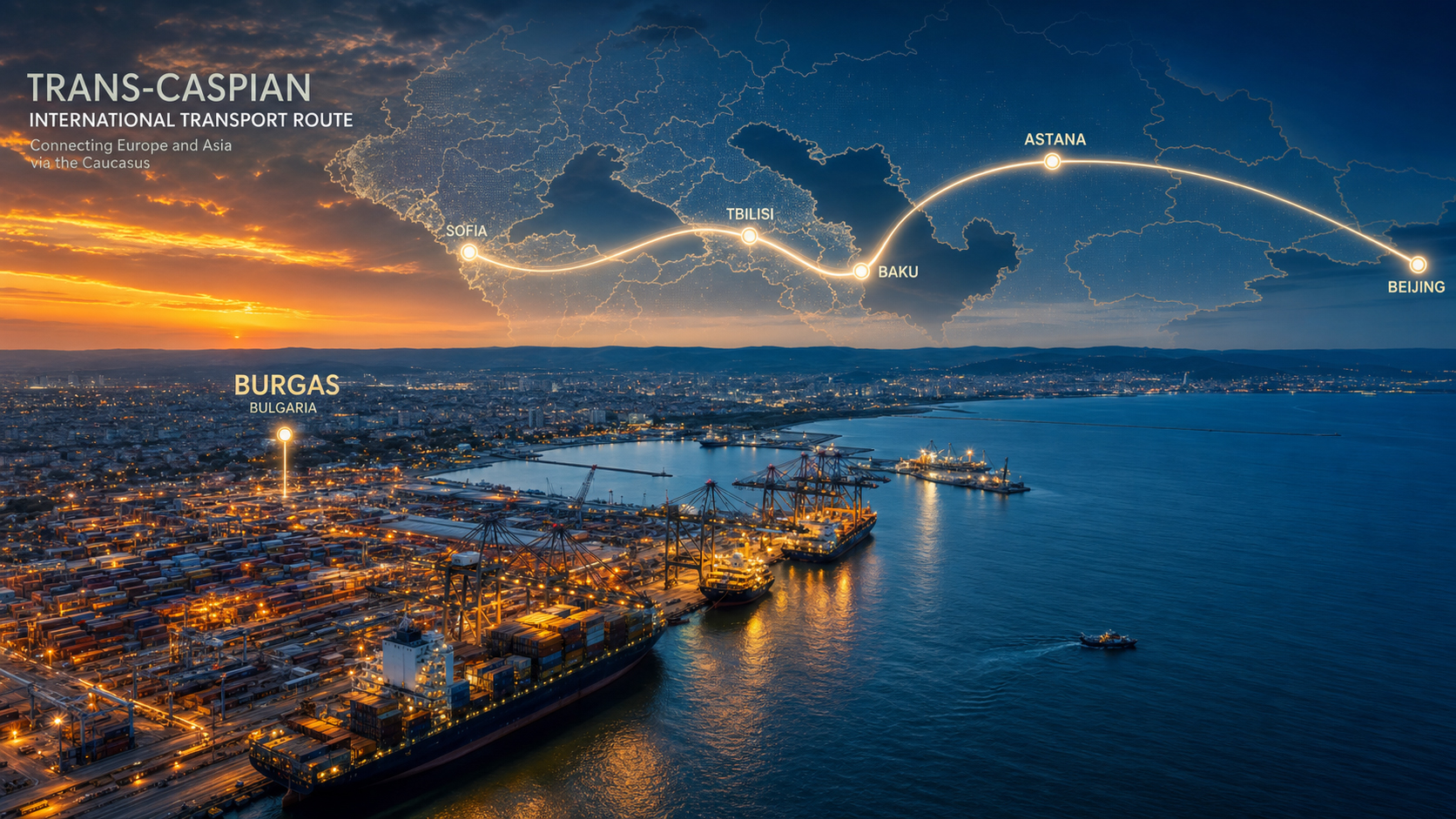
Trans-Caspian Nearshoring and Bulgaria: Why global supply chains need to be rethought in Europe – Creative image: Xpert.Digital
Why there is no way around this new Eurasian mega-route
How three underestimated countries can reshape global trade
When Europe's new supply chain heart beats on the Black Sea
Global trade is in flux: For years, the principle of maximum efficiency prevailed in the global economy – until pandemics, the war in Ukraine, and the ongoing crisis in the Red Sea ruthlessly exposed the vulnerability of global supply chains. For European and especially German industry, a radical rethink has long since moved from a marginal issue to a strategic imperative. The answer is "nearshoring." But the search for secure, geographically close production locations is bringing entirely new players onto the scene. At the heart of this geo-economic power shift are three countries: Bulgaria, Georgia, and Turkey. As crucial nodes of the "Middle Corridor," they not only offer a secure transport alternative away from Russia but are also increasingly establishing themselves as industrial powerhouses on the EU's doorstep. This comprehensive analysis shows how this strategic triangle is intended to make Europe's economy more resilient to crises, what enormous potential awaits investors, and what political risks companies must necessarily factor in.
Why Europe is building its backbone on the Black Sea: Bulgaria, Georgia and Turkey as new pillars of European supply chain strategy
Why Europe is building its backbone on the Black Sea: Bulgaria, Georgia and Turkey as new pillars of European supply chain strategy
The global supply chain system, as it developed in the three decades following the end of the Cold War, was designed for maximum efficiency and minimum costs—not resilience. The consequences of this structural imbalance became frighteningly clear: First, the COVID-19 pandemic paralyzed global production and transport networks starting in 2020; then, in February 2022, Russia's war of aggression against Ukraine disrupted the most important rail link between China and the European Union, the so-called Northern Eurasian Land Bridge. Simultaneously, the escalation in the Red Sea and the associated attacks on merchant ships caused significant disruptions to maritime trade routes via the Suez Canal. The result of this chain of crises was an accelerated rethink in the strategic planning departments of European corporations and SMEs: Supply chain diversification and nearshoring to geographically closer and politically more stable regions evolved from a peripheral issue to a strategic imperative.
For Germany – as the EU's largest economy and one of the world's most export-oriented industrialized nations – this shift in thinking is particularly significant. For decades, dependence on Chinese intermediate goods in the electronics, pharmaceutical, and automotive industries was a calculated business decision. Today, it appears as a systemic risk. According to a study by KPMG and the German Eastern Business Association from February 2025, one in five German companies can envision establishing production activities in Central and Eastern Europe in the medium term. This finding is not merely an opinion, but a measurable shift in priorities that is reflected in investment decisions, site assessments, and logistics contracts.
In this context, three countries come into focus that have so far been rather on the periphery of the economic policy debate: Bulgaria, Georgia, and Turkey. All three share a strategic characteristic that, in times of geopolitical fragmentation, is becoming a decisive competitive advantage: They lie on the shortest politically viable path between the European single market and the production centers of Asia. And all three possess increasingly developed capacities to exploit this location economically.
Bulgaria's new role: From low-wage location to strategic hub
The underestimated locational advantages of an EU member state
For a long time, Bulgaria was primarily seen as a location for cost reduction in labor-intensive manufacturing processes – an image that no longer reflects the reality of the 2020s. The country has undergone a remarkable economic transformation in the past decade, one that extends far beyond low labor costs. Bulgaria's GDP growth in 2025, at 3.1 percent, was among the highest in the European Union, and preliminary estimates for the first quarter of 2026 were 2.9 percent. This macroeconomic stability is underpinned by a debt-to-GDP ratio of just 24.1 percent – a figure unparalleled in the European periphery.
The decisive institutional leap took place in a two-stage process: In January 2025, Bulgaria fully joined the Schengen Area, thus eliminating the last internal borders within the European free market. On January 1, 2026, the country became the 21st member state of the European Union to adopt the euro. The binding exchange rate was set at 1 EUR = 1.95583 BGN, corresponding to the previous ERM II midpoint rate. These two steps eliminate the last significant institutional hurdles to full integration into the European Economic Area. For foreign investors, this means, specifically: no more exchange rate risks, no border costs, and no duplicate accounting systems.
Trade relations between Germany and Bulgaria reflect this growing importance. In 2020 alone, German companies invested around €308 million in Bulgaria, with the majority of this investment going to export-oriented sectors such as IT, electrical engineering, and automotive. From January to October 2025, Germany exported goods worth €5.3 billion to Bulgaria – an increase of 7.2 percent compared to the previous year. Germany has now been Bulgaria's largest supplier for five consecutive years. At the same time, Bulgarian exports to Germany amounted to €5.26 billion, representing a 14 percent increase compared to the previous year.
Industrial depth instead of wage arbitrage
What distinguishes Bulgaria from other low-wage locations is its growing industrial and technological depth. Around 25 percent of GDP is generated in the manufacturing sector, and the country boasts a dynamically expanding IT and ICT sector that operates within the EU legal framework. For companies in the automotive, electronics manufacturing, and mechanical engineering industries, Bulgaria offers the rare combination of low production costs and an EU-compliant legal framework.
A prime example of this development is the automotive parts manufacturer Kayser Automotive, which launched production in Pleven, Bulgaria, in July 2024. The company produces lines for brake fluid and windshield washer fluid and supplies BMW, Porsche, VW, and Daimler. According to company representatives, the availability of qualified specialists at all levels of education, as well as Bulgaria's EU membership, were decisive factors – coupled with the explicit intention to remain in the country for at least ten years. At the same time, an internationalization of the investor base can be observed for the first time: Last year, a Chinese company established itself in the Trakia Economic Zone for the first time and is producing aluminum components for the automotive industry there. The fact that Asian companies are also discovering Bulgaria as a production location within the EU points to a strategic attractiveness that extends beyond the traditional German-European nearshoring narrative.
The corporate tax rate is just ten percent, one of the lowest in the entire EU. This fiscal advantage, combined with generous EU funding for investments in automation, digitalization, and decarbonization, creates an incentive structure that is virtually unrivaled in Europe. The Nuremberg Chamber of Industry and Commerce (IHK Nürnberg) noted in March 2026 that Bulgaria had gained considerable economic momentum at the start of 2026 and was presenting itself as a bridge between EU markets and as a location with growing industrial strength.
Bulgaria on the Black Sea: The underestimated gateway to the Central Corridor
The Trans-Caspian route as a new Eurasian artery
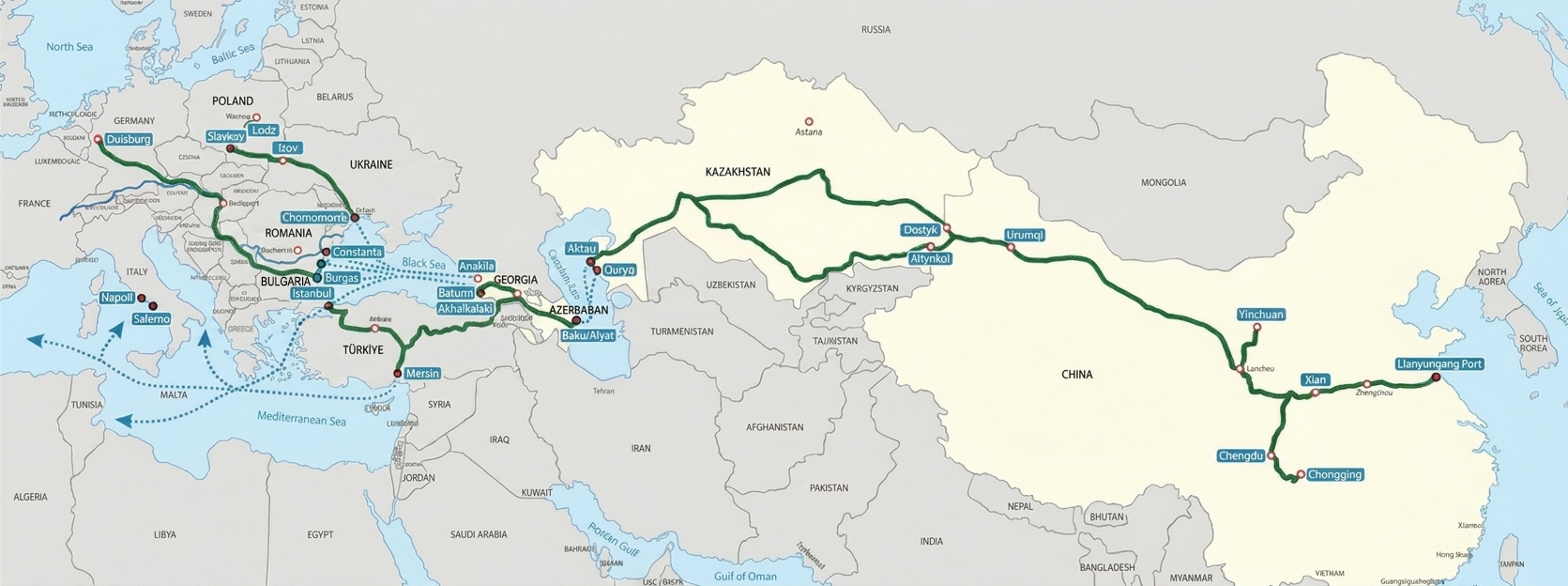
Bulgaria's geopolitical significance only becomes fully apparent when it is understood not merely as a production location, but as a logistical gateway to one of the most important trade corridors of our time. The so-called Middle Corridor – officially the Trans-Caspian International Transport Route (TITR) – connects China and Southeast Asia to Europe via Kazakhstan, the Caspian Sea, Azerbaijan, and Georgia. What makes this route appear fundamentally different from all alternatives is that it runs entirely outside of Russia, Belarus, and Ukraine. In a world where sanctions, the risk of war, and political constraints effectively block the northern Eurasian land bridge, this is not merely an advantage – it is a unique strategic advantage.
The figures document impressive growth dynamics. Transport volume on the Trans-Caspian route increased from around 586,000 tons in 2021 to approximately 1.87 million tons in 2025 – a fivefold increase in four years. Container traffic grew from around 25,000 TEU to almost 77,000 TEU during the same period. Even more impressively, the transport of goods via Kazakhstan quadrupled between 2022 and 2025 to 4.1 million tons. Kazakhstan has announced plans to more than double its freight volume to ten million tons by 2028 and is investing billions in modernizing its Caspian Sea ports. The EU, for its part, announced investments of ten billion euros in early 2025 to develop this route, supplemented by twelve billion euros from the Global Gateway Programme. Experts expect that the corridor could handle between ten and twenty percent of Europe-China trade by 2035.
Transit times from China to Europe via this route can be reduced to fifteen to eighteen days – considerably shorter than with conventional sea routes via the Suez Canal and significantly faster than the sea route around the Cape of Good Hope. In this trade geography, Bulgaria is the last maritime hub before goods from the Georgian Black Sea ports of Poti and Batumi reach the European single market.
The port of Burgas as a container hub is emerging
On April 1, 2025, the concessionaire BMF Port Burgas completed its modernization and expansion project, "ReBirth 28." The new deep-water quay 28 at the Burgas West Terminal allows for the handling of ships up to 260 meters in length and 15 meters in draft, with a container capacity of up to 4,500 TEU. The rail infrastructure at the terminal was also expanded to accelerate intermodal transport to the European hinterland. At the same time, Bulgaria is seeking a strategic investor for the Port of Varna: the investment requirement exceeds €500 million, and Bulgaria is collaborating with the World Bank's International Finance Corporation (IFC) and the European Bank for Reconstruction and Development (EBRD) on this. In April 2026, the Bulgarian Ministry of Transport approved four strategic projects to modernize the terminals in Varna and Burgas, with a total volume of around seven million euros, embedded in a broader program of 17.6 million euros under the Connectivity Programme 2021 to 2027.
A scientific analysis by the Todor Kableshkov University of Transport and the Bulgarian Chamber of Commerce and Industry from December 2025 succinctly summarizes the geo-economic situation: Bulgaria occupies a central position for the Central Corridor – as an EU and NATO member with a Black Sea coastline, directly bordering Turkey, integrated into the Trans-European Transport Network (TEN-T), and connected to Central European river transport networks via the Danube. Freight from Central Asia can currently reach Bulgaria in twelve to fifteen days. During his visit to Kazakhstan in June 2025, Bulgarian President Rumen Radev signed a memorandum of understanding for the joint development of the Central Corridor, and Kazakhstan formally highlighted the Black Sea ports of Burgas and Varna as strategic hubs within this corridor.
Energy as a second dimension of strategic relevance
Bulgaria's logistical function on the Black Sea is inextricably linked to its energy policy role. In October 2025, the EU decided to phase out all gas imports from Russia by 2028. In this scenario, Bulgaria assumes a key role as a gas transit hub: via the gas interconnector with Greece, it can transport Azerbaijani gas from the Southern Gas Corridor northeastward – to Romania, Ukraine, Moldova, and, in the medium term, via the planned EASTRING pipeline, to Slovakia, Hungary, and Austria. Germany intends to import natural gas from the Black Sea via the state-owned gas company Uniper starting in 2027. Simultaneously, a 1,100-kilometer-long underwater cable is planned to transport green electricity from Azerbaijani sources to the EU via Romania and Hungary – a project signed by Azerbaijan, Georgia, Romania, and Hungary in the presence of EU Commission President Ursula von der Leyen.
Bulgaria is therefore not merely a production location. It is the infrastructural link between Central Asia and the European single market – for goods, energy and raw materials alike.
Georgia: The bottleneck of the Central Corridor with a geopolitical volatility factor
Economic rise amid political tension
Georgia recorded economic growth of 7.5 percent in 2025 – the highest among all its neighboring countries. In the first quarter of 2025, growth even reached 9.8 percent. Key drivers of this growth were the information and communication sector, which increased by 28.6 percent, as well as education (+27.7 percent), healthcare (+17.9 percent), transportation and warehousing (+9.5 percent), and financial and insurance services (+8.7 percent). Growth of 5.9 percent is projected for 2026. These macroeconomic data read like the growth curve of a breakthrough emerging market.
Georgia is functionally indispensable for the Central Corridor. Anyone traveling from Azerbaijan to Europe without crossing Russian or Iranian territory must pass through Georgia. The Black Sea ports of Poti and Batumi are the western endpoints of the Caucasus transit axis, and Georgia took a significant bureaucratic step towards simplifying European trade by joining the Common Transit System (NCTS) on February 1, 2025. Shipments can now be processed via the electronic NCTS system – a pragmatic step that considerably simplifies day-to-day logistics for European companies.
The volume of direct investments is estimated to average around US$1.6 billion per year. Investors increasingly come from Turkey, Russia, and Saudi Arabia, indicating a geopolitically mixed but economically active investment dynamic.
The EU accession question as a strategic disruptive factor
Georgia's political situation is the crucial element of uncertainty in any economic calculation. Although the country officially received EU candidate status in December 2023, the European Council declared a de facto standstill in the accession process in June 2024. The ruling Georgian Dream party has signaled its intention not to actively pursue EU accession, leading to massive protests among the Georgian population – polls show an overwhelming majority of over 80 percent in favor of EU membership. The political elite, however, is performing a precarious balancing act between Western institutions and Russian-Iranian trade relations.
For European investors and logistics companies, this means an increased political risk premium. Georgia is virtually irreplaceable as a transit country in the Central Corridor – geographical necessity trumps any political will. However, the question of whether the country will offer reliable long-term conditions for Western companies remains open. The EU Commission has frozen accession negotiations, which, while increasing the pressure on the Georgian government to modernize, does not force any immediate structural reforms.
The potential that Georgia could offer as a free trade and logistics zone—a post-Soviet Singapore at the crossroads of Europe and the Caucasus—is real and has been discussed by trade experts for years. Germany Trade & Invest (GTAI) describes how the South Caucasus is transforming into a key transport hub, driven by new geopolitical realities and growing investment. The industry increasingly views Georgia as an essential option for trade between Europe and Asia. Georgia itself is positioning itself as a major transit country in global trade, with new initiatives to promote transport and logistics infrastructure. This development is irreversible—the only questions are at what speed and with what political predictability it will proceed.
The Türkiye-Georgia axis as a link in the Central Corridor
Georgia should not be viewed as an isolated actor, but rather as part of a trilateral connectivity system together with Azerbaijan and Turkey. At a trilateral meeting in Tbilisi, high-ranking representatives of the three countries discussed the expansion of the transport corridor and increasing competitiveness along the entire route. Turkey has been Georgia's largest trading partner for fourteen years and aims to increase bilateral trade to three billion US dollars. Turkish direct investment in Georgia recently amounted to 2.14 billion US dollars (Note: The "214 billion" in the original text is an obvious factual error; I have corrected this to a more realistic 2.14 billion) – a figure that demonstrates the deep economic interdependence between the two countries. The planned extension of the free trade agreement between Turkey and Georgia, as well as the shared focus on the South Caucasus Corridor as a strategic infrastructure project, underscore that this route should be understood not merely as a bilateral issue, but as an integrated logistics system.
🎯🎯🎯 Data-driven B2B industry hub as a quasi-in-house solution


The quasi-in-house solution: How Xpert.Digital closes operational gaps in B2B marketing and sales – Smart Content-Driven Business - Image: Xpert.Digital
Xpert.Digital is a data-driven B2B industry hub led by Konrad Wolfenstein . The company acts as an external, quasi-in-house solution for industrial partners, closing operational gaps in marketing, content, and sales – without requiring additional resources on the client side.
More information here:
From the Black Sea Corridor to resilience: Europe's new trade hubs and their hurdles
Turkey: A nearshoring giant with a politically fractured foundation
Europe's second largest plastics producer on its way to becoming a supply chain hub
Turkey is a unique player in the European nearshoring debate in several respects. No other country outside the EU is as deeply integrated into European value chains. Bilateral trade between Germany and Turkey reached a record high of US$47.5 billion in 2024, and total EU-Turkey trade rose to US$218.9 billion in 2024. In 2023, Germany was Turkey's largest export market, accounting for 8.7 percent of its total exports. These figures alone illustrate why a nearshoring debate that ignores Turkey misses the mark when it comes to economic reality.
The range of industries where Turkish nearshoring expertise is concentrated is impressively broad. Turkey is Europe's second-largest producer of plastic products and has established itself as a leading player in automotive supply, mechanical engineering, and the textile industry. The export volume of the Turkish defense and aerospace industries increased by 48.8 percent in 2025 to over ten billion US dollars, underscoring the country's technological maturation in strategic industries. Total Turkish exports reached a new record of 273.4 billion US dollars in 2025, an increase of 4.5 percent. In April 2026, the Ulm Chamber of Industry and Commerce (IHK Ulm) determined that German companies view Turkey as a location with high economic potential in the medium to long term – boasting excellent infrastructure, a broad industrial base, diverse logistics options for trade with Europe, and comparatively low production costs.
Geographical proximity is a structural advantage that directly translates into improved logistics costs and delivery times. Unlike suppliers from the Far East, such as Indonesia, Malaysia, or Vietnam, transport routes from Turkey are unaffected by bottlenecks in the Suez Canal or closures of the Red Sea. Turkish government officials and business associations have actively marketed this position: disruptions in global supply chains are explicitly interpreted in Ankara as an opportunity to relocate European production chains to Turkey.
Of particular strategic importance is the fact that the EU explicitly includes Turkey as part of its production area in the context of its planned Industrial Accelerator Act (IAA). Trade Minister Bolat hailed this as a crucial step for bilateral economic relations, as the existing customs union between the EU and Turkey is explicitly taken into account within the framework of the new industrial policy. This could allow Turkey to fall under the "Made in EU" label – a novel development with far-reaching implications for the value chains of European corporations.
Critical raw materials: Boron as a strategic monopoly
A frequently underestimated, but highly relevant aspect of Turkey's economic position for the EU, is its boron monopoly. With a share of approximately 73 percent of global reserves, Turkey is the world leader in this critical raw material. Around 98 percent of the EU's boron needs are met by Turkish production. Boron is used in the defense industry, aerospace, nanotechnology, automotive manufacturing, energy technology, and construction – wherever hardness, chemical stability, and heat resistance are required. This raw material monopoly gives Turkey a strategic negotiating position vis-à-vis Europe that extends far beyond normal trade relations.
Furthermore, Turkey boasts excellent natural conditions for wind and solar energy, creating significant potential in the fields of green hydrogen and renewable energies. Within the context of the European decarbonization strategy, Turkey could become a relevant energy supplier for the EU – provided the regulatory and diplomatic framework is right.
Governance deficits as a systemic investment risk
A nuanced analysis of Turkey as an economic partner cannot be achieved without a clear identification of the risk dimension. The German Institute for International and Security Affairs (SWP), in its July 2025 study on Turkey's industrial and supply chain policy, precisely highlighted this tension: Turkish industrial policy is oriented towards the EU and strives for greater integration into European supply chains – at the same time, the authoritarian domestic policy, with its erosion of democracy, rule-of-law deficits, and restrictions on fundamental rights, undermines the reliability of the investment climate.
Furthermore, there are significant shortcomings in the implementation of decarbonization measures, which, in light of the European Carbon Border Adjustment Mechanism (CBAM), could become a serious trade problem. The 2025 Export Evaluation Report by the Ankara Chamber of Commerce explicitly warns that Turkey could be placed in the same supplier basket as China, which would expose it to the same burdens imposed by European climate measures. Another structural risk: Over 65 percent of Turkish exports are concentrated in just 20 markets, creating a significant vulnerability to dependency.
The EU-Turkey Customs Union has existed for 25 years and is still not fully implemented. There have even been setbacks, and reforming the Customs Union is considered politically difficult as long as fundamental governance issues remain unresolved. German direct investment in Turkey amounted to almost US$700 million last year – the second-highest figure in the last 13 years. However, the trend that these investments come predominantly from companies already familiar with the Turkish market, and hardly at all from newcomers, points to a persistent barrier to entry for inexperienced players.
The strategic triangle: Systemic complementarity instead of isolated individual options
Division of labor as a principle
The real analytical achievement lies not in evaluating Bulgaria, Georgia, or Turkey individually, but in recognizing their systemic complementarity. These three countries are not competing alternatives – they are complementary components of a functional supply chain system that can make Europe more resilient to geopolitical shocks.
Turkey provides industrial depth, manufacturing capacity, and raw material expertise; it is the production arm. Georgia is the transit bottleneck of the Central Corridor; without Georgian territory, there is no connection between the Caspian region and the Black Sea that bypasses Russia. Bulgaria is the European entry point—the first EU member to bring goods from the corridor onto European legal and infrastructural territory. This division of labor is not a theoretical construct; it describes the actual economic-geographical logic of the emerging trade corridor.
The EU has recognized this systemic dimension. Both the Black Sea Synergy of 2007 and the new EU Black Sea Strategy of 2025 highlight Bulgaria as a central hub for regional connectivity. The Global Gateway Initiative plans a submarine cable in the Black Sea to transport green energy from Azerbaijan to Romania and thus into the EU. The Three Seas Initiative focuses on deepened infrastructure cooperation between the eastern EU member states.
The circumvention of Russia as a structuring principle
All three countries – Bulgaria, Georgia, and Turkey – are linked by a common structural characteristic that is of paramount importance in the current geopolitical constellation: their network allows Europe to maintain trade links with Central Asia, the Caucasus, and China without relying on Russian territory. This is not merely a logistical advantage, but a security policy imperative.
The Middle Corridor symbolizes the transition from a hierarchical post-Soviet integration to a networked and pluralistic order of regional states. Countries like Kazakhstan and Uzbekistan are using this dynamic to expand their foreign policy options vis-à-vis Russia. For Europe, this represents a strategic opportunity: Building close economic ties along this axis simultaneously binds the transit states more closely to Western institutions and norms – a classic example of geoeconomics as a tool of foreign policy.
Risk profile and realistic assessment: What's missing to unlock the potential?
Infrastructure as a chronic bottleneck
The biggest operational obstacle to deeper integration of the Black Sea-Caucasus Corridor remains infrastructure. The Bulgarian railway network suffers from outdated technology and insufficient capacity, and connections to neighboring EU countries are inadequate. Important cross-border projects such as Corridor VIII, which connects Bulgaria to the Adriatic via North Macedonia and Albania, are progressing slowly. The Burgas-Sofia-Danube axis urgently requires accelerated investment in rail infrastructure. The World Bank estimates that freight volumes via the Central Corridor could triple to around 11 million tons by 2030 if the infrastructure is upgraded accordingly. This is a prerequisite, not a given.
A similar situation exists in Georgia: Expanding port capacity in Poti and Batumi and modernizing railway connections are necessary investments that require stable government planning. Furthermore, the falling water level in the Caspian Sea jeopardizes navigability on the Caspian section of the corridor, as heavy ships struggle to transport their cargo – a climatic risk that has received little attention so far.
Geopolitical ambivalence of the anchor landscape
Neither Georgia nor Turkey are easy partners. Georgia navigates between EU aspirations and a Russian-oriented government policy. Turkey, at the same time, maintains close economic ties with Russia and China, which, from a European perspective, raises questions about reliability. The SWP study openly describes this as Ankara's balancing act between Western integration and a Russian-Chinese technology and energy partnership. Turkey's trade with Russia and China amounted to approximately US$105 billion in 2023 – 17 percent of total Turkish foreign trade. This entanglement is not a temporary anomaly, but rather a strategic calculation.
For European companies seeking to diversify their supply chains, this means increased due diligence requirements: partnerships with Turkish and Georgian actors must include robust compliance structures that address both sanctions risks and governance deficiencies. The protection of intellectual property, the modernization of the EU-Turkey Customs Union, and improved governance structures are explicitly cited by economic policy institutions as prerequisites for effective cooperation.
Bureaucratic inefficiency as a brake on investment
Opaque and lengthy bureaucratic procedures are still considered the greatest operational risk in Bulgaria. While Georgia has made significant progress in reducing bureaucracy and digitizing its operations—the country was long considered a model region for reform in the post-Soviet world—these reform processes have stalled under the current government. And in Turkey, democratic deficits and disregard for the rule of law directly hinder the effectiveness of even purely economic policy initiatives.
Recommendations for European companies and decision-makers
The economic analysis of the three countries leads to a clear strategic conclusion: The Black Sea-Caucasus Corridor is not a theoretical construct, but a reality in the making. The growth dynamics of the Central Corridor, Bulgaria's full EU accession to the Eurozone, Georgia's transit potential, and Turkey's vertical integration together constitute a system that will structurally alter European supply chain strategy. Those who invest today do so at prices and under conditions that will be significantly less favorable in five years.
Specifically, the following conclusions can be drawn:
Firstly, Bulgaria is a mature nearshoring destination for manufacturing companies in the automotive, electronics, and IT sectors, offering full protection under the EU legal framework, favorable tax conditions, and a growing skilled workforce. A corporate tax rate of ten percent and generous EU subsidies make the country financially attractive. The introduction of the euro and full Schengen accession have eliminated the last remaining transaction barriers.
Secondly, logistics companies and freight forwarders should include Bulgaria's Black Sea ports as strategic options in their network planning for the Central Corridor. The port of Burgas has reached a new level of capacity through the ReBirth-28 modernization; Varna is currently undergoing investment. Transit times of twelve to fifteen days from Central Asia are competitive.
Thirdly, Georgia should be considered as a transit country, not a production location. Its accession to the common transit procedure on February 1, 2025, is an important signal that will simplify the day-to-day logistics of European companies. Political volatility necessitates risk mitigation strategies and contingency planning, but does not preclude Georgia from being a transit partner.
Fourth: Turkey offers the most mature nearshoring option outside the EU in the automotive, mechanical engineering, textile, and plastics sectors – with the advantage of significant industrial capacity and geographical proximity. However, companies should systematically incorporate governance risks, the need for CBAM adjustments, and Ankara's political unpredictability into their risk models. A strategically diversified supply chain that uses Turkey as a mainstay, but not as its sole pillar, appears to be the most robust approach.
The Black Sea is no longer just a geographical periphery of Europe. It is the crossroads between the EU and a newly structured Eurasian trading system. And whoever fails to occupy this crossroads will leave it to others.
Consulting - Planning - Implementation

Konrad Wolfenstein
I would be happy to serve as your personal advisor.
You can contact me at wolfenstein∂xpert.digital or
Just call me on +49 7348 4088 965 .
Your container high-bay warehouse and container terminal experts


Container high-bay warehouses and container terminals: The logistical interplay – expert advice and solutions - Creative image: Xpert.Digital
This innovative technology promises to fundamentally change container logistics. Instead of stacking containers horizontally as before, they will be stored vertically in multi-story steel racking structures. This not only allows for a drastic increase in storage capacity within the same area, but also revolutionizes all processes at the container terminal.
More information here: