
Technology leadership versus competence leadership: An analysis of national competitiveness and resilience
Xpert pre-release

Available in 27 languages 📢
Prefer Xpert.Digital on GoogleⓘPublished on: May 3, 2025 / update from: May 3, 2025 - Author: Konrad Wolfenstein

Technology leadership versus competence leadership: An analysis of national competitiveness and resilience - Image: Xpert.digital
Technology vs. Competence leadership: How sustainable dominance really arises (reading time: 26 min / no advertising / no paywall)
Technology vs. Competence leadership: How sustainable dominance really arises
The global economic landscape is characterized by an intensive competition in which nations and companies struggle for technological supremacy. The leadership in specific technology fields - the so -called "technology leader" - is often regarded as the primary indicator of strength and future viability. Examples such as China's dominance in photovoltaics (PV) production or installations of industrial robots seem to support this assumption. However, the underlying thesis of this report, initiated by the observation of specific national dominances, is: Technology leadership in delimited sectors is not necessarily synonymous with a deeply anchored, broad national "competence leadership".
This article aims to define and differentiate between the concepts of technology and competence leadership. Based on the case examples of China in the areas of PV and robotics, the drivers and nature of these specific technology leaderships are analyzed. Building on this, it is examined to what extent this dominance is based on a comprehensive national competence base and which implications result in long -term competitiveness and economic resilience. The analysis is based on the evaluation of industrial data, political documents, academic research and expert reports.
Suitable for:

Conceptualization of leadership: Technology vs. Competence
In order to examine the central question, a clear conceptual delimitation is necessary. In particular, the terms competitiveness, technology leadership and competence leadership must be defined and related to each other.
Definition of national competitiveness
The concept of national competitiveness is complex and is not used uniformly in economic literature and political discussion. The definitions range from the ability to achieve a high level of income and employment on a sustainable basis, to securing a high standard of living for the population compared to other countries, to the creation of a cheap environment for productive companies through institutions and political measures. From a company's point of view, competitiveness means to generate or remove market shares in the long term.
The competitiveness of a nation or a company is made up of various components. It includes the ability to assert itself against market partners (vertical), competitors (horizontally) and external threats (lateral). Key factors that influence national competitiveness are diverse and, in addition to price aspects such as exchange rates and wage costs, are increasingly also non-priced. This includes in particular productivity growth, innovative ability, the quality of the infrastructure, the level of education, the effectiveness of institutions and legal certainty. Modern approaches expand the term aspects such as environmental and climate protection as well as quality of life and thus go beyond purely economic dimensions such as the gross domestic product ("Beyond-GDP").
The different definitions of competitiveness already reflect a potential tension. Metrics that focus on direct economic results such as income or market shares could favor nations that have a strong technology leader in currently dominant sectors. Definitions, on the other hand, emphasize sustainable well -being, institutional quality or broad innovative ability to correlate more with the concept of competence leadership. The choice of definition thus implicitly shapes the evaluation of different leadership models.
Definition of technology leadership (sector -specific dominance)
In the context of this report, technology leadership is primarily understood as the achievement of a dominant global position in production, use or market share of a specific technology or an industrial sector. Examples of this are China's leading role in the production of PV modules or installing industrial robots.
This type of leadership is often driven by specific factors:
- Targeted industrial policy: state strategies, subsidies, cheap loans and the creation of domestic demand can massively promote the development of dominant industries.
- Scale effects: High investments in production capacities enable mass production and significant cost advantages.
- Cost leadership: Aggressive cost reduction strategies, often supported by favorable energy prices or wage costs, can suppress competitors.
- Technology acquisition and adaptation: The acquisition of key technologies through licenses, purchase of production facilities or recruitment of talents can enable the entry and rapid rise.
- Large internal market: A large home market can serve as the basis for scaling and testing before the global market is addressed.
However, such a technology leadership concentrated on specific sectors also harbors potential risks and limits. It can be based on temporary advantages (e.g. subsidies, specific regional cost structures), lead to global overcapacity and mask a dependency on imported key components or basic research and development (F&E) in other countries. This form of leadership could therefore be less resilient compared to technological upheavals, geopolitical tensions or the elimination of specific advantages.
Suitable for:

Definition of competence leadership (wide -based ability)
In contrast, competence leadership describes a deep, width and resistant national ability to innovate across different fields. It is rooted in a strong national innovation system (NIS). A NIS comprises the network of institutions in the public and private sector (companies, universities, research institutes, government agencies), whose activities and interactions initiate new technologies initiating, importing, modifying and spreading.
The central pillars of competence leadership are:
- Human capital: A high level of education, qualified specialists, systems for lifelong learning and the ability to train, attract and keep talents are fundamental. Investments in human capital directly affect innovative ability and resilience.
- F&-E-E-ECOSYSTYS: Strong public and private investments in F&E, excellent research institutions, effective cooperation between industry and science as well as capacity for basic and applied research are crucial.
- Institutional framework: This includes innovation -friendly politics, effective government, strong protection of intellectual property, access to financing (e.g. risk capital) and a powerful infrastructure (digital, physical).
- Corporate competencies: strong management and organizational skills within the companies, including technical, cognitive, interpersonal and result-oriented leadership skills, as well as the ability to integrate innovations and successfully commercialize.
Competence leadership implies adaptivity, the ability to not only generate new knowledge, but also to absorb and apply, as well as a sustainable potential for innovation. This contributes significantly to long -term economic resilience. It is about the ability to be innovative and stay innovative about waves of technological change.
Interaction and divergence
Technology leadership can certainly grow out of competence leadership if, for example, a strong F&E E-base leads to a technological breakthrough, which is then successfully scaled. However, the analysis of the case studies, in particular China, suggests that technology leadership can also be achieved through other means - such as strategic industrial policy, massive scaling and technology acquisition - without this inevitably reflecting a deep, broad competence in the entire national innovation system.
It is also important to distinguish the definition of technology leadership (national sectarian dominance) used here from the academic definition of “Technology Leadership”. The latter often refers to the ability of individuals or organizations to effectively lead people in the technological context. This type of leadership requires a combination of sound technical competence and broader leadership skills (communication, strategic thinking, change management).
The analysis of China's rise to PV and robotics primarily focuses on national sectordominance, which was largely achieved through scale effects and industrial policy. A central question of this report is whether this sparkling dominance also leads to a deepening of the underlying skills, including leadership skills in the technological area, or whether a gap remains between market dominance and fundamental competence. This potential discrepancy is a core aspect of the debate.
Key differences: Technology leadership vs. Competence leadership
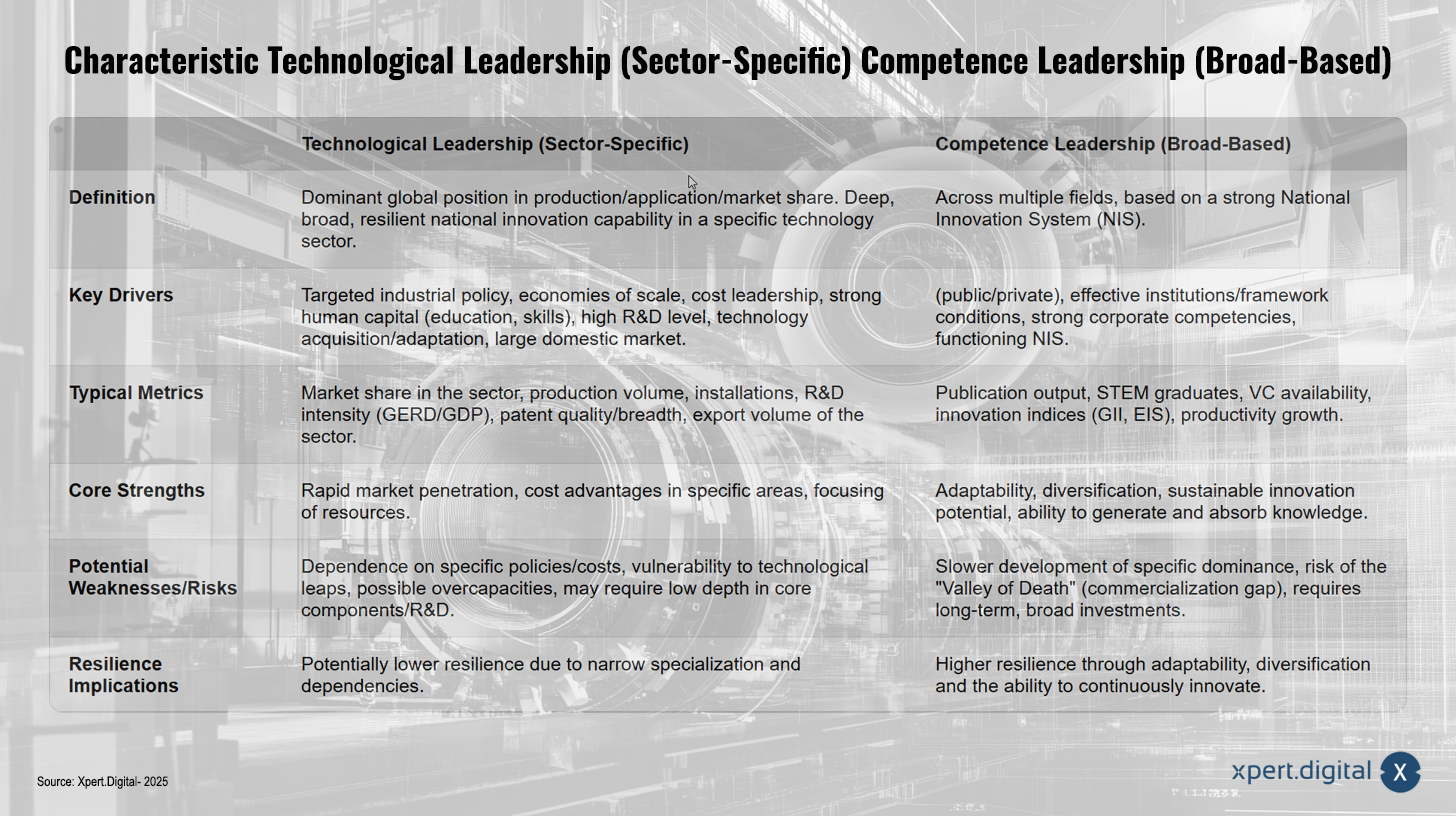
Key differences: Technologief leader vs. Competence leadership - Image Xpert.digital
The technology leadership and competence leadership differ in several central aspects. While technology leadership is aiming for a dominant global position in production, use or market share of a specific technology sector, competence leadership focuses on a depth, width and resilient national innovative ability across several fields, supported by a strong national innovation system (NIS). The key drivers of technology leadership are targeted industrial policy, scale effects, cost leadership, technology acquisition or adaptation as well as a large internal market. In contrast, the drivers of competence leadership are based on strong human capital, a high level of use, effective institutions, strong corporate skills and a functioning NIS.
Typical metrics for measuring technology leadership include market shares and production volume in the sector and export data. For competence leadership, F&-intensity, patent quality, publication services, the number of STEM graduates, availability of risk capital and induction indices are used. The core strengths of the technology leadership lie in the fast market penetration, cost advantages and the targeted use of resources, while competence leadership scores through adaptability, diversification and sustainable innovation potential.
However, every model has potential weaknesses: the technology leadership often depends on specific policies and costs, susceptible to technological jumps and can generate possible overcapacity. The competence leadership, on the other hand, develops specialized dominances slower, is susceptible to the “Valley of Death” commercial gap and requires long -term investments. With regard to resilience, the technology leader is less resilient due to its close specialization and dependencies, while competence leadership through adaptability, diversification and the ability to continuously renewal promises higher resilience.
🎯🎯🎯 Benefit from Xpert.Digital's extensive, fivefold expertise in a comprehensive service package | R&D, XR, PR & SEM

AI & XR 3D Rendering Machine: Fivefold expertise from Xpert.Digital in a comprehensive service package, R&D XR, PR & SEM - Image: Xpert.Digital
Xpert.Digital has in-depth knowledge of various industries. This allows us to develop tailor-made strategies that are tailored precisely to the requirements and challenges of your specific market segment. By continually analyzing market trends and following industry developments, we can act with foresight and offer innovative solutions. Through the combination of experience and knowledge, we generate added value and give our customers a decisive competitive advantage.
More about it here:
Technology and strategy: How China dominates the global PV industry
China's technology leader in photovoltaics (PV): a deep analysis
China's rise to global leadership in the PV industry is a striking example of achieving technology leadership in a strategically important sector. This dominance extends across the entire value chain.
Mapping of the dominance along the value chain
The global PV manufacturing landscape has shifted dramatically in the past decade, away from Europe, Japan and the USA to China. Current data shows China's overwhelming market share, which is over 80% in all central production levels - polysilicon, ingots, wafers, cells and modules. For the upstream, capital -intensive levels such as Wafer and Polysilicon, experts even forecast an increase to almost 95% in the near future. This dominance is underpinned by massive investments: since 2011 China has invested over $ 50 billion in new PV production capacities, ten times more than Europe. China is not only home to the world's largest PV factories, but also the ten leading providers of PV manufacturing systems. This production power is also reflected in the trade: PV products are a significant export article for China, with exports worth over $ 30 billion in 2021.
Suitable for:

Analysis of the drivers
Several factors have made this unprecedented dominance possible:
Industrial policy
The Chinese government identified the PV industry as a strategic sector and encouraged them massively. This included subsidies (e.g. the “Golden Sun Demonstration Project” after the 2011 crisis), feed -in tariffs to stimulate domestic demand, cheap loans from state banks and advantageous electricity tariffs in production high castles such as Xinjiang and Jiangsu. Politicians developed from an initial focus on export promotion through subnational governments to a stronger central state coordination to design the internal market and to manage overcapacity.
Scale effects & costs
The enormous investments enabled the construction of gigantic factories and thus the implementation of significant scale effects. This, combined with lower costs for energy (especially in coal regions), work and investments, led to a drastic reduction in production costs and established China as the most cost -effective production location worldwide. In 2023, the module costs in China fell by 42%, which further expanded the cost advantage over India, the USA and Europe.
Supply chain integration
Leading Chinese PV companies successfully pursued strategies of vertical integration, ie they are active in several stages of the value chain. This increases the cost efficiency and enables fluctuations in individual segments to be better cushioned. In addition, the geographical concentration of production - upstream stages in regions with favorable energy, downstream stairs closer to the ports - promotes cost efficiency.
Technology acquisition & innovation
The introduction to PV production was largely due to the acquisition of technologies, in particular through the purchase of turnkey production lines (“Turnkey Production Lines”) and the recruitment of Chinese specialists and managers trained abroad. China managed to acquire and master production technologies without being a large user of PV systems. In the meantime, however, a shift towards stronger domestic innovation has taken place. Chinese companies invest in F&E to increase the efficiency of the cells (from approx. 16% to over 22%) to reduce material consumption (silicon, silver) and to develop and scale new technologies such as Topcon (Oxide Passivated Contact) and Back Contact (BC).
Competence assessment
The analysis of the drivers suggests that China's technology leader in the PV sector was primarily achieved by a strategically oriented industrial policy, massive scaling of production and aggressive cost reduction. Initially, the technology was rather acquired and adapted as originally developed. The innovation activities that are visible today seem to be a result of the established market power and production capacities than their original driver. This supports the interpretation of a model that relies on “Deployment First, Innovate Later” to obtain sector leadership.
However, this model also harbors specific vulnerability. The dependence on favorable electricity prices in certain regions creates vulnerability to energy policy changes or cost increases. The strong geographical concentration of production increases risks due to local disorders (natural disasters, etc.). Another significant problem is the tendency towards global overcapacity caused by the massive expansion in China. These overcapacities lead to drop in prices, margin pressure and potential consolidations or even bankruptcies in the industry. These factors raise questions regarding the long -term resilience and sustainability of this specific technology leader model and support the assumption that such a leadership could be fragile than one that is based on broader skills.
China PV Dominance & Driver (as of approx. 2023/2024)
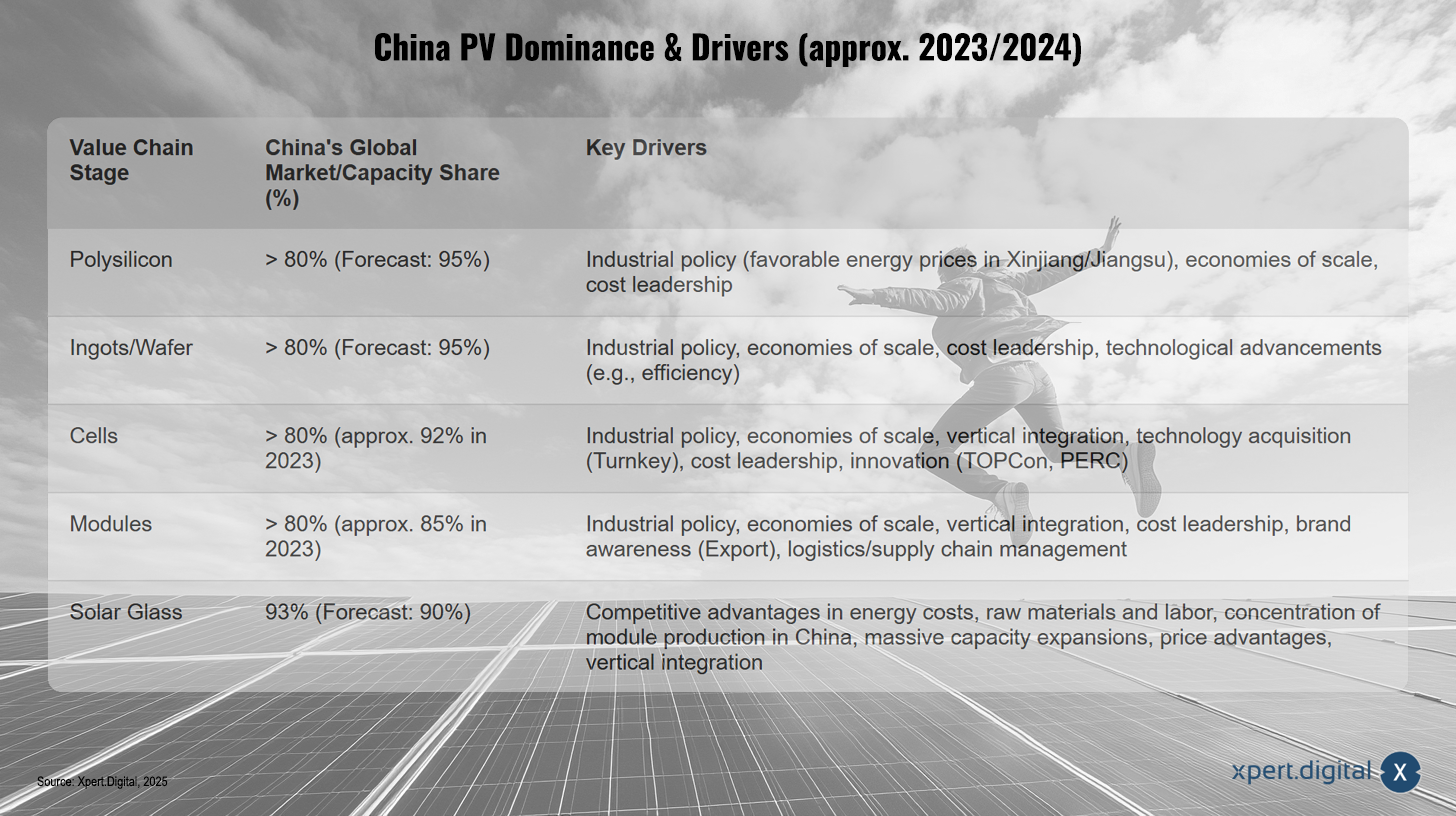
China PV Dominance & Driver (as of approx. 2023/2024) - Image: Xpert.digital
China dominates the global photovoltaic value chain with market shares of over 80 % in all important levels. In the area of polysilicon, an increase of over 80 % is forecast to almost 95 %, which is primarily achieved through favorable energy prices, scale effects and cost leadership in regions such as Xinjiang and Jiangsu. For Ingots and Wafern, the current proportion also corresponds to over 80 %, with a similar forecast towards 95 %, supported by industrial policy, technological advances and cost efficiency. The market share in solar cells was around 92 %in 2023, driven by vertical integration, technology leadership (e.g. Topcon, Perc) and cost leadership. In the area of solar modules, China currently reaches a share of around 85 %, favored by brand awareness, efficient logistics management and low production costs. A particularly strong segment is solar glass, where China dominates with 93 %. Despite a slight forecast decline to 90 % by 2025, Chinese manufacturers benefit from competitive advantages such as favorable energy costs, raw materials and workers as well as massive capacity extensions and price advantages.
Suitable for:

China's technology leader in robotics: scaling and strategy
Similar to the PV sector, China has also built a remarkable technology leader in the field of industrial robotics, which, however, is primarily manifested in the range of application and market size.
Mapping of dominance in use and market
China has been by far the largest market for industrial robots worldwide for years. In 2022, 290,258 units were reinstalled, which corresponded to 52% of the global market. This trend continued in 2023, with China once again uniting over 50% of global demand. The operative inventory of industrial robots in China exceeded the 1.5 million units - a unique value worldwide.
The high adoption rate is particularly striking, even taking into account the lower wage costs compared to industrialized countries such as the USA. Studies indicate that China achieved 12 times the robot rate expected due to the wage level in 2021. At the same time, domestic robot manufacturers rapidly win the ground. Their share of the annual installations in Germany rose from 30% in 2020 to 47% in 2023.
Analysis of the drivers
This development is not a coincidence, but the result of a concerted strategy and specific market conditions:
Industrial strategy ('Made in China 2025'): The robotics were identified as one of ten key industries in the “Made in China 2025” (MIC 2025) that was launched in 2015. The goals are the comprehensive modernization of the Chinese industry, the increase in the domestic proportion of core components (goal: 70% by 2025), the reduction of the dependence on foreign technology and ultimately the acquisition of a global management position in high-tech production areas. The following five -year plans confirmed these ambitions, including the target of global leadership in robotics and the development of highly qualified specialists.
State support: The strategy is flanked by massive financial support. This includes state -funded risk capital funds with target volumes of up to 1 trillion yuan (approx. 138 billion USD) as well as extensive subsidies at national and provincial level that promote the use of robots and automation technology.
Market demand & scaling: The huge internal market, especially in sectors such as electronics production (where almost two thirds of the industrial robots were installed in 2023) and automotive construction, creates enormous demand and enables local providers to achieve scale effects.
Cost competitiveness: Due to localized supply chains and production calming, Chinese robots become increasingly cost -effective than imported alternatives.
Competence assessment
Despite the impressive number of market and adoption, China's technology leader in the robotics shows significant signs of an even incomplete competence leadership:
Dependence on core components: A critical weak point remains the strong dependence on foreign suppliers in technologically demanding core components such as precision drives (reducers), controls, servomotors and increasingly also AI chips. These components make a significant part of the robot costs (up to 70%) and are often technologically dominated by Japanese, German or Swiss companies. Although domestic providers develop here too, this dependence remains strategic vulnerability, especially in the context of geopolitical tensions and technology export controls.
Innovation character (“Fast Follower”): International reviews, such as those of the ITIF, characterize Chinese robot manufacturers in many areas more as “quick followers” (“Fast Follower”), which catch up technologically and compete primarily through costs and scaling instead of being at the top of the fundamental innovation.
Qualification gap (“Skills GAP”): The rapid distribution of robots and automation exceeds the availability of specialists who can operate, wait, integrate and develop them further. Although the government is massively investing in retraining and further education programs, this “Skills GAP” represents a barrier for the transformation and could limit future productivity increases and jumps in innovation. The coexistence of worldwide leading adoption rates and significant qualification gaps impressively illustrates the possible divergence between the use of technology (technology leadership in adoption) and the development of the necessary human competence base (competence leadership).
Future ambitions: China invests strongly in future fields such as humanoid robots and the integration of artificial intelligence and builds up domestic skills for components. This shows the clear will to convert the existing technology leadership into a more comprehensive competence leadership.
In summary, it can be said that China's leadership role in robotics is currently primarily a leadership in the application and market size, driven by an ambitious industrial policy and state support. However, the continuing dependence on foreign nuclear technologies and the visible qualification gaps indicate that this market leadership is not yet equivalent to full technological depth with complete competence leadership.
China Robotics Dominance & Driver (as of approx. 2023)
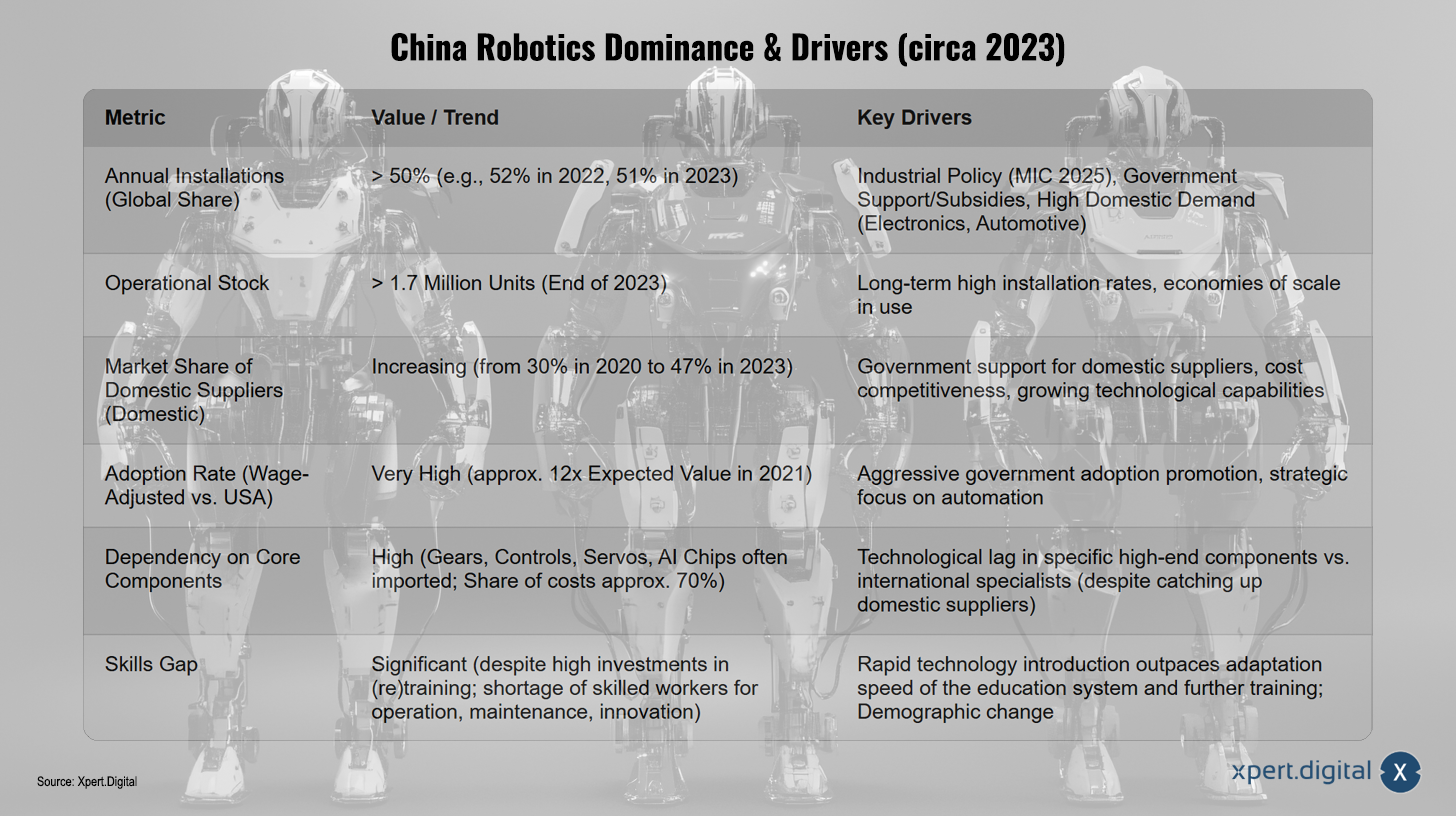
China Robotics Dominance & Driver (as of approx. 2023) - Image: Xpert.digital
China strives for dominance in the area of robotics, with various drivers and metrics illustrate progress. In the annual installations, the global share is over 50 % (e.g. 52 % in 2022, 51 % in 2023), supported by industrial policy “Made in China 2025”, state grants and strong domestic demand in the areas of electronics and automotive industry. The operational inventory exceeded 1.7 million units at the end of 2023, due to years of high installation rates and scale effects. The market share of domestic providers in Germany rose from 30 % in 2020 to 47 % in 2023, thanks to state support, cost competitiveness and growing technological competence. The adoption rate in terms of wage -adjusted comparison to the United States is remarkably high and in 2021 was around twelvefold of her expected value. This is due to aggressive state grants and a strategic focus on automation. Nevertheless, there is a high dependency on imported core components such as driven, controls, servos and AI chips that make up about 70 % of the costs, which indicates a technological deficit in certain high-end areas compared to international specialists. At the same time, a significant qualification gap can be seen-despite great investments in (circumstances) training, there is a lack of specialists for operation, maintenance and innovation. Fast technological progress exceeds the adaptability of the education system, while demographic change tightens the challenge.
Suitable for:

The foundation: national competence, innovation systems and resilience
According to the analysis of the specific technology leaderships of China in PV and robotics, the report now turns to the question of the broader foundation of national strength: the competence leadership, anchored in effective national innovation systems (NIS) and their importance for economic resilience.
The pillars of competence leadership
As already explained in Section 2.3, competence leadership is based on a well -functioning national innovation system (NIS). This system is more than the sum of its parts; It is the network of public and private actors - companies, universities, research institutions, financial institutions, government agencies - and their interactions that create new knowledge. The effectiveness of this system significantly determines the innovation performance of a nation.
Central elements of a strong nis and thus the competence leadership are:
Investments in research and development (F&E): Sustainable public and private investments in F&G are a necessary basis. The public sector plays a critical role, especially in the financing of basic research and research on society as a whole, often through research funding organizations and direct institutional support. In many OECD countries, the corporate sector is the main bearer of F&E. However, it is decisive not only the amount of expenses, but the efficiency of the system in the implementation of F&E into innovations.
Human capital and education: Knowledge that is embodied in humans (“human capital”) is a central resource. A high -quality education system at all levels, programs for lifelong learning and the ability to train and attract qualified specialists are essential. The exchange of knowledge through the mobility of specialists is an important mechanism within the nis. Investments in human capital have a direct positive effect on the ability to innovate and the resilience of companies and economies.
Framework conditions and institutions: This includes innovation-friendly politics, effective government, strong protection of intellectual property, access to financial resources (in particular risk capital for start-ups), a modern infrastructure (physical and digital) as well as a culture that promotes innovation and entrepreneurship.
Measurement of deeper competence and innovation potential
The sole consideration of market shares in individual sectors falls short in order to capture the actual, profound competence leadership of a nation. A more comprehensive assessment requires a look at a wider range of indicators that map the health and performance of the entire NIS.
Relevant indicators include:
Input indicators: F & e-intensity (total editions for F&E in relation to GDP-Gerd/GdP), proportion of corporate-F & e (BerD), share of university-F & e (stove), number and quality of StEM graduates (science, technology, engineering, mathematics), availability of risk capital.
Activity and output indicators: Number and quality of patent applications (e.g. PCT applications, citation rates), number and impact of scientific publications in key fields, number of technology-based company foundations, cooperation between companies and research institutions.
Impact indicators: Share of high-tech exports in overall exports or GDP, share of knowledge-intensive employment, productivity development, sales of new markets, digital skills of the population.
Holistic indices: rankings in established innovation indices such as the global innovation index (GII) of the WIPO or the European Innovation Scoreboard (ice cream), which combine a variety of indicators.
The need for such a multi -dimensional view becomes clear if one takes into account the complexity of innovation systems. A sole focus on output metrics such as market shares can disguise underlying weaknesses in the base of competence. For example, a country can cut very well in innovation rankings (which indicates a high level of competence), but still have no broad market leadership in many high-tech sectors, as the example of Switzerland shows. This underlines the need to consider inputs, processes and various outputs in order to be able to differentiate between technology and competence leadership.
Connection of competence and resilience
A broad and deep national base of competence is an essential prerequisite for economic resilience. Resilience describes the ability of a system (here: an economy) to resist shocks, to adapt and possibly even develop transformatively. The connection between competence leadership and resilience results from several aspects:
Adaptability (adaptability): A strong NIS with well -trained specialists and flexible institutions enables an economy to react faster to technological upheavals, market changes or external shocks and to take new opportunities. The ability to absorb and apply knowledge is central here.
Diversification: A high technological and economic complexity, which often results from a broad base of competence, leads to a more diversified economic structure. This reduces susceptibility to crises in individual sectors. However, it should be noted that excessive, incompatible complexity also have negative effects on the efficiency of the factoralocation and can reduce resilience.
Continuous innovation: Competence leadership is the engine for ongoing innovation. This enables an economy to move up along the value chain, to open up new growth sources and to secure their competitiveness in the long term.
In contrast, a close, possibly strategically brought about technology leadership contains specific resilience risks:
Technological lock-in: The focus on dominant technology can lead to disruptive new approaches to be overlooked or adapted too late.
Supplier risks: A high dependence on imported key components or raw materials creates vulnerability, as is clear in the case of the robotics core components of China.
Political and cost dependence: If the leadership depends heavily on specific subsidies, cheap energy prices or other state measures, their loss or change can quickly undermine the competitive position.
Under investment in basics: A focus that is too strong on short -term market leadership can lead to neglecting long -term basic research and broad technology development, which makes it difficult for future jumps in innovation.
The analysis thus suggests that economic resilience correlates strongly with the characteristics of competence leadership: adaptability, diversification through broad skills and the potential for continuous innovation from a robust nis and a strong human capital basis. This is in contrast to technology leadership models that may be optimized for current market dominance, but which lack the underlying width and depth for long -term adaptability. China's specific dependencies (e.g. energy costs in PV production, core components in robotics) illustrate the potential vulnerability of its model focused on technology leadership.
Our recommendation: 🌍 Limitless reach 🔗 Networked 🌐 Multilingual 💪 Strong sales: 💡 Authentic with strategy 🚀 Innovation meets 🧠 Intuition

From local to global: SMEs conquer the global market with clever strategies - Image: Xpert.Digital
At a time when a company's digital presence determines its success, the challenge is how to make this presence authentic, individual and far-reaching. Xpert.Digital offers an innovative solution that positions itself as an intersection between an industry hub, a blog and a brand ambassador. It combines the advantages of communication and sales channels in a single platform and enables publication in 18 different languages. The cooperation with partner portals and the possibility of publishing articles on Google News and a press distribution list with around 8,000 journalists and readers maximize the reach and visibility of the content. This represents an essential factor in external sales & marketing (SMarketing).
More about it here:
Paths to innovation: What differentiates Germany, Japan and Switzerland from China
Comparative perspectives on innovation and leadership models
In order to further illustrate the differences between technology and competence leadership, it is worth taking a look at the innovation models of other leading industrialized nations such as Germany, Japan and Switzerland compared to China.
Suitable for:

Germany: established competence in change
Germany traditionally has a strong industrial competence base, especially in automotive construction, which is based on excellent engineering knowledge, high product quality and productivity. The F&E expenditure is high, with a significant proportion of industry (BERD). However, the challenges lie in the adaptation of these established strengths to the “double transformation” - digitization and decarbonization. High energy costs, bureaucratic hurdles and an increasing shortage of skilled workers strain competitiveness. In key areas of the future such as battery cell production or high -automated driving, Germany threatens to fall behind global competitors such as China. Germany's strategic answer consists in massive investment plans in F&E and modern production facilities to strive for a leadership role in digital and climate -neutral products and to improve the location factors. Germany's model thus represents a deep industrial competence that now has to face a profound transformation process.
Japan: Strategic breaks and remaining strengths
Japan's relative loss of meaning In the semiconductor and electronics industry since the late 1980s, a fundamental lack of technical competence has been attributed less, but rather to strategic wrong decisions. This includes adhering to the integrated manufacturer model (IDM) in a globalizing industry with a horizontal division of labor (foundry model from TSMC), hesitant industrial restructuring and too late focus on software development. External factors such as the US-Japan semiconductor agreement from 1986 and the Yen upgrading also played a role.
However, Japan continues to retain global strengths in specific niches in the value chain, such as semiconductor materials, manufacturing systems and high -quality electronic components. Current efforts aim at a “semiconductor Renaissance”, driven by state strategies and international cooperation (e.g. with TSMC), but face challenges such as shortage of skilled workers and high costs. The example of Japan illustrates how strategic course can influence and even undermine the competence based on competence.
Switzerland: High innovation capacity, focused market leadership
Switzerland has been taking top positions in global innovation rankings such as Gii and ice cream for years. This position is based on excellent framework conditions: a first -class educational system at all levels, programs for lifelong learning and the ability to train and attract qualified specialists are essential. The exchange of knowledge through the mobility of specialists is an important mechanism within the nis. Investments in human capital have a direct positive effect on the ability to innovate and the resilience of companies and economies.
Despite this fundamental strength, Switzerland does not show dominant market leadership in all areas. The exports of medium and high technological products are below the EU average. Potential for improvement is also seen in the innovation activity of SMEs, the willingness to take risks, start-up culture and the degree of digitization. Instead, Switzerland shines in specific, highly profitable niches such as Life Sciences/Pharma, financial technology (especially crypto/blockchain), biotechnology, precision instruments and possibly drone technology. Switzerland thus embodies a model of competence leadership, which is based on strong fundamental and leads to high general innovative ability and selective excellence, but does not necessarily lead to broad sectordominance in mass markets.
Synthesis of the models
The comparison reveals different national innovation paths. Germany stands for profound industrial competence that has to adapt to new realities. Japan shows how strategic decisions can influence leadership despite existing technical skills. Switzerland demonstrates how strong basics (education, research, institutions) can lead to high innovation capacity and niche leadership without necessarily striving for broad market shares.
China's model examined here (focused on PV and robotics) appears different from it. It prioritizes the scaling and quick market conquest in strategically selected sectors by industrial policy. A lower technological width or dependencies in core components may be accepted at short notice in order to quickly gain a visible technology leader. This comparative analysis underlines that there is no way to “leadership” and that the type of this leadership- whether primarily technology or competence-based- varies significantly.
Comparative indicators of national innovation systems (selection)
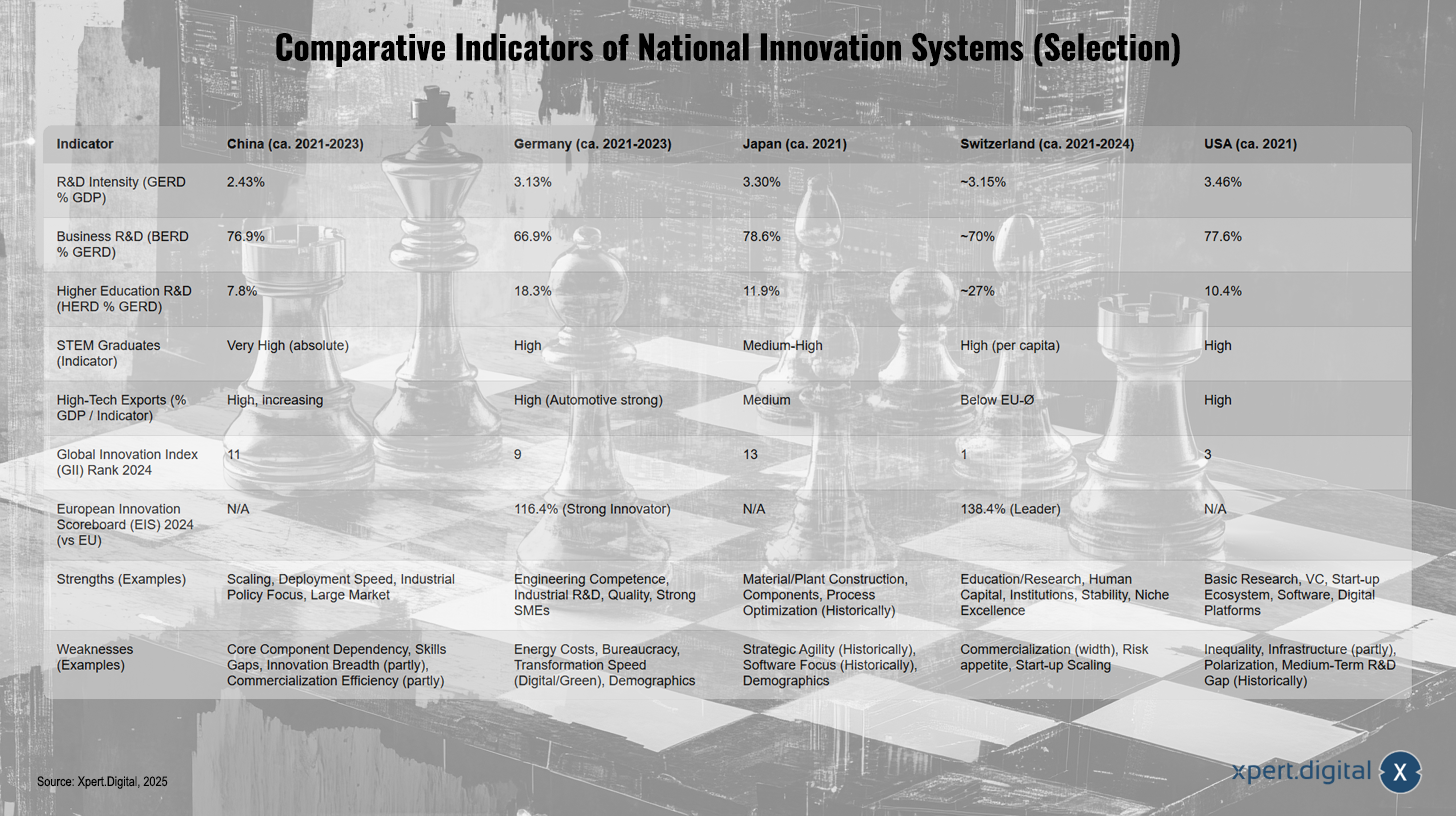
Comparative indicators of national innovation systems (selection) - Image: Xpert.digital
Comparative indicators of national innovation systems show interesting country -specific differences. In China, the research and development intensity (Gerd %BIP) was 2.43 %between 2021 and 2023, in Germany at 3.13 %, in Japan at 3.30 %, in Switzerland at around 3.15 %and 3.46 %in the USA. At company-F & E (BERD %Gerd), China reached 76.9 %, Germany 66.9 %, Japan 78.6 %, Switzerland about 70 %and the USA 77.6 %. University research (Herd % Gerd) was significantly lower in China at 7.8 % than in Germany with 18.3 %, Japan with 11.9 %, Switzerland with around 27 % and the USA with 10.4 %. The indicator of StEM graduates in China is absolutely very high, high in Germany, in Japan Mittel-Hoch, in Switzerland per capita and high in the USA.
With regard to the high-tech exports, a high and increasing proportion was shown in China, a high proportion of strong automotive industry in Germany, in Japan a medium level, in Switzerland values below the EU average and also a high proportion in the United States. In the global innovation index (GII) for 2024, the countries took the following places: China Rank 11, Germany rank 9, Japan rank 13, Switzerland 1st place 1 and the USA 3rd. In the European Innovation Scoreboard (ice cream), Germany reached 116.4 % of EU average (Strong Innovator), Switzerland impressive 138.4 % (leader), while no data about China, Japan and the USA templates.
The strengths of the individual countries showed significant differences: China scaled with scaling, deployment speed, industrial policy focus and its large market. Germany convinced with engineering skills, industrial-f & e, quality and strong SMEs. Japan showed strengths in material and plant construction, components and process optimization. Switzerland captivated with top achievements in education, research, human capital, institutional stability and niche excess. The United States, on the other hand, was particularly characterized by basic research, risk capital, a strong start-up ecosystem as well as competence in software and digital platforms.
Weaknesses of the innovation systems also appeared significantly. China was confronted with a dependency on core components, a lack of specific skills, limited innovation width and partially inefficient commercialization. Germany suffered from high energy costs, bureaucracy, slowed transformation pace in digitization and sustainability as well as demographic challenges. In Japan there were deficits in strategic agility, a historically low software focus and demographic problems. Switzerland showed weaknesses in particular in the broad commercialization and partly lower risk to risk and scaling start-ups. The United States had problems with social inequality, partly inadequate infrastructure, social polarization and a historical gap in medium -term research and development.
Suitable for:

Synthesis and strategic implications
The analysis of the concepts of technology and competence leadership as well as the case examples of China and other industrialized nations allows a synthesis of the results and the derivation of strategic considerations.
Revaluation of the core question
The investigation confirms the central thesis: China's impressive technology leadership in sectors such as PV and robotics is real and was significantly achieved by a consistent industrial strategy, massive scaling and effective technology use. At the same time, however, the continuing dependence on core foreign components (especially in robotics) and the emerging qualification gaps indicate that this sectoral dominance does not yet completely correspond to a deep, broadly anchored competence leadership.
The original assumption is thus supported: technology leadership, which is primarily based on such factors, can be decoupled from a comprehensive national competence base and is potentially less resilient. While China undoubtedly strengthens its innovative skills as a whole, the model in the sectors examined rather seems to be able to create facts through quick market control, of which further competence is then built up.
Strategic considerations for national competitiveness
The various national models illustrate a strategic area of tension:
Targeted technology leadership: Can enable quick success in strategically important sectors and secure market shares. However, risks lie in possible dependencies, lack of width and less adaptability in the case of paradigm changes.
Width of competence leadership: Building long -term investments in education, research and institutions. It promotes resilience and adaptability, but can lead to more visible market leaderships in specific sectors. There is a risk that excellent research will not be effectively translated into marketable products and services (the “Valley of Death” problem).
The challenge for nations is to find a balance. Neither pure input orientation (high F&E expenditure without effective implementation) nor sole focus on a few sectors seem to be optimal long-term strategies. The functionality of the entire national innovation system is decisive - the ability to use investments in knowledge and human capital effectively through strong links between research, development, financing, production and market. High expenses alone guarantee no success if the systemic connections are weak or the commercialization stalls.
Implications for politics
The analysis results in several implications for political decision -makers:
Holistic evaluation: national strength should not be measured solely on market shares in individual sectors. It requires more extensive indicators that capture the depth, width and resilience of the national competence base (e.g. health of the NIS, quality of the human capital, diversity of the F&I landscape, adaptivity indicators).
Systemic funding: Politics should not only promote inputs (F&-Budgets, study places), but also specifically strengthen the connections in the NIS: cooperation between science and business, technology transfer, access to risk capital, creation of test markets and real laboratories.
Technology and competence diffusion: In addition to the creation of new technologies, their effective adoption and diffusion in the breadth of the economy is crucial for productivity increases and competitiveness.
Proactive competence management: Technological change and automation require continuous adaptation of the qualifications. Politics and companies have to proactively invest in training, further education and retraining in order to avoid “skills gaps” and to fully exploit the potential of new technologies.
Balance between focus and width: strategic focus on key technologies can be useful, but must not lead to the neglect of the basic base of competence. Long-term investments in education and broad (basic) research remain essential for future adaptability.
National resilience through competence leadership: success factor for global competition
Technology leadership and competence leadership are distinct concepts with different drivers and implications for national resilience. While sector -specific dominance can be achieved relatively quickly through strategic focus and scaling, as the example of China shows, long -term, resistant competitiveness is probably based on cultivating a deep and broad national base of competence. Understanding these dynamics is of crucial strategic importance for political and economic actors in an era of rapid technological upheavals and intensive global competition. The ability to not only develop or use technologies, but to create an ecosystem that enables continuous innovation, adaptation and knowledge application, becomes increasingly the decisive factor for the prosperity of nations.
🎯📊 Integration of an independent and cross-data source-wide AI platform 🤖🌐 for all company matters

Integration of an independent and cross-data source-wide AI platform for all company matters-Image: Xpert.digital
Ki-Gamechanger: The most flexible AI platform-tailor-made solutions that reduce costs, improve their decisions and increase efficiency
Independent AI platform: Integrates all relevant company data sources
- This AI platform interacts with all specific data sources
- From SAP, Microsoft, Jira, Confluence, Salesforce, Zoom, Dropbox and many other data management systems
- Fast AI integration: tailor-made AI solutions for companies in hours or days instead of months
- Flexible infrastructure: cloud-based or hosting in your own data center (Germany, Europe, free choice of location)
- Highest data security: Use in law firms is the safe evidence
- Use across a wide variety of company data sources
- Choice of your own or various AI models (DE, EU, USA, CN)
Challenges that our AI platform solves
- A lack of accuracy of conventional AI solutions
- Data protection and secure management of sensitive data
- High costs and complexity of individual AI development
- Lack of qualified AI
- Integration of AI into existing IT systems
More about it here:
We are there for you - advice - planning - implementation - project management
☑️ SME support in strategy, consulting, planning and implementation
☑️ Creation or realignment of the AI strategy
☑️ Pioneer Business Development

Konrad Wolfenstein
I would be happy to serve as your personal advisor.
You can contact me by filling out the contact form below or simply call me on +49 7348 4088 965 (Munich) .
I'm looking forward to our joint project.
Write to me

Xpert.Digital - Konrad Wolfenstein
Xpert.Digital is a hub for industry with a focus on digitalization, mechanical engineering, logistics/intralogistics and photovoltaics.
With our 360° business development solution, we support well-known companies from new business to after sales.
Market intelligence, smarketing, marketing automation, content development, PR, mail campaigns, personalized social media and lead nurturing are part of our digital tools.
You can find out more at: www.xpert.digital - www.xpert.solar - www.xpert.plus
Keep in touch











