
Permanently cheaper and 75% cheaper, AI price war escalates: How China's DeepSeek is destroying the calculations of Western tech giants
Xpert Pre-Release

Available in 27 languages 📢
Prefer Xpert.Digital on GoogleⓘPublished on: May 26, 2026 / Updated on: May 26, 2026 – Author: Konrad Wolfenstein
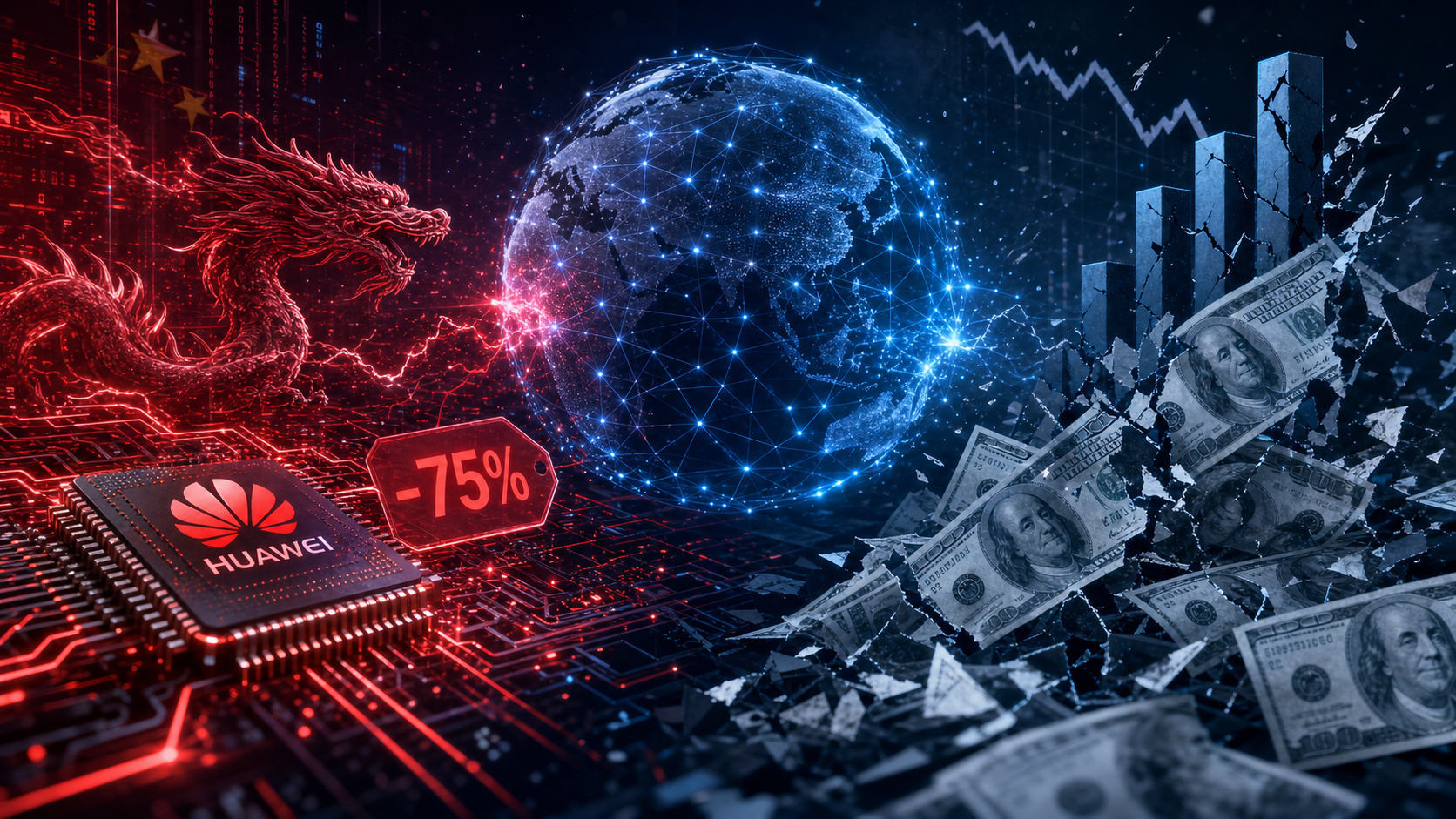
Permanently cheaper and 75% cheaper, AI price war escalates: How China's DeepSeek is destroying the calculations of Western tech giants – Image: Xpert.Digital
When a Chinese startup disrupts the pricing of the entire Western AI industry – and Western corporations suddenly lose control of their own budgets
The world's cheapest AI, but a GDPR nightmare? What the DeepSeek shock means for German companies
The end of Nvidia dependency: How Huawei and DeepSeek are currently reshaping the global AI market
An unprecedented price war is shaking the global AI industry: The Chinese startup DeepSeek has sent shockwaves through the market with a permanent 75 percent price cut for its flagship model. Fueled by national sovereign wealth funds and powered by domestic Huawei chips, the company is freeing itself from dependence on Western Nvidia hardware – and suddenly dictating global prices. This is proving to be a critical test for Western providers like Anthropic and Google. They are responding with hidden price increases through altered token structures, which is already causing budgets to explode for major clients like Uber and Microsoft. But while the incredibly low cost of Chinese AI appears highly attractive from a business perspective, it is quickly proving to be a massive GDPR nightmare for German companies. The only solution to the dilemma between exploding AI costs and looming data protection fines lies in a path that few decision-makers have yet considered.
DeepSeek and the new AI price war
Permanently cheaper: What DeepSeek's price reduction really means
On May 23, 2026, the Chinese AI startup DeepSeek announced that it was permanently fixing the previously temporary 75 percent discount on its flagship V4-Pro token. This means the price of issue tokens will remain permanently at US$0.87 per million tokens – a level that was considered simply unimaginable just a few months ago. For comparison, the API costs for the predecessor at full price ranged from 0.1 to 24 yuan per million tokens, which was approximately US$0.014 to US$3.30 – the now permanent rates are 0.025 to 6 yuan (approximately US$0.0035 to US$0.83).
This decision is not merely a marketing ploy. It is the result of a fundamental recalculation of production costs, made possible by two factors: First, the V4-Pro model now runs natively on Huawei's Ascend 950 chips instead of Nvidia hardware. This made DeepSeek the first Chinese frontier AI model ever to be fully optimized on a domestic chipset. Second, the company announced that prices are expected to fall significantly further with the mass production of Huawei's Ascend 950 supernodes in the second half of 2026. The strategic message is clear: DeepSeek is betting that technological scaling and domestic semiconductor technology will enable a downward cost spiral that Western competitors cannot replicate in the foreseeable future.
Geopolitical chips instead of Wall Street capital: The financing architecture behind the price attack
To understand why DeepSeek can afford price cuts of this magnitude while simultaneously seeking a billion-dollar funding round, one must examine the company's unusual ownership and capital structure. Founded as a private lab by the Chinese hedge fund High-Flyer Capital Management, DeepSeek consistently pursued a strategy of rejecting external financing for years. This period of deliberate self-financing now appears to be over.
According to reports from several informed sources to MarketScreener and the Financial Times, DeepSeek could be valued at up to $50 billion in its first official funding round. This would represent a dramatic increase in valuation compared to previous estimates of just $10 to $30 billion. Particularly revealing is the identity of the potential lead investor: China's National AI Fund, with approximately $8.8 billion in capital, is in talks to lead this round. Meanwhile, tech giants such as Tencent and Alibaba had previously explored potential investments at a valuation of $20 billion. DeepSeek could raise a total of $3 to $4 billion in this funding round.
What at first glance appears to be normal growth financing is in reality a form of state-strategic capital allocation. China is positioning DeepSeek as the national AI champion in a race that is no longer merely technological, but geopolitical in nature. The chip manufacturer Huawei supplies the hardware, the sovereign wealth fund provides the capital, and DeepSeek provides the models – a vertical ecosystem that is significantly more resilient to US export controls and sanctions than any solution based on Nvidia GPUs.
The pricing strategy of Western competitors: When tokenizers become a price weapon
While DeepSeek dramatically reduces its costs, Anthropic and Google are moving in the opposite direction – albeit through technically disguised methods that receive little attention in public discourse. As a detailed report by the FAZ from April 2026 reveals, Anthropic has fundamentally redesigned the tokenizer of its latest models, with the new version generating 32 to 45 percent more native tokens with identical text. This means that anyone performing the same task as before is effectively paying significantly more – without a single official list price being increased.
This method of hidden price increases is particularly insidious from an economic perspective because it is difficult for many enterprise customers to anticipate. Budgets are planned based on historical usage patterns, not on tokenomic nuances. The effective cost increase can therefore easily reach 22 to 37 percent. Added to this is the elimination of flat-rate models. Anthropic has gradually transitioned enterprise customers from fixed-price subscriptions to purely usage-based token billing. What represents a more reliable revenue stream for providers becomes a fundamentally unpredictable cost factor for enterprise customers.
Google is implementing a similar strategy with its Gemini models: The cheapest Flash variant remains competitive, while the high-performance Pro models command significantly higher prices. Gemini 3.1 Pro, for example, costs $2 input and $12 output per million tokens – considerably cheaper than Claude Opus 4.7 with $5 input and $25 output, but still around 14 times more expensive than DeepSeek V4 Pro at its current perpetual pricing.
Ubiquity and budget shock: When AI tools financially overwhelm the company
Perhaps the most striking illustration of the new cost reality comes from Uber. The ride-hailing company rolled out Claude Code, Anthropic's AI-powered terminal programming tool, to a few teams in December 2025—without a coordinated rollout plan, but driven by organic demand. In December, 32 percent of its engineers were using the tool. By February 2026, this figure had risen to 63 percent. In April, Chief Technology Officer Praveen Neppalli Naga announced that the entire AI budget for 2026—for approximately 5,000 engineers—had already been completely exhausted. Four months, an entire year's budget. The company, according to the CTO, was "back to the drawing board" with its financial assumptions.
This case is not an isolated incident, but rather symptomatic of a structural failure in enterprise AI FinOps. Companies have learned to budget for software licenses. They haven't yet learned to forecast and manage token-based usage costs. Claude Opus 4.7—the model of choice for demanding programming tasks—costs $5 in input and $25 in output per million tokens. When 5,000 engineers process complex code repositories through the model daily, data streams are generated in the background that grow exponentially and, with widespread adoption, can exceed budget limits within weeks.
Microsoft provides the second striking example: In December 2025, the software giant invited thousands of its developers to use Claude Code in their daily work. The tool quickly became popular—too popular. At the end of May 2026, it was announced internally that all Claude Code licenses would be terminated on June 30, 2026. Microsoft recommended that affected developers working with Windows, Microsoft 365, Outlook, Teams, and Surface migrate their workflows to GitHub Copilot CLI. The official explanation remained vague, but the data speaks for itself: Token-based billing had completely depleted the AI segment budget within just a few months. Ironically, Microsoft remains an Anthropic customer: Claude models (Haiku, Sonnet, Opus) are still available via GitHub Copilot CLI—the business model changes, but the technological dependency remains.
The structural dysfunction: Why token pricing models systematically destroy enterprise budgets
The cases of Uber and Microsoft are not management errors. They are the direct product of a structural incompatibility between the billing models of AI providers and the planning cycles of large corporations. Traditional software is licensed: per seat, per year, predictable and budgetable. AI APIs, on the other hand, are billed like electricity – usage-based, dynamic, and the actual cost is only known after the fact.
The problem is exacerbated by several dynamics simultaneously. First, token consumption per task is virtually impossible for non-experts to estimate. A developer who has Claude Code analyze a 10,000-line code repository will unknowingly or unintentionally generate hundreds of thousands of tokens in the background. Second, most companies currently lack the necessary observability infrastructure: tools like Langfuse or Helicone, which log every API call with token counts and cost breakdowns, are only used by a fraction of companies so far. Third, the elimination of flat fees by providers like Anthropic creates a planning vacuum: previous usage profiles are no longer valid because both tokenizer updates and the adoption of new agent-based workflows significantly alter consumption per task.
This situation is advantageous for providers in the short term – higher and difficult-to-control consumption volumes generate higher revenue. In the medium term, however, consequences are looming: companies will throttle usage, shift workloads to cheaper models, or evaluate self-hosting options. The damage to Anthropic from Microsoft's termination and Uber's withdrawal is not only monetary but also strategic: both companies were prime reference customers.
A new dimension of digital transformation with 'Managed AI' (Artificial Intelligence) - Platform & B2B solution | Xpert Consulting

A new dimension of digital transformation with 'Managed AI' (Artificial Intelligence) – Platform & B2B solution | Xpert Consulting - Image: Xpert.Digital
Here you will learn how your company can implement customized AI solutions quickly, securely and without high entry barriers.
A managed AI platform is your all-inclusive, worry-free solution for artificial intelligence. Instead of dealing with complex technology, expensive infrastructure, and lengthy development processes, you receive a ready-made solution tailored to your needs from a specialized partner – often within just a few days.
The key advantages at a glance:
⚡ Rapid implementation: From idea to ready-to-use application in days, not months. We deliver practical solutions that create immediate added value.
🔒 Maximum data security: Your sensitive data stays with you. We guarantee secure and compliant processing without sharing data with third parties.
💸 No financial risk: You only pay for results. High upfront investments in hardware, software, or personnel are completely eliminated.
🎯 Focus on your core business: Concentrate on what you do best. We take care of the entire technical implementation, operation, and maintenance of your AI solution.
📈 Future-proof & scalable: Your AI grows with you. We ensure continuous optimization and scalability, and flexibly adapt the models to new requirements.
More information here:
From hype to cost control: How DeepSeek is changing the AI business
Geopolitics of chips: DeepSeek as a strategic response to US export controls
To fully understand DeepSeek's success, it must be seen in the context of the US-China technology conflict. Since 2022, the US has gradually imposed export restrictions on high-performance chips to China, most recently with stricter rules for Nvidia's A100 and H100, as well as their successors. The explicit intention was to slow down China's AI development. The result was the opposite: DeepSeek developed models that achieve comparable results with a fraction of the computing power and optimized them for Huawei's Ascend chips – a technology that is hardly available outside of Chinese supply chains, but also not subject to US sanctions.
The move to Huawei Ascend 950 is not just a technical necessity, but a geopolitical emancipation. This makes DeepSeek independent of American chip supply chains and Nvidia's pricing power. The announcement that prices are expected to fall even further once mass production of the Ascend 950 supernodes begins suggests a planned long-term price attack – not a one-off promotional offer, but a strategic, long-term positioning as the most affordable, high-performance AI API worldwide.
For Western providers, this presents a dilemma: they cannot arbitrarily lower prices because their infrastructure relies on Nvidia hardware, which is becoming more expensive every month. At the same time, investment pressure is mounting: the major American tech companies – Amazon, Microsoft, Meta, and Google – have announced plans to invest a combined total of around $650 billion in AI infrastructure by 2026. These expenditures must be recouped, which structurally forces higher API prices or at least significantly limits the scope for price reductions. According to Gartner, total global AI spending will reach $2.59 trillion in 2026, an increase of 47 percent compared to the previous year.
The data privacy dilemma: Economic rationality versus regulatory reality
The cheapest token is worthless if its use results in a fine. This is the central dilemma for European, and especially German, companies considering Chinese AI: DeepSeek offers outstanding value for money, but a highly problematic data privacy profile. Data protection authorities in several German states have already launched investigations. Dieter Kugelmann, the data protection commissioner for Rhineland-Palatinate, put it succinctly: "It seems that DeepSeek is lacking in pretty much every aspect of data protection law."
The specific criticisms are serious. DeepSeek's privacy policy includes the explicit recording of keystroke patterns – a method that, according to the German Federal Office for Information Security (BSI), can be misused for user identification and has led the BSI to classify the technology as "at least questionable for security-critical areas." All user data is stored on servers in China, a country without a GDPR-compliant level of data protection. Chinese intelligence law obliges Chinese companies to cooperate with security authorities – which de facto implies potential state access to data. The Italian data protection authority has already blocked DeepSeek.
However, it would be an incomplete analysis to attribute these risks solely to Chinese AI without naming the counterpart: The US Cloud Act obligates American companies to grant their authorities access to stored data – regardless of where that data is physically located. Both OpenAI and Anthropic operate under this legal framework. The crucial difference lies in GDPR compliance: US providers have European subsidiaries, data processing agreements, and recognized data protection frameworks. DeepSeek, on the other hand, has, to the best of our knowledge, neither a European subsidiary nor a legal representative in the EU.
The self-hosting option: When open source bridges the gap between price and data privacy
However, a second option opens up here that has received too little attention in the public debate so far: DeepSeek is open-source software under the MIT license. This means that companies can run the model on their own infrastructure – completely without transferring data to external providers, fully GDPR-compliant, and at operating costs that can be significantly lower than the API prices of even the cheapest providers.
Technology consultancies like Zühlke have explicitly highlighted this as a strategic opportunity: Self-hosting DeepSeek on on-premises hardware or in controlled cloud environments like Azure or AWS enables full data sovereignty while maintaining competitive performance. The cost per million tokens drops to €0.40 or less with self-hosting, depending on the hardware configuration – compared to €1 to €3 for cloud APIs. The trade-off lies in operational complexity: Self-hosted models require AI and infrastructure expertise, regular updates, security management, and a robust evaluation pipeline.
For large companies with their own IT operations and existing cloud infrastructure, this is a serious option. For SMEs, however, the API route remains more pragmatic, provided that data privacy issues can be circumvented by using exclusively publicly available, non-personal data. The decision matrix is therefore complex: it's not just about the lowest token price, but about the overall cost, including API costs, infrastructure investment, compliance effort, and the strategic risk of vendor lock-in.
Market structural consequences: From AI hype to sober cost accounting
Gartner analyst John-David Lovelock aptly described the current industry phase as the "year of pragmatic integration"—the initial euphoria surrounding generative AI has given way to a sober cost-benefit analysis. This shift in sentiment is reflected in the data: While global AI spending is projected to grow by 47 percent to $2.59 trillion in 2026, a study simultaneously reveals that approximately 72 percent of AI investments fail to deliver a measurable return on investment. The era of uncritical pilot projects is over; companies are demanding measurable business results.
In this context, DeepSeek's price reduction is not merely a competitive maneuver, but a catalyst for a long-overdue market consolidation. It forces a reassessment of the economic foundations of the entire LLM market. When a frontier model with a 1-million-token context window is available for $0.87 per million output tokens, more expensive alternatives can only be justified by proven quality advantages—not by brand loyalty or convenience alone.
The medium- and long-term effects on market structure are far-reaching. First, pressure is increasing on all providers to transparently disclose their cost structures and justify their pricing. Second, demand is growing for multi-provider strategies that distribute workloads across the most cost-effective models based on requirements—a development that favors API aggregators and routing solutions. Third, the issue of vendor lock-in is becoming more pressing: companies that have built their entire AI strategy on a single proprietary provider now face costly corrections.
Strategic recommendations: What decision-makers need to do now
The development that triggered DeepSeek's permanent price reduction is not temporary. It marks the transition from a phase of experimental AI adoption to one in which AI operating costs must be managed as strategically as other production factors. Companies that continue to uncritically rely on the most expensive APIs without evaluating alternatives are acting negligently from a business perspective.
Specifically, this means that every AI strategy today must include a cost architecture that incorporates model tiering (the right models for the right tasks), observability (token tracking at the task level), and vendor diversification as integrated components. Using Claude Opus for every task when GPT-4.1 Mini could solve the problem for fifteen times less is not a sign of quality, but a budget error. The experiences of Uber and Microsoft should be taken seriously as a warning: token consumption does not scale linearly with the number of users, but exponentially with their intensity of AI usage.
For European companies, it's also important to remember: an AI strategy without a data protection architecture is incomplete. The cheapest provider can end up being expensive in the long run if GDPR fines, reputational damage, or regulatory requirements are added to the mix. The question isn't whether Chinese AI is fundamentally usable—it certainly is under self-hosting conditions—but rather what legal and technological framework should be established for it. Using open-source models like DeepSeek in compliance with data protection regulations on certified European cloud infrastructure offers a way to combine cost advantages with regulatory compliance.
The price war in the LLM market is not a passing episode. It is the structural redefinition of a market that, until 2025, was dominated by supplier pricing power. With DeepSeek's permanent 75 percent price reduction and the strategic support of the Chinese state, a new gravitational force has emerged, pulling the entire price structure downward. Anyone who ignores this—whether as a company using AI or as a supplier selling AI—risks their competitiveness in the medium term.
🎯🎯🎯 Data-driven B2B industry hub as a quasi-in-house solution

The quasi-in-house solution: How Xpert.Digital closes operational gaps in B2B marketing and sales – Smart Content-Driven Business - Image: Xpert.Digital
Xpert.Digital is a data-driven B2B industry hub led by Konrad Wolfenstein . The company acts as an external, quasi-in-house solution for industrial partners, closing operational gaps in marketing, content, and sales – without requiring additional resources on the client side.
More information here:
Your global marketing and business development partner
☑️ Our business language is English or German
☑️ NEW: Correspondence in your native language!

Konrad Wolfenstein
I and my team are happy to be available to you as your personal advisor.
You can contact me by filling out the contact form here simply call me at +49 7348 4088 965. My email address is [email protected]:or
I'm looking forward to our joint project.





