
Data toll, EU trade policy and digital sovereignty in the context of the USA
Xpert pre-release

Language selection 📢
Published on: August 22, 2025 / Updated on: August 22, 2025 – Author: Konrad Wolfenstein
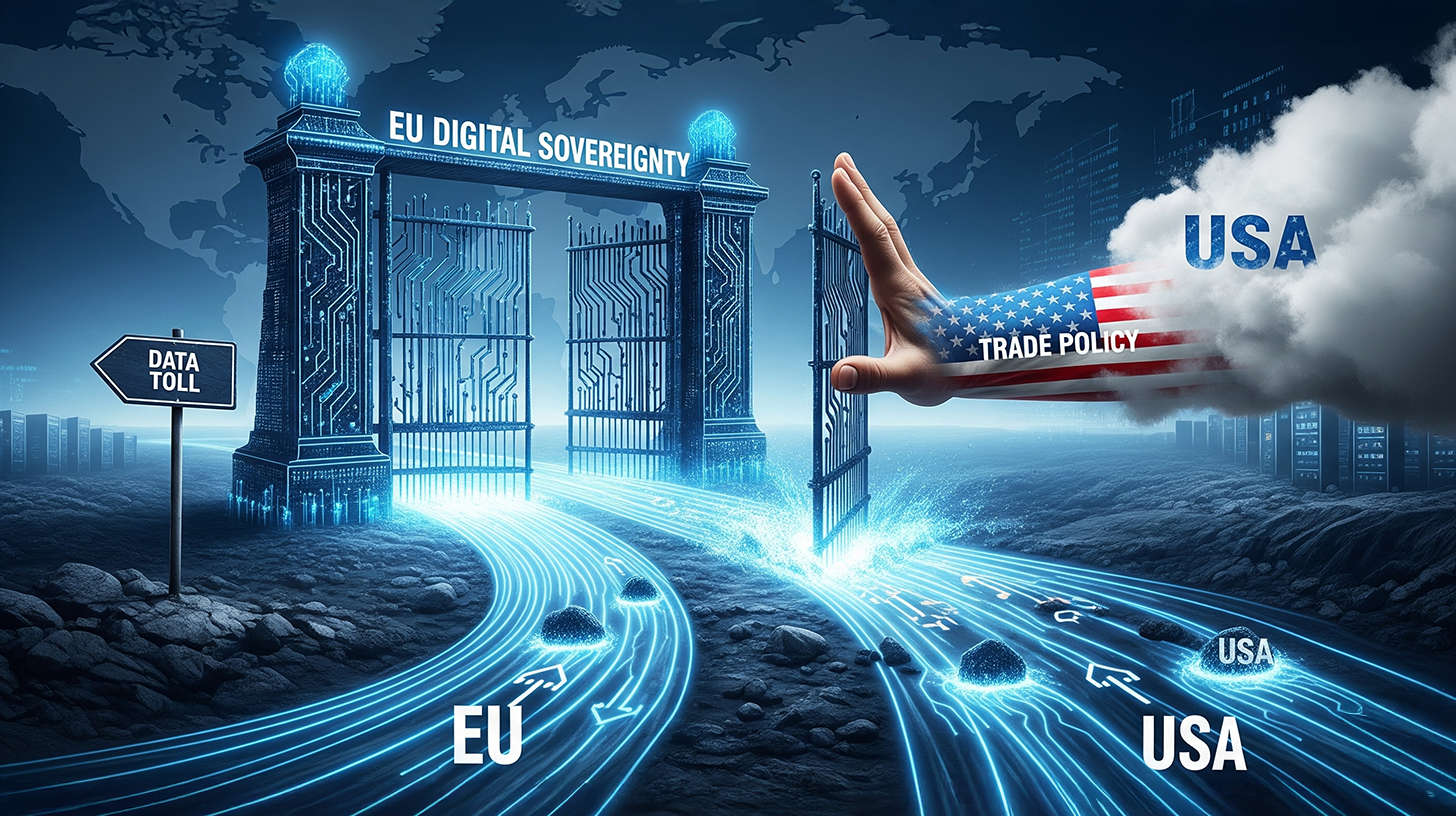
Data toll, EU trade policy and digital sovereignty in the tension field of the USA – Image: Xpert.Digital
Trump's threat works: Why the EU is now capitulating to US tech giants
### Netflix, Google & Co. don't have to pay after all: What the end of the data toll means for you ### More than just a fee: How Europe is selling its digital future to the USA ### EU vs. USA: The secret deal that could change Europe's internet forever ### Suddenly off the table: The surprising end of the EU data toll and who is really behind it ###
Data toll is just the beginning: Is the EU now also overturning its most important digital laws?
In a momentous decision that redefines the digital balance of power between Europe and the US, the European Union has abandoned a long-held prestige project: the data toll. The idea of making tech giants like Google, Meta, and Netflix share in the costs of European network infrastructure is finally off the table following a trade agreement between the EU Commission and the Trump administration.
But this waiver is not a voluntary withdrawal, but the result of massive political and economic pressure from Washington. Faced with the threat of hefty punitive tariffs on European goods, the EU has capitulated, sparking a heated debate about its digital sovereignty. The decision raises fundamental questions: How strong is Europe truly when it comes to enforcing its own digital rules? Will already adopted milestones such as the Digital Services Act (DSA) and the Digital Markets Act (DMA) now also come under pressure? This pact is far more than just the end of a fee debate – it could shape the rules of the game for the digital economy in Europe for years to come and demonstrates how closely intertwined trade policy and digital regulation are.
Suitable for:

What does the abolition of the data toll mean for Europe?
The latest developments in the transatlantic trade relationship raise fundamental questions about Europe's digital future. Why has the European Union decided to abandon the data toll that has been discussed for years, and what impact does this decision have on European digital policy?
The answer lies in a complex web of economic pressure, political compromises, and strategic considerations. As part of the trade agreement between EU Commission President Ursula von der Leyen and US President Donald Trump on July 27, 2025, the EU committed not to introduce or maintain network usage charges. This decision marks the final end of a years-long project to make major technology companies like Google, Amazon, Meta, Netflix, and Microsoft share in the costs of European internet infrastructure.
Suitable for:

Background to the data toll discussion
What was the original idea behind the data toll? The discussion about network usage charges arose from the demand of European telecommunications companies for a new source of revenue. Network operators such as Deutsche Telekom, Orange, Telefonica, and others argued that large content providers should be charged for the excessive strain on the digital infrastructure caused by their data-intensive services.
The telecommunications industry justified its demands with various arguments: sometimes it was the low return on investment, sometimes a lack of investment funds, or the maintenance of the digital infrastructure, which would be burdened by large amounts of data. They found an influential advocate in EU Internal Market Commissioner Thierry Breton, a former head of France Telecom.
Why did the data toll ultimately fail?
Opposition to the planned data toll came from various quarters. As early as June 2023, a majority of EU member states rejected the introduction of so-called network charges. At a meeting with Commissioner Breton in Luxembourg, ministers from 18 of the 27 EU countries criticized the proposed levy or called for comprehensive studies.
The main criticisms included several compelling arguments: there was no impact assessment of a network levy, there was no demonstrable investment gap in network expansion, and there was a risk that content providers would pass the additional costs on to consumers in the form of higher prices. Furthermore, the ministers warned of a violation of EU net neutrality rules, barriers to innovation, and lower product quality.
Germany, Austria, Belgium, the Czech Republic, Denmark, Finland, Ireland, Lithuania, Malta, and the Netherlands clearly positioned themselves as critics of the plans. Federal Network Agency Minister Volker Wissing firmly rejected the planned data toll. Consumer advocates also warned of the consequences: The German Consumer Organization (Verbraucherzentrale Bundesverband) feared that a data toll would lead to distortions of competition and ultimately be paid for by consumers.
Suitable for:

What role did political pressure from the USA play?
The decisive factor in the ultimate failure of the data toll, however, was the massive political and economic pressure from the US under the Trump administration. The US government viewed the European digital initiatives as a direct attack on American technology companies. US Secretary of Commerce Howard Lutnick openly spoke of an EU "attack" on American technology companies and threatened further retaliation.
The threat was unmistakable: Either the EU leaves US tech companies alone, or the US imposes punitive tariffs on Europe. This strategy proved successful when Trump threatened a general tariff of 15 percent on EU goods and even higher levies on specific sectors.
How does this decision affect European digital policy?
The decision to forgo the data toll has far-reaching consequences for European digital policy. It signals a fundamental weakening of Europe's position vis-à-vis American tech companies and raises questions about the continent's digital sovereignty.
It is particularly noteworthy that, shortly before the agreement with Trump, the EU Commission had made a new attempt to introduce a fair share rule through the back door via the planned Digital Networks Act. This strategy has now been thwarted by the trade agreement.
Will the EU digital laws DSA and DMA remain untouched?
A key question in the negotiations was whether the EU would use its already adopted digital laws – the Digital Services Act and the Digital Markets Act – as bargaining chips. Officially, these laws remain untouched under the framework agreement. The agreement does not provide for any concessions regarding EU digital legislation.
However, reports of informal talks and possible compromises are increasing. Media reports indicate that the US wants to keep the possibility of future concessions on the DSA open. The Trump administration postponed the promised tariff reductions for car exports from the EU until a joint declaration is signed.
Even more explosive are reports of a planned joint committee that could give US tech companies a say in the application of the Digital Markets Act. Such a body, comprised of US experts and representatives of the tech industry, could offer the opportunity to relax existing rules or make their enforcement more industry-friendly.
EU/DE Data Security | Integration of an independent and cross-data source AI platform for all business needs

Independent AI platforms as a strategic alternative for European companies – Image: Xpert.Digital
Ki-Gamechanger: The most flexible AI platform – tailor-made solutions that reduce costs, improve their decisions and increase efficiency
Independent AI platform: Integrates all relevant company data sources
- Fast AI integration: tailor-made AI solutions for companies in hours or days instead of months
- Flexible infrastructure: cloud-based or hosting in your own data center (Germany, Europe, free choice of location)
- Highest data security: Use in law firms is the safe evidence
- Use across a wide variety of company data sources
- Choice of your own or various AI models (DE, EU, USA, CN)
More about it here:
Digital policy in a stranglehold – Digital sovereignty at a crossroads: Europe’s risky strategy
What does this mean for the enforcement of existing EU laws?
The practical enforcement of EU digital laws is already under intense scrutiny. The EU Commission has initiated numerous proceedings since the Digital Services Act came into force: one against X, three against TikTok, one against AliExpress, two against Meta's platforms Facebook and Instagram, and one against Temu.
Violations of the DSA carry penalties of up to six percent of global annual turnover. The DMA even provides for fines of up to ten percent of global annual turnover. These high penalties were originally intended to force even large corporations to comply.
The question, however, is whether the EU Commission remains willing to consistently enforce these penalties in the face of political pressure from Washington. While EU Commissioner Henna Virkkunen emphasized the Commission's determination in the EU Parliament, negotiations behind the scenes appear to be more complex.
Suitable for:

What impact does this have on German digital policy?
This development presents particular challenges for Germany. The German government under Chancellor Friedrich Merz is urging the EU Commission to quickly reach agreements with Trump to protect important German exporters, such as the pharmaceutical and automotive industries, from high US tariffs.
At the same time, Germany faces the question of the planned "platform solidarity tax" proposed by CDU Minister of State for Culture Werner Weimer. This envisages a special levy on advertising revenue from platforms that use media content. Whether this project can still be politically implemented in light of US pressure remains to be seen.
How is the German economy reacting to these developments?
The German economy is directly affected by the effects of transatlantic tensions in the digital sector. On the one hand, German exporters benefit from avoiding higher US tariffs, while on the other, Europe loses important instruments for regulating dominant tech platforms.
In this context, the debate about digital sovereignty is gaining new momentum. Germany and Europe face the challenge of finding a balance between economic interests and strategic autonomy in the digital sphere.
What are the long-term consequences for the European digital economy?
Abandoning the data toll could have far-reaching consequences for the European digital economy. Critics fear that excessive leniency to US demands could stifle the significantly smaller European digital industry. MEP Alexandra Geese warned: "If Ursula von der Leyen actually relaxes the competition rules in the DMA for American tech giants, she will be declaring war on the European digital industry."
European telecommunications companies, which had fought for years for cost-sharing from the tech giants, must now develop alternative financing models for network expansion. This could ultimately lead to higher costs for consumers, which, ironically, was one of the main arguments against the data toll.
What alternatives does the EU have?
Despite the abandonment of the data toll, the EU still has various options for regulating the digital economy. The debate about a digital tax could gain momentum again. There are growing cross-party calls to revisit this issue to ensure fair taxation of tech companies.
Another tool would be the repeal of the so-called adequacy decision, which forms the legal basis for transatlantic data transfers. Should the Trump administration continue to incapacitate a crucial supervisory body, the Commission would have little choice but to return to shaky standard contractual clauses.
Suitable for:

How is the relationship between digital regulation and trade policy developing?
Current events illustrate how closely digital regulation and trade policy are intertwined. The US under Trump has successfully demonstrated its willingness to use trade instruments to achieve its digital policy goals.
This presents the EU with a fundamental dilemma: Should it sacrifice its digital ambitions for trade peace, or is it willing to accept economic costs to pursue its regulatory goals? The decision against the data toll suggests that the EU is currently choosing the former.
What does this mean for the future of transatlantic relations?
The agreement on the data toll is just one piece in a larger puzzle of transatlantic relations under Trump. The fundamental tensions between the US's "America First" policy and the EU's values-based regulatory approach remain.
Experts warn of a digital policy alienation between the two partners, which entails significant economic and security risks. The EU must ask itself how it can strengthen its digital sovereignty without jeopardizing its important partnership with the US.
What lessons can be learned from this process?
The abandonment of the data toll highlights the limits of European power in the digital sphere. Despite the size of the EU single market and Brussels' regulatory ambitions, Europe remains vulnerable to US economic pressure.
At the same time, the process highlights the need for a more coherent European strategy for dealing with digital platforms. Internal disagreement among member states over the data toll significantly weakened the EU's negotiating position.
The European Union faces the challenge of finding a new path between digital sovereignty and transatlantic partnership. While waiving the data toll may have avoided trade tensions in the short term, it raises fundamental questions about Europe's long-term digital strategy. In an increasingly digitalized world, the ability to independently regulate the digital economy is becoming a crucial factor for political and economic sovereignty.
We are there for you – advice – planning – implementation – project management
☑️ SME support in strategy, consulting, planning and implementation
☑️ Creation or realignment of the AI strategy
☑️ Pioneer Business Development

Konrad Wolfenstein
I would be happy to serve as your personal advisor.
You can contact me by filling out the contact form below or simply call me on +49 7348 4088 965 (Munich) .
I'm looking forward to our joint project.
Write to me

Xpert.digital – Konrad Wolfenstein
Xpert.Digital is a hub for industry with a focus on digitalization, mechanical engineering, logistics/intralogistics and photovoltaics.
With our 360° business development solution, we support well-known companies from new business to after sales.
Market intelligence, smarketing, marketing automation, content development, PR, mail campaigns, personalized social media and lead nurturing are part of our digital tools.
You can find more at: www.xpert.digital – www.xpert.solar – www.xpert.plus
Keep in touch









