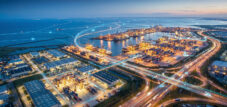
The logistical miracle in the Gulf: How Saudi Arabia and the UAE circumvent the Hormuz blockade – trucks and ports in turbo mode – Image: Xpert.Digital
Counterpoint to China: How Saudi Arabia is using the gigantic Hormuz crisis for its rise to resource power
Why a small desert port suddenly saves the global economy
From 100 to 7,000 trucks a day: The incredible story of how a desert state is reorganizing global supply chains
In the spring of 2026, the absolute worst-case scenario for the global economy becomes a bitter reality: Iran blocks the Strait of Hormuz. While global oil and gas trade collapses, energy prices skyrocket, and global markets are paralyzed by shock, an even greater danger is brewing in the shadow of this crisis – the disruption of the global phosphate supply and thus an existential threat to global food security. Yet, amidst the geopolitical chaos, Saudi Arabia pulls off a logistical miracle that even seasoned analysts considered impossible. With a hastily mobilized fleet of 3,500 trucks, port infrastructure built overnight on the Red Sea, and gigantic investment plans, the kingdom transforms the crisis into a unique opportunity. The blockade of the world's most vital maritime chokepoint not only reveals the deadly vulnerability of global supply chains but also accelerates Saudi Arabia's rapid rise to a new, strategically indispensable resource power as a Western counterweight to China.
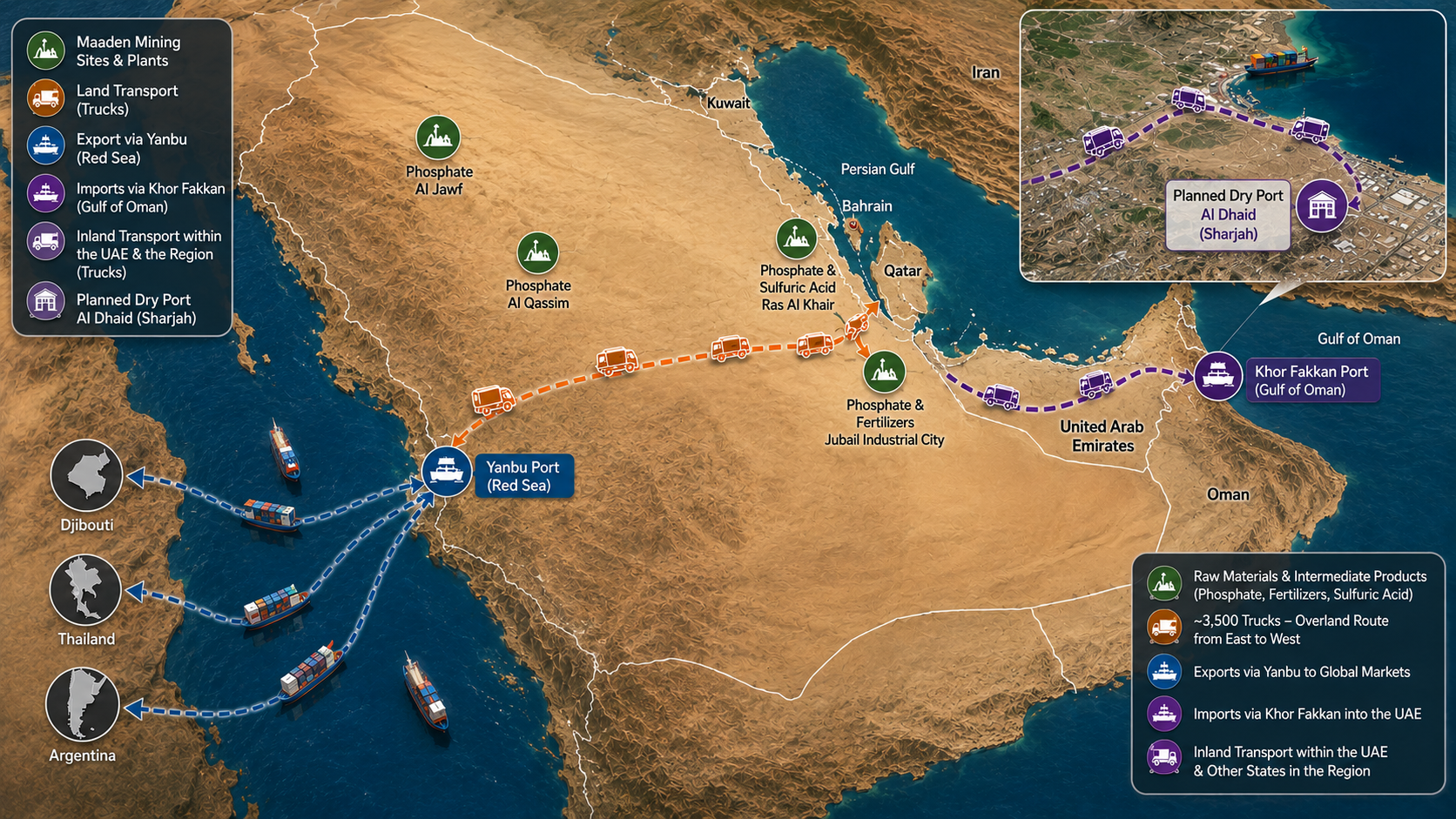
The state-controlled Saudi mining company Maaden transports the fertilizers, phosphate, and sulfuric acid from its mining and production sites, which are typically located inland and on the Persian Gulf (the east coast of Saudi Arabia).
Under normal circumstances – before the outbreak of the Iran crisis – these raw materials and semi-finished products were shipped via the ports on the Persian Gulf and exported directly through the now-blocked Strait of Hormuz. Since this sea route is virtually impassable, Maaden is now resorting to the extremely difficult overland route, transporting the cargo with its fleet of 3,500 trucks across the Arabian Desert to the port of Yanbu on the Saudi Arabian west coast on the Red Sea.
From the port of Yanbu, the phosphate and fertilizers are exported by ship to countries such as Djibouti, Thailand and Argentina.
The port of Khor Fakkan, an exclave belonging to the Emirate of Sharjah, is one of the seven emirates of the United Arab Emirates (UAE). During the crisis, it serves as a gateway for imports (containers and foodstuffs) into the UAE. From there, the goods are transported by approximately 7,000 trucks daily to the interior of the UAE and to other countries on the Arabian Peninsula that are cut off from direct maritime trade by the blockade of Hormuz. A concrete target for expanding inland logistics is the planned dry port in Al Dhaid, 50 kilometers inland from Sharjah.
Crisis in the Strait of Hormuz: Desert convoys, resource power and the reorganization of global supply chains
When the eye of the global economy closes – and a desert state responds with 3,500 trucks
At the end of February 2026, a threat that had been discussed theoretically for decades became a bitter reality: Iran effectively closed the Strait of Hormuz to international shipping. Since then, a major bottleneck of the global economy, through which some 20 million barrels of crude oil flowed daily—almost a quarter of the entire global oil trade—has virtually ground to a halt. According to the United Nations, the number of ships passing through the strait has decreased by more than 95 percent since the start of the war. Shipping companies such as Hapag-Lloyd and Maersk have suspended their voyages through the region and are instead diverting their fleets around the Cape of Good Hope at the southern tip of Africa.
The Strait of Hormuz, with a width of only 50 kilometers and usable shipping lanes of three kilometers in each direction, is the only sea connection between the Persian Gulf and the open ocean. A significant portion of global oil trade flows through it, as does approximately one-fifth of the world's trade in liquefied natural gas (LNG), primarily from Qatar. The importance of this strait for Asian economies is even more pronounced than for Europe: around 80 percent of the oil and gas transported through Hormuz is destined for Asian markets, primarily China with 5.4 million barrels per day and India with 2.1 million barrels daily. What is primarily a price shock for Europe represents a genuine supply crisis for large parts of Asia.
The energy markets reacted immediately and drastically. The European natural gas price (TTF) temporarily skyrocketed to €74 per megawatt-hour – compared to around €31 before the war. Crude oil prices nearly doubled, which, according to IEA chief Fatih Birol, significantly impacted global economic growth. The Ifo Institute specified the impact on the European Union: While direct trade via Hormuz accounts for approximately 2 percent of total EU imports, crude oil and liquefied natural gas (LNG) account for 6.2 and 8.7 percent, respectively – with indirect effects from rising energy prices and supply chain disruptions far outweighing the direct impact. The IEA itself described the situation as the greatest energy crisis in history and warned that Hormuz had permanently lost its reputation as a reliable trade route.
Improvisation as a matter of national interest: How 3,500 trucks avert an export crisis
Amid this global upheaval, the state-controlled Saudi mining company Maaden accomplished what analysts initially considered impossible. Within just two weeks, the company mobilized rail and truck operators to reroute its fertilizer exports overland from the Persian Gulf to the Red Sea. The scale of this improvisation is remarkable: starting with 600 vehicles, the fleet quickly escalated to 1,600, then 2,000, and finally 3,500 trucks—each with two drivers and mostly operating around the clock. Maaden CEO Bob Wilt told the Wall Street Journal that he initially hadn't believed this pace could be maintained.
The logistical challenge extended far beyond mere land transport. At the Red Sea ports, which had not previously been developed for phosphate trading, temporary fertilizer warehouses had to be erected in record time. Special piping systems were installed to transfer sulfuric acid—a corrosive and highly hazardous component of phosphate production—into specialized stainless steel tank trucks. Each of these adaptations required not only capital and logistics, but also regulatory approvals, safety protocols, and staff training, all within a very short timeframe. The entire operation resembled an improvised military campaign more than a regular business operation.
Nevertheless, the approach worked. According to data from the analysis firm Kpler, several phosphate shipments from the Saudi port of Yanbu on the Red Sea reached destinations including Djibouti, Thailand, and Argentina in the weeks since the start of the war. Maaden CEO Wilt announced that the export backlog would be cleared by the end of May. CRU analyst Peter Harrison described this crisis response as nothing less than "Saudi Arabia's logistical miracle." This assessment from an otherwise level-headed industry analyst underscores the extraordinary nature of the achievement.
Khor Fakkan: From transshipment port to national gateway to the world
Perhaps an even more dramatic transformation took place in the small port of Khor Fakkan on the Gulf of Oman. Located east of the Strait of Hormuz, on the open-sea side of the Arabian Peninsula, the port is the first directly accessible seaport for goods that don't have to pass through the blocked bottleneck. Where previously around 100 trucks traveled daily, there are now around 7,000 – a seventyfold increase within just a few weeks. Weekly container traffic exploded from 2,000 to 50,000 units, representing a twenty-five-fold increase in volume.
Operator Gulftainer reacted with a speed that redefines industrial adaptability. Within just two weeks, the company hired 900 new employees and set up a new truck sorting yard to handle the influx of freight and prepare it for onward transport. Gulftainer CEO Farid Belbouab described the situation with a striking image: "It's like having to assemble an orchestra overnight to play a Mozart symphony." Historically, Khor Fakkan was primarily developed as a transshipment platform where containers were transferred from one ship to another; today, it has become the central national gateway for imports ranging from food to medical supplies.
The strategic significance of this transformation extends beyond the borders of the United Arab Emirates (UAE). For Qatar, Kuwait, and Bahrain, whose maritime connections all lie beyond Hormuz, Khor Fakkan is now their primary sea link to the outside world. This makes the port a geopolitical hub for the entire Gulf region. Gulftainer CEO Belbouab is already planning a permanent expansion: a new inland logistics hub is to be built in Al Dhaid, 50 kilometers away – a dry port of more than 100 hectares, connected by road and rail, with an initial investment of over $100 million, as a joint venture with the government of Sharjah. The crisis is thus becoming the blueprint for a long-term infrastructure offensive.
Phosphate: The forgotten bottleneck of global food security
While the world's attention is focused on oil prices and energy supplies, a potentially even more threatening development is emerging in the shadow of the Hormuz crisis: the threat to the global phosphate supply and thus the food security of billions of people. Around 50 million tons of phosphate fertilizer are sold worldwide annually, and feeding the growing global population is virtually impossible without phosphorus. Maaden is, under normal circumstances, one of the world's largest exporters of phosphate fertilizer, and these exports typically transit the Strait of Hormuz.
The structural vulnerability of the global phosphate market is alarming. Around 70 percent of the world's phosphate reserves are concentrated in Morocco and Western Sahara. China, the world's largest phosphate exporter with a share of around 30 percent of global trade, has previously imposed export quotas to secure domestic demand. Now, the Hormuz blockade is hitting Saudi Arabia, the world's third-largest phosphate exporter, particularly hard – coinciding with a Chinese export ban and limited capacity in Morocco. The confluence of these factors has created a dangerous bottleneck, initially leading analysts at the commodities consultancy CRU to doubt the sustainability of Saudi exports.
The phosphate market is not only under short-term pressure. With an estimated volume of $17.25 billion in 2025 and a projected annual growth rate of 5.45 percent until 2033, phosphate is a structurally growing market – driven by increasing food demand, intensified agriculture, and the expansion of biofuel production. The Hormuz crisis is accelerating an existing trend toward restructuring phosphate supply chains. Countries that have relied on cheap and reliable imports are now forced to diversify their sources – a process that is paradoxically facilitated by the Saudi response to the crisis, as Maaden is demonstrating its ability to supply via alternative routes.
Maaden as a strategic instrument: Vision 2030 meets geopolitical reality
For Maaden, managing the Hormuz crisis is far more than crisis management – it's a practical stress test for a much more ambitious strategic agenda. In January 2026, shortly before the outbreak of the Iran-Iraq War, Maaden CEO Wilt announced to Semafor a $110 billion investment plan over the coming decade, intended to transform the company into one of the world's largest resource companies. Specifically, phosphate and gold production are to be tripled, and the aluminum business doubled – with eight megaprojects currently underway, two of which are already operational. Saudi Arabia claims to have identified metal and mineral reserves totaling $2.5 trillion and aims to make mining the third pillar of its economy, alongside oil and tourism.
This mining strategy is embedded in the overarching Saudi Vision 2030 program, which aims to systematically reduce dependence on oil. The share of non-oil exports is projected to rise to 50 percent of GDP by 2030 – more than triple the baseline figure. In this context, the crisis serves as an unintentional but compelling demonstration of the effectiveness of this diversification strategy. Maaden is demonstrating that Saudi Arabia is not only capable of extracting raw materials but also of establishing and maintaining complex logistics operations under extreme conditions. This capacity will not disappear after the crisis ends – it will remain as organizational knowledge and physical infrastructure, permanently strengthening Saudi export capabilities.
The crisis also reveals a structural weakness in Saudi Arabia's existing export logistics: its one-sided dependence on the east coast and the Strait of Hormuz. Maaden CEO Wilt announced that the company is examining how its operations can be adapted to gain easier access to the now more important export ports on the Red Sea. The ports of Yanbu and Jeddah on the Red Sea are thus gaining structural importance – a trend that has been prepared for years by government investment programs for Saudi Arabia's west coast and is now receiving a significant boost.
Your container high-bay warehouse and container terminal experts


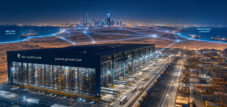
Container high-bay warehouses and container terminals: The logistical interplay – expert advice and solutions - Creative image: Xpert.Digital
This innovative technology promises to fundamentally change container logistics. Instead of stacking containers horizontally as before, they will be stored vertically in multi-story steel racking structures. This not only allows for a drastic increase in storage capacity within the same area, but also revolutionizes all processes at the container terminal.
More information here:
Crisis, logistics, power shift: What the Hormuz closure teaches us about global supply chains – Saudi raw materials as a key to Western diversification
Rare earths: Saudi Arabia as the western counterpart to China
Parallel to managing the phosphate crisis, Maaden is undertaking a strategic move of far greater geopolitical significance: its entry into the rare earth value chain. In November 2025, Maaden, the US company MP Materials, and the US Department of Defense announced the formation of a joint venture to build a rare earth refinery in Saudi Arabia. The ownership structure is politically significant: Maaden holds at least 51 percent, while MP Materials and the Pentagon together hold up to 49 percent, with the US Department of Defense providing the full financing for the American share.
The planned facility is intended to produce both light and heavy rare earth oxides – a capability currently almost exclusively reserved for China. China dominates rare earth processing globally, with a market share exceeding 90 percent in some process chains, and has strategically used this position as geopolitical leverage in the past. The involvement of the US Department of Defense unequivocally signals the strategic nature of the project: it is not about maximizing commercial returns, but about securing critical materials for the defense, electronics, and energy industries. The new refinery is intended not only to supply US and Saudi industries, but also to sell surpluses to allied nations.
For Saudi Arabia, this engagement opens up a new dimension of geopolitical influence. Until now, the kingdom has primarily been defined as an oil exporter and regional security actor. By entering critical mineral supply chains – phosphate for food security, aluminum for the construction industry, gold as a store of value, and now rare earth elements for high technology and defense – Riyadh is positioning itself as an indispensable partner in the West's efforts to diversify supply chains away from China. However, the German Institute for International and Security Affairs (SWP Berlin) warns that Saudi Arabia cannot be a reliable pillar for Europe's diversification strategy as long as many projects remain in the conceptual phase and the kingdom itself is dependent on international partners.
The economics of avoidance: Inefficiency as a calculated price
From a business perspective, desert transport is clearly an inefficient solution. Maaden CEO Wilt admitted that many trucks return empty from the ports – a classic problem of diversionary logistics that significantly drives up transport costs per ton of freight. The truck convoys can neither replace the capacity of container shipping nor alleviate the shortages of kerosene and other energy products. The sheer scale of capacity alone illustrates the limitations of this approach: The world's largest container ships transport up to 24,000 standard containers per voyage – a capacity that even 3,500 trucks can only replicate to a fraction of their capacity.
Nevertheless, the business logic of the operation is clearly positive for Maaden. The sharply increased phosphate prices – a direct result of the global shortage – more than compensate for the additional transport costs. What would be unprofitable under normal market conditions becomes profitable due to the crisis surcharge on export prices. This mechanism explains why private shipping companies like MSC and Maersk are also switching to truck transport, even though this is structurally more expensive than sea transport. In a crisis situation, where the ability to deliver itself becomes a scarce commodity, pricing power shifts fundamentally in favor of those who can still deliver.
The longer-term economic costs of this logistical shift are considerable and very unevenly distributed globally. For importing countries, higher fertilizer prices directly translate into rising food prices – with particularly severe consequences for low-income countries and net food importers in sub-Saharan Africa, Southeast Asia, and Latin America. The IEA estimates that the doubled oil prices are measurably impacting global economic growth. A study by Delft University showed that if the Hormuz blockage lasts more than four weeks, supply chain delays escalate globally – a period that, at the time of writing, has already been significantly exceeded.
Structural vulnerability of global supply chains: Lessons from the crisis
The Hormuz crisis is the latest in a series of shocks that reveal a fundamental weakness of the globalized economy: the extreme concentration of trade volumes on a few maritime chokepoints. Within five years, global supply chains have had to cope with the Covid-19 pandemic, the Ever Given blockade of the Suez Canal, the Houthi attacks in the Red Sea, and now the Hormuz closure. Each of these crises followed a common pattern: initial disbelief, then frantic improvisation, then gradual adaptation – and ultimately a new normal that does not fully restore the old one.
The resilience demonstrated by Saudi Arabian actors in this crisis is no accident. It is the result of state control, substantial capital allocation, and a geopolitical situation in which Saudi Arabia, as an export nation, has maximum incentive to demonstrate its ability to deliver. For other countries lacking this specific combination of state capacity, financial resources, and geopolitical interest, the picture is considerably less rosy: Qatar, Kuwait, and Bahrain are effectively trapped and dependent on the logistical goodwill of Saudi Arabia and the UAE. Their structural dilemma cannot be resolved through mere improvisation.
The crisis is accelerating existing trends. Oil and gas importers who relied on the Strait of Hormuz are now actively seeking alternative sources. The IEA is in talks with Canada and Brazil about alternatives, and Europe is increasingly sourcing its aviation fuel from Nigeria. These diversification measures will not be completely reversed after the crisis ends—trust in Hormuz as a reliable route has been permanently damaged. Paradoxically, this presents an opportunity for Saudi Arabia: A kingdom that can deliver its phosphate via the Red Sea and process rare earth elements for Western partners is more valuable than one that relies solely on oil exports through a blockable strait.
Geopolitical geometry: Who wins, who loses
The Hormuz crisis is shifting geopolitical balances in ways that extend beyond its immediate impact. On the losing side are, first and foremost, the oil-importing countries of Asia—China, India, South Korea, and Japan—which together consume more than 80 percent of the energy transported through Hormuz. For China in particular, which obtains over 90 percent of its Iranian oil via this route, the blockage poses a strategic problem. This dependence on a single sea route for such critical imports reveals a vulnerability that China has been aware of for years and has attempted to mitigate through the so-called "String of Pearls"—a network of port and infrastructure projects along the sea routes.
Paradoxically, the winners at first are countries with alternative export routes that can now command higher prices. Saudi Arabia is in a unique position: thanks to its East-West pipeline system, the country was able to maintain its oil exports of around 7 million barrels per day via Yanbu on the Red Sea. However, Iran attacked both the pipeline and the port at the beginning of the year – a warning sign that no alternative is completely secure. The UAE benefited in the short term from its port of Fujairah, whose crude oil exports had risen to 1.62 million barrels per day before Iranian drone attacks also caused damage there.
In the medium and long term, the economy that emerges structurally stronger from the crisis will be the winner. Saudi Arabia's combined strategy—a short-term solution through truck convoys, medium-term infrastructure investments in the Red Sea, and long-term positioning as a producer of critical minerals—is the most coherent and best-funded response to the crisis that any single country has yet delivered. Whether this strategy actually succeeds depends on factors that extend far beyond logistical competence: the outcome of the Iran-Iraq War, the longevity of the US-Saudi partnership, and whether the international community is prepared to accept Saudi Arabia as the anchor point of a new, Western-oriented raw materials supply chain.
Lessons in global economic policy
The Hormuz crisis provides global economic policy with a number of insights that extend beyond its immediate impact. The first and most important is the confirmation that concentration in supply chains poses a systemic threat—not only in semiconductors or pharmaceuticals, which came into focus after the Covid pandemic, but also in energy, fertilizers, and critical minerals. The political response to this insight has been characterized by announcements in recent years; the Hormuz crisis now compels actual action.
The second lesson concerns the capacity of governments to act in crises. The impressive logistical feats of Maaden and Gulftainer were only possible because government resources, mandates, and coordination could be mobilized immediately. This mechanism works in political systems that can implement rapid decisions without bureaucratic obstacles—it works less well in fragmented markets lacking a central coordinating body. For European and other pluralistic democracies, this means the need to proactively build resilience and redundancy in supply chains—there is usually no time for this during a crisis itself.
The third point is the realization of the value of infrastructure flexibility. Ports like Khor Fakkan and Fujairah were only able to absorb many times their normal volume because capacity had been built up and operators with logistical expertise had been established in the preceding years. Infrastructure that appears redundant under normal circumstances proves to be the crucial buffer asset in a crisis. This insight should be incorporated into the planning of critical infrastructure worldwide – from ports and pipelines to rail networks. Resilience comes at a price, but as the Hormuz crisis demonstrates, it is far lower than the cost of failure.
Consulting - Planning - Implementation

Konrad Wolfenstein
I would be happy to serve as your personal advisor.
You can contact me at wolfenstein∂xpert.digital or
Just call me on +49 7348 4088 965 .
Our global industry and economic expertise in business development, sales and marketing

Our global industry and economic expertise in business development, sales and marketing - Image: Xpert.Digital
Industry focus areas: B2B, digitalization (from AI to XR), mechanical engineering, logistics, renewable energies and industry
More information here:
A thematic hub offering insights and expertise:
- Knowledge platform covering global and regional economies, innovation and industry-specific trends
- A collection of analyses, insights, and background information from our key areas of focus
- A place for expertise and information on current developments in business and technology
- A hub for companies seeking information on markets, digitalization, and industry innovations
Your container high-bay warehouse and container terminal experts
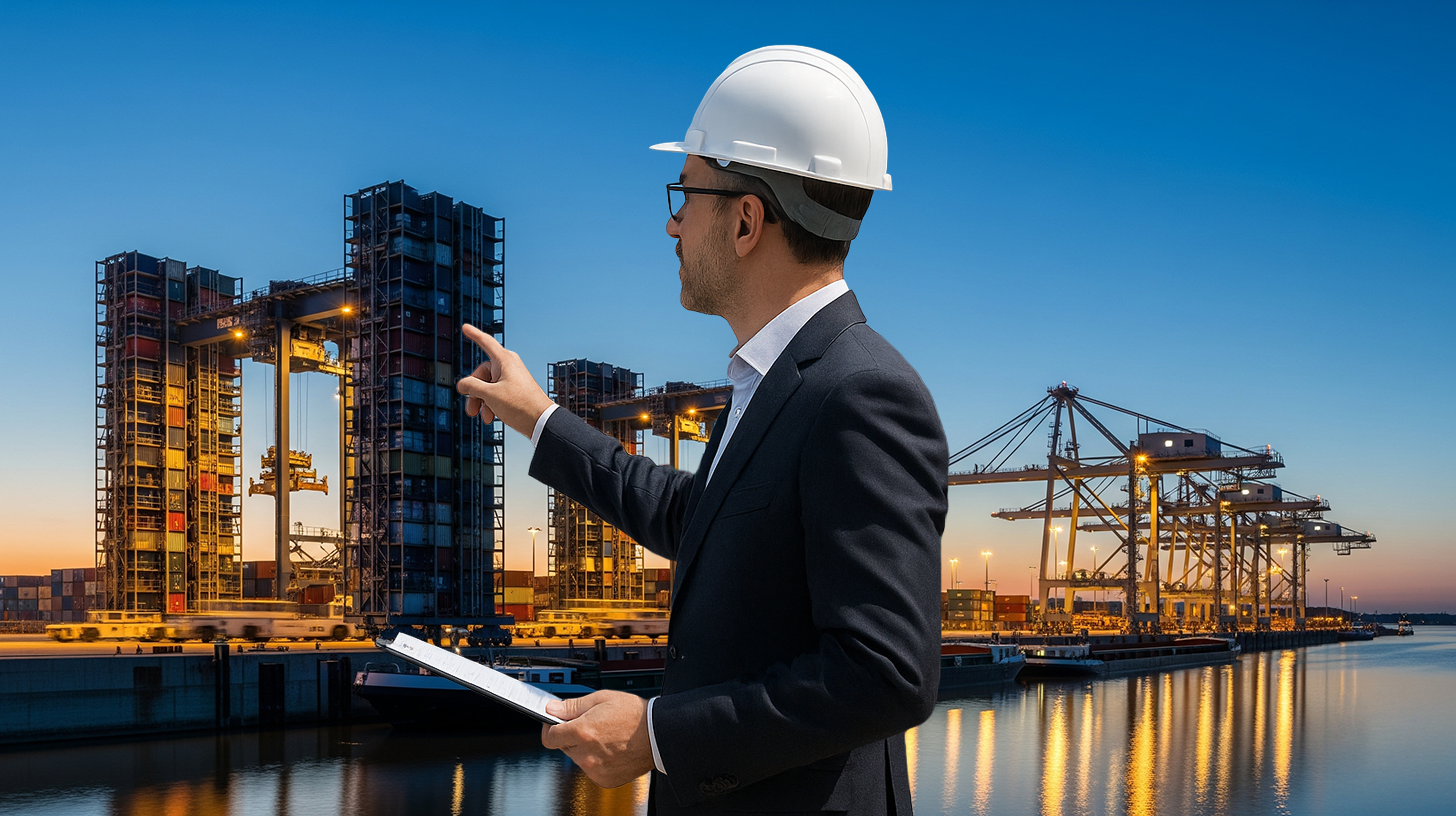
Container terminal systems for road, rail and sea transport in the dual-use logistics concept of heavy-lift logistics - Creative image: Xpert.Digital
In a world marked by geopolitical upheavals, fragile supply chains, and a new awareness of the vulnerability of critical infrastructure, the concept of national security is undergoing a fundamental reassessment. A state's ability to guarantee its economic prosperity, the provision of essential goods and services to its population, and its military capability increasingly depends on the resilience of its logistical networks. In this context, the concept of "dual-use" is evolving from a niche category of export control to a broader strategic doctrine. This shift is not merely a technical adjustment but a necessary response to the "paradigm shift" that demands a profound integration of civilian and military capabilities.
Related to this: