
700 million parcels under one brand: GLS and DPD join forces – What the parcel merger means for Hermes and the German market
Xpert Pre-Release

Available in 27 languages 📢
Prefer Xpert.Digital on GoogleⓘPublished on: November 19, 2026 / Updated on: November 19, 2026 – Author: Konrad Wolfenstein
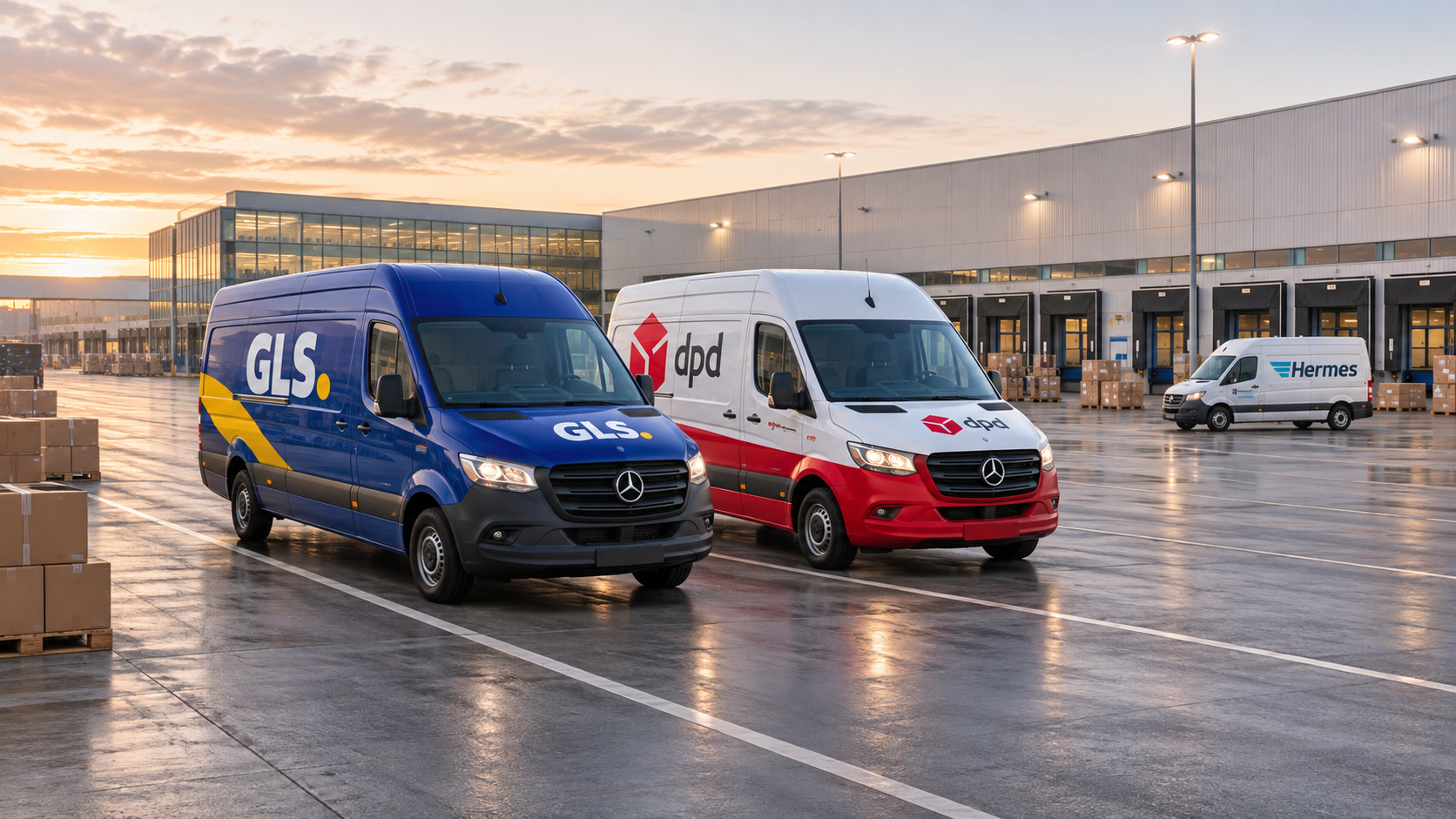
700 million parcels under one brand: GLS and DPD join forces – What the parcel merger means for Hermes and the German market – Creative image on the topic, with AI: Xpert.Digital
GLS and DPD want to merge: Why the merger could change the parcel market
More size, more pressure: What the planned GLS-DPD merger means for Hermes
Parcel market on the verge of upheaval: Can the merger of GLS and DPD strengthen competition?
The German parcel market is facing a potential restructuring: GLS and DPD plan to merge their parcel operations in Germany. Under the GLS brand, a company could emerge that delivers around 700 million parcels annually and generates more than four billion euros in revenue. This would create a significantly larger competitor in a market where DHL and Amazon Logistics are major players. However, the merger is not yet finalized: it is subject to necessary regulatory approvals and the planned co-determination processes. Until then, both companies will remain independent.
The planned network is about more than just additional shipment volume. The crucial question is whether it will allow for better utilization of the delivery networks, cost reduction, and more effective pooling of investments in digitalization, automation, and parcel lockers. A larger network can offer advantages, but it doesn't guarantee higher profitability or improved delivery quality. The integration of IT systems, locations, and processes, in particular, could prove complex.
Hermes is also likely to be watching developments closely. A joint competitor of GLS and DPD could offer large customers a broader range of services and strengthen its negotiating position. However, this doesn't automatically mean that Hermes will be the loser: The company has considerable infrastructure and has recently increased its revenue, but continues to post losses. Ultimately, the impact of the merger will depend on whether the new alliance can translate its size into dense, reliable, and economically viable delivery routes – and whether competition will actually improve for retailers and consumers.
Bigger than Hermes – but far from better: Why the parcel merger will only be decided on the street
The German parcel market is facing a restructuring whose significance extends far beyond new vehicle markings and redesigned company logos. GLS and DPD plan to merge their German parcel operations. The resulting company, operating under the GLS brand, would deliver approximately 700 million parcels annually and generate more than four billion euros in revenue. This would create a significantly larger competitor in a market increasingly dominated by DHL and Amazon Logistics. However, the merger remains a planned undertaking: the necessary permits and the planned co-determination processes are still pending. Until the merger is completed, both companies will remain independent.
The economic significance lies not simply in the addition of two parcel volumes. Behind the merger lies the question of what company size is required to sustainably and economically combine delivery, digitalization, automation, and nationwide accessibility. Parcel logistics is a business with high demands on capacity utilization and reliability. Even small changes in the cost per shipment can have a significant impact on the bottom line.
Hermes needs to monitor this development particularly closely. A larger GLS alliance could pool investments, attract large customers with a broader range of services, and better utilize its delivery networks. However, this does not necessarily mean an economic decline for Hermes. The crucial dividing line is not between large and small parcel services, but between profitably organized network density and expensively acquired volume.
The rationale is therefore: size is becoming more important in the German parcel market, but it is not a sufficient guarantee of success. Mergers can strengthen competition against leading providers while simultaneously reducing the number of independent alternatives. Which effect prevails depends on the implementation, the contract terms, and above all, the actual delivery quality.
Two German networks are to become a single challenger
A joint venture is planned, into which GLS and Geopost will contribute their parcel businesses in Germany. Geopost belongs to the French La Poste Group and operates in the German market under the DPD brand. GLS is part of International Distribution Services. According to the published key points, GLS will hold 80 percent and Geopost 20 percent of the new company. The joint market presence will be under the GLS brand.
This structure is distinct from a global merger of the two corporate groups. The German parcel delivery operations are to be consolidated. Furthermore, the international networks will remain an integral part of each company. The planned merger is intended to benefit precisely from its access to the cross-border connections of both partners.
The majority ownership structure gives GLS a stronger legal position. At the same time, Geopost will retain a financial stake and will be represented on the management boards. This does not represent a complete withdrawal of DPD's owner from the German parcel market, but rather a different form of participation. Operational responsibility, brand management, and international cooperation will be reorganized.
For customers, the timing is crucial. The announcement does not yet imply an immediate merger of pickups, depots, delivery routes, or customer contracts. Until the merger is completed, management, contact persons, contracts, and service agreements will remain unchanged. Therefore, a planned merger should not be interpreted as either a completed integration or as an immediate service improvement.
Economically, however, the announcement marks the beginning of a new phase. Major customers will assess their future dependencies, competitors will adjust their sales strategies, and employees and transport partners will inquire about the future network structure. A significant portion of the strategic impact will therefore occur even before the operational merger.
Four billion euros in revenue is a significant figure, but it's no guarantee of success
With annual revenues exceeding four billion euros and around 700 million parcels handled, the company represents a significant economic force. The planned enterprise is also projected to have approximately 150 locations and employ around 15,000 people. While these figures describe a large German parcel delivery network, they alone reveal little about its future profitability.
Revenue is not a sufficient performance indicator in the parcel delivery business. A provider can increase its shipment volume and simultaneously face profit pressure if additional parcels are accepted at low prices or incur above-average delivery costs. Similarly, a deliberately smaller, better-calculated customer portfolio can be more economically valuable than a high-volume business with insufficient contribution margins.
For the new network, the type of shipments being consolidated is therefore crucial. Business customers with regular pickups, high parcel volume, and predictable recipients have different requirements than highly fluctuating private customer shipments with numerous individual stops. Additional factors include differences in weight, dimensions, return frequency, and regional distribution.
Even the annual volume masks significant fluctuations. A parcel network must not only handle average demand, but also promotional weeks, seasonal peaks, and regional imbalances. Capacities urgently needed during the Christmas season may remain partially unused in weaker months. Therefore, the most economically successful network is not automatically the largest, but rather the one with the best balance of baseline capacity utilization, peak performance capability, and cost flexibility.
The new GLS network would therefore only translate its size into a tangible advantage if it could process additional volume without a corresponding increase in complexity. This is precisely the central integration challenge.
Why market shares without a common data basis are misleading
The German parcel industry cannot be described by a single, undisputed market figure. Different surveys use different definitions. Some consider only parcels, while others also include courier and express services. Furthermore, there are differences regarding cross-border shipments, self-delivery, and reporting periods.
The Federal Network Agency reports a preliminary shipment volume of 4.52 billion and a revenue of €20.56 billion for the entire parcel market in 2024. For 2023, figures of 4.36 billion shipments and €19.19 billion are reported. The CEP study 2025, which defines the courier, express, and parcel market differently, projects approximately 4.29 billion shipments and €27.6 billion in revenue for 2024. These figures should not be combined without methodological scrutiny.
This leads to an important limitation for evaluating the merger: The announced 700 million shipments cannot simply be divided by any available market volume to obtain a supposedly exact market share. First, the time period, geographical scope, and definition of a shipment would have to match.
The ranking of providers also requires precision. The Federal Network Agency sometimes specifies bandwidths for the major companies. DHL leads in terms of shipment volume, followed by Amazon as a significant provider with its own delivery service. DPD, GLS, Hermes, and UPS are other major network operators. Together, these six companies handle approximately 98 percent of domestic and international parcel shipments.
The merger of DPD and GLS would significantly alter this structure. A larger, unified position behind the leading companies is plausible. However, a new ranking calculated down to the decimal point would be illusory without standardized comparative data. For economic analysis, what is more important is how much independent competitive pressure remains and which services retailers can actually exchange with each other.
The real competitive advantage arises between two front doors
Parcel logistics is largely an economy of density. A delivery vehicle incurs costs for personnel, vehicle, energy, and organization. These costs are not proportional to the number of parcels transported. If additional shipments can be delivered to nearby addresses on an existing route, the cost per parcel often decreases.
That's why the distance between two delivery stops is so economically significant. A densely populated route with several packages per stop can be cheaper than a route with few, widely separated recipients. National scale only helps if it leads to better routes locally.
This presents a significant potential benefit for GLS and DPD. Where two vehicles currently serve similar streets, a single, better-utilized route could suffice in the future. Advantages can also arise on the routes between sorting centers if loading areas are used more evenly and parallel transports are reduced.
However, these effects are neither uniformly significant everywhere nor automatically available. Pickup times, promised transit times, vehicle capacities, and the technical design of the depots limit the possibilities. Two neighboring locations cannot simply be merged just because they appear redundant on a map. The crucial factor is what quantities they need to process and at what times.
Furthermore, increased size can create new complexity. Longer access routes, overloaded transshipment points, or unsuitable route layouts can partially negate expected savings. The key to sound business management, therefore, lies in leveraging density advantages without unnecessarily lengthening routes and transfers within the overall system.
Integration can end up being more expensive than a visible merger
The greatest risk of such a project often lies not in the strategic concept, but in the transition. Two parcel delivery companies bring different IT systems, shipment tags, sales processes, billing methods, and operational routines. What appears to customers as a uniform transport service is, in reality, based on a long chain of precisely coordinated events.
Every shipment must be accurately recorded at pickup, handling, onward transport, and delivery. At the same time, retailers expect reliable status updates, efficient complaint processes, and accurate invoicing. If information is lost or transmitted late during a system migration, it not only creates technical challenges but also leads to additional customer inquiries, investigations, and potentially replacement shipments.
During a transition phase, duplicate structures may remain necessary. Systems must be operated in parallel, employees trained, and customers gradually switched over. Location changes can trigger investments before savings become apparent. Therefore, a merger that makes sense in the long term can lead to a significant short-term burden on earnings.
The existing collaboration between GLS and DPD reduces at least some of the organizational distance. Since October 2024, both companies have been cooperating on building a joint network for deliveries outside the front door. The inboxx parcel station network was added in March 2026. This provides practical experience in cooperation, but does not replace the complete integration of the German parcel networks.
A meaningful measure of success would therefore not be the speed at which the brand is unified. More meaningful would be stable performance, traceable customer migrations, decreasing error rates, and actually realized cost benefits. Rapid external standardization can make operational integration visible, but it cannot replace it.
More than 500 million euros still need to prove their effectiveness
Following completion, the future company is expected to invest more than €500 million in the coming years. Plans include digitalization, innovation, network performance, and sustainability. This is a substantial undertaking, but its economic evaluation would require a concrete timetable and a clear allocation of funds.
The crucial distinction is between integration investments and additional capacity. Expenditures for merging IT systems may be necessary without directly creating new capacity. An automated sorting center, additional parcel stations, or more efficient customer interfaces, on the other hand, pursue different economic objectives.
Digitization is not an end in itself. Better forecasts can help plan personnel and vehicles more effectively. More precise address data can prevent misrouting. Reliable notifications can increase the likelihood that recipients will receive their shipments on the first attempt. The benefits only materialize when information is actually translated into better operational decisions.
The same applies to artificial intelligence. An automated forecast is only as good as the data it processes and the process in which it is used. Incomplete scans, contradictory master data, or delayed quantity forecasts cannot be compensated for simply by a more sophisticated model.
The investment amount should therefore neither be dismissed as a mere announcement nor treated as an already realized competitive advantage. It signals the intention to further develop the joint venture. Whether this results in higher productivity and better quality depends on prioritization, implementation, and measurable results.
Parcel lockers are changing the cost structure of last-mile delivery
By the end of 2030, the joint network of GLS and DPD is expected to grow to around 25,000 parcel shops and parcel stations. This is explicitly a shared target for both types of locations, not 25,000 automated stations. This distinction is important because parcel shops and stations have different costs, opening hours, and operating models.
The economic appeal lies in the consolidation. If a delivery driver can drop off several packages at one location, this ideally replaces numerous individual door-to-door stops. At the same time, the risk of not finding a recipient at home decreases. For consumers, flexible pickup times and predictable deliveries can also be beneficial.
However, this model only works with sufficient demand and good accessibility. A parcel shop requires space and staff. A station incurs investment, land, and operating costs and must function reliably. A location with low usage can remain unprofitable despite theoretical efficiency advantages.
Another factor that has often been underestimated is the dwell time. If packages remain in a station for an extended period, compartments become blocked even as new shipments arrive. Especially during peak times, this can necessitate additional rerouting or redelivery. The efficiency of the system depends not only on the number of compartments but also on their turnover rate.
For retailers, the most published number of locations is therefore not the deciding factor, but rather the coverage of their actual customer base. A dense network in relevant residential and commercial areas can be more valuable than a larger, geographically unsuitable total number.
Hermes is under pressure, but is not necessarily a loser
For Hermes, a larger GLS alliance would worsen its strategic situation. A competitor could then combine higher volume, greater investment capacity, and a broader range of services within a single organization. This would increase the pressure on prices, quality, and sales.
Hermes' economic situation is more nuanced than the image of a merely declining provider might suggest. In the fiscal year from March 1, 2025, to February 28, 2026, revenues increased from approximately €1.63 billion to approximately €1.73 billion. This represents a growth of six percent. The annual report cites higher parcel volumes, an optimized customer portfolio, and implemented price increases as key factors.
This reveals a crucial business principle: Hermes is not only working on increasing volume, but also on the quality of its revenue. A parcel service can improve its financial position by adjusting poorly calculated contracts and focusing its resources on more sustainable customer relationships.
At the same time, the financial situation remains strained. A net loss of approximately €96 million is projected for 2025/26, following a significantly larger loss in the previous year. This signals a considerable improvement, but not yet achieved profitability.
The ownership structure also requires a precise description. The Otto Group is once again the sole shareholder of Hermes Germany; the 25 percent previously held by Advent was repurchased. Hermes has approximately 250 company-owned and partner locations, as well as around 17,000 parcel shops. The company thus possesses a substantial operational infrastructure and is not comparable to a small niche provider.
The discussion about the failed sale therefore only explains part of the situation. A lack of ownership change, in itself, proves neither a lack of industrial value nor a sustainable long-term strategy. The crucial question is whether Hermes can translate its improved business performance into a sustainably positive result.
Your intralogistics experts

Consulting, planning and implementation of complete solutions for high-bay warehouses and automated storage systems - Image: Xpert.Digital
More information here:
The strategic challenges for Hermes in the context of the merger
For Hermes, independence could become a scarce commodity
Merging two competitors doesn't just create a larger adversary. It can also increase the value of the remaining independent alternatives. Merchants who currently use both GLS and DPD need to consider how much genuine risk diversification would remain after full integration.
If both shipping channels use the same sorting centers, IT systems, or transport capacities in the long term, the historical division between two brands no longer provides the same level of protection against operational disruptions. An independent Hermes network could therefore become strategically more attractive to customers, even if it lags behind the new network in terms of volume.
This could create a counter-movement to the disadvantage of scale. Large shippers could strategically retain or shift volumes to Hermes to avoid becoming dependent on a few dominant systems. However, this effect wouldn't be automatic. It requires Hermes to offer reliable quality, sufficient capacity, and competitive overall costs.
The connection to the Otto Group can also be a double-edged sword. On the one hand, a retail group as the owner creates close ties to the requirements of e-commerce and potentially provides a significant volume base. On the other hand, external retailers must be able to trust that their data is protected and that their shipments are handled independently of the group's interests.
Hermes' most viable response would therefore not be to imitate every new level of competition. A more promising approach would be to consistently position itself as a reliable, financially disciplined, and technologically well-connected alternative. A lower ranking need not be a problem if it is accompanied by better results and stable customer relationships.
DHL and Amazon set different standards
The competition at the top of the market is not based on identical business models. DHL is a large, widely accessible parcel service provider. Amazon, on the other hand, integrates its trading platform, warehousing, order processing, and its own delivery services particularly closely. For this reason alone, competitive position cannot be assessed solely on the basis of the number of parcels transported.
The Federal Network Agency has classified Amazon, with its own delivery service, as one of the most significant players in the German parcel market for years. The 2024 parcel market report cites a market share of 15 to 25 percent. DHL is ahead of it.
The close connection between commerce and delivery results in a structural difference. Companies that can see orders directly on their own platform can better coordinate warehousing, delivery commitments, and transport planning. Traditional parcel services, on the other hand, are more dependent on the quality and timeliness of information provided by their business customers.
The planned GLS network cannot compensate for this difference simply by increasing shipment volume. It would also need to improve its technical integration with its customers' inventory management, warehousing, and ordering processes. The sooner volumes, recipient information, and service requirements are known, the better the network can be planned.
At the same time, Amazon's size should not lead to the conclusion that its capabilities are a completely interchangeable alternative for every retailer and every shipping scenario. For genuine competition, access, scope of services, contract terms, and which parts of the supply chain a provider can take over are crucial.
Wolt and Lieferando are not attacking everywhere, but they are changing expectations
Additional competitive pressure arises from local delivery platforms. Wolt Drive offers businesses deliveries via its own website or app, either immediately or at a desired time, depending on the service. The service promise is often delivery within one hour. This makes the service attractive not only to restaurants but also to local retailers and other business customers.
Lieferando is also expanding its role beyond traditional restaurant orders. A concrete example is the collaboration launched in 2026 between REWE, Wolt, Lieferando, and Uber Eats for local, immediate deliveries from selected stores. Orders are picked in the store, and delivery is then handled via the respective platform.
These models are nevertheless not a complete replacement for nationwide parcel networks. Direct delivery from a local store to a nearby address follows a different cost logic than the standardized transport of a shipment across Germany. The service is faster, but geographically more limited and less consolidated by large transport volumes.
The strategic impact extends beyond the shipments handled directly. When consumers experience precise arrival forecasts, live tracking, and short-notice delivery window selection, their expectations rise for other orders as well. Traditional parcel services must respond to this without turning every standard shipment into an expensive express delivery.
The most sensible answer, therefore, is greater differentiation. Not every order requires maximum speed. Some customers prefer low costs, others reliability, a specific delivery day, or convenient pickup. Successful logistics translates these differences into clearly calculated services.
Retailers must compare delivery costs, not just package prices
For retailers, the most important consequence is a change in procurement logic. The lowest transport price is not necessarily the most economical solution. A low package price can be more than offset by additional complaints, failed deliveries, or costly investigations.
A complete comparison therefore includes all the costs associated with a successful delivery. This includes not only the base price but also surcharges, collection conditions, costs for special dimensions, returns processing, and any fees for additional services. Furthermore, internal expenses in customer service and shipping organization must be considered.
The connection between delivery quality and customer relations is particularly relevant. In case of problems, the recipient often doesn't clearly distinguish between the retailer and the parcel service. A delayed or damaged shipment can damage trust in the seller, even though the cause lies in the transport.
Retailers therefore need to consider shipping profiles separately. A service provider might be highly economical for compact, standard shipments, but less suitable for bulky goods. Similarly, services can vary depending on region, recipient demographics, or seasonal demand.
The larger GLS network could create new negotiating opportunities if it combines better terms with a broader range of services. However, it could also reduce the number of directly comparable offers. Therefore, retailers should separately examine price commitments and quality promises and not assume that a larger provider automatically operates more cheaply or reliably.
Two shipping contracts do not yet provide a reliable risk diversification
A multi-service provider strategy is only effective if the alternatives are actually usable in an emergency. An additional contract alone does not guarantee reliability. What's needed are functioning technical connections, coordinated pickups, tested labeling processes, and realistic agreements regarding additional quantities.
Especially during a busy season, a backup provider cannot accept an unlimited number of new packages. Capacity doesn't suddenly appear the moment a retailer urgently needs it. Those who only intend to rely on a second provider in case of disruptions may be overestimating its short-term capacity.
The planned merger of GLS and DPD exacerbates this issue. The crucial question going forward will be which operational structures are shared and which remain independent. Even legally separate contracts can entail similar default risks if their service delivery relies on the same network.
An economically sound approach to risk diversification may cost slightly more. Smaller individual quantities can lead to less favorable price tiers, additional interfaces create extra work, and multiple pickups complicate warehouse operations. However, these drawbacks are offset by avoided losses in case of disruptions and a stronger negotiating position.
For smaller retailers, technical shipping platforms can simplify the use of multiple providers. However, they do not replace checking the underlying transport capacity. Software can generate a different shipping label, but it cannot relieve an overloaded delivery route if the alternative network is also already at capacity.
Abroad, the quality of the crossings is what counts
Germany is not only a sales market for European parcel logistics, but also an important point of origin, destination, and transit. For exporting retailers, the planned merger could therefore be attractive if it actually simplifies cross-border shipping and returns processes.
GLS and Geopost have extensive international structures. GLS cites a network in more than 40 European countries, as well as in Canada and the USA. Geopost is represented in more than 50 countries with various delivery brands. The new German company will be able to access the international connections of both partners.
However, range alone does not guarantee seamless service. Cross-border quality depends on how well shipment data, liability, delivery options, and claims handling are coordinated between the participating networks. A retailer gains little if a shipment quickly crosses the border but can then only be tracked incompletely.
Returns represent a particularly important factor. They tie up capital, incur processing costs, and affect how quickly goods can be resold. Therefore, a clear returns process with reliable status updates can be more economically valuable than a slight reduction in the original shipping time.
The new network would have significant potential here. However, this should be measured against consistent performance: transparent timeframes, robust repatriation processes, and clear points of contact across national borders.
Fewer providers can create more competition – or less
From a competition policy perspective, the merger is not one-dimensional. On the one hand, two previously independent German parcel delivery companies will disappear into a single entity. On the other hand, this very merger could create a stronger competitor to the leading providers.
Both effects are economically plausible. A larger competitor can finance investments, better serve major customers, and put more pressure on market leaders. At the same time, retailers lose an independent negotiating option if GLS and DPD jointly calculate their costs and combine their capacities in the future.
Therefore, the crucial factor is which market is being considered. The competitive landscape for a large online retailer handling national volumes differs from that of a private sender, a specialized shipping company, or a local retailer. Access to parcel shops, stations, and efficient interfaces can also be relevant.
The companies have explicitly stated that the project is subject to obtaining the necessary permits. A final assessment of the competitive consequences has therefore not yet been made.
A meaningful benchmark would be whether the expected efficiency gains benefit the customer. Lower internal costs alone do not prove consumer benefit. This only arises when improvements are reflected in prices, quality, selection, or more reliable services. Conversely, a smaller number of suppliers alone would not be sufficient proof of weaker competition if a significantly more competitive competitor emerges.
Employees and transport partners bear a significant part of the implementation
Parcel networks consist of more than just sorting technology and software. Their performance depends on the people who collect, sort, load, transport, and deliver shipments. Transport partners, whose financial stability is crucial for daily service quality, also play a vital role.
A larger company can create better conditions for training, workplace safety, and standardized procedures. At the same time, the search for synergies regularly raises questions about overlapping locations, administrative functions, and altered routes. Such changes should not be automatically equated with already decided job cuts. The specific consequences will depend on the subsequent integration plan.
The announced co-determination processes are therefore not merely a formal step. They concern the practical organization of a network that must function every day, even during its restructuring.
From an economic perspective, it would be short-sighted to try to achieve savings primarily by increasing pressure on last-mile delivery. If transport partners cannot consistently provide profitable services, turnover, quality problems, and additional management costs are likely. What initially appears to be a cost-effective purchase can later lead to higher overall costs.
Sustainable productivity arises from more efficient routes, less waiting time, better data, and reliable processes. A merger creates the opportunity to implement such improvements more systematically. It does not guarantee that they will actually be achieved.
Sustainability depends on capacity utilization, energy consumption, and customer behavior
A shared network can offer ecological benefits by reducing parallel journeys and improving vehicle utilization. Consolidated deliveries to parcel shops or stations can also lower the effort required per shipment. However, these effects are subject to certain conditions.
Additional trips to more distant depots can partially negate any savings. Similarly, picking up packages at a parcel locker isn't automatically more climate-friendly if it requires a separate car journey. The overall impact is more favorable if recipients can combine the pickup with trips they would otherwise be making.
Electric mobility must also fit into the respective operational processes. Range, charging infrastructure, downtime, and available grid connections determine which vehicles can be used economically at which locations. Therefore, purchasing an electric van is only one part of the transition.
For a reliable assessment, both emissions per shipment and absolute emissions would be important. A company can become more efficient per package and still cause more emissions overall if the volume increases significantly.
The larger network could strengthen the financial and organizational prerequisites for improvements. Sustainability would then not be a mere add-on, but an integral part of productivity development: fewer unnecessary kilometers, better capacity utilization, and energy consumption tailored to the operational profile.
Chinese platforms are a possible factor, but not a finished scenario
The influence of Chinese e-commerce companies raises an additional strategic question. Large cross-border platforms can consolidate significant shipping volumes, thereby altering their negotiating position vis-à-vis European logistics companies. This, in principle, opens the door to new partnerships, the development of their own capacities, or acquisitions.
However, it would be irresponsible to derive a concrete takeover plan from this when assessing the German parcel market. Large volumes from a source market do not automatically mean that a company based there will buy a German parcel service.
Furthermore, an acquisition is only one possible path. Long-term transport contracts, investments in individual logistics stages, or collaborations with multiple delivery networks can also achieve strategic goals. A high-volume platform customer can be attractive for a parcel service, but at the same time, it can create new dependencies.
The economically relevant point is therefore less the nationality of a potential investor than control over volumes, data, and customer access. Whoever controls large volumes can influence terms and conditions. Whoever also controls the order interface can influence shipping options and delivery expectations.
For European parcel services, this means the need to serve large international customers without becoming solely dependent on their order volumes. Size can help, but it doesn't replace a balanced customer base.
Three development paths show what matters now
In a favorable scenario, integration will proceed gradually and without major drops in quality. The joint venture will improve its route density, expand efficient interfaces, and use the announced investments for additional productivity. Retailers will gain a stronger competitor to the leading networks. At the same time, Hermes will benefit from remaining a sought-after independent alternative.
While savings will be realized in the medium term, these will be partially offset by integration costs and increasing requirements. The market will become more concentrated without a significant increase in prices or quality. For retailers, the importance of careful contract drafting and viable alternatives will increase dramatically.
In the worst-case scenario, the partners underestimate the complexity. Technical adjustments, network changes, or customer migrations negatively impact quality. Volumes are lost, while anticipated savings materialize later. The new alliance would then be larger, but not initially more economically viable. Competitors could even gain new customers precisely during the integration process.
None of these scenarios have been decided yet. Developments could be observed using concrete indicators: delivery time stability, complaint rate, customer loyalty, operating profit, and the actual use of new delivery services. Mere sales and volume reports are insufficient.
For Hermes, it would be particularly relevant whether its improved results continue and whether the company can acquire additional customers without again purchasing unprofitable volume. For retailers, the crucial question is whether the new GLS network combines better overall costs with reliable quality.
The new market regulations will not be decided based on the company logo
The planned merger of GLS and DPD is a logical response to the increasing demands of parcel logistics. Large volumes, high-performance networks, digital integration, and flexible delivery options are becoming increasingly important. A joint German network handling around 700 million parcels could provide a stronger foundation for this.
The notion that Hermes is an inevitable loser is nevertheless too simplistic. Hermes is under considerable economic pressure, but possesses relevant infrastructure, improved sales performance, and an owner who has regained full control of the company. The real test is sustainable profitability, not simply a ranking.
For retailers, the relationship between price, performance, and dependency is shifting. A larger service provider can offer more, but an additional independent alternative cannot be replaced by an increased number of packages. Therefore, bargaining power arises not only from purchasing volume but also from the ability to actually redistribute shipments.
The clear economic conclusion is this: the German parcel market isn't simply consolidating in favor of the largest available network. It's evolving in favor of those companies that best combine density, technology, capital, and reliable execution. GLS and DPD intend to join forces to achieve this. Whether this creates a new parcel delivery powerhouse will be decided not by the announcement, but by every single delivery.
Your global marketing and business development partner
☑️ Our business language is English or German
☑️ NEW: Correspondence in your native language!

Konrad Wolfenstein
I and my team are happy to be available to you as your personal advisor.
You can contact me by filling out the contact form here [email protected]:or simply call me at +49 7348 4088 965. My email address is
I'm looking forward to our joint project.