Forget the zero-click myth: Why Google search is currently making its biggest comeback
Xpert Pre-Release

Available in 27 languages 📢
Prefer Xpert.Digital on GoogleⓘPublished on: May 25, 2026 / Updated on: May 25, 2026 – Author: Konrad Wolfenstein
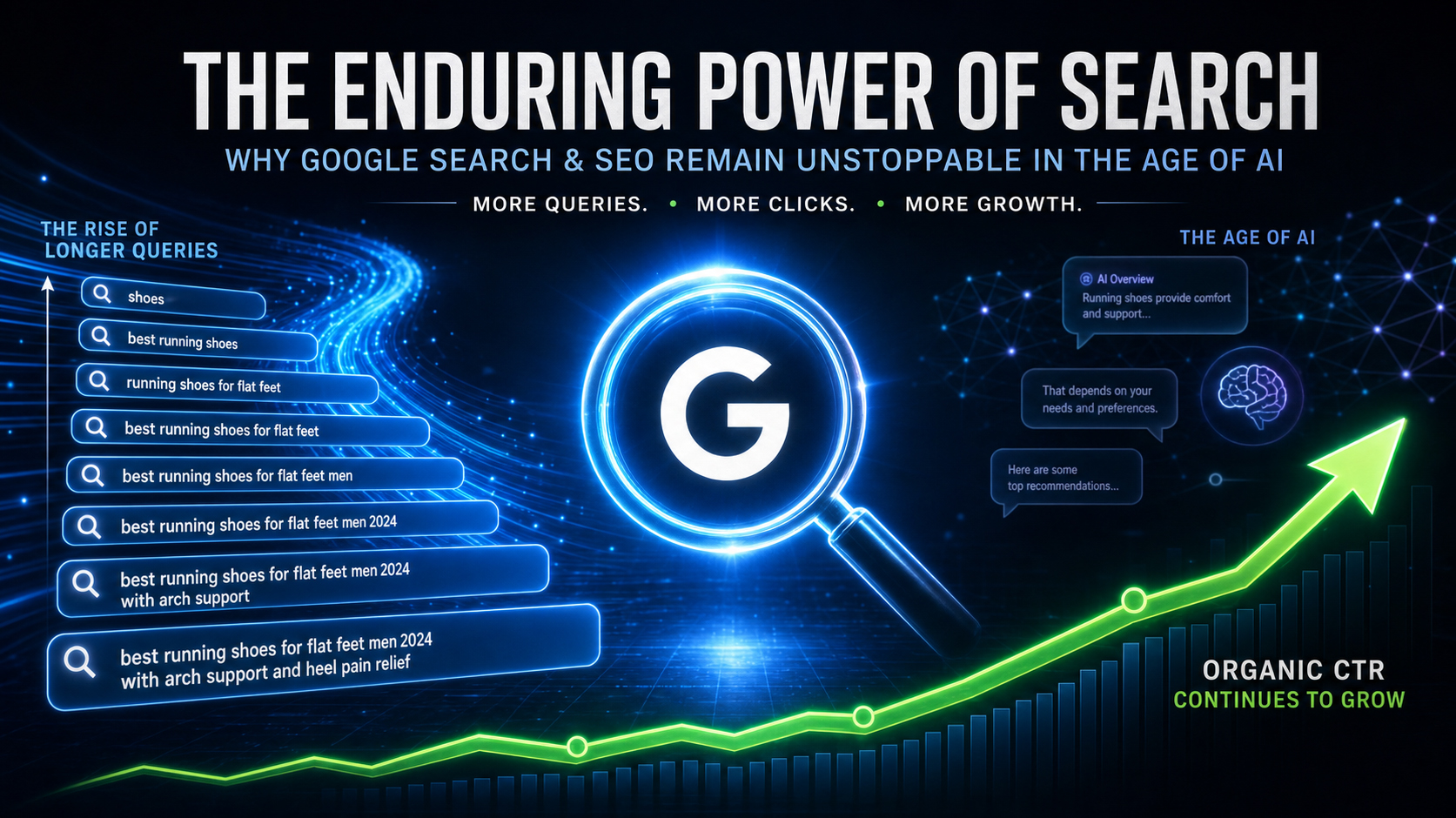
Forget the zero-click myth: Why Google search is currently making its biggest comeback – Image: Xpert.Digital
Is AI killing SEO? New data from 2026 shows the exact opposite
The AI Paradox: Why ChatGPT & Co. Paradoxically Lead to More Google Clicks
Surprising turn of events at Google: The true click figures for 2026 are here
Since the meteoric rise of ChatGPT, Gemini, and similar technologies, a gloomy prediction has dominated the digital marketing world: the end of traditional Google search is imminent. Generative AI and smart chatbots would supposedly render search engines obsolete, stifle traffic to external websites, and finally bury the discipline of search engine optimization (SEO). But a look at the hard facts reveals a completely different reality. Current and methodologically sound clickstream data from the first quarter of 2026 exposes the fear of the end of search as premature. The surprising truth is: search volume is breaking records, the dreaded zero-click searches are declining dramatically, and click-through rates on organic search results are rising again. Instead of replacing search, artificial intelligence is acting as a catalyst for more complex search behavior—making sound SEO more lucrative and important than ever. The following deep dive reveals what's really behind the renaissance of organic search and how website operators must now respond strategically.
Search is alive – and even growing: What the clickstream data of the first quarter of 2026 really mean
The digital marketing industry has been intensely debating the supposed demise of traditional web search for years. Chatbots, AI-generated answers, and voice-controlled assistants, according to the widespread theory, would gradually render the traditional search engine irrelevant. However, empirical data from the first quarter of 2026 paints a surprisingly different picture: Organic search is not only stable, it's actually growing in key metrics. Anyone who prematurely declared SEO dead will be significantly corrected by these latest figures.
What the data shows: A yearly low in zero-click searches
The latest "State of Search" report for the first quarter of 2026, compiled by the analytics firm Datos (a Semrush company) in collaboration with Rand Fishkin, CEO of SparkToro, provides a snapshot of the desktop search behavior of millions of active users in the US, EU, and UK. The data is based on real clickstream data, which, according to the authors, encompasses billions of daily digital desktop events—a methodologically robust foundation that far surpasses what typical survey studies can achieve.
The most striking result: The share of so-called zero-click searches – that is, search queries that end without a single click on an external website – fell to 22.4 percent in the US in March 2026, compared to 24.5 percent in December 2025. This is the lowest value of the entire observation period. In the EU and the UK, the decline was even more pronounced: There, the zero-click share fell from 22.5 percent in December 2025 to 19.6 percent in March 2026. At the same time, the organic click-through rate rose to 44.9 percent in the US and to 46.0 percent in the EU and the UK.
This development deserves special attention because it contradicts the dominant narrative of recent years. As recently as the first quarter of 2025, the same study showed the opposite picture: at that time, the zero-click rate in the US had risen to 27.2 percent, while organic clicks had fallen to 40.3 percent. The trend reversal within a year is therefore statistically significant and not simply random noise in the data.
Why click rates are rising: Structural drivers behind the recovery
A decline in the zero-click rate cannot be explained by a single cause. Rather, several structural factors interact to produce the observed shift.
First, let's look at the search volume itself: Google CEO Sundar Pichai announced during the Q1 2026 earnings call that search queries had reached an all-time high. Search volume is increasing because AI features have made search more attractive to many users – not less. At the same time, the absolute number of clicks on external sites is also rising along with the volume, even if the percentage of clicks per search query were to remain mathematically constant. The mathematical logic here is compelling: If the total search volume grows while the organic click-through rate remains stable or even increases, then by definition, website operators receive more organic traffic.
In addition, there is a qualitative shift in the composition of search queries. Users are formulating their queries with increasing nuance: So-called mid-length queries with six to nine words are experiencing continuous growth in all regions studied, while very short search queries remain stable. These longer, more specific queries express a different user intent – they signal a targeted need for information that cannot be fully satisfied by a single-line featured snippet or an AI summary. Clicking on the original source thus becomes more likely because the answer on the SERP (Search Engine Results Page) alone is insufficient.
Another explanation lies in the changed SERP architecture itself. Google's AI-generated overviews, introduced in the DACH region in March 2025, fully answer many simple, information-driven search queries within the search results page. While this may sound paradoxical, it has a logical consequence: users whose trivial queries are answered directly subsequently ask more complex, detailed follow-up questions – and for these more in-depth queries, they actually click on external sources. The AI overview thus filters out the trivial traffic, leaving behind a higher-quality residual set of search queries that more frequently lead to actual clicks.
Google's financial strength as an indicator of search toughness
Anyone doubting the structural robustness of traditional search should take a look at Alphabet's financial reports. In the first quarter of 2026, Alphabet recorded total revenue of $109.9 billion, a 22 percent increase year over year. This is the company's strongest growth rate in over two years. Revenue from Google Search and other services rose by 19 percent to $60.4 billion – a clear indication that advertisers are not only maintaining but expanding the reach of Google Search.
These figures are economically significant: When advertisers in a market with AI search tools and autonomous chatbots increase their spending on Google search ads by almost a fifth, it reflects a rational market assessment of the channel's efficiency. Markets rarely lie in this regard. The advertising industry's investment decision thus confirms what clickstream data on the user side shows: Search is not in crisis—it is undergoing a transformation that, for the time being, does not shake its core business.
Google continues to dominate the traditional search market with a global market share of around 90 to 94 percent. In the US, its market share is approximately 94 percent, and in the EU and the UK, it exceeds 95 percent. This concentration is not due to market inertia – it reflects the structural advantages Google has built through its index ecosystem, infrastructure, and years of investment in machine learning.
The SEO market: Growth despite the AI narrative
Parallel to the stability of organic search, the market for search engine optimization (SEO) itself is growing significantly. Estimates suggest that the global SEO market will reach a volume of approximately $84 to $108 billion by 2026. While figures from different analysts vary depending on the definition of the market segment (SEO services, software, tools), the underlying trend is clear: the industry is growing at double-digit annual growth rates, driven by e-commerce, content marketing, and the increasing complexity of AI-optimized search.
Paradoxically, this market is growing precisely because AI is making search more complex. AI Overviews, Featured Snippets, People-Also-Ask boxes, Local Packs, and the new Google AI Mode require more sophisticated SEO strategies than ever before. This increases the demand for expertise. For medium-sized businesses and publishers, this means that the barrier to entry for organic visibility has risen, while at the same time, the value of a good ranking has increased because the total number of search queries is growing.
One of the most important structural drivers of SEO demand is the end of the third-party cookie era. As programmatic targeting based on third-party data becomes increasingly difficult, companies are shifting budgets toward organic search visibility, which doesn't require tracking. This also makes SEO a more attractive long-term strategy from a data privacy perspective compared to paid advertising.
AI tools: Rapid growth, but still a marginal share of traffic
It would be analytically incomplete to ignore the rise of AI search tools. The data paints a nuanced picture: AI-powered tools are growing at impressive rates, but in absolute numbers, they still lag behind the dominant traffic channels in terms of market share.
According to the Q1 2026 report by Datos and SparkToro, AI tools combined account for less than two percent of total desktop visits. By comparison, traditional search generates a far larger share of traffic. ChatGPT remains the undisputed market leader among AI tools, but has stabilized at a high level: According to Statcounter data from April 2026, ChatGPT holds approximately 76.85 percent of the AI chatbot market share, Google Gemini 9 percent, and Perplexity 7.73 percent.
Particularly striking is the rapid growth of ChatGPT's competitors. Gemini more than quadrupled its share of AI desktop visits in the first quarter of 2026, from 4 percent to 16 percent; Claude's rose from 3.6 percent to 8.5 percent. The Trakkr traffic index shows that Claude's referral traffic tripled over a six-week period. Gemini's referral traffic surpassed Perplexity globally during the same period, driven by Gemini's deep integration with Android, Chrome, and Google Search itself.
Even more remarkable is the development of Google's own AI mode: Its share of desktop visits in the US grew 2.5 times in the first quarter of 2026 – from 0.06 percent in December 2025 to 0.16 percent in March 2026. In Europe, despite a delayed rollout, the share was 0.21 percent, even surpassing the US figures. This shows that as soon as AI features are embedded in established search environments, adoption increases dramatically.
At the same time, it would be misleading to confuse these growth rates with structural market power. Tripleting a small base value still results in a small value. According to current estimates, ChatGPT has around 891 million monthly users and accounts for approximately 17 percent of all digital search queries – but even this figure must be considered in relation to Google's 5.3 billion monthly users and 77.9 percent market share.
🎯🎯🎯 Data-driven B2B industry hub as a quasi-in-house solution

The quasi-in-house solution: How Xpert.Digital closes operational gaps in B2B marketing and sales – Smart Content-Driven Business - Image: Xpert.Digital
Xpert.Digital is a data-driven B2B industry hub led by Konrad Wolfenstein . The company acts as an external, quasi-in-house solution for industrial partners, closing operational gaps in marketing, content, and sales – without requiring additional resources on the client side.
More information here:
Long-tail keywords instead of mass keywords: The new rule of the game for content strategists
The paradox of AI search: More questions, more clicks
One of the key findings from the Q1-2026 dataset is a structural paradox that redefines the relationship between AI use and traditional search: Those who use AI tools like ChatGPT or Gemini do not necessarily make fewer search queries on Google – they make more, and above all, more complex ones.
Usage research shows that the average desktop user performs around 100 searches per month using Google alone. AI tools take over certain tasks, primarily quick knowledge queries and text generation, without significantly displacing traditional search behavior. Instead, the two forms of use appear to complement each other: users utilize AI chats for initial orientation and then resort to traditional search to find more in-depth, source-based information.
This behavior is supported by data on click behavior in AI tools: ChatGPT generates an average of 1.4 outgoing clicks to external websites per session, compared to 0.6 clicks per session for a traditional Google search. This means that users directed to external content via AI tools are more likely – and more willing – to click on the linked source. For publishers and website operators visible in this segment, this creates a high-quality, albeit still small in terms of volume, channel.
AI overviews and their real impact on organic traffic
The introduction of Google's AI Overviews in Germany and the DACH region in March 2025 initially raised significant concerns. Analysts feared a widespread decline in organic click-through rates, particularly for informational content. A Sistrix analysis from February 2026 quantified the loss due to AI Overviews for German websites alone at 265 million clicks per month – a figure that seems alarming at first glance.
But the overall picture is more complex. At the same time, the total volume of search queries is reaching all-time highs, and the organic click-through rate is recovering, at least on desktop devices. The 265 million lost clicks represent real losses for certain content categories—especially for informational, lexical, and simple factual questions that AI Overviews can fully answer. Transactional, purchase-oriented, and locally relevant search queries, on the other hand, are significantly less affected by this trend, as they require redirection to external pages or services.
A key structural difference exists between desktop and mobile search. This Datos report focuses exclusively on desktop behavior. On mobile devices, the zero-click rate is traditionally much higher because users often search without a specific intention to click, and SERP features are even more prominent on small screens. A complete market assessment must take this caveat into account: The positive data for desktop SEO should not be uncritically extrapolated to the mobile segment.
Who benefits – and who doesn't?
Not all website operators are benefiting equally from the observed recovery in organic traffic. The structure of search traffic is highly concentrated: A disproportionately large share of organic click volume flows to a small number of large, established domains. According to industry data, 96.55 percent of all websites receive no significant organic traffic from Google. This means that the increase in the organic click-through rate to 44 to 46 percent statistically benefits primarily the market-leading providers who are already well-positioned.
For medium-sized and smaller publishers, specialist portals, and independent website operators, the reality is therefore more nuanced. Google's own services, such as Maps, Hotels, Shopping, and YouTube, are also gaining in click volume: In the EU and the UK, clicks on Google's own ecosystems reached a new high of 18 percent in March 2026. This means that a growing portion of the click volume remains internal to the Google ecosystem and does not reach external providers. The consequence for website operators: Relying solely on organic Google search is becoming increasingly risky.
The Sensor Tower report "State of Web 2026" from May 2026 confirms this picture from a different perspective: Organic search accounts for around 17 percent of total web traffic globally, while direct traffic is at almost 64 percent. For website operators who want to be resilient in the long term, building a direct user relationship – via newsletters, apps, brand loyalty, and communities – is therefore at least as important as organic search optimization.
Search queries are getting longer: What this means for content strategists
The observed lengthening of search queries is not a minor detail – it's a strategic signal. Search queries with six to nine words are growing steadily, and these so-called long-tail queries behave fundamentally differently from short search queries. They signal a more specific need for information, a higher willingness to buy in the case of commercial queries, and less competition in the search results.
This trend has direct implications for content strategy. Those who optimize content for short, generic keywords face increasing competitive pressure from AI-generated answers that cover precisely these simple queries. Conversely, those who create specific, differentiated content for detailed search queries—expert knowledge, case studies, price comparisons, regional information, application-specific solutions—position themselves in an area where AI-generated standard answers perform structurally worse. Depth and originality will thus become the decisive competitive advantages of the next generation of SEO.
Furthermore, SEO and AI visibility increasingly share the same fundamental qualitative requirements. According to Sensor Tower data, pages that perform well in AI referral traffic consistently have higher organic search results, less reliance on paid channels, and strong thematic authority. Investing in high-quality, in-depth content therefore pays off for both traditional SEO and the emerging discipline of Generative Engine Optimization (GEO).
Strategic conclusions: What website operators should do now
The data from the first quarter of 2026 provides clear strategic guidance. Organic search is not only viable as a traffic channel – in the best-case scenario, it will evolve into a higher-quality channel because trivial queries are increasingly answered by AI, and the remaining traffic is more intent-based.
The first strategic priority is structured and in-depth content, rather than superficial keyword optimization. Google and AI systems alike favor clearly structured, technically sound content that answers a specific question with verifiable expertise. Generic, mass-produced content lacking added value quickly loses visibility compared to such content.
The second priority is the systematic building of brand authority and direct user access. Given the increasing concentration of click volume within the Google ecosystem, publishers must strengthen direct user engagement through newsletters, community platforms, brand-specific apps, and repeat reader relationships. Even with growing organic traffic, dependence on a single channel is structurally fragile.
As a third strategic element, technical SEO expertise is gaining importance. AI overviews, structured data, schema markup, and fast loading times are no longer optional extras, but basic requirements for even being cited in AI-generated search results. Those who are invisible in the AI-powered search interface will gradually lose brand presence, even if their ranking in the traditional SERP remains stable.
Methodological limitations and reservations about interpretation
Any analysis of market data requires a sober examination of the limitations of the methodology used. The Datos study is based on a panel of several million desktop users—a generous sample size compared to others in the industry, but one that nevertheless does not constitute a representative census. Panels typically exhibit selection biases: users participating in clickstream panels may systematically differ in their behavior from the overall user population.
Furthermore, there's the focus on desktop usage. Mobile search queries account for more than 60 percent of all Google searches worldwide, and zero-click rates are structurally higher on mobile devices. By definition, an analysis based on desktop data provides a more optimistic picture of the organic click-through rate than the overall market perspective would suggest. Anyone applying these results to the overall strategy of a mobile-first website should explicitly incorporate this difference into their planning.
Regional differences should also be considered. EU and UK data may benefit from regulatory factors: Europe-wide data protection regulations (GDPR) and the enforcement of the Digital Markets Act have limited Google's leeway in placing its own services in search results, which could partially explain the comparatively higher organic click share in this region.
The overall economic perspective: Search as infrastructure of the digital economy
From a broader economic perspective, search is not simply a marketing channel – it is a fundamental infrastructure of the digital information economy. The way people find information determines which content generates economic value and which disappears into oblivion. A shift in search architecture therefore alters the value creation logic of the entire digital ecosystem.
The figures for the first quarter of 2026 show that this infrastructure is more stable than often feared. Google's search revenue grew by 19 percent to $60.4 billion, the global SEO market is approaching a value in the hundreds of billions, and organic click-through rates are recovering after their dip in 2025. These are not signs of a dying market, but rather of a market undergoing a fundamental, yet orderly, transformation.
The real structural question of the coming years is not: "Will AI kill search?" The more empirically relevant question is: "Who controls the interface through which users access information?" With AI Overviews, AI Mode, and the Gemini integration, Google has demonstrated its determination to occupy this interface itself—while simultaneously increasing search volume. For independent publishers and SEO practitioners, this is the real strategic challenge: not the demise of search, but whether the path from the searcher to external content remains open or increasingly ends within the Google ecosystem.
The data from the first quarter of 2026 initially provides an optimistic answer to this question. However, it should not be interpreted as an invitation to complacency, but rather as a call to refine the SEO strategy using the same analytical tools with which this report measured the reality of the search market: data-driven, nuanced, and without jumping to conclusions one way or the other.
Your global marketing and business development partner
☑️ Our business language is English or German
☑️ NEW: Correspondence in your native language!

Konrad Wolfenstein
I and my team are happy to be available to you as your personal advisor.
You can contact me by filling out the contact form here simply call me at +49 7348 4088 965. My email address is [email protected]:or
I'm looking forward to our joint project.
☑️ SME support in strategy, consulting, planning and implementation
☑️ Creation or realignment of the digital strategy and digitization
☑️ Expansion and optimization of international sales processes
☑️ Global & Digital B2B trading platforms
☑️ Pioneer Business Development / Marketing / PR / Trade Fairs
B2B support and SaaS for SEO and GEO (AI search) combined: The all-in-one solution for B2B companies

B2B support and SaaS for SEO and GEO (AI search) combined: The all-in-one solution for B2B companies - Image: Xpert.Digital
AI search changes everything: How this SaaS solution will revolutionize your B2B ranking forever.
The digital landscape for B2B companies is undergoing rapid change. Driven by artificial intelligence, the rules of online visibility are being rewritten. For companies, it has always been a challenge not only to be visible in the digital mass, but also to be relevant to the right decision-makers. Traditional SEO strategies and managing local presence (geo-marketing) are complex, time-consuming, and often a battle against constantly changing algorithms and intense competition.
But what if there were a solution that not only simplified this process but also made it smarter, more predictive, and far more effective? This is where the combination of specialized B2B support with a powerful SaaS (Software as a Service) platform comes into play, specifically designed for the demands of SEO and GEO in the age of AI search.
This new generation of tools no longer relies solely on manual keyword analysis and backlink strategies. Instead, it leverages artificial intelligence to more accurately understand search intent, automatically optimize local ranking factors, and conduct real-time competitive analysis. The result is a proactive, data-driven strategy that gives B2B companies a decisive advantage: they are not only found, but perceived as the leading authority in their niche and location.
Here's the symbiosis of B2B support and AI-powered SaaS technology that transforms SEO and GEO marketing, and how your company can benefit from it to grow sustainably in the digital space.
More information here: