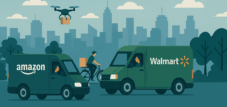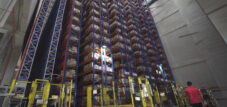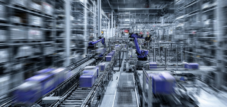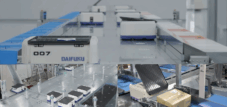
The invisible bottleneck: Why the last mile begins at the warehouse shelf – Creative image on the topic, with AI: Xpert.Digital
Staff shortage vs. same-day delivery: How AI robots are now solving the logistics problem
The most expensive manual task in the warehouse: Why logistics will soon be impossible without AI
Same-day delivery is no longer a luxury, but the absolute standard. However, while customers expect their orders to arrive at their doorstep in record time, the logistics industry is struggling behind the scenes with an unprecedented, structural shortage of skilled workers. The bottleneck in this conflict of objectives often lies where automation has previously reached its limits: order picking, the famous "last move." This is precisely where a new generation of learning, AI-powered robots promises a breakthrough. Instead of expensive complete overhauls, these intelligent systems adapt to existing warehouse infrastructures, learn independently with each item picked, and alleviate the personnel shortage without making humans redundant. Learn why rigid systems are obsolete, how the technology pays off in practice, and why smart picking robots will determine competitiveness in the fulfillment landscape of tomorrow.
Can your order picking process keep up with the increasing demand?
By 2026, same-day delivery will no longer be a differentiator, but the new expectation. In the United States, more than 80 percent of all e-grocery deliveries are now made the same day, and within this segment, the share of orders delivered in less than three hours increased from just over half to nearly two-thirds of total deliveries in a single quarter. All of this market growth during that period came from orders fulfilled within one hour. At the same time, ultra-fast delivery of less than one hour already accounted for 18 percent of all delivery orders and 10 percent of home delivery orders.
This acceleration shifts the bottleneck in the value chain to where it is least visible but most impactful: the picking zone. Every reduction in the delivery time at the front end immediately creates more pressure on processes within the warehouse, especially on the so-called "last step," i.e., removing individual items from containers and packaging them for shipping. For e-grocery and fulfillment companies, this simultaneously means more orders, more product variations, and ever shorter lead times, while the margin for error approaches zero.
Structural load instead of temporary bottleneck
The shortage of skilled workers in warehouse logistics is no longer a seasonal phenomenon, but a structural condition of the industry. According to IAB statistics, over 60,000 warehouse logistics positions remained unfilled in Germany in 2025, a significant increase compared to previous years. By comparison, in the fourth quarter of 2024, around 45 percent of the surveyed warehousing companies stated that their business operations were currently hampered by a shortage of skilled workers, whereas this figure was below ten percent at the beginning of the survey in 2009. While the shortage has eased slightly from its recent peak, it remains at a historically high level.
This is due to a combination of factors that are difficult to resolve in the short term. Around a third of logistics workers are already over 50, while younger workers are increasingly opting for academic careers rather than vocational training in warehousing or freight forwarding. Added to this are physically demanding tasks, shift work, and lower wages compared to other sectors, which further diminish the attractiveness of warehouse work. While a majority of 63.3 percent of logistics professionals believe that career changers from other industries could at least partially alleviate the shortage, this effect alone is insufficient to close the structural gap.
This combination of growing demand and shrinking staff availability creates precisely the conflict of objectives that many operations managers know from their own experience: productivity and accuracy are expected to increase, while the resources for achieving these goals are becoming increasingly scarce. Fluctuating order picking performance, for example due to sick leave, high staff turnover, or seasonal peaks, consequently leads to delays that directly impact customer perception.
Robotics as an answer to a process problem, not as an end in itself
This is where a new generation of AI-powered picking robots comes in, fundamentally different from older, rigid automation solutions. Previous picking robots required complex programming and fixed gripping points for each new product, making them impractical for assortments with a high degree of variety, typical in the e-grocery sector. Modern systems, on the other hand, use three-dimensional image processing combined with pre-trained deep learning algorithms to recognize and grip items regardless of shape, size, transparency, or surface texture, without requiring separate training for each individual product.
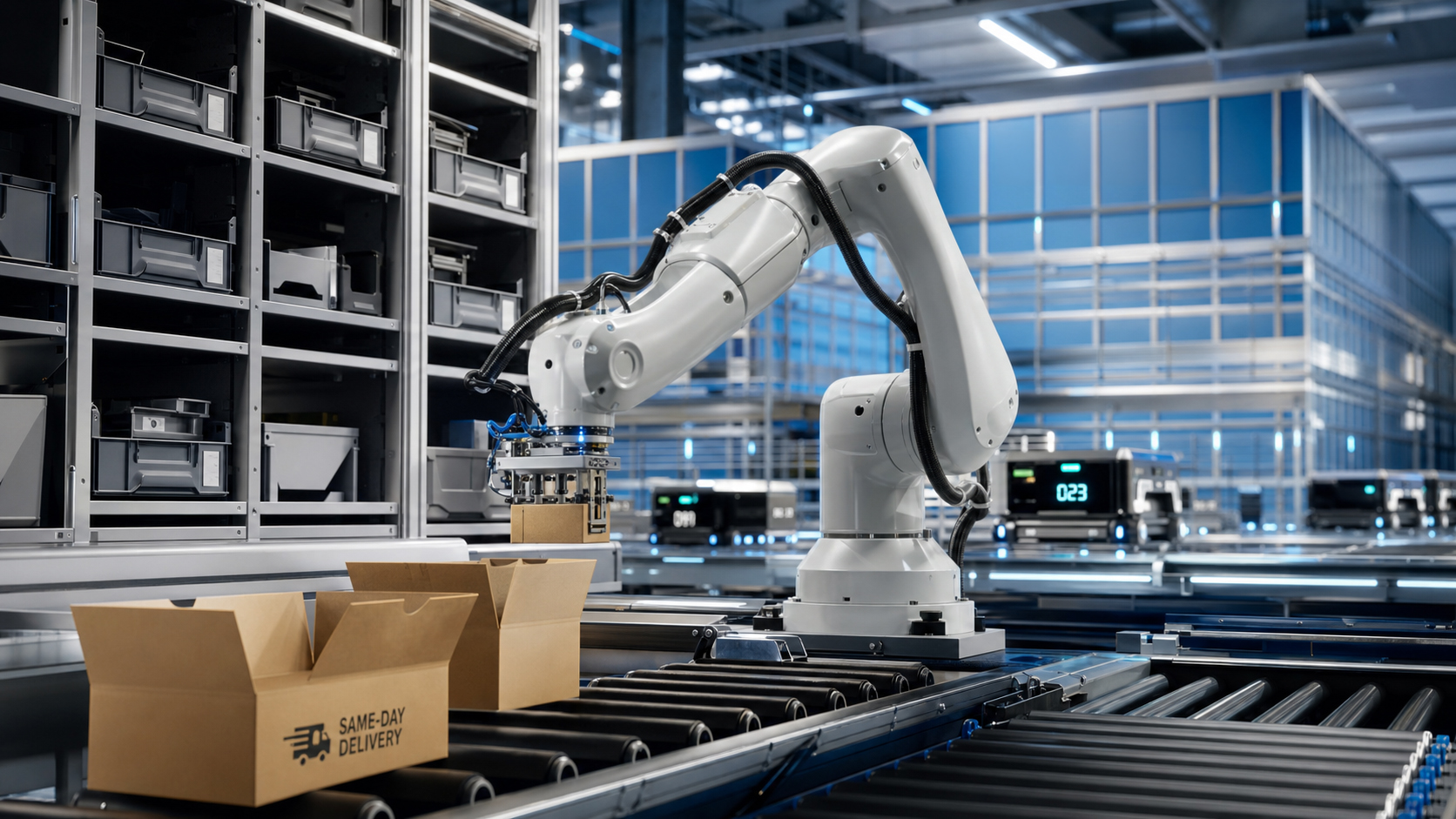
A striking example comes from the Swiss fittings specialist OPO Oeschger, which deliberately chose the opposite approach when integrating an AI-supported picking solution: Instead of adapting the warehouse to the robot, the robot was adapted to the existing warehouse. The picking robot was integrated directly into an existing order picking workstation and takes over precisely those work steps that were previously performed manually: removing anti-slip mats from destination containers, retrieving the required items from source containers, and placing them in the shipping carton before the existing conveyor system takes over the further flow of materials. The artificial intelligence independently recognizes the items and decides how a product is placed and stacked in the destination container.
This integration approach is economically crucial because it refutes the widespread assumption that automation inevitably requires a complete overhaul of the warehouse infrastructure. Robotic systems can increasingly be integrated into existing picking workstations, conveyor technology, and storage systems like AutoStore, instead of requiring a complete redesign of the facility. This significantly lowers the investment barrier, allowing operators to introduce automation gradually rather than disruptively.
How the technology has proven itself in practice
The benefits of these systems are most evident in large-scale operational deployment. The Rohlik Group, which operates the online food platforms Knuspr and Gurkerl, has expanded its rollout to 24 AI-controlled picking robots at its Berlin logistics center in Schönefeld, following the initial introduction of one robot at the Schönefeld site. These robots now assemble orders at the fulfillment centers in Berlin and Vienna, with further locations, such as Frankfurt, slated to follow in the coming months. The company even plans to scale up to a three-digit number of robots in the long term. The robots take over one of the last remaining manual steps in warehouse operations: the precise gripping and packaging of individual products in both refrigerated and non-refrigerated environments.
The Group Head of Automation and Expansion at Rohlik emphasizes that this robotics program was developed from the ground up to fundamentally transform food delivery, with its scaling across multiple markets simultaneously laying the foundation for the future of automated logistics in the e-grocery sector. Similar effects can be observed outside the food sector as well. In a configure-to-order manufacturing facility that transitioned to AI-driven process discipline in intralogistics, overall lead time decreased by 84 percent and order-to-ship lead time by 77 percent. In another documented case, the error rate decreased by 68 percent and productivity increased by double digits, with the entire picking process being converted within a single week.
Established automation providers from the mechanical engineering sector are also positioning themselves in this field. Siemens, together with the intralogistics specialist Mecalux, has developed AI-supported image processing software called Simatic Robot Pick AI, which enables robots to grasp any item regardless of its shape and size, thereby realizing high-throughput systems of up to 1,000 picking operations per hour in 24/7 operation. In another collaboration, Siemens, Universal Robots, and the camera manufacturer Zivid combined their respective technologies to reliably detect even transparent and see-through objects, which has previously posed a significant technical challenge, especially with packaging made of glass or clear film.
LTW Intralogistics Solutions

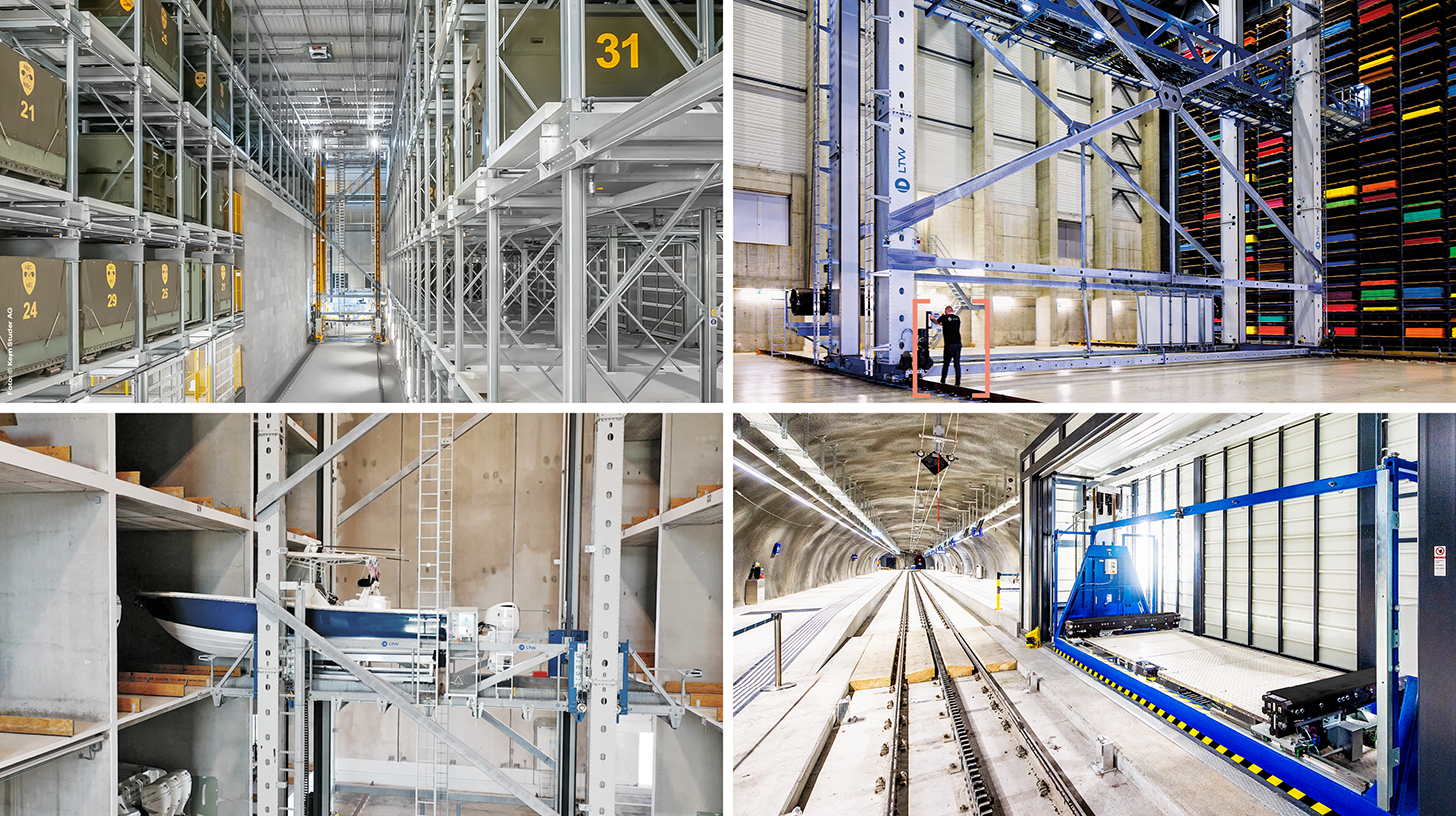
LTW Intralogistics – Engineers of Flow - Image: LTW Intralogistics GmbH
LTW offers its customers not individual components, but integrated complete solutions. Consulting, planning, mechanical and electrotechnical components, control and automation technology, as well as software and service – everything is networked and precisely coordinated.
In-house production of key components is particularly advantageous. This allows for optimal control of quality, supply chains, and interfaces.
LTW stands for reliability, transparency, and collaborative partnership. Loyalty and honesty are firmly anchored in the company's philosophy – a handshake still means something here.
Related to this:
From automated machines to learning systems: The future of order picking – How learning robots are transforming the modern warehouse
From rigid automaton to learning system
From an economic perspective, the decisive advancement of this technology generation is not merely automation itself, but the shift from rule-based to learning automation. Industry classifications now distinguish several development stages of order picking automation, ranging from simple semi-automated systems with fixed image processing and barcode scanning, through largely autonomous robots, to intelligent, learning robot picking, which is currently considered the most advanced stage. At this highest level, the robot's ability for continuous self-improvement is central, enabling the system to operate not only autonomously, but also adaptively and self-optimizing.
This learning component solves a key economic problem of previous generations of automation: their lack of scalability when product ranges change or grow. With systems that already have pre-trained AI capabilities, new products no longer need to be individually trained because the underlying capabilities already cover a broad spectrum of objects. This is particularly important for industries with highly dynamic product ranges, such as pharmaceuticals, fashion, e-commerce, and returns processing. An autonomous mobile robot, which navigates the warehouse aisles with a shopping cart like a human, picking and consolidating orders, has already been trained on more than a billion picks. Machine learning makes it more precise with each subsequent pick, while a complementary goods-to-person station for heavy or hard-to-reach items ensures consistent picking reliability of 100 percent.
Furthermore, such systems do not require fixed infrastructure such as racks or conveyor belts and operate with standard shelves and containers, enabling rapid deployment and end-to-end supply chain automation without fundamentally altering existing logistics processes. This lightweight infrastructure approach differs significantly from cube storage systems or shuttle solutions, which require fixed grid structures, and thus provides operators with considerably more flexibility in the gradual automation of their existing facilities.
The human factor remains central
Despite impressive technological advances, the use of AI robotics by no means signifies the complete displacement of human labor from the warehouse. Rather, a hybrid model is increasingly emerging in which robots reliably and effortlessly handle standardized, repetitive, or ergonomically demanding picking tasks, while employees are relieved of these duties and can concentrate on exceptional cases, quality control, or overarching process management. This division of labor is proving particularly valuable in light of the ongoing skilled labor shortage, as it directs existing personnel resources specifically to those tasks that genuinely require human judgment.
From an economic perspective, this development can also be seen as a response to demographic change. Given a workforce in which a third of employees are already over 50 and the number of young people entering the workforce is increasingly dwindling, the automation of physically demanding, repetitive tasks appears less as a threat to jobs and more as a necessary compensation for a structural bottleneck that cannot be resolved solely through recruitment. This connection is also explicitly acknowledged from the supplier's perspective: the effects of the labor shortage could be mitigated by AI-controlled picking robots, while simultaneously increasing operational efficiency in warehouses.
Economic assessment of investment versus benefit
The central business question when introducing such systems concerns less the technical feasibility, which can now be considered largely resolved, but rather the economic calculation in each individual case. Crucially, modern AI robotics solutions can be integrated into existing order picking workstations instead of requiring a completely new system, which significantly shortens the amortization period compared to traditional large-scale investments in automated storage systems. For operators with existing conveyor technology or AutoStore systems, this means that the last, previously manual step can be retrofitted without interrupting the existing material flow.
At the same time, the documented efficiency gains demonstrate the significant economic leverage. A 68 percent reduction in the error rate, coupled with double-digit productivity increases within a single week of implementation, represents a scale that would be virtually impossible to achieve with traditional process optimizations. Furthermore, a throughput of up to 1,000 order pickings per hour in continuous 24/7 operation illustrates that these systems not only compensate for staffing shortages but can also create additional capacity, which is essential for handling peak demand for same-day and ultra-fast delivery.
Nevertheless, it's important to consider that not every product range and not every warehouse structure is equally well-suited for robotization. Systems that rely on fixed gripping points and pre-structured objects offer less flexibility than adaptive, learning solutions. Therefore, the choice of the appropriate level of automation depends on the specific product range, order volume, and existing infrastructure. Companies that prematurely invest in unsuitable systems risk failing to realize the expected efficiency gains and instead introducing additional complexity into their processes.
The fulfillment landscape of the coming years
The combination of a structural shortage of skilled workers, rising operating costs, and customer expectations that are inexorably shifting towards same-day and even sub-same-day delivery makes the automation of order picking one of the most pressing investment decisions in the fulfillment industry in the coming years. Artificial intelligence in logistics is increasingly evolving from a purely automation project into a comprehensive, AI-driven process discipline that integrates security, data quality, and process compliance into automation, rather than operating isolated, stand-alone solutions. Research institutions such as the Fraunhofer Institute for Material Flow and Logistics also emphasize that AI-based optimization of storage locations, automatic identification of load carriers, and the transfer of simulated robotic processes into real-world environments are increasingly going hand in hand to enable proactive planning and unlock additional efficiency potential.
For operators currently deciding whether to invest in AI-powered picking robotics, the market already provides reliable benchmarks: from targeted integration into a single picking workstation to scaling to fleets of multiple robots, and potentially hundreds, across several countries. The crucial question is therefore no longer whether artificial intelligence will change order picking, but how quickly individual companies can leverage this change before the gap to already automated competitors becomes too large.
Consulting - Planning - Implementation

Konrad Wolfenstein
I would be happy to serve as your personal advisor.
You can contact me at wolfenstein∂xpert.digital or
Just call me on +49 7348 4088 965 .
Your intralogistics experts

Consulting, planning and implementation of complete solutions for high-bay warehouses and automated storage systems - Image: Xpert.Digital
More information here: