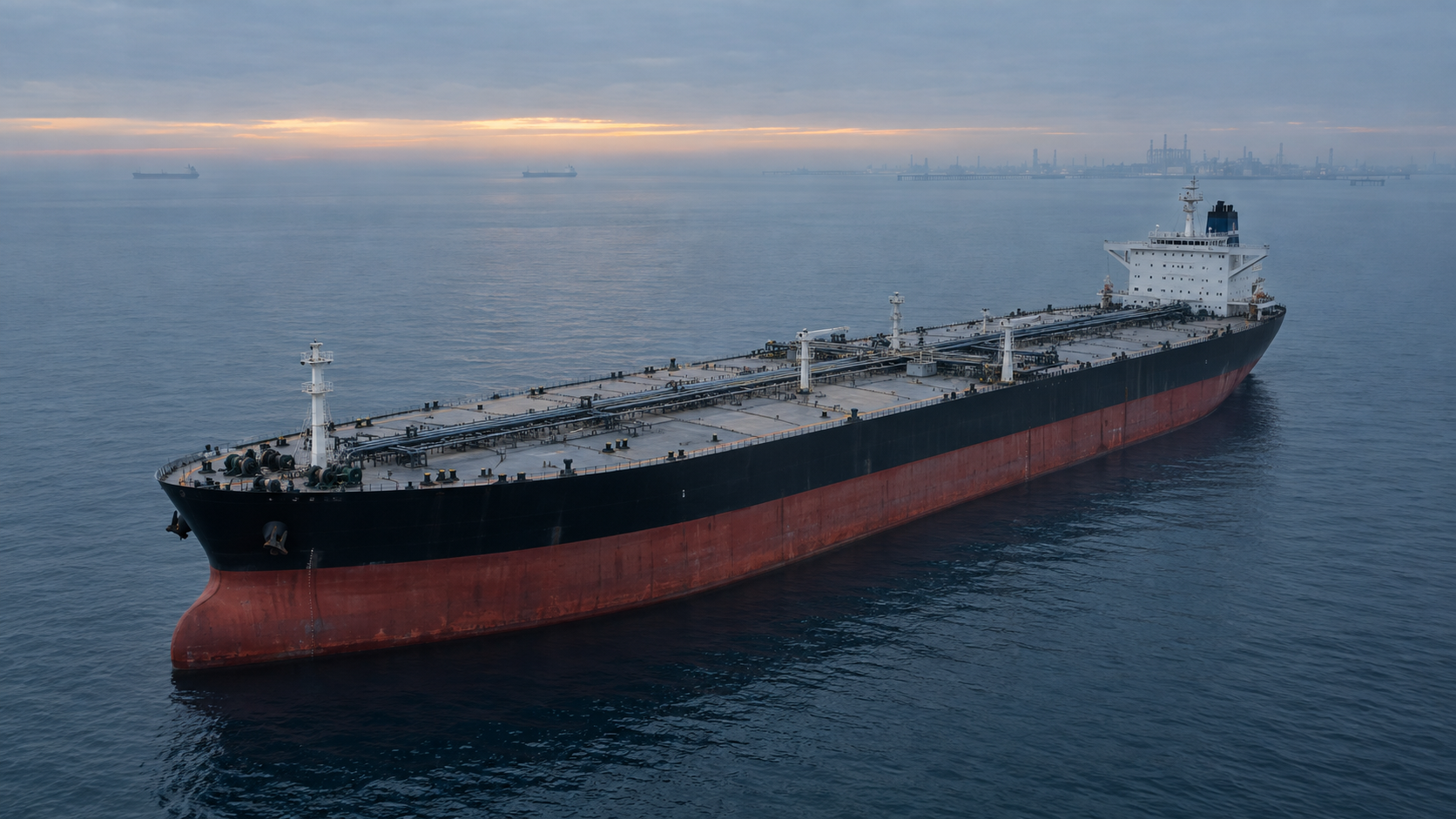
Oil blockade against Iran: Oil reserves on tankers are dwindling – Why Tehran is now missing billions – Creative image on the topic, created with AI: Xpert.Digital
Oil in the ground, but no money in the coffers: Iran's export crisis is worsening
Empty tankers, less revenue: How Iran's oil blockade is affecting its economy
Iran's oil reserves are almost depleted – and the consequences extend into everyday life
Iran's oil hasn't disappeared – but a key avenue for short-term monetization has largely dried up. The floating reserves off the coast of Asia, from which Tehran was still able to sell crude oil to Chinese refineries despite blocked export routes, will be almost depleted by mid-October 2026, according to leading estimates. There are differing figures regarding the exact remaining quantity. What is clear, however, is that the financial buffer that had previously mitigated the effects of the blockade has shrunk considerably.
This does not mean that Iran's oil fields are depleted or that the country will become insolvent immediately. Rather, the crucial question is whether the country can convert its raw materials into reliable export revenues. If new deliveries fail to materialize, foreign exchange supplies, the state budget, and imports will come under increasing pressure. The consequences could extend to industrial production and the purchasing power of the population. The severity of the crisis also depends on whether Iran can secure new sales channels and reliable inflows of funds.
Iran's empty tankers: How the oil blockade is crippling Tehran's economy: Oil in the ground doesn't pay the bills
Iran is losing a crucial financial buffer as its floating oil storage facilities in Asia are largely depleted. Crude oil that was outside the blocked export routes and could therefore still be sold to Chinese refineries will, according to a leading estimate, no longer be available by mid-October 2026. Other observations indicate smaller remaining stocks. While there is uncertainty about the exact endpoint, there is considerably less uncertainty about the massive decline in available reserves. The economically decisive factor is not the last shipment, but the transition from a temporarily bridgeable supply interruption to a persistent lack of new export revenue.
The consequences extend far beyond the oil industry. Based on the current figures, oil sales account for roughly 30 to 40 percent of Iran's state revenue and constitute a key source of foreign currency. If this flow dries up, the budget, currency, imports, and industrial production will all come under simultaneous pressure. However, this will not necessarily lead to immediate insolvency of the state, nor will it inevitably result in a political collapse. Rather, the reasonable outlook is that Iran can continue to function economically, but at rising costs, with declining productivity, and with an increasingly unequal distribution of the burden.
The oil wells are not exhausted
The statement that Iran's oil reserves are empty requires careful clarification. It refers to crude oil stored on tankers in the Asian market and available outside of blocked export routes. It does not refer to the country's geological reserves, all Iranian storage tanks, or automatically every remaining shipment of oil. This is not a linguistic nuance. Between the possession of a raw material and its economic utilization lie extraction, storage, transport, sale, and payment. A disruption at just one stage can prevent physical wealth from being converted into actual disposable income.
Production has not completely ceased. Iranian crude oil production is still estimated at around 1.94 million barrels per day for September 2026, compared to approximately 2.16 million in August. One barrel is roughly equivalent to 159 liters. However, production volumes are not the same as export volumes. Some of the extracted oil can be processed domestically or stored without generating new foreign currency. Therefore, continued production does not guarantee that the existing source of revenue will remain intact.
Iran's immediate weakness, therefore, lies not in a lack of natural resources, but in blocked access to paying foreign customers. For the state budget, crude oil reserves are only beneficial if they generate usable revenue. Financing a shipment of medicine doesn't depend on the size of an oil field, but on whether an importer can actually make an acceptable payment. The crisis thus concerns the economic availability of raw material assets, not their mere existence.
Inventory as a financial bridge
The floating storage facilities served multiple functions simultaneously. Tankers transported Iranian oil to waters off Malaysia and Singapore. There, cargoes were transferred to other ships and subsequently delivered to China. This transshipment made it difficult to definitively trace the origin of the oil and allowed for the separation of transport, intermediate storage, and final delivery. At the same time, a reserve was created near the customers, which could be sold even if new shipments from Iran failed to arrive.
This system was therefore more than just an unusual storage technique. It kept an otherwise disrupted export business going for a limited time. The already stored quantities enabled further sales, while initially mitigating the immediate consequences of disrupted Iranian exports. The stock itself, however, was not yet cash. Only a completed shipment and its payment transformed it into financial liquidity. An economic risk remained between a loaded ship and a usable payment.
Therein lay its weakness. A storage facility can temporarily replace a lack of supplies, but it cannot compensate for a permanent disruption. As long as more oil is sold than is stored, the stock inevitably shrinks. Its initial size merely determines how long the buffer lasts. The fact that Iran was initially able to continue supplying its customers was therefore not conclusive proof that the blockade was ineffective. It only showed that the country was still drawing on previously accumulated reserves.
How the buffer dissolved
At the start of the war in February 2026, Iran's overseas floating oil reserves were estimated at around 135 million barrels. Following the imposition of an initial US naval blockade in April, these reserves were sold off and thus reduced. When the restrictions were temporarily eased in mid-June as a result of negotiations, Iran was able to export additional quantities and rebuild its reserves to nearly 90 million barrels. After the blockade was reinstated in mid-July, the reduction continued.
At the beginning of October, the system was nearing economic exhaustion. One inventory series shows less than one million barrels for October 5th and assesses the supply available outside the blockade as completely depleted by mid-month. Another estimate put the remaining Iranian crude oil stocks off Singapore at approximately six million barrels on October 9th. These figures cannot be combined into a supposedly complete time series due to differing observation dates and definitions.
The magnitude of the change is nonetheless clear: a substantial supply buffer has dwindled to a very small residual stock, or even an economically depleted system. The crucial factor is the ratio between inventory and current sales demand. Even several million remaining barrels could not compensate for an export connection interrupted for months. The end of the buffer is therefore not a single, dramatic event, but rather the culmination of a longer-term process. The blockage is increasingly affecting not only new deliveries, but the entire ability to continuously serve existing customers.
Why the last million is deceptive
The uncertainty regarding the exact remaining quantity is objectively important. Under sanctions conditions, deactivated ship signals, changing declarations of origin, and transshipments make it difficult to fully track the actual flow of goods. Furthermore, there are discrepancies between oil on the water, long-term floating storage, already sold cargoes, and the actual amount of goods still available. Not every recorded tanker inventory is fully accessible to the Iranian seller. Conversely, not every shipment that is difficult to detect is necessarily missing from all monitoring systems.
An economically sound analysis should therefore not insist that literally every relevant tank is empty. It should examine whether the upstream system can still fulfill its previous function. To do so, it would need to continuously supply marketable quantities and regularly generate new revenue. If supplies are permanently lacking and inventories have drastically shrunk, this function is largely lost, even if individual shipments do eventually appear.
Conversely, it would be wrong to conclude from measurement problems that nothing can be said about the economic damage. Differing residual stock levels do not refute the common finding of a massive decline. Uncertainty here primarily concerns the precision of the endpoint, not automatically the direction of the trend. Especially in an opaque market, this distinction is more important than a seemingly exact zero, which conveys more certainty than the data actually supports.
Properly assessing billions in losses
The value of Iranian crude oil exports prevented by the blockade is estimated at at least US$25 billion. This figure is an estimate of the blockade's impact and not an independently verified calculation of lost net government revenue. The restriction does not automatically diminish the economic significance. However, it prevents confusion between different categories. A blocked export transaction is neither synonymous with lost profit nor with an equally large shortfall in the public budget.
Between the calculated value of the goods and the revenue Iran can actually use lie price reductions, transport costs, brokerage fees, payment terms, and the actual availability of funds. Even before the current escalation, significant discounts were quoted for Iranian crude oil compared to similar offers. Furthermore, it should be considered that unsold oil is not necessarily destroyed. It may be marketed later, provided that extraction, storage, and transport remain technically and economically feasible until then.
This makes it important to distinguish between a permanent loss of assets and initially lost income. However, this distinction offers only limited comfort in the short term. A state must pay ongoing expenses even if some of its frozen raw materials could be sold later. A financial shortfall can be acute, even though the underlying asset still exists. Precisely for this reason, the loss of current revenues has a greater immediate impact than a purely balance-sheet-based view of national resource wealth would suggest.
The budget is losing its flexibility
If oil sales account for roughly 30 to 40 percent of government revenue, a drastic decline would impact a key source of funding. However, the actual budgetary effect depends on what revenues from other sources remain, what expenditures can be reduced, and what obligations can be deferred. The exchange rate used and the distribution of revenues between the government, businesses, and other entities also influence the amount that reaches the core budget. The stated figure is therefore a guideline, not an immutable law of nature.
Short-term response options are not free alternatives. Spending cuts can worsen public services and delay investments. Higher taxes can strain the liquidity of already weakened companies. Additional borrowing shifts the financing need into the future or onto the banking system. Payment deferrals initially relieve the public purse, but can trigger bad debts and new financing gaps for contractors. A burden does not disappear simply because its immediate bearer changes.
Current macroeconomic projections anticipate a budget deficit of 5.8 percent of GDP for Iran in the 2026/27 fiscal year, compared to an estimated 3.2 percent in the previous year. This is a forecast for the fiscal year running until March 2027, not a finalized annual result. It also reflects the overall conflict and economic situation, not just the depleted tanker fleet. Nevertheless, the connection remains relevant: the fewer reliable export revenues are available, the more difficult it becomes to limit the deficit without placing additional burdens on the economy and the population.
Between armaments and reconstruction
The loss of revenue also affects the ability to rebuild destroyed factories and replace lost weapons stockpiles. Both tasks require financial resources but can have very different procurement channels and priorities. Therefore, reduced oil revenue does not mean that all expenditures decrease proportionally. It initially intensifies the competition between ongoing supply, government operations, industrial reconstruction, and military requirements.
This distinction is crucial for economic evaluation. A state could protect security-related expenditures and postpone other investments. Conversely, a lack of industrial capacity could also hinder military replacement in the long term. Therefore, the estimated value of prevented oil exports does not directly reveal the number of unreplaced weapons, nor does it provide a precisely quantified reconstruction gap. A more reliable statement is this: fewer usable revenues reduce the ability to finance several costly projects simultaneously.
The foreign exchange gap is impacting production
In addition to the fiscal problem, a foreign economic one arises. Iran needs foreign currency to procure goods and services from abroad. Oil sales represent a key source of revenue for this purpose. Financing in its own currency can satisfy a domestic payment obligation, but it cannot arbitrarily replace payment to a foreign supplier. This limitation becomes particularly acute when access to international financial markets is simultaneously restricted. The crucial question, therefore, is not only whether the state can finance domestic expenditures, but also whether the country maintains its international solvency.
A shortage of foreign currency not only affects the consumption of imported goods. It can also make it difficult to procure machine components, industrial semi-finished products, and other goods necessary for domestic production. For the first five months of the Iranian fiscal year 2026/27, a decline in non-oil exports of 28 percent and in imports of 26 percent compared to the previous year is already reported. Weaker imports exacerbate both supply risks and production bottlenecks. Under these conditions, a lower import value is not a reliable indicator of economic strength.
This threatens a feedback loop: Lower oil revenues make imports more difficult, a lack of intermediate goods weakens domestic production, and weaker production in turn limits alternative export opportunities. Not every sector will be affected equally. Crucial factors are its import dependency, its inventory levels, and its access to financing. However, the notion that a country can compensate for the shortfall in crude oil revenues in the short term simply by increasing domestic production overlooks the fact that this production, too, is partly dependent on international supply chains.
The falling rial increases import costs
The Iranian currency has lost approximately one-third of its value against the US dollar since the beginning of July. This is different from a one-third increase in the dollar price expressed in rials. The reverse exchange rate reacts more dramatically in mathematical terms. For economic purposes, it suffices to say that anyone with a stable income in rials who has to buy import-dependent goods is losing considerable international purchasing power. The devaluation thus becomes a conduit for the export crisis and its impact on everyday life.
Under normal conditions, a currency devaluation can make export-oriented companies more competitive. However, this requires that they can produce and export additional quantities and utilize the revenue. If transport and payment systems are disrupted or intermediate goods are scarce, this compensation can only be mobilized to a limited extent. In such cases, the increased cost of imports initially predominates. Whether and to what extent this impacts end consumers depends on subsidies, competition, inventory levels, and government price controls. Exchange rate movements and increases in consumer prices are therefore linked, but not identical.
For the state, a devaluation can theoretically convert remaining foreign exchange earnings into more rials. However, this is not an equivalent replacement for lost purchasing power abroad. At the same time, import costs and domestic spending can increase. Therefore, a higher figure on a budget statement says little about how many medicines, spare parts, or infrastructure services can actually be procured. The decisive factor is real economic power of disposal, not just the nominal amount in the national currency.
🎯🎯🎯 Data-driven B2B industry hub as a quasi-in-house solution


The quasi-in-house solution: How Xpert.Digital closes operational gaps in B2B marketing and sales – Smart Content-Driven Business - Image: Xpert.Digital
Xpert.Digital is a data-driven B2B industry hub led by Konrad Wolfenstein . The company acts as an external, quasi-in-house solution for industrial partners, closing operational gaps in marketing, content, and sales – without requiring additional resources on the client side.
More information here:
Iranian economy faces extreme inflation challenges: A look at forecasts until 2027
Inflation with no easy way out
Price trends demonstrate the extent to which these burdens are already overlapping. Average inflation of 84.8 percent is projected for April to August 2026. The current forecast for the entire Iranian fiscal year 2026/27 is 74.2 percent. These two figures refer to different periods and therefore should not be directly equated or treated as the actual development for the entire year. However, they do illustrate an exceptionally high strain on purchasing power.
The loss of oil reserves is not the sole cause. The Iranian economy entered the conflict plagued by chronic inflation, weak investment, undercapitalized banks, and energy and water shortages. Added to this are damage to infrastructure, disrupted trade routes, and difficulties in repatriating export revenues. The depleted oil buffer exacerbates these problems because it eliminates a previously effective financial safety net. A single-cause explanation would therefore be just as misleading as attempting to portray the new burden as economically insignificant.
Under such conditions, economic policy instruments face conflicting objectives. A more restrictive credit policy could limit additional price pressure, but would further burden financing and production. Price ceilings can initially relieve the burden on households, but at the same time make it more difficult to provide scarce goods if suppliers cannot cover their costs. Additional government support can stabilize purchasing power, but it itself requires sustainable financing. Therefore, a lasting easing of the situation requires more than interventions in individual prices: it presupposes more reliable supply, available foreign currency, and more credible financing of public spending.
China can more easily evade
The economic relationship between Iran and China is close but asymmetrical. Before the recent escalation, a very large share of Iranian crude oil exports went to Chinese buyers. A commonly cited figure is around 90 percent. Conversely, according to a tanker tracking estimate, Iranian deliveries in 2025 amounted to approximately 1.38 million barrels per day, or about twelve percent of total Chinese crude oil imports. These figures are based on different estimates but illustrate the same structural difference.
Iran is thus far more dependent on China than China is on Iran. A supply disruption is relevant for Chinese refineries, but it affects a buyer with a significantly broader procurement portfolio. For the seller, the loss of this sales channel is harder to replace. This dependency affects not only the quantity but also negotiating power: those with fewer alternatives are more likely to be exposed to less favorable prices, payment terms, or financing arrangements. Political proximity does not automatically eliminate this economic imbalance.
As early as the beginning of 2026, China already possessed large oil reserves, providing a significant capacity to mitigate disruptions to individual supply sources lasting several months. This does not imply that these reserves would remain unchanged in October. However, past stockpiling policies demonstrate that the two trading partners had built up different safety margins. For China, Iranian oil is a significant component of larger procurements. For Iran, Chinese sales represent a difficult-to-replace source of income and foreign purchasing power.
Cheap crude oil comes at a price
Independent Chinese refineries, the so-called teapot refineries, are particularly affected. They were among the main buyers of Iranian crude oil and used the price discounts on sanctioned crude oil grades to bolster their profitability. Before the current escalation, discounts of around eight to ten US dollars per barrel were quoted for Iranian oil compared to relevant similar offers. These earlier figures are not a reliable price indication for October 2026, but they do explain the economic appeal of the trade.
The lower purchase price did not equate to a risk-free advantage. Complex transport chains, longer payment terms, and the possibility of new restrictions had to be factored into the procurement. For the refinery, what ultimately matters is not just the price of the crude oil shipment, but the profit from the products manufactured from it, after all procurement and processing costs. If a cheap and technically suitable raw material becomes unavailable, the margin can decrease, even if a substitute is generally available.
In October, reports indicate increased alternative purchases by Chinese refineries from Brazil and West Africa. Such alternatives facilitate adjustment but are not interchangeable in every respect. Transport distance, delivery time, and crude oil properties can differ. For Iran, it is also relevant that repeated disruptions could have lasting consequences. If buyers establish new supply relationships and refining blends, a later return to the market might only be possible with additional concessions. The short-term loss of revenue could thus lead to a longer-term weakening of its market position.
Late payments postpone the low point
There is a time lag between the sale of a shipment and the receipt of usable revenue. For Chinese purchases of Iranian oil, payment processing is described as taking approximately two months. Therefore, even after the physical depletion of its upstream reserves, Iran can still receive payments from previous shipments. A failure to immediately collapse all incoming payments would thus not be proof that the export relationship continues to function unchanged. Likewise, it would be inadmissible to treat every subsequent payment as the result of a new shipment.
This delay is crucial for assessing the coming months. The physical supply gap may become apparent sooner than the full financial impact. As long as older receivables are settled, there is a limited residual effect. This can temporarily ease expenses but does not generate a new, self-sustaining revenue stream. Once the outstanding receivables are paid off, the corresponding follow-up financing will be lacking without additional sales. Therefore, a delayed effect should not be equated with a complete absence of effect.
Furthermore, three factors must be distinguished: the value of a sold shipment, the outstanding receivable, and the actual amount of payment received that is freely available. Under sanctions, the repatriation of export proceeds is already a problem in itself. Therefore, for a reliable liquidity assessment, it is insufficient to derive a supposedly secure cash flow from previous delivery volumes. The decisive factor would be when, which amounts, and under what conditions are actually available for import needs and current expenses. Public data on precisely this remains limited.
Land routes cannot replace tankers
Iran is attempting to maintain some of its trade via land routes and deliveries to neighboring countries. However, these routes cannot even come close to replacing the previous seaborne crude oil volumes. This does not mean that such alternative routes are economically insignificant. They can secure some revenue and ensure the supply of certain goods. Their usefulness, however, should not be confused with a complete restoration of the previous export model. Remaining trade is something different from simply compensating for lost volume.
The reason lies in the entire transport chain. Large quantities of bulk goods require suitable loading facilities, reliable transport routes, border clearance, customers, and functioning payment systems. A freely available truck or an additional border opening does not automatically solve the other bottlenecks. A comprehensive alternative system would have to operate permanently and on a sufficient scale. It would also have to remain economically viable after all additional costs and risks have been taken into account. The crucial factor is not just whether a load can be transported, but whether a regular, sufficiently large, and profitable flow of goods is generated.
Pipeline connections are not a readily available, short-term substitute. Their economic viability would require suitable connections, available capacity, technical suitability, and political agreements. A theoretically conceivable route, therefore, does not automatically translate into a real export flow. The relevant question is not whether Iran can find any sales channel at all. It is whether alternative routes will enable enough additional, and actually paid for, deliveries to compensate for the loss of maritime trade. Currently, there is no reliable basis for such compensation.
One crisis intensifies the next
Macroeconomic forecasts show that the oil shortage is hitting an already severely weakened environment. A decline in real gross domestic product of 7.7 percent is expected for 2026/27. Gross fixed capital formation is projected to fall by 17.4 percent. These are explicitly conflict-dependent forecasts with a high degree of uncertainty, not final annual figures. However, they illustrate how far the economic burden can extend beyond individual export shipments. Furthermore, these figures should not be interpreted as the isolated consequence of the depleted reserves in mid-October.
Investment losses have a different impact than a one-off reduction in consumption. If a machine isn't replaced or a plant isn't repaired, this can limit production capacity even after the situation eases. Direct damage to energy facilities, industrial plants, and transportation networks has already further hampered productive capacity. If financing becomes scarcer at the same time, the need for repairs and the investment backlog threaten to exacerbate each other. Companies might then receive orders but lack the resources to fulfill them efficiently.
This explains why an end to the blockade would not automatically mean an immediate return to previous prosperity. First, supply chains, payment methods, and operational processes would need to function reliably again. Subsequently, investments would be necessary to address the damage incurred and to address postponed upgrades. Conversely, a normalization of trade would be a significant relief factor. Higher export revenues and improved access to foreign currency could enhance the conditions for recovery. However, they would not automatically eliminate the existing structural weaknesses.
Who pays for the adjustment
The economic costs are not distributed evenly. Those with fixed incomes in rial and little wealth find it more difficult to offset price increases and devaluation than households with larger financial reserves or access to foreign currencies. Similarly, businesses have different resources. A company with significant import requirements and limited working capital reacts differently than a supplier that primarily uses domestic resources. Average economic figures mask these differences and cannot fully reflect the particular vulnerability of individual groups.
For the 2025/26 fiscal year, the proportion of the population below the poverty line used for upper-middle-income countries is estimated at 35.5 percent. For 2026/27, 38.4 percent is projected. This threshold corresponds to US$8.30 per person per day in 2021 purchasing power parity, not a dollar amount directly convertible at the current exchange rate. The indicator serves as an international benchmark and does not represent a uniform Iranian budget. Nevertheless, it indicates that the economic slowdown is likely to result in widespread social hardship.
From an economic policy perspective, a sharp conflict arises over distribution. If scarce resources are prioritized for certain government tasks, they may be lacking elsewhere. If subsidies are reduced, previously protected budgets may be placed under greater strain. If they remain unchanged, the need for financing may increase. An objective assessment must therefore distinguish between the pressure on the state apparatus and the consequences for the civilian population. An economic coercive measure can limit revenues and simultaneously cause significant social damage. Both can be true at the same time, without one negating the other.
The global market will not remain unaffected
The end of Iran's oil storage buffer also affects the international oil market, but should not be equated with the complete cessation of all deliveries from the Persian Gulf. Crude oil exports from Gulf producers are projected to reach 13.9 million barrels per day in September 2026, following a significant increase compared to August. Total oil flows through the Strait of Hormuz rose to an estimated 10.9 million barrels per day in the same month. These two figures have different geographical and substantive definitions and are therefore not interchangeable.
The recovery remained vulnerable to renewed attacks and logistical disruptions. Despite weaker demand, a significantly reduced global oil supply is expected for the entire year of 2026. The decline in Iranian storage deliveries therefore does not coincide with an entirely stable market. While other producers and existing reserves can partially mitigate shortfalls, the extent to which this is successful depends on actual achievable sales volumes, transportation routes, and processing capacities. A theoretical production capacity does not necessarily translate into delivery to the customer.
Iran faces a particularly unfavorable situation. While a higher global market price could generally support an exporting country, it offers little help if additional quantities cannot be sold and paid for. Simultaneously, high energy and transportation costs may increase the cost of necessary imports. The common assumption that every rise in oil prices automatically translates into profit for a resource-rich nation is therefore inaccurate under an effective export blockade. The decisive factor remains the combination of price, quantity sold, costs, and usable payment receipts.
Diesel makes the crisis tangible
For industry and logistics outside Iran, the price of crude oil is not the only decisive factor. The supply of manufactured goods can develop significantly differently than crude oil availability. In September, according to current market observations, global diesel exports were almost 700,000 barrels per day below the previous year's level. The losses from Russia and the Middle East were only partially offset by higher deliveries from other suppliers. This finding reflects the broader energy crisis and cannot be attributed solely to depleted Iranian tanker storage facilities.
The distinction is economically important. An additional shipment of crude oil only becomes usable diesel after transport and processing. If refineries, product exports, or suitable crude oil grades are scarce, the product market can remain tight despite a certain recovery in crude oil supplies. This is precisely why restrictions on middle distillates are still considered a risk well into 2027. Therefore, easing the situation in one part of the energy system does not guarantee a simultaneous normalization of all other parts.
For companies, this necessitates a more nuanced cost analysis. A more stable crude oil price does not guarantee that diesel prices, freight rates, and procurement costs will fall to the same extent. Higher transport costs can be passed on to the prices of many goods and weaken real demand. A dispassionate analysis must therefore consider both the immediate impact of the blockade on Iran and its integration into a larger system of scarce energy and transport capacities. The pressure on Tehran is not necessarily limited to Tehran itself.
Economic pressure is not automatic
The massive depletion of floating reserves shows that the blockade has largely eliminated a crucial economic bridging mechanism. However, this does not provide the same certainty as to when and how the Iranian leadership will react politically. The chain of effects, from lost revenue to fiscal pressure to foreign policy concessions, contains several uncertain transitions. Economic performance and political viability are not synonymous. A weaker economy can coexist for an extended period with a still-functioning state apparatus.
A state can attempt to concentrate scarce resources more effectively, reprioritize spending, or shift some of the adjustment burden onto private households and businesses. Such measures can prolong its ability to act, even if the overall economic situation deteriorates. Similarly, economic pressure can make negotiations more attractive without automatically generating a willingness to make specific concessions. Which interests are considered indispensable cannot be determined solely from a single budget indicator. Economic analysis explains constraints on action, but it does not replace a sound understanding of political decisions.
Three possible development paths should therefore be distinguished. A continued blockade would likely increase pressure on foreign exchange, supplies, and investment. Limited easing could reopen individual revenue streams without eliminating the underlying uncertainty. A robust political agreement could provide broader relief but would need to be validated by genuinely functioning trade and payment systems. These are scenarios, not predictions that can be quantified with any degree of certainty. The existing data explain the growing economic pressure, not the precise timing of a political decision.
The next influx of money is crucial
For further developments, therefore, interconnected observations are more crucial than individual headlines. New Iranian shipments would indicate something about physical supplies. Deliveries to Chinese refineries would show whether sales levels are actually being reached again. Finally, available payments would be the decisive indicator of financial relief. None of these stages replaces the others. A departing tanker alone proves no more a restored source of revenue than a subsequent payment from an old sale.
Even a stabilization of the rial would not be conclusive in itself. It could have various causes and would have to be considered in conjunction with inflation, import opportunities, and the financing situation. An improvement would only be economically sustainable if it extends beyond short-term relief. The same applies to public finances. Deferred payments or temporarily higher nominal revenues are not the same as a sustainably sustainable budget. A development in which supply, real purchasing power, and investment opportunities recover simultaneously would be particularly meaningful.
The loss of the floating oil buffer thus primarily marks a shift in the economic situation. Iran can no longer rely on existing upstream reserves to a comparable extent, while supplies are drying up. The central question now is whether new and genuinely usable revenues will emerge before financing problems, production losses, and a decline in purchasing power further exacerbate each other. Abundant natural resources remain a potential starting point for recovery. However, without reliable market access, they cannot replace current revenue streams.
📈🚀 From visibility to trust 👀🤝 Your scalable path with Xpert.Digital


From visibility to trust: Your scalable path with Xpert.Digital - Image: Xpert.Digital
In industrial B2B, sustainable business relationships rarely emerge overnight. They develop step by step – through visibility, professional relevance, recurring touchpoints, and growing trust. Xpert.Digital's 4-stage model addresses precisely this: It offers a structured path that begins with a manageable entry point and can evolve into deeper collaboration in business development if needed.
Instead of relying on loud marketing promises, this model puts the relationship at the forefront. Companies start with clearly defined, easily calculable measures and then decide, based on their own experience, how far they want to expand the collaboration. A key factor for this undisturbed trust-building process: The platform completely avoids annoying advertising ads, so the editorial focus remains solely on the companies' expertise.
More information here:
Your global marketing and business development partner
☑️ Our business language is English or German
☑️ NEW: Correspondence in your native language!

Konrad Wolfenstein
I and my team are happy to be available to you as your personal advisor.
You can contact me by filling out the contact form here wolfenstein@xpert.digital:or simply call me at +49 7348 4088 965. My email address is
I'm looking forward to our joint project.