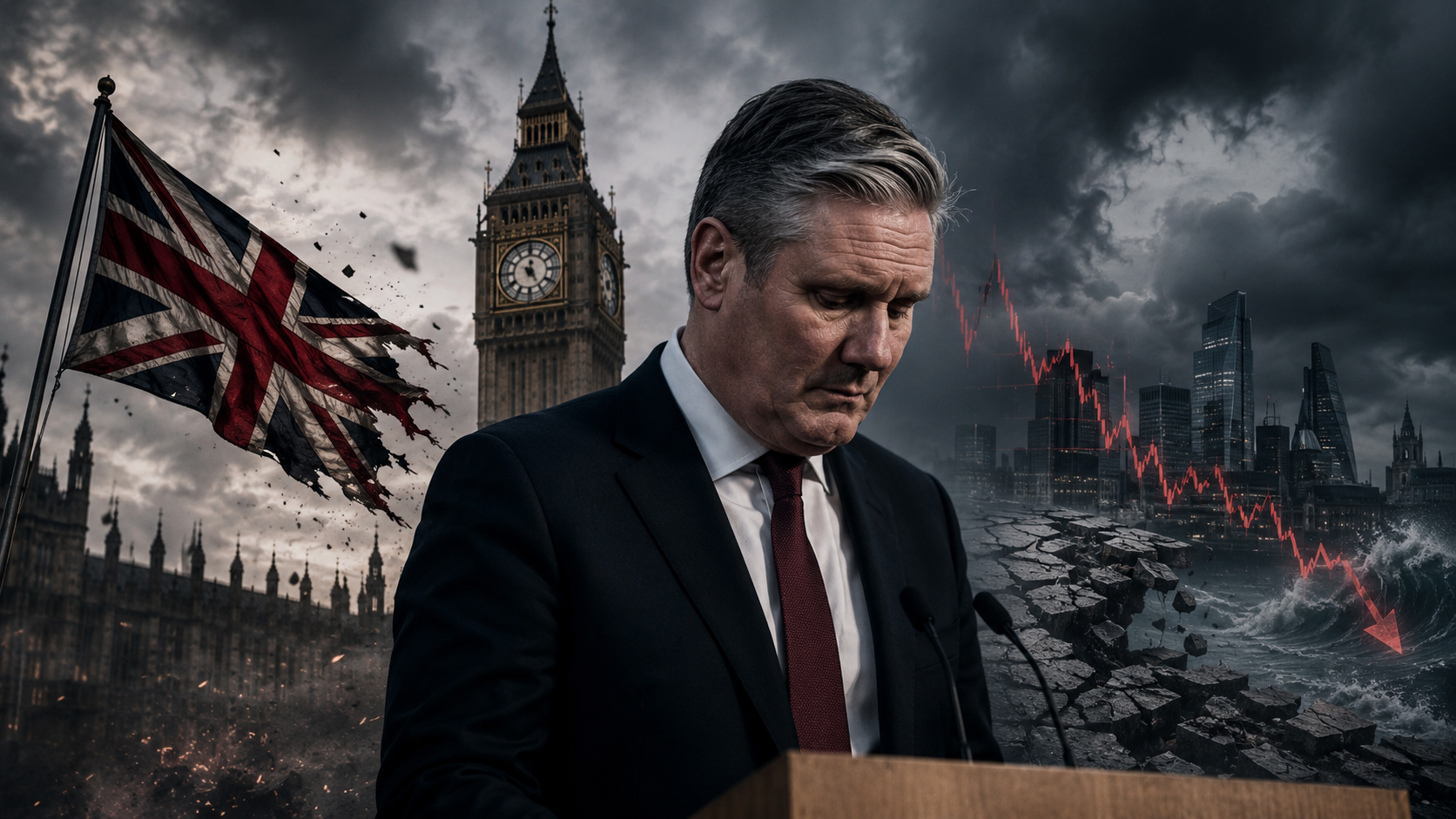
Political earthquake in Great Britain: Why Prime Minister Keir Starmer is resigning and what that means for the economy – Creative image: Xpert.Digital
Seventh Prime Minister in ten years: Britain's endless crisis claims its next victim
Starmer's dramatic fall: How tax increases and Nigel Farage brought down the Labour government
The Brexit curse strikes again: Why Labour is also breaking under the weight of Britain's problems
On June 22, 2026, Keir Starmer succumbed to the inevitable pressure and announced his resignation. After barely two years in office, he joined the long list of failed British prime ministers—the seventh leadership change in Downing Street in just a decade. What began in the summer of 2024 as a resounding landslide victory for Labour ended in an unprecedented loss of confidence, fueled by historic tax hikes, economic stagnation, and the rapid resurgence of right-wing populists under Nigel Farage. But Starmer's dramatic fall is more than a political footnote. It exposes the structural crisis of a nation still suffering from the toxic economic aftermath of Brexit, overburdened public services, and chronic underfunding. As international financial markets watch the political theater in London with nervous detachment, the party's hopes now rest on Andy Burnham. The charismatic former mayor of Manchester faces a Herculean task as a potential successor: he must revitalize the country with his economic model of "Manchesterism" without jeopardizing the confidence of the strict bond markets. This is an analysis of the pattern of institutional failure in the United Kingdom and the question of whether the next Prime Minister can halt the unprecedented downward trend.
The seventh prime minister in ten years – and the pattern of institutional failure repeats itself
On the morning of June 22, 2026, Keir Starmer stepped outside 10 Downing Street and did what political observers had been expecting for weeks: he announced his resignation as leader of the Labour Party and, consequently, as Prime Minister. His voice breaking, and visibly moved, he declared that he had made "every decision to put the country I love first." Britain is now facing its seventh Prime Minister in ten years – a fact that can no longer be dismissed as a mere political footnote, but rather signals a systemic breach of trust and governability.
From landslide victory to ruin: The brief euphoria of election victory
In the summer of 2024, Starmer secured one of the most significant parliamentary victories for Labour in recent British history. After fourteen years of Conservative rule, marked by Brexit chaos, COVID scandals, and Liz Truss's infamous 49-day chancellorship, expectations for the new Labour government were immense. Starmer positioned himself as a man of seriousness, stability, and institutional respect—a deliberate contrast to the cacophony of previous administrations. The public believed it was witnessing the dawn of a new era.
But the foundation of this new beginning proved more fragile than expected. As early as August 2024, Chancellor Rachel Reeves warned of a £22 billion fiscal "black hole" left behind by the previous Conservative government. This warning became the guiding principle of a government that found itself on the defensive before it could even take action. The budget, passed in the autumn of 2024 with historic tax increases of £40 billion, sparked fierce public opposition and raised doubts about Labour's commitment to providing economic relief for the working middle class.
The erosion of trust and popularity
Starmer's approval ratings plummeted within the first few months of his term. Three issues ran like a thread through public discontent: rising living costs, an overburdened public service, and an immigration policy that failed to meet either progressive or restrictive expectations. The abolition of the heating allowance for pensioners was an early symbolic blunder, demonstrating the new government's inability to communicate social policy compromises effectively. Meanwhile, the NHS continued to grapple with waiting lists of millions of patients and chronic staff shortages—structural problems that had accumulated over decades and could not be erased simply by changing governments.
In February 2026, the crisis reached a new level when Starmer's confidant and chief advisor, Morgan McSweeney, along with another close associate, resigned. The trigger was the controversial appointment of Peter Mandelson as US ambassador, despite Starmer's knowledge of Mandelson's friendship with convicted sex offender Jeffrey Epstein. The capital markets reacted swiftly: yields on ten-year British government bonds rose by up to eight basis points, and the pound temporarily lost 0.7 percent against the euro. The markets' message was unmistakable: political instability in London comes at a direct price.
The local election disaster and the trigger for the end
UK reform as a seismograph of public discontent
The regional and local elections in May 2026 proved to be the definitive turning point. Labour lost more than 260 seats on English local councils, while the right-wing populist Reform UK party, led by Nigel Farage, gained over 700 seats. The symbolic significance of the results was particularly painful: in Tameside, in Greater Manchester, Labour lost control of the city council for the first time in almost 50 years, after Reform UK won all 14 seats up for election. In Wales, a historical Labour stronghold, the party finished third behind Plaid Cymru and Reform UK – marking the end of a 27-year run in power. In Scotland, the trend continued; the SNP maintained its dominance.
These results were more than a local vote on road maintenance or waste disposal. They reflected a fundamental alienation between the Labour leadership and the party's traditional voter base: those working-class communities in the north of England that had once formed the core bastion of social democracy and were now flocking to a party that articulated their economic marginalization without offering any real substance. More than 70 of Labour's roughly 400 MPs publicly withdrew their support for Starmer; the number grew to over 95 in the following weeks.
The by-election in Makerfield as a guillotine
The final impetus came from a parliamentary by-election in the Makerfield constituency, which Andy Burnham – the long-serving mayor of Greater Manchester – won by a significant margin. Burnham thus entered the House of Commons and positioned himself as the most credible challenger to Starmer's leadership. His victory speech was a public expression of distrust: he warned that this was Labour's "last chance" to fundamentally renew itself. After this defeat, Starmer was politically dead, even though he outwardly refused to announce his resignation for several more days. On June 22, he took the inevitable step.
The structural roots of failure – more than a communication problem
The Brexit legacy as a persistent economic poison
Any honest analysis of the British economy must acknowledge Brexit as a fundamental constant. The figures speak for themselves: According to a study by Aston University, British goods exports to the EU fell by 27 percent between 2021 and 2023, while imports declined by 32 percent. The London School of Economics found that 16,400 companies had completely ceased trading with EU partners. The Office for Budget Responsibility (OBR) estimates that Brexit will cost the UK four percent of economic growth in the medium term. An analysis by Euronews showed that British GDP per capita at the beginning of 2025 was around eight percent lower than it would have been without Brexit.
Starmer inherited an economy that was structurally damaged and lacked the political capacity to fundamentally reshape the relationship with the EU. The Brexit electorate, which remains a politically mobilizable segment, would have viewed a rapprochement strategy as a betrayal. Thus, the government vacillated between pragmatic partial agreements and adhering to the fundamental Brexit decision – a position that failed to truly stimulate either trade or investment.
Weak growth, inflation and the fiscal bottleneck
The macroeconomic environment offered no support to the Starmer government. KPMG predicted as early as the end of 2025 that the British economy would grow by only one percent in 2026 – down from 1.4 percent the previous year – weighed down by weak consumer confidence, cooling labor demand, and persistent fiscal headwinds. EY further lowered its forecast to just 0.8 percent for 2026 following an energy-related shockwave and warned that inflation could rise again to over four percent by the end of 2026 – with the consequence that further interest rate cuts by the Bank of England would have to be postponed until spring 2027.
Yields on British government bonds reached their highest level since 2008 in May 2026: Ten-year gilts yielded over five percent at times. This significantly increased the cost of servicing the government's debt and further restricted fiscal space. Chancellor Rachel Reeves had declared "non-negotiable" budget rules for herself – a phrase intended to calm the bond markets but which also so limited the government's political room for maneuver that it could only respond to societal demands for more investment to a very limited extent.
Public services as social dynamite
The NHS remains the bleeding mascot of British domestic politics. Millions of patients wait for routine procedures, staff shortages are structural, and waiting times of over 18 weeks for many treatments are now the norm. The Starmer government aimed to reduce waiting lists but failed due to insufficient funding, a lack of qualified personnel, and a system that had simply been systematically underinvested for far too long. Added to this were the dilapidated state of infrastructure in the education system and overburdened social services. All of this created a reality in which many citizens simply did not experience the promised change.
Our EU and German expertise in business development, sales and marketing


Our EU and German expertise in business development, sales and marketing - Image: Xpert.Digital
Industry focus areas: B2B, digitalization (from AI to XR), mechanical engineering, logistics, renewable energies and industry
More information here:
A thematic hub offering insights and expertise:
- Knowledge platform covering global and regional economies, innovation and industry-specific trends
- A collection of analyses, insights, and background information from our key areas of focus
- A place for expertise and information on current developments in business and technology
- A hub for companies seeking information on markets, digitalization, and industry innovations
Manchesterism and markets: How Burnham could reshape Britain's economy
Markets caught between anxiety and pragmatism
How financial markets react to political noise
The pound sterling initially showed weakness on the day of the resignation, falling at one point to around $1.319, approaching its three-month low. Yields on ten-year gilts rose slightly by one basis point to 4.85 percent. Overall, however, the markets reacted with remarkably muted swings, allowing for several interpretations. First, Starmer's departure had long been priced in after weeks of speculation. Second, the widespread view that Andy Burnham, as his successor, would adhere to budget rules reduced the perceived risk of fiscal erosion. Third, British markets have developed a certain immunity to political shocks over a decade of chaotic government transitions.
But this superficial calm should not mask the underlying structural unease. Bond watchdogs had clearly demonstrated in the preceding weeks how quickly markets react when a change in policy is interpreted as fiscally risky. The possibility that a left-leaning successor might weaken budget rules or accept higher deficits is a latent market risk premium that keeps the pound and British government bonds under persistent pressure.
Andy Burnham and the legacy of Manchesterism
From the metropolitan area to Downing Street
Andy Burnham is considered the overwhelming favorite to succeed Starmer. The former health minister and long-serving mayor of Greater Manchester has created a deliberately polarizing economic narrative with the term "Manchesterism." He understands it to mean the end of neoliberalism, a more interventionist economic policy, greater public control over essential infrastructure such as energy, water, and rail, and a massive decentralization of powers away from Westminster and into the regions. His deputy mayor, Kate Green, praises his ability to combine economic prosperity with social inclusion.
The intellectual foundation of Manchesterism was provided by the think tank paper "The Productive State: A Framework for Manchesterism," authored by Mathew Lawrence, director of the Common Wealth think tank. It outlines an economic architecture in which the state not only regulates but also actively participates in value creation – a direct rejection of the Chicago School orthodoxy that has shaped British economic policy since Thatcher.
The constraints of the markets
Yet, at the very moment of his rise, Burnham signaled a significant self-restraint: he would adhere to Rachel Reeves's fiscal rules and pledged not to borrow significantly more. This is the fundamental contradiction of his political project: anyone who proclaims the end of neoliberalism while simultaneously accepting the strict debt rules of the neoliberal era as binding must explain how they intend to manage transformative investments in housing, infrastructure, and public services without additional funding. Pantheon Macroeconomics analyzed that Burnham might be "leaning toward the more left-leaning instincts of Labour MPs" and could finance higher spending through tax increases and more moderately relaxed fiscal rules. Markets will be watching this development closely.
What Burnham could mean for the economy
In a Burnham government scenario, the following economic policy priorities emerge: greater nationalization or regulation of public infrastructure, higher taxes on luxury properties and top earners, a pronounced regional policy agenda favoring northern England and other structurally weak areas, and a readjustment of relations with the EU towards closer economic cooperation – without seeking a formal return to the single market. The question of whether these measures will be sufficient to address the structural growth problem remains open. The OECD has revised its UK growth forecast upwards to 1.2 percent for 2026 and to 1.3 percent for 2027 – figures that show moderate growth is possible, but by no means signal a new beginning.
The deeper diagnosis: A decade of institutional disintegration
Seven prime ministers, one crisis
Britain has gone through seven prime ministers in ten years: David Cameron, Theresa May, Boris Johnson, Liz Truss, Rishi Sunak, Keir Starmer – and now a seventh. A country once considered the epitome of stable parliamentary democracy has become the subject of academic studies on government failure. Tony Travers of the London School of Economics put it succinctly: Previously, countries like Italy, where governments constantly changed, were seen as examples of instability. Today, Britain is that country.
The causes of this pattern are structural and run deeper than the personalities of individual leaders. Brexit has fragmented the political system into camps that barely share any common ground. The first-past-the-post electoral system mathematically produces disproportionately large parliamentary majorities that do not reflect deep societal consensus. And the British media system, dominated by an aggressive tabloid press, creates a cycle of attrition for leaders, systematically eroding middle management.
The crisis of confidence as a core economic problem
Political instability has measurable economic costs. Investors avoid economies with unpredictable government activity because risk premiums rise and planning certainty is lacking. The UK suffered a significant decline in foreign direct investment immediately after the Brexit referendum. At the beginning of 2025, UK GDP per capita was estimated to be up to 10 percent lower than in comparable economies that had not left the EU. The pound has permanently lost purchasing power since the Brexit referendum. And every new political earthquake—whether the Mandelson affair, a local election debacle, or a change of leadership—sends a further signal of unpredictability to international capital flows.
Opportunities and risks for economic development
The opportunities: A new beginning as a catalyst
Despite all the continuity issues, every change in leadership also presents a genuine opportunity for renewal. Under the following conditions, a successor prime minister could actually change the economic course for the better:
Firstly, a more pragmatic approach to the EU could be achieved without using the politically toxic buzzword "rejoin." Improved veterinary and food law agreements, facilitated exchanges of skilled workers, or greater integration into European research programs could partially mitigate the structural trade damage of Brexit without requiring formal membership. This is also more realistic than under Starmer because Burnham did not invest personal prestige in the Brexit stance.
Secondly, Manchesterism as an economic policy agenda offers the opportunity to invest strategically in the country's productive infrastructure: housing, renewable energy, regional transport networks, public education, and healthcare. If such an investment strategy is accompanied by credible fiscal management, it can generate growth that is not solely concentrated in financial services and London, but also strengthens the country's neglected regions.
Thirdly, a change of power within the party – without a parliamentary election – could signal to the public that the political class is capable of learning. Labour remains in power until the next election in 2029, which offers at least three years of political agency, provided internal energy is not wasted on leadership struggles.
The risks: The echo of past crises
The risks currently outweigh the benefits in both breadth and depth. The most immediate risk is the uncertainty surrounding Burnham's economic policy. As long as it remains unclear whether he will truly adhere to the budget rules or whether left-wing factions within the party will push him towards higher deficits, latent volatility in gilts and pounds will persist. Any hint of a departure from fiscal discipline would revive memories of the Truss trauma of 2022, when UK bond yields soared to historic highs within days.
The second risk is structural: Reform UK demonstrated in the local elections that it is not merely a protest movement, but a political force with deep roots in the traditional working-class electorate. Nigel Farage occupies the space of economic insecurity, loss of control, and cultural alienation with an articulateness that Labour cannot simply counter with a change of leadership. The risk is that Burnham's more left-leaning economic policies will fail to win back conservative voters while simultaneously failing to convince right-wing populist voters.
The third risk lies in the external economic dimension. The British economy is highly dependent on financial services – a sector already weakened by regulatory uncertainty and the gradual relocation of activities to the EU. Higher corporate taxes or increased regulation could accelerate this process. At the same time, global uncertainties – US trade policy, the Middle East, energy prices – remain potential sources of external shocks to which a politically weakened government can only respond to a limited extent.
Finally, there is the risk of reform fatigue. A population that has experienced seven prime ministers in ten years simply cannot trust political promises anymore. Trust in state institutions—the benchmark for long-term economic investment, social cohesion, and political participation—has suffered long-term damage. And trust is a resource that cannot be decreed through a budget or a party conference.
The pattern behind the individual case
Keir Starmer's resignation is not an isolated incident, but rather the latest link in a chain. The United Kingdom is caught in a political and economic cycle of degeneration, which individual figures can only briefly interrupt, not break. Structural causes—Brexit as a brake on growth, chronically underinvested public services, a first-past-the-post electoral system that exacerbates rather than moderates social divisions, and a media culture that penalizes stability—demand structural solutions.
Andy Burnham is given the opportunity to formulate such a response. His strength lies in his ability to combine personal credibility, regional roots, and an economic narrative that extends beyond London. His weakness lies in the vagueness of his plans, the constraints of the bond markets, and the fundamental impossibility of generating enthusiasm at will in a politically exhausted country.
One thing is certain: Britain cannot afford another change of government without a serious economic course. The price of political change is always ultimately paid by those whose purchasing power, healthcare, and job prospects depend on the government's ability to act – the working middle class of the country, whom Labour has claimed to represent for decades and who have now, in Makerfield and elsewhere, voiced their impatience at the ballot box.
🎯🎯🎯 Data-driven B2B industry hub as a quasi-in-house solution


The quasi-in-house solution: How Xpert.Digital closes operational gaps in B2B marketing and sales – Smart Content-Driven Business - Image: Xpert.Digital
Xpert.Digital is a data-driven B2B industry hub led by Konrad Wolfenstein . The company acts as an external, quasi-in-house solution for industrial partners, closing operational gaps in marketing, content, and sales – without requiring additional resources on the client side.
More information here:
Your global marketing and business development partner
☑️ Our business language is English or German
☑️ NEW: Correspondence in your native language!

Konrad Wolfenstein
I and my team are happy to be available to you as your personal advisor.
You can contact me by filling out the contact form here wolfenstein@xpert.digital:or simply call me at +49 7348 4088 965. My email address is
I'm looking forward to our joint project.