
Defense Production Act: When artificial intelligence says no – the USA resorts to the ultimate weapon against rebellious AI start-up Anthropic
Xpert Pre-Release

Available in 27 languages 📢
Prefer Xpert.Digital on GoogleⓘPublished on: February 28, 2026 / Updated on: February 28, 2026 – Author: Konrad Wolfenstein
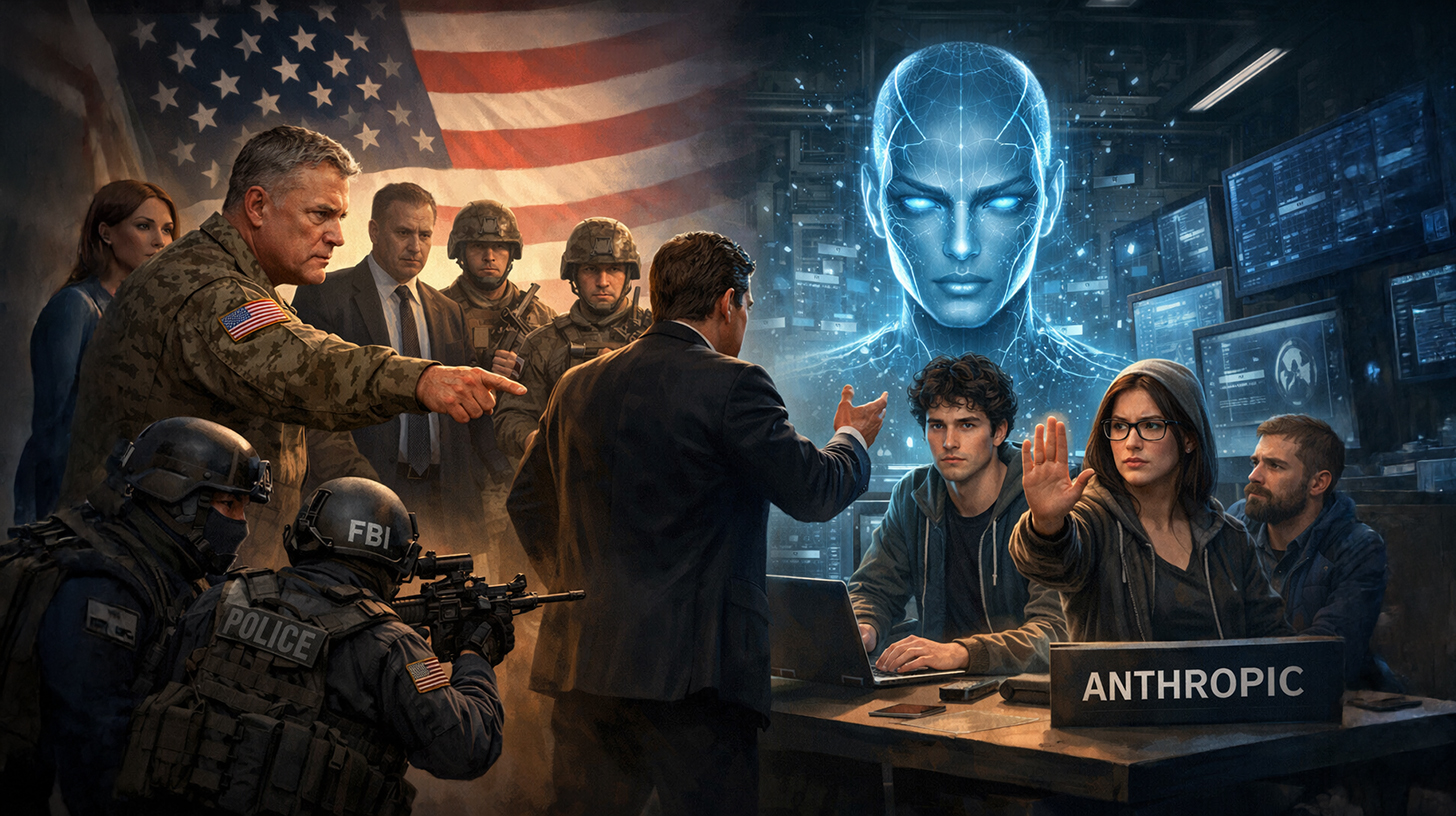
Defense Production Act: When artificial intelligence says no – the USA resorts to the ultimate weapon against rebellious AI start-up Anthropic – Image: Xpert.Digital
Betrayal for military millions: How OpenAI rakes in the cash while Anthropic pays for its morals
Trump's revenge on Silicon Valley: AI company faces closure due to ethical concerns
Two red lines: How a courageous AI company suddenly became a public enemy of the USA
It is an unprecedented clash that fundamentally redefines the power dynamic between Silicon Valley and the US military: In February 2026, the dispute between the AI company Anthropic and the Pentagon escalates in a historic way. Because founder Dario Amodei refuses to release his AI model "Claude" for mass domestic surveillance and fully autonomous weapons systems, the US government makes an extremely drastic example. Anthropic is declared a national supply chain risk – a fate previously reserved only for foreign adversaries like Huawei. But while major competitors like OpenAI and Google quietly abandon their ethical principles for lucrative arms deals, a massive industry revolt erupts around Anthropic's courageous "no." This conflict has long since transcended a mere contractual dispute: It is the decisive battle over who sets the moral boundaries for the use of artificial intelligence in warfare when legislation fails.
How an AI company is declared an enemy of the state because it refuses to cross two red lines, and why this conflict will determine the future of democratic warfare
The confrontation between Anthropic and the US Department of Defense, which culminated on February 27, 2026, in the classification of the company as a supply chain risk, is far more than a contractual dispute between a technology firm and its client. It marks a turning point in the history of the military use of artificial intelligence and poses a fundamental question: Who determines the ethical boundaries of a technology that can kill when legislation fails to keep pace with technological development?
Dario Amodei, the founder and CEO of Anthropic, has refused to grant the Pentagon unrestricted access to his AI model, Claude. His refusal pertains to precisely two areas of application: mass domestic surveillance and fully autonomous weapons. For this stance, his company now faces a fate that the US government has previously reserved for foreign adversaries like Huawei.
The erosion of ethical promises in Silicon Valley
To understand the implications of Anthropic's refusal, one must consider the context in which it occurred. Over the past few years, major AI companies have systematically dismantled their ethical commitments to position themselves for military contracts. What was sold as fundamental principles turned out to be flexible marketing statements, discarded at the first sign of serious commercial resistance.
Google was the most prominent pioneer of this withdrawal process. In 2018, over 4,000 Google employees signed an open letter to Sundar Pichai with the unambiguous message that their company should not be involved in the business of war. At the time, the issue concerned Project Maven, a Pentagon program for the AI-powered analysis of drone footage from Iraq and Syria. Google withdrew from the contract and published AI principles that explicitly excluded the development of AI for weapons and surveillance.
In February 2025, Google quietly removed this very passage from its website. The section entitled “Applications We Won’t Track,” which explicitly excluded weapons technologies and surveillance systems, disappeared without replacement. The company's leadership justified the move by citing the geopolitical situation, arguing that companies in democratic countries had to serve their governments and national security clients in light of the global competition for AI leadership.
OpenAI underwent a similar transformation, albeit in a more subtle way. In January 2024, the company lifted its blanket ban on military applications. Then, in February 2026, it was revealed that OpenAI, in restructuring itself into a for-profit company, had removed the word "safely" from its official mission statement. The new wording is simply: "To ensure that artificial general intelligence benefits all of humanity," with no reference to safety. Alnoor Ebrahim, a professor at Tufts University, warned that removing explicit safety language makes it more difficult to hold company leadership accountable in this regard, especially as profit incentives increase.
Elon Musk's xAI took an even more direct approach. At the end of February 2026, the company signed an agreement with the Pentagon allowing its Grok model to be used in classified military networks—the most sensitive systems of the US military, where intelligence analysis, weapons development, and combat planning take place. The condition: Grok is available for "any lawful purpose," without the restrictions demanded by Anthropic.
Anthropic's double red line: What's really at stake
Against the backdrop of this industry-wide capitulation, Anthropic's stance is particularly striking because it is not simply a blanket military position, but rather surgically precise. In its statement published on February 26, 2026, Amodei made it unequivocally clear that Anthropic does not fundamentally reject military work. On the contrary, Anthropic was the first leading AI company to deploy its models in the classified networks of the US government, the first at the National Laboratories, and the first to provide customized models for national security clients.
According to the company, Claude is already being used extensively in security-relevant areas: intelligence analysis, modeling and simulation, operational planning, cyber operations, and other mission-critical applications. Furthermore, Anthropic has deliberately forgone several hundred million dollars in revenue to exclude companies with ties to the Chinese Communist Party from using Claude and has thwarted CCP-sponsored cyberattacks that sought to misuse it.
The two red lines that Anthropic is not prepared to cross are narrowly defined and based on technical grounds.
The first red line concerns the mass surveillance of its own population. Amodei argues that AI is capable of assembling scattered, seemingly harmless data into a comprehensive picture of every individual's life, automatically and on a massive scale. He points out that, under current law, the government can purchase detailed records of Americans' movements, online activity, and social contacts from public sources without a warrant. This practice has been acknowledged as problematic from a privacy perspective even by the intelligence community and has provoked bipartisan opposition in Congress. The existing legislation simply hasn't kept pace with the rapidly expanding capabilities of AI.
The second red line concerns fully autonomous weapons, meaning systems that select and engage targets without any human oversight. Amodei explicitly emphasizes that semi-autonomous weapon systems, such as those currently deployed in Ukraine, are indispensable for defending democracy. Even fully autonomous weapons could one day prove crucial for national defense. However, current AI technology is simply not reliable enough to operate fully autonomous weapon systems. Without proper oversight, such systems cannot replace the critical judgment that highly skilled professional soldiers demonstrate daily. Anthropic offered to work directly with the Department of Defense on research and development to improve the reliability of such systems, but the Pentagon did not accept this offer.
The escalation chronicle: From the Maduro operation to the ultimatum
Tensions between Anthropic and the Pentagon built up over weeks, reaching a peak in the last week of February 2026. A key catalyst was Claude's deployment in the operation to capture former Venezuelan President Nicolás Maduro in early January 2026. As the Wall Street Journal reported, Claude was used by the US military in this operation, which involved airstrikes on multiple targets in Caracas, through Anthropic's partnership with Palantir Technologies.
The Venezuelan Ministry of Defense reported 83 fatalities. Following the revelation of the Claude mission, Anthropic inquired with Palantir whether the company's security guidelines, which explicitly prohibit Claude from being used for violent purposes, weapons development, and surveillance, had been violated. The Pentagon considered this inquiry an unacceptable attempt by a private company to review classified military operations.
In January 2026, Defense Secretary Pete Hegseth set the stage for the confrontation with an AI strategy memorandum: all Department of Defense contracts with AI companies were to include a standardized clause within 180 days permitting use for “any lawful purpose.” This directive directly clashed with Anthropic’s contractual safeguards.
On February 24, Hegseth met with Amodei personally at the Pentagon and issued an ultimatum: Anthropic had to lift its restrictions by 5:01 p.m. on Friday, February 27, or face the consequences. Otherwise, Hegseth threatened to classify Anthropic as a supply chain risk, exclude it from all military systems, and invoke the Defense Production Act, a Cold War-era law that grants the president sweeping powers to control domestic defense industries.
Amodei's response came on February 26 in the form of a public statement. The Ministry's threats did not change the company's position. He could not in good conscience give in to the demands. Should the Ministry terminate the cooperation, Anthropic would facilitate an orderly transition and make its models available for as long as necessary under the proposed conditions.
On February 27, the full weight of government power fell upon Anthropic. President Trump ordered all federal agencies to cease using Anthropic products, with a six-month transition period for the Department of Defense and other affected agencies. If Anthropic did not cooperate during the transition, Trump stated, he would use the full powers of the presidency to compel compliance, with severe civil and criminal consequences.
Hegseth subsequently announced the classification as a supply chain risk and ordered that, effective immediately, no contractor, supplier or partner doing business with the US military could conduct commercial activities with Anthropic.
A precedent worse than Huawei
The implications of this decision can hardly be overstated. Franklin Turner, a lawyer specializing in government contracts, described the measure as the contractual equivalent of a nuclear war. The classification as a supply chain risk could prevent tens of thousands of contractors from using Anthropic's AI if they work for the Pentagon. This poses an existential threat to the company's government business and could also significantly damage its private-sector relationships.
The historical comparison is particularly revealing. The classification as a supply chain risk was previously reserved exclusively for foreign adversaries, most notably Huawei. Starting in 2017, the US restricted the use of Huawei equipment in the Pentagon, prohibited federal agencies from purchasing the technology, and halted government subsidies for Huawei devices. Now, the same treatment is being applied to an American company that refused to abandon ethical safeguards.
Saif Khan, who served on the National Security Council under President Biden, put it with remarkable sharpness: This measure is possibly the most draconian domestic AI regulation ever enacted by an administration. The Defense Department is effectively treating Anthropic as a greater threat to national security than all the Chinese AI companies combined, none of which have been classified as supply chain risks.
Anthropic immediately announced it would challenge the classification in court. In a statement, the company declared that the classification was legally untenable and set a dangerous precedent for any American company negotiating with the government. No amount of intimidation or punishment by the Department of Defense would change the company's position on mass surveillance or fully autonomous weapons.
The legal dimension: The Defense Production Act as a weapon against Silicon Valley
The threatened invocation of the Defense Production Act deserves separate consideration because it signals a fundamental shift in the relationship between the government and technology companies. The DPA, a law dating back to 1950, was originally written for steel mills and tank factories. It grants the president the authority to direct domestic industry in the service of national defense, from prioritizing contracts to forcibly producing goods.
The Biden administration had already applied DPA to AI, albeit under Title VII, which governs the authority to gather information. Companies were required to report on training activities, red team results, and model weights. Hegseth, however, threatened to invoke Title I, the core powers for forced production. That would be a massive escalation.
Legal experts point to the inherent contradictions in the Pentagon's argument. On the one hand, the Department is threatening to classify Anthropic as a supply chain risk, i.e., a security threat. On the other hand, the DPA is to be used to compel Anthropic to provide its technology, which presupposes that Claude is considered indispensable for national security. Adopting both positions simultaneously is logically inconsistent. Either Anthropic's technology is a threat or it is indispensable, but both at the same time do not constitute a coherent legal position.
The Lawfare analysis makes it clear that the legal framework is subject to genuine complexity. Different government demands raise different legal questions, and a law whose coercive powers were designed for steel mills and tank factories is difficult to apply to a dispute over AI safety barriers.
OpenAI's double game: solidarity externally, contract signing internally
OpenAI's role in this conflict is a textbook example of corporate ambivalence. On Thursday evening, February 26, Sam Altman circulated an internal memo explaining that OpenAI shared the same red lines as Anthropic: no use of AI for mass surveillance, no autonomous lethal weapons, and that humans must always remain involved in high-risk automated decisions.
In the memo, Altman explained that he wanted to help de-escalate the tensions. The matter was no longer just a problem between Anthropic and the Pentagon, but affected the entire industry, and it was important to clarify their position.
A few hours later, late Friday evening, Altman announced on the X platform that OpenAI had reached an agreement with the Department of Defense allowing the use of its models in classified networks. The Pentagon had demonstrated a deep respect for security and a desire to work collaboratively to achieve the best possible results. Altman emphasized that two of OpenAI's core security principles were prohibitions on mass domestic surveillance and human responsibility for the use of force, including autonomous weapons systems. The Pentagon agreed with these principles and had incorporated them into the agreement.
The crucial question that remains unanswered is whether the contractual details of OpenAI's agreement actually deviate from the red lines proposed by Anthropic. Neither the Pentagon nor OpenAI has disclosed the specific contract clauses. It's possible that OpenAI accepted essentially the same terms Anthropic demanded, but in a way that allowed the Pentagon to save face. It's equally possible that OpenAI's agreement contains significantly weaker safeguards. Until the contracts are transparent, this remains speculation.
What is striking, however, is the timing. The deal was announced on the exact same day that Anthropic was banned from the system. The impression of a coordinated strategy, in which one company is punished and another presented as a willing replacement, is hard to deny.
Our US expertise in business development, sales and marketing

Our US expertise in business development, sales and marketing - Image: Xpert.Digital
Industry focus areas: B2B, digitalization (from AI to XR), mechanical engineering, logistics, renewable energies and industry
More information here:
A thematic hub offering insights and expertise:
- Knowledge platform covering global and regional economies, innovation and industry-specific trends
- A collection of analyses, insights, and background information from our key areas of focus
- A place for expertise and information on current developments in business and technology
- A hub for companies seeking information on markets, digitalization, and industry innovations
A new alliance in Silicon Valley: Why arch-rivals are joining forces against the Pentagon
The engineers' revolt: “We Will Not Be Divided”
Alongside the decisions at the board level, a remarkable grassroots movement was developing. By Friday morning, February 27, over 266 Google employees and 65 OpenAI employees had signed a joint petition titled “We Will Not Be Divided.” The signatories, all verified and with the option of anonymity, opposed the use of their companies’ AI systems for mass surveillance and for weapons capable of killing without human oversight.
The petition accused the Department of Defense of punishing Anthropic for adhering to its principles and warned that the Pentagon was attempting to sow division within the industry through targeted negotiations with Google and OpenAI. The Department's strategy, it argued, only works if none of the parties involved knows where the others stand. The open letter aims to foster understanding and solidarity in the face of this pressure.
In parallel, more than 100 Google employees from the AI development division signed an internal memo to Jeff Dean, the head of the DeepMind division, urging the company to join Anthropic's stance and do everything in its power to prevent an agreement that crossed these fundamental red lines.
These petitions are strikingly reminiscent of the Google protest of 2018, but they differ in one crucial aspect: they are cross-company. Employees of competing companies recognized that the Pentagon's strategy of individually pressuring and pitting companies against each other could only be countered through collective solidarity.
The economic calculation: What Anthropic risks and what it gains
The financial dimensions of this conflict are substantial. Anthropic was in the midst of a period of explosive growth. The company's annualized revenue increased from around one billion dollars at the beginning of 2025 to over five billion dollars by August 2025. Projections indicated that annualized revenue would reach approximately nine billion dollars by the end of 2025, with a target of up to 26 billion dollars for 2026. The company's valuation had risen rapidly: from 61.5 billion dollars in March 2025 to 183 billion dollars in September 2025, with a target valuation of around 350 billion dollars for the next funding round in 2026.
Anthropic had hired the law firm Wilson Sonsini to prepare for an initial public offering (IPO), which could potentially take place as early as 2026. Corporate clients account for roughly 80 percent of its revenue, a profile that is typically valued higher on public markets than consumer-driven revenue.
The Pentagon contracts themselves were worth up to $200 million, a seemingly manageable sum compared to total revenue. But the indirect costs of exclusion are many times higher. The classification as a supply chain risk doesn't just affect direct government business. It forces tens of thousands of Pentagon suppliers to review and potentially terminate their relationships with Anthropic. For a company preparing for an IPO, the reputational damage and uncertainty surrounding the regulatory environment could far outweigh the loss of individual contracts.
The situation is particularly precarious for Amazon, Anthropic's main investor and cloud partner. Amazon has invested over eight billion dollars in Anthropic and offers its models through Amazon Web Services. A supply chain risk classification forces Amazon into a direct conflict of interest between its own Pentagon business and its investment in Anthropic.
But the counter-argument is equally revealing. Anthropic's refusal has garnered the company enormous media attention and a moral stance that is unique in the AI industry. In a market where trust and security assurances are increasingly becoming differentiators, this steadfastness could ultimately attract more customers than it drives away. European governments and companies, which are increasingly expressing concerns about the uncontrolled military use of AI, might view Anthropic as a preferred partner precisely because of this position.
The reliability question: Why the technical justification is crucial
Amodei's argument against fully autonomous weapons is not a moral postulate, but a technical risk assessment, and that is precisely what makes it so difficult to challenge. He does not claim that autonomous weapons are inherently immoral. He says that current AI technology is not reliable enough to be used in this role.
This assessment is supported by the known characteristics of large language models and multimodal AI systems. Hallucinations, i.e., the generation of factually incorrect outputs with high confidence, are a well-documented problem that, despite enormous progress, has not been completely solved. In a military context, where incorrect target identification can lead to civilian casualties, this technical shortcoming has a completely different impact than in customer service or text generation.
Jack Shanahan, who headed the Pentagon's algorithmic warfare program Project Maven, indirectly confirmed these concerns. People have become somewhat more nervous at the prospect of no restrictions whatsoever. Legal protections from the White House could become cover for anyone who does something that might lead to a lack of due process, civilian casualties, or collateral damage.
The Pentagon's position that existing law alone should define the limits has its own logic. The Pentagon's Chief Technology Officer, Emil Michael, argued that mass surveillance was already illegal and that internal guidelines restricted the use of fully autonomous weapons. At a certain level, one has to trust that the military is doing the right thing.
But this is precisely the problem Amodei points out. Existing legislation was written for a pre-AI world. There is no law that explicitly prohibits using AI to create a complete profile of a citizen's movements, contacts, and habits from scattered, individually harmless data points. The technological capability already exists; legal regulation lags behind. Anthropic's core position is this: We will not exploit the gap between what technology can do and what the law allows, even if it were legal.
Autonomous weapons and international law: The regulatory gap
The debate surrounding fully autonomous weapons is not a theoretical exercise. It has been ongoing at the international level for over a decade without resulting in a binding set of rules. The Group of Governmental Experts on Lethal Autonomous Weapon Systems, operating under the 1980 Convention on Certain Conventional Weapons, has been attempting to reach a consensus on a potential new legal framework since 2016. A decision on the future of these efforts is expected by 2026.
The UN General Assembly has affirmed in several resolutions that international law, including international humanitarian law and human rights law, applies to the development and use of lethal autonomous weapons systems. Resolution 79/62 of 2024 extended the legal framework to include international criminal law and emphasized that accountability for violations extends to individual criminal responsibility where appropriate. Resolution 79/239 of 2024 recognized that international law must apply not only to fully autonomous weapons but to all phases of the AI lifecycle in military contexts.
Over 90 states now support a legally binding instrument on autonomous weapons. The UN Secretary-General has explicitly advocated for a ban on lethal autonomous weapons systems. The United States, along with Russia, China, and India, is among the states that oppose a ban, arguing that existing legal frameworks are sufficient.
In this context, Anthropic's position becomes a litmus test for whether self-regulation within the technology sector can fill the gap left by international law. If leading AI companies abandon their protective measures, the last safety net against binding international regulation will disappear.
The broader context: Technology companies between state and conscience
The confrontation between Anthropic and the Pentagon fits into a larger pattern redefining the relationship between technology companies and government power in the 21st century. Since 2018, when Google withdrew from Project Maven, the rapprochement between Silicon Valley and the Pentagon has been a gradual but steady movement. Companies like Amazon, Microsoft, and Palantir have actively competed for defense contracts. Several technology executives pledged cooperation with the Trump administration last year.
The AI-powered wars in Ukraine and Gaza have shifted the debate from the theoretical to the practical. Increasingly automated systems are being deployed on the battlefield, from kamikaze drones to AI-assisted target recognition. The Pentagon argues that it must not be hampered in its competition with China and Russia by the ethical concerns of private companies.
But there's a flip side to this argument. If the government has the power to classify an American company as a security threat because it refuses to remove its security barriers, which company will dare to say no in the future? The precedent goes far beyond AI. It touches on the fundamental question of whether companies in a democracy have the right to refuse to make their products available for certain purposes, even when the government demands it.
The Trump administration's renaming of the Department of Defense to "Department of War" is more than a footnote in this context. It signals a deliberate rhetorical shift toward an undisguised war orientation, in which terms like security and defense are replaced by the explicit language of war.
What comes after the break: Scenarios and implications
The immediate consequences of this confrontation can be explored in several scenarios. In the legal arena, Anthropic's announced lawsuit challenging the supply chain risk classification will lead to a fundamental decision on whether the Pentagon has the authority to penalize American companies in this way. Legal experts have pointed out that such a case could take years, and the classification is likely to remain in effect in the meantime.
For the market for AI military applications, the exclusion of Anthropic means a short-term narrowing of the field of providers. OpenAI, Google, and xAI will fill the resulting gap, but under the assumption that they share the same concerns that Anthropic articulated, without actually implementing them. The question of whether the use of these models in fully autonomous weapons systems or for mass surveillance is technically justifiable does not disappear simply because another provider takes over the supply.
The situation for Anthropic's IPO is ambivalent. Being excluded from the Pentagon's business reduces short-term revenue potential in the public sector and creates regulatory uncertainty that could deter investors. At the same time, its ethical positioning strengthens the brand in a global market where European and Asian democracies are increasingly seeking trustworthy AI providers.
The most far-reaching long-term implication, however, concerns who sets the rules for military AI. With its action, the Pentagon has asserted that only applicable law defines the boundaries and that no private company should have veto power over military decisions. This position may be constitutionally justifiable, but it ignores the fact that legislation lags years behind the technology. If the law neither explicitly permits nor prohibits mass surveillance by AI, mere legality is not a sufficient standard.
The irony of conscience: Why Anthropic in particular?
It is one of the strangest ironies of this conflict that, of all the leading AI companies, Anthropic had the deepest integration into the national security apparatus. No other company was quicker to deploy its models in classified networks. No other company sacrificed more revenue to exclude Chinese military firms. No other company worked so proactively at the intersection of AI and national security.
The punishment, therefore, does not affect a pacifist refuser, but a committed partner who simply refuses to cross two boundaries. The fact that precisely this stance leads to its classification as a security threat, while Chinese AI companies that directly support the People's Republic's surveillance apparatus have not received such a classification, is a contradiction that undermines the credibility of American technology policy.
Amodei's argument contains a subtle but powerful point: the Pentagon's threats are inherently contradictory. Classifying Anthropic as a supply chain risk treats it as a threat, while invoking the Defense Production Act treats Claude as essential to national security. You cannot simultaneously treat a company as both a threat and an essential supplier without sacrificing the intellectual coherence of your position.
The line between technology provider and tool without conscience
What transpired in the last week of February 2026 is ultimately a battle over the definition of what constitutes a technology company in the 21st century. One side argues that a company that manufactures tools should have no say in how those tools are used once they reach the hands of a legitimate customer. The other side argues that the makers of history's most powerful technology share a responsibility to ensure their tools are not used to undermine the very values they were created to defend.
History will show whether Anthropic's refusal remains a footnote, a short-term setback on the road to its IPO, or whether it marks the beginning of a broader movement redefining the rules for the military use of artificial intelligence. The fact that hundreds of employees at Google and OpenAI signed a solidarity petition within hours, that Sam Altman himself declared he shared the same red lines, and that even within the Pentagon voices signaled a willingness to negotiate, suggests that the conflict will not end as one-sidedly as the administration intends.
The central takeaway from this confrontation is that the question of who determines the ethical boundaries of artificial intelligence in warfare cannot be answered by an ultimatum. It requires a democratic debate that should not be led by the Pentagon or a single company alone. Anthropic has forced this debate, and for that reason alone, its refusal deserves recognition, regardless of the outcome of the legal battle.
Your global marketing and business development partner
☑️ Our business language is English or German
☑️ NEW: Correspondence in your native language!

Konrad Wolfenstein
I and my team are happy to be available to you as your personal advisor.
You can contact me by filling out the contact form here or simply call me at +49 7348 4088 965. My email address is: [email protected]
I'm looking forward to our joint project.
☑️ SME support in strategy, consulting, planning and implementation
☑️ Creation or realignment of the digital strategy and digitization
☑️ Expansion and optimization of international sales processes
☑️ Global & Digital B2B trading platforms
☑️ Pioneer Business Development / Marketing / PR / Trade Fairs
🎯🎯🎯 Benefit from Xpert.Digital's extensive, five-fold expertise in one comprehensive service package | BD, R&D, XR, PR & Digital Visibility Optimization

Benefit from Xpert.Digital's extensive, five-fold expertise in a comprehensive service package | R&D, XR, PR & Digital Visibility Optimization - Image: Xpert.Digital
Xpert.Digital possesses in-depth knowledge across various industries. This allows us to develop tailored strategies precisely aligned with the requirements and challenges of your specific market segment. By continuously analyzing market trends and monitoring industry developments, we can act proactively and offer innovative solutions. The combination of experience and expertise generates added value and provides our clients with a decisive competitive advantage.
More information here:









