
What exactly is SaaS? Who are the largest SaaS providers and what are their most important products?
Xpert Pre-Release

Available in 27 languages 📢
Prefer Xpert.Digital on GoogleⓘPublished on: February 8, 2026 / Updated on: February 8, 2026 – Author: Konrad Wolfenstein
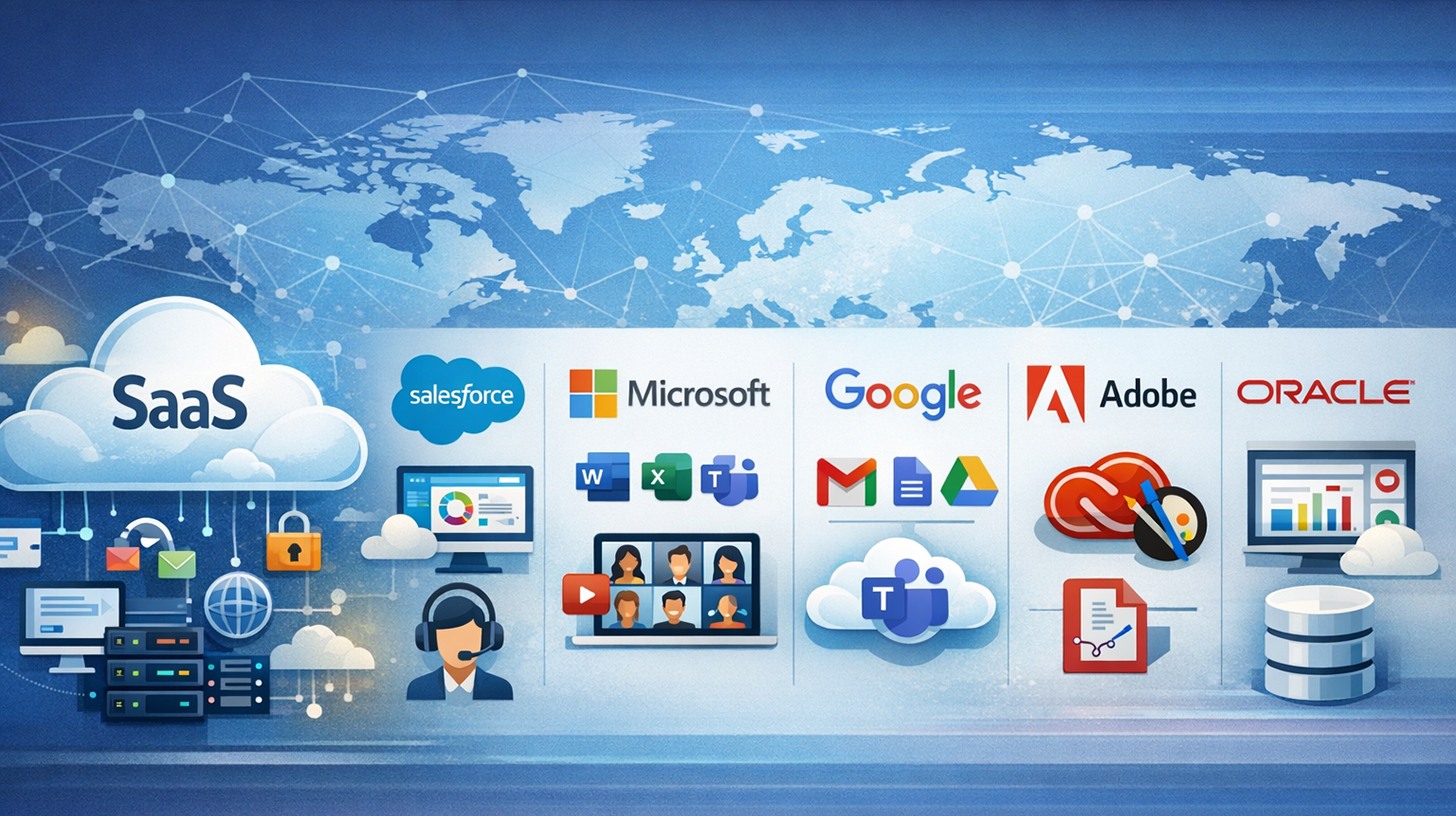
What exactly is SaaS? Who are the largest SaaS providers and what are their most important products? – Image: Xpert.Digital
Cloud instead of hard drive: Why SaaS has changed the software world forever
From home offices to large corporations: Why nobody can do without SaaS today
Anyone writing an email, participating in a video conference, or maintaining customer data in a CRM system today is highly likely using a SaaS solution, often without even realizing it. The days of laboriously installing software on individual computers via CD-ROM and manually maintaining it are largely a thing of the past. Instead, a model has taken hold that promises flexibility, scalability, and constant availability: Software as a Service.
With this cloud-based approach, software is no longer purchased but rather "rented" and conveniently accessed via a web browser. For companies, this means a significant reduction in the burden on their IT infrastructure, as updates, security patches, and storage space are managed by the provider. However, the market is vast and often confusing for non-experts. Global tech giants like Microsoft, Salesforce, Oracle, and SAP are engaged in a race to develop the best platforms and most comprehensive ecosystems.
But how does the technology work in detail? What advantages does the subscription model offer compared to traditional licensing? And above all: Which products from the major providers are indispensable for today's economy? In this article, we examine the fundamentals of SaaS, analyze the core features of modern cloud solutions, and introduce the most important players and their market-leading products.
Related to this:

What exactly is SaaS? – Basics and how it works
Software as a Service, or SaaS for short, refers to a cloud-based software delivery model in which applications are provided via the internet and used through a web browser or a lightweight client application. Instead of installing software locally on their own computer or server, users access a solution hosted by the provider via the internet. Typically, the provider manages the entire infrastructure, middleware, application software, and security, while users access the solution via a subscription or a pay-as-you-go model.
SaaS is a subset of cloud computing and differs from traditional on-premises licensing, where companies license the software, install it on their own servers, and maintain it themselves. With the SaaS model, the provider handles updates, patches, security measures, and infrastructure scaling, allowing customers to focus primarily on usage rather than technical operational tasks. The software is often operated in a multi-tenant model, meaning that the infrastructure and codebase are shared by many customers, while the data and configurations of each tenant remain separate.
The typical functionality of a SaaS product is such that the application runs in the provider's data centers, and users access it via the internet, logging in through a web browser or app. Billing is usually monthly or annually per user, per module, or per resource consumed. Many providers also offer APIs that enable integration into existing system landscapes—such as ERP or CRM solutions. This makes SaaS a flexible component in the digital infrastructure of modern companies.
Key features of modern SaaS
A key feature of SaaS is its web-based accessibility. The software is typically accessible via a standard browser or a cross-platform app, without requiring local installations. End devices can vary widely – from desktop computers and laptops to smartphones and tablets – as long as a stable internet connection is available. This accessibility ensures high flexibility and supports modern work arrangements such as working from home or remote teams.
Another key feature is the subscription model. Instead of paying one-time license fees for permanent use, there are ongoing operating costs. For companies, this means better planning and a reduction in high initial investments in software. At the same time, users can adjust the number of licenses as needed, for example, in response to company growth or seasonal peaks in usage.
A third important point is the automatic maintenance and further development by the provider. New features, bug fixes, and security updates are provided centrally in the background; users generally always see the latest version without having to perform any updates or patching processes themselves. This reduces the administrative workload for the IT department and lowers error rates, as manual update management is no longer necessary.
Furthermore, SaaS is often characterized by high scalability and multi-tenancy. The infrastructure can be elastically adapted at the platform level, so performance is not limited by local hardware constraints. At the same time, many customers benefit from the same basic functions and security standards, while their data remains isolated. This makes SaaS an efficient and economical model for companies of all sizes.
Key application areas of SaaS
SaaS solutions are now widespread in virtually all areas of business. In the productivity and collaboration sector, office suites, email services, calendars, and chat tools are central components of digital work environments. In business management, SaaS-based ERP, CRM, and HCM solutions form the backbone of numerous business processes. Companies also use SaaS for finance applications, project and portfolio management, e-commerce platforms, marketing automation, customer support systems, data analytics, and business intelligence tools.
In the area of development and IT infrastructure, SaaS solutions are used for DevOps tools, version control, CI/CD pipelines, monitoring and observability platforms, and security solutions. Additionally, SaaS offerings are gaining importance for specialized industries, such as healthcare, finance, education, and the public sector. In practice, SaaS is thus becoming an integral building block for the transformation, scaling, and automation of business processes.
The world's largest SaaS providers
The global market is dominated by a few providers with a broad portfolio of SaaS solutions. Among the highest-revenue and most influential companies are Microsoft, Amazon Web Services, Salesforce, Oracle, and SAP. In addition, providers such as Adobe, Google, Zoom, Atlassian, and ServiceNow are very significant with their specialized SaaS solutions. All of these companies have gradually transitioned to cloud deployment models in recent years and increasingly offered their traditional products as SaaS offerings.
Microsoft deserves special mention, as it holds a leading global position in productivity and collaboration software with products like Microsoft 365. Microsoft 365 combines Word, Excel, PowerPoint, Outlook, Teams, and other tools into a cloud-based suite accessible via subscription. At the same time, Microsoft offers a wide range of cloud services through Azure, which support many SaaS solutions from other providers. Overall, Microsoft is thus both a direct SaaS provider and a platform host for countless other SaaS solutions.
While Amazon Web Services is primarily known as an infrastructure provider, it also operates numerous SaaS-based services such as AWS S3, Amazon RDS, AWS Lambda, and Amazon WorkSpaces. These services are largely billed based on consumption and allow other companies to run their own SaaS software on a scalable cloud platform. AWS is therefore a key driver of the SaaS economy, even if the actual end-user applications are not always visibly labeled as "SaaS.".
Salesforce is another key player in the SaaS sector. The company originally established itself as a CRM provider and today offers a comprehensive platform for customer relationship management, marketing, sales automation, and service management. Salesforce solutions are fully cloud-hosted and accessed via a subscription model. The platform is also extensible through its own and third-party apps, creating a comprehensive ecosystem.
Oracle and SAP are long-established providers of enterprise software that are increasingly offering their classic ERP, CRM, and HCM products as SaaS solutions. Oracle offers cloud solutions for ERP, HCM, supply chain management, and database deployment, among others. SAP, with SaaS offerings such as SAP S/4HANA Cloud, SAP SuccessFactors, and SAP Ariba, is building on providing applications for finance, human capital management, and supply chain processes in the cloud. These providers combine years of experience in mission-critical processes with modern cloud deployment models.
A new dimension of digital transformation with 'Managed AI' (Artificial Intelligence) - Platform & B2B solution | Xpert Consulting

A new dimension of digital transformation with 'Managed AI' (Artificial Intelligence) – Platform & B2B solution | Xpert Consulting - Image: Xpert.Digital
Here you will learn how your company can implement customized AI solutions quickly, securely and without high entry barriers.
A managed AI platform is your all-inclusive, worry-free solution for artificial intelligence. Instead of dealing with complex technology, expensive infrastructure, and lengthy development processes, you receive a ready-made solution tailored to your needs from a specialized partner – often within just a few days.
The key advantages at a glance:
⚡ Rapid implementation: From idea to ready-to-use application in days, not months. We deliver practical solutions that create immediate added value.
🔒 Maximum data security: Your sensitive data stays with you. We guarantee secure and compliant processing without sharing data with third parties.
💸 No financial risk: You only pay for results. High upfront investments in hardware, software, or personnel are completely eliminated.
🎯 Focus on your core business: Concentrate on what you do best. We take care of the entire technical implementation, operation, and maintenance of your AI solution.
📈 Future-proof & scalable: Your AI grows with you. We ensure continuous optimization and scalability, and flexibly adapt the models to new requirements.
More information here:
The invisible operating system of the economy: Insights into the world of Microsoft, Salesforce, SAP and Co.
Key products from leading SaaS providers
Microsoft and Microsoft 365
Microsoft 365 is one of the world's best-known SaaS products. It includes cloud-based versions of Word, Excel, PowerPoint, Outlook, OneNote, and Publisher, as well as the collaboration platform Microsoft Teams. Additional services such as OneDrive for file storage, SharePoint for intranet and document management, and Planner and Whiteboard are also part of the ecosystem. The solution is offered via a per-user subscription and is available in various editions tailored to small businesses, large corporations, and the public sector.
Another key SaaS product from Microsoft is Dynamics 365, a suite for customer relationship management, enterprise resource planning, and business intelligence. Dynamics 365 includes modules for sales, customer service, field service, marketing, finance, supply chain management, and human resources. The solution is modular, allowing companies to use individual components as needed. Dynamics 365 is deployed in the cloud and integrates tightly with Microsoft 365 and Azure.
Salesforce and its platform
Salesforce's core product is a cloud-based CRM platform focused on sales, service, marketing, and e-commerce. Salesforce Sales Cloud supports lead, opportunity, and account management, while Service Cloud handles customer service cases, self-service portals, and omnichannel support processes. Marketing Cloud addresses campaign management, personalization, and customer journey orchestration. Commerce Cloud enables the creation of e-commerce platforms with integrated payment and inventory management capabilities.
In addition to its out-of-the-box software, Salesforce offers a platform called Salesforce Platform, where companies can develop and run their own SaaS applications. The platform provides tools for low-code development, workflow automation, database management, and integration. This creates an ecosystem that runs not only Salesforce's own products but also numerous third-party apps from the Salesforce AppExchange. This platform functionality makes Salesforce both a SaaS provider and a marketplace and development environment.
Oracle and SAP as enterprise software providers
Oracle offers a wide range of SaaS solutions for various business functions. Key products include Oracle Fusion Cloud ERP, Oracle Fusion Cloud HCM, Oracle Fusion Cloud SCM, and Oracle Fusion Cloud CX. These solutions each provide a cloud-based module for finance, human resources, supply chain, and customer experience. For example, Oracle Fusion Cloud ERP covers accounting, controlling, asset management, and invoicing, while Oracle Fusion Cloud HCM encompasses human resources management, recruitment, talent management, and compensation.
SAP's offerings are similarly structured. SAP S/4HANA Cloud is a cloud-based ERP solution that consolidates finance, logistics, materials management, and production processes into a single, central system. SAP SuccessFactors is a SaaS solution for human capital management with modules for recruiting, onboarding, performance management, learning, and talent planning. SAP Ariba offers a cloud platform for e-procurement and supply chain collaboration, while SAP Fieldglass addresses contingent workforce management. All of these solutions are modular and can be used individually or in combination, depending on a company's needs.
Adobe and Google as SaaS providers
Adobe is also a major player in the SaaS sector with its Adobe Creative Cloud. This platform offers cloud-based access to professional tools such as Photoshop, Illustrator, InDesign, Premiere Pro, and After Effects. Instead of purchasing the programs outright, users access them via a subscription. Additionally, Adobe Experience Cloud offers SaaS solutions for marketing, personalization, and analytics, supporting businesses in their digital customer engagement.
Google delivers a range of SaaS applications through Google Workspace (formerly G Suite), including Gmail, Google Drive, Google Docs, Sheets, Slides, Meet, and Chat. These services are hosted in the cloud and can be accessed via web browsers or Google apps. Billing is per user and edition, with different packages available for businesses, educational institutions, and public organizations. Google Workspace is therefore a central component of modern, web-based work environments.
Related to this:

Other relevant SaaS providers
Besides the major players, numerous specialized SaaS providers exist that are leaders in specific domains. Atlassian, for example, offers SaaS solutions such as Jira Software, Jira Service Management, Confluence, and Bitbucket for project management, incident management, documentation, and version control. These tools are frequently used in development and IT environments and support agile working methods.
Zoom is a prominent example of SaaS in the field of communication and collaboration. The video conferencing platform is provided via the internet and enables meetings, webinars, and messaging through web clients and apps. Billing is based on different plans, which are determined by the number of participants and the required features.
Zendesk offers SaaS solutions for customer service and support that can be integrated via web widgets, chatbots, and help center features. The platform enables incident management, ticketing, and analytics to measure and improve the quality of customer interactions.
Today, SaaS is a central model for software delivery. Major providers like Microsoft, Salesforce, Oracle, SAP, Adobe, and Google offer broad platforms and specialized solutions that have become established in a wide variety of business areas. The combination of cloud deployment, subscription models, automated maintenance, and scalability makes SaaS a crucial driver for digital transformation and modern ways of working.
Your global marketing and business development partner
☑️ Our business language is English or German
☑️ NEW: Correspondence in your native language!

Konrad Wolfenstein
I and my team are happy to be available to you as your personal advisor.
You can contact me by filling out the contact form here or simply call me at +49 7348 4088 965. My email address is: [email protected]
I'm looking forward to our joint project.
☑️ SME support in strategy, consulting, planning and implementation
☑️ Creation or realignment of the digital strategy and digitization
☑️ Expansion and optimization of international sales processes
☑️ Global & Digital B2B trading platforms
☑️ Pioneer Business Development / Marketing / PR / Trade Fairs
🎯🎯🎯 Benefit from Xpert.Digital's extensive, five-fold expertise in one comprehensive service package | BD, R&D, XR, PR & Digital Visibility Optimization

Benefit from Xpert.Digital's extensive, five-fold expertise in a comprehensive service package | R&D, XR, PR & Digital Visibility Optimization - Image: Xpert.Digital
Xpert.Digital possesses in-depth knowledge across various industries. This allows us to develop tailored strategies precisely aligned with the requirements and challenges of your specific market segment. By continuously analyzing market trends and monitoring industry developments, we can act proactively and offer innovative solutions. The combination of experience and expertise generates added value and provides our clients with a decisive competitive advantage.
More information here:









