
Looking for a virtual showroom, augmented, mixed & extended reality agency from Frankfurt or Würzburg?

Language selection 📢
Published on: June 16, 2021 / update from: October 27, 2021 - Author: Konrad Wolfenstein

Virtual Showroom, Augmented, Mixed & Extended Reality – Image: Ahmet Misirligul|Shuttestock.com
Economic factor XR technology
With every new market opportunity comes market risks. However, if you look at the potential of the market for this new immersive technology, it quickly becomes clear that the question of risks will soon be resolved. Regardless, the market is developing rapidly. Especially in the B2B sector, the market has moved forward comparatively inconspicuously. XR technologies have become indispensable in the areas of health, automotive and industry. XR technology already has a firm place in the B2C sector.
But XR technology is also increasingly being used and used in strategic plans, which would be as follows:
- Virtual showrooms
- Virtual Fairs
- Virtual events & meetings
Suitable for:
- Current status of Virtuality (Digital Showroom & Virtual Fairs)
- Augmented reality in the digital-physical world
- Extended Reality (XR) Library (PDF)
Virtual reality (VR) is a simulated experience that can be similar to the real world or completely different from it. The goal of VR is to create a sensory experience for the user, sometimes including sight, touch, hearing, smell or even taste. Global spending on augmented reality and virtual reality (AR/VR) is forecast to reach $18.8 billion in 2020, while the consumer VR hardware and software market alone is expected to reach $5.1 billion by 2023 dollar should rise. The potential impact of new technologies like VR is becoming increasingly clear: forecasts suggest that VR will increase global gross domestic product (GDP) by $450.5 billion by 2030. Additionally, it is predicted that over 23 million jobs worldwide will be enhanced by VR/AR technologies by 2030.
🏢 👨🏻 👩🏻 Digital services for your company - locally and globally
We work in the area of business development and help you strengthen and expand the market.
We look forward to seeing you!
🚀 👧🏽 👦🏽 For agencies that can use our help
We support you in strategic questions, regionally and internationally. Project-based or comprehensive.
Currently, standard virtual reality systems use either virtual reality headsets or multi-projection environments to create realistic sensations that simulate a user's physical presence in a virtual environment. The effect is typically created by VR headsets, which consist of a head-mounted display (HMD) - a wraparound headset that doesn't allow light or real-world images to interfere with the virtual world. VR headset suppliers include HTC, Oculus, PlayStation and Valve, with millennials in the UK more likely to own a VR headset than members of any other generation.
VR gaming and VR video are the largest consumer use cases for VR technology, with $20.8 billion expected to be spent globally in these areas alone in 2023. In Poland, a fifth of gamers used VR devices, with a VR mobile device being one of the most common device types. However, experts believe that the benefits of VR will also have an impact on industry, as efficiency improvements are possible. As a result, by 2023, global industrial use is expected to be three times greater than consumer use.
Suitable for:
- The Power of Xtended/Extended Reality – Short insight
- Extended Reality potentials and areas of application
Legal concerns regarding the development of XR/AR/VR/MR technologies
Legal concerns regarding the development of XR/AR/VR/MR technologies – Image: Xpert.Digital
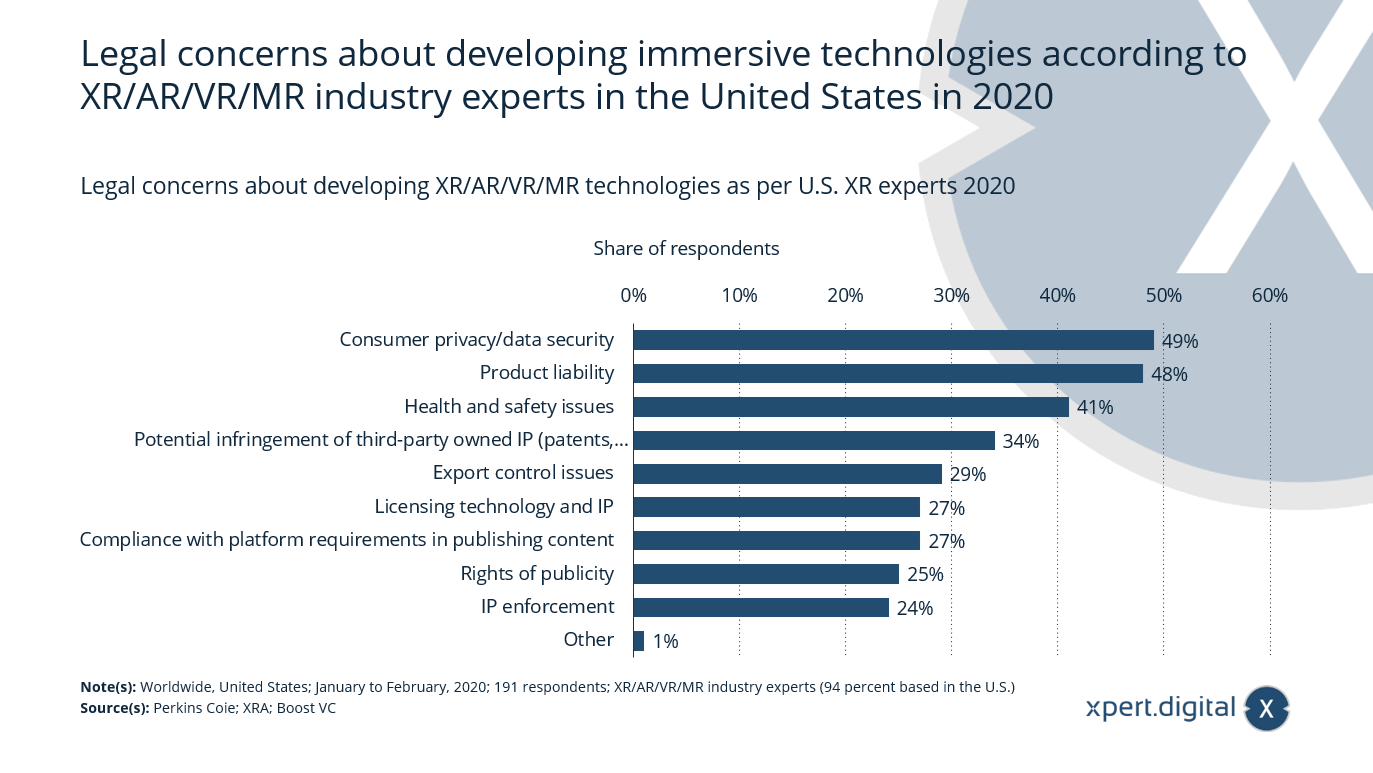
Legal Concerns About Developing Immersive Technologies According to XR/AR/VR/MR Industry Experts in the US: In 2020, 49 percent of XR industry experts surveyed said consumer privacy and data security was a legal concern when developing immersive technologies and presents content.
Which of the following legal risks are important to your company when developing immersive technologies or content?
49% - Consumer protection/data security
48% - Product liability
41% - Health and safety issues
34% - Potential infringement of third party intellectual property (patents, trademarks, copyrights, trade secrets)
29% - Export control issues
27% - Licensing of technology and IP
27 % – Compliance with platform requirements when publishing content
25% – Rights of the public
24% – Enforcement of IP rights
1% – Other
Barriers to mass adoption of AR/VR technologies, according to XR experts
Obstacles to mass adoption of AR/VR technologies – Image: Xpert.Digital
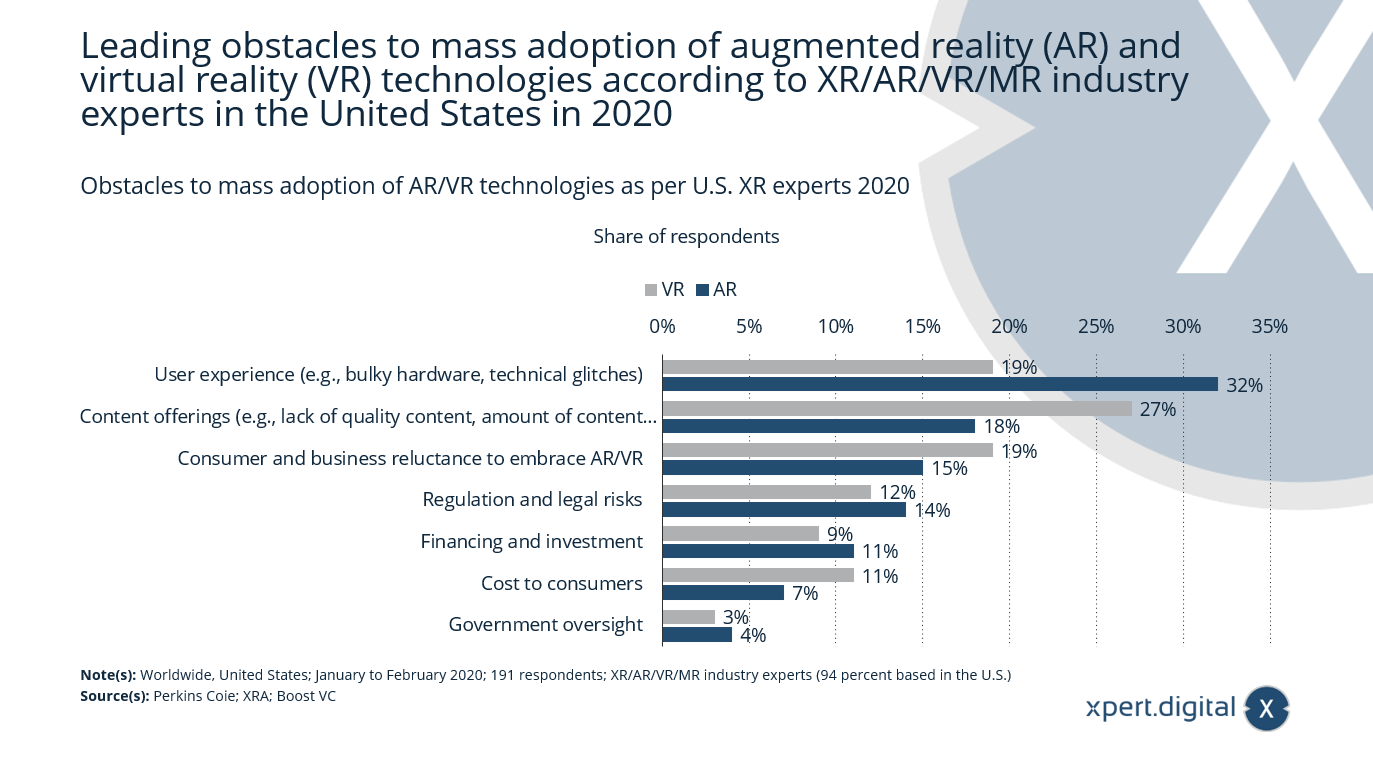
Barriers to mass adoption of augmented reality (AR) and virtual reality (VR) technologies according to XR/AR/VR/MR industry experts in the United States: In a survey earlier in 2020, 32 percent of XR industry experts surveyed cited user experience as one of the biggest barriers to mass adoption of augmented reality (AR) technologies. In second place was the availability of content, which 18 percent cited as an obstacle.
Suitable for:
- Xtended: Extended Reality for business and industry
- Continuous improvements and further developments in extended reality
What are the obstacles to the mass adoption of augmented reality – AR technology?
- 32% – User experience (e.g. bulky hardware, technical issues)
- 18% – Content offerings (e.g. lack of quality content, amount of content available)
- 15% – Consumer and business reluctance to adopt AR/VR
- 14% – Regulation and legal risks
- 11% – Financing and Investment
- 7% – costs to consumers
- 4% – Government supervision
What are the obstacles to the mass adoption of virtual reality – VR technology?
- 19% – User experience (e.g. bulky hardware, technical glitches)
- 27% – Content offering (e.g. lack of quality content, amount of content available)
- 19% – Consumer and business reluctance to adopt AR/VR
- 12% – Regulation and legal risks
- 9% – Financing and Investment
- 11% – Cost to consumers
- 3% – Government supervision
Increase in GDP through AR/VR worldwide
Increase in GDP through AR/VR worldwide – Image: Xpert.Digital
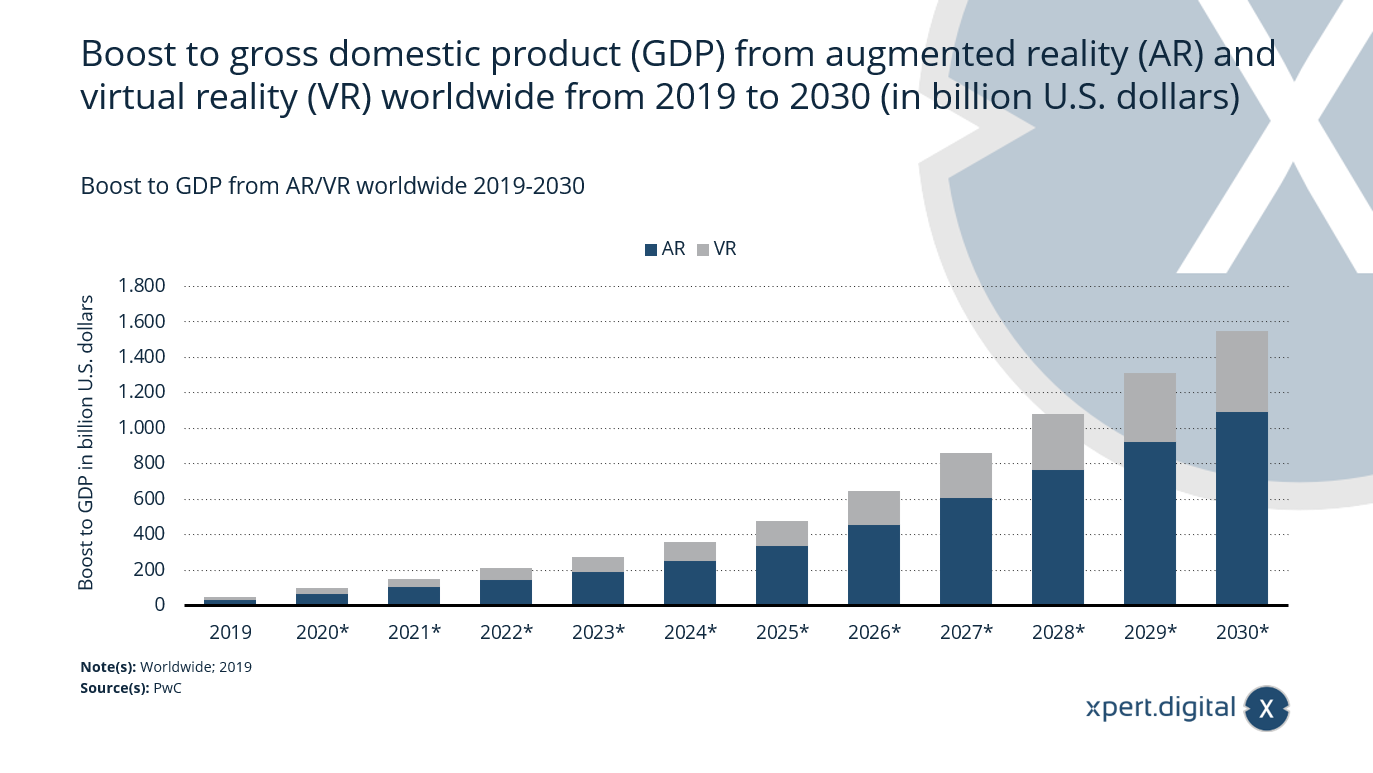
Increase in gross domestic product (GDP) due to augmented reality (AR) and virtual reality (VR) worldwide from 2019 to 2030 (in billion US dollars): According to a 2019 report, it is predicted that virtual reality (VR) and augmented Reality (AR) will increase global gross domestic product (GDP) by $1.5 trillion by 2030 - an increase from the $46.4 billion these technologies added to GDP in 2019.
Number of workplaces improved by AR/VR worldwide
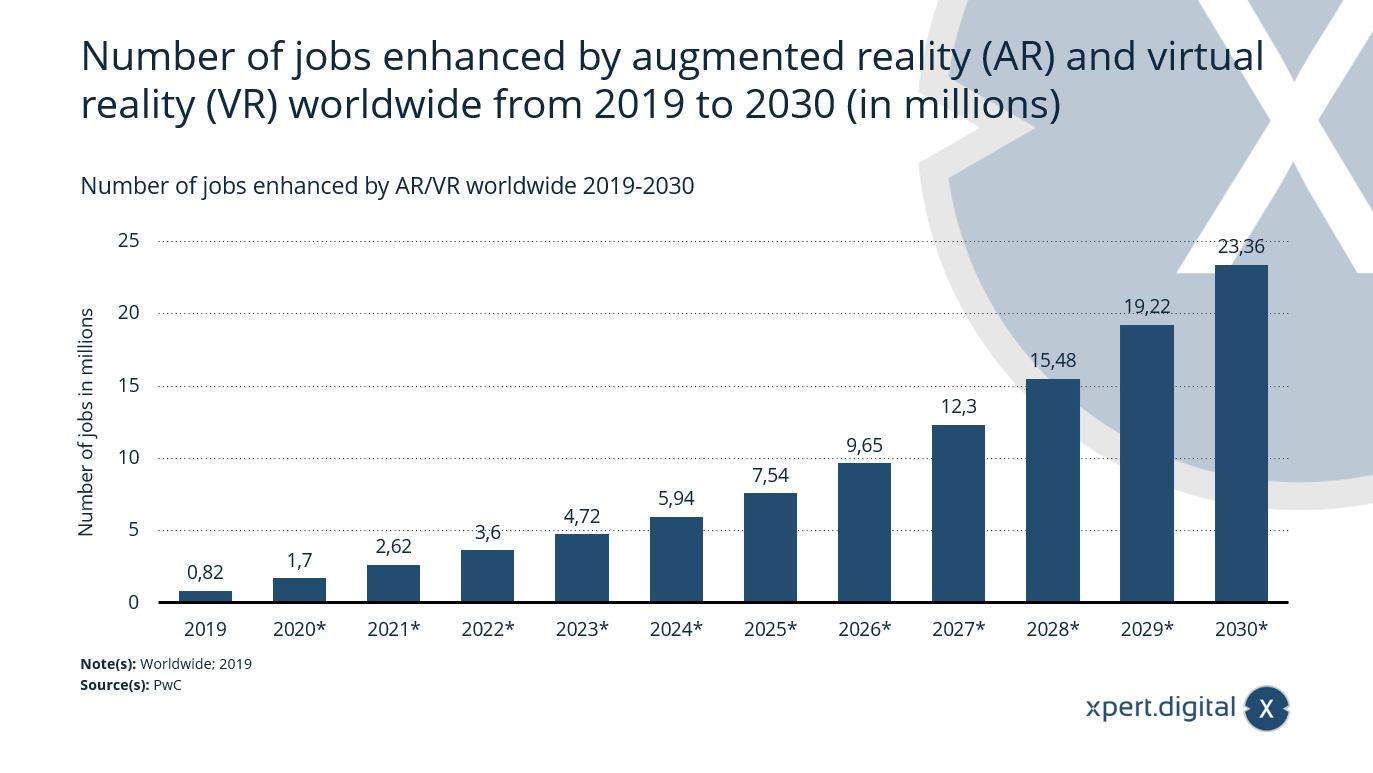
According to a 2019 report, more than 23 million jobs worldwide are predicted to be enhanced by virtual reality (VR) and augmented reality (AR) technologies by 2030, an increase from the 800 thousand jobs created in 2019 VR and AR have been upgraded. VR, AR and Mixed Reality (MR) are often referred to as Extended Reality (XR), an emerging term used for all immersive technologies.
Suitable for:
Number of jobs improved by augmented reality (AR) and virtual reality (VR) worldwide from 2019 to 2030 (in millions)
Number of workplaces improved by AR/VR worldwide – Image: Xpert.Digital
Economic benefits of VR worldwide
Global spending on augmented reality and virtual reality (AR/VR) is forecast to increase again in 2020, and the consumer VR hardware and software market will also see an uptick through 2023. The potential impact of new technologies like VR is now becoming clearer globally: forecasts suggest that VR will increase global GDP by $450.5 billion by 2030. In addition, it is predicted that over 23 million jobs will be created worldwide through VR/AR technologies by 2030.
Economic benefits of VR in Europe
For European nations, VR is predicted to bring a range of social and economic benefits. The UK is forecast to see a gross domestic product (GDP) increase of $20.1 billion by 2030, while France is expected to see a $14.4 billion GDP increase from VR technology. In addition, more than 400 thousand jobs will be created by VR/AR in the UK by 2030, an increase on the 10 to 15 thousand jobs created by VR/AR in the UK in 2019.
Size of the Augmented & Virtual Reality (AR/VR) market in Europe
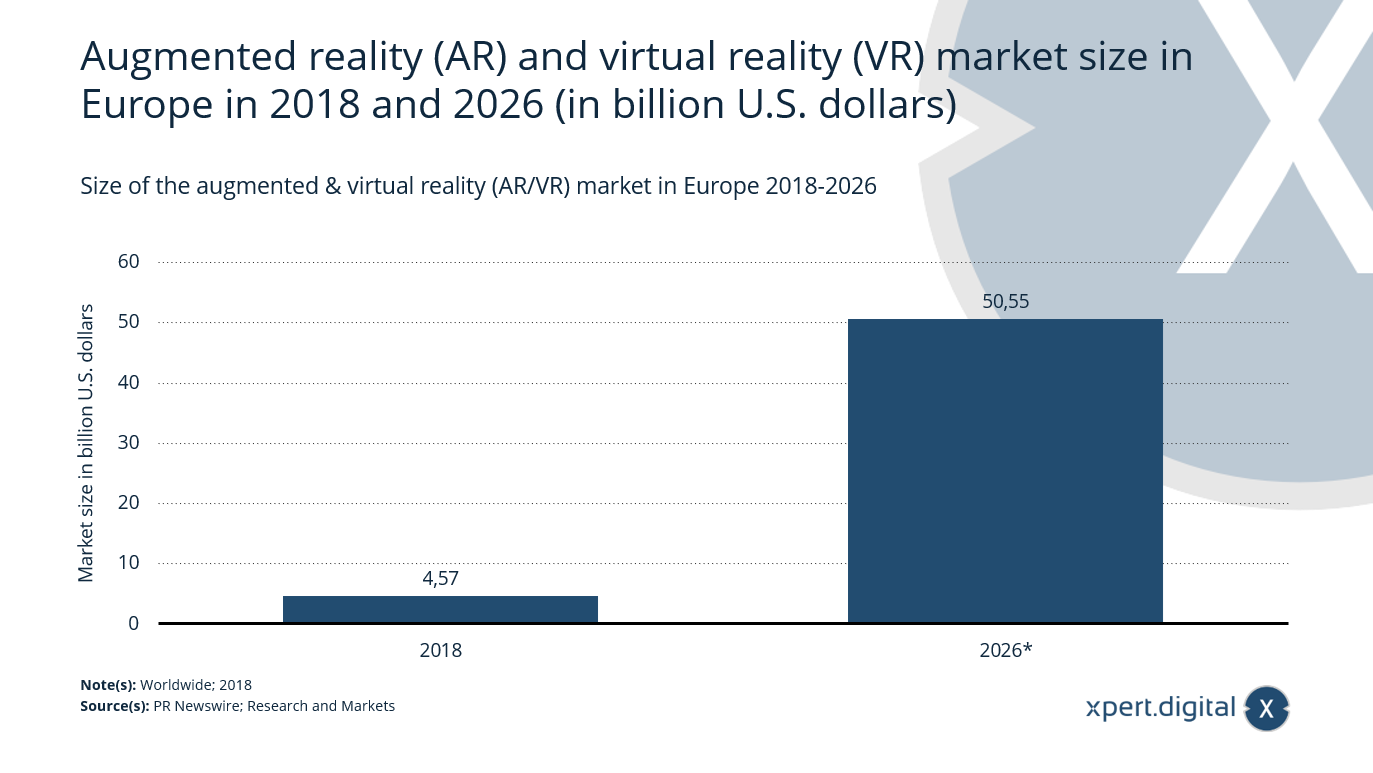
Market development of Augmented & Virtual Reality (AR/VR) in Europe – Image: Xpert.Digital
Size of the augmented reality (AR) and virtual reality (VR) market in Europe 2018 and 2026 (in billion US dollars): In 2026, the augmented reality (AR) and virtual reality (VR) market will be in Europe is expected to reach $50.55 billion, an increase from the $4.57 billion the market was worth in 2018.
Current PDF libraries to support your further strategic planning and activities
We provide you with further numerous insights into numbers, data and facts that can help you optimize and expand your strategic goals:
- Customer Demographics Library – Demographics Knowledge Base (PDF)
- Online Marketing Library (PDF)
- E-Commerce Library – Knowledge Base (PDF)
- Social Media Marketing Library – Knowledge Base (PDF)
- SEO Library – SEM knowledge database (PDF)
- Search Engine Advertising / SEA Library – Search Engine Advertising Knowledge Base (PDF)
- Extended Reality (XR) Library (PDF)
That’s why Xpert.Digital for Frankfurt and Würzburg! – Your Virtual Showroom, Augmented, Mixed & Extended Reality consultants and agency

Konrad Wolfenstein
I would be happy to serve as your personal advisor.
You can contact me by filling out the contact form below or simply call me on +49 7348 4088 965 .
I'm looking forward to our joint project.
Write to me

Xpert.Digital – Konrad Wolfenstein
Xpert.Digital is a hub for industry with a focus on digitalization, mechanical engineering, logistics/intralogistics and photovoltaics.
With our 360° business development solution, we support well-known companies from new business to after sales.
Market intelligence, smarketing, marketing automation, content development, PR, mail campaigns, personalized social media and lead nurturing are part of our digital tools.
You can find out more at: www.xpert.digital – www.xpert.solar – www.xpert.plus
Keep in touch











