
Three giants, three crises – Why neither the USA, nor China, nor Germany are prepared for the future
Xpert Pre-Release

Available in 27 languages 📢
Prefer Xpert.Digital on GoogleⓘPublished on: May 30, 2026 / Updated on: May 30, 2026 – Author: Konrad Wolfenstein
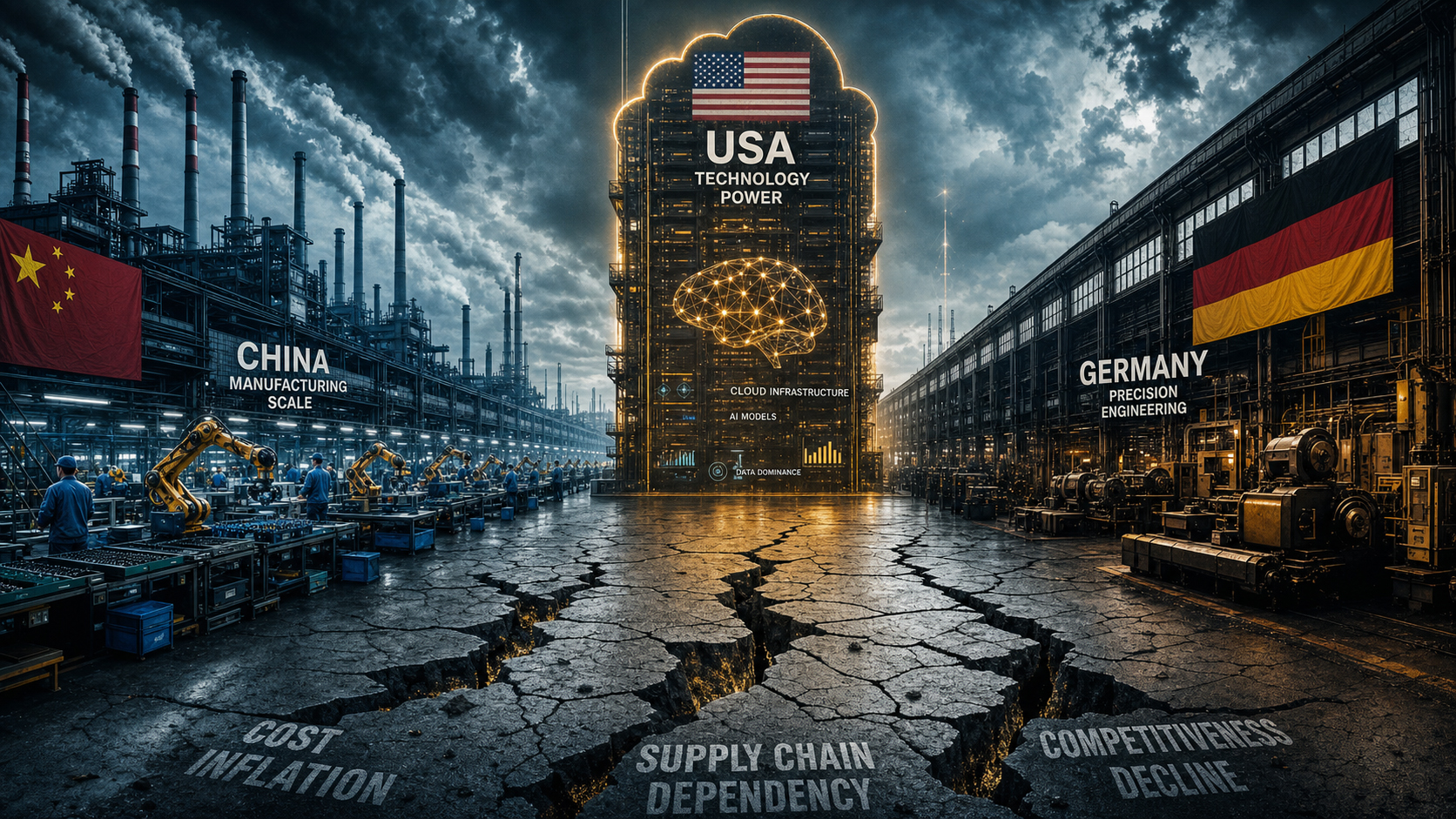
Three giants, three crises – Why neither the USA, nor China, nor Germany are prepared for the future – Image: Xpert.Digital
Three giants on the brink: An economic analysis of the global power structure
Stagnation or new beginnings? Why the biggest problem facing the German economy lies in our minds
### The Working Time Myth: Why China's Economic Power Is Based on a Massive Misconception ### AI from the USA, Robots from China: Who Will Really Win the Global Economic War ### China's Dangerous Export Trap: How Beijing's Greatest Strength Is Now Becoming a Global Threat ### The 996 Lie: Why More Work Alone Does Not Make a Successful Economy ###
The global economic order is facing an epochal upheaval in which old certainties are rapidly losing their value. While China, with its state-directed industrial policy and aggressive export strategy, is striving for global dominance in the hardware sector, the USA is securing supremacy in the digital sphere and artificial intelligence with unprecedented scaling power. But behind the impressive facades of these superpowers, a closer look reveals massive structural cracks. China is in danger of suffocating under a chronically weak domestic market and dangerous overcapacities, America is suffering from advancing deindustrialization, and former export champions like Germany and Japan are mired in painful economic stagnation. This in-depth economic analysis illuminates the fragile power structure of these three major economic centers and vividly demonstrates that in the global competition of the future, it is not necessarily the strongest that wins, but the most adaptable. Especially for Germany, it becomes clear that the current crisis is less a purely economic problem, but rather a communicative and psychological one – and how a much-needed change of perspective can be achieved in order not to fall behind completely.
We rationalize what has long since passed us by
It's not just hard work that decides: The global myth of working hours and its limits
When Western observers discuss China's economic rise, the argument of hard work is almost reflexively invoked. And indeed: Chinese workers average between 2,000 and 2,200 hours per year, while Germans, according to a survey by the German Economic Institute, only manage around 1,036 hours per employee – ranking third from last among all 38 OECD countries. The difference is therefore real and significant: In China, people spend almost twice as much time at work as in Germany.
However, international comparisons of working hours should be treated with caution from a methodological perspective. They reveal nothing about how productively these hours are used, the social context in which work takes place, or the underlying structural constraints. China's infamous "996 culture"—from 9 a.m. to 9 p.m., six days a week—is not an expression of cultural diligence, but rather of a system in which employees have little choice. The fact that the Chinese central government now wants to regulate this model itself because it stifles domestic demand is telling: The leadership in Beijing recognizes that exhausted people don't spend money.
When other parameters are considered, the picture becomes even more complex. South Korean workers work around 1,296 hours per year, Polish workers 1,305, and Czech workers over 1,326 – and these economies, too, are part of a global competitive landscape where working hours alone are not a recipe for success. Mexico leads the OECD statistics with more than 2,126 hours per year – and yet it is not among the most innovative or wealthiest economies in the world. More hours do not automatically mean more added value, more innovation, or greater social resilience.
What has truly made China an economic superpower is something else entirely: decades of state-directed industrial policy, massive infrastructure investments, a combination of technology transfer and independent capacity building, and strategically established control over critical raw materials. These factors cannot be explained by references to individual work ethic. They are the result of political decisions—and political risks.
The strategic foundation: Rare earths, know-how absorption, and the Apple lesson
Few examples illustrate China's strategic approach as succinctly as the history of rare earths and the role of Apple. Today, China controls roughly 60 percent of global rare earth production and operates approximately 90 percent of global processing capacity. This dominance was not achieved overnight, but is the result of decades of state-coordinated investment in mining infrastructure, processing technologies, and supply chain control – a geostrategic foresight that Western democracies have long underestimated.
For over two decades, Apple has built a dense network of highly specialized suppliers in China, bringing manufacturing expertise, quality standards, and industrial knowledge to the country. China has benefited enormously from this collaboration: not only from direct manufacturing revenues, but also from the profound transfer of engineering knowledge, process management, and quality control, which has enhanced the standing of Chinese companies. Today, while Apple can relocate final assembly to India, the majority of the complex pre-production remains in China—and many of the suppliers that have moved to India are themselves Chinese companies.
Related to this:

The strategic leverage China wields from this position was ruthlessly exposed in the trade dispute with the US. When Beijing imposed an export ban on seven critical raw materials, such as neodymium and terbium, in 2025, manufacturers worldwide faced the threat of production shutdowns. For Apple, this measure meant that even if production took place in India, the components would still require Chinese raw materials. The company's response—a $500 million investment in the US raw materials producer MP Materials—demonstrates how seriously it takes this dependence. However, structural change in supply chains takes time and is expensive. In the short term, China remains the heart of global manufacturing expertise in the electronics industry.
What we really need to understand about China's rise is that it is not an organic market development, but rather a highly planned and state-supported industrial strategy. This is neither good nor bad in itself – it is an economic and political reality that the West must confront without getting lost in simplistic narratives.
Related to this:

The paradox of the export world champion: When strength becomes a trap
Herein lies the fundamental contradiction in the Chinese economic model, which is too rarely clearly articulated in Western discourse. China's economy formally achieved its 5 percent growth target in 2025 – yet this growth is driven almost exclusively by the export sector. The country's trade surplus reached a historic record of US$1.2 trillion in 2025 – larger than the total economic output of many G20 nations. The previous year, total exports had already reached €3.4 trillion, with a trade surplus of €1 trillion, a new all-time high since records began in 1950.
The problem is structural: Private consumption in China accounts for only about 40 percent of economic output – in Germany, Japan, or India, this figure is around 57 percent. The Chinese population simply doesn't buy enough to support domestic production. This isn't a temporary economic downturn, but the result of a decades-long growth model focused on investment and exports – at the expense of domestic consumption. Since the 2021 real estate crash, this imbalance has worsened dramatically: Real estate investment plummeted by 17.2 percent in 2025, and total fixed asset investment declined for the first time since 1996. Falling real estate and stock prices, low wage growth, and labor market uncertainty are forcing Chinese households into a savings reflex that the government cannot reverse with economic stimulus programs.
Since the real estate crash, Beijing has consistently channeled capital and subsidies into industry instead of boosting consumption – resulting in structural overcapacity. Factories produce more than the domestic market can absorb and therefore compete aggressively on the global market. What appears to be stabilizing in the short term is a dangerous gamble in the long run: A trade surplus of this magnitude is geopolitically unsustainable and provokes protectionist countermeasures.
These reactions are already well underway. Brazil, Turkey, South Korea, Thailand, and Indonesia have all imposed import tariffs or additional taxes on Chinese steel, electric cars, and inexpensive consumer goods. In Europe, punitive tariffs have been levied on Chinese electric cars. The US under Trump massively increased tariffs on Chinese goods, causing Chinese exports to the US to plummet by around 20 percent. China is thus threatening not only the competitiveness of Western industries but also the development opportunities of emerging economies in Asia, Africa, and Latin America. An export model that threatens the very existence of the economic infrastructure of other regions cannot be a sustainable foundation for Chinese prosperity in the long run—it is a leap of faith, not a sustainable strategy.
China's technology bet: Robotics and electromobility between dominance and risk
It would be wrong to interpret China's current economic situation solely as a weakness. In certain technology sectors, the country has established a remarkable and concerning leadership position. In the field of humanoid robotics, China holds a market share of 80 to 87 percent of units shipped worldwide. The companies AgiBot and Unitree Robotics lead the field with a combined market share of more than 56 percent. In 2024, China installed more industrial robots domestically than all foreign manufacturers combined – with 295,000 newly installed units and a 54 percent market share of global sales.
The parallels to the photovoltaic industry are unmistakable: billions in government subsidies, aggressive capacity expansions, vertically integrated supply chains, and a regulatory environment that fosters rapid iteration. While European and American companies are still debating strategies, China is creating facts on the ground. The risk of the global market being flooded with cheap robots—analogous to the destruction of Western solar companies by Chinese dumping—is real.
And yet, betting on these technologies is fraught with considerable uncertainty. The actual economic benefits of humanoid robots in widespread industrial applications have not yet been clearly demonstrated. The market is still in its early commercial stages, and many years of error correction, standardization, and software development lie between the units currently being delivered and widespread increases in industrial productivity. It is realistic to assume that it will take another two decades before the initial errors translate into genuine, lasting efficiency gains.
The real risk, however, lies on the export side. China primarily produces robots for the global market – and this global market is beginning to resist. Protectionism, security concerns regarding Chinese technology in critical infrastructure, and geopolitical tensions could abruptly limit sales. A growth strategy focused on technology exports while neglecting domestic consumption remains structurally fragile – regardless of whether we're talking about electric cars, solar panels, or humanoid robots.
Related to this:

Our global industry and economic expertise in business development, sales and marketing

Our global industry and economic expertise in business development, sales and marketing - Image: Xpert.Digital
Industry focus areas: B2B, digitalization (from AI to XR), mechanical engineering, logistics, renewable energies and industry
More information here:
A thematic hub offering insights and expertise:
- Knowledge platform covering global and regional economies, innovation and industry-specific trends
- A collection of analyses, insights, and background information from our key areas of focus
- A place for expertise and information on current developments in business and technology
- A hub for companies seeking information on markets, digitalization, and industry innovations
Germany's silent crisis: More communication, less lamenting – SMEs as a treasure for the future
The digital titan with a heavy body: The economic dual nature of the USA
The United States dominates the global cloud and AI market to an unparalleled degree. Amazon Web Services holds 28 to 30 percent of the global cloud infrastructure market, followed by Microsoft Azure with 21 percent and Google Cloud with 14 percent. Together, these three US companies control more than 60 percent of a market that grew to $129 billion in the first quarter of 2026—a 35 percent increase year-over-year. For the full year 2026, annual revenue is projected to exceed $500 billion for the first time. No other provider even comes close to this scale: Google Cloud is almost four times the size of fourth-placed Alibaba Cloud.
A new KPMG study confirms that the US is clearly ahead in all metrics examined in the global AI comparison. With $400 billion in planned AI investments by Amazon, Meta, Microsoft, and Google alone in 2025, AI has become a strategic national priority. European providers have seen their market share in their own continental cloud market plummet from 29 percent in 2017 to below 15 percent today. Even SAP and Deutsche Telekom each only achieve around two percent. As one entrepreneur aptly put it at the 2026 World Economic Forum, the train has already left the station in key areas.
But this claim to digital leadership masks a deep structural wound. Traditional industry, mechanical engineering, manufacturing – in short, everything that produces physical objects – has been a low priority in the US for decades. While digitalization and finance dominated the economic discourse, the industrial base was neglected. The result is increasing deindustrialization, which is now being painstakingly reversed under the pressure of geopolitical rivalries, Chinese subsidies, and the reshoring program of the Inflation Reduction Act. This demonstrates just how cumbersome such reindustrialization is: it takes decades to build the knowledge, supply chains, and workforce necessary for a high-performing industrial base.
The US is thus a giant with a clear strength – its digital platform economy – and an equally clear weakness: the loss of industrial substance. A country that bases its prosperity primarily on services, finance, and digital platforms, while core areas of manufacturing have migrated abroad, is living off its past. Digital dominance can compensate for this as long as it lasts. But 95 percent of American companies have so far not achieved a measurable return on their investments in generative AI – an indication that the hype has not yet translated into structural economic power.
Germany and Japan: When industrial capacity is no longer sufficient
Germany and Japan share a remarkable economic parallel: Both are traditionally focused on export strength and high-quality industrial production, both are struggling with persistent economic stagnation, and both have run out of steam in the current era of digital transformation. Japan slipped into a technical recession at the end of 2023 with two consecutive negative quarters, and its GDP level in the first quarter of 2024 was still 0.5 percent below its pre-crisis peak. The Japanese economy is thus lagging behind the major industrialized nations in its post-pandemic recovery. In 2024, Japan lost its position as the world's third-largest economy to Germany – ironically, since Germany is also not exactly a pillar of stability.
The German economy is stagnating for the third year in a row. The DIW Berlin expects virtually no growth for 2025, and the EU Commission has reduced its forecast from 0.7 percent growth to zero. Industrial production has fallen by 7.5 percent in real terms over the past seven years, and around half a million industrial jobs have been lost. The investment rate as a percentage of economic output has reached its lowest level since reunification. In an IW survey, 31 of the 49 industry associations surveyed rated the situation at the end of 2024 as worse than a year earlier.
The structural causes are well-known, yet they are being addressed too slowly: high energy costs, a rigid bureaucratic system, a digital economy that lags behind international standards, and a specialization in industries facing dual pressures. While Germany is an international leader in research-intensive industries—automotive and mechanical engineering contribute 13.9 percent to gross value added—the share of knowledge-intensive services has stagnated for two decades. In 2023, Germany recorded a decline of 4.3 percent in trade in high-tech goods. Two-thirds of the companies surveyed have already relocated parts of their value chain abroad; in mechanical engineering and the automotive industry, 65 percent expect a further decline in the attractiveness of Germany as a business location.
What connects Japan and Germany is a kind of industrial hubris: the conviction that what was their strength yesterday will also suffice tomorrow. Both countries missed the transition to the age of the platform economy, digital infrastructure, and software-driven value creation—or deliberately approached it slowly because existing industries still delivered profits in the short to medium term. Now they are paying the price.
The logic of epochal change: speed, flexibility, and openness as new currencies
An analysis of the current global economic situation reveals a pattern that transcends the specific problems of individual countries. The present era is characterized by an acceleration of technological change, a fragmentation of global supply chains, and an increase in geopolitical influences on economic decisions. In this environment, speed of response, flexibility in adaptation, and openness to new standards are becoming the decisive economic variables.
Economies trapped in cumbersome planning processes, overregulated markets, or cultural inertia systematically lose ground in such an environment. This applies to Germany's regulatory sluggishness as much as to China's state-driven risk aversion despite genuine market liberalization, or America's sluggish reindustrialization policy. In a development race, the ability to quickly identify and correct errors is more crucial than the sheer size or historical strength of an economy. A Darwinian economist would say: It is not the strongest economy that survives, but the most adaptable.
The dilemma becomes particularly clear when it comes to standards. In an era where AI systems, robotics platforms, energy infrastructures, and communication networks are being built anew worldwide, the ability to set or adopt new standards early on determines future market positions. China is attempting to establish technical standards in the robotics and electric vehicle sectors that will secure long-term advantages for its manufacturers. The US is using export controls and compute governance to limit China's access to AI hardware, thereby simultaneously anchoring American standards in AI development as the global benchmark. Europe, for its part, remains largely a spectator and regulator – strong in setting normative standards for data protection and AI governance, but weak in shaping technological developments.
The geo-economic paradigm shift means that economic and political power are once again inextricably linked. Trade relations are no longer a neutral game on a level marketplace, but a competition waged with government subsidies, geopolitical leverage, and strategic raw material reserves. Anyone who ignores this or believes that pure market logic will prevail is fundamentally mistaken.
The silence of strength: Germany's real problem is not economic
To understand the German economic crisis, one must look beyond economic indicators. The figures are well-known: stagnation for three years, deindustrialization trends, digital backwardness, above-average energy costs. But these figures are symptoms, not the root cause. The deeper question is: Why is mobilization failing? Why is there no signal for a new beginning, even though the diagnosis is clear?
A significant part of the answer lies in the communication culture and the psychological state of German society. Economic success is largely a matter of psychology – trust, confidence, and the willingness to take risks and try new things. Where these fundamental psychological conditions are lacking or disrupted, even structurally healthy economies lose momentum. At the turn of the year 2024/2025, the IW survey recorded that 31 out of 49 industry associations assessed the situation as worse than a year earlier, and the outlook was also dominated by pessimism. Given rising real wages and at least stable consumption, this sentiment cannot be fully explained by facts – it is a cultural phenomenon.
The German language reflects this problem: it has a rich tradition of lamentation and problem description. Words for concern, crisis, lack, rule violation, and failure fill public discourse. Visionary language that opens up possibilities instead of closing them often sounds foreign or suspicious in German. In economic reporting, political debates, and even corporate communications, the analysis of the negative dominates. This creates a general social mood that oscillates between complacency, maintaining the status quo, and paralysis—three attitudes that have fatal consequences in an age of acceleration.
This does not mean that problems should not be identified. Critical engagement is a strength of German discourse. The problem lies in the one-sided emphasis: compared to the diagnosis of problems, there is a lack of constructive solutions, a visionary framework, and a willingness to communicate Germany's considerable strengths—its engineering culture, its expertise in small and medium-sized enterprises, its geopolitical stability, its social cohesion—as a starting point for progress. A country that does not narratively define its own strengths relinquishes the power of interpretation to others.
Miscommunication as a strategic disadvantage: What Germany needs to do differently
The economic policy conclusions drawn from this analysis are less technical than communicative in nature. Structural reforms, investment programs, and industrial policy measures are necessary conditions for recovery—but not sufficient ones. Without a shift in public discourse that enables rather than hinders progress, these measures will not ignite the social energy required for a genuine transformation process.
Experience from other societies shows that economic renewal usually begins with a narrative. South Korea mobilized itself in the 1980s with a national narrative of technological catch-up. Israel cultivated a start-up nation narrative that had a self-reinforcing effect. China used the narrative of its resurgence to historical greatness to channel societal energy—with all the ambivalences that this entails. Germany lacks such a contemporary narrative of renewal. The story of the post-war economic miracle is outdated; the narrative of Europe's sick man is demobilizing. A communicative gap exists between these two narratives.
Specifically, this means that Germany's strengths in mechanical engineering and precision manufacturing are not obsolete, but rather a potential foundation for robotics integration, intelligent automation, and Industry 4.0 solutions that far surpass what China currently offers. The Mittelstand – some 2.6 million companies and over 50 percent of jobs subject to social security contributions – is not a sign of backwardness, but rather one of the deepest resilience structures an economic system can possess. And Germany's integration into a domestic market of 450 million consumers is an asset that China and the USA cannot replicate. However, these strengths are systematically understated in the discourse.
At the same time, the situation demands a brutally honest assessment of weaknesses: the digital infrastructure is too weak, the bureaucracy too slow, the capital markets too rudimentary for growth companies, and the education systems too sluggish in adapting to new skill requirements. Identifying these issues without deriving constructive action plans from them breeds pessimism. Identifying them while simultaneously outlining concrete, feasible steps fosters the ability to act.
Three giants and an open race: No winner without structural renewal
When all the threads are considered, no clear winner emerges in global economic competition. China is strong in key technologies and possesses strategic raw material power – but its growth model is structurally unstable, its domestic consumption underdeveloped, and its export dominance generates global resistance that threatens the model in the medium term. The US dominates digital infrastructure and the AI platform economy with a strength that is unlikely to be challenged in the foreseeable future – but its industrial base is weakened, and social and political polarization jeopardizes planning certainty for investments. Germany and Japan are struggling with structural adjustment deficits in an era of digital transformation – but both possess industrial and engineering expertise that could regain importance in an increasingly hardware-intensive world of robots, electric vehicles, and energy infrastructure.
The decisive factor is not who holds the strongest position today, but who can adapt most quickly. In a race characterized by technological discontinuities, advantages can melt away faster than in previous eras of gradual change. China demonstrated this with its solar panel dominance, which rendered European manufacturers obsolete within just a few years. Conversely, a country that lags behind today can take the lead in a key technology of the future – if it sets the right course.
For Germany, this means that the way out of stagnation lies not in nostalgia or panic, but in strategic clarity and communicative renewal. The economic foundations – a strong middle class, a tradition of engineering, social stability, and European integration – are in place. What is lacking is the societal will to utilize these foundations with the speed and openness that the current decade demands. Ultimately, this is less a question of economic policy than a question of national attitude – and thus a question of communication.
🎯🎯🎯 Data-driven B2B industry hub as a quasi-in-house solution

The quasi-in-house solution: How Xpert.Digital closes operational gaps in B2B marketing and sales – Smart Content-Driven Business - Image: Xpert.Digital
Xpert.Digital is a data-driven B2B industry hub led by Konrad Wolfenstein . The company acts as an external, quasi-in-house solution for industrial partners, closing operational gaps in marketing, content, and sales – without requiring additional resources on the client side.
More information here:
Your global marketing and business development partner
☑️ Our business language is English or German
☑️ NEW: Correspondence in your native language!

Konrad Wolfenstein
I and my team are happy to be available to you as your personal advisor.
You can contact me by filling out the contact form here simply call me at +49 7348 4088 965. My email address is [email protected]:or
I'm looking forward to our joint project.










