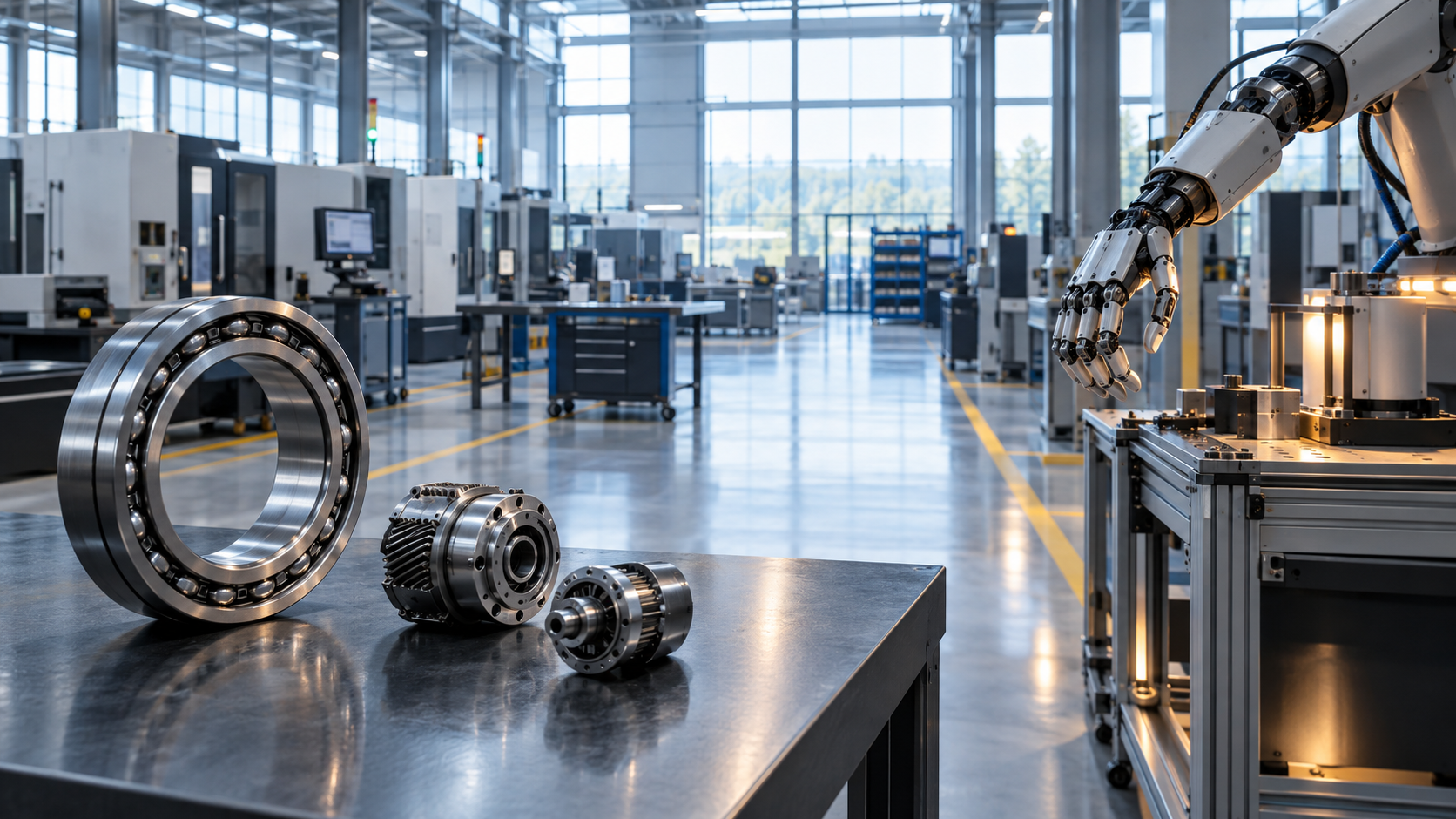
Schaeffler is cutting thousands of jobs: Will the cost-cutting program be enough for the future? 2,660 jobs in Germany are affected – Creative image on the topic, created with AI: Xpert.Digital
Schaeffler is closing four locations: The company is facing a major restructuring
€480 million in restructuring costs: How Schaeffler plans to become competitive again
Less car, more robotics? Schaeffler's risky change of course
Schaeffler is planning a major restructuring: 3,460 jobs are to be cut worldwide, 2,660 of them in Germany. The automotive and industrial supplier also intends to close four German locations. The company is reacting to weak demand in the automotive sector, high costs, and complex structures. At the same time, competition from China and the slower ramp-up of electromobility are intensifying the pressure to adapt. From 2030 onward, the measures are expected to save around €300 million annually – however, initial restructuring costs of approximately €480 million are anticipated. Cuts in research and development are also planned.
This is about more than just a short-term cost adjustment. Schaeffler must adapt its spending to a changing market environment and simultaneously decide which skills and capacities are essential for future business. New business areas, such as components for humanoid robots and applications in the defense industry, could open up additional perspectives. However, they will not automatically replace the existing business. The crucial question is whether the restructuring will create a sustainably competitive structure for the company – or merely buy time.
Schaeffler's restructuring and the new reality of the German supplier industry
When the future costs jobs first: Why cost-cutting alone doesn't create a business model
Schaeffler is facing a restructuring that goes far beyond a typical cost adjustment. The automotive and industrial supplier plans to cut 3,460 jobs worldwide, including 2,660 in Germany, and close four German locations. The company cites weak demand in the automotive sector, high personnel costs, and complex corporate structures as reasons for the cuts. Added to this are pressure from Chinese competitors and a slower-than-expected ramp-up of electric mobility.
The economic significance of this development lies in the interplay of the various challenges. Weaker demand reduces the utilization of existing capacities. Increased competition makes it more difficult to pass on rising or structurally high costs through higher prices. At the same time, technological change requires investments whose returns remain uncertain. Schaeffler must therefore not only stabilize its current business but also decide which skills and capacities will still be needed in a changing industrial landscape.
From 2030 onwards, the measures are expected to save around €300 million annually. Initially, however, restructuring costs of approximately €480 million will be incurred. In addition to staff and site reductions, simplified structures and cuts in research and development are planned. Schaeffler had already announced a further cost-cutting program in 2024, which included the elimination of 4,700 jobs in Europe.
The central question, therefore, is not simply whether Schaeffler will reduce its costs sufficiently. The crucial question is whether the restructuring will create a sustainably competitive structure for the company or merely buy time. New business areas, such as components for humanoid robots and applications in the defense industry, offer opportunities. However, they do not automatically replace the economic substance of the existing business.
Several crises coincide with a common cost base
The difficulties cannot be meaningfully reduced to a single cause. Weak demand in the automotive sector is primarily a sales problem. High personnel costs, on the other hand, are a matter of cost positioning. Complex corporate structures affect the organization. Chinese competitive pressure is changing market conditions, while the slower ramp-up of electromobility is shifting the timing of strategic investments.
These factors reinforce each other. An organization can cope with high costs as long as it achieves correspondingly high prices or utilizes its capacity effectively. Both become more difficult when customers order less and cheaper competitor offers are available. If additional development and start-up costs for new technologies are then incurred, both profitability and financial flexibility come under pressure.
This creates a twofold adjustment challenge for Schaeffler. In the short term, the company must adjust its spending to the actual achievable business volume. In the long term, it must align its value creation so that it generates sufficient returns even under changing competitive conditions. These two challenges are linked, but not identical.
Cost reduction can be successful in the short term but still cause long-term damage if it destroys key competencies. Conversely, clinging to strategically important projects can become economically problematic if ongoing business can no longer support their financing. The core of the restructuring, therefore, lies in prioritizing under uncertainty.
However, the aforementioned burdens do not allow us to determine the contribution of each individual cause to the need for adjustment. Without a corresponding breakdown, it would be an oversimplification to attribute the job losses solely to German labor costs, electromobility, or Chinese competition.
Germany is at the center of the adaptation process
Of the 3,460 jobs to be cut worldwide, 2,660 are in Germany. This represents approximately 77 percent of the announced reductions. Outside of Germany, this equates to a calculated 800 job losses. Together with the four planned site closures, this distribution demonstrates that the German part of the company is particularly hard hit.
This concentration is economically significant, but it should not be overinterpreted. Without information on the regional distribution of employees, the product structure, and the capacity utilization of individual plants, it cannot be directly concluded that German locations are generally less productive. A high proportion of job cuts could also result from the fact that certain affected functions or product areas are primarily located in Germany.
Nevertheless, the decision makes it clear that, from the company's perspective, existing German structures do not appear viable under the expected market conditions. This is not solely about wage levels. The decisive factor is the relationship between the total costs of a location and its economic contribution.
An expensive location can be competitive if it is particularly productive, manufactures sophisticated products, or creates high customer value. Conversely, a location with lower wages can become economically unattractive if capacity utilization, quality, or product mix are not optimal.
A proper debate on location must therefore go beyond simply comparing high German and lower foreign labor costs. It is essential to examine which activities offer a locational advantage, which processes have become too costly, and where existing capacities no longer meet anticipated demand. Only then can a reliable picture of actual competitiveness emerge.
The cost-saving calculation is plausible, but not yet proof of success
The announced ratio of conversion costs to savings initially appears attractive. One-off expenditures of approximately €480 million are offset by expected annual savings of around €300 million from 2030 onwards. Purely mathematically, the conversion costs thus correspond to 1.6 times the full annual savings.
However, this calculation is not a complete amortization calculation. It simplifies the process by assuming that the savings actually materialize as projected and that the conversion costs are not exceeded. Furthermore, it does not consider the timing of payments, potential tax effects, financing costs, or operational transition burdens.
The key point is the wording that the annual savings are to be achieved from 2030 onwards. This does not clarify what savings will occur before then. Nor does it specify when the total conversion costs will actually be realized. For the actual capital commitment, it makes a significant difference whether expenses are incurred early and savings only become fully effective years later.
Furthermore, the 300 million euros cannot simply be divided by the number of job cuts and interpreted as average personnel costs. The program also includes site closures, organizational simplifications, and interventions in research and development. The cost savings thus result from several measures, the individual contributions of which are not specified.
Ultimately, economic success depends on how much of the planned savings is permanently retained in the bottom line. If prices fall, sales decline, or additional start-up costs arise simultaneously, a significant portion of the savings can be negated. Therefore, the savings target describes a gross effect compared to a benchmark situation, not automatically an equivalent increase in group profit.
Liquidity determines the freedom of movement during restructuring
A restructuring program can be beneficial in the long term, yet it can increase the financial burden in the short term. This tension arises precisely from the initial restructuring costs. Schaeffler must allocate funds to reduce future expenses.
It is important to distinguish between accounting expenses and actual cash outflows. Depending on their specific structure, provisions, valuation adjustments, and actual payments can take effect at different times. Therefore, the aforementioned total of approximately €480 million alone does not allow for a precise derivation of the liquidity trend.
This distinction is important for corporate management. The financing of ongoing operations, necessary investments, and restructuring costs must all be managed simultaneously. If financial flexibility becomes too limited, a company may be tempted to postpone expenditures that would be essential for its future competitiveness.
This leads to a clear priority: Not every saved expense improves the economic situation to the same degree. A permanently eliminated administrative step can increase efficiency. Conversely, failing to modernize might conserve liquidity in the short term, but lead to higher costs later.
A thorough assessment of the program would therefore need to consider not only the announced savings volume but also the operational cash flow, the investment requirements, and the timing of the restructuring payments. The available key data allows for an estimate of the scale, but not yet a definitive judgment on its financial viability.
Site closures change more than just the number of employees
Closing four German locations is a more profound intervention than an equivalent reduction in staff spread across numerous units. A single location not only concentrates employees and machinery, but also established processes, expertise, supplier relationships, and local responsibilities.
From a business perspective, a closure can be beneficial if it eliminates permanently underutilized capacity and allows for more efficient consolidation of remaining production. Higher capacity utilization can help distribute fixed costs across more units. Fewer locations can also simplify coordination and management.
This potential advantage doesn't materialize automatically. Relocation involves transitional costs. Equipment may need to be moved, processes readjusted, and employees trained. Even temporary disruptions to sensitive production processes can have significant repercussions.
Furthermore, there is the question of how much knowledge is actually transferable. Technical documentation can describe processes, but it does not completely replace the practical experience of a well-coordinated team. If the restructuring underestimates this difference, savings can be diminished by quality problems, longer start-up times, or additional rework.
The quality of a location decision is therefore not solely measured by the fixed costs saved. It also depends on whether the remaining units can perform the tasks reliably and economically. A successful consolidation creates a more efficient production network. A poorly planned consolidation merely shifts the problems to another location.
Chinese competition intensifies the question of customer value
The pressure from Chinese competitors is particularly relevant for Schaeffler because it calls into question the economic value of existing market positions. When customers can choose between several technically suitable offerings, price, delivery capability, and development speed become increasingly important.
However, simply mentioning Chinese competitors doesn't reveal which product groups are under particular pressure or what the specific price differences are based on. Likewise, it would be unjustified to explain all competitive disadvantages across the board as being due to government support or lower wages.
For Schaeffler, the strategic consequence is nevertheless clear: Higher costs can only be justified in the long term if they are offset by a tangible added value for the customer. This could lie, for example, in reliability, lifespan, precision, integration capabilities, or reduced effort during use.
Crucially, a technological advantage must also be economically viable. A more complex solution is not automatically more successful if customers don't need or aren't willing to pay for the added benefits. Conversely, a component that is initially more expensive can be attractive if it significantly reduces the overall cost of an application.
The restructuring must therefore be linked to a review of the value proposition. Which products have become interchangeable? Where does the company truly possess unique capabilities? And in which areas does the internal complexity outweigh the added value for the customer? These questions will have a greater long-term impact on profitability than an isolated comparison of hourly wages.
The slower electric vehicle ramp-up creates a costly transition phase
For a supplier, a delayed ramp-up of electromobility is not just a matter of lower production volumes. It alters the timing of investments and returns. Development work, plant planning, and organizational setup may already be completed, while the expected volumes will materialize later.
This creates a capacity utilization problem. Capacities designed for a higher sales volume initially spread their costs across fewer units. Even if a product is fundamentally marketable, its profitability may fall short of expectations during the start-up phase.
At the same time, the need for adjustments in existing business operations doesn't automatically disappear. A slower transition doesn't necessarily mean that old structures can continue unchanged indefinitely. Rather, a longer interim phase may ensue, during which different technologies must be managed in parallel.
This parallel activity ties up resources. Development, production, and customer service must meet different demands, even though the returns from the new areas may not yet be sufficient to cover the additional expenses. This complicates planning and increases the value of flexible structures.
For Schaeffler, this doesn't simply mean either a recommendation to expand its electric vehicle business further or the opposite demand to withdraw from it. The crucial factor is the adaptability of investments. Projects should be assessed in a way that takes different market ramp-ups into account. The more uncertain the volume, the more important modular capacities, clear decision points, and a realistic assessment of start-up costs become.
Our EU and German expertise in business development, sales and marketing


Our EU and German expertise in business development, sales and marketing - Image: Xpert.Digital
Industry focus areas: B2B, digitalization (from AI to XR), mechanical engineering, logistics, renewable energies and industry
More information here:
A thematic hub offering insights and expertise:
- Knowledge platform covering global and regional economies, innovation and industry-specific trends
- A collection of analyses, insights, and background information from our key areas of focus
- A place for expertise and information on current developments in business and technology
- A hub for companies seeking information on markets, digitalization, and industry innovations
The transformation at Schaeffler: A look at the new business areas
Organizational simplification can be more valuable than across-the-board job cuts
Complex corporate structures are not just an administrative problem. They can create economic disadvantages across numerous areas: decisions take longer, responsibilities remain unclear, and similar tasks are performed multiple times.
Therefore, Schaeffler's organizational simplification represents a distinct lever. The benefits lie not only in reduced personnel costs, but also potentially in faster response to customer requests, clearer accountability for results, and less need for coordination.
However, a distinction must be made between genuine simplification and mere streamlining. If positions are eliminated while processes, reporting obligations, and boundaries of responsibility remain unchanged, the workload of the remaining employees increases significantly. The organization then becomes smaller, but not necessarily more efficient.
A viable reorganization must therefore start with the tasks themselves. Which decisions require multiple approvals? Which data is processed multiple times? Which functions do not create sufficient added value? And where does unclear allocation hinder accountability for costs and results?
At the same time, simplification should not be confused with excessive centralization. Some decisions can be effectively grouped together, while others require proximity to customers, products, or manufacturing processes. Therefore, the appropriate organizational model is not the one with the fewest boxes in the organizational chart, but rather the one with the clearest possible interfaces and short, efficient decision-making processes.
Research cuts pose the greatest strategic ambivalence
The planned cuts to research and development are the most sensitive part of the program. Here, immediate cost targets clash with the ability to offer competitive products in the future. What appears as an expense today could form the basis of future revenue.
However, it would be too simplistic to consider every budget cut a mistake. Development portfolios can also be overloaded. Projects can overlap, lose their economic viability, or tie up resources without a compelling application prospect.
The crucial question, therefore, is not whether development spending will decrease, but rather which activities will be eliminated and according to which criteria these decisions will be made. Eliminating redundancies and terminating less promising projects can lead to greater effectiveness with lower overall expenditure. Conversely, weakening key capabilities risks long-term competitiveness.
A purely proportional reduction across all areas would be particularly problematic. A uniform discount fails to account for the varying stages of development of projects or their strategic importance. A customer-focused project nearing market launch should be assessed differently than a long-term research project with an open-ended application path.
Schaeffler faces an additional conflict of objectives due to the targeted new business areas. Anyone aiming to develop components for humanoid robots or new applications in the defense industry needs the capacity for development and adaptation. The reorientation will only be convincing if cost savings in the existing portfolio are combined with a targeted safeguarding of the most promising future competencies.
The previous austerity program increases the demands on the new strategy
Back in 2024, Schaeffler had already announced another program involving the reduction of 4,700 jobs in Europe. This history changes how the current plan is viewed. It shows that the pressure to adapt did not originate with the most recent announcement.
However, the two job figures cannot simply be added together and presented as a confirmed total loss. The programs have different geographical scopes. Furthermore, there is no information on whether and to what extent the measures overlap or are intertwined in time.
The economically decisive question is rather why additional interventions are necessary after the previous program. Several explanations are possible: market assumptions may have deteriorated further, organizational problems may run deeper, or previous measures may have affected a different part of the business. It is not possible to determine which explanation predominates based on the information provided.
Repeated restructurings are not automatically a sign of poor management. In a changing market, additional adjustments may become necessary. However, they increase the demands on the credibility of the planning.
A new program must therefore achieve more than just the next round of cost-cutting. It should clearly define the desired economic outcome after the restructuring is complete. Without such a vision, the company risks a series of cost-cutting rounds that will continuously shrink it without achieving a stable new position.
Humanoid robotics is a follow-up opportunity, not an immediate replacement market
The interest in components for humanoid robots presents Schaeffler with a strategically sound opportunity. Applications requiring precise movements and reliable mechanical functions can, in principle, offer starting points for industrial component expertise.
However, this does not automatically guarantee a business model. Several steps lie between technical suitability and a commercially significant market. A component must meet the requirements of the respective application, be able to be integrated into a system, and be available at a cost that the eventual customer will accept.
Therefore, for the evaluation, less spectacular application scenarios are crucial than concrete questions about value creation. Which components will Schaeffler supply? What percentage of the total cost of a robot do they represent? How well can existing production processes be utilized? And at what production volumes will the business become profitable?
The question of production volume is particularly important. A technically sophisticated product can incur high development and manufacturing costs in small batches. Only with repeatable processes and sufficient sales volume can a reliable contribution to the bottom line be achieved.
Robotics should therefore initially be treated as a strategic option with verifiable milestones. Its value can be considerable if existing capabilities are transferred to new applications. However, it will only become a viable solution to problems in the automotive industry when technological possibilities translate into reliable orders, cost-effective production runs, and sustainable revenue.
The arms trade requires its own economic logic
Applications in the defense industry can also contribute to diversification. The potential benefit lies in opening up additional customers and fields of application, thereby reducing dependence on the automotive business.
It is important to carefully distinguish between component deliveries and complete armament systems. The plans mentioned do not allow for any statement regarding which specific products Schaeffler intends to deliver or what revenue figures might result. Likewise, no specific orders or margins can be derived from them at this time.
The specific product requirements are crucial for the economic evaluation. Depending on the application, particular requirements may arise regarding documentation, availability, reliability, or approvals. Such requirements can create attractive barriers to market entry, but may also lead to additional costs and longer lead times.
Therefore, a new industry is not attractive simply because it appears strategically interesting. What is crucial is whether the company possesses a defensible competitive advantage there and whether the expected returns justify the necessary development, adaptation, and sales efforts.
For Schaeffler, the defense business would be particularly beneficial if existing industrial capabilities could be transferred into economically viable applications with manageable additional effort. An expansion that primarily creates new complexity and thus exacerbates precisely those organizational problems that the company is simultaneously trying to eliminate would be less convincing.
Diversification only helps if it matches one's own expertise
From a restructuring perspective, robotics and the defense industry initially share a common goal: to open up additional opportunities beyond the struggling automotive sector. However, the strategic value of this diversification does not depend solely on the number of new markets.
A broader portfolio can spread risks. However, it can also tie up management resources, increase development costs, and complicate the organization. Those who want to simplify while simultaneously exploring new areas must explicitly manage this inherent contradiction.
The most effective form of diversification arises when existing competencies can be used multiple times. Development knowledge, manufacturing capabilities, and quality processes are then distributed across additional applications. The new business complements the existing foundation, rather than requiring a largely independent second organization.
A weaker form of this occurs when new markets are chosen primarily because of their public profile. High expectations are no substitute for reliable customer access or a competitive product.
The same discipline should therefore apply to capital allocation as to the core business. New projects require verifiable assumptions regarding revenue, costs, timeframe, and risk. At the same time, decision points must be defined at which projects are expanded, modified, or terminated. Especially during restructuring, it is crucial to protect future investments without exempting them from sound economic principles.
Job cuts have operational and regional consequences
The planned job cuts are initially a business measure, but they affect more than just internal cost accounting. For employees, their income, career prospects, and the marketability of their qualifications are at stake. In the case of site closures, the geographical dependence on a particular labor market can also become a problem.
The affected regions may experience ripple effects if local suppliers, service providers, and other businesses are geared towards the economic activity of a particular location. The extent of these effects depends on the regional economic structure and alternative employment opportunities. Without location-specific data, their magnitude cannot be reliably quantified.
From a business perspective, social design is not merely a secondary consideration. It influences whether important knowledge is retained, whether employees support transitions, and whether the remaining organization remains functional. A restructuring can be economically well-founded and yet still lose its effectiveness due to poor implementation.
Furthermore, there is a problem of employee retention. It's not just those employees whose jobs are directly affected who react to a restructuring. Other skilled workers may also reassess their career prospects. If the company loses key competencies it actually wanted to retain, the indirect costs increase.
An objective analysis must therefore acknowledge both points: Companies cannot maintain capacity regardless of their economic viability. At the same time, staff reductions are not successful simply because the planned number of employees is reached. The crucial factor is whether a resilient, qualified, and capable organization remains afterward.
Success must be measured by more than just the amount of savings
The announced €300 million in annual savings is an important benchmark, but insufficient for a comprehensive assessment. A company can achieve its savings target and still lose economic ground if sales quality, customer loyalty, or innovation capacity declines simultaneously.
Therefore, several perspectives would be needed for reliable success monitoring. First, it would have to be determined whether the announced measures are implemented within the planned budget. Then, it would have to be examined whether the savings are actually sustainable.
Equally important is operational performance. Is the utilization of remaining capacities improving? Are quality and delivery reliability remaining stable? Are decisions being made more quickly? And is it possible to focus development funds more effectively on economically promising projects?
In new business areas, concrete progress should count more than general growth expectations. Technical testing, economically viable series production, and recurring revenues mark different stages of development. They should not be confused with one another.
Finally, the improvement in earnings must be assessed in relation to the capital invested. If significant additional funds are required for new business areas, increased revenue alone may not be an adequate indicator of success. The crucial factor is whether the overall business model gains greater financial resilience after the restructuring and can finance its investments from a more sustainable operational base.
Three development paths reveal the actual risks
Three basic scenarios can be distinguished for Schaeffler's future path, without deriving any concrete forecasts from them.
In a favorable scenario, the cost base and market volume will be better aligned after the restructuring. Site consolidation will improve capacity utilization, organizational simplifications will increase speed, and development work will be prioritized more effectively. New applications will gradually contribute to a broader revenue base. In this case, the program would not only reduce expenses but also improve the company's structure.
In the medium term, significant savings are achieved, while the operating environment remains challenging. Price and demand pressures consume some of the relief. New business areas develop, but are initially too small to significantly alter the overall picture. The restructuring then stabilizes the situation without yet establishing a new growth trajectory.
In an unfavorable scenario, implementation costs may be higher or savings may materialize later. At the same time, knowledge loss, development bottlenecks, or operational disruptions weaken competitiveness. If demand also falls short of expectations, further adjustments may be necessary.
The difference between these scenarios lies not solely in market developments. It also depends on the quality of decisions and their implementation. Precisely for this reason, it would be wrong to explain the outcome solely in terms of external factors. The market sets the framework; how consistently Schaeffler reduces complexity and protects its expertise remains a corporate challenge.
Competitiveness arises from choice, not size
Schaeffler's announced restructuring is economically understandable given the aforementioned challenges. Weak automotive demand, high personnel costs, complex structures, Chinese competitive pressure, and a delayed electric vehicle ramp-up can all combine to render a cost base unsustainable that would have seemed plausible under different market assumptions.
The scale of these measures also demonstrates that this is no small adjustment. The global reduction of 3,460 jobs, the concentration of approximately 77 percent of these in Germany, and the four planned closures of German sites represent a profound intervention in the industrial structure. The anticipated annual savings of around €300 million must first be offset by restructuring costs of approximately €480 million.
A clearly reasoned perspective is therefore: The company needs cost discipline, but must not mistake it for a future strategy. The restructuring will only be sustainably successful if Schaeffler selects more precisely which products, locations, processes, and development projects will create a sustainable competitive advantage.
The emerging fields of robotics and the defense industry can contribute to this. However, they are not an economic shortcut, nor an automatic replacement for the struggling automotive sector. Their value must be demonstrated through concrete applications, paying customers, and sustainable returns.
The decisive factor is therefore not whether Schaeffler is smaller after the restructuring. What matters is whether the company operates with less complexity, clearer priorities, and a more economically compelling competence base. Cost savings create the necessary leeway. Only a sustainable competitive position translates into a future.
🎯🎯🎯 Data-driven B2B industry hub as a quasi-in-house solution


The quasi-in-house solution: How Xpert.Digital closes operational gaps in B2B marketing and sales – Smart Content-Driven Business - Image: Xpert.Digital
Xpert.Digital is a data-driven B2B industry hub led by Konrad Wolfenstein . The company acts as an external, quasi-in-house solution for industrial partners, closing operational gaps in marketing, content, and sales – without requiring additional resources on the client side.
More information here:
Your global marketing and business development partner
☑️ Our business language is English or German
☑️ NEW: Correspondence in your native language!

Konrad Wolfenstein
I and my team are happy to be available to you as your personal advisor.
You can contact me by filling out the contact form here wolfenstein@xpert.digital:or simply call me at +49 7348 4088 965. My email address is
I'm looking forward to our joint project.