
OpenClaw shock, also known as "MoltBot" – The Solitaire Effect: How a single developer will outcompete entire corporations in 2026
Xpert Pre-Release

Available in 27 languages 📢
Prefer Xpert.Digital on GoogleⓘPublished on: February 12, 2026 / Updated on: February 12, 2026 – Author: Konrad Wolfenstein
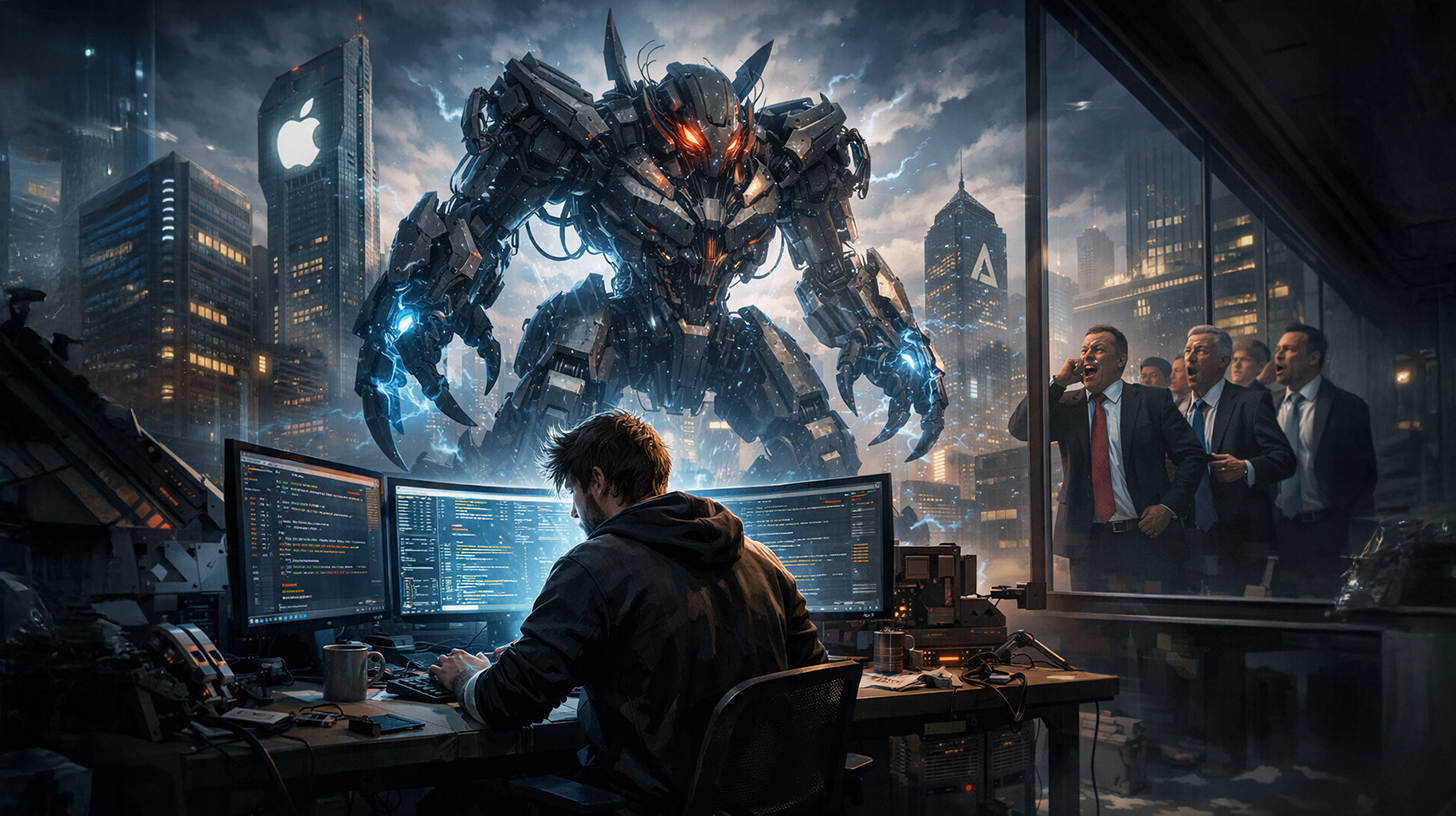
OpenClaw shock, also known as "MoltBot" – The Solitaire Effect: How a single developer will outperform entire corporations in 2026 – Image: Xpert.Digital
Something is happening in the global tech world that analysts will later call the "solitary effect"
February 2026: The "MoltBot" project and the end of the traditional company?
3 weeks instead of 3 years: Why AI roadmaps are suddenly worthless
At the center of the storm is "OpenClaw" (also known internally as "MoltBot"), a fully autonomous AI system that automates complex decision-making processes. But the real sensation is not the software itself, but its origin story: It wasn't developed by a multi-billion-dollar corporation with hundreds of engineers, but by a single person – in just three weeks.
This moment marks a historical turning point. For centuries, the industrial law of scaling held true: more people and more capital generate more value. But generative AI has inverted this paradigm. Through powerful models and intelligent agents, value creation is decoupled from mere labor. The result is a radical asymmetry in which speed and individual creativity trump the inertia and bureaucracy of large organizations.
While traditional companies remain bogged down in compliance loops and budget debates, independent "AI artisans" are using the technology not merely as a tool, but as an exoskeleton for their intellect. They build, test, and scale ideas overnight. The barriers to entry for innovation are approaching zero, and the monopoly of capital is crumbling.
The moment everything changes: A radical paradigm shift – why passion, speed and autonomy destroy and recreate entire industries
In February 2026, the international tech press reported on a new phenomenon. A single developer—not employed by a global tech corporation, not backed by a venture capital-backed startup, but an independent practitioner—had created a fully autonomous AI system in just three weeks. The project, known as "OpenClaw" or internally as "MoltBot," completely automates complex decision-making processes that previously required human expertise or expensive software ecosystems.
What makes this moment special is not only the technical sophistication of the system, but also the symbolic contrast: while corporations keep their strategy departments busy developing “AI roadmaps” and debate budgets over quarters, a functional product with disruptive potential is created in an improvised scenario – built by a single person.
This process marks more than a technological achievement; it illustrates the profound shift in the economy of innovation, power, and speed. The story of 2026 is thus also the story of a transformation: from collective, hierarchically organized production to decentralized, radically rapid value creation by individuals.
From tool to intelligence: Why the production logic collapses
Since the beginning of the Industrial Revolution, economic progress has been linked to the ability to scale labor. The larger the company, the higher the output – economies of scale, specialization, standardization. This paradigm held true for over two centuries. But artificial intelligence, particularly in its generative and self-organizing forms, inverts this principle: it decouples output from labor and creates a scaling model based on individual creativity.
Today, thanks to powerful models like GPT-5, Claude, or Gemini Ultra, a single individual can create systems that previously required hundreds of specialists. This shift dramatically reduces the barriers to entry in key industries. Value is no longer created by dividing up functional tasks, but by the ability to operationalize comprehensive systems thinking with the help of AI. The “solitary developer” is at the dawn of an era in which entrepreneurial creativity prioritizes individual excellence over collective organization.
The Economics of One
This new logic leads to the emergence of a "one-person economy." Here, strategic, technical, and creative roles merge into a single individual, supported by a network of intelligent agents. Instead of teams of developers, data scientists, designers, and project managers, there is a technological ensemble of AI tools that conduct interviews, debug code, generate interface components, and model operational logic in seconds.
From an economic perspective, this represents a shift from a division of labor to an assisted form of work. An individual's productivity increases exponentially when cognitive tasks are no longer delegated but automated. The crucial bottleneck shifts: the limiting resource becomes not the availability of labor, but the ability to integrate into the system.
This phenomenon also explains why individual developers can gain such a significant advantage over corporate structures. In an environment where ideas are implemented and tested immediately, speed replaces institutional stability as a success factor. Where corporations try to avoid risks, independent developers recognize the market opportunity within the risk itself.
The culture of speed
Pace is not just an operational factor, but a cultural one as well. Traditional companies face significant "organizational resistance"—every decision is slowed down by communication chains, compliance rules, responsibility structures, and budget cycles. The speed at which decisions are made is therefore often much slower than the actual pace of technological development.
This inertia doesn't exist for individual developers. The "OpenClaw" project exemplifies how development cycles can be shortened: ideas are prototyped in the evening, tested overnight, and implemented the next day. Feedback loops are immediate, and adjustments are continuous. This "iterative culture" is the core of modern innovation economics.
But speed has a second dimension: it's also an indicator of cultural adaptability. Companies that remain firmly entrenched in their internal rules for years lose the ability to productively absorb external knowledge. Individual developers, on the other hand, operate in open, global networks—in forums, developer communities, and on platforms where the exchange and freedom of ideas take precedence.
The crucial difference is not technological, but mental. Speed here is an expression of autonomy.
From tool to talent: How value creation is reimagined
In the old way of thinking, AI was a tool – a technical asset that made operational processes more efficient. In the new way of thinking, AI is seen as an extension of one's own capabilities. It doesn't replace them, it enhances them. Those who recognize this perspective shift their focus from "tool management" to "talent scaling.".
The difference is fundamental: While companies debate licensing costs for chatbots, individuals see these same systems as having unlimited productive potential. The economic value no longer arises from controlling the tool, but from the ability to translate its potential into a clear use case.
This attitude explains the rise of the so-called “indie AI” movement, in which developers build small, highly optimized systems for niche markets – systems that often displace enterprise solutions within a few months because they are focused on a specific task and free from overhead structures.
In economic terms, this reflects a fundamental shift in social stratum: the capital factor becomes secondary, the creativity factor primary.
The demopolization of innovation
For a long time, innovation was the monopoly of well-capitalized organizations. Large research departments, access to data, economies of scale – all of this created barriers to entry that effectively excluded individuals. By 2026, however, it is becoming clear that these barriers are crumbling.
Large-scale models are accessible via APIs, open-source frameworks are taking over the role of base models, and the entire infrastructure – from cloud deployment to training tools – has become modular and affordable. The barrier to entry for high technology is approaching zero.
This means that capital loses its role as the primary driver of innovation. What matters is no longer who can invest, but who can design. The downside of this development is also its greatest opportunity: innovation is becoming democratized. Anyone with access to a high-performance model, a clear idea, and the necessary willingness to learn can build a marketable product.
This demopolization has massive consequences for the macroeconomic structure. As innovation becomes decentralized, traditional competition between large corporations also loses its significance. Instead of competition between organizations, a hybrid network of individual actors, loose networks, and platform ecosystems emerges.
A new dimension of digital transformation with 'Managed AI' (Artificial Intelligence) - Platform & B2B solution | Xpert Consulting

A new dimension of digital transformation with 'Managed AI' (Artificial Intelligence) – Platform & B2B solution | Xpert Consulting - Image: Xpert.Digital
Here you will learn how your company can implement customized AI solutions quickly, securely and without high entry barriers.
A managed AI platform is your all-inclusive, worry-free solution for artificial intelligence. Instead of dealing with complex technology, expensive infrastructure, and lengthy development processes, you receive a ready-made solution tailored to your needs from a specialized partner – often within just a few days.
The key advantages at a glance:
⚡ Rapid implementation: From idea to ready-to-use application in days, not months. We deliver practical solutions that create immediate added value.
🔒 Maximum data security: Your sensitive data stays with you. We guarantee secure and compliant processing without sharing data with third parties.
💸 No financial risk: You only pay for results. High upfront investments in hardware, software, or personnel are completely eliminated.
🎯 Focus on your core business: Concentrate on what you do best. We take care of the entire technical implementation, operation, and maintenance of your AI solution.
📈 Future-proof & scalable: Your AI grows with you. We ensure continuous optimization and scalability, and flexibly adapt the models to new requirements.
More information here:
Going it alone in business: When a developer is as powerful as a corporation
The new centers of power: Platform economy 2.0
While innovation is becoming decentralized, infrastructure is simultaneously becoming centralized. Models like GPT-5 or Claude Sigma form the basis on which the new individual developers operate. These platforms are becoming the true power centers of the global AI economy.
Economically, a similar structure emerges as in early industrialization – an asymmetric dependency between producers (individual developers) and infrastructure providers (tech platforms). Only this time, the value chain is virtual and data-driven.
The crucial strategic question, therefore, is whether this platform dependency will enable or restrict creative autonomy in the long run. Control over access, pricing, and computing power determines who is allowed to innovate. The risk of hyper-dependence on centralized AI providers is real, even if it is currently mitigated by open-source alternatives (such as HuggingFace models or local deployments).
In the long term, this tension will shape the artificial intelligence economy: decentralized ingenuity meets centralized infrastructures – a new form of digital feudalism.
Safety as a weak point of innovation
Every technological revolution creates uncertainties at its edges. In the case of OpenClaw and similar projects, this uncertainty lies in the area of data security and governance. Individual developers, driven by creativity and speed, often work outside of formal security architectures. The risks range from unprotected data flows to uncontrolled interactions with sensitive corporate systems.
However, an economically interesting dynamic emerges here as well: while corporations see security as a prerequisite for innovation, individual developers view security as a subsequent optimization. Only the functioning of the system justifies the investment in its security.
This approach is risky, but rational from a business perspective when considering the market cycle: speed generates visibility, visibility generates capital, capital enables security. The order may be controversial, but in the new pace of innovation, it is often the only way forward.
Historically, this is reminiscent of the early days of the internet, when startups operated without data protection mechanisms and only established governance structures as their market presence grew. This pattern is repeating itself in the context of AI in 2026.
The new competition: companies versus individuals
In traditional markets, organizations compete for market share. In the AI market of 2026, organizational structures will compete.
With today's tools, a single developer can create a product in weeks that would take a company months to produce, given the necessary budgeting processes, personnel planning, internal coordination, and legal approvals. This creates a structural imbalance: speed and freedom of decision trump the power of capital.
This development is economically disruptive because it undermines traditional competitive advantages. What once made corporations untouchable—size, processes, data access—now becomes a liability. Organizational inertia becomes the biggest cost factor, and flexibility the rarest commodity.
Speed becomes a competitive advantage, risk-taking becomes currency.
The rise of the “AI artisans”
In this new landscape, a new type of knowledge worker is emerging: the "AI artisan." They combine technical understanding, economic thinking, and aesthetic judgment. Their work is not that of a traditional programmer, but rather that of a systems designer.
The AI artisan uses models like Claude or GPT not as a code generator, but as a creative partner. They orchestrate a network of digital tools to compose systems designed for both efficiency and experience.
This way of working is profoundly artistic, yet highly efficient economically. It does not follow the principles of scaling, but rather those of emergence: Small, highly intelligent systems are effective because they are optimized for point solutions.
The economy is thus moving towards an “art of work”, in which man once again becomes the creative center of technology – not through muscle power, but through intelligent architecture.
The geopolitical context: Innovation centers and deregulation
The speed at which this transformation is taking place globally is further influenced by regulatory heterogeneity. While the European Union prioritizes data protection, AI governance, and liability issues, countries like the USA and Singapore focus on innovation-friendly frameworks.
This imbalance creates asymmetric innovation spaces. Individual developers in less regulated markets can experiment more quickly, while European players often have to wait for legal uncertainties to resolve. The effect: a shift of creative momentum to regions with maximum freedom of action.
In the long term, Europe faces a structural challenge. If innovation is driven not by capital but by cultural and regulatory openness, the risk is not of capital but of creativity.
Corporate restructuring: From hierarchy to fluidity
Many large companies will have to adapt their structures in the coming years simply to remain competitive. Traditional hierarchies with strict responsibilities and approval processes are no longer viable in a world where development happens in days.
Organizations that want to survive must form internal "AI cells"—autonomous teams or individuals with direct access to decision-making processes and without lengthy escalation chains. In a sense, this requires corporations to transform themselves into micro-entrepreneurial units.
Companies that seriously pursue this transformation can draw strength from their size: They possess data, customer trust, and capital. When they combine these resources with the speed of individual innovation, a new form of collective intelligence emerges.
Education and talent development in the new age
Education systems have so far barely responded to this tectonic shift. While companies are searching for "prompt engineers," university education often remains theoretical. But in a world where individual systems intelligence counts, new forms of education are needed – project-oriented, interdisciplinary, and practice-based.
Economically, this results in a new job market: People are needed who don't just handle partial processes, but think about systems. Creativity and economic thinking become more important than specialized knowledge. In the age of AI, education shifts from "knowledge acquisition" to "empowerment.".
Going it alone as an economy – a new industrial revolution
The year 2026 marks a turning point in the history of technological innovation. For the first time since the beginning of the industrial division of labor, a point has been reached where an individual, equipped with intelligent machines, can exert the same economic influence as an organization.
The examples of recent months show that it's no longer about owning AI, but about embodying it. Companies that grasp this insight will open up their structures to create space for creative autonomy. Those who don't will lose – not to other corporations, but to individuals with vision, courage, and the willingness to build in three weeks what others plan for three years.
What is new about 2026 is less technical than cultural. It is the end of industrial logic and the beginning of an era in which the individual once again becomes the most productive force in the economy – supported, but not replaced, by artificial intelligence.
Your global marketing and business development partner
☑️ Our business language is English or German
☑️ NEW: Correspondence in your native language!

Konrad Wolfenstein
I and my team are happy to be available to you as your personal advisor.
You can contact me by filling out the contact form here or simply call me at +49 7348 4088 965. My email address is: [email protected]
I'm looking forward to our joint project.
☑️ SME support in strategy, consulting, planning and implementation
☑️ Creation or realignment of the digital strategy and digitization
☑️ Expansion and optimization of international sales processes
☑️ Global & Digital B2B trading platforms
☑️ Pioneer Business Development / Marketing / PR / Trade Fairs
🎯🎯🎯 Benefit from Xpert.Digital's extensive, five-fold expertise in one comprehensive service package | BD, R&D, XR, PR & Digital Visibility Optimization

Benefit from Xpert.Digital's extensive, five-fold expertise in a comprehensive service package | R&D, XR, PR & Digital Visibility Optimization - Image: Xpert.Digital
Xpert.Digital possesses in-depth knowledge across various industries. This allows us to develop tailored strategies precisely aligned with the requirements and challenges of your specific market segment. By continuously analyzing market trends and monitoring industry developments, we can act proactively and offer innovative solutions. The combination of experience and expertise generates added value and provides our clients with a decisive competitive advantage.
More information here:









