
The Robot Age: An Assessment of the Transformation of the Global Economy and its Future Development
Xpert Pre-Release

Available in 27 languages 📢
Prefer Xpert.Digital on GoogleⓘPublished on: June 29, 2025 / Updated on: June 29, 2025 – Author: Konrad Wolfenstein

The Robot Age: An Assessment of the Transformation of the Global Economy and its Future Development – Image: Xpert.Digital
Robotics is revolutionizing the global economy: How intelligent machines are shaping our future
4.28 million industrial robots worldwide: Analysis of a technological revolution
The global economy is at a historic turning point: robotics has evolved from a futuristic vision into a transformative force redefining the foundations of our economic order. This comprehensive assessment illuminates the profound changes already brought about by robotic technologies and forecasts their future development under the influence of artificial intelligence (AI) and geopolitical realignments. Robotics is proving to be not merely a technological upgrade, but a fundamental driver of economic and social transformation.
To understand the implications of this development, it is worth looking back at the starting point of the global economy around 1970 – a time characterized by economic stress from energy crises, inflation, and the beginnings of a decline in productivity. In this challenging context, robotics established itself as a strategic answer to the existential competitive challenges facing high-wage countries. A counterfactual perspective illustrates its immense importance: A world without robotics would likely be characterized today by a near-complete exodus of the manufacturing industry from the West, lower global GDP growth, and higher prices for consumer goods.
The quantitative dimension of the robotics revolution is impressive. With an operational stock of over 4.28 million industrial robots in 2023 and an average robot density of 162 units per 10,000 employees in the manufacturing industry, automation has become an integral part of industrial production. Asia, led by China, has established itself as the undisputed center of this development. Robotics has delivered a significant productivity dividend, reducing costs and improving quality. However, these gains have been unevenly distributed. Academic studies indicate that automation is responsible for 50% to 70% of the increase in wage inequality in the US by displacing workers performing routine tasks and reducing their wages, both relatively and, in some cases, absolutely.
The future of robotics is driven by two main forces: its symbiosis with AI and geopolitical competition. AI is transforming robots from pre-programmed machines into learning, adaptive systems, unlocking explosive growth markets in logistics, healthcare, agriculture, and collaborative robots (cobots). At the same time, robotics has become a central element of national industrial strategies. A strategic divergence is emerging between China's state-directed techno-nationalism ("Made in China 2025") and the research- and innovation-driven approach of the US (National Robotics Initiative) and the EU (Horizon Europe).
Long-term development scenarios range from an “intelligence explosion” with a winner-take-all economy, through an adaptation scenario requiring massive retraining, to a scenario of stagnation and inequality if automation primarily displaces jobs without significant productivity gains. Which path is taken is not a technological inevitability, but rather the result of current political and business decisions.
This analysis reveals clear strategic imperatives: Governments must invest massively in human capital, modernize social security systems, and steer innovation in a direction that complements human capabilities. Companies must embrace retraining as a core strategy and redesign work processes. Finally, establishing robust ethical frameworks for issues such as algorithmic bias, data privacy, and accountability is not only a moral necessity but also a strategic factor in building a sustainable and globally competitive robotics industry. The era in which robots were viewed as mere tools is over; we are entering a new phase in which intelligent machines are becoming integral economic partners.
Related to this:

The redesigned economic landscape: The impact of robotics to date
This section lays out the basic argument by first defining the economic landscape before robotics, then examining a counterfactual world without automation, and finally grounding the analysis in hard data on the actual impact of robotics on productivity and society.
The World Before the Robot: A Baseline Analysis (c. 1970-1980)
To fully grasp the transformative power of robotics, it is first necessary to analyze the economic landscape that preceded its widespread adoption. The 1970s marked a critical turning point, when the post-World War II “golden age of manufacturing” encountered significant headwinds. This era was not characterized by stability, but rather by considerable economic stress, which created the conditions for the subsequent wave of automation.
The economic environment was shaken by severe shocks. The 1973 oil crisis led to a fourfold increase in oil prices, from $3 to $12 per barrel, dramatically raising production costs for energy-intensive industries such as steel and automobiles. At the same time, high inflation prompted central banks to raise interest rates—to as high as 20% in the US in the early 1980s—dampening consumer demand and making capital investment more expensive.
During this period, manufacturing was a cornerstone of employment in industrialized countries. In the United States, manufacturing employment reached a historic high of 19.6 million in June 1979. These jobs were often well-paid, unionized, and formed the foundation of the middle class. However, this model came under pressure. The influence of unions began to wane, and the first wave of automation—even before robotics, for example, through computer-controlled machines—was introduced.
At the same time, the US economy experienced a significant slowdown in productivity growth, a marked departure from the postwar boom. Global competition intensified with the rise of newly industrialized countries, particularly the “Asian Tigers” (South Korea, Taiwan, Hong Kong, Singapore), which offered lower labor costs and put enormous pressure on manufacturers in the US and Europe. This marked the beginning of the large-scale relocation of production to lower-cost regions.
Although not yet mainstream, the seeds of modern automation have been sown. In the 1960s, the first industrial robots were used for specific, repetitive tasks. The 1970s saw the emergence of computer-aided design (CAD) and computer-aided manufacturing (CAM), which began to digitize the design and production process.
The economic crises of the 1970s acted as a powerful, albeit painful, catalyst for the adoption of automation. The pre-robotics economy was already under enormous pressure, and robotics did not enter a stable system, but rather as a potential solution to a crisis of competitiveness. Manufacturers in high-wage countries found themselves caught in a pincer movement: rising domestic costs (energy, labor, capital) and increasing competition from low-cost foreign suppliers. Their main competitive levers were either relocating production abroad (globalization) or drastically reducing domestic production costs. Early automation and the subsequent robotics revolution provided a powerful tool for the latter. This was not a technology in search of a problem, but a solution to an existential threat facing many manufacturing companies. The narrative, therefore, is not simply “robots destroyed jobs,” but rather “robots were introduced at an era when the existing manufacturing model was becoming economically unsustainable, and offered a path to survival for companies operating in high-cost environments.”.
A counterfactual economy: Global trade without automation
A well-founded thought experiment illustrates the extent of the robotic transformation: What would today's global economy look like if the robot revolution had never taken place? This scenario, which builds on the baseline of the 1970s, paints a picture of a radically different global order.
Without the productivity gains brought about by robotics, the relocation of production from North America and Europe to low-wage countries would have been far more extensive and complete. It is plausible that entire industries, such as the assembly of automobiles and electronics, would have almost completely disappeared from high-wage countries. The currently discussed trend of reshoring would be unthinkable, as the wage cost differential would be insurmountable. Competitiveness would have been defined almost exclusively by labor costs, which would have massively accelerated the deindustrialization of the West.
The significant contributions of robotics to productivity and GDP growth – estimated to have increased annual GDP growth by 0.36% in 17 countries – would have failed to materialize. This would mean a global economy with a slower growth trajectory over the past 40 years, leading to lower aggregate prosperity and living standards.
Global value chains (GVCs) would likely be simpler and more fragmented, driven almost entirely by labor cost arbitrage. Complex, just-in-time, and highly integrated supply chains based on automated ports, logistics centers, and factories would be less feasible. The "Made in the World" phenomenon would be less pronounced. The cost of many industrial goods, from cars to electronics, would be significantly higher due to reliance on more expensive labor or less efficient production methods. Product quality and consistency, a key benefit of robotic precision, would be lower and more variable. The era of mass customization would be severely limited.
Regarding labor and wages, while more low-skilled manufacturing jobs might exist in high-wage countries, the wages for these jobs would be under extreme downward pressure from global competition. The problem of wage inequality might manifest itself differently—perhaps less as a gap between highly skilled and routine workers, and more as a chasm between a small class of capital owners and a vast, low-paid workforce.
In a world without robotics, globalization would likely have led to greater geopolitical tensions and protectionism earlier. Robotics' ability to keep some manufacturing profitable in industrialized countries acted as a crucial economic and political safety valve. The counterfactual assumption of a massive, accelerated exodus of jobs from the West would have resulted in even more severe economic disruption and social unrest in regions like the US Rust Belt than were actually experienced. The political pressure to impose high tariffs and protectionist measures to "save" these jobs would have been immense and would likely have occurred decades earlier and with greater intensity. Robotics, which enabled companies like Ford and GM to remain competitive while still producing domestically, mitigated the worst effects of this development. It facilitated a "productivity trade-off" in which companies could reduce labor costs without completely abandoning their home countries. Thus, robotics has not only transformed the economy; It has subtly reshaped the political economy of globalization and delayed and altered the reaction to it.
The robotic footprint: A global quantitative analysis
Robotics is no longer a niche technology, but a fundamental component of the global industrial base. A data-driven analysis of its current prevalence, based primarily on reports from the International Federation of Robotics (IFR), illustrates the extent of this development.
The global operational stock of industrial robots reached an impressive 4.28 million units in 2023, representing a 10% increase compared to the previous year. Annual new installations exceeded half a million for the third consecutive year, reaching 541,302 units in 2023.
A key indicator of automation intensity is robot density – the number of robots per 10,000 manufacturing employees. The global average reached a record high of 162 in 2023, more than doubling in just seven years (from 74). South Korea leads the way with 1,012 robots per 10,000 employees, followed by Singapore (770). Particularly noteworthy is China's rise, which, with 470 robots, has moved into third place, overtaking Germany (429) and Japan (419). The USA ranks tenth with 295 robots.
The geographical distribution shows a clear dominance of Asia, which accounted for 70% of all new installations in 2023.
China is by far the world's largest market. The country has an operational stock of 1.76 million robots (41% of the global total) and accounted for 51% of all new installations in 2023. Japan remains a robotics powerhouse with the second-largest operational stock (435,299) and a 9% share of global installations.
The USA is a major player with 381,964 surgical robots and the third-highest number of annual installations. Germany is the dominant force in Europe and recorded a record 28,355 new installations in 2023.
The automotive and electronics industries have traditionally been the main drivers of adoption. In 2023, the automotive industry reclaimed the top spot with 25% of all installations (135,461 units). The electronics industry fell to second place with 23% of installations (125,804 units), representing a significant decline of 20% compared to the previous year and highlighting the sector's vulnerability to economic cycles in the consumer goods sector.
Global industrial robot landscape, 2023
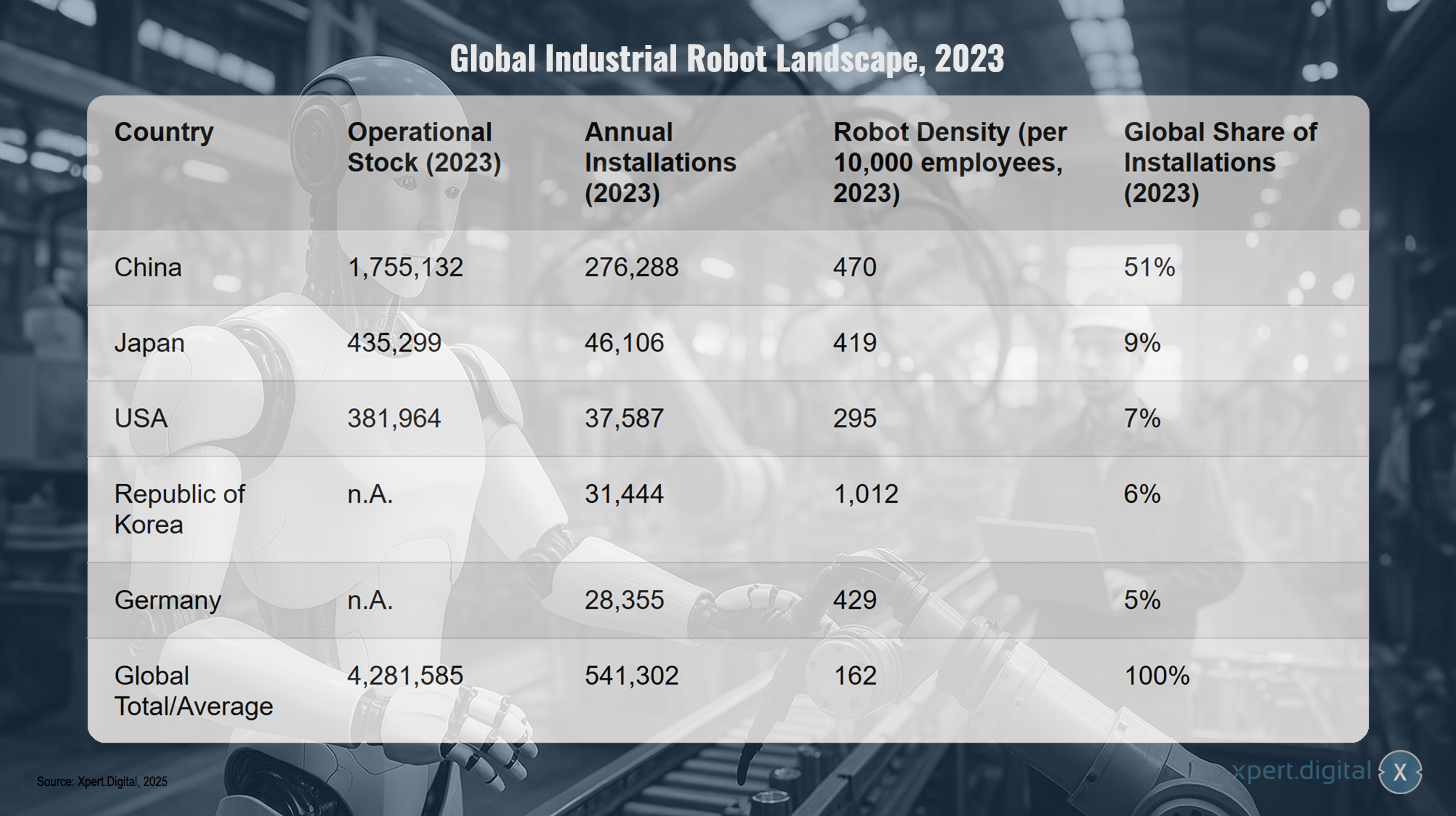
Global industrial robot landscape, 2023 – Image: Xpert.Digital
Note: kA = no information in the cited sources for the specific value.
These figures unequivocally demonstrate that robotics is an established and growing force in the global economy, and its geographical and sectoral distribution provides crucial insights into the current and future power dynamics of global industry.
The global industrial robot landscape in 2023 shows a clear dominance by China, which has the largest stock worldwide with 1,755,132 operational robots and recorded 276,288 new installations, representing 51 percent of all global installations. Despite these impressive figures, China's robot density is 470 robots per 10,000 employees. Japan follows with 435,299 operational robots and 46,106 annual installations, representing nine percent of the global share, but with 419 robots per 10,000 employees, it achieves a similarly high density to China. The USA ranks third with 381,964 operational robots and 37,587 new installations (seven percent globally), but with 295 robots per 10,000 employees, it has a lower density. Of particular note is the Republic of Korea, which, despite a lack of data on its operational stock, installed 31,444 new robots (six percent globally) and achieved the highest robot density of all the listed countries with 1,012 robots per 10,000 employees. Germany completes the top five with 28,355 installations (five percent globally) and a robot density of 429 per 10,000 employees. Overall, the global operational stock comprises 4,281,585 industrial robots with 541,302 annual installations and an average global robot density of 162 per 10,000 employees.
The productivity dividend and its unequal distribution
The introduction of robotics has yielded a clear economic dividend, but its distribution presents significant societal challenges. This duality of macroeconomic gain and socioeconomic tension is central to understanding the impact of automation.
On the one hand, there is the undeniable productivity gain. Studies show a clear correlation: a 1% increase in robot density correlates with a 0.8% increase in productivity. Another analysis estimates that robotics contributed 0.36 percentage points to the annual growth in labor productivity between 1993 and 2007. These efficiency gains manifest themselves in significant cost savings through lower labor costs, 24/7 operation, and minimized material waste. AI-powered robots are expected to reduce production costs by 25% and improve quality by 30%. Intelligent, predictive maintenance can reduce downtime by up to 50%. These effects at the company level add up to overall economic growth. One study attributes a 0.36% increase in annual GDP growth to the increasing use of robots, and the McKinsey Global Institute predicts that automation will account for up to half of the total productivity growth needed for 2.8% GDP growth over the next 50 years.
On the other hand, there is the unequal distribution of these gains, which is primarily evident in the polarization of jobs and wage inequality. Academic research, particularly the work of Acemoglu and Restrepo, provides a robust explanatory framework for this. Automation technologies expand the scope of tasks performed by capital and displace certain groups of workers—especially those performing routine manual and cognitive tasks—from the areas of work where they previously held a comparative advantage.
This displacement effect is not a side issue. Research documents that between 50% and 70% of changes in the US wage structure over the past four decades can be attributed to the relative wage declines of precisely these labor groups in industries undergoing rapid automation. While workers who complement the new technology (e.g., highly skilled analysts, robotics engineers) see wage increases, workers whose jobs can be replaced by machines are worse off. One study estimates that automation reduced the real wages of men without a high school diploma by 8.8% between 1987 and 2016. This has been a major driver of the widening income gap between higher- and lower-educated workers.
Although automation also creates new jobs (e.g., robot programmers, data analysts, maintenance technicians), the net effect is complex. The World Economic Forum (WEF) report from 2023 estimates that by 2025, 85 million jobs could be lost, while 97 million new roles could be created, suggesting a net positive effect but one that comes with massive change and retraining needs. However, the report also notes that job creation is slowing, while job losses are accelerating.
Here, a profound shift is evident. The “productivity paradox” of the 1990s, in which massive investments in information and communication technology were not immediately reflected in productivity statistics, appears to be dissolving. However, it is being replaced by a “distribution paradox.” The gains from automation are clearly visible at the company and macro levels, but they are not widely distributed, leading to significant social and political tensions. The data clearly show productivity and GDP gains from robotics. At the same time, rigorous academic studies demonstrate that this same technological force is the single largest driver of wage inequality during the same period. The paradox lies in the fact that a technology that enlarges the overall economic pie simultaneously shrinks the share, relatively and sometimes even absolutely, for a large segment of the workforce. This is a fundamental departure from previous technological waves, such as electrification, which, after an adjustment period, tended to result in widespread prosperity. Acemoglu describes modern automation as a “mediocre technology” because its productivity gains are modest compared to its significant negative distributional effects. This insight is crucial for policymakers: simply promoting automation for the sake of productivity without actively managing its distributional consequences is a recipe for social instability. The focus must shift from whether we automate to how we automate and distribute the gains.
🎯🎯🎯 Benefit from Xpert.Digital's extensive, five-fold expertise in one comprehensive service package | BD, R&D, XR, PR & Digital Visibility Optimization

Benefit from Xpert.Digital's extensive, five-fold expertise in a comprehensive service package | R&D, XR, PR & Digital Visibility Optimization - Image: Xpert.Digital
Xpert.Digital possesses in-depth knowledge across various industries. This allows us to develop tailored strategies precisely aligned with the requirements and challenges of your specific market segment. By continuously analyzing market trends and monitoring industry developments, we can act proactively and offer innovative solutions. The combination of experience and expertise generates added value and provides our clients with a decisive competitive advantage.
More information here:
Automation 2030: Three scenarios for the human-machine economy of the future
The next wave: AI, geopolitics, and the future of automation
This section shifts the focus from a historical assessment to a forward-looking analysis, examining the three powerful forces that will define the next chapter of robotics: the merging with AI, escalating geopolitical competition, and the long-term redefinition of human labor.
Related to this:
- Automation and robotics as key drivers in modern logistics: HWArobotics, Iggy Rob, Robotize and ROEQ

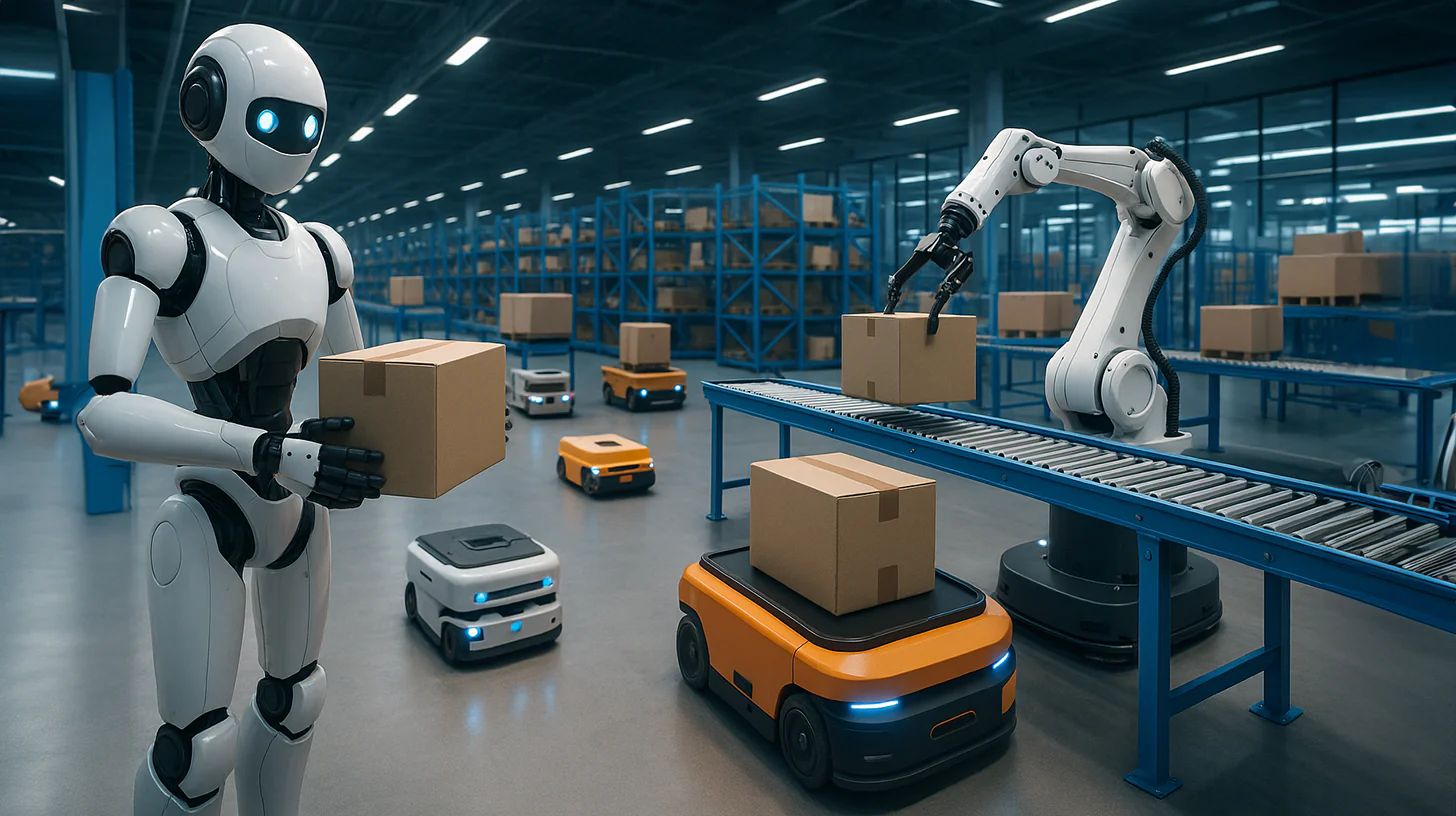
The Intelligence Catalyst: How AI Redefines Robotics
The next stage of robotics' evolution is driven by the profound integration of artificial intelligence (AI). This symbiosis transforms robots from pre-programmed automatons performing repetitive tasks in structured environments into adaptive, learning systems capable of operating in the complex and unstructured real world. AI provides the "brain" for the robot's "body" and is the primary technological driver for future growth.
The key AI technologies that enable this transformation are:
- Computer Vision: Enables robots to visually perceive and interpret their environment, which is essential for navigation, object recognition, and interaction.
- Machine Learning (ML) & Reinforcement Learning: Enables robots to learn from data and experience and iteratively improve their performance in tasks such as grasping objects or navigating complex paths without the need for explicit programming.
- Natural Language Processing (NLP): Enables more intuitive human-robot interaction through voice commands.
- Predictive analytics: Allows robots to predict problems such as maintenance needs, preventing downtime and increasing efficiency.
This AI-driven evolution unlocks transformative growth in sectors that extend far beyond the traditional factory floor:
- Logistics & Warehousing: The e-commerce boom and the pressure for efficiency are fueling a huge market for logistics robots (autonomous mobile robots, driverless transport systems). The market is projected to grow from approximately USD 14.5 billion in 2024 to approximately USD 35 billion in 2030 (CAGR of approximately 16%). Companies like Amazon already have 750,000 robots in operation to automate their fulfillment centers.
- Healthcare: A rapidly growing sector. The medical robotics market is projected to increase from USD 16.6 billion in 2023 to USD 63.8 billion in 2032. Applications include high-precision robot-assisted surgery (e.g., the da Vinci system), patient care, disinfection, and drug delivery.
- Agriculture (Agri-Tech): Driven by labor shortages and the need for food security, the agricultural robot market is poised for massive expansion. Forecasts predict growth from approximately USD 15-18 billion in 2024/2025 to over USD 90 billion by 2034 (CAGR approximately 20-25%). Robots are used for precise planting, weeding, spraying, and harvesting.
- Collaborative robots (cobots): This is a crucial emerging market. Cobots are designed to work safely alongside humans, are more cost-effective, and easier to program, making them ideal for small and medium-sized enterprises (SMEs). The market is projected to grow from approximately USD 2.1 billion in 2024 to over USD 11.6 billion in 2030 (CAGR >31%). They are rapidly gaining traction in assembly, welding, and material handling.
Growth forecasts for key emerging robotics segments
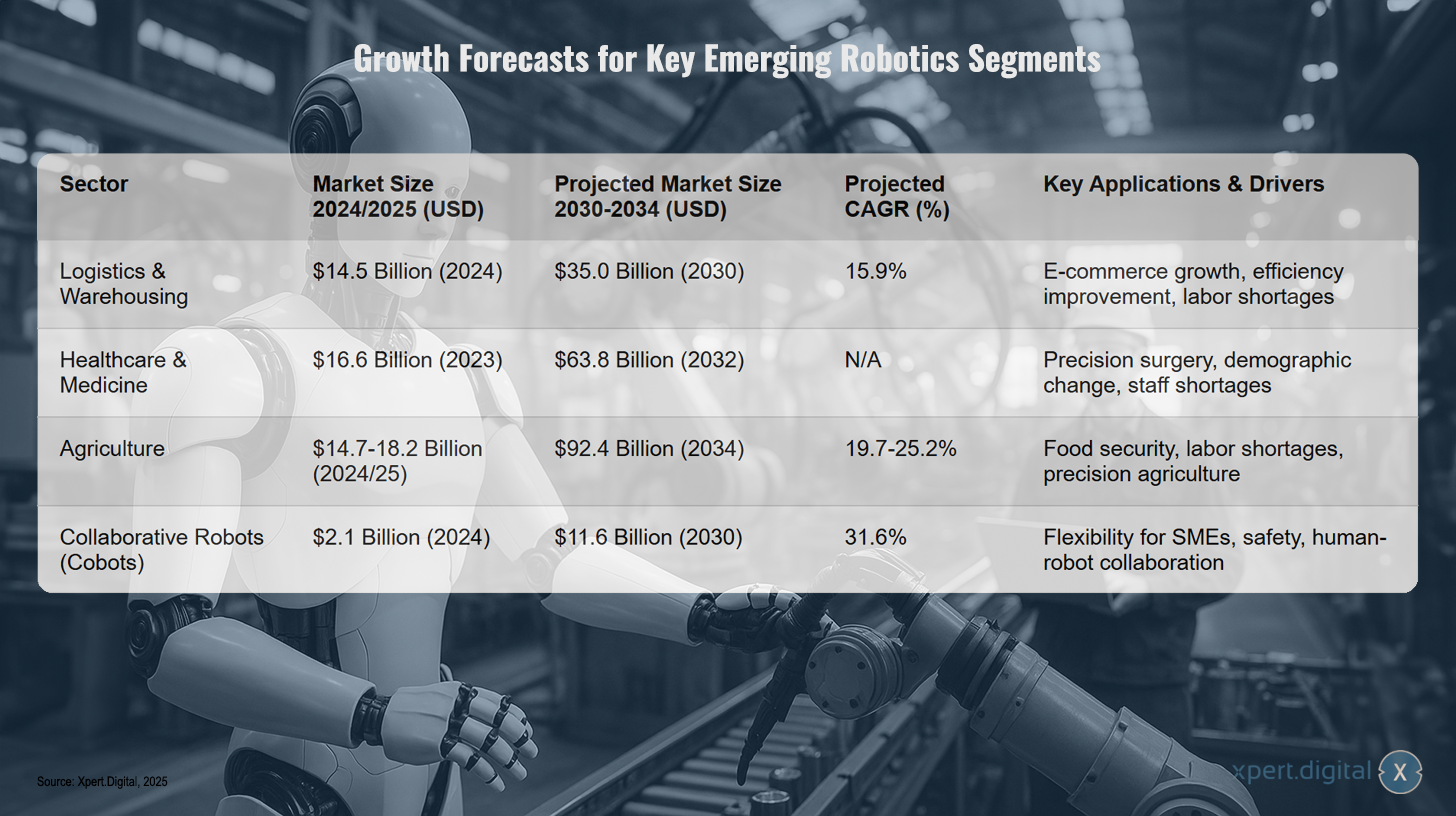
Growth forecasts for key emerging robotics segments – Image: Xpert.Digital
Note: CAGR and market size forecasts vary depending on the source and forecast period.
These figures demonstrate that the future of robotics lies not only in more factory robots, but in diversification into entirely new, high-growth economic sectors, all driven by AI. This quantifies the “next wave” of automation.
The robotics industry is showing exceptional growth prospects across various segments. In the logistics and warehousing sector, the market is projected to grow from USD 14.5 billion in 2024 to USD 35.0 billion by 2030, representing a compound annual growth rate (CAGR) of 15.9 percent. This growth is driven by continued e-commerce expansion, the need for efficiency improvements, and the increasing labor shortage.
The healthcare and medical sectors are also reporting impressive figures: From USD 16.6 billion in 2023, the market is projected to grow to USD 63.8 billion by 2032. Precision surgery, demographic change, and staff shortages are the main drivers of this expansion.
The agricultural sector is developing particularly dynamically, with robotics solutions projected to reach between USD 14.7 and 18.2 billion in 2024/25 and growing to USD 92.4 billion by 2034. This development, with a projected annual growth rate of 19.7 to 25.2 percent, is driven by food security, labor shortages, and the increasing prevalence of precision agriculture.
Collaborative robots, or cobots, are experiencing the strongest growth, with their market value projected to increase from USD 2.1 billion in 2024 to USD 11.6 billion by 2030. With an exceptional annual growth rate of 31.6 percent, this segment benefits from the flexibility they offer small and medium-sized enterprises, increased safety standards, and the ongoing development of human-robot collaboration.
The new industrial race: Geopolitical strategy and technological supremacy
Robotics and AI have evolved from purely economic tools to central pillars of national geopolitical strategies. The way global powers promote these technologies reveals profound differences in their economic and political philosophies.
China’s “Made in China 2025” (MIC 2025) is a state-directed industrial policy aimed at making China the dominant force in global high-tech manufacturing, including robotics and AI. The explicit goal is to reduce reliance on foreign technology and achieve 70 percent self-sufficiency in core components and materials by 2025. This poses a direct challenge to the West’s technological leadership. The strategy employs massive state subsidies, estimated at hundreds of billions of dollars, the mobilization of state-owned enterprises, low-interest loans, and an aggressive acquisition of foreign intellectual property and talent. The results are visible: China’s robot density is increasing rapidly, and its domestic robot manufacturers now capture 47% of their domestic market, up from a long-term average of 28%.
The United States National Robotics Initiative (NRI) takes a more decentralized, research-oriented approach to accelerating the development and use of robots that work cooperatively with humans (co-robots). Its goal is to advance basic research and maintain U.S. innovation leadership. The NRI is a multi-agency federal program (NSF, NASA, NIH, USDA, etc.) that provides funding for academic and community research. Funding amounts to tens of millions of dollars annually per agency and focuses on areas such as human-robot interaction, scalability, and societal impact. This contrasts sharply with China's top-down approach to industrial development.
The European Union's strategy (Horizon Europe) aims to strengthen the EU's scientific and technological base, increase innovation capacity, and maintain competitiveness, while respecting ethical considerations. The EU views robotics as essential for reindustrialization and addressing societal challenges such as an aging population. The EU utilizes its massive R&D framework program, Horizon Europe (with a budget of €95.5 billion until 2027), to fund research projects. It maintains a public-private partnership (SPARC) to coordinate efforts and plans to implement a comprehensive EU-wide robotics strategy by 2025. The focus is on building a robust ecosystem and a regulatory framework (e.g., the AI Law).
These differing approaches are also reflected in the debate surrounding the reconfiguration of supply chains (reshoring/nearshoring). Geopolitical tensions and supply chain disruptions have prompted Western companies to consider bringing production back home. Automation is seen as a key driver of this shift, as it can offset higher labor costs in the US and Europe. Surveys indicate strong intent: 74% of European and 70% of US companies plan to reshort or nearshore, with the majority planning to invest in robotics to facilitate this. However, the reality is more complex. A World Bank study found a negative correlation between automation adoption and reshoring from 2008 to 2019, suggesting that automation may have actually made offshore production more efficient and attractive, thus reducing the incentive to reshort.
There is a fundamental philosophical and strategic divergence in the major powers' approaches to robotics. China pursues a state-capitalist model of "techno-nationalism" aimed at industrial dominance and self-sufficiency. The US and the EU pursue a more "liberal-technological" model focused on basic research, public-private partnerships, and regulatory leadership. This is not just a technology race, but a clash of economic systems. China's MIC 2025 explicitly sets goals of import substitution and creating national champions to dominate global markets. In contrast, the US NRI and the European Horizon Europe focus on funding "basic research" and "upholding ethical considerations." This reflects their underlying economic philosophies: China's state-directed development versus the West's market-oriented innovation ecosystem. This sets the stage for a long-term competitive struggle being fought on different battlefields.
At the same time, the reshoring narrative is oversimplified. Automation is a double-edged sword for supply chains: it can enable reshoring by making domestic production profitable, but it can also entrench offshoring by making distant factories even more efficient and cost-effective. The end result will depend on a complex interplay of technology costs, labor costs, transportation costs, and geopolitical risk calculations. The current reshoring trend may therefore be driven more by non-economic factors (geopolitical risk, government incentives) than by the pure economic calculations of automation. Automation is a necessary, but not sufficient, condition for reshoring.
Long-term scenarios for the human-machine economy
Synthesizing current trends allows for forecasting potential long-term futures for the global economy that go beyond short-term projections and take profound structural changes into account. Three main scenarios emerge, each based on different assumptions about the development of technology and society.
- Scenario 1: The Intelligence Explosion & the Winner-Take-All Economy.
This scenario, popular in Silicon Valley, posits that applying AI to AI development itself will lead to recursive self-improvement and an exponential increase in technological capabilities. Combined with robotics (“self-driving labs”), this could result in unprecedentedly rapid progress in all fields, from medicine to materials science. The economic outcome is a “winner-take-all” dynamic, where the company or nation that achieves this breakthrough first amasses immense economic and political power. This could exacerbate inequality on a global scale, but also potentially create an economy of abundance after scarcity. - Scenario 2: The Transformation and Adaptation Economy.
This is a more moderate scenario, consistent with OECD and WEF forecasts. It posits that AI is a general-purpose technology (GPT), like steam power or electricity, which will profoundly transform all sectors but will not lead to mass unemployment. The core dynamic is continuous change in the labor market: tasks will be automated, jobs will be transformed, and new jobs will be created. The WEF forecasts that by 2030, 14% of today's jobs will be new (170 million), while 39% of a worker's core skills will be obsolete. The central challenge in this scenario is not a lack of jobs, but a massive skills gap and the need for lifelong learning to keep pace. - Scenario 3: The Stagnant and Inequality Economy.
This scenario builds on the work of Acemoglu and Restrepo. It suggests that if future automation remains “mediocre”—that is, displacing labor without generating massive productivity gains—the result could be persistently slow GDP growth coupled with increasing inequality. In this future, automation primarily serves to shift income from labor to capital owners, eroding the middle class and dampening consumer demand. This could lead to a self-reinforcing cycle in which weak demand discourages precisely the investments needed for groundbreaking innovation, resulting in economic stagnation.
Regardless of the scenario, AI and robotics will have a profound impact on public finances. Widespread use could boost GDP and tax revenues. However, job losses could increase spending on social security systems (unemployment, retraining programs). Government use of AI could improve efficiency (e.g., in tax collection), but it also requires significant upfront investment.
The ultimate long-term economic outcome is not technologically predetermined. It is shaped by the policy decisions made today in the areas of education, R&D funding, taxation, and social support. The three scenarios are all plausible and based on different interpretations of the available data. Scenario 1 depends on a specific technological breakthrough. Scenario 3 depends on the continuation of a particular type of automation (labor-displacing but not highly productive). Scenario 2 is the middle ground. Policy can influence which path we take. For example, a tax policy that favors capital over labor may encourage “mediocre” automation and push us toward Scenario 3. Conversely, massive public investment in basic research and education could foster more complementary technologies and a highly skilled workforce, steering us toward Scenario 2. Thus, the “future of work” is not something that will simply happen to us; it will be actively shaped by the policy and investment decisions of governments and businesses in the coming decade. The debate about the future is really a debate about the priorities of the present.
Our recommendation: 🌍 Limitless reach 🔗 Connected 🌐 Multilingual 💪 Sales power: 💡 Authentic with strategy 🚀 Innovation meets 🧠 Intuition

From local to global: SMEs conquer the world market with a clever strategy - Image: Xpert.Digital
In an era where a company's digital presence determines its success, the challenge lies in creating an authentic, personalized, and far-reaching presence. Xpert.Digital offers an innovative solution that positions itself as the intersection of an industry hub, a blog, and a brand ambassador. It combines the advantages of communication and sales channels in a single platform and enables publication in 18 different languages. Cooperation with partner portals and the ability to publish articles on Google News and a press distribution list with approximately 8,000 journalists and readers maximize the reach and visibility of the content. This represents a crucial factor in external sales and marketing (SMarketing).
More information here:
The End of Automation: Why Robots Are Becoming Real Business Partners
Navigation in the age of robots: Strategic recommendations and ethical frameworks
This final part translates the analysis into actionable strategies and highlights the crucial ethical guidelines needed to ensure that the robot age benefits society as a whole.
Related to this:

A political roadmap for an automated future
This section summarizes the challenges identified throughout the report into a coherent set of policy recommendations for key stakeholders.
For governments
- Investing in human capital: By far the most important challenge is improving the breadth and quality of education and training. This includes strengthening STEM skills, but also focusing on competencies that machines cannot easily replicate: creativity, critical thinking, collaboration, and resilience. Lifelong learning should be supported through subsidized accounts or tax incentives for retraining.
- Modernizing social security systems: The old model of unemployment insurance is unsuitable for an era of frequent job changes. New ideas such as wage insurance (to supplement the wages of displaced workers who accept lower-paying jobs), more generous income tax credits, and transferable benefits for workers in the gig economy must be researched and tested.
- Steering innovation: Tax policy and R&D funding should be used to promote the development of technologies that complement, rather than replace, human labor. Consideration should be given to taxing companies that permanently lay off workers due to automation, while subsidizing those that retrain them.
For companies
- Retraining as a core strategy: Business leaders largely expect to have to retrain their workforce. This should not be an afterthought, but rather a central component of the company's strategy. Investments in on-the-job training and partnerships with educational institutions are essential.
- Redesigning work and workflows: The integration of humans and machines must be actively shaped to create safe, productive, and fulfilling work environments. The focus should be on human-machine collaboration, which can be more productive than humans or robots working alone.
For educational institutions
- Curriculum reform: Curricula need to be updated to prepare students for the future of work. This means less rote learning and more emphasis on problem-solving, systems thinking, and digital skills.
- Integrating robotics into education: There is a significant gap between the importance of robotics and its presence in educational programs. More institutions need to use robots in the classroom to build a future-proof workforce.
The ethical imperative: The government of a world of intelligent machines
This section addresses the critical non-economic challenges which, if left unaddressed, could undermine public confidence and hinder progress.
- Bias and fairness: AI systems learn from data, and if this data reflects historical biases, the robots they control will perpetuate and even reinforce discrimination in areas such as recruitment or law enforcement. This necessitates the development of diverse and representative training datasets and the performance of regular algorithmic audits.
- Data protection and surveillance: Robots equipped with cameras, microphones, and sensors are powerful data collection devices. Their use in homes, hospitals, and public spaces raises significant data privacy concerns. Clear regulations governing data collection, use, and storage are needed to ensure transparency and user control.
- Responsibility and liability: As robots become increasingly autonomous, determining responsibility for damages becomes complex. If a self-driving car has an accident or a surgical robot malfunctions, who is liable – the owner, the manufacturer, or the programmer? Clear legal frameworks are essential to clarify these issues. This is particularly urgent in the case of lethal autonomous weapons, where international agreements are necessary.
- Human-robot interaction and societal impacts: The increasing integration of robots into everyday life, particularly social or companion robots, raises psychological and social questions. Concerns exist regarding emotional dependency, the potential for robots to replace rather than complement human relationships, and how this might alter our sense of empathy and community. Ethical design must prioritize human well-being and social connectedness.
The ethical challenges of robotics and AI are not separate from, but deeply intertwined with, economic and geopolitical issues. A failure to establish ethical governance can lead to a significant economic and competitive disadvantage. The EU's approach is indicative of this. It explicitly links its technology funding (Horizon Europe) to strong regulatory and ethical frameworks (the AI law). This can be seen as a strategic move. By establishing a "gold standard" for trustworthy and ethical AI/robotics, the EU could leverage this as a competitive advantage, similar to how it has done with data protection (GDPR). Companies and countries perceived as ethically negligent could face a "trust deficit," leading to consumer backlash, restricted market access in regulated regions like the EU, and difficulties in attracting top talent. Proactive ethical governance is therefore not just a matter of “doing the right thing,” but a crucial component of a long-term strategy for building a sustainable and globally competitive robotics industry. It transforms a potential burden into a strategic advantage.
From automated tools to business partners
The analysis has shown that robotics has already irrevocably changed the global economy, and its transformative power, driven by convergence with artificial intelligence and shaped by geopolitical imperatives, will continue to increase. The era in which robots were viewed as simple, repetitive tools for increasing efficiency is definitively over. We are entering a new phase in which intelligent, autonomous machines are becoming integral players in the economy—partners, competitors, and catalysts of change.
The journey from the first programmable arms in 1970s factories to today's AI-driven systems was a response to economic pressures and a source of immense productivity gains. Without this development, the industrial landscape of the West would be more barren, global supply chains less sophisticated, and many consumer goods more expensive. But this dividend came at a price: a significant increase in wage inequality and a painful displacement of workers whose skills were replaced by machines.
The future promises even deeper integration. The next wave of robotics will permeate not only factories, but also hospitals, farms, warehouses, and our homes. This exponential growth potential has placed robotics at the heart of national strategies and ignited a global race for technological supremacy that will help shape the contours of the 21st-century world order.
However, long-term development is not predetermined. Scenarios range from a future of technological abundance to one of stagnation and social division. The decisive factor that will tip the scales is not the technology itself, but our ability to steer it wisely. Our future prosperity depends on our ability to shape this new, complex partnership with intelligent machines in a smart, fair, and ethical way. This requires bold investments in education and lifelong learning, the modernization of our social safety nets, and the creation of robust ethical and legal frameworks. Only in this way can we ensure that the benefits of the robot age are widely shared and create a future in which technology serves all of humanity.
We are here for you - Consulting - Planning - Implementation - Project Management
☑️ SME support in strategy, consulting, planning and implementation
☑️ Creation or realignment of the digital strategy and digitization
☑️ Expansion and optimization of international sales processes
☑️ Global & Digital B2B trading platforms
☑️ Pioneer Business Development

Konrad Wolfenstein
I would be happy to serve as your personal advisor.
You can contact me by filling out the contact form below or simply call me on +49 7348 4088 965 (Munich) .
I'm looking forward to our joint project.
Write to me

Xpert.Digital - Konrad Wolfenstein
Xpert.Digital is a hub for industry focusing on digitalization, mechanical engineering, logistics/intralogistics and photovoltaics.
With our 360° Business Development solution, we support renowned companies from new business to after-sales.
Market intelligence, smarketing, marketing automation, content development, PR, mail campaigns, personalized social media and lead nurturing are part of our digital tools.
You can find more information at: www.xpert.digital - www.xpert.solar - www.xpert.plus
Keep in touch









