
The reorganization of the XR market: When hardware becomes secondary and AI takes over value creation
Xpert pre-release

Available in 27 languages 📢
Prefer Xpert.Digital on GoogleⓘPublished on: January 6, 2026 / Updated on: January 6, 2026 – Author: Konrad Wolfenstein
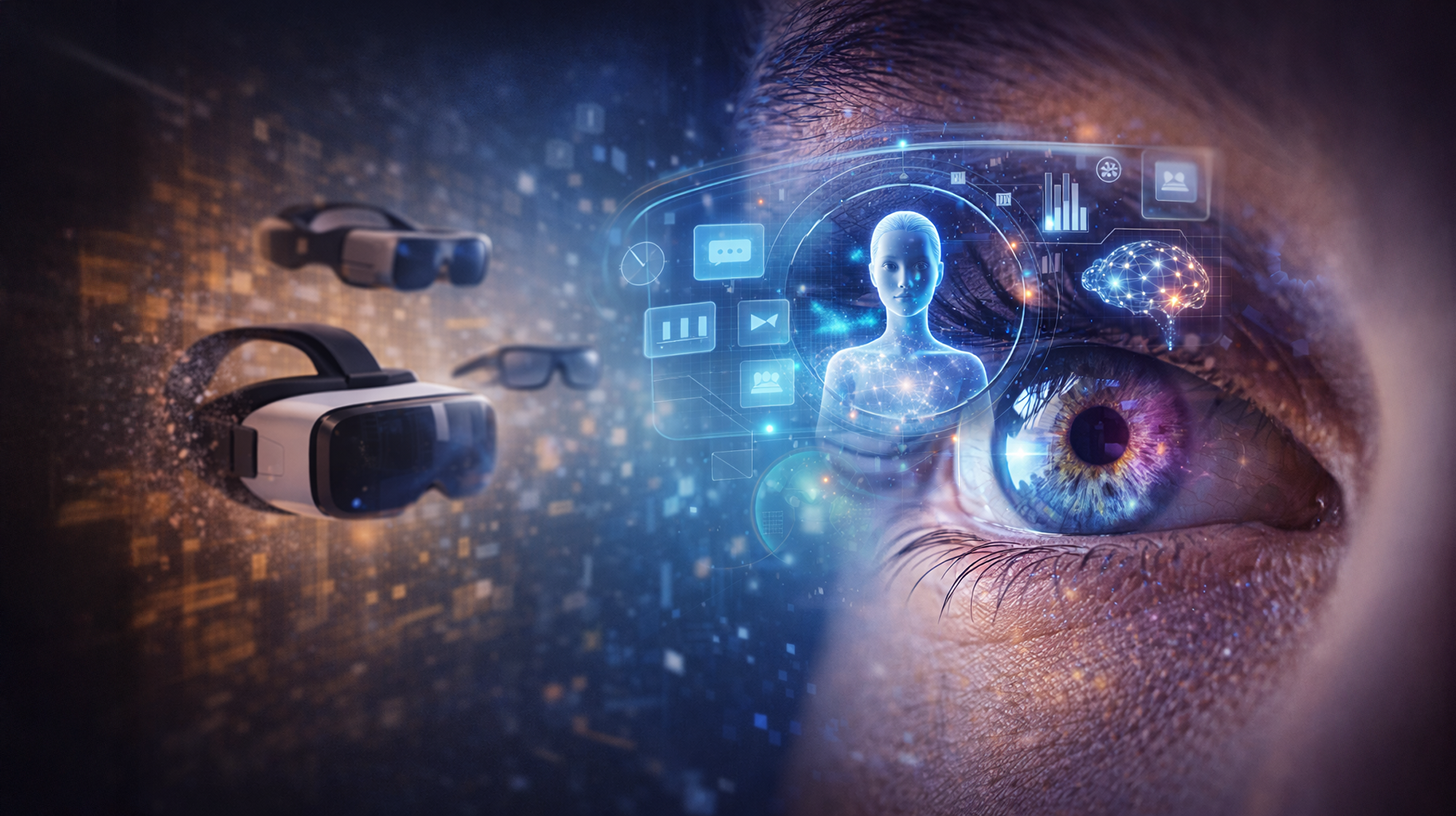
The reorganization of the XR market: When hardware becomes secondary and AI takes over value creation – Image: Xpert.Digital
Meta's billion-dollar bet: Between Ray-Ban success and Reality Labs disaster
The year 2026 marks a turning point in the XR market: The dream of the metaverse gives way to the reality of AI assistants, while tech giants radically readjust their strategies
Forget VR glasses: Why AI is the real reason for the new boom – The future belongs to the AI assistant right before your eyes
Twelve years after the spectacular failure of Google Glass, the tech industry is once again at a turning point. But unlike those early attempts, in 2026 it's no longer just about technical feasibility, but about the very existence of viable business models. The major players – Meta, Google, Samsung, and Apple – have learned their lessons, but are drawing completely different conclusions. While Meta is trying to break free from platform dependency with subsidized hardware and aggressive AI integration, Google is returning with an open ecosystem approach that evokes memories of its successful Android strategy. Apple, on the other hand, disillusioned by the limited reach of its Vision Pro, is practicing strategic patience and shifting its focus to mass-market solutions.
Analyzing the current market situation reveals a paradox: Technologically, hardware is approaching a commodity phase where specifications become interchangeable. The real battle for value creation is invisibly shifting to software – towards advanced language models and context-aware AI. But while the industry is pumping billions into this vision, fundamental questions remain unanswered: Are consumers truly prepared to sacrifice their privacy for the convenience of a digital assistant on their face? And can a market so fragmented, with forecasts fluctuating between a billion-dollar boom and niche existence, finally live up to these high expectations?
This report sheds light on the profound reorganization of the XR market, analyzes the risky bets of tech companies, and reveals why the next big leap may not lie in virtual reality, but in inconspicuous, AI-controlled glasses.
When the mass market finally becomes a reality – or is it just a new illusion?
The year 2026 does not mark a technological breakthrough in the classic sense, but rather a strategic consolidation in a market that has oscillated between hype and disillusionment for over a decade. Twelve years after the spectacular failure of Google Glass, the tech giants are attempting another launch – this time, however, under radically different circumstances. The central question is no longer whether smart glasses work technically, but whether the industry has finally found a convincing business model that goes beyond hardware subsidies and billions invested in questionable metaverse visions.
The situation seems paradoxical: While Meta is achieving significant sales success for the first time with its Ray-Ban Smart Glasses and expanding production capacity to ten million units annually, the company is simultaneously postponing its next VR headset generation, the Meta Quest 4, from 2026 to 2027. Google is returning to a battlefield it fled in 2013 with Android XR. Apple is announcing smart glasses for the end of 2026, after the Vision Pro, a $3,500 prestige project, failed to reach the mass market. And Samsung is positioning itself with the Galaxy XR, priced at $1,799, in a segment previously dominated by budget-friendly Quest headsets.
This complex situation points to a fundamental shift: The industry's focus is moving from immersive virtual reality experiences to practical augmented reality applications. Smart glasses without integrated displays, but equipped with AI assistants, are becoming a strategic priority – not because they are technologically superior, but because they finally promise a scalable business model. The real innovation lies not in the hardware, but in the integration of advanced speech models that could transform simple camera glasses into potentially indispensable digital assistants.
The market is fragmenting – but is the overall volume really growing?
Market figures fluctuate between cautious optimism and aggressive growth forecasts, which, upon closer examination, reveal significant methodological weaknesses. The European AR market is estimated at US$6.85 billion for 2024 and is projected to grow to US$115.30 billion by 2032, representing an average annual growth rate of 44.5 percent. For the more specific market of AR and VR glasses in Europe, estimates for 2024 are only US$1.8 billion, with a projection of US$20.5 billion by 2032 and a CAGR of 35.8 percent.
These significant discrepancies are not statistical noise, but reflect the fundamental uncertainty surrounding the definition of smart glasses. Do audio glasses like the first Ray-Ban Meta Stories, which lack both a display and AR capabilities, belong to the market? Are enterprise solutions like the Microsoft HoloLens 2, priced well over €3,000, categorized the same as $300 consumer glasses? Market estimates for 2024 range from $878.8 million to $5.98 billion – a range that renders any serious forecast absurd.
What is undeniable, however, is that sales figures are growing. In the first quarter of 2025, 1.49 million smart glasses units were shipped worldwide, an increase of 82.3 percent compared to the previous year. Meta dominates this market with a 73 percent share and recorded a tripling of sales in the first half of 2025 compared to the same period of the previous year. By February 2025, a total of two million Ray-Ban Meta Glasses had been sold – a figure that seems modest in the tech context, but marks a turning point for this segment, which had long been considered doomed.
The price trend suggests a deliberate market penetration strategy. While Google Glass failed in 2013 at $1,500, current consumer models range from $300 to $500. Ray-Ban Meta Glasses are offered for €329, and the sportier Oakley version for €439. These price points allow for positioning beyond the early adopter niche for the first time, although the question of broader consumer willingness to pay remains unanswered.
Market fragmentation is particularly evident in its geographic distribution. Asia-Pacific is projected to be the fastest-growing region, with a CAGR of 29.5 percent, driven by lower manufacturing costs and the presence of Chinese manufacturers such as Xiaomi, Huawei, and Rokid. China not only produces a significant portion of global hardware but is also becoming a testing ground for new form factors and price points. In the first quarter of 2025, 494,000 smart glasses units were shipped in China, an increase of 116.1 percent—a dynamic that Western markets have not yet replicated.
The revenue distribution shows that, despite the consumer hype, the XR industry primarily thrives on B2B business. In Germany, one of the strongest European XR markets, the industry generated between €490 and €550 million in revenue in 2021, with 29 percent of companies citing manufacturing and industry as their most important customer sector. Arts and entertainment – specifically the consumer gaming sector, which dominates public perception – followed with only 13 percent. This discrepancy between media attention and actual value creation is characteristic of the entire XR sector.
Meta dominates – but at what price and with what perspective?
Meta's position in the smart glasses market appears comfortable at first glance. The company has partnered with EssilorLuxottica, a company that not only possesses global production and distribution capabilities but also boasts over 18,000 retail locations worldwide. The €3 billion investment for a three percent stake in EssilorLuxottica – with an option to increase to five percent – underscores the strategic importance of this partnership. Meta plans to increase its annual production capacity to ten million units by the end of 2026, which, given current sales figures, represents a significant bet on future growth.
Usage data suggests that at least some buyers are actively using the devices. Monthly active users quadrupled in the first quarter of 2025 compared to the previous year. The use of voice commands is growing even faster, underscoring the strategic importance of AI integration. Meta AI, the in-house assistant, is deeply integrated into Ray-Ban glasses, enabling features such as real-time translations, visual object recognition, and context-aware information queries.
However, these successes must be viewed in the context of the Reality Labs division, which alone recorded a loss of $4.53 billion in the second quarter of 2025. Since 2020, Meta has invested over $100 billion in VR, AR, and the Metaverse—a sum that dwarfs any other recent technological development. While smart glasses represent a growing share of Reality Labs revenue, their absolute value remains marginal compared to Meta's advertising business, which generated over $130 billion in 2024.
The strategic rationale behind these investments lies not in immediate profitability, but in platform independence. Mark Zuckerberg aims to free Meta from its structural dependence on Apple and Google. Apple's privacy changes in iOS have significantly impacted Meta's advertising business and highlighted the fragility of its business model. Smart glasses, and later fully-fledged AR glasses, are intended to establish a proprietary platform on which Meta defines the rules – from the operating system and app ecosystems to data collection and utilization.
Meta is planning several product launches for 2026: a Ray-Ban variant with an integrated heads-up display, the Oakley Meta Sphaera with a centered camera for optimized first-person videos, and other model variants. This product diversity aims to cover different usage scenarios and aesthetic preferences – from lifestyle-oriented fashion models to sports and outdoor eyewear. In parallel, Meta is working on two more fundamental projects: an ultralight mixed-reality headset with an external computing module for 2027, and the fully-fledged AR headset Artemis, designed as the successor to the Orion prototype and also slated for release in 2027.
The postponement of the Meta Quest 4 from 2026 to 2027 is more than just a delay in this context. It signals a strategic realignment. VR headsets remain important for gaming and immersive applications, but the mass-market breakthrough is increasingly being sought in smart glasses. According to internal memos, the Reality Labs division has shifted its focus from VR hardware to Horizon OS and the entire ecosystem. The software platform is to be fundamentally overhauled before new hardware is launched – a realization that Meta apparently had to pay a high price for.
Google and Samsung are returning – with a platform strategy instead of a hardware obsession
Google's return to the smart glasses market is taking place under radically different circumstances than the disastrous Google Glass launch of 2013. Back then, Google tried to sell a single premium product that lacked both a clear target audience and compelling use cases. In 2026, the company is pursuing a platform strategy: Android XR is intended to become what Android is for smartphones – an open operating system that allows hardware partners to develop different devices for different markets.
The Samsung Galaxy XR is the first device in this strategy and, at $1,799, deliberately positions itself in the premium segment. Its technical specifications are impressive: two micro-OLED displays, each with 3,552 by 3,840 pixels – a total of 27.3 million pixels, surpassing the 23 million of the Apple Vision Pro. The Snapdragon XR2 Plus Gen 2 processor offers 15 percent more GPU performance and 20 percent higher CPU clock speed than the standard version. With 16 gigabytes of RAM and 256 gigabytes of storage, as well as comprehensive sensor suite – six tracking cameras, four eye-tracking cameras, a depth sensor, and iris recognition – the Galaxy XR is technically on par with its competitors.
The initial market launch was limited to the US and South Korea, suggesting both limited production capacity and a cautious go-to-market strategy. Samsung wants to avoid disappointing global expectations with an immature product. The battery life of 2 to 2.5 hours is on par with the competition, and the external battery design reduces the headset's weight to 545 grams – significantly less than the 750 to 800 grams of the Apple Vision Pro.
Android XR as a platform differs fundamentally from Meta's closed Horizon OS or Apple's visionOS. Google relies on Gemini as its central AI assistant, with voice commands being the primary method of interaction. The new platform supports PC Connect for Windows integration, a travel mode for stabilized views while moving, and Likeness for realistic 3D avatars in video calls. These features target productivity applications—an area where VR and AR have so far failed to deliver on their promises.
For 2026, Google is announcing three categories of smart glasses: AI Glasses without a display for voice control and simple gestures, Display AI Glasses with a transparent mini-display for navigation and information overlays, and Wired XR Glasses with a cable connection to an external computing module for maximum performance. This differentiation addresses different price points, application scenarios, and user groups – from the mass consumer market to enterprise professionals.
The partnerships with eyewear manufacturers like Warby Parker, Gentle Monster, and Xreal follow Meta's strategy with EssilorLuxottica. Warby Parker targets the US market with a minimalist-progressive design approach, Gentle Monster brings expertise in avant-garde fashion eyewear with particular strength in Asia, and Xreal focuses on tech-savvy early adopters with its wired Project Aura. This diversification allows Google to address different aesthetics and target groups simultaneously without having to make a single product a success.
However, the Android XR strategy raises fundamental questions: Will developers invest heavily in yet another AR ecosystem after Google has already discontinued several XR projects – from Google Glass and Daydream to ARCore experiments? How will Google prevent the fragmentation that has plagued Android smartphones for years, with different hardware partners offering varying capabilities and update cycles? And above all: What is Google's long-term monetization strategy beyond advertising – a business model that raises significant privacy concerns for wearable devices with always-on cameras?
Apple is delaying its big push – and focusing on incremental market expansion
Apple's strategy in the XR sector seems contradictory at first glance: After presenting a technical masterpiece with the Vision Pro, which flopped due to its $3,499 price tag and lack of killer apps, Apple is planning a radically simpler product for the end of 2026 – smart glasses without a display, primarily paired with the iPhone. However, the market launch is not expected until 2027, which puts Apple in this market significantly later than Meta or the first Android XR devices.
According to industry reports, Apple's planned smart glasses will include cameras, microphones, and speakers, but initially forgo visual displays. The focus will be on features such as photo and video recording, music playback, calls, translations, and voice-activated assistant queries via Siri – a feature set similar to Ray-Ban's Meta Glasses, but with Apple's premium craftsmanship and seamless integration into the Apple ecosystem. Bloomberg reporter Mark Gurman, whose Apple predictions have generally been accurate in the past, describes the planned glasses as similar to the Meta products, but with higher manufacturing quality.
This positioning is remarkable for several reasons. First, Apple is implicitly capitulating to the reality that the mass market for $3,500 headsets doesn't exist—at least not in the foreseeable future. According to analysts, the Vision Pro sold fewer than 500,000 units, a fraction of initial expectations. Second, Apple admits that displays in smart glasses—technically feasible and spectacularly implemented in the Vision Pro—are not essential for everyday use and may even be a hindrance. Third, Apple acknowledges that the strategic value of these devices lies not in their standalone functionality, but in strengthening the iPhone ecosystem.
The delay in development of a more affordable Vision variant – internally discussed as Vision Air – in favor of focusing on smart glasses signals a reprioritization. Apple is apparently pursuing a two-stage strategy: smart glasses for the mass market starting in 2027, and fully-fledged AR glasses no earlier than 2028 or later. This timeline gives competitors like Meta a significant head start in establishing user habits, app ecosystems, and market presence.
Apple's biggest challenge lies in AI integration. While Meta and Google market their smart glasses as AI glasses and equip them with powerful speech models, Apple Intelligence – Apple's answer to ChatGPT and Gemini – lags behind in several areas. Object recognition via the camera, context-aware information, and natural language interaction are core functions of modern smart glasses. If Apple cannot offer these features at the level of its competitors, even superior hardware and ecosystem integration will not compensate for the disadvantage.
The question of Apple's business model for smart glasses remains open. Meta heavily subsidizes hardware to gain user data and platform control. Google monetizes through services, advertising, and platform economies. Apple, on the other hand, traditionally earns its money on hardware margins. For smart glasses that have to compete with the Ray-Ban Meta Glasses in the $300 to $400 price range, margins are limited. Apple could focus on services and subscriptions—Apple Fitness Plus, Apple Music, expanded iCloud features, or a new AR content ecosystem—but this strategy requires compelling content and added value, which is not yet apparent.
🗒️ Xpert.Digital: A pioneer in the field of extended and augmented reality

Find the right Metaverse agency and planning office such as a consulting firm - Image: Xpert.Digital
🗒️ Find the right Metaverse agency and planning office such as a consulting firm - search and search for top ten tips for consulting & planning
More about it here:
XR glasses 2026: Why hardware will become unimportant and AI will decide everything
Technology is converging – but business models are diverging radically
The technological differences between the various XR devices are steadily shrinking. All current and planned premium headsets rely on micro-OLED or LCD displays with pancake lenses, inside-out tracking via multiple cameras, eye tracking for foveated rendering, and powerful processors from Qualcomm's XR chip family or – in Apple's case – its own silicon chips. The differences in resolution, field of view, and refresh rate are incremental, not revolutionary.
The Snapdragon XR2 Plus Gen 2, used in the Samsung Galaxy XR, supports 4.3K x 4.3K pixels per eye at 90 frames per second. GPU performance is 15 percent higher than the standard version, and CPU clock speed is 20 percent higher. However, these specifications alone don't guarantee a superior user experience. In practice, the Meta Quest 3 with the standard XR2 Gen 2 often delivers better results than technically superior competing products because Meta has invested years in software optimization, content library, and user interface design.
The real technological differentiation is increasingly achieved through AI integration and rendering techniques. Gaussian splatting—a new method for photorealistic 3D rendering—enables the more efficient rendering of complex scenes than traditional polygon-based models or neural radiance fields. This technique utilizes millions of 3D Gaussian functions to reconstruct volumetric data, offering particular advantages for VR applications with high frame rate requirements. However, initial implementations show that performance decreases with the number of Gaussians, necessitating foveated rendering—the concentration of computing power on the area targeted by the user.
AI capabilities are becoming the decisive differentiator. Meta AI enables real-time translations in over 20 languages, visual object recognition, QR code scanning, and context-aware information queries in Ray-Ban Glasses. Google's Gemini promises similar functions with deeper integration into Google services like Maps, Translate, and Search. Apple's Apple Intelligence must replicate—and ideally surpass—these features to remain competitive.
Software platforms are evolving in different directions. Meta's Horizon OS remains closed and proprietary, which allows for full control but also binds developers to Meta's terms. Android XR follows the open-source model that founded Google's smartphone success, but carries risks of fragmentation and a lack of quality control. Apple will tightly integrate visionOS and the smart glasses software into iOS and the Apple ecosystem, promising a seamless user experience, but only for users within the Apple universe.
The business models diverge fundamentally. Meta views hardware as a user acquisition channel, monetizing their data and attention – analogous to the Facebook model, but applied to wearables. Google pursues a similar strategy, focusing on services, advertising, and platform commissions. Apple traditionally relies on hardware margins and service subscriptions. These different approaches lead to different price points, subsidy strategies, and long-term ecosystem goals.
A critical element that all players underestimate is the supply chain for specialized components. High-pixel-density micro-OLED displays are produced by only a few manufacturers – Sony, Samsung, and Chinese suppliers dominate. The Fraunhofer IPMS in Germany is developing OLED microdisplays with over 70,000 nits of brightness for AR applications, but production capacity is limited. Optical components such as pancake lenses and waveguides require precision manufacturing, which is not infinitely scalable. Qualcomm's XR chips are the de facto standard, but dependence on a single supplier carries risks.
The three trends of 2026 – analysis beyond the marketing hype
The article from heise.de identifies three trends for 2026: the diversity of smart glasses, the declining importance of VR headsets, and the growing role of AI and Gaussian splatting. These trends are real, but require a more nuanced economic analysis.
The proliferation of smart glasses is primarily a supply-side phenomenon, not necessarily an expression of demand. Numerous startups and smaller manufacturers are flooding the market with low-cost products, often of questionable quality and without a long-term software support strategy. Xiaomi AI Glasses for around US$250, various no-name Chinese products, and specialized enterprise solutions are fragmenting the market. This diversity can confuse consumers and make it difficult to form expectations. Consolidation will follow – only manufacturers with compelling ecosystems, distribution channels, and brand reputation will survive in the medium term.
The declining visibility of VR headsets is less a market trend than a strategic realignment by the major players. Meta is postponing the Quest 4 because Horizon OS needs an overhaul and the focus is shifting to smart glasses. While Google launched an MR headset (Samsung Galaxy XR) with Android XR, it primarily communicates via smart glasses. Apple is pausing work on more affordable Vision headsets. This doesn't mean VR headsets are disappearing—gaming, enterprise training, and immersive applications remain relevant markets—but strategic investments are currently flowing into smart glasses.
The only truly new VR product with market relevance for 2026 is Valve's Steam Frame. This wireless headset, powered by a Snapdragon 8 Gen 3 processor—remarkably a smartphone chip, not a dedicated XR processor—is positioned for PC VR streaming and standalone gaming. With 2160 x 2160 pixels per eye, a 110-degree field of view, a refresh rate of 72 to 144 Hz, and a modular design, it primarily targets the Steam community. Its weight of just 440 grams is impressive, but the battery life of approximately two hours limits its usage time. Valve's strategy is focused: not a mass-market product, but a gaming device for an existing user base.
Pico's planned premium VR headset for the first half of 2026, featuring 4K OLED microdisplays, a pixel density of approximately 4000 PPI, and a dedicated passthrough chip, represents a significant technological achievement. Weighing around 270 grams and with all components fully integrated – without an external processing unit or battery – it would undercut the Apple Vision Pro and set new standards. However, this information comes from a ByteDance manager, not from official product announcements. Its feasibility and actual market launch remain to be seen.
Calling AI and Gaussian splatting a trend oversimplifies their significance. AI isn't a trend; it's the fundamental prerequisite for smart glasses to make any sense at all. Without powerful computer vision models, speech processing, and context-aware information synthesis, smart glasses are merely camera glasses with speakers—a product category that has already failed multiple times. The integration of large language models like MetaAI and Google Gemini potentially transforms these devices into digital assistants that deliver relevant information at the right moment.
The critical question is whether these AI assistants are truly useful or primarily serve as a marketing tool. Real-time translations are impressive, but how often do average users actually need this feature? Object recognition can be helpful, but how reliable are the results with everyday objects? Navigation via smart glasses may be more elegant than staring at a smartphone, but does this increase in convenience justify the purchase and constant wearing of yet another device?
Gaussian splatting is a promising rendering technique, but its relevance for consumer applications remains limited. The method enables photorealistic 3D reconstructions from photographs or videos, which is valuable for enterprise applications such as architectural visualization, real estate viewings, or industrial maintenance. For consumer gaming or entertainment, traditional rendering pipelines remain more efficient and better integrated into existing engines.
The societal and regulatory hurdles – underestimated and unresolved
Technical and economic analyses often neglect the fundamental societal and regulatory challenges that stand in the way of the mass-market breakthrough of smart glasses. These hurdles are not trivial and can cause even technically and commercially compelling products to fail.
Data protection and privacy are paramount. Smart glasses with integrated cameras constantly record the user's surroundings – and thus inevitably also uninvolved third parties. The GDPR in Europe requires that personal data be processed only with explicit consent or on the basis of a legitimate legal ground. Photos and videos of people are undoubtedly personal data. Smart glasses users therefore become data processors who continuously infringe on the rights of third parties in public spaces.
The technical data privacy challenges extend beyond camera recordings. VR and AR devices capture movement patterns, gaze directions, dwell times on specific objects, speech patterns, and biometric data via eye tracking. This data enables extremely precise behavioral profiles and psychometric analyses. Meta, Google, and other platform operators thus possess data that penetrates deeper into privacy than anything smartphones can collect.
Anonymizing this data is practically impossible. Movement and gaze patterns are highly individual and allow for re-identification even with supposedly anonymized datasets. The spatial environment in which a user moves provides additional points of identification. Data protection-compliant operation of smart glasses requires transparent information, explicit consent, minimal data collection, and local processing without cloud upload – requirements that are diametrically opposed to the business model of data-driven platforms.
Social acceptance is the second fundamental hurdle. Google Glass didn't fail primarily due to technical or price issues, but rather due to societal rejection. Users were labeled "Glassholes" and asked to leave bars, restaurants, and gyms for privacy reasons. The constant uncertainty of whether one was being filmed generated discomfort and rejection.
Current smart glasses attempt to solve this problem through discreet design. Ray-Ban Meta Glasses look like normal sunglasses; a white LED indicates camera activity when taking photos. However, this LED is small and difficult to see in daylight. The uncertainty remains. Furthermore, technological advancements allow for increasingly smaller cameras and more inconspicuous integration – which exacerbates the detection problem.
There is no societal norm that considers wearing smart glasses in public acceptable. On the contrary, surveys show that younger generations in particular – Gen Z – are skeptical of smart glasses and constant camera surveillance. The argument that smartphones also have cameras falls short: smartphones must be actively taken out and pointed at a subject, which constitutes a form of social signaling. Smart glasses, on the other hand, record continuously and unobtrusively.
The regulatory framework is not yet fully established. National legislation and EU regulations on AI, biometric data, and surveillance are constantly evolving. It is possible that smart glasses with always-on cameras will be banned in certain areas—for example, in schools, hospitals, government buildings, or on public transportation. Such bans would significantly restrict their everyday usability and thus reduce the value they offer.
The business model question – hardware alone is not enough
The central economic question is: How do manufacturers make money with smart glasses? Hardware margins alone are marginal at price points of $300 to $500, especially when considering development costs, marketing expenses, and distribution structures. Meta subsidizes hardware to gain platform control and user data. Google pursues a similar strategy. Apple could rely on hardware margins, but even for Apple, $300 products with high component complexity and low production volumes are not highly profitable.
Meta's core business model lies in services, subscriptions, and ecosystem effects. Meta monetizes through advertising and data. Every interaction with Meta AI, every object recognition, every translation provides data points that refine audience targeting. Google pursues a similar strategy with an additional focus on service commissions—for example, for navigation, restaurant recommendations, or e-commerce integrations.
Subscription models for premium features are an alternative monetization strategy. Meta could position advanced AI capabilities, unlimited cloud storage for recordings, or exclusive AR content behind a paywall. Google could bundle Gemini Advanced for smart glasses users. Apple could expand Apple One or introduce a separate AR services subscription.
Enterprise applications offer higher margins and more clearly defined use cases. AR glasses for maintenance technicians that display repair instructions directly in their field of vision have a demonstrable ROI. VR training in industries such as aviation, medicine, and the military justifies price points exceeding $2,000 per device plus software licenses. The healthcare industry shows the fastest growth in the AR/VR segment at a CAGR of 33.9 percent, driven by surgical navigation, medical education, and teleconsultation.
However, enterprise markets scale more slowly and require sales cycles, customization, and support structures that are fundamentally different from consumer markets. Meta and Google lack a strong enterprise sales tradition. Apple serves enterprise customers, but primarily through iPads and Macs. The question is whether the tech giants are prepared to build the necessary infrastructure—or whether specialized providers like RealWear, Rokid, or Vuzix will retain this market share.
The content ecosystem is the third pillar of monetization. Without compelling apps, games, experiences, and productivity tools, the devices remain mere gimmicks. Meta has established a functioning VR content ecosystem with its Quest platform, but this relies on substantial subsidies for developers. Google has experience with the Play Store, but AR apps require different development approaches. Apple possesses the most successful digital distribution platform with its App Store, but AR content remains a niche market.
The question is whether enough developers will invest in new XR platforms. History is sobering: Windows Phone failed despite Microsoft backing because of a lack of apps. Google Stadia was discontinued because its ecosystem didn't take off. The VR industry is full of highly praised headsets without relevant content. Meta has proven that a functioning ecosystem is possible – but only with massive financial investment. Whether Google and Apple are prepared to invest similarly remains to be seen.
The strategic perspective – who wins the platform wars?
XR development is not an isolated product category, but part of broader platform wars between tech giants. Meta is fighting for independence from Apple and Google. Google is defending its dominance in mobile operating systems. Apple is protecting its premium ecosystem and searching for the next hardware category after the iPhone.
Meta's strategy is aggressive and long-term. The company invests over ten billion dollars annually in reality labs, without a clear profitability forecast. These investments aim to establish a platform before competitors position themselves. The first-mover advantage is to be used to set standards, retain developers, and shape user habits. The shift from VR to smart glasses is tactical; the strategic vision remains: a fully-fledged AR platform that complements or replaces smartphones.
Google's strategy is opportunistic and diversified. Android XR allows Google to enter the market without any hardware risk of its own. Partners like Samsung, Sony, Xreal, and Lenovo cover development and production costs. Google provides the operating system, AI, and services—and monetizes through commissions, advertising, and data. This strategy has worked for smartphones, but has also led to fragmentation and an inconsistent user experience.
Apple's strategy is defensive and selective. The company waits until markets define themselves before entering with premium products. The Vision Pro was a tech statement, not a mass-market product. The planned smart glasses for 2027 are intended to be practical for everyday use and affordable – by Apple standards, that likely means $500 to $700. Apple will not subsidize hardware, but will instead focus on ecosystem integration, build quality, and brand value.
The platform question will ultimately be decided by developers, content, and network effects. Meta has an advantage, but no guarantee. Google owns the infrastructure, but has a tarnished reputation in hardware projects. Apple has the most loyal customers and the most profitable ecosystem, but also the highest profit margin expectations.
A fourth player should not be overlooked: China. Manufacturers such as Xiaomi, Rokid, Pico (ByteDance), Xreal, and Nreal (Xreal) are developing technologically competitive products at significantly lower prices. They primarily target the Asian market but are expanding. Regulatory hurdles, security concerns, and political tensions hinder their expansion into Western markets, but their pace of innovation and cost structure are remarkable.
Breakthrough or further disappointment?
2026 will not be the year of the major XR breakthrough, but it will be a year of market maturity. The technology is ready for use, prices are reaching consumer levels, and platforms are consolidating. Whether this becomes a mass-market phenomenon depends on factors beyond the manufacturers' control: social acceptance, regulatory frameworks, killer apps, and ultimately, consumers' willingness to carry, charge, and integrate yet another device into their daily lives.
The most realistic forecast is gradual growth with strong segmentation. Enterprise applications will continue to grow, driven by demonstrable ROI. Enthusiasts and early adopters are buying smart glasses for specific use cases – sports, outdoor activities, content creation. The broader mass market remains skeptical for now, but will gradually open up through lower prices, improved AI features, and social normalization.
VR headset markets are stagnating or shrinking in the consumer sector, while enterprise applications remain stable. Gaming remains the dominant consumer application, but growth is slowing. Mixed-reality headsets like the Samsung Galaxy XR position themselves between VR and AR, but struggle to find their niche.
Technological development is progressing: higher resolutions, longer battery life, lighter form factors, better AI integration. But these incremental improvements do not solve the fundamental questions of utility, business model, and social acceptance.
Meta will continue to dominate simply because the company is willing to burn through billions. Google will gain a foothold in the enterprise segment and through Android XR. Apple will deliver a high-quality niche product for its ecosystem. Chinese manufacturers will grow in Asia and create price pressure.
The crucial question isn't whether smart glasses work technically—they do. The question is whether they solve a problem consumers face. So far, the answer is: for most people, in most situations, not really. The industry has developed technologically impressive products, but has yet to provide a convincing reason why these products should be indispensable.
The year 2026 will show whether this foundation is found – or whether smart glasses and XR headsets will remain a niche product for enthusiasts, professionals, and tech-savvy individuals for the time being. Market fragmentation, business model uncertainty, and unresolved societal questions point more toward the latter. However, technological history is full of products that were initially ridiculed and then suddenly became indispensable. Whether this will happen with smart glasses will only become clear in the coming years.
Your global marketing and business development partner
☑️ Our business language is English or German
☑️ NEW: Correspondence in your national language!

Konrad Wolfenstein
I would be happy to serve you and my team as a personal advisor.
You can contact me by filling out the contact form or simply call me on +49 7348 4088 965 (Munich) . My email address is: wolfenstein ∂ xpert.digital
I'm looking forward to our joint project.
☑️ SME support in strategy, consulting, planning and implementation
☑️ Creation or realignment of the digital strategy and digitalization
☑️ Expansion and optimization of international sales processes
☑️ Global & Digital B2B trading platforms
☑️ Pioneer Business Development / Marketing / PR / Trade Fairs
🎯🎯🎯 Benefit from Xpert.Digital's extensive, five-fold expertise in a comprehensive service package | BD, R&D, XR, PR & Digital Visibility Optimization

Benefit from Xpert.Digital's extensive, fivefold expertise in a comprehensive service package | R&D, XR, PR & Digital Visibility Optimization - Image: Xpert.Digital
Xpert.Digital has in-depth knowledge of various industries. This allows us to develop tailor-made strategies that are tailored precisely to the requirements and challenges of your specific market segment. By continually analyzing market trends and following industry developments, we can act with foresight and offer innovative solutions. Through the combination of experience and knowledge, we generate added value and give our customers a decisive competitive advantage.
More about it here:









