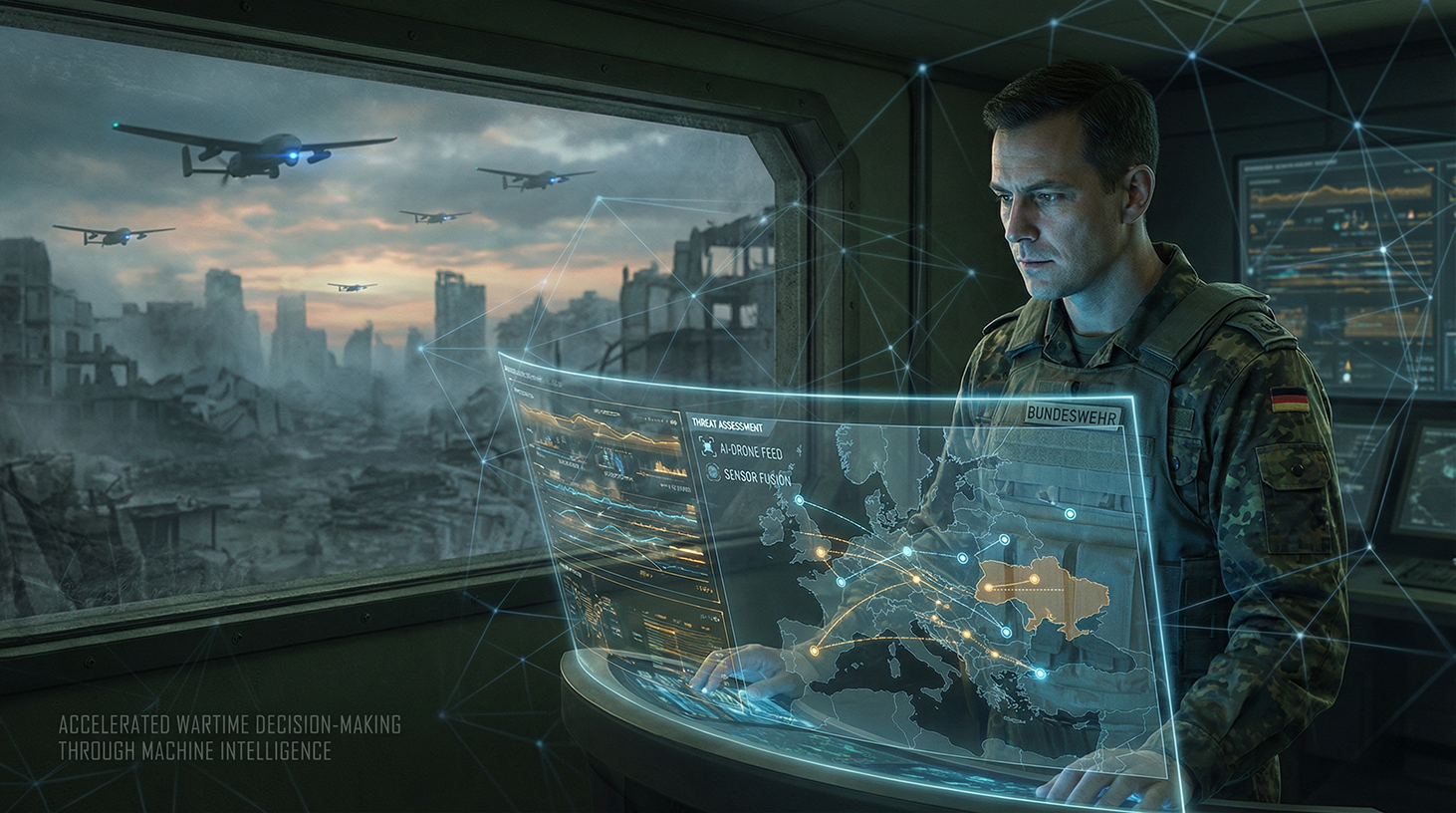
The OODA Loop: Why the German Armed Forces would be without AI – Four years in Ukraine as a technological learning experience – Image: Xpert.Digital
Lessons from Ukraine: Why the German Armed Forces are now massively upgrading with AI
When machines think for themselves: The German Armed Forces and the AI revolution in combat
Decide faster than the enemy – or lose
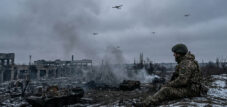
The war in Ukraine has fundamentally changed 21st-century warfare – and the German Armed Forces are watching closely. Lieutenant General Christian Freuding, Inspector of the Army since October 2025 and previously responsible for German arms deliveries to Kyiv for many years, has personally visited Ukrainian battlefields and draws a clear strategic conclusion: Whoever wants to win on the modern battlefield must radically accelerate their decision-making cycles – and that is no longer possible without artificial intelligence. Ukraine has built up a unique collection of battlefield data over four years of war, unparalleled worldwide, said Ukrainian Digital Minister Mykhailo Fedorov: millions of annotated images from tens of thousands of combat flights, supplemented by continuously updated sensor data.
What at first glance sounds like a purely military problem is in reality a profound economic and organizational challenge: How can a massively increased volume of data be translated into actionable decisions without overwhelming the processing capacities of staffs and commanders? According to official figures, the Ukrainian Avengers AI system detects over 12,000 enemy targets weekly. In 2025 alone, Ukraine recorded around 820,000 verified drone attacks against Russian positions. These are data dimensions that no human analyst can process in real time – and this is precisely where the German Armed Forces' new doctrine comes into play.
The OODA loop as a strategic currency
The concept behind AI integration is by no means new. As early as the 1970s, the American military strategist John Boyd developed the so-called OODA loop: Observe, Orient, Decide, Act. The basic military premise is that whoever completes this cycle faster than the enemy puts them in a permanently reactive state, only able to react to outdated situations, while their own units are already taking the next action. What Boyd described theoretically at the time has become a technologically measurable competition through the proliferation of drones, ground sensors, and digitized communication networks.
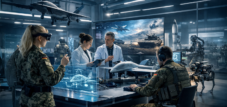
Freuding puts it precisely: Tasks that currently occupy hundreds of employees for several days could be significantly accelerated by AI. Conventional methods alone are no longer sufficient to break the enemy's decision-making cycle. This finding has far-reaching economic implications. The German Armed Forces must invest not only in hardware, but in a fundamentally new information architecture – one that fuses data flows from drones, radar systems, cameras, and other reconnaissance units in real time and provides the commander with a unified, AI-assessed situational awareness picture. At the tactical level, so-called combat clouds form the infrastructure for accelerating decision-making cycles in target engagement to machine speed using mathematical algorithms.
Uranos AI: The German Response Project
"Faster than the enemy": The German Armed Forces' new war doctrine – Project Uranos and how artificial intelligence is set to revolutionize the German army
The German Armed Forces have not been idle. The Uranos AI project, whose procurement was approved by the German Bundestag in December 2025, is intended to support Panzer Brigade 45 in Lithuania with AI-based reconnaissance. The system merges data from drones, ground sensors, cameras, and radar systems in a digital command post in near real-time – virtually no change on the battlefield should escape the system's notice. Initial operational capability for two combat battalions of the brigade in Lithuania is planned for the period between 2026 and 2028.
The procurement method is noteworthy: The German Armed Forces (Bundeswehr) are deliberately awarding the contract twice to test two competing solutions before making a decision. The consortium of Airbus Defence and Space and the Munich-based drone manufacturer Quantum Systems will receive a contract worth approximately €55.8 million; the start-up Helsing will receive nearly €80.4 million for its solution. This procedure is modeled on American prototype competitions and marks a cultural shift in German defense procurement – away from lengthy standardization processes and towards faster technology validation through competition. The first systems are scheduled for delivery to the troops in 2027. In parallel, the Bundeswehr is developing and operating AI-supported loitering munitions for Panzer Brigade 45, which digitally networks reconnaissance and effects and transmits target information to the human operator without delay.
Related to this:

The American reference model and the Palantir factor
While Germany is still testing prototypes, the US is already operational. The US military uses the Maven Smart System, an AI system from the Silicon Valley company Palantir, to process battlefield data, including images and video footage, improve situational awareness, and accelerate decision-making. The system has evolved from a classified experiment to a fundamental infrastructure of modern warfare: it is used by over 20,000 active users across more than 35 military tools. The efficiency gains are remarkable: what once required a targeting cell of 2,000 personnel—as was the case during Operation Iraqi Freedom—is now accomplished by around 20 specialists. In September 2024, Palantir signed a five-year, $100 million contract extending the Maven Smart System to the Army, Air Force, Space Forces, Navy, and Marine Corps.
The contract has since evolved into a fundamental infrastructure. In March 2026, the Pentagon consolidated 75 separate contracts into a single framework agreement, thereby securing Palantir a position as a central AI infrastructure layer between AI models and military operations. Freuding does not rule out a European solution of its own, but acknowledges that American systems offer practical advantages due to their advanced level of deployment. Speed is crucial: functional solutions must be obtained quickly, even if issues of data sovereignty and security must be taken into account.
Hub for Security and Defense - Advice and Information


Hub for Security and Defense - Image: Xpert.Digital
The Security and Defence Hub offers expert advice and up-to-date information to effectively support companies and organizations in strengthening their role in European security and defence policy. Working closely with the SME Connect Defence Working Group, it particularly promotes small and medium-sized enterprises (SMEs) that wish to further develop their innovative capacity and competitiveness in the defence sector. As a central point of contact, the Hub thus creates a crucial bridge between SMEs and European defence strategy.
Related to this:
Hybrid strategy of the German Armed Forces: Catching up, becoming independent, remaining NATO-compatible
The economic logic behind the arms buildup
The financial dimensions of Germany's policy shift are historic. Germany's defense spending is projected to rise to €108.2 billion in 2026 – a record high since the end of the Cold War. Of this, €82.69 billion is earmarked for the regular defense budget and a further €25.51 billion from the special Bundeswehr fund. Measured against the 2024 gross domestic product, this corresponds to a rate of 2.5 percent – meaning Germany is significantly exceeding its NATO obligations for the first time. This leap was made possible by the €100 billion special fund established in 2022 and an amendment to the Basic Law (Germany's constitution) that exempts defense spending from the debt brake.
The potential for improvement in digital infrastructure is enormous. The German Armed Forces' Cyber Innovation Hub will receive a total of €40 million in the 2026 budget – €14 million more than previously planned. By comparison, in 2023, the German Armed Forces' AI-specific research funding amounted to only €16.4 million, which was slashed to a mere €2.5 million by 2025. This contrast vividly illustrates how the strategic reassessment following the Russian invasion of Ukraine has shifted budgetary priorities. The Bitkom association is calling for an additional €5 billion for the digital modernization of the German Armed Forces by 2029 and emphasizes the need to prioritize autonomous systems, AI, software-defined defense, and networking and information systems.
Data sovereignty: The strategic Achilles heel
Freuding identifies a dilemma that extends far beyond the German armed forces: data sovereignty and security on the one hand, and operational capability on the other. The EU is estimated to be dependent on foreign suppliers for 80 percent of its digital technologies and applications. When purchasing key semiconductor components, there is hardly any alternative to US providers like Nvidia – even those European governments that proclaim sovereignty effectively buy chips on American terms. The EU has responded with a new AI strategy that views AI as a strategic asset that must be deeply embedded in institutional, industrial, and security policy structures; one billion euros from existing funding programs are to be mobilized for this purpose.
The problem is exacerbated by the data dynamics of the war in Ukraine. In March 2026, Ukraine opened its battlefield data to its allies for the training of AI models. Ukraine possesses millions of annotated images from tens of thousands of combat flights—a database invaluable for training the next generation of military AI systems. At the same time, NATO has been developing a cloud solution to securely store and share Ukrainian classification data with allies—a challenge that is less technical than procedural: accreditation of such systems for the cloud-centric security architecture is still pending. The possibility that Chinese and Russian AI models could systematically benefit from battlefield data is considered a serious risk to NATO's technological competitiveness by the French Institute of International Relations (Ifri).
Humans and machines: The ethics debate in the operating room
Freuding's position is clear: AI should serve solely as an advisory tool to facilitate human decision-making. The task of making analytical and balanced decisions always remains with humans, with the soldiers. This statement is not only ethically but also operationally significant: it defines the boundary between AI-supported decision preparation and autonomous weapons use.
In practice, this boundary is proving more permeable than expected. The Munich-based startup Tytan Technologies, for example, is already deploying interceptor drones in Ukraine that autonomously detect and destroy enemy drones – the soldier simply has to authorize the target for takedown. Balász Nagy, CEO of Tytan Technologies, describes the principle as making decisions easier for humans, while still allowing them to review and ultimately make the final decision. The Finabel Institute, a European think tank for land forces, states that AI is most effectively used to accelerate analysis and coordination – not to replace human decision-making. The Ukrainian experience shows that practical gains come from integrating AI into existing systems to reduce workload and response times, not from striving for complete autonomy.
Nevertheless, operational reality is pressing. Ukraine, by its own admission, is striving for full drone autonomy: systems that can locate and destroy targets without human control. War as a laboratory is accelerating technological development in a way that ethical frameworks can scarcely comprehend. The German Armed Forces must position themselves within this tension – bound by NATO standards that emphasize the responsible use of AI, and simultaneously under pressure to close the gap that is opening up compared to more technologically agile actors.
Strategic implications: Between catching up and independence
The German armed forces face a three-pronged choice, one that also represents a strategic turning point for European defense capabilities as a whole. First, they could rely on existing American systems like Maven – with the advantage of operational testing, but the disadvantage of dependence on US technology and data policies. Second, they could rely on European-developed systems – with the potential for strategic autonomy, but with longer development times and the risk of technological gaps in time-critical emergencies. Third – and this appears to be the path Freuding is aiming for – they could pursue a hybrid approach: relying on proven systems in the short term, developing European solutions in the medium term, and ensuring compliance with NATO-compatible standards.
The new German Aerodata system Prometheon points in this direction: It is designed to aggregate data from multiple sensors and subsystems to provide commanders with a unified, real-time overview of all phases of an operation – from planning to follow-up – and to not only depict current conditions but also anticipate changes before they occur. This ambition – proactive reconnaissance instead of reactive situational assessment – is the true strategic added value of AI in a military context.
The invisible arms race
For the German armed forces under Freuding, it's more than just a modernization measure. It's the recognition of a new reality of warfare, in which informational superiority is just as important as firepower. The OODA loop has become the central strategic currency: whoever completes it faster wins – not always, but more often and with greater consequences. AI isn't a magic bullet, but a crucial multiplier that can replace hundreds of analysts and compress decision-making times from days to hours or minutes.
The fundamental economic message is clear: the costs of inaction far outweigh the investment costs. A brigade that reacts faster and more precisely thanks to AI-supported situational awareness achieves a level of military output that conventional staffs, regardless of personnel size, cannot replicate. Germany has laid the financial groundwork with its special fund, the 2026 budget, and projects like Uranos AI. The real challenge now lies in the speed of implementation, data sovereignty vis-à-vis strategic partners, and—most difficult of all—the cultural transformation of an army that must learn to think with machines without relinquishing its own thinking to them.
Consulting - Planning - Implementation

Markus Becker
I would be happy to serve as your personal advisor.
Head of Business Development
Chairman SME Connect Defense Working Group
Consulting - Planning - Implementation
Konrad Wolfenstein
I would be happy to serve as your personal advisor.
You can contact me at wolfenstein∂xpert.digital or
Just call me on +49 7348 4088 965 .