

Published on: April 18, 2025 / update from: April 29, 2025 - Author: Konrad Wolfenstein
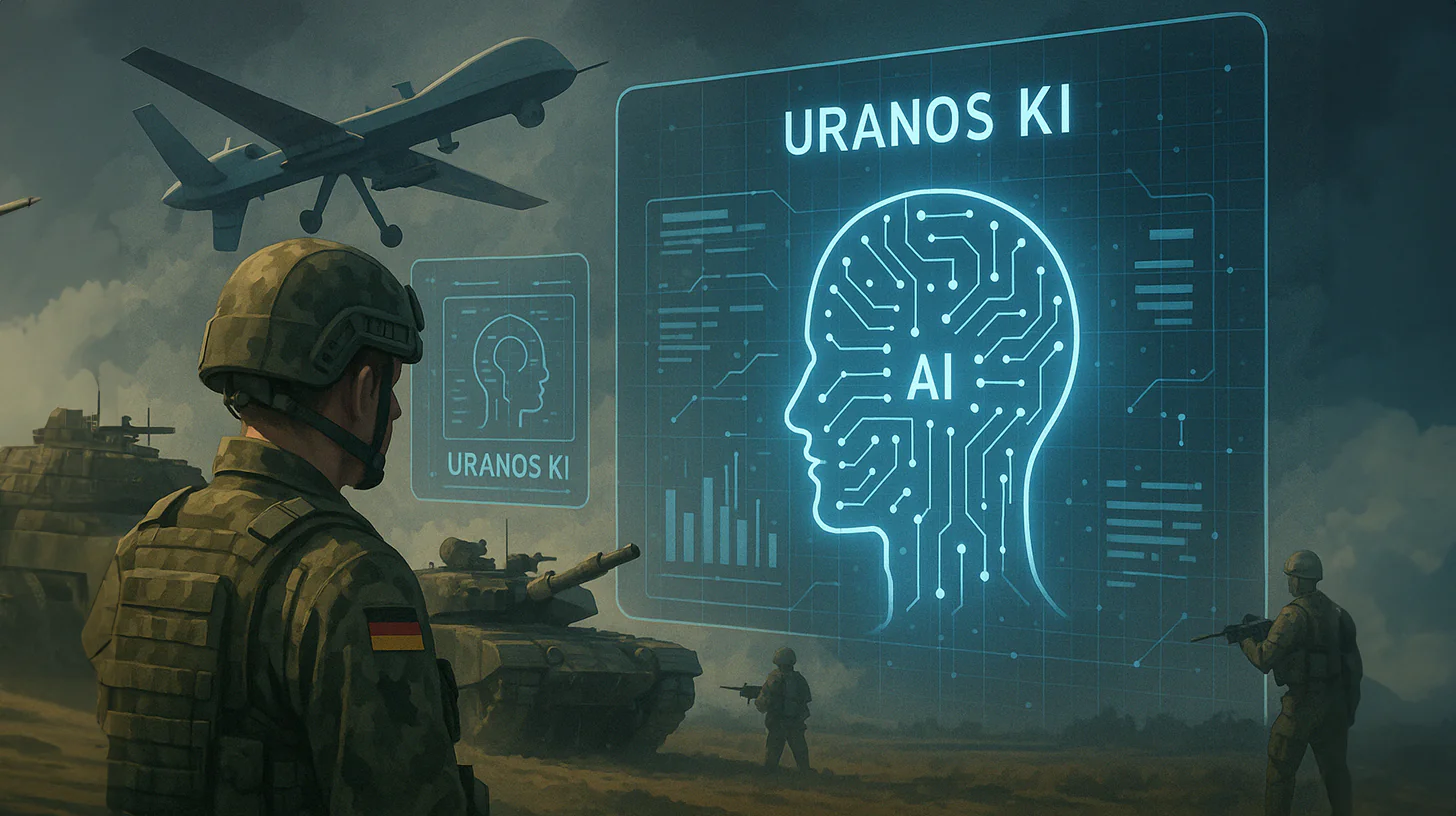
Artificial intelligence in the military: the AI project “Uranos Ki” of the Bundeswehr and its ethical implications-Image: Xpert.digital
Uranos AI and the transformation of German defense technology
Uranos Ki: How Germany redefined the military future
The Bundeswehr is in the final phase of a secret tender for one of its most important projects in the near future. “Uranos Ki” marks a turning point in the military use of artificial intelligence in Germany and raises basic questions about the relationship between technology, security and ethical responsibility. This development reflects a global trend, in which AI is increasingly moving into military applications and brings with both an enormous opportunities and considerable risks.
Suitable for:

The “Uranos Ki” project - a new era of military technology
With the “Uranos Ki” project, the Bundeswehr is planning the large -scale use of artificial intelligence in the defense area for the first time. In essence, it is about creating a digital battle stand that brings together and analyzes data from a wide range of information sources in real time. Both established armaments such as Airbus, Rheinmetall and Hensoldt as well as specialized technology start-ups such as Quantum Systems and Helsing are involved in the non-public tender.
The quality concepts submitted differ considerably in their quality, and there are already favorites for the surcharge of the order estimated to around 80 million euros. After the parliamentary summer break, the plan is to be presented to the Bundestag's own holders, with the Bundeswehr initially trying to test two competing solutions before a final decision is made.
The system is to be used at the German Brigade in Lithuania from 2026 and monitor the NATO east flank. The over 1600 kilometer -long border, which is included without the Kaliningrad exclave, represents an enormous challenge for traditional surveillance methods. The use of AI is intended to significantly reduce personnel costs and at the same time improve the quality of surveillance.
Functioning and goals of the system
The Uranos system is intended to form a kind of digital battle stand in which data from radar systems, drones, cameras, satellites, lasers and other reconnaissance units are collected and evaluated by AI in real time. This approach aims to warn German armed forces early on potential threats from Russian troops and thus create a strategic advantage.
In a first phase, the military planners primarily deal with the acquisition of information and leadership superiority through an improved situation overview. In the future, however, it is planned in a later phase to forward the data collected to weapon systems. A further tender is planned for this second step.
Ethical dimensions of military AI
The increasing integration of AI into military systems raises fundamental ethical questions that go far beyond technical aspects. Various initiatives have already dealt with these questions.
The white paper from Fraunhofer IOSB and Hensoldt
The Fraunhofer Institute for Optronics, System Technology and Image Evaluation (IOSB) and the sensor solving provider Hensoldt have jointly published a white paper entitled “Ethical Considerations for the Military Use of Artificial Intelligence in Visual Reconnaissance”. This study examines how ethical principles can be implemented in the military use of AI and comes to the conclusion that responsible use of AI in military applications is possible if ethical principles are consistently taken into account.
The authors identify four central ethical principles:
- Fairness prevents unintentional bias from AI procedures
- Traceability ensures understandable decisions
- Transparency enables verifiable decision making possible
- Responsibility ensures that people always remain the last instance
These principles have been applied to three practical applications: maritime monitoring, protection of military field camps and urban education. A central contribution to the study is to contribute European and German values to the discussion of ethical principles for military AI treatments.
Basic ethical controversy
One of the most fundamental ethical questions in the context of military AI is whether decisions about the life and death of a person can be left to a machine. Critics argue that it violates human dignity when decisions about life and death are delegated to algorithms on the battlefield. Making people killing the war on machines and "working through" automatically turns people into objects.
This debate is conducted by various actors, including the KI & Defense working group, which calls for a “national military AI strategy”, which, among other things, should include ethical guidelines for the use of AI in weapons systems.
Suitable for:

Security policy implications and international context
The development of military AI systems takes place in a complex international environment in which different states pursue different approaches.
Germany in international comparison
In contrast to the USA or France, which have already presented AI strategies for weapon systems, there are no binding guidelines for the military use of AI in Germany. Even the draft adopted by the EU for a AI law (Artificial Intelligence Act) does not offer sufficient orientation, since AI systems that are developed exclusively for military purposes are explicitly excluded from the scope.
The Obama administration defined KI as a key technology to secure military superiority. The Trump government replaced this strategy with a new AI military strategy entitled “Harnessing Ai to Advance Our Security and Prosperity”, the primary goal of which is to secure the US military and technological supremacy to strategic competitors.
The risk of a “AI armor”
A central concern in the context of military AI is the risk of a “AI scaffolding”. The real danger is not that a country falls behind its competitors in AI development, but that the perception of a race could cause all countries to use hastily insecure AI systems and thus endanger itself and others.
This aspect underlines the need for international cooperation and regulations to ensure that AI systems are used safely and responsibly in the military area.
Technical requirements and structures of responsibility
The Bundeswehr places specific requirements for military AI systems that take into account both technical and ethical aspects.
Requirements for military AI systems
For “Uranos KI”, the Bundeswehr demands an open system architecture with standardized interfaces to enable future extensions. In addition, the solution with the large -scale project digitization of land -based operations (DLBO) must be compatible.
In general, military AI systems must have the following properties:
- Modularity and ability to integrate: AI systems must be designed in such a way that they can be adapted to new threats and can be exchanged quickly if necessary.
- Security and transparency: AI systems must withstand security and transparency tests in advance, so that manipulations or security gaps can be largely excluded.
- Ethical and legal norms: The use of AI must always be carried out in accordance with ethical and international law standards.
The role of man
A recurring principle in all discussions about military AI is the emphasis on human control. In its directive 3000.09, for example, the Pentagon has clearly spoken out against the use of full-autonomous weapons systems in the military and demands that a person must always be “in the loop”.
It is also emphasized for the “Uranos KI” project that the decision -making power must remain in humans when using weapons systems. The AI is intended to serve as an advisory tool, which shows options and accelerates data processing, while the ultimate decision is always made by a person.
Bundeswehr and research: Cooperation for responsible AI
The development of military AI systems requires close cooperation between different actors from the military, research and industry.
Strategic partnerships
The Bundeswehr relies on strategic partnerships with research institutes and industry in the development of AI technologies. The most important partners include the Fraunhofer Institute, the German Aerospace Center (DLR), the Bundeswehr Universities in Munich and Hamburg as well as innovative start-ups.
Together with the Fraunhofer Institute, for example, the Bundeswehr has developed a scoring system that shows how safe the AI is in its decisions. The Bundeswehr universities play a central role in the development of AI prototypes and cooperate closely with the Federal Office for Equipment, Information Technology and Use of the Bundeswehr (BAAINBW).
Concrete research projects
In addition to “Uranos KI”, there are other research projects in the field of military AI, such as the “Genius” project, in which drones with AI and advanced sensors are supposed to track down threats such as improvised explosives and land mines.
These projects make it clear that the Bundeswehr is increasingly relating to AI-based systems in order to modernize its defense skills and adapt to the challenges of the 21st century.
Between innovation and responsibility
The Bundeswehr project “Uranos Ki” is an example of the challenges and opportunities associated with the use of artificial intelligence in the military field. On the one hand, KI offers the potential to significantly increase the effectiveness of military operations, increase the safety of your own troops and enable more precise decisions. On the other hand, it raises basic ethical, legal and security policy questions that require careful consideration.
The Bundeswehr urgently needs a guideline document that regulates responsibility with AI and automation. This should not only define technical standards, but also determine ethical principles and create clear structures of responsibility.
The international dimension should not be neglected. A “national goal” in the regulation of military AI systems would not be expedient in view of the global nature of this technology. Rather, close coordination with allies and international organizations is required to develop common standards and to prevent a potential “AI set-up”.
Ultimately, the challenge for the Bundeswehr and German politics is to keep up with technological development without neglecting security, legal and moral principles. In this context, the “Uranos Ki” project will be an important test case that will show to what extent Germany is able to reconcile military innovation and ethical responsibility.
Suitable for:
Your AI transformation, AI integration and AI platform industry expert
☑️ Our business language is English or German
☑️ NEW: Correspondence in your national language!

Konrad Wolfenstein
I would be happy to serve you and my team as a personal advisor.
You can contact me by filling out the contact form or simply call me on +49 7348 4088 965 (Munich) . My email address is: wolfenstein ∂ xpert.digital
I'm looking forward to our joint project.


