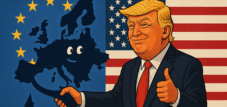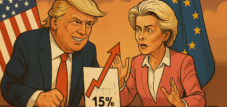
The next political farce: The EU caves to Trump – and we foot the bill! – Image: Xpert.Digital
“Those at the top are completely taking us for a ride”: Why the new “breakthrough” in the trade dispute is nothing more than a program of subjugation
The death knell for our economy: How the "elite" is sacrificing domestic industry in the US tariff deal
Complete sell-off instead of "breakthrough": How Brussels is finally betraying us in the customs drama with the USA
It's being sold to us once again as a major political breakthrough: After weeks of drama, absurd ultimatums, and all-night negotiating marathons, the European Union has agreed to implement the controversial tariff agreement with the US. Champagne corks are popping in Brussels; there's talk of a "breakthrough" and averted disaster. But anyone who takes a closer look at the figures quickly recognizes the bitter political charade: Instead of negotiating as equals, Europe has allowed itself to be maneuvered into a historic act of subjugation. While the US maintains massive tariffs on our products, the EU is opening its markets, reducing duties to zero, and committing itself to astronomical billions in investments across the Atlantic – including a completely new and dangerous dependence on American fracking gas. Germany, in particular, whose economy is driven by exports, is threatened with massive losses as a result of this asymmetric agreement. Is this so-called "deal" truly the only way to avoid economic collapse, or are we witnessing Europe's gradual strategic self-abandonment? A ruthless economic assessment reveals that the European citizen will ultimately foot the bill for this power play.
The debate surrounding the EU-US deal is also a debate about the state of the international trading order. For decades, the principle of most-favored-nation treatment and non-discriminatory market access was considered the backbone of the multilateral trading system, which was monitored by the World Trade Organization (WTO).
The biggest deal in history or the biggest concession in Europe?
Transatlantic trade is among the largest and most interconnected economic relationships in the world. In 2024, the exchange of goods and services between the European Union and the United States amounted to approximately €1.7 trillion – a figure that underscores the sheer depth of this economic partnership. However, this trade architecture, which had developed over decades, was shaken to its core by Donald Trump's second term. What began with isolated threats evolved into a systematic instrument of political blackmail, forcing the EU into a defensive position from which it has not yet fully recovered.
The initial situation before the conflict was by no means characterized by great inequality. Average US tariffs on EU imports were 1.47 percent, while European retaliatory tariffs on US goods were 1.35 percent. A statistical equilibrium, which Trump, however, interpreted as a structural disadvantage for the US and used as the basis for an aggressive tariff policy. From April 3, 2025, the US imposed punitive tariffs of 25 percent on all automobile imports not manufactured in the US. At the same time, the Trump administration threatened tariffs of up to 30 percent on all European goods if no agreement was reached. The clock was ticking.
The origin of the Turnberry deal
The political agreement was reached on July 27, 2025 – and it came under considerable pressure. EU Commission President Ursula von der Leyen and US President Donald Trump agreed on a framework agreement in Turnberry, Scotland, which Trump immediately hailed as the "biggest deal in history." However, closer examination of the specifics of the agreement raised significant doubts about its balance.
The core of the agreement: The US will limit its tariffs on the vast majority of EU exports to 15 percent – a so-called all-inclusive tariff, which serves as a cap and does not allow for the accumulation of further duties. For a number of strategic goods – including aircraft and aircraft parts, certain chemicals and generic drugs, semiconductor equipment, as well as certain agricultural products and critical raw materials – reciprocal zero tariffs are stipulated. A quota system was agreed upon for the steel and aluminum sectors. The EU, in turn, committed to a comprehensive reduction of its own tariffs on US industrial goods to zero, to expanding market access for US agricultural and seafood products, and to massive financial commitments: energy purchases from the US worth $750 billion over three years, additional European investments in the US of $600 billion, and increased arms purchases of American manufacture.
An asymmetrical power structure
A dispassionate analysis of the Turnberry deal reveals a sobering conclusion: the agreement is structurally and profoundly asymmetrical. The EU made concrete and quantifiable commitments, while the US limited itself to limiting future escalations. While Brussels is reducing its already relatively low tariffs to zero, Washington is maintaining a rate of duties that far exceeds the historical standard.
Particularly revealing is the overall calculation carried out by Austrian trade union economists: The EU concessions in the form of approximately five billion euros in annual tariff savings through the deal are offset by the EU's financial obligations totaling 1.35 trillion US dollars. The EU's current trade surplus with the US of around 50 billion euros per year is thus at risk of turning into a deficit in the long term. Even the assessment by analysts at BNP Paribas, who describe the deal as "damage control," cannot avoid concluding: "The deal is undoubtedly a negative shock compared to the tariff levels that existed at the beginning of the year"—with an effective tariff rate that has increased roughly tenfold.
Nevertheless, the opposing view is not without merit. Without an agreement, the US would have imposed tariffs of 30 percent or more, which would have fundamentally threatened EU exports to the US. The agreement created a minimum level of planning certainty for companies on both sides of the Atlantic and prevented an escalation spiral whose economic damage would have been virtually incalculable.
How the German economy is feeling the shock
No other European economy is feeling the effects of the trade conflict as acutely as Germany. The Federal Republic is by far the largest European exporter to the USA, and the affected sectors – automotive, mechanical engineering, and pharmaceuticals – are core components of the German industrial model. Cars, machinery, and pharmaceuticals alone account for approximately 60 percent of all German exports to the United States.
The Kiel Institute for the World Economy (IfW) has calculated that the combination of a general tariff of 15 percent and the special tariffs on steel and aluminum will reduce German GDP by 0.15 percent within a year – equivalent to approximately 6.5 billion euros in lost economic output. The Munich-based ifo Institute projects a decline of 0.2 percent over the medium term, which corresponds to around 8.6 billion euros. According to the ifo Institute's forecasts, German exports to the US could fall by up to 15 percent in the medium term. Lisandra Flach, head of the ifo Center for Foreign Trade, sums up the situation: "A deal may slightly reduce uncertainty for companies – but US tariffs of 15 percent will harm the German economy."
Until April 2025, the German automotive industry had benefited from a standard US tariff rate of just 2.5 percent. The jump to 15 percent and the subsequent threat of 25 percent therefore represent a historic turning point that fundamentally worsens the competitive position of European vehicle manufacturers. The German Association of the Automotive Industry (VDA) warned that the burden on German automakers from the punitive tariffs, in effect since April 2025, would amount to billions of euros. The pressure on the industry was and remains immense – which explains why the industry, on the one hand, welcomed the agreement, but on the other hand, continues to push for a reduction of the remaining tariffs.
Parliamentary theater: Between claims to sovereignty and vulnerability to blackmail
The internal history of the deal was anything but smooth. The European Parliament, which had to approve the ratification of the legally binding agreement, was skeptical of the asymmetrical conditions from the outset. The chairman of the trade committee, Bernd Lange of the SPD, became the central figure in this struggle – sometimes as a voice of warning, sometimes as a brake on progress, sometimes as a pragmatic negotiator.
In January 2026, ratification stalled again when a US Supreme Court ruling undermined the legal basis of Trump's tariff policy: The court ruled that the president was not authorized to impose tariffs based on a declared economic emergency. The result was paradoxical: The tariff rate on EU goods initially fell from 15 to 10 percent – but Trump immediately introduced new tariffs based on other legal provisions, so that the total burden on many products rose again to 25 percent. Lange reacted decisively: He declared that the US had broken the deal and demanded a suspension of the ratification process. "For us, it is crystal clear that the US is breaking the deal," Lange said on the Euronews program "Europe Today.".
The European Parliament insisted on binding guarantees before giving its Segen . It demanded a suspension clause allowing the EU to revoke tariff preferences for the US should Washington again violate agreements; a so-called "sunrise clause," stipulating that EU tariff reductions would only take effect once the US fulfilled its commitments; and a fixed expiry date for the entire agreement. Parliament was thus prepared to accept the deal – but on its own terms.
Our EU and German expertise in business development, sales and marketing


Our EU and German expertise in business development, sales and marketing - Image: Xpert.Digital
Industry focus areas: B2B, digitalization (from AI to XR), mechanical engineering, logistics, renewable energies and industry
More information here:
A thematic hub offering insights and expertise:
- Knowledge platform covering global and regional economies, innovation and industry-specific trends
- A collection of analyses, insights, and background information from our key areas of focus
- A place for expertise and information on current developments in business and technology
- A hub for companies seeking information on markets, digitalization, and industry innovations
Bilateral power politics instead of the WTO: The trade pact that blurs the world order
Trump's ultimatum and the race against time
The situation escalated again on May 1, 2026, when Trump announced on Truth Social that he would increase tariffs on cars and trucks from the EU from 15 to 25 percent starting the following week because the EU was "not fulfilling its commitments." His justification was nothing short of harsh: Trump claimed it had been "well-known" that no tariffs would be levied on vehicles—an interpretation disputed by the EU.
A week later, on May 7, 2026, after a phone call with Ursula von der Leyen, Trump set a new deadline: By July 4, 2026, the 250th anniversary of the United States, the EU had to fully implement its obligations under the agreement – or the tariffs would “immediately jump to a much higher level.” The symbolic significance of this deadline was no accident: Trump once again framed the trade conflict as a matter of national dignity and American strength.
The nighttime breakthrough and its design flaws
On the night of May 19-20, 2026, the agreement now being reported was reached. Representatives of the EU member states and the European Parliament agreed on the full implementation of the tariff deal, coupled with a safety net of safeguard clauses. The key elements are known: the elimination of EU tariffs on US industrial goods, improved market access for US seafood and agricultural products, and – as a crucial European safeguard – a whole arsenal of safeguard mechanisms.
Specifically, the agreement stipulates that EU tariff concessions can be suspended if the US violates the agreements. A fixed expiry date specifies that by December 31, 2029, the impact of the deal on the European economy will be comprehensively reviewed, and if damage or new imbalances are identified, the deal will be automatically terminated. The European Commission will be required to report on trade developments every three months; a comprehensive assessment must be submitted six months before the tariff benefits expire, on the basis of which EU institutions will decide on a possible extension.
The agreement still needs formal confirmation from the Council of Ministers and the plenary of the European Parliament before it enters into force – at the latest before July 4. The formal hurdles are known, but the political direction is already set.
A systemic energy dependency
One of the least discussed, yet most economically consequential, chapters of the entire agreement concerns energy policy. With the Turnberry deal, the EU committed to purchasing $750 billion worth of energy products from the US over three years – primarily in the form of liquefied natural gas (LNG). What at first glance sounds like a diversification strategy away from Russian gas, on closer inspection reveals itself to be a systematic replacement of one dependency with another.
Even today, more than 55 percent of Europe's LNG supply comes from the USA. The Institute for Energy Economics and Financial Analysis (IEEFA) has calculated that by 2030, between 75 and 80 percent of total EU LNG imports could come from the USA if existing supply agreements are fulfilled and gas demand does not decline substantially – this would correspond to up to 40 percent of all European gas imports from a single source. A concentration at this level not only undermines European security of supply but also gives Washington powerful leverage in future conflicts. The taz analysis succinctly summarized this: "Until the war in Ukraine, it was dependence on Russian gas; now, Europe has made itself vulnerable to blackmail through an oversupply of liquefied natural gas from the USA."
To make matters worse, the EU's massive investment commitments of 600 billion US dollars to American projects are being withdrawn from the European capital market at a time when the EU urgently needs investment in its own innovation and defense infrastructure – recommendations that both the Letta report and the Draghi report had strongly emphasized.
Structural imbalances and the silence of the global trade order
The debate surrounding the EU-US deal is also a debate about the state of the international trading order. For decades, the principle of most-favored-nation treatment and non-discriminatory market access was considered the backbone of the multilateral trading system, which was monitored by the World Trade Organization (WTO). Trump's tariff policies have damaged this system to an extent that cannot be easily repaired, even after any agreements are reached.
Following the recent agreement, the Association of German Chambers of Industry and Commerce (DIHK) issued an unequivocal demand: “The asymmetric nature of the EU-US deal must not become a benchmark for European trade policy. The rules-based multilateral trading system must be preserved and strengthened.” This warning underscores the structural dilemma: When the world’s largest trading powers conclude bilateral deals based on political pressure, the legitimacy of multilateral institutions erodes. Other countries and trading blocs draw their own conclusions. The global trading system fragments into a network of bilateral power relations – with the US as the central hub dictating the terms.
At the same time, pressure from Trump paradoxically forced the EU to accelerate its own bilateral trade agenda. The agreement significantly stimulated negotiations with other partners – from Mercosur and India to various Indo-Pacific states. This effect is real and positive: Europe is diversifying its dependencies, even if this is no substitute for stable transatlantic relations.
Between pragmatism and strategic self-abandonment
The now-agreed full implementation of the deal raises a fundamental strategic question: Is Europe negotiating with an economic power that generally views agreements as negotiable starting points – and what strategy is rational under such conditions?
On the one hand, there is the pragmatic argument: a bad deal is better than no deal because it at least creates a framework within which companies can plan. Uncertainty itself, as economic research shows, is the greatest detriment to investment and growth. On the other hand, there is the warning that every concession under pressure opens the door to future escalations – and that a negotiating partner who has repeatedly declared agreements to be in breach and unilaterally introduces new tariffs is structurally not a reliable partner.
The safety net that the European Parliament has built into the now-adopted implementation is therefore not only technically sound, but strategically necessary. The suspension clause, the sunrise clause, and the 2029 expiry date create levers that Europe can use in a future escalation. They are not a triumph, but they are a modest insurance policy for a community that must not panic over threatening scenarios, but neither should it be naive.
Overall economic balance: Damage limited, but real
A nuanced yet clear assessment can be made of the overall economic evaluation of the deal and its implementation. The 15 percent tariff will result in a GDP decrease of approximately 0.1 percent for the EU economy as a whole – compared to a hypothetical scenario without any tariffs. This is manageable, but not trivial. For the EU as a whole, exports to the US, at less than 3 percent of EU GDP, remain manageable. However, for individual economies and sectors – particularly Germany with its export-oriented industrial structure – the picture is considerably more challenging.
Crucial for medium-term developments is whether the deal holds or whether Trump initiates further rounds of escalation. The period until the end of 2029 presents both an opportunity and a risk in this regard. An opportunity because Europe can build resilience during this time through diversification and industrial policy adjustments. A risk because the time horizon of Trump's trade policy is significantly shorter than that of structural change.
The political economy of pressure
Finally, one aspect deserves special attention, one that is often overlooked in economic discourse: the domestic political logic of Trump's trade policy. The July 4th deadline is not a random date—it is a political issue of the highest order. The 250th anniversary of the USA, used as the backdrop for the "biggest deal in history," is a political spectacle that benefits Trump domestically. For him, trade policy is not primarily economics, but theater—and in this theater, he needs victories to present to his voters.
This means that the EU is not only an economic partner, but also a prop in an American domestic political drama. Every European reaction, every concession, and every threat is measured not only by its economic rationality, but also by how well it fits into the American domestic narrative. Europe would be well advised not to ignore this dimension – and to calibrate its responses accordingly: firm enough to be perceived as a serious actor, and flexible enough not to completely deny the other side the desired moments of victory, as long as its own core interests are protected.
Against this backdrop, the EU's agreement on the full implementation of the customs deal is neither a capitulation nor a triumph. It is the result of a rational balancing of interests under conditions of structural inequality – a pragmatic damage control measure equipped with a robust control mechanism. Time will tell whether this mechanism is sufficient. The emergency brake has been pulled. One can only hope that it works.