
The broken promise-promised relief is no longer available: the failed electricity tax reduction in Germany
Xpert pre-release

Available in 27 languages 📢
Prefer Xpert.Digital on GoogleⓘPublished on: June 25, 2025 / update from: June 25, 2025 - Author: Konrad Wolfenstein
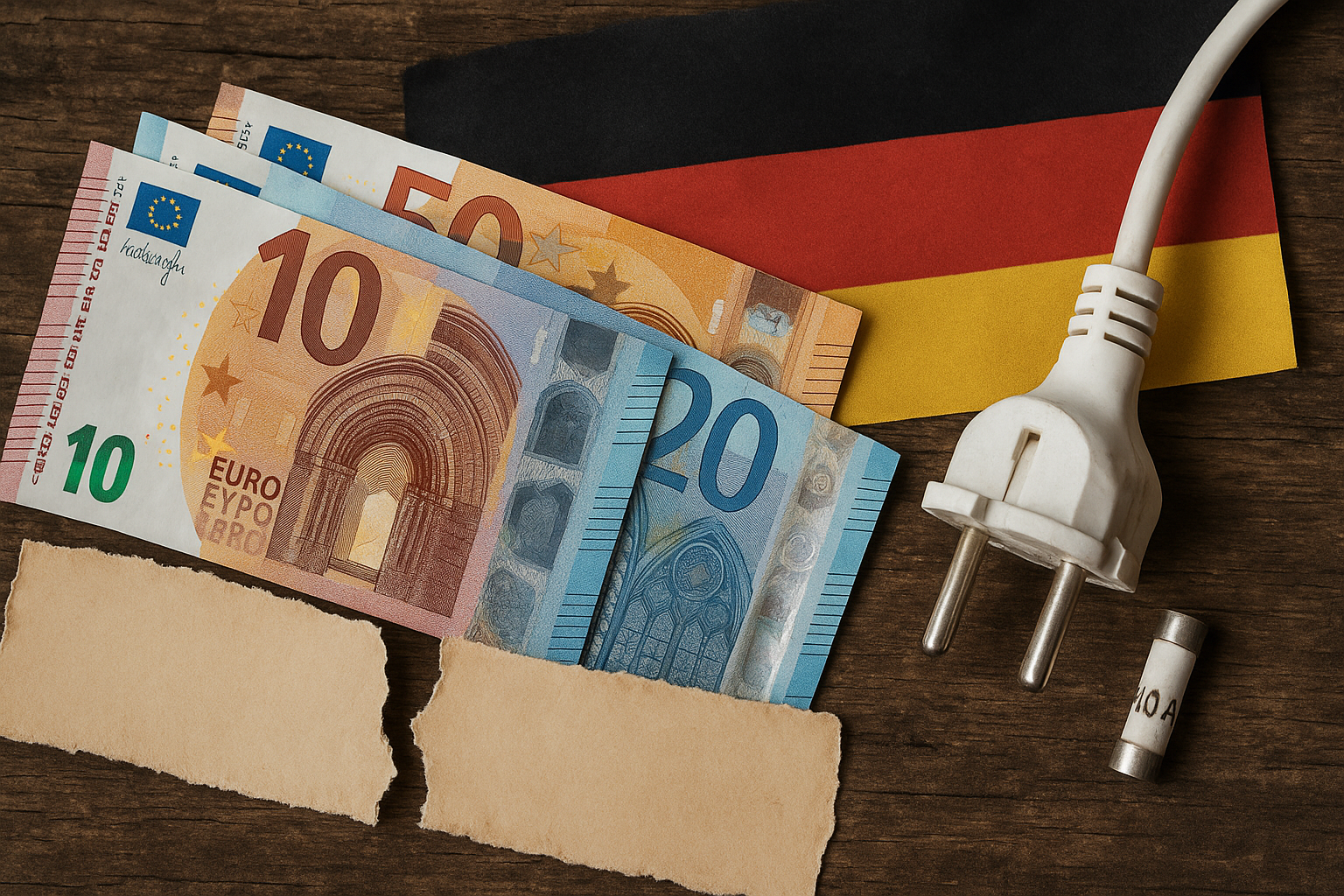
The broken promise-promised relief is no: the failed electricity tax reduction in Germany-Image: Xpert.digital
Merz government breaks electricity tax promises after only 50 days in office
Coalition break in electricity tax: SPD finance minister ignores election promises-no electricity tax reduction in the draft budget 2025/26 despite the coalition agreement
The new black and red federal government under Chancellor Friedrich Merz is under massive criticism after only 50 days. The reason: A central election promise from the coalition agreement was broken. Finance Minister Lars Klingbeil from the SPD did not plan a reduction in electricity tax for consumers in his budget draft for the years 2025 and 2026, although this was clearly agreed in the coalition agreement between the CDU, CSU and SPD.
Background of political development
After the early Bundestag election on February 23, 2025, a grand coalition from the Union and SPD formed after no other majority was possible without the AfD. Friedrich Merz was elected on May 6, 2025 with 325 votes in the second ballot as Chancellor, after he had narrowly missed the necessary majority in the first ballot. Lars Klingbeil from the SPD took over the office of finance minister and Vice Chancellor.
The coalition negotiations between the Union and the SPD started on March 13, 2025 and were successfully completed on April 9, 2025. In the 144 -page coalition agreement with the title “Responsibility for Germany”, extensive relief for consumers and companies were agreed.
The broken promise to electricity tax
The coalition agreement between the CDU, CSU and the SPD contained a clear promise: "We want to permanently relieve companies and consumers in Germany by at least five cents per kilowatt hour with a package of measures. For this, we will reduce electricity tax for everyone as an immediate measure". This wording did not allow any room for interpretation - the relief should be explicitly "for everyone".
The European minimum level for electricity tax is 0.05 cents per kilowatt hour, while German consumers currently pay 2.05 cents per kilowatt hour. A complete lowering would have saved a saving of two cents per kilowatt hour.
In reality, however, budget planning looks completely different. Klingbeil's draft budget only provides for a lowering of electricity tax for companies in the manufacturing trade and for farms in agriculture and forestry. This temporary regulation that has been in force since November 2023 is now to be “stabilized” permanently. Consumers and small businesses go out completely empty.
Massive financial effects for the citizens
The financial consequences of this breach of contract are significant for German households. According to the electricity mirror, an average person in Germany consumes around 2,050 kilowatt hours of electricity per year. With the current electricity tax of 2.05 cents per kilowatt hour, annual costs of more than 40 euros per person only result in this tax.
For families, the promised reduction could have resulted in relief of up to 200 euros per year. These savings are now eliminated without replacement. The comparison portal Verivox had already analyzed in March 2025 that a full reduction in electricity tax had relieved a family with a consumption of 4,000 kilowatt hours by gross gross per year.
This development is particularly bitter against the background that electricity prices in Germany are among the highest in Europe. The average electricity price was 39.69 cents per kilowatt hour in mid -2025, with taxes and levies to make up about 32 percent of the electricity price.
The government attempts to justify
The government's justifications for this breach of the contract seem not very convincing. Economic Minister Katherina Reiche granted the CDU frankly at the day of the industry in Berlin: "Here coalition agreement meets financial possibility and reality". This wording reveals that the government deliberately makes election promises without having secured its financing.
It became known from circles of the Ministry of Economic Affairs that the discharge would have liked to be extended to consumers, but the Ministry of Finance had seen “no further financial scope”. However, this argument is contradictory, since the government is also planning massive expenditure increases in other areas.
Finance Minister Klingbeil defended his budget planning with the argument that priorities had to be set and see a greater pressure to act in companies than for private households. However, this approach is direct in the direct contradiction to the election promises, which provided a relief “for everyone”.
Record expenses despite alleged savings shortages
The government's argument is particularly hypocritical when you look at the actual budget figures. While there is supposedly no money for consumers' electricity tax relief, expenses in other areas increase at a record level.
The cost of the citizens' allowance will be estimated in the federal budget in 2025 at 42.6 billion euros, which means an increase of 5 billion euros compared to the previous year. The regulatory rates for the citizens' benefit alone cost the federal government 29.6 billion euros, which corresponds to an increase of 3.1 billion euros. In addition, the federal shares in the accommodation and heating costs increase from 11 to 13 billion euros.
If one calculates the expenditure of the countries, total costs of almost 50 billion euros will result in the citizens' allowance - an absolute record value. These figures make it clear that there are very well financial scope, but the government deliberately sets different priorities.
The entire federal budget in 2025 provides for expenditure of 503 billion euros, which corresponds to an increase of 28.8 billion euros compared to 2024. The new debt reaches a historic high with planned 850 billion euros over several years.
Sharp criticism from the taxpayers' association
Reiner Holznagel, President of the Federation of Taxpayers Germany, criticized the broken contract. He made it clear to the press: "The traffic light breaks its promise in the coalition agreement: the electricity tax is not reduced for everyone, but only for companies. The people who have hoped for real relief go away empty -handed - this is not a little change of course, this is a break".
Holznagel, who has been president of the influential taxpayer association since 2012, is considered one of the sharpest critics of tax waste and unsolid budgetary policy. His assessment is particularly important because the federal government of taxpayers as “financial conscience of the nation” represents more than 200,000 members and is known for its independent assessment of financial policy.
Limited relief measures as consolation plasters
In order to conceal the breach of the contract, the government is planning some limited relief measures, which, however, are far from replacing what was originally promised. As of January 1, 2026, three measures are to apply: Consumers are relieved of the costs of the gas storage levy, the existing electricity tax reduction for industry is made permanent, and the federal government takes over a higher proportion of the costs of network expansion.
These measures are expected to reduce electricity prices by around five cents per kilowatt hour. This corresponds to the originally promised total scope of the relief, but the electricity tax reduction should only be a component of the relief package, not its replacement.
The irony of this situation lies in the fact that the government tries to achieve the original goal of a reduction by “at least five cents per kilowatt hour” through alternative measures while at the same time breaks the core promise of electricity tax reduction. This shows that the financial resources would definitely be available, but the political priorities are set differently.
Novel photovoltaic solution for reducing costs and saving time

Novel photovoltaic solution for reducing costs and saving time: Xpert.digital
More about it here:
Electricity tax scandal: As Federal Minister of Economics Katherina rich millions of Germans abandoned
The minister and her responsibility
Minister of Economics Katherina Reiche is at the center of this controversy. The 51-year-old CDU politician, born on July 16, 1973 in Luckenwalde, is considered one of the most experienced energy politicians in her party. After studying chemistry at the University of Potsdam, she was a member of the German Bundestag from 1998 to 2015 and held various government offices before moving to the economy.
As the chair of the Federal Government's National Hydrogen Council and former CEO of Westenergie AG, rich experience has extensive experience in the energy sector. Her admission at the day of the industry in Berlin weighs all the more severely that the government cannot or does not want to keep its own coalition promise.
Richly defense that the government had to act "where the greatest pressure was - namely to strengthen Germany," reveals a problematic priorities. While companies are relieved, private households still have to pay excessive current taxes, although they have been promised.
Structural problems of German energy policy
The electricity tax scandal is symptomatic of more deeper problems of German energy policy. Germany already has some of the highest energy prices worldwide, which massively affects international competitiveness. The current amount of 2.05 cents per kilowatt hour has existed unchanged since 2003 and is well above the European minimum.
In addition to electricity tax, the complex structure of German electricity prices also includes network charges, various levies and VAT. Taxes and levies make up a total of 32 percent of the electricity price. A real relief of consumers would require a fundamental reform of this structure, for which the current government is apparently not willing.
The regional differences in electricity consumption increase the social effects of the failed reform. While households in Saxony only consume an average of 1,075 kilowatt hours per year, consumption in Saarland is 1,365 kilowatt hours. The promised electricity tax reduction would have particularly relieved households with higher consumption, which often live in structurally weak regions.
International comparisons and EU law
German electricity tax is not only above the European minimum, but also well above the level of many neighboring countries. The European minimum of 0.05 cents per kilowatt hour would offer Germany considerable scope for relief without violating EU law requirements.
Other EU member states have already adapted their current tax to the minimum or significantly reduced to strengthen their competitiveness. Germany lags behind this development and puts a strain on its citizens and companies with excessive energy taxes.
The fact that the government is very well relieved of the producing trade company, while private households go away empty -handed, violates the principle of equal treatment and creates unjustified privileges. Small businesses and self -employed who do not fall under the exception are particularly disadvantaged.
Long -term effects on trust
The electricity tax scandal will have long-term effects on the trust of citizens in politics. If central election promises are broken in office after 50 days, this questions the credibility of the entire political system.
It is particularly problematic that the breach of contract was not caused by unpredictable events or changed framework conditions, but by conscious political decisions. The government had and had to calculate the financial effects of its promises before the election.
The fact that at the same time the expenses for the citizens' allowance increase at a record level, while taxpayers have to do without promised relief, increases the impression of an unjust distribution of the loads. This could give populist movements further buoyancy and exacerbate political polarization.
Constitutional questions
The systematic breaking of coalition contracts also raises constitutional questions. Coalition contracts are not legally binding, but they represent the basis for the trust of voters in the elected parties.
The democracy requirement of the Basic Law presupposes that elections offer a real option. If central election promises are systematically broken, this requirement is undermined. Citizens have the right to ensure that their election decision is based on reliable foundations.
The selective implementation of coalition promise - discharge for companies yes, for consumers no - could also violate the principle of equality of the Basic Law. Without factual justification, different groups may not be treated unevenly.
Economic consequences of failed politics
The effects of the failed electricity tax reform go far beyond the immediate financial burdens. High energy prices not only burden private households, but also affect purchasing power and thus overall economic development.
At a time when Germany experienced a recession for the third year in a row, a noticeable relief for consumers would have been an important economic signal. Instead, citizens have to continue to pay excessive current taxes, while the government also complains about lack of competitiveness.
The one-sided preference for industry in terms of electricity tax also increases the existing structural problems of the German economy. While large companies are relieved, small companies and private households remain at their expense.
Perspectives for the future
The current legislative period will show whether the black and red coalition will break further central promises or whether the electricity tax is an isolated case. However, the trust of the citizens in the reliability of political commitments is already damaged.
An honest policy would require that the government either revise its budget planning to finance the promised relief, or openly admits that it cannot adhere to its election promises. Current tactics with alternative relief measures only obscure the fact of the fracture of the contract.
In the long term, German energy policy must be reformed in order to reconcile international competitiveness and social justice. However, the current government gives the opportunity to make this reform process credible.
The electricity tax scandal will go down in history as an early example of the unreliability of the Merz government. Whether the trust of the citizens can be restored will significantly depend on how the government deals with future challenges and whether it is willing to learn from its mistakes.
We are there for you - advice - planning - implementation - project management
☑️ Construction and advice on photovoltaic open-space systems
☑️ Solar park planning ☑️ Agri-photovoltaic implementation
☑️ Solar outdoor systems with dual-use solutions
Xpert.Solar is your ideal partner for the planning, consulting and construction implementation of ground-mounted photovoltaic systems and agricultural photovoltaic projects due to our many years of experience and expertise in the solar energy industry. Xpert.Solar has an experienced team of professionals that offers tailored solutions to farmers and investors. From location analysis to financial and legal advice to technical implementation and monitoring, Xpert.Solar supports its customers professionally and reliably to ensure successful and sustainable implementation.

Konrad Wolfenstein
I would be happy to serve as your personal advisor.
You can contact me by filling out the contact form below or simply call me on +49 7348 4088 965 (Munich) .
I'm looking forward to our joint project.
Write to me

Xpert.Digital - Konrad Wolfenstein
Xpert.Digital is a hub for industry with a focus on digitalization, mechanical engineering, logistics/intralogistics and photovoltaics.
With our 360° business development solution, we support well-known companies from new business to after sales.
Market intelligence, smarketing, marketing automation, content development, PR, mail campaigns, personalized social media and lead nurturing are part of our digital tools.
You can find out more at: www.xpert.digital - www.xpert.solar - www.xpert.plus
Keep in touch








