
An analysis of indoor agriculture and intralogistics-failed vision or market maturity?
Xpert pre-release

Available in 27 languages 📢
Prefer Xpert.Digital on GoogleⓘPublished on: April 1, 2025 / update from: April 1, 2025 - Author: Konrad Wolfenstein
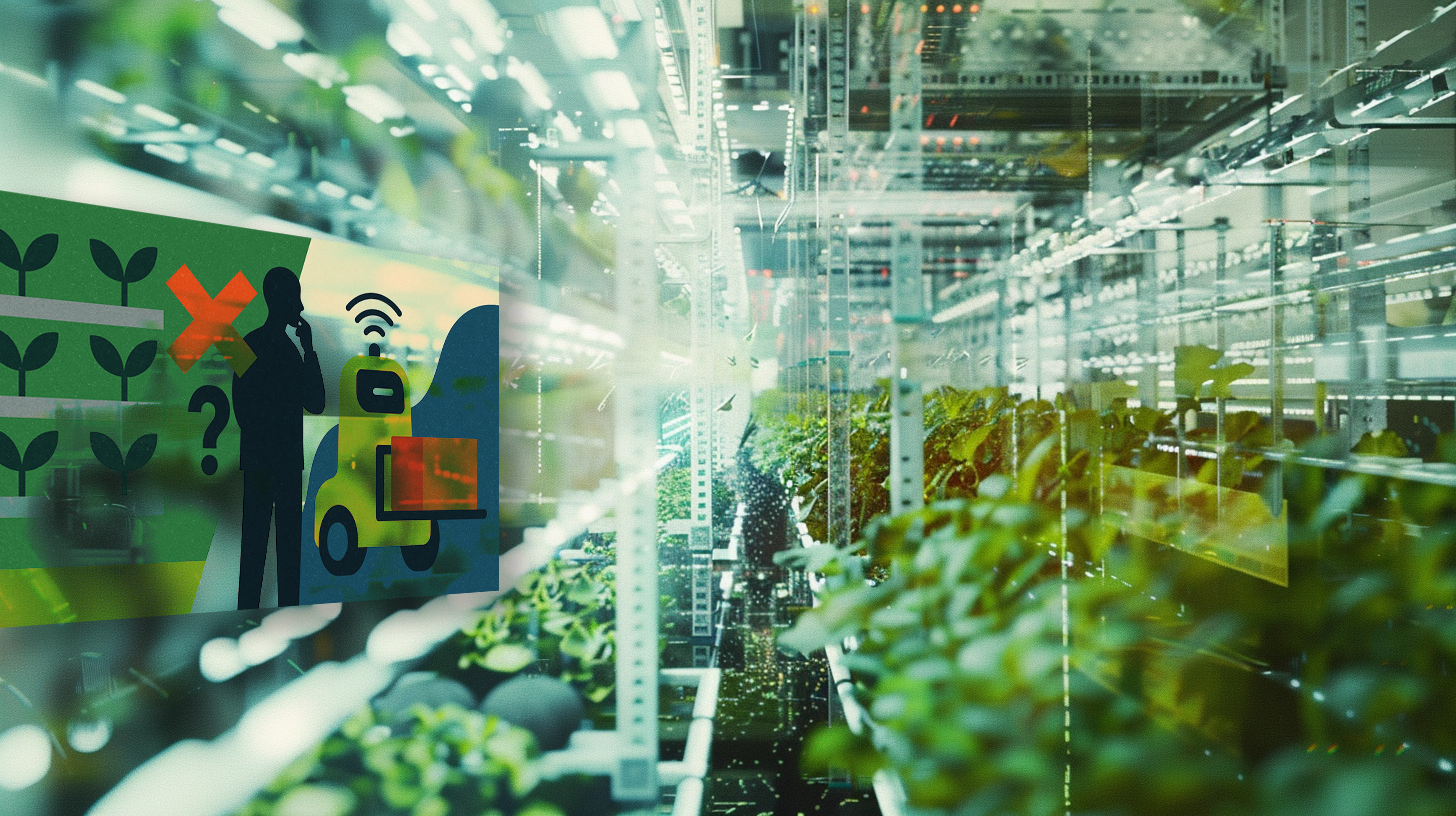
An analysis of indoor agriculture and intralogistics-failed vision or market maturity? - Image: Xpert.digital
Vertical Farming: Progress or Sackgasse of Agriculture?
More than just green walls and shelves
Indoor agriculture, often presented as a “vertical farming” (vertical agriculture) in highly towering buildings with artificial light, has caused both enthusiasm and skepticism in recent years. Investors and entrepreneurs have attracted the promise to deliver fresh, locally grown food regardless of the season, climate or geographical location. But reality has often proven to be more complex.
The bankruptcy of Plenty, a prominent player in the vertical farming area, despite an investment of almost one billion US dollars, has raised questions about the economic load capacity of this cultivation method. Is Vertical Farming a failed experiment, or is it just an industry that still has to achieve its market maturity? In order to answer this question, it is important to examine the specific challenges and opportunities in the vertical farming sector and to consider it in the context of the broader area of controlled agriculture (Controlled Environment Agriculture, CEA).
CEA includes a variety of methods, including greenhouses, indoor farms and other technologies that aim to optimize the growth conditions for plants. While Vertical Farming is a subgroup of CEA, it is characterized by its vertical arrangement of the plants, the use of artificial light and closed water cycles.
Plenty's problems should not be misunderstood as a general judgment about the entire indoor agricultural industry. Rather, it is a symptom for the specific challenges with which Vertical Farming is confronted. It is crucial to carefully contextualize the reporting on Plenty's bankruptcy and avoid generalizations.
Suitable for:

Plentys decline: a deconstruction of the factors behind the bankruptcy
Plenty voluntarily registered creditor protection according to Chapter 11 to restructure liabilities, optimize processes and concentrate on the market for premium earth berries. The Interims CEO attributed the difficulties to market forces and challenges in capital procurement. The bankruptcy registration was preceded by complaints from contractors for unpaid work. In order to concentrate on strawberries in Richmond, Virginia, Plenty closed his salad farm in Compton, California due to high operating costs, including energy prices.
The reasons for Plentys failure are diverse and complex:
Too much “slightly earned money”
Plenty received considerable investments before a sustainable business model was detected. This led to excessive expenses and a lack of focus on profitability.
Technology company vs. agricultural enterprise
Plenty tried to be a technology company and a farm at the same time. This led to overemphasizing technology and neglecting fundamental agricultural principles.
Too fast growth
Plenty expanded too quickly without creating a solid basis for sustainable growth.
Excessive reviews
Plenty's rating was unrealistically high, which led to unrealistic expectations and a lack of focus on profitability.
Prioritization of intellectual property
Plenty priorified intellectual property compared to the exchange of knowledge within the Vertical Farming community. This hindered the innovation and progress of the industry.
Lack of agricultural expertise
Plenty did not have enough agricultural expertise, which led to wrong decisions and inefficient growing methods.
Unrealistic business models
Plentys business models were unrealistic and ignored the realities of agriculture. Biological processes take time and funds cannot avoid this.
Macroeconomic factors
General economic challenges and the inability to record equity since 2022 also contributed to failure.
Rising energy costs
Rising energy costs, especially in California, made the operation of Vertical Farms uneconomical.
Cheaper traditional agriculture
Traditional agriculture was cheaper than Vertical Farming, which made it difficult to compete with prices.
More expensive financing
Rising interest rates made the financing more expensive, which increased the financial burden of Plenty.
Discrepance between willingness to pay and costs
The willingness of the consumer for salad did not match the costs of Vertical Farming.
Switch to strawberries too late
The switch to strawberries was too late to save the company.
Loss of the “agricultural perspective”
After the takeover of Bright Agrotech, the “agricultural perspective” was lost, and the company focused more on the procurement of funds than on agriculture.
Financial check: Investigation of the broader Vertical Farming landscape
Plenty is not the only vertical farm company that has become financial difficulties. A growing number of companies has filed for bankruptcy or had to reduce their business. Examples of this are Aerofarms, Appharvest, Bowery Farming, Smallhold, Fifth Season, Kalera, Infarm, Iron Ox, Upwards Farms, Farmedher, Podponics, Local Garden Vancouver, Growup Urban Farms, Plantagon, Sky Greens, Agricool, Infinite Harvest, Aquaharvest and Green Spirit Farms.
This development indicates a broader trend in the industry. Many Vertical Farming companies have difficulty being profitable.
The reasons for the financial difficulties include:
High start -up costs
The construction and equipment of Vertical Farms are expensive.
Limited number of economically profitable cultures
Few cultures can be grown economically profitably in Vertical Farms.
Inability to compete with traditional agriculture
Vertical Farms often cannot compete with traditional agriculture.
Excessive dependence on external financing
Many vertical farming companies are too dependent on external financing.
Questionable business models
Some Vertical Farming companies have questionable business models that resemble automated car factories than vegetable arms.
Bad unit costs
High operating costs and low margins make it difficult to be profitable.
Lack of agronomic expertise
Some vertical farming companies do not have enough agronomic expertise.
Resource -intensive character
The resource-intensive character of Vertical Farming is in contrast to the growth expectations of SaaS companies.
Inefficiencies in the supply chain
Inefficiencies in the supply chain can increase the costs.
High operating costs
High energy and labor costs can affect profitability.
Over -automatization
Outlaboration can increase the costs without improving efficiency.
Market saturation
The market for certain cultures, such as B. Babysalates can be saturated.
🎯🎯🎯 Benefit from Xpert.Digital's extensive, fivefold expertise in a comprehensive service package | R&D, XR, PR & SEM

AI & XR 3D Rendering Machine: Fivefold expertise from Xpert.Digital in a comprehensive service package, R&D XR, PR & SEM - Image: Xpert.Digital
Xpert.Digital has in-depth knowledge of various industries. This allows us to develop tailor-made strategies that are tailored precisely to the requirements and challenges of your specific market segment. By continually analyzing market trends and following industry developments, we can act with foresight and offer innovative solutions. Through the combination of experience and knowledge, we generate added value and give our customers a decisive competitive advantage.
More about it here:
Is indoor farming profitable? A look at costs and efficiency
The economy of indoor farms: analysis of cost structures and capital requirements
The profitability of indoor farms is largely influenced by the high costs for the replica of natural growth conditions in a controlled environment. In particular, energy consumption for lighting and air conditioning is a critical factor that influences profitability.
The specific costs include:
Initial capital expenditure
The construction or conversion of systems, the purchase of specialized equipment (LED lighting, HLK, hydroponic/aeroponic systems) and technology represent considerable entry barriers. The costs can range from $ 50,000 for small businesses to over $ 1 million for large commercial systems.
Running operating costs
The ongoing operating costs are considerable, with energy consumption for artificial lighting and air conditioning often constitutes the largest proportion (30-70 % of operating costs). The labor costs are also considerable (20-60 %). Further costs include rent/leasing, seeds, nutrients, water, packaging, sales, maintenance and insurance.
Production costs
The production costs in Vertical Farms ($ 3.07/pound for green stuff) are significantly higher than in greenhouses ($ 2.33/pound) and conventional farms ($ 0.65/pound). The retail prices must reflect this, which makes vertically grown products more expensive for consumers.
Energy costs
The energy costs can make up 50-70 % of the sales costs, about seven times as high as with conventional greenhouses.
Suitable for:

Intralogistics and automation: Effects on efficiency and profitability
Automation is increasingly regarded as a key factor for achieving profitability and scalability in vertical agriculture. Automated systems and robotics can take on various tasks, including sowing, harvesting, irrigation, nutrient intake, air conditioning, surveillance and even packaging.
The advantages of automation are:
Reduction of the shortage of workers
Automation can reduce the need for manual work, which is particularly advantageous in regions with a shortage of workers.
Improvement of efficiency
Automation can improve the efficiency of the cultivation processes, which leads to higher yields and lower costs.
Reduction of operating costs
Automation can reduce operating costs, in particular the labor costs.
Precise control of environmental factors
AI and IoT, which are integrated into automation systems, enable precise control of environmental factors and resource supply, which leads to optimized harvesting yields, reduced waste and lower energy consumption.
Predictive maintenance
Predictive maintenance can prevent costly failures.
Key of success: case studies of profitable indoor farms
Despite the challenges, some indoor farms have shown success. These companies focus on specific niches, use technology effectively and build up strong market connections.
Examples of this are:
Oishii
Oishii is a company that specializes in the cultivation of premium earth berries.
80 ACRES Farms
80 ACRES Farms focuses on taste and local supply chains and uses Dutch technology.
Eden Green Technology
Eden Green Technology operates energy -efficient greenhouses with vertical hydroponics.
Farm.One, Smallhold, Freight Farms
These are smaller, niche -oriented companies.
The success factors of these companies
- The right air conditioning, lighting and arrangement
- A knowledgeable gardener
- The concentration on the selection of cultures, logistics, automation and target group
- Hyperlocality
- The combination of established horticultural technology with advanced manufacturing and processing technology
- The focus on consistent quality, customer loyalty, profitability and scalability
- The concentration on data analysis and partnerships for innovations
Look ahead: future trends and technological progress
The future of indoor farming will be shaped by technological advances and market trends.
The most important trends include:
Innovations in LED lighting
Energy efficiency and spectral control will reduce the costs and improve earnings.
Automation and robotics
More advanced harvesting technology and lower labor costs will increase efficiency.
AI and machine learning
Optimized supplements and forward -looking analyzes will improve the income and reduce costs.
IoT
Real -time monitoring and control will increase efficiency and reduce costs.
Plant genetics
The earnings tailored to indoor environments will improve the income and reduce costs.
Increasing demand for sustainable and locally produced foods
Urbanization and concerns about nutritional security will continue to support the growth of indoor farming.
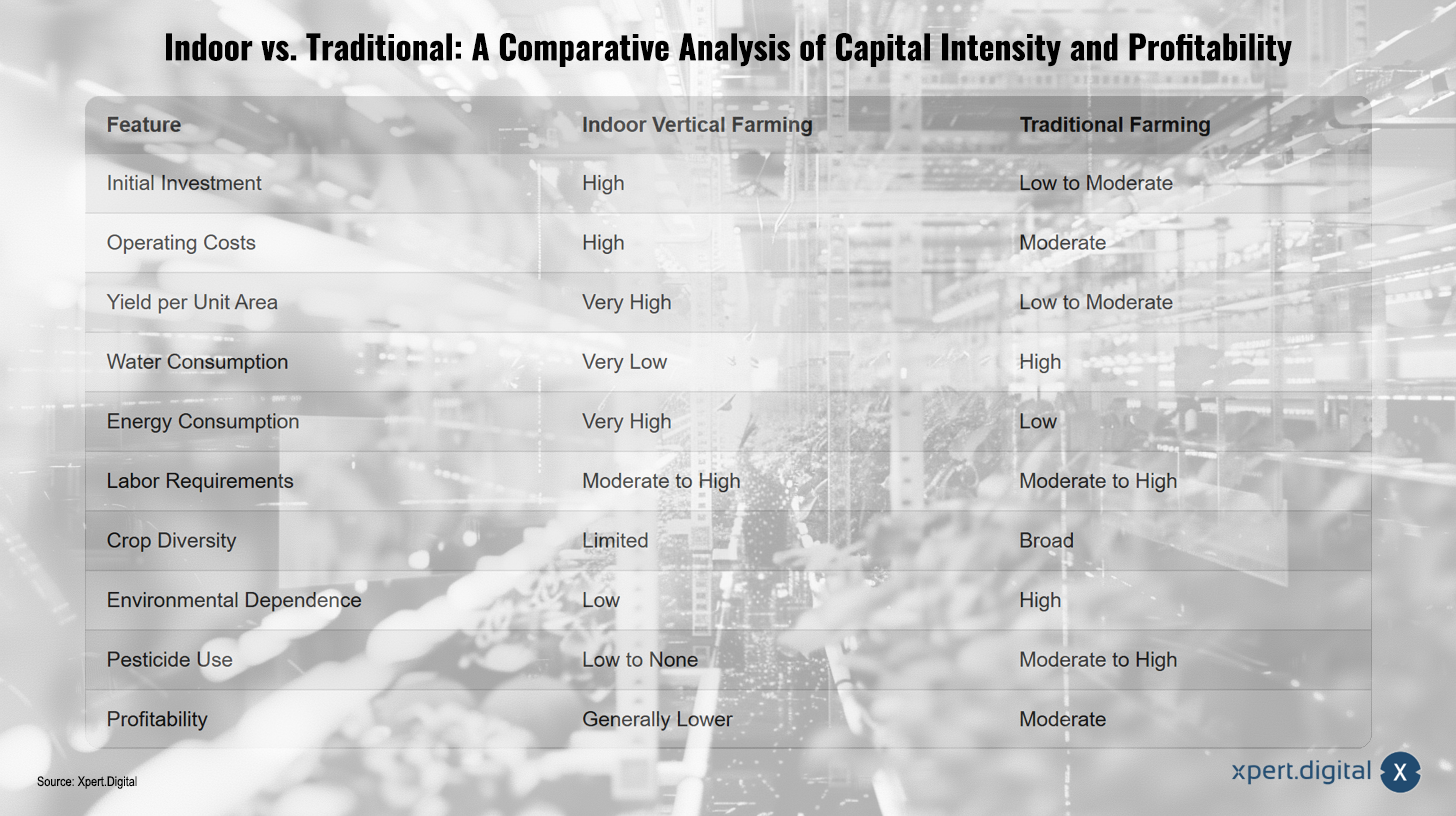
Indoor vs. Traditional: A comparative analysis of capital intensity and profitability
Indoor vs. Traditional: A comparative analysis of capital intensity and profitability - Image: Xpert.digital
Indoor vertical agriculture and traditional agriculture differ significantly in relation to capital intensity and profitability. The initial investments in indoor vertical agriculture are high, while they vary in traditional agriculture from low to moderately. The operating costs are also higher in indoor vertical agriculture, while they remain moderate in traditional agriculture. With regard to the yield per unit of space, the indoor vertical agriculture is significantly superior because it generates very high yields, while they are low to moderate in traditional agriculture. Water consumption is exceptionally low in indoor vertical agriculture, whereas it is high in traditional agriculture. However, a direct disadvantage of the indoor method is the extremely high energy consumption compared to the low energy consumption of traditional agriculture. Both approaches require moderate to high labor requirements. Indoor vertical agriculture offers a limited diversity of culture, while traditional agriculture enables a broad diversity. In addition, environmental addiction to indoor vertical agriculture is low, whereas traditional agriculture depends heavily on environmental conditions. In addition, the indoor vertical agriculture has a low or no use at all, in contrast to traditional agriculture, where it is moderate to high. With regard to profitability, indoor vertical agriculture is generally considered less profitable, while traditional agriculture is moderate profitably.
Expert opinions and research results
Experts generally agree that vertical agriculture is a promising concept for the future of food production despite significant economic challenges. Research studies actively examine ways to improve the economy and sustainability of indoor farming.
An important finding of experts is the need for vertical farming companies to develop solid business models that provide profitability and sustainable growth on quick scaling and technological hype.
Navigation through the challenges and opportunities of indoor agriculture
Plenty's bankruptcy should be regarded as part of the learning curve and the development of the indoor agricultural sector. The future profitability of indoor farming depends on coping with current economic hurdles through strategic focus, technological breakthroughs and a deeper understanding of the agricultural market. Although the way to broad success may be challenging, the basic driving forces for indoor agriculture remain convincing, and with continued innovation and adaptation, the sector has the potential to play an important role in the design of a more resistant and sustainable nutrition system.
The question of whether indoor agriculture and intralogistics have "failed" is therefore answered with a differentiated perspective: While there are significant challenges and some companies have failed, the sector as a whole develops and contains considerable potential, which indicates the need for continuous innovation and strategic development instead of rejection of its potential.
We are there for you - advice - planning - implementation - project management
☑️ SME support in strategy, consulting, planning and implementation
☑️ Creation or realignment of the digital strategy and digitalization
☑️ Expansion and optimization of international sales processes
☑️ Global & Digital B2B trading platforms
☑️ Pioneer Business Development

Konrad Wolfenstein
I would be happy to serve as your personal advisor.
You can contact me by filling out the contact form below or simply call me on +49 7348 4088 965 (Munich) .
I'm looking forward to our joint project.
Write to me

Xpert.Digital - Konrad Wolfenstein
Xpert.Digital is a hub for industry with a focus on digitalization, mechanical engineering, logistics/intralogistics and photovoltaics.
With our 360° business development solution, we support well-known companies from new business to after sales.
Market intelligence, smarketing, marketing automation, content development, PR, mail campaigns, personalized social media and lead nurturing are part of our digital tools.
You can find out more at: www.xpert.digital - www.xpert.solar - www.xpert.plus
Keep in touch











