
Billions for weapons, but no way to reach the front lines? The EU's dangerous logistics gap
Xpert Pre-Release

Available in 27 languages 📢
Prefer Xpert.Digital on GoogleⓘPublished on: August 31, 2025 / Updated on: August 31, 2025 – Author: Konrad Wolfenstein

Billions for weapons, but no way to reach the front lines? The EU's dangerous logistics gap – Creative image: Xpert.Digital
The invisible backbone: The development of a dual-use logistics strategy for European defense readiness
“Strategic cacophony”: Why Europe is getting in its own way when it comes to defense – and why logistics is the solution
Europe is at a strategic turning point. The return of conventional warfare to the continent has dramatically highlighted the need for robust collective defense. In response, we are witnessing a wave of political “activism”: defense spending is increasing, new strategies are being announced, and the procurement of tanks, ammunition, and soldiers dominates the headlines. But these visible measures risk overlooking a fundamental and dangerous gap—the ability to rapidly deploy, effectively supply, and sustainably support these forces.
This article sheds light on the invisible backbone of European defense: an integrated, resilient, and efficient dual-use logistics network. This involves far more than simply controlling individual goods. It is the strategic use of civilian infrastructure—ports, rail networks, airports, and digital systems—for military purposes. This is not a theoretical abstraction, but a proven practice, as the strategic hubs in Rostock, Split, and Rijeka impressively demonstrate. These ports act as force multipliers for NATO and the EU, combining economic interests with military requirements, thereby reducing costs, increasing resilience, and strengthening strategic autonomy.
The analysis, however, does not shy away from the massive obstacles standing in the way of Europe-wide implementation: deep-rooted political fragmentation, known as “strategic cacophony,” a labyrinth of national regulations, decades of underinvestment in critical infrastructure, and the constant threat of cyberattacks. These factors create a vicious cycle of stagnation that widens the gap between political ambition and logistical reality. Genuine European defense readiness is an illusion without a functioning logistical foundation. It is time to make this invisible backbone visible and to make the fundamental investments that will underpin Europe’s security in the 21st century.
Suitable for:

From Baltic Sea port to NATO fortress: How Germany is quietly becoming the most important logistics hub
Europe is at a strategic turning point. The return of conventional warfare to the continent has made the need for robust collective defense unmistakable. In response, policymakers have announced a number of high-level initiatives and strategies intended to usher in a new era of European defense readiness. This report argues, however, that this wave of political “activism”—however necessary it may be as a declaration of intent—risks overlooking the most basic and critical element of defense capability: logistics. Focusing on acquiring military equipment and increasing troop strength is insufficient without the ability to rapidly deploy, effectively supply, and sustainably support these forces.
This report reveals the invisible backbone of European defense – an integrated, resilient, and efficient dual-use logistics network. It deconstructs the concept of dual-use logistics and expands it from the traditional control of individual goods to the strategic use of entire infrastructures and supply systems for both civilian and military purposes. Through concrete case studies of the ports of Rostock, Split, and Rijeka, it demonstrates that this concept is not a theoretical abstraction but a proven practice that acts as a strategic force multiplier for NATO and the EU. These hubs demonstrate how the synergy between civilian economic interests and military requirements leads to cost savings, increased resilience, and enhanced strategic autonomy.
However, the analysis also identifies the significant obstacles to Europe-wide implementation: deep-rooted political fragmentation, known as “strategic cacophony,” a labyrinth of national regulations, decades of underinvestment in critical infrastructure, and the growing threat of cyberattacks. These challenges create a vicious cycle of stagnation that widens the gap between political ambition and logistical reality.
To break this cycle, the report proposes a concrete strategic roadmap. This includes the creation of integrated civil-military planning structures, the mobilization of targeted investments through EU instruments and public-private partnerships, the implementation of pilot projects to promote technical interoperability, and the development of human capital through specialized training programs.
The conclusion is unequivocal: genuine European defense readiness is an illusion without a functioning logistical foundation. The necessity has been made clear. It is now up to Europe's political decision-makers to recognize the need, create the demand for change, and make the long-term, fundamental investments required to forge the invisible backbone of European defense.
Suitable for:

The strategic imperative: From political "activism" to logistical reality
This section outlines the core problem: the dangerous gap between the political rhetoric of European defense readiness and the neglected logistical reality on the ground. It argues that the current focus on equipment and troop numbers is insufficient if the resources for their deployment, maintenance, and reinforcement are lacking.
The modern European security landscape: A paradigm shift
Russia’s full-scale invasion of Ukraine in 2022 marked a profound paradigm shift for European security. After decades characterized by a crisis management approach and overseas deployments, the continent now faces the need for credible collective defense. This new security environment is defined not only by conventional military threats but also by a wide range of hybrid tactics. These include the sabotage of critical infrastructure, targeted disinformation campaigns, and the exploitation of economic dependencies, such as those related to Russian gas supplies. In this context, resilience—the ability to withstand shocks and maintain operational capability—becomes a central component of national and alliance-wide defense.
In response to this shift, a kind of political “activism” can be observed. Governments announce increased defense spending and unveil ambitious new strategies. While these visible actions send important political signals, they risk becoming a substitute for substantial, fundamental capability development. Public and political debate focuses on the “what”—more tanks, more soldiers, more ammunition—and criminally neglects the “how”: how these troops and this equipment will be delivered to the front lines quickly, efficiently, and safely, and then supplied there. The term “activism,” rooted in critical theory, describes activity for its own sake, often masking a lack of deeper strategic reflection—a critique that aptly describes the current situation.
This flurry of activity leads to a paradoxical effect. While announcing new strategies and funds signals an intention to act, it simultaneously consumes political attention and media resources. Focus is diverted from the unglamorous, long-term, and technically complex work of building logistical capacity. The process typically begins with a security crisis, generating political pressure for action. Policymakers respond with politically communicable, high-profile strategies such as EDIS or the White Paper. This satisfies the immediate demand for action and establishes the narrative of decisive leadership. However, as political focus shifts to the next crisis or announcement, the multi-year, cross-border work—such as reinforcing a railway bridge or harmonizing customs forms for military transport—is sidelined because it lacks a compelling political narrative and is thus underfunded and deprioritized. The result is a cycle of strategic pronouncements without corresponding logistical implementation, steadily widening the gap between stated ambition and actual capability.
The gap between politics and reality: Analysis of key strategic frameworks
A critical review of the EU's key defence policy documents reveals how logistics is treated – often as a necessary but secondary issue.
Joint White Paper on European Defence Readiness 2030: This document presents an ambitious framework that correctly identifies the urgency of logistical improvements. It explicitly calls for the creation of an EU-wide network of land corridors, airports, seaports, and supporting elements to enable the “seamless, rapid transport of troops and military equipment across the EU and in partner countries.” The White Paper identifies the “what”—for example, 500 hotspot projects and the need for strategic stockpiles. However, closer analysis reveals that the “how”—the governance structures, sustainable financing, and political consensus required to implement this vision—remains underdeveloped.
European Defence Industrial Strategy (EDIS): EDIS aims to strengthen the European defence technology and industrial base (EDTIB) in order to transition from a crisis response mode to a "war economy." It sets ambitious targets, such as a 40% share of joint procurement by 2030 and a 35% share of intra-European defence trade. However, these targets are fundamentally dependent on logistics – both for supplying the industrial base with raw materials and components and for delivering the finished systems to the armed forces. This dependency is not given the necessary priority in the public narrative of the strategy.
Defense Readiness Omnibus & SAFE Instrument: These initiatives aim to simplify regulations, reduce regulatory hurdles, and provide funding for defense projects, including dual-use infrastructure (e.g., through the SAFE instrument). These tools are necessary but not sufficient. They treat the symptoms—bureaucratic slowness, funding gaps—without addressing the root cause: the lack of a unified, politically supported, and integrated logistics strategy.
Redefining European defense: Logistics as a strategic enabler
The synthesis of the preceding analysis leads to a central conclusion: genuine European strategic autonomy is a strategic impossibility without a coherent, resilient, and integrated logistics network. The classic military aphorism, "Amateurs discuss tactics, professionals discuss logistics," underscores the political neglect of this critical area at the highest levels.
A crucial conceptual flaw in current EU thinking is the inadequate distinction between "mobility" and "logistics." While the EU's focus on "military mobility"—the movement of armed forces—is an important step forward, it is dangerously incomplete. It neglects the static infrastructure (bases, depots, maintenance facilities) and the complex supply chains that make mobility possible in the first place. Logistics is not merely a supporting function that reacts to requirements; it is a primary strategic enabler that determines the pace, scale, and sustainability of every military operation.
The failure to develop a coherent logistics strategy is not a mere oversight, but a direct symptom of Europe's "strategic cacophony"—the deep-seated divergence in threat perceptions and national interests. Logistics is the physical manifestation of a military strategy; supply lines are built to support a specific operational plan. However, because EU member states exhibit "profound, continent-wide divergences" in their defense policies, there is no consensus on a common operational plan. A frontline state like Poland has different priorities than Spain. Without a truly common threat analysis, it is impossible to agree on a single, prioritized, Europe-wide logistics network. Military mobility projects thus become a collection of national priorities under an EU umbrella, rather than a top-down, strategically coherent system. The political neglect of logistics is therefore a rational, albeit dangerous, consequence of deeper political fragmentation. Making this “invisible backbone” visible is the first and most important step towards genuine defense readiness.
Hub for security and defense - advice and information

Hub for security and defense - Image: Xpert.digital
The hub for security and defense offers well-founded advice and current information in order to effectively support companies and organizations in strengthening their role in European security and defense policy. In close connection to the SME Connect working group, he promotes small and medium -sized companies (SMEs) in particular that want to further expand their innovative strength and competitiveness in the field of defense. As a central point of contact, the hub creates a decisive bridge between SME and European defense strategy.
Suitable for:
Dual-use logistics: Strategic infrastructure between the civilian economy and military defense
Deconstructing dual-use logistics: A fundamental skill
This section provides the clear, authoritative definition and value proposition needed to move from "Why it is needed" in Part I to "What it is" and "What it does".
Key concepts: From goods to networks
The term "dual-use" originates from the legal framework of export controls. EU Regulation (EU) 2021/821 defines dual-use goods as goods, software, and technology that can be used for both civilian and military purposes. The main objective of this regulation is to control the proliferation of sensitive technologies, particularly those related to weapons of mass destruction.
The strategic leap to dual-use logistics, however, represents a crucial conceptual expansion. This is not about individual products, but about the "strategic use of infrastructures, systems, and capacities for both civilian and military purposes." This concept encompasses "entire supply systems and transportation networks." It is this comprehensive understanding that policymakers must internalize. It means planning and constructing bridges, rail networks, ports, airports, and digital communication systems from the outset to meet the requirements of both worlds—the civilian economy and military defense.
A further concept is "dual dual-use logistics" (Du-Logistics²). This advanced approach describes the integration of different modes of transport (e.g., rail and road) for civilian and military purposes to create a resilient, multi-layered overall system. This approach underscores the need for systemic rather than piecemeal thinking.
The value proposition: A matrix of strategic advantages
The dual-use approach offers a number of advantages that make it attractive to policymakers and society as a whole. These can be systematically presented to make the concept convincing and understandable.
Economic efficiency and cost savings: Instead of maintaining expensive, redundant, and parallel systems for civilian and military purposes, sharing infrastructure allows for a distribution of fixed costs. This avoids massive misinvestments in purely military systems that often remain unused in peacetime and significantly relieves the burden on national budgets.
Increased resilience and redundancy: A dual-use network is inherently more resilient. In a crisis, military needs can be met by utilizing the capabilities of the civilian sector. Conversely, civil society benefits from infrastructure built to higher military standards in terms of durability, security, and especially cybersecurity. This is crucial for both military defense and civilian crisis response (e.g., in the event of natural disasters or pandemics).
Scalable Responsiveness & Flexibility: In peacetime, the infrastructure can be used primarily for commercial purposes. In a crisis, however, it can be rapidly scaled up to handle military surge capacity without the delay that would result from activating dormant, purely military facilities. This flexibility is essential for modern, responsive defense planning.
Innovation & Technological Synergies: The dual-use model acts as a powerful driver of innovation. Military requirements for robust cybersecurity can strengthen civilian networks, while advances in the civilian sector in artificial intelligence, automation, and efficiency optimization can be adapted to improve military logistics.
Strengthening strategic autonomy: By building robust, interoperable European capacities, the EU reduces its dependence on external logistics service providers (including non-EU/NATO allies) and strengthens its ability to act independently in a crisis.
The concept of dual-use infrastructure offers a politically viable way to achieve deeper defense integration. Instead of asking member states to relinquish control of purely military assets, which would likely meet with considerable resistance, they are asked to jointly invest in shared infrastructure that delivers tangible economic benefits to their civilian economies. This reframes a sensitive defense issue as a smart economic and infrastructure policy. The military requirement is limited to ensuring that this infrastructure meets certain specifications (e.g., bridge load-bearing capacity, runway length) to allow for military use in a crisis. This presents a much lower political hurdle. Dual-use logistics is therefore not just a technical solution, but a political strategy to overcome the long-standing obstacles to European defense cooperation.
At the same time, the attractiveness of the concept carries a risk. Without strict, universally accepted definitions of what constitutes a genuine dual-use project, there is a danger of "dual-use washing," where purely civilian projects are relabeled to gain access to defense or security-related funding. This could lead to a misallocation of resources, with funds intended to strengthen defense readiness being diverted to projects with marginal security benefits. Therefore, developing a clear, rigorous EU-wide framework for the certification and auditing of dual-use infrastructure projects is essential to ensure they deliver genuine military value.
The dual-use approach
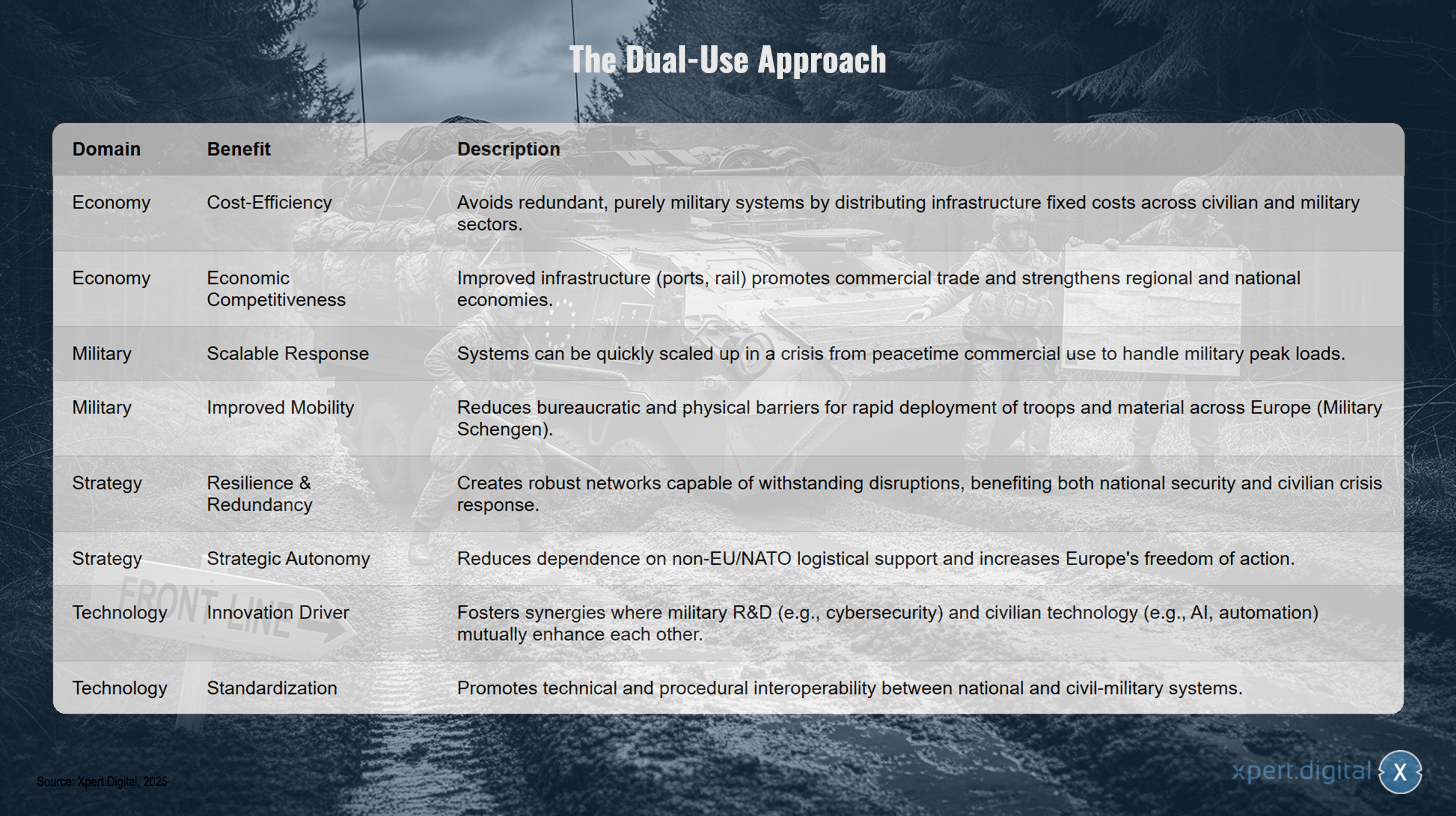
The dual-use approach – Image: Xpert.Digital
The dual-use approach is a strategic concept that fully leverages the advantages of integrated civil-military infrastructure and technology development. In the economic domain, this approach enables significant cost efficiency by sharing fixed costs for infrastructure projects between the civilian and military sectors. Simultaneously, it promotes economic competitiveness through the expansion of transportation infrastructure such as ports and railways, which strengthens commercial trade.
In the military sphere, the dual-use approach offers crucial strategic advantages. It allows for scalable responsiveness, enabling commercial systems to be quickly adapted to military requirements in times of crisis. Furthermore, it improves military mobility by reducing bureaucratic hurdles and facilitating the faster deployment of troops and equipment.
At a strategic level, this approach creates resilience and redundancy in networks that benefit both national security and civilian crisis response. It reduces dependence on external logistical support and increases Europe's strategic autonomy.
In the technology sector, the dual-use approach acts as a driver of innovation. It fosters synergies between military research and civilian technology development, for example in areas such as cybersecurity, artificial intelligence, and automation. Furthermore, it supports standardization and improves technical interoperability between different national and civil-military systems.
Dual-use logistics in action: Strategic hubs as force multipliers
This section provides the concrete evidence to make the abstract concept of dual-use logistics tangible and to undeniably demonstrate its impact.
Case study: The Port of Rostock – NATO's Baltic Gateway
The transformation of the Port of Rostock into a central military hub is a direct response to the changed security situation in the Baltic Sea following Russian aggression and the NATO accession of Finland and Sweden. Today, it serves as a forward-looking logistical base for the defense of NATO's eastern flank.
Rostock's dual-use capability is manifested in the perfect symbiosis of its civilian strength and military integration. As the largest universal port on the German Baltic coast, with massive cargo handling, 47 berths, and the capacity to accommodate very large vessels, its civilian capabilities form the basis for its military role. Crucial military functions have been established on this foundation. The port is home to the new multinational naval headquarters, Commander Task Force Baltic (CTF Baltic), led by the German Navy, which monitors the Baltic Sea around the clock. It serves as the primary staging and staging area for major NATO exercises such as BALTOPS and National Guardian, which involve the deployment of thousands of troops and hundreds of vehicles, including main battle tanks. Furthermore, critical military equipment such as Patriot air defense systems is shipped from Rostock to NATO allies.
A prime example of a forward-looking dual-use project is the planned operational hub at the Warnow shipyard. Here, a NATO deployment hub is being developed jointly with private investors who will also produce converter platforms for offshore wind farms at the same location. This project directly links military necessities with the civilian energy transition and demonstrates how modern defense planning can be harmonized with economic and environmental goals.
The port's effectiveness is made possible by its excellent multimodal connections. Direct links to the A19 and A20 motorways, as well as an extensive and expandable rail network, enable the rapid deployment of troops and equipment from the port to other parts of Europe. Its enormous storage capacity is another crucial factor that makes the port ideal for large-scale military operations.
Suitable for:

Case study: The ports of Split & Rijeka – securing the Mediterranean flank
This case study demonstrates that dual-use logistics is not a new concept, but a long-standing, proven practice. Croatian ports are important NATO resources for power projection and ensuring security in the Mediterranean and the Balkans.
The Port of Rijeka has served as a critical transshipment hub for equipment belonging to the US Army and NATO since at least 1998, supporting operations such as SFOR in Bosnia and Herzegovina. The handling of helicopters, vehicles, and supplies is a concrete example of its military-logistical function. Civil-military synergy is particularly pronounced here: US Navy ships regularly use Croatian ports, especially Rijeka, for maintenance and repair work. These contracts have generated hundreds of millions of dollars for the local economy. This is a perfect example of mutual benefit: the Navy gains access to world-class shipyards, and the local economy profits.
The port of Split serves as a command and cooperation center. It regularly hosts high-level NATO units, including the flagship of the US Sixth Fleet, the USS Mount Whitney, and NATO's Standing Maritime Group 2 (SNMG2). Furthermore, Split is an important venue for leadership conferences, such as those of NATO Special Forces, which promote interoperability and strengthen alliance partnerships.
Crucially, the modernization of the Port of Rijeka, particularly the improvement of its rail infrastructure and connections to Central European transport corridors, was co-financed by EU funds from the Connecting Europe Facility (CEF). This vividly demonstrates how EU civilian infrastructure funds directly enhance a critical, NATO-relevant dual-use capability.
Suitable for:

Network expansion: The untapped potential of rail and air transport
Beyond seaports, the dual-use concept is applicable to the entire transport system and unfolds its full potential there.
Airports: Examples such as Rzeszów-Jasionka in Poland, which has become a crucial NATO logistics hub for supporting Ukraine, Cologne/Bonn in Germany with its mix of cargo and military transport aircraft, and Pisa in Italy with its civilian terminal alongside a military air transport brigade, demonstrate the diverse range of applications. A pioneering major project is the planned Central Communications Port (CPK) in Poland, designed from the ground up as an integrated dual-use hub for air, rail, and road transport.
Rail networks: With an estimated 94% overlap between civilian and military networks, rail is the most critical land-based dual-use system. There is an urgent need to upgrade key corridors for the transport of heavy military equipment (e.g., 70-ton tanks), ensure the load-bearing capacity and clearance of bridges and tunnels, and implement interoperable signaling systems such as ERTMS across the board. The identification of four strategic multimodal corridors and 500 "hotspot" projects in the EU White Paper is an important but only initial step.
These case studies demonstrate that dual-use hubs are more than just transit points. They become anchor points for alliance activities – joint exercises, multinational headquarters, shared maintenance facilities. The constant interaction in a port like Rostock or Split builds trust, institutional knowledge, and interoperability among allied forces in ways that sporadic field exercises cannot achieve. Establishing a facility like the CTF Baltic in Rostock necessitates the daily collaboration of personnel from 13 nations. An investment in a physical dual-use hub is therefore also an investment in NATO's political and military cohesion.
At the same time, the Rijeka case reveals a crucial, often unspoken synergy. EU civilian infrastructure funds from the CEF directly enhance NATO's defense capabilities, which utilize the port as a vital logistics hub. This creates a highly efficient, de facto partnership. The EU provides the resources and framework for infrastructure development, and NATO benefits from a significant increase in security. This understanding is essential for advocating for greater alignment between EU infrastructure planning and NATO's defense policy requirements.
NATO port strategies: Military and economic synergies in Rostock and Split/Rijeka
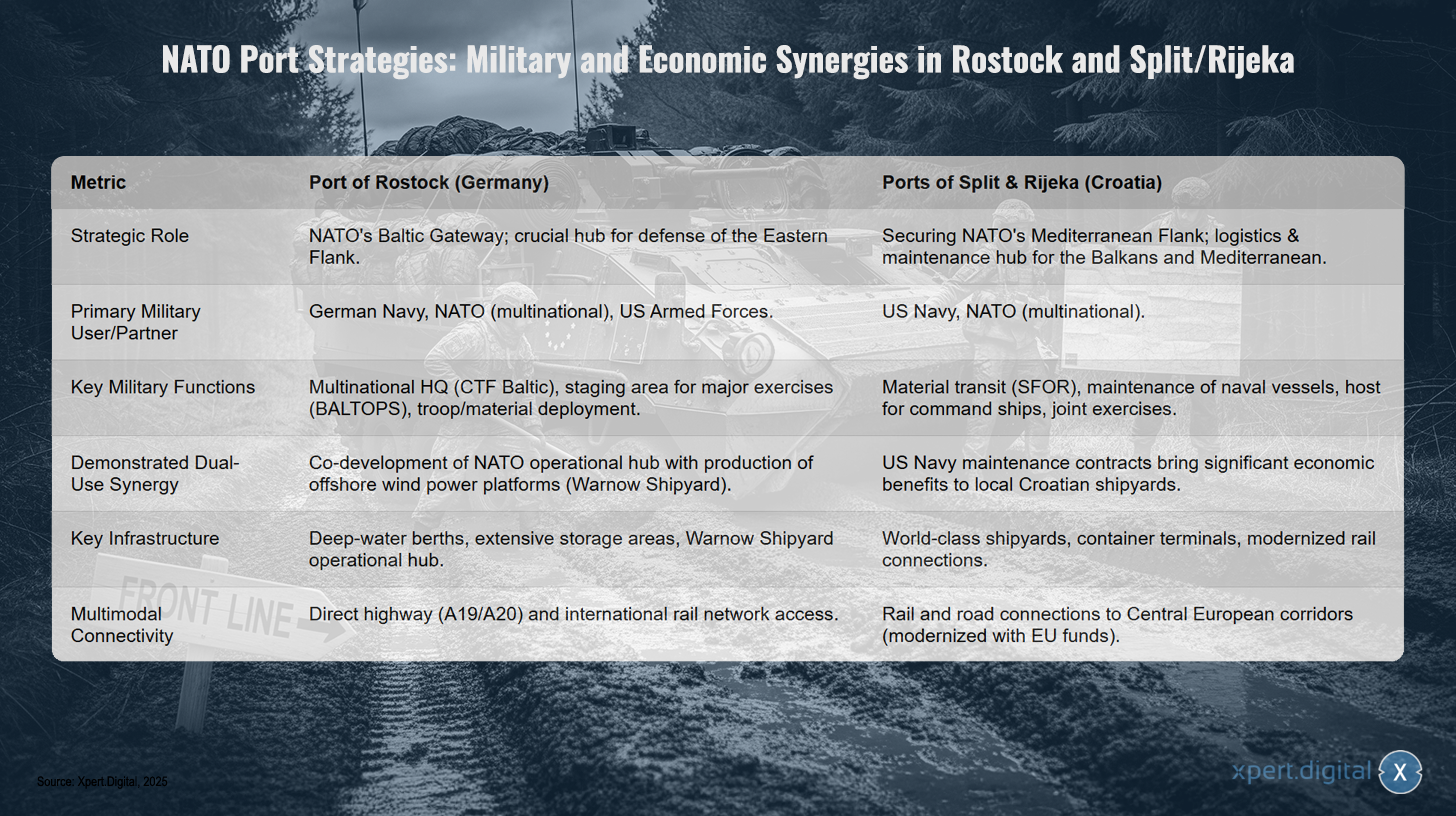
NATO port strategies: Military and economic synergies in Rostock and Split/Rijeka – Image: Xpert.Digital
NATO's port strategies in Rostock and Split/Rijeka demonstrate a remarkable military and economic synergy between German and Croatian ports. Rostock serves as NATO's strategic gateway to the Baltic Sea and is a key defense hub for the eastern flank. Its infrastructure includes deep-water berths, extensive storage areas, and the Warnow shipyard operational hub, where innovative projects such as the co-development of offshore wind power platforms are taking place.
In contrast, the Croatian ports of Split and Rijeka secure NATO's Mediterranean flank and serve as logistical hubs for the Balkans and the Mediterranean region. Their world-class shipyards benefit from maintenance contracts with the US Navy, generating significant economic advantages for local industry. Both port locations have multimodal connections – Rostock via highways and international rail lines, and the Croatian ports via modernized transport corridors developed with EU funding.
The military functions include multinational exercises such as BALTOPS, troop movements, material transit, and ship maintenance. German and US forces jointly utilize these strategic hubs, underscoring close cooperation within NATO while simultaneously promoting local economic development.
Your dual -use logistics expert

Dual -use logistics expert - Image: Xpert.digital
The global economy is currently experiencing a fundamental change, a broken epoch that shakes the cornerstones of global logistics. The era of hyper-globalization, which was characterized by the unshakable striving for maximum efficiency and the “just-in-time” principle, gives way to a new reality. This is characterized by profound structural breaks, geopolitical shifts and progressive economic political fragmentation. The planning of international markets and supply chains, which was once assumed as a matter of course, dissolves and is replaced by a phase of growing uncertainty.
Suitable for:
From fragmentation problems to strategic integration: Dual-use networks between obstacles and solutions
The points of friction: Overcoming the barriers to a coherent network
This section directly addresses the obstacles to the widespread adoption of a dual-use logistics strategy and provides a sober assessment of the political, legal, and technical landscape.
Suitable for:

Political and institutional inertia
The core problem is the aforementioned “strategic cacophony.” Analyses show that despite increased spending, European defense cooperation is declining, with a large portion of the investment flowing into readily available US equipment. This is driven by differing threat perceptions and a deeply entrenched “procurement nationalism” that prioritizes national industrial bases over collective capabilities.
This political fragmentation leads to a “deliberate neglect of logistics.” Lacking a compelling political narrative, the focus remains on prestigious hardware rather than the unglamorous but essential infrastructure. The EU’s institutional structure, in which member states retain primary responsibility for defense and security, exacerbates this problem. The EU can propose and fund, but cannot mandate a unified logistics plan, making the system vulnerable to vetoes or non-participation by individual member states.
Regulatory and legal labyrinths
The cross-border nature of logistics encounters a wall of differing national regulations. This necessitates a massive effort to harmonize rules for everything from military transport permits to customs clearance. The concept of a "military Schengen" is the stated goal, but its implementation is slow and fraught with bureaucratic obstacles.
The complexity of dual-use controls themselves presents a further hurdle. The regulations governing the control of dual-use goods (EU Regulation 2021/821) can lead to complexity when applied to entire logistics systems. The lack of a universal classification system, differing interpretations by customs officials, and the risk of diversion create significant compliance challenges for private sector partners. Enforcement is inconsistent across the EU, which lacks a unified enforcement structure.
Infrastructural and technical deficiencies
Many European infrastructure networks, especially the railways, suffer from decades of underinvestment. The German network, a critical transit country, is in a "catastrophic state." This means that bridges cannot support heavy tanks, tunnels are too small, and there is a shortage of specialized railway carriages.
In addition to these shortcomings, capacity bottlenecks exist. Key transport corridors and terminals are already operating at or near their capacity limits for civilian traffic. Adding military peak load requirements risks gridlock and pits military prioritization against the just-in-time logic of modern civilian supply chains. Finally, the lack of standardization and interoperability poses a significant technical challenge. Systems—civilian and military, and across nations—must be able to communicate and collaborate. While NATO standards exist, their integration with civilian and industry standards is a massive and complex undertaking.
The cybersecurity front
The integration of civilian infrastructure (ports, railway signaling systems, air traffic control) into military logistics networks dramatically increases the attack surface for cyber threats from state and non-state actors. Cybersecurity and physical security, therefore, cannot be considered afterthoughts. The infrastructure must be designed from the ground up to be resilient against physical and cyber attacks, requiring redundancy and robust security protocols – an approach known as “design for resilience”.
The points of friction are not only technical or political, but also cultural in nature. The military demands security, redundancy, and the ability to override normal procedures in a crisis ("just-in-case"). The private logistics sector, on the other hand, prioritizes speed, cost-efficiency, and predictability ("just-in-time"). This fundamental clash of operational philosophies is a major barrier. A successful dual-use model must therefore include clear governance frameworks, communication protocols, and financial compensation mechanisms to bridge this cultural and operational gap.
These challenges are interconnected, creating a self-reinforcing negative cycle. Political fragmentation prevents a unified plan. Without a plan, there is no clear business model for industry to invest in standardized equipment. The resulting technological gaps hinder cross-border military movements, reinforcing nations' tendency to focus on national solutions and further deepening political fragmentation. Breaking this vicious cycle requires a powerful intervention that addresses the political, industrial, and technological dimensions simultaneously.
Strategies for overcoming civil-military challenges in EU infrastructure development
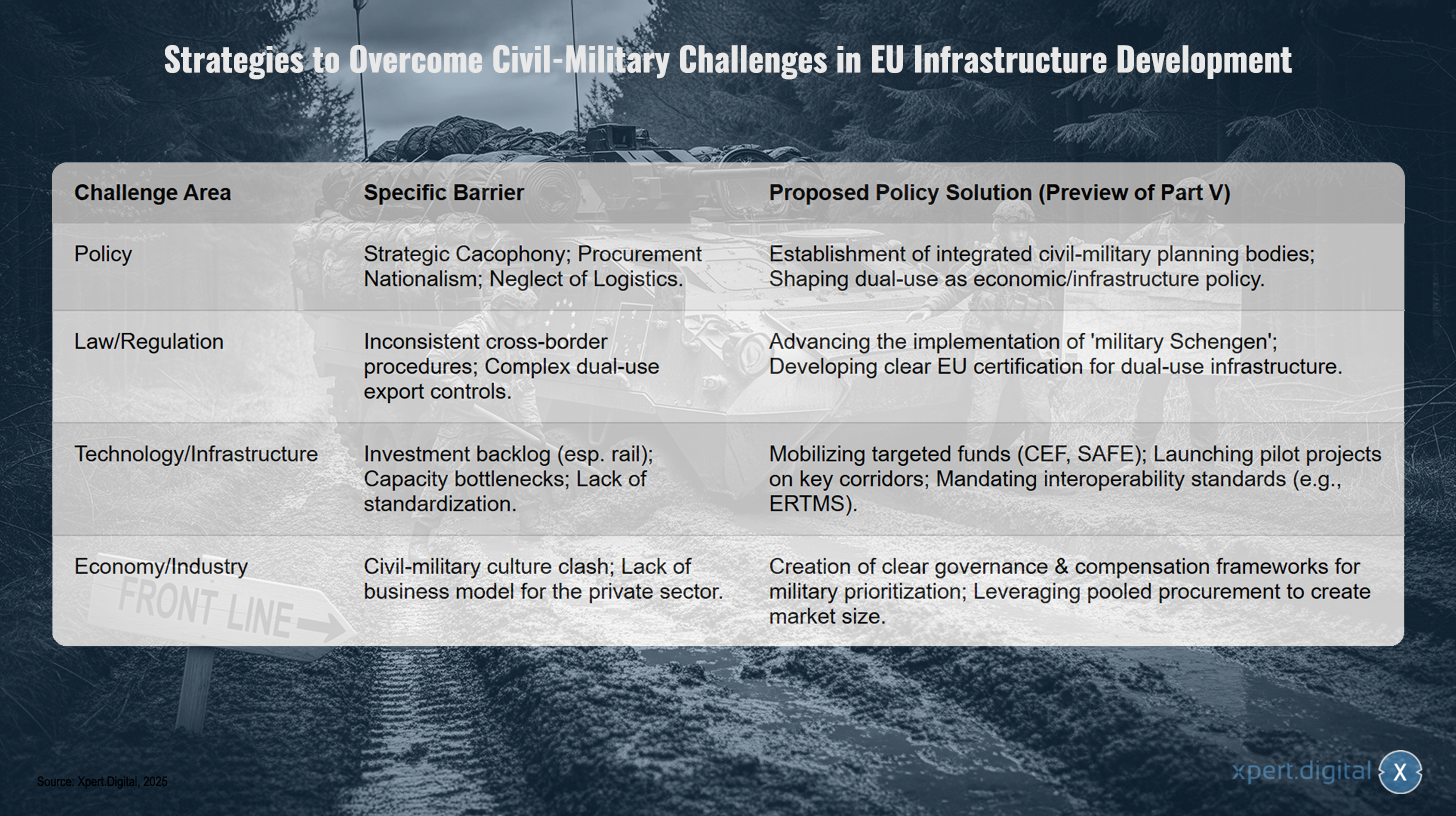
Strategies for overcoming civil-military challenges in EU infrastructure development – Image: Xpert.Digital
The development of EU infrastructure faces complex civil-military challenges that require a multidimensional approach. In the political sphere, a “strategic cacophony” and procurement nationalism dominate, which can be addressed by establishing integrated civil-military planning bodies and adopting a new perspective on dual-use as an economic and infrastructure policy.
Legal and regulatory obstacles manifest themselves in inconsistent cross-border procedures and complex export controls. Possible solutions include the implementation of a “military Schengen” and the development of a unified EU certification for dual-use infrastructure.
The technical infrastructure is characterized by investment backlogs, particularly in the rail sector, capacity bottlenecks, and a lack of standardization. Strategies such as mobilizing targeted funding, pilot projects on key corridors, and the introduction of binding interoperability standards like ERTMS can facilitate progress in this area.
In the economic and industrial sectors, a civil-military culture clash and a lack of business models for the private sector hinder development. Clear governance and compensation frameworks, as well as consolidated procurement strategies, can help create market sizes and generate investment incentives.
Forging the backbone of European defense: A strategic roadmap
This final section contains a number of concrete, actionable recommendations that summarize the findings of the entire report in order to show a clear way forward.
Integration of planning and governance: From ad-hoc to institutionalized
The current ad-hoc integration of logistical considerations is insufficient. A fundamental change in the planning culture is needed.
Recommendation: Establish permanent, integrated civil-military planning structures at EU and national levels. These bodies must include representatives from defense ministries, transport ministries, infrastructure agencies, and the private sector.
A feasible step: the creation of multi-stakeholder "dual-use logistics councils." Their task would be to ensure that logistical considerations are integrated into strategic planning from the outset and not treated as an afterthought. This would guarantee institutionalized coordination among all relevant stakeholders.
A new investment and financing paradigm: Mobilizing capital
Financing the necessary infrastructure upgrades exceeds the capabilities of traditional defense budgets. A new approach is needed that intelligently combines public and private resources.
Recommendation: Fully utilize and expand existing EU financial instruments. This includes earmarking a larger portion of the Connecting Europe Facility (CEF) for dual-use projects and ensuring that the new SAFE instrument is agile and accessible.
A feasible step: Advocate for a higher EU co-financing rate for certified dual-use projects to encourage member state participation. At the same time, innovative public-private partnership (PPP) models with clear frameworks for risk sharing and compensation should be promoted to attract private capital.
Promoting technical and operational cohesion: Building the network
Identifying problems must lead to implementing solutions. Practical progress is the best way to overcome political and technical obstacles.
Recommendation: Launch highly visible pilot projects on one or two of the most critical strategic corridors (e.g., North Sea-Baltic Sea or Rhine-Danube). These projects should test and refine operational models for civil-military cooperation in real time.
A feasible step: Use the EU's regulatory power to mandate key interoperability standards for all new transport infrastructure projects receiving EU funding. This includes the use of ERTMS for rail, standardized communication protocols, and physical specifications for handling military loads.
Building human capital: The people behind logistics
A 21st-century logistics network requires a 21st-century workforce. Technology and infrastructure are only as good as the people who operate them.
Recommendation: Recognize that the development of skilled workers is an essential part of the strategy.
A feasible step: supporting and expanding initiatives such as the "Pact for Skills in the Defense and Aerospace Industries" to create specialized "dual-use academies." These would focus on training a new generation of logisticians, engineers, and planners proficient in cybersecurity, digital twin technology, AI-driven logistics, and intelligent energy systems.
Suitable for:

From recognized necessity to realized capability
This report returns to the original analogy. Its purpose was to highlight the need for a dual-use logistics network. It has outlined the strategic imperative, defined the concept, demonstrated its real-world successes, identified the obstacles, and presented a clear roadmap for action. The analysis has shown that neglecting logistics is not merely a technical oversight, but a symptom of deeper political fragmentation and a dangerous blind spot in the European security architecture.
The concluding appeal is directed at Europe's political leaders. They must move beyond short-term "activism" and commit to the long-term, fundamental work of building the invisible backbone of European defense. The case studies of Rostock, Split, and Rijeka prove that the concept works and brings immense strategic and economic benefits. The roadmap shows that while the challenges are enormous, they are not insurmountable.
The need has been made clear. The time is ripe to mobilize the political will, create the demand for change, and build the capacity that will underpin Europe's security in the 21st century.
Advice - planning - implementation

Markus Becker
I would be happy to serve as your personal advisor.
Head of Business Development
Chairman SME Connect Defense Working Group
Advice - planning - implementation
Konrad Wolfenstein
I would be happy to serve as your personal advisor.
contact me at wolfenstein ∂ xpert.digital
Just call me on +49 7348 4088 965 (Munich) .





