The bureaucratic labyrinth and its architects: A comparative analysis of administration and the role of the consulting industry – Image: Xpert.Digital
The bureaucratic labyrinth and its architects: A comparative analysis of public administration in Europe, the USA and Japan, and the role of the consulting industry
The Anatomy of Bureaucracy: A History of Three Systems
This article lays out the fundamental problem. It defines and deconstructs the nature of bureaucracy in Europe, particularly in the EU and Germany, before using the systems of the USA and Japan as critical counterpoints to highlight the unique features and challenges of the European model.
Related to this:


The European Labyrinth: Deconstructing Bureaucracy in the EU and its Member States
This section argues that European bureaucracy is not just a collection of rules, but a systemic problem resulting from a unique combination of multi-level governance, a specific administrative culture, and a significant digital deficit.
The necessary evil and the negative perception
The analysis begins with the recognition of the dual nature of bureaucracy: on the one hand, it is a necessary organizational apparatus for a democratically legitimized state, acting to safeguard the common good; on the other hand, it is often perceived negatively as a "monster." This creates the central tension of the analysis. Weber's ideal of a rationally grounded, rule-based administration that ensures equal treatment for all is contrasted with the lived experience of excessive complexity and inefficiency. Bureaucracy, often used synonymously with the term administration, is not inherently negative, but rather the necessary organization of a state apparatus. However, criticism of the bureaucratism of the European Union is ubiquitous, both in the media and in European studies. Alleged negative developments and excesses of European integration are commonly attributed to the EU's bureaucratic burden. This negative connotation remains widespread despite efforts to counteract it.
Structural drivers: The EU's multi-level governance
The central structural problem lies in the institutional framework of the EU itself. The EU is a complex network of decision-making and executive bodies, including the European Commission, the European Parliament, the Council of the European Union, and a multitude of agencies and specialized bodies. The European Commission, as the main executive body, uses its "right of initiative" to propose new laws. These laws are then examined and adopted by the Parliament and the Council. The crucial point, however, is that while legislation is the decisive instrument of action at the national and EU levels, implementation lies with the individual states and municipalities.
This division of responsibilities leads to a phenomenon known as the "cascade of delegation." Legislation flows from the EU level to national and then to local governments. This process inherently adds layers of interpretation, regulation, and administrative procedures at each stage, often without sufficient consideration of practical implementation at the local level. This separation between legislation and enforcement slows down modernization processes and creates incentives that lead to unnecessary bureaucracy. For example, when municipalities have to implement new EU legislation, such as on food control, without being able to invoke the principle of cost reimbursement (whoever orders, pays), they are often left with no option but to pass on the costs of enforcement to private entities and businesses.
The EU's nature as a "bureaucratic power" is deeply rooted in its internal structures of delegation and intergovernmental decision-making. This structure predisposes it to rules-based, multilateral approaches. While this structure fosters cohesion, it also inherently favors complex regulatory solutions over other forms of exercising power. The EU is characterized by a preference for multilateralism and rules-based policy approaches, which shapes its external policy but also complicates its internal processes.
Cultural and historical drivers: The German case study
The specific administrative culture in key member states such as Germany significantly exacerbates the structural problems of the EU.
- Risk aversion and the pursuit of "legal soundness": A dominant characteristic of German administration is the attempt to make every action "legally sound," meaning legally unassailable and upheld in court. This preventive defense against potential legal challenges stifles pragmatic and efficient solutions in favor of overly detailed, rigid, and documented processes. This cultural trait significantly exacerbates the complexity emanating from the EU. Instead of finding workable solutions, the administration often anticipates potential court rulings and acts in a way that aims to preemptively nullify every conceivable objection.
- Distrust and control: A culture of distrust between administrative bodies, as well as between the state and citizens and businesses, leads to excessive control efforts and high verification burdens. Instead of relying on principles such as random sampling, de minimis thresholds, or flat fees, which could significantly reduce bureaucratic effort, a high level of control is employed. This reflects a deep distrust that hinders efficiency-enhancing measures.
- Silo thinking: Deeply entrenched departmental and agency silos ("silo thinking") hinder interdepartmental collaboration and project-based work, which are essential for modernizing and streamlining processes. This paradigm impedes networking and, in particular, cross-departmental project work, leading to significant losses in efficiency.
The combination of these cultural factors means that the problem of European bureaucracy cannot be located solely in Brussels. It is a systemic flaw arising from the interaction between the EU's supranational legislative structure and the pre-existing, path-dependent administrative cultures of its key member states, such as Germany. EU directives are not self-executing; they are transposed into national law. When a complex directive designed for many countries encounters a risk-averse, legalistic, and siloed national bureaucracy, the result is an exponential increase in complexity and perceived administrative burden. Therefore, it is an oversimplification to blame only "Brussels"; the friction and reinforcement at the national level are equally, if not more, responsible for the final outcome experienced by citizens and businesses.
Related to this:


The digital backlog as a multiplier of bureaucracy
Germany's significant lag in the digitalization of its public administration is a major cause of unnecessary bureaucracy. In the EU's 2019 Digital Economy and Society Index (DESI) report, Germany ranked only 24th out of 28 countries in e-government. This lag is not primarily a technical problem, but rather reflects a lack of cultural change within the administration. The public administration has failed to accept and implement the changes associated with digitalization.
The consequences are far-reaching: processes remain paper-based, communication is opaque, and citizens and businesses are confronted with incomprehensible forms and unclear requirements. Irritating and unnecessary bureaucracy arises when responsibilities are unclear and requested documents are not clearly labeled. In contrast, the most economically powerful economies exhibit widespread use of electronic systems and online platforms to meet regulatory requirements. The lack of digitalization in Europe, particularly in Germany, thus acts as a multiplier for existing bureaucratic hurdles.
Myth vs. Reality: Is the EU a "bureaucratic monster"?
The analysis must also address common criticisms, often symbolized by regulations such as those concerning the curvature of cucumbers and bananas. Some sources argue that this is a persistent myth and that the EU administration is not excessively large. They point out that the EU's linguistic diversity, which necessitates extensive translations, is a necessary price to pay for cultural diversity and contributes to its complexity.
The perception of a “bureaucratic monster” is, however, fueled by the very real structural and cultural problems identified above. The complexity does not necessarily stem from the number of bureaucrats—the European Commission has fewer staff than many large city administrations—but from the multifaceted, risk-averse, and under-digitized nature of its legislative and administrative processes. The criticism that the EU is a “bureaucratic monster” that absurdly interferes in the “structures of daily life” may be exaggerated, but it is rooted in the tangible experience of inefficiency and over-regulation. Sociologically speaking, the issue is not whether the EU exhibits more or less bureaucratization tendencies, but rather the specific type of bureaucracy at the European level. This type is characterized by a pronounced tendency toward over-regulation and paternalism, resulting from the EU’s unique institutional structure.
The American and Japanese counterpoints: Alternative administrative models
This section uses quantitative data and specific policy examples from the USA and Japan to create a sharp contrast to the European model and to highlight different approaches to regulation and reform.
A quantitative starting point: The World Bank's "Doing Business Made Easy" index
The analysis will be based on the World Bank's "Business Activity Report 2020." Although this index was later discontinued due to data irregularities, it provides a standardized snapshot of the regulatory environment for businesses as perceived at the time. The report measured regulations that directly affect businesses, rather than broader conditions such as infrastructure or crime.
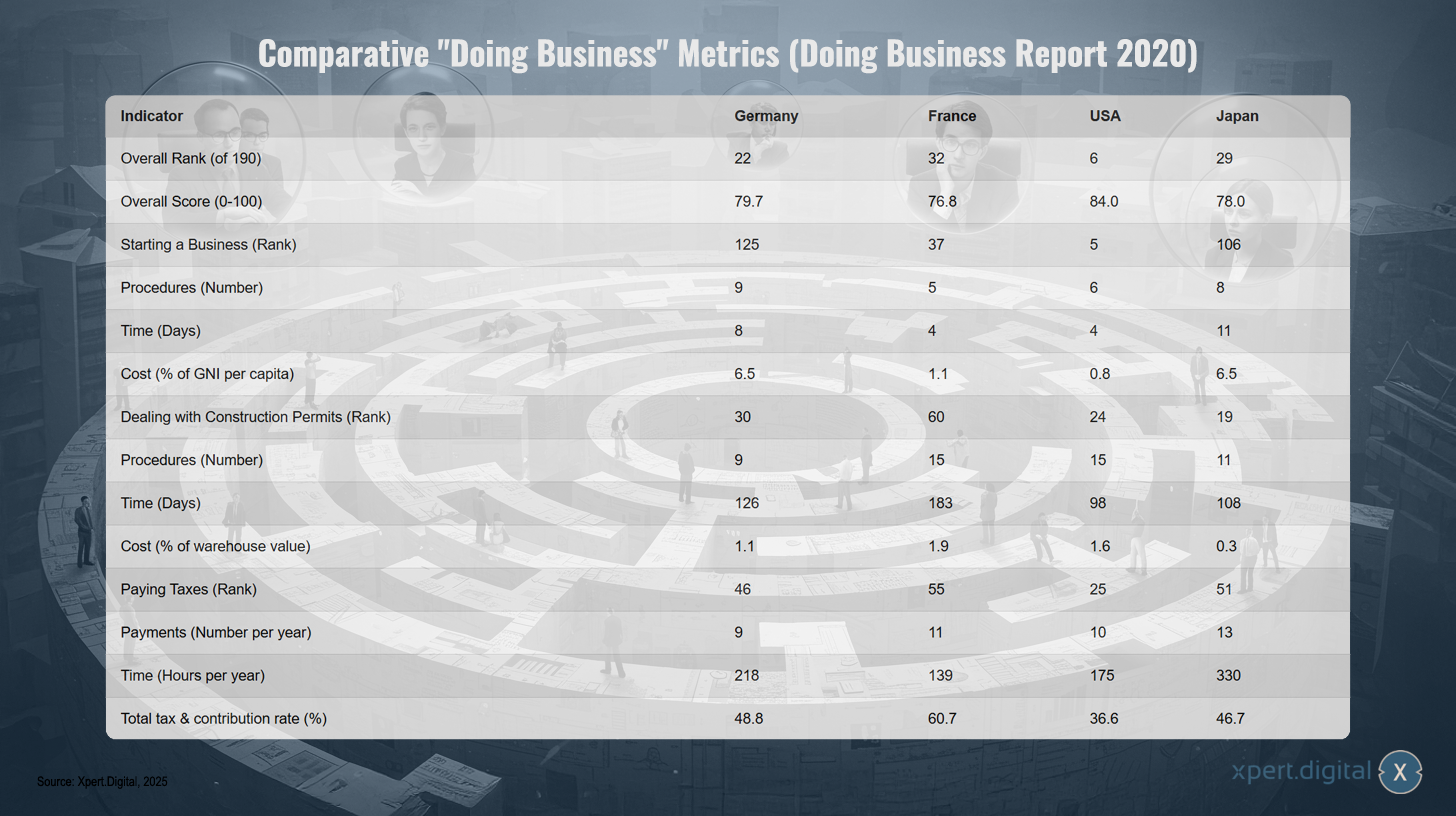
The following table summarizes the key indicators for the compared economies and provides an objective, data-driven basis for comparative analysis. It enables a granular diagnosis of where the European model (represented by Germany and France) performs below average compared to the USA and Japan.
Comparative “Business Made Easy” Metrics (Business Activity Report 2020)
Comparative “Business Made Easy” Metrics (Business Activity Report 2020) – Image: Xpert.Digital
The analysis of the table shows that the USA (ranked 6th) performed significantly better in the overall 2020 ranking than Germany (22nd), Japan (29th), and France (32nd). A particularly revealing result for Germany is its exceptionally poor ranking in "business start-up" (125th), which requires 9 procedures and 8 days. This indicates high procedural hurdles to entrepreneurship and provides concrete evidence of the bureaucratic burden discussed in Section 1. France fares particularly poorly in terms of building permits (60th) and tax burden (55th, with a total rate of 60.7%). Japan, in turn, has a high number of tax payments (13) and a very high time expenditure for tax returns (330 hours), suggesting a complex tax bureaucracy.
The 2020 business activity report provides a comparative overview of various economic indicators in Germany, France, the USA, and Japan. Overall, the USA holds the top position with 6th place and a total score of 84.0, while Germany, with 22nd place and 79.7 points, is in the middle range.
Significant differences emerge when it comes to starting a business: The USA ranks 5th with only 4 processing days and minimal costs of 0.8% of per capita income. Germany, on the other hand, ranks 125th with 8 processing days and 6.5% start-up costs.
In terms of building permits, Germany ranks 30th, better than France (60th), but requires 126 days for the procedures. The USA is more efficient, with a processing time of 98 days and a ranking of 24th.
The tax burdens are particularly interesting: France has the highest total tax and contribution rate at 60.7%, while the USA, at only 36.6%, is significantly lower. Germany, at 48.8%, is in the middle range. The number of tax payments and the time required also vary considerably between countries.
The US model: Fragmentation and focus on cost reduction
The US system, while complex in its own way (e.g., due to the coexistence of federal and state regulations), often provides a less procedurally intensive environment for doing business, which is reflected in its high ranking. Reforms in the US frequently focus on direct cost reduction. One example is the reduction of the corporate tax rate, which directly improves the "paying taxes" indicator. This contrasts with the European focus on procedural correctness and legal certainty. The US also facilitates business formation through the introduction of online filing. This pragmatic approach, focused on efficiency and cost reduction, largely explains its lead in the "doing business made easy" ranking.
The Japanese model: State-led, internally driven digital transformation
Japan offers the most compelling strategic alternative to the European model. Recognizing its administrative inefficiencies, the Japanese government established a new digital agency in 2021.
- Mission and Structure: The agency's mission is to act as a "control tower" for the country's digital transformation by standardizing systems and breaking down data silos between government organizations. Its goal is to fundamentally improve public services and eliminate inefficient past practices. One specific objective is a "one-stop service" for citizens, eliminating the need to repeatedly enter the same information at different government agencies.
- A new approach to expertise: Crucially, the digital agency's strategy is to actively recruit experts from the private sector and integrate them into government roles, rather than simply outsourcing projects to consulting firms. This represents a deliberate step toward transforming the public service from a closed to an open system and accumulating knowledge internally. It is a direct attempt to build sovereign state capacity. The agency is intended to act as a "lubricant" and engine of reform to advance government at both the national and local levels.
This approach represents a deliberate strategic shift away from the New Public Management (NPM) paradigm that has dominated public sector reform in the West for decades. It is an implicit critique of the outsourcing model and an attempt to proactively address the problem of state erosion—a topic explored in detail in Part II. While the NPM model encourages the outsourcing of functions defined as non-core, which, critics argue, leads to a loss of internal capabilities and increased dependency, the Japanese model does the opposite: it insources talent and methods from the private sector (such as agile development) to build sustainable, internal governmental capacity. This is not just a different tactic; it is a different philosophy of government. It signals an acknowledgment at the highest levels of the Japanese government of the long-term risks associated with the consultant-dependent model that has become so entrenched in Europe and the US. This transforms the Japanese reform from a mere technical project into a significant political and strategic shift.
🎯🎯🎯 Benefit from Xpert.Digital's extensive, five-fold expertise in one comprehensive service package | BD, R&D, XR, PR & Digital Visibility Optimization


Benefit from Xpert.Digital's extensive, five-fold expertise in a comprehensive service package | R&D, XR, PR & Digital Visibility Optimization - Image: Xpert.Digital
Xpert.Digital possesses in-depth knowledge across various industries. This allows us to develop tailored strategies precisely aligned with the requirements and challenges of your specific market segment. By continuously analyzing market trends and monitoring industry developments, we can act proactively and offer innovative solutions. The combination of experience and expertise generates added value and provides our clients with a decisive competitive advantage.
More information here:
Invisible Drivers: How Management Consultants Manipulate Governments
The shadow government: The pervasive influence of external advisors
This section shifts the focus from the internal characteristics of bureaucracy to the role of a powerful external actor: the consulting industry. It will quantify the market, explain the reasons for engaging consultants, and describe in detail the mechanisms by which these firms exert influence, often to the detriment of public sector capacities.
Related to this:

The consulting gold rush in the public sector
This section aims to demonstrate the extent of the phenomenon and the underlying reasons why governments have become so dependent on external advisors.
Market mapping: size, growth, and regional differences
The global market for public sector consulting services is a multi-billion dollar industry. However, estimates of its size vary considerably depending on the source and methodology, highlighting the sector's own lack of transparency. Figures range from approximately USD 76 billion in 2025 to over USD 518 billion in 2023. This discrepancy reflects differing definitions of what constitutes "consulting," encompassing everything from strategic advice to IT implementation and outsourcing.
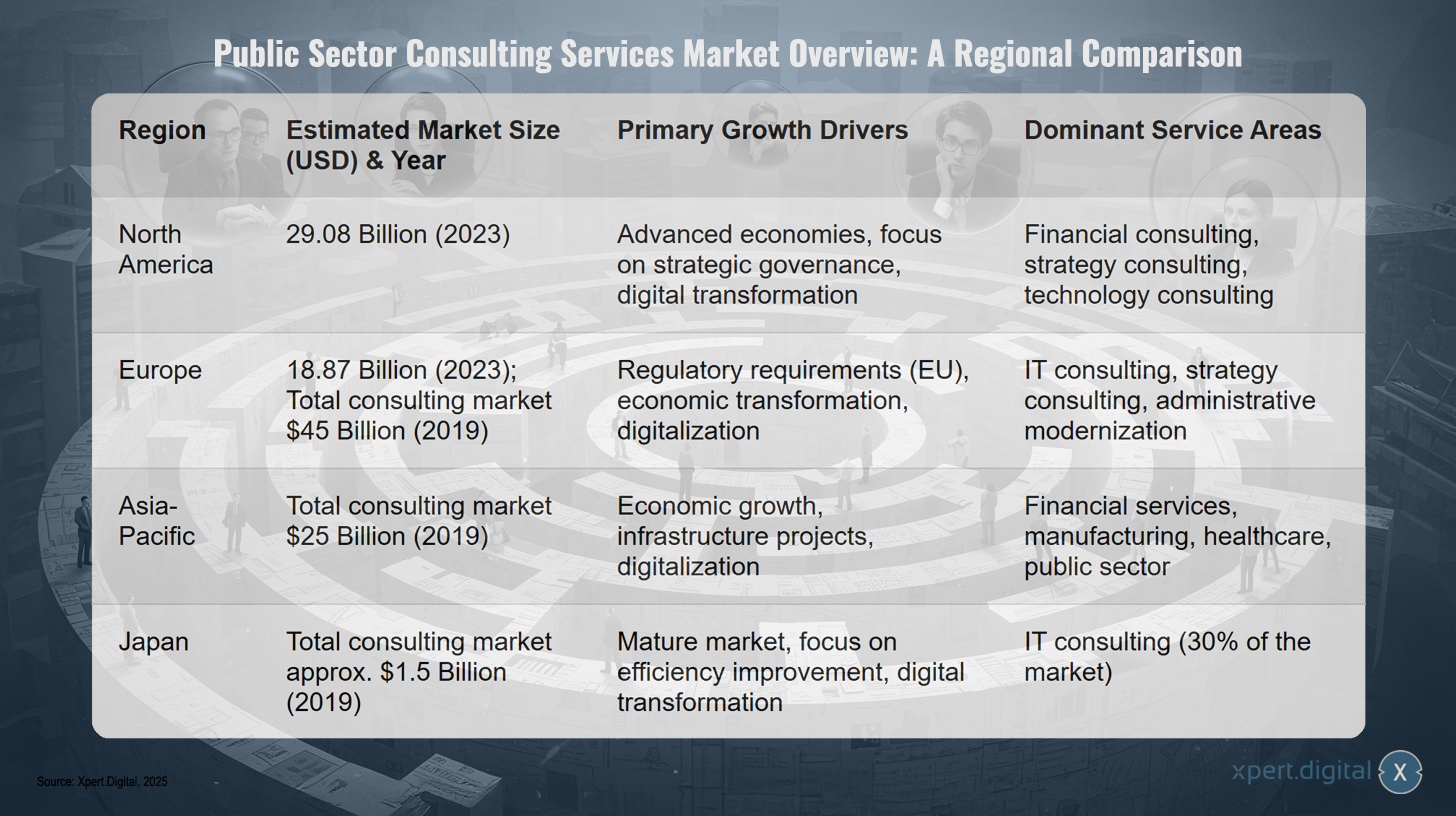
Market overview for consulting services in the public sector: A regional comparison
Market overview for consulting services in the public sector: A regional comparison – Image: Xpert.Digital
The regional breakdown shows that North America is the dominant market. In Europe, Germany and France are key markets. The share of the public sector in consulting firms' revenue is significantly higher in the US (approximately 20%) and the UK (26%) than in Germany (10%), indicating differing degrees of dependence. The Japanese market is mature but smaller in absolute terms. Global growth is driven by the increasing adoption of digital technologies, the rising demand for outsourcing services, and the growing need for specialized consulting in areas such as cybersecurity and sustainable development.
The global market for public sector consulting services exhibits impressive regional dynamics. North America dominates with an estimated market size of USD 29.08 billion in 2023, driven by advanced economies and a strong focus on strategic governance and digital transformation. Consulting services in North America primarily focus on finance, strategy, and technology consulting.
Europe follows with a total consulting market of USD 18.87 billion in 2023, down from USD 45 billion in 2019. The European consulting landscape is characterized by regulatory requirements, economic transformation, and digitalization. Key areas of focus include IT consulting, strategy consulting, and public administration modernization.
The Asia-Pacific region had a total consulting market of $25 billion in 2019, driven by economic growth, infrastructure projects, and digitalization. Financial services, manufacturing, healthcare, and the public sector play a key role in this market.
Japan presents itself as a more mature market with a total volume of approximately $1.5 billion (2019), with a clear focus on efficiency improvements and digital transformation. It is particularly noteworthy that IT consulting already accounts for 30 percent of the Japanese consulting market.
The reasons for this commitment: Why governments are opening the door
The massive use of consultants by governments has profound causes that are both practical and ideological in nature.
- The capacity gap: Governments are increasingly turning to consultants to fill knowledge and capacity gaps, particularly when faced with new, complex challenges such as digitalization, administrative modernization, or climate policy. The appropriate use of external expertise can help public administrations find the right answers to new and complex questions in a rapidly changing environment. This need is often exacerbated by decades of public sector cuts, which have eroded internal expertise. Sociologist Silke van Dyk criticizes the fact that parts of the public service have been "cut to pieces," resulting in a loss of expertise.
- The Rise of “New Public Management” (NPM): Analysis must identify NPM as the central ideological driver. This doctrine, which gained prominence in the 1980s under politicians like Margaret Thatcher and Ronald Reagan, frames the state as inherently inefficient and promotes the adoption of private-sector, managerialist logics. Consultants are the primary proponents and advocates of this logic. They were historically introduced into public administration to prevent market dominance and to respond to the demand for specialized professional services. Contrary to the assumption that neoliberalism merely cuts public spending, it more accurately describes a redirection of public expenditure toward a stronger market role. Thus, government spending increased in real terms during the Thatcher era, while spending on consultants in the UK public sector increased fortyfold.
- Legitimacy and risk mitigation: Engaging a renowned firm like McKinsey, Boston Consulting Group (BCG), or one of the "Big Four" (PwC, Deloitte, KPMG, EY) lends controversial decisions an air of authority and objectivity. It serves as a "scapegoat," allowing politicians and high-ranking officials to shift responsibility; if a project fails, the consultant can be blamed. Executives often use consultants to rubber-stamp decisions they intended to make anyway, such as layoffs or cuts to R&D budgets.
These factors create a self-reinforcing relationship. The ideology of New Public Management (NPM) justifies outsourcing, which leads to the erosion of internal government capacity, making the state even more dependent on consultants for future tasks. The more a government outsources, the less it knows how to do things itself. This infantilizes the government and turns it into a perpetual client for the consulting industry. The problem (lack of capacity) and the solution (hiring consultants) are trapped in a feedback loop that benefits the consultants' business model.
Mechanisms of influence and the erosion of state capacities
This section moves from the "why" to the "how" and describes the specific ways in which consultants shape policy, as well as the negative consequences of excessive dependence.
From consultants to agenda setters
Consultants are not neutral providers of advice; they are active political actors who shape political agendas. They do this through various mechanisms:
- Control of information and framing of problems: They produce influential reports and studies that frame political problems in a way that favors their preferred (and profitable) solutions. Economic consulting firms use this to influence legislation on behalf of clients such as large technology companies, for example by flooding antitrust authorities with economic studies.
- Curatorial function: In reform processes, they act as moderators and gatekeepers, amplifying certain voices of interest groups (including their own) and marginalizing others. They curate the input into reform packages, promote specific content, and in doing so practice a form of self-destruction that undermines accountability to stakeholders.
- Exploiting the revolving door: The movement of personnel between government and regulatory authorities and consulting firms creates powerful informal networks and potential conflicts of interest. Former officials from European and national competition authorities are hired by consulting firms, giving them insider knowledge and access. The European Ombudsman has noted a tendency to underestimate the harmful effects when EU officials bring their knowledge and networks into related areas of the private sector.
The official criticism: The indictment by the German Federal Court of Auditors
The German Federal Court of Auditors has issued a strong, official critique of the federal government's use of consultants. Its findings are not abstract, but based on audits of over 90 real-world projects.
The Court of Auditors' main criticisms, summarized in ten key points, cover a wide range of shortcomings:
- Inadequate problem and goal definition: Decisions are rarely based on a comprehensible problem analysis.
- Lack of necessity assessment: The administration does not critically examine whether it can provide the service itself.
- Inadequate economic analysis: Alternatives, including in-house contributions, are not adequately assessed.
- Vague description of services: The desired service is not described clearly and comprehensively.
- Unclear contract design: Contracts are often vague, which makes monitoring difficult.
- Lack of competition in the awarding of contracts: contracts are often awarded without a formal tender process instead of being publicly advertised.
- Inadequate control and management: The administration is not managing the projects properly.
- Lack of performance monitoring: A final, verifiable performance review often does not take place.
- Lack of transparency: There is insufficient cross-departmental exchange about consultation results.
- Inadequate documentation: The entire process is not documented in a comprehensible manner.
Particularly serious is the finding that core administrative tasks, such as drafting specifications or monitoring contractors, are being outsourced. This official audit provides robust, internal government confirmation of the more widespread external criticisms.
The "erosion" of the state
The most damaging long-term consequence of excessive reliance on advisors is the erosion of the state's own capabilities, a concept that is central to the work of Mazzucato and Collington.
- Loss of institutional knowledge: When core tasks are outsourced, the organization does not learn by doing. The consultant generates the knowledge, but it is often not effectively transferred back to the client or remains proprietary. This creates a permanent dependency. The cumulative use of large consulting firms with extractive business models inhibits innovation, capacity development, and learning.
- Stunted Innovation: The state loses the ability to solve its own problems and innovate. It becomes "stuck in the past" and incapable of evolving. Previous state-led innovations, for example in IT, are now almost unthinkable, as this capability has been ceded to the private sector. Decades of privatization, lower public sector salaries, and the doctrine of government inefficiency have created a self-fulfilling prophecy: states no longer know how to perform key functions.
The opaque and informal nature of consultancy engagement creates a shadow governance structure that undermines democratic accountability. Consultancy services are often treated as simple procurement, thus falling through the cracks of the rules governing collaboration with other non-state actors or permanent staff. This lack of transparency means that key policy-making activities take place outside of public scrutiny. Even the titles of consultancy reports for the European Commission are often not public. This obscures political accountability and allows policymakers to dilute responsibility. The result is a system in which unelected, for-profit actors exert significant influence on public policy in an opaque manner, weakening the link between elected officials, the policies they enact, and their accountability to the public. This poses a fundamental challenge to democratic governance.
Our recommendation: 🌍 Limitless reach 🔗 Connected 🌐 Multilingual 💪 Sales power: 💡 Authentic with strategy 🚀 Innovation meets 🧠 Intuition


From local to global: SMEs conquer the world market with a clever strategy - Image: Xpert.Digital
In an era where a company's digital presence determines its success, the challenge lies in creating an authentic, personalized, and far-reaching presence. Xpert.Digital offers an innovative solution that positions itself as the intersection of an industry hub, a blog, and a brand ambassador. It combines the advantages of communication and sales channels in a single platform and enables publication in 18 different languages. Cooperation with partner portals and the ability to publish articles on Google News and a press distribution list with approximately 8,000 journalists and readers maximize the reach and visibility of the content. This represents a crucial factor in external sales and marketing (SMarketing).
More information here:
Consulting industry exposed: How experts exploit the state
### Bureaucratic Complexity Decoded: The Strategy of Management Consultants ### The Great Trust Trick: When Consultants Sabotage Reforms ### State on Life Support: How External Consultants Paralyze Public Administration ### Consulting as a Profit Machine: The Systematic Attack on State Efficiency ### Billion-Dollar Fraud in the Shadows: The Dark Side of Management Consulting ###
The Great Deception: An Examination of the Core Hypothesis
This section directly addresses the user's most provocative question: Do consultants deliberately undermine reforms for their own benefit? It uses the "Great Fraud" thesis as a lens to analyze the business models and incentives of the consulting industry.
The consultant's dilemma: Profit vs. the common good
This section deconstructs the central argument that the business model of the consulting industry is fundamentally incompatible with the public interest.
The “The Great Deception” Thesis (Mazzucato & Collington)
The central argument of the book "The Great Deception" is that industry is engaging in a "confidence trick." It positions itself as an objective source of added value, but often delivers little, while instead extracting "economic rents"—income that far exceeds the value actually provided.
This is enabled by a power dynamic in which consultants profit from “hollowed-out and risk-averse governments.” They sell security and expertise to clients who lack the confidence or ability to act independently. The authors argue that our economies’ reliance on firms like McKinsey, BCG, PwC, Deloitte, KPMG, and EY stifles innovation, obscures corporate and political accountability, and hinders our collective mission to halt climate change. “The Great Fraud” thrives on the ills of modern capitalism, from financialization and privatization to the climate crisis.
Convergence of critiques: auditors and academics
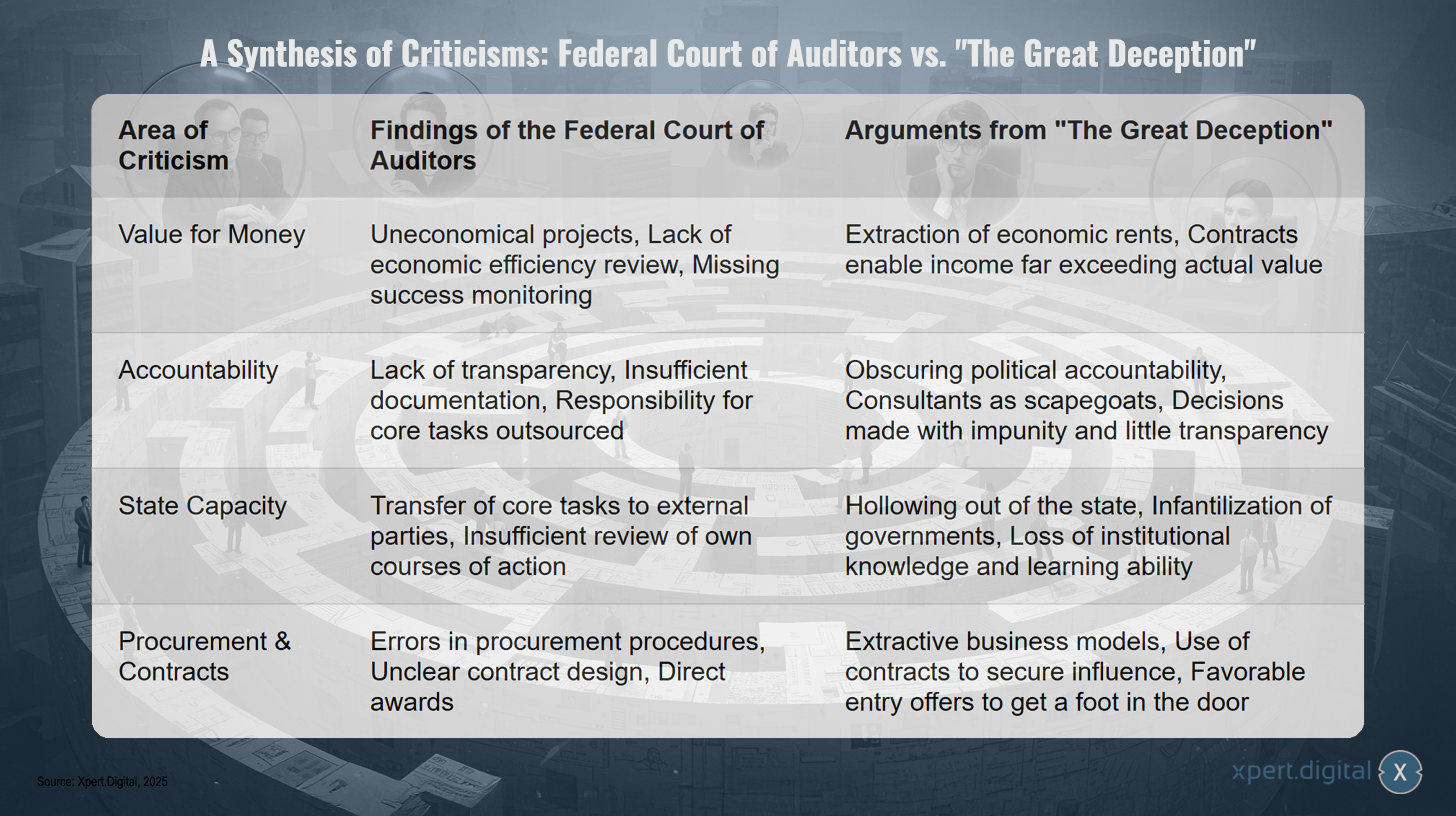
The following table contrasts the criticisms of the German Federal Court of Auditors with the central arguments of "The Great Deception." This comparison is the analytical heart of the report, as it demonstrates that the criticism is not voiced solely by radical academics. The striking agreement in the description of the symptoms by a conservative state auditing body and critical economists lends considerable weight to the analysis.
A synthesis of the criticisms: Federal Court of Auditors vs. “The Great Fraud”
A synthesis of the criticisms: Federal Court of Auditors vs. “The Great Fraud” – Image: Xpert.Digital
The analysis of the Federal Court of Auditors' report and the book "The Great Deception" reveals a disturbing perspective on the relationship between state institutions and external consultants. Both sources paint a similar picture of systemic problems in public administration.
The Federal Court of Auditors initially criticizes the economic inefficiency of projects and the lack of oversight of their outcomes. Specifically, it criticizes uneconomical projects, the absence of cost-benefit analyses, and inadequate performance monitoring. In parallel, the authors of "The Great Deception" argue that this constitutes a systematic extraction of economic rents, in which contracts generate income that far exceeds their actual value.
Another critical point is accountability. The Federal Court of Auditors identifies shortcomings in transparency and documentation and notes that core tasks are outsourced. The book goes even further, speaking of a deliberate obfuscation of political responsibility, with consultants serving as scapegoats and decisions being made without real consequences.
The assessment of the state's capacity to act is particularly alarming. While the Court of Auditors criticizes the transfer of core tasks to external actors, the authors see a fundamental erosion of state structures. They describe a process of the "infantilization" of governments and a dramatic loss of institutional knowledge and learning capacity.
Procurement and contracting practices are also sharply criticized. Errors in the tendering process, unclear contract terms, and opaque procurement procedures are cited as problems. "The Great Fraud" interprets this as part of extractive business models, where contracts primarily serve to secure influence and create lucrative access.
The convergence of these two perspectives is remarkable. They point to a systemic failure in which public funds are wasted, accountability is circumvented, and state capacity is systematically undermined. It is an alarming diagnosis of the relationship between the public sector and external consultants, one that demands fundamental reforms and a rethinking of governance.
Case studies on complexity and failure
Concrete examples illustrate this thesis. The McKinsey-led reorganization of the British National Health Service (NHS) in 1974 is a classic case where the intended goal of reducing bureaucracy led to the opposite: an increase in paperwork and additional layers of administration. This shows that the problem is not new.
Recent examples, such as the heavily consultancy-driven responses to the COVID-19 pandemic in the UK and France, which were characterized by excessive spending and mismanagement, confirm this pattern. Another example is a Swedish hospital so burdened by consultant costs that medical staff were jeopardized. These cases demonstrate how management methods imported from the private sector by consultants, aimed at cost reduction, can disregard the specific workings and objectives of the public sector and lead to negative outcomes.
The self-interest motive: Intentional complexity or systemic flaw?
This section offers a nuanced answer to the question of intent, arguing that the outcome is based less on conscious malice than on the inherent logic of the consulting business model.
The business model of dependency
Consulting firms are profit-oriented businesses. Their business model is based on securing future revenue streams. This creates a strong incentive for the following practices:
- Land and Expand: Offer initial work cheaply or for free to get a foot in the door, understand the organization, and identify opportunities for upselling and cross-selling other services. Affordable offers help companies gain access to the heart of government and buy influence, prestige, and visibility.
- Proposing phased solutions: Design solutions that require ongoing support, maintenance, and future "phases" of work to ensure a long-term revenue stream.
- Knowledge withholding: Avoid a complete transfer of knowledge to ensure the customer remains dependent for future needs. The organization doesn't learn what it could use for future tasks and thus remains reliant on consultants.
Creating a market for complexity
Consultants don't necessarily have to create complexity; they need to frame problems as complex and managerial in nature to demonstrate the necessity of their unique expertise. They thrive by convincing organizations that their challenges cannot be solved with simple, internal measures, but require sophisticated, external strategic intervention.
This rephrases the user's question: It may not be about consultants undermining the reduction of bureaucracy, but rather about them diverting the impetus for reform into complex, multi-stage "transformation projects" that they are uniquely positioned to lead. In doing so, they secure the reform budget for themselves. Instead of reducing bureaucracy, this often leads to a "multiplication of structures, committees, meetings, processes, reports, etc.".
A counterargument: The role of reputation and genuine complexity
The report must adopt a balanced perspective. Consultants' reputations are built on perceived success, and outright failure carries a reputational risk. Many public sector challenges, such as digital transformation, climate change mitigation, and supply chain logistics, are indeed complex and require specialized knowledge that a government may not possess internally.
Furthermore, clients are not "sock puppets"; they can and do reject consultant recommendations. The relationship is a two-way street, and the blame also lies with public sector clients who fail to manage contracts effectively and monitor results. The Federal Court of Auditors' criticism is explicitly directed at the shortcomings of the administration itself.
The core problem is a fundamental misalignment of incentives, not necessarily a conspiracy. The consultant's primary duty is to their partners and shareholders, not the public good. The public sector's primary duty is the opposite. When the latter outsources its core functions to the former, it creates a system in which the profit motive naturally often overshadows the public interest. The problem is not that consultants are evil, but that we have created a system that asks profit-driven companies to solve public problems and is then surprised when they do so in a way that maximizes their profits, often at the expense of the common good.
Synthesis and strategic recommendations
This final part will bring all the threads together, provide a concluding synthesis, and offer actionable recommendations for the target audience.
Conclusion: Align systems, regain capacity
Synthesis of the results
A final summary of the article's main findings:
- European bureaucracy is a pronounced and serious problem stemming from the unique interaction of its multi-level governance structure with the risk-averse, under-digitalized administrative cultures of its member states. This complexity is not only created in Brussels but is amplified at the national level.
- The US and Japan offer contrasting models. The US is more business-friendly on paper, while Japan pursues a deliberate strategy of building internal government capacity to drive reforms.
- The consulting industry has become a powerful, often unaccountable force in the public sector. Driven by the ideology of New Public Management and a business model that creates dependency, its excessive use leads to the erosion of government capacity.
- The hypothesis that consultants undermine deregulation for profit is best understood not as a deliberate conspiracy, but as the logical consequence of a system in which the profit motive is incompatible with the common good. They channel reform impulses into complex, profitable projects instead of promoting simple, sustainable solutions.
The way forward: Lessons from the Japanese model
The article concludes with a renewed look at Japan's digital agency as the most promising strategic blueprint for other nations. The key lesson is the importance of building sovereign, internal capacities within the public sector. This is the only sustainable, long-term antidote to the cycle of dependency created by over-reliance on consultants. Instead of outsourcing expertise, it must be insourced to create institutional knowledge, foster innovation, and strengthen democratic accountability.
Strategic recommendations for public sector leaders
Based on the criticisms of the Federal Court of Auditors and the entire analysis of the article, a series of clear, actionable recommendations are formulated:
- Prioritize internal resources: Invest in public sector talent. Create career paths that are competitive with the private sector. Adopt models like the Japanese digital agency to bring expertise into government instead of simply outsourcing it. Establish internal consulting teams, similar to the PD – Berater der öffentlichen Hand GmbH (Public Sector Consultants Ltd.) that already exists in Germany.
- Enforce rigorous procurement and management: Before engaging a consultant, conduct robust, independent "needs and cost-effectiveness assessments." Draft watertight contracts with clear, measurable deliverables and penalties for non-compliance (using elements of a works contract, as recommended by the Federal Court of Auditors).
- Demand complete knowledge transfer: Make the complete transfer of all data, models, and methods to public sector staff a non-negotiable contractual requirement. This prevents knowledge withholding and builds internal expertise.
- Establish a "do-first" principle: Before outsourcing is considered, the standard position must be to attempt the task internally. Accept that internal "failure" is a necessary part of organizational learning and capacity building. This is the only way to break out of the cycle of "infantilization.".
- Increase transparency: Order the public disclosure of all consultant contracts, the key issues they were commissioned to answer, and a summary of their final reports. This is a crucial step toward restoring democratic accountability and curbing the influence of the “shadow government.”.
XPaper AIS - R&D for Business Development, Marketing, PR and Content Hub
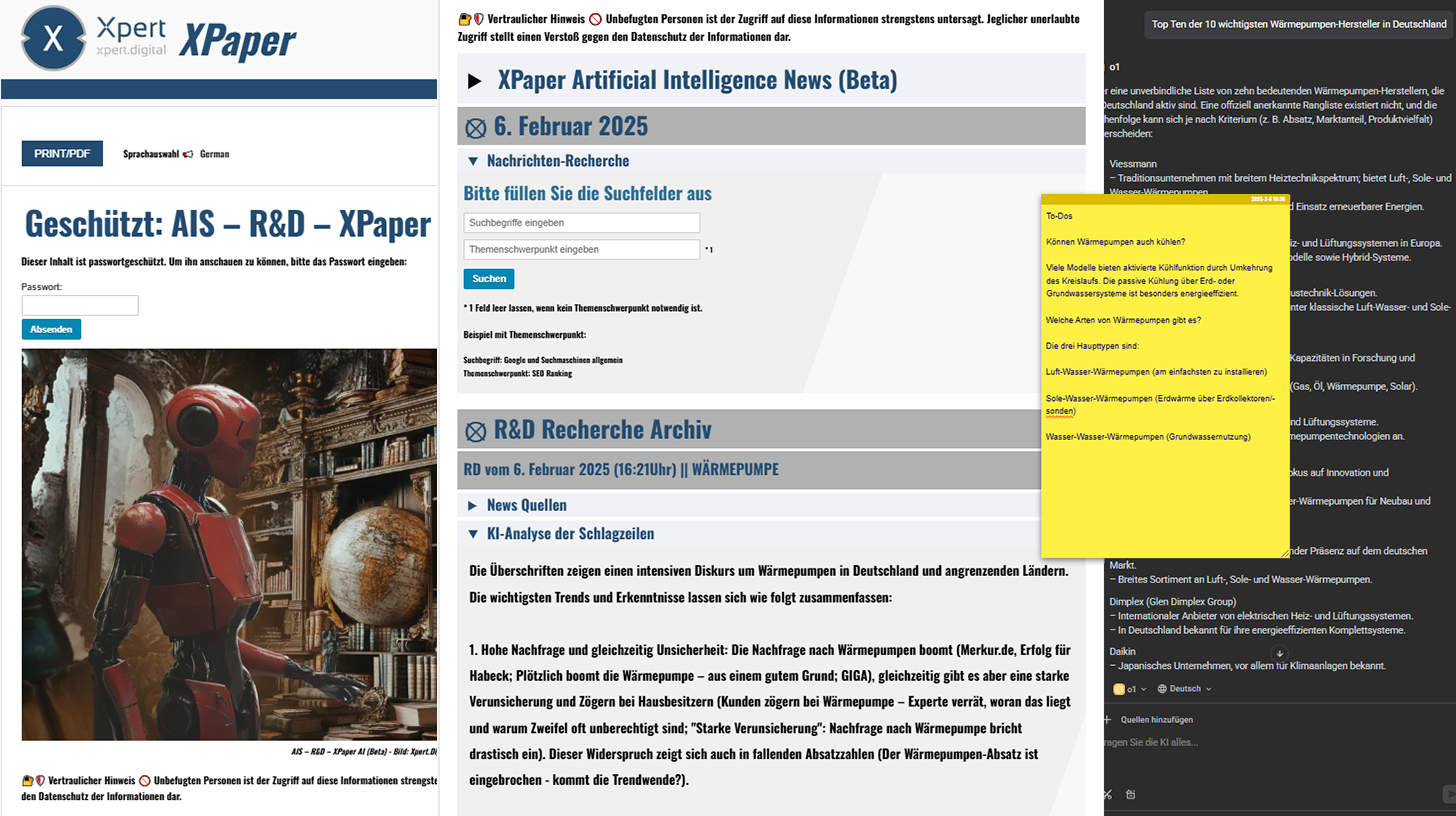
XPaper AIS application possibilities for business development, marketing, PR and our industry hub (content) - Image: Xpert.Digital
This article was handwritten. I used my self-developed R&D research tool, 'XPaper,' which I primarily use for global business development in a total of 23 languages. Stylistic and grammatical refinements were made to make the text clearer and more fluid. Topic selection, drafting, and the collection of sources and materials are all handled by an editorial team.
XPaper News is based on AIS (Artificial Intelligence Search) and differs fundamentally from SEO technology. However, both approaches share the goal of making relevant information accessible to users – AIS on the search technology side and SEO on the content side.
Every night, XPaper sifts through the latest news from around the world with continuous, round-the-clock updates. Instead of investing thousands of euros monthly in cumbersome and generic tools, I've created my own tool to stay up-to-date in my work in Business Development (BD). The XPaper system is similar to tools used in the financial sector, which collect and analyze tens of millions of data points every hour. At the same time, XPaper isn't just for business development; it's also used in marketing and PR – whether as a source of inspiration for the content factory or for article research. The tool allows you to evaluate and analyze all sources worldwide. No matter what language the data source speaks, it's no problem for the AI. Various AI models are available for this purpose. The AI analysis quickly and clearly generates summaries that show what's currently happening and where the latest trends lie – and XPaper offers this in 18 languages. XPaper allows for the analysis of independent subject areas – from general to specific niche topics, in which data can be compared and analyzed with past periods, among other things.
We are here for you - Consulting - Planning - Implementation - Project Management
☑️ SME support in strategy, consulting, planning and implementation
☑️ Creation or realignment of the digital strategy and digitization
☑️ Expansion and optimization of international sales processes
☑️ Global & Digital B2B trading platforms
☑️ Pioneer Business Development

Konrad Wolfenstein
I would be happy to serve as your personal advisor.
You can contact me by filling out the contact form below or simply call me on +49 7348 4088 965 .
I'm looking forward to our joint project.
Write to me


Xpert.Digital - Konrad Wolfenstein
Xpert.Digital is a hub for industry focusing on digitalization, mechanical engineering, logistics/intralogistics and photovoltaics.
With our 360° Business Development solution, we support renowned companies from new business to after-sales.
Market intelligence, smarketing, marketing automation, content development, PR, mail campaigns, personalized social media and lead nurturing are part of our digital tools.
You can find more information at: www.xpert.digital - www.xpert.solar - www.xpert.plus
Keep in touch